

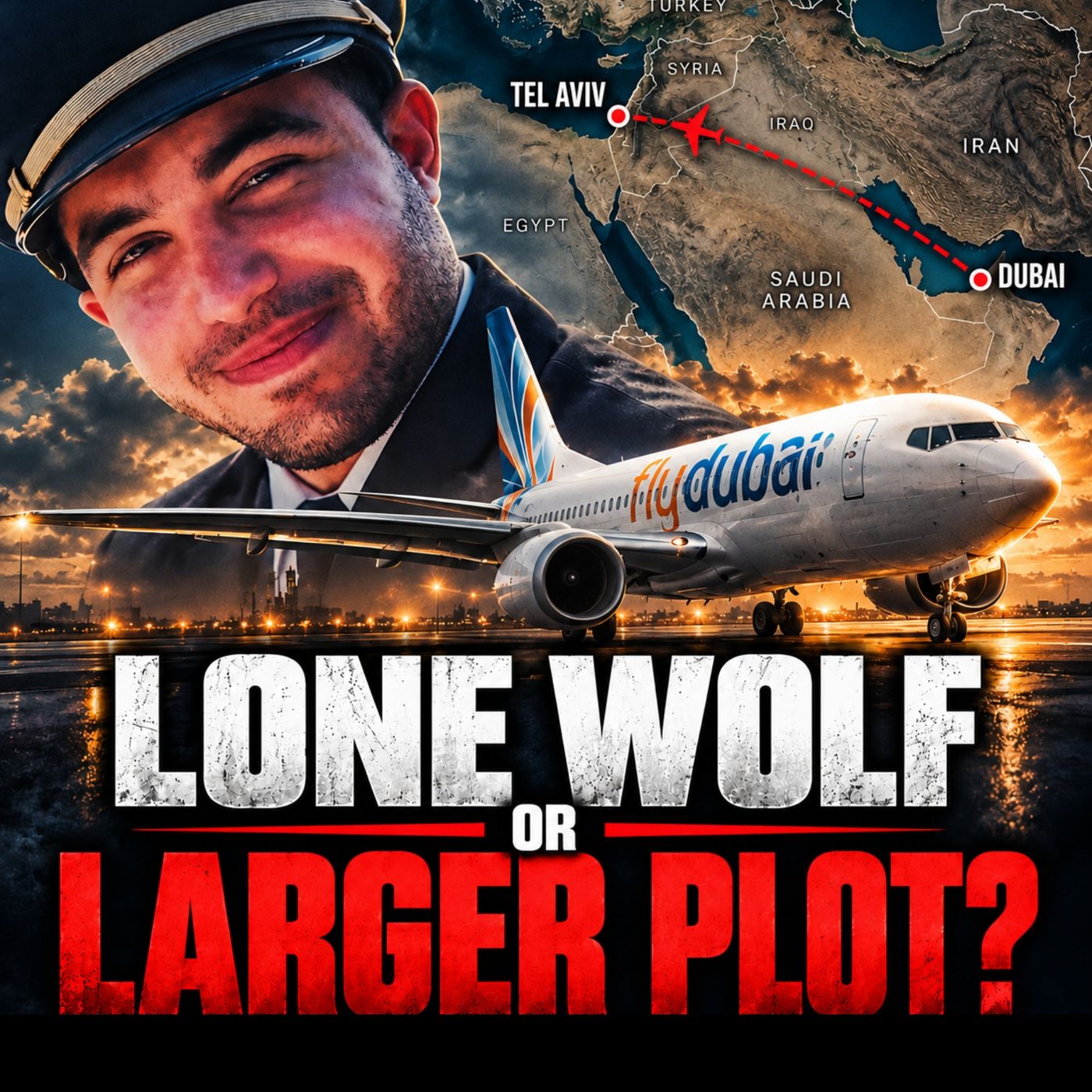
Terror in the Cockpit: The Flydubai Hijacking Attempt | EYES ON GEOPOLITICS
Montag, 5. Oktober 2026 · 1 h 10
Kapitelklicken springt direkt hin
Shownotes
We break down the attempted hijacking of Flydubai Flight 1073, the warning signs investigators may have missed, and whether the attack was connected to Iran or a lone-wolf extremist. We also discuss suspected IRGC-linked plots in the UK, the U.S. withdrawal from Iraq, what that means for the Kurds and Iranian influence, and whether the latest troop and carrier movements signal a new round of escalation in the Middle East.
VAER Watches ⬇️
vaerwatches.com/theteamhouse
get a free watch roll with your purchase.
20% for active duty, veteran, leo, & first responders
Support the show on Patreon:⬇️
patreon.com/TheTeamHouse
Jack's news outlet:⬇️
thehighside.substack.com
Find Jon Hackett here:⬇️
Jon's Twitter:
x.com/jonathanhackett
Jon's LinkedIn:
linkedin.com/in/thejonathanhackett
Jon's books:
amazon.com/stores/author/B0C5L659N5?ccs_id=e11…
Linkedin: linkedin.com/in/thejonathanhackett
Twitter: x.com/jonathanhackett
Check out Mick's new podcast here:⬇️
Apple Podcasts:
podcasts.apple.com/at/podcast/pub-and-porch-ap…
Spotify:
open.spotify.com/show/1k3QPmkAMwnGJxMLDwUSSd?s…
Youtube:
youtube.com/@UCd0Hq6QFk8CoTu5j-VU0Ong
Find Mick Mulroy here:
Fogbow ⬇️
fogbow.com
Lobo Institute ⬇️
loboinstitute.org
Twitter ⬇️
x.com/mickmulroy?s=21&t=-Ze3F_Ix2vlJ18KFvO…
LinkedIn ⬇️
linkedin.com/in/michael-patrick-mulroy-31198b52
Whitefish security summit ⬇️
whitefishsecuritysummit.com
Find Marc P here:
x.com/Mpolymer
Find Andy Milburn here:
Twitter ⬇️
twitter.com/i/flow/login?redirect_after_login=…
LinkedIn ⬇️
linkedin.com/in/andrewmilburn2023
Substack ⬇️
amilburn.substack.com
Andy’s book ⬇️
amazon.com/When-Tempest-Gathers-Mogadishu-Oper…
– Start
– Flydubai Flight 1073 Hijacking Attempt
– How Close the Flight Came to Disaster
– The Intelligence Failures Before the Attack
– Aviation’s Worst-Case Insider Threat
– How Flydubai Missed the Warning Signs
– Was Iran Behind the Attack?
– Israel Says It Wasn’t Iran
– The Lone-Wolf Terrorism Problem
– Suspected Iran-Linked Plot in Manchester
– Is the IRGC Getting Sloppier?
– What Would Iran-Backed Attacks Mean for Britain?
– Iran’s History of Covert Attacks in the UK
– How Iran Uses Proxies and Simple Attacks
– Why Is the UK Such a Major Target?
– The U.S. Finally Pulls Out of Iraq
– Was Iraq Worth It?
– What the Withdrawal Gives Iran
– Are the Kurds the Biggest Losers?
– Why Not Leave a Small U.S. Force Behind?
– Did America Throw Away Its Position in Iraq?
– Decades of U.S. Blunders in Iraq
– What U.S. Forces Still Remain in Iraq?
– Did America Learn Anything From the Iraq War?
– Do Troops Need to Understand the Bigger Mission?
– Explaining the War to the People Fighting It
– Gold Star Families & the Cost of Endless War
– 9,000 More U.S. Troops Head to CENTCOM
– Is the U.S. Preparing to Escalate Against Iran?
– Could There Be U.S. Ground Operations?
– Three Carriers in the Middle East & the China Problem
– What the Camp David Meeting Could Mean
– Will the U.S. Strike the Houthis for Saudi Arabia?
– Closing Thoughts
VAER Watches ⬇️
vaerwatches.com/theteamhouse
get a free watch roll with your purchase.
20% for active duty, veteran, leo, & first responders
Become a supporter of this podcast: spreaker.com/podcast/the-team-house--5960890/s….
Transkriptvom Podcast bereitgestellt · Zeitmarken springen hin
This episode is presented by Vare Watches. Go to varewatches.com slash theteamhouse.
Hey, everybody.
We're back for another episode of Eyes on Geopolitics. I'm here with Andy Milburn, Jonathan Hackett, and Mark Polymeropoulos. A lot happening, as usual. The big story on September 30th, flight Dubai flight. I was trying to practice that, too, because I knew I would trip it up. 1073 flying from Dubai to Tel Aviv was... essentially hijacked. The co-pilot attacked the captain inside the cockpit with an emergency crash axe and tried to seize control of the aircraft. During the struggle, the 737 plunged roughly 17,000 feet before the captain managed to open the cockpit door. Passengers and cabin crew basically came in and were able to, you know, get the essentially co-pilot who attacked the captain under control.
There were a couple like deadhead slash like other fly Dubai pilots in the plane that were able to landed safely in Saudi Arabia. There was a lot of gold, like back and forth, a ton of like conspiracy theories going on about this. It looks like the UAE is actually saying that this was a terrorist attack and they're trying to figure out if this guy acted alone or if he was, had some ties to other extremist groups.
And so that's happening. And, and, rumors and conspiracy theories are swirling everywhere. Um, Mark, you go first. And what do you, what are you thinking?
Uh, you know, the people who are doing their rumors and conspiracy theories are out of their fricking gourd. Um, but it's, it's social media. I mean, that's where you see it on. So what are you going to do about that? I mean, you know, ultimately what happened here is we averted a major mass casualty event. Um, it's, it's, uh, it is based on the heroism of, um, the, the pilot, uh, whose co-pilot literally attacked him, you know, the pilot. And a lot of this has come out now in the debriefs.
But the co-pilot said he wanted to pray. And so the pilot said, sure, not all that unusual. And then all of a sudden, the guy gets attacked by an axe. And, you know, an axe, this axe that actually exists in the cockpit. I think Jonathan was talking about this before and in the green room. This is not something that was smuggled on. It actually exists. And, you know, in this incredible struggle that ensues, the pilot then managed to open the door. Passengers rush in, drag them both out.
And then some pilots who are, I guess, reserve pilots in the back ended up landing the plane. But, you know, it's only by the grace of God that this was not a massive, awful terrorist incident. The co-pilot under interrogation now or I guess the, I think he's been transferred actually to the UAE from Saudi and the Israelis are going to be allowed to participate, which I think is important. Um, has said that his target was Israel. Uh, and if you could just imagine the terror inside that, that, that airplane, you know, plunges several thousand meters, uh, and that exceeded the max limit of the 737. Um, there's pictures on social media. It's kind of the, the, the tail of the fin, uh, the tail of the plane.
It's amazing.
It didn't break up in flight. Um, And so just really an extraordinary incident. I think there's a couple of keys on this. One is that we talk a lot on the show about terrorism. You know, terrorism is not a problem until it is. This was almost a mass casualty event. It looks like it was a lone wolf, but we still don't know. Clearly, his background, everyone's kind of going through his background. It turns out he's an Omani and he was barred from flying there.
Incredible.
He got a job in the Emirates and then he passed the Israeli checks. And in Israel, the Ministry of Transportation is supposed to check out all pilots who end up landing in Israel. They obviously failed in this miserably. And so there was a pretty significant security and intelligence failure on everyone's part, the Emirates, but also in the Israelis.
And the final piece is that this now turns into a political issue in Israel. Election's October 27th. Netanyahu is trying to embrace this notion of security, but it turns out that his government has failed pretty spectacularly. Again, the notion of background checks and investigations. But as I said, as is everything, there's no really foreign policy in Israel.
It's only domestic politics. So this has actually taken a turn in terms of the domestic political scene there. And lastly, there's five Americans, four or five Americans on board as well. So just could have been just an awful incident. There's no tie yet to Iran, even though there's some hints of this. But it does look like it's a lone wolf.
But I think they'll figure this out in the debriefs, the interrogation, and they're kind of digging through which everyone in social media is doing. And I mean, it's incredible. You can find all of his extremist leanings on social media. It's incredible that nobody kind of picked this up.
And also, this is a good example of bilateral intelligence relationships between states that aren't necessarily, you know, openly declared friends. Israel was able to interrogate the individual before he was sent back to the Emirates, presumably either in Saudi Arabia or the Emirates or Israel. So kind of an interesting, you know, series of decisions that had to be made between the leaders of those countries and with those liaison relationships that those countries have to have for security reasons.
And it looks like after the fact, it's working well.
The challenge is, like you said, Mark, before the fact, where was the knowledge of these indicators?
Because there were indicators.
If you see on his LinkedIn, he had two posts on his LinkedIn, period, both of which were extremist in nature that were available to the public to see. One of them was him complaining about how his mom has to find a woman for him to live with that's willing to wear a niqab and stop working after he gets married and how the West has ruined women and.
Et cetera, et cetera.
This was a publicly available video. Of course it was taken down after the attack, but it was there. He also made a post right around the same time the attack was happening. That was, that was scheduled to be published after the attack. So, you know, if you're looking for intent, this is an indicator of that. And it was another, you know, obviously extremist post. And it's interesting because like from a legal perspective, the Emirates, the reason he's in the Emirates now, is because Emirati law allows the Emirati legal system to follow you if you're in an aircraft. So he committed this crime in an aircraft, and so the Emirates continue to maintain custody or jurisdiction over his actions, even though it was in another country's
airspace or soil. And that's why he's back in the Emirates now, which I thought was kind of interesting.
Yeah, it's kind of... I mean, this is aviation's worst insider threat, right? I mean, I know... There have been other cases. There was the 2015 German wings pilot who, that was a mental health issue. He crashed the plane. It was a plane from Barcelona to Germany, but this is kind of the ideological version of that, right? I mean, the whole system is built to keep threats out of the cockpit with reinforced doors, screening, you know, air marshals, and of course, You know, had this been an LL flight, that would have been, you know, four or five guys on that flight, armed guys on that flight. But none of that matters if you've got the threats in the cockpit itself and the door is secure and it all,
you know, much is being made quite rightly of the heroism, the passengers, blah, blah, blah. But the real, in my mind, the real hero was the pilot. That plane would have crashed. You know, he had already leveled the plane. And he had fought off his attacker, even though he was badly wounded. And if he hadn't opened that door, that plane would have gone down. The plumber wouldn't have been in a position to pull back on the yoke and meet Netanyahu.
By the way, the plumber, is that the guy who was watching Canadian videos on how to.
Fly a plane? Apparently, yeah. It's unbelievable.
Dee, all of your time on Flight Simulator, all of your time gaming, Dee, will come into fruition one day. Yeah, I'm getting ready for it.
So, you know, I mean, hopefully airlines, you know, obviously FlyDubai hired him without checking with Omani authorities. That's a worry, right? You know, as you guys mentioned, Omani Air had already moved to more flying duties because of his web activity. But FlyDubai didn't. who I've flown on, maybe not again, didn't do a good job of checking them out. So, you know, hopefully airlines across the region are going to be now sharing pilot vetting information across borders. I don't know if this is true, but, you know, the target was one of the normalization flights, right? I mean, that's significant.
The direct Gulf-Israel routes are one of the most visible results of the Abraham Accords. The El Al has stopped flying that route because of security concerns. And I believe Emirates has done so now too. So, I mean, even a failed attack has achieved part of what it was after, which is raising the cost and the fear around normal travel between Israel and Dubai. And by the way, the prices of those flights were pretty crazy anyway. So, you know, there's clearly going to be more pressure on Gulf carriers to cut back on those routes even more. I think it's, you know, I think it's important, not just because, you know, I'm saying it, but I may want to fly that route.
But resisting that pressure is important if, you know, the normalization project is to continue Um, and, and lastly, um, you know, it's not helpful to attribute this to Iran. I mean, I, I, it's, it seems likely that what the Israelis are saying, this was a lone wolf attack and it was Islamist radicalization. Um, You know, all the online material that he was dabbling in points towards an al-Qaeda style jihadism, not the IRGC. And, you know, I think that's... I don't think this is going to be used as justification before strikes, but we've got to be obviously careful, especially as leaders of country, you know, leader of a country coming out and saying, based on what I'm hearing, it was an Iranian plot. But anyway, I
think that, you know, cooler heads will prevail that.
You know, it's interesting, Andy, because of attribution. I mean, so that's maybe that's a good way to kind of shift because, OK, this happens. Everyone wants to then take action. But in the case of if it's Islamic extremism or al-Qaeda, there's no target to hit. And that's where I think, and what you just noted, the leak on the attribution right now comes from the Israeli side. And I think that's important, actually, because this is the Israeli security services telling someone in the press, in the Middle Eastern press, yeah, we think it's a lone wolf and it's not Iran. Um, uh, that that's different than a political statement from one of the political leaders. So, so I, I agree with you.
I hope cooler heads will prevail on this. Now, of course, if it was Iran, then you do have to take action. I mean, so, but that's why the intelligence, uh, side of it is, is, is incredibly important. Um, one note is that I think fly Dubai has suspended their flights to Israel now until they get this in order. And it kind of like going back to the Israeli politics part of it, though, the ministry of trade, it was interesting in Israel as I'm a kind of geek out on Israeli, uh, national security press, the ministry of transportation is actually somehow taken responsibility several years ago for this vetting from Shin Bet and Mossad. And the individual who was responsible for this completely failed, obviously. And so, you know,
there's going to be a very, there's already the blame game going on. Um, but there's, there's a, you know, uh, there's a, there's a huge, uh, uh, you know, after action that I think will be done here rather than October 7th, which that after action is never going to be done under this current Israeli government. But here, I think there's a lot already that's come out that just shows kind of where the system totally broke down.
Yeah, I mean, and just by pure luck and the courage of the few, things went well. You know, we talked about the off-duty pilots being on board, taking over, the guy having, you know, being a gamer or whatever and being on a flight simulator. Although I think that's probably a better story than it sounds. But, you know, Saudi air traffic control picking up, diverting to Dubuque where the passengers, there's some great video in the local media here of nurses, Saudi nurses, you know, all covered up treating Israeli passengers. Which, you know, I mean, as you just can't imagine, can you? And the regional cooperation between Israeli, Emirati, and Saudi investigators now working together. So, you know, all
that deserves to be said. It's positive things. We're accused of not having positive things on this show, so I thought I'd throw that in.
Nicely done, Andy. Thank you.
Yeah, actually Netanyahu came out and said that he doesn't believe it to be Iran-linked. which to your point, Mark, I think that's very important coming from Israel because there's every incentive for them to try to find a link to Iran. And the fact that they have come out publicly in multiple outlets with multiple people saying that, that's a big deal. I saw Trump said that there might be a link to Iran. So that's kind of interesting, the disparity between the US perspective versus the closer to their home perspective of.
Israel saying that it's not Iran.
When at the same time, we have other things in other parts of the world, like in the UK, where there are some perhaps links to Iran. So That definitely is an interesting difference, I think, to previous ways to describe attacks before we have an after action.
There's some great memes. How do you say it? Memes, memes, memes.
I don't know. I'm too old for this.
Memes.
Memes.
Excellent.
Memes.
I mean, there's one in which it's people getting on board. And as opposed to what obviously happens, there's a lot of anti-Semitism in the world. In this case, there's a flight attendant asking, who's an Israeli here? And everyone is a little worried. And they're like, well, you sit in the front row. Can you sit in business class? And they're like, but I have an economy class ticket. You've been upgraded. We want we want you up front. And it just you know, there is there is a notion of a country in which, you know, everyone serves in the military. And there's there's such a kind of focus on on, you know, citizen soldiers there that there might be more of a proclivity for someone to have the capabilities to act. Um, if you're used to living in
that kind of world, unfortunately, that's, that's, you know, one would hope that that kind of thing is not necessary. But, you know, we talk about terrorism so much here. I mean, you know, I, this, it's a, it's a whole separate subject, not for today, but it is a question of, you know, do we, you know, we get complacent on the Islamic terrorism threat. If this is a Islamic extremism, if it's Al Qaeda, well, wait a second. You know, I thought Al Qaeda was defeated. Um, and if they just took down an airline or 200, if they were about to take down an airline or 200 people, there's a different conversation to be had after that. Uh, even if it's a lone wolf with which everyone here knows is the hardest type of terrorist, um, activity for an intelligence service
to combat because there's no cells to penetrate, to recruit, you know, intercept, uh, communications intercept. There's no terrorist training camp. If you get self-radicalized yourself, you know, that's, it's very hard to, uh, uh, to combat that.
So.
But Jonathan, you brought up Iran and terrorism. Maybe we switch there because there are some events in the UK that are going on.
No, no.
I have one thing to ask about the fly Dubai incident. He went to school in Melbourne, Australia. And didn't the Australian authorities kind of ping him in terms of– I don't know what– they had him. Some reports are saying that they pinged him essentially. Before he went on, I guess, became a full-fledged pilot. Is there anything to that in terms of, did they know something? Yeah, maybe.
Well, he also didn't pass Royal Air Maroc, the Moroccan airline flight school. He was not selected out of that flight school either. So he's been attempting to become a pilot, which if you remember before 9-11, that was another thing is like they were shopping around trying to find places to get flight training. So, you know, obviously speculating, but that would be an interesting thing to investigate about how far back was his intent.
Yeah.
He showed no interest in landing the plane at flight school. Okay, so that was actually, and that was true of the 9-11 plotters who went back and talked to the... I don't know if that's true of this guy, but what is true, and Mark's absolutely right, you know, lone wolf attacks are the most difficult to preempt. However, this one left...
Left indicators and clues splashed all over the internet. And it shouldn't have been hard to preempt. It should have been preempted simply by him not being hired by Fly Dubai.
Mark, sorry, I ruined your segment. It was an incredible segment.
It was a good segue to Jonathan to talk about it.
We're going back to it now, yeah. In the UK.
I just wanted to point that out, how incredible that was.
I'm taking over your whatever role, your MC role.
Yeah. Hey, Jack.
What's going on?
Guess who our new presenting sponsor is. Tell us about it.
We've heard a lot over the last few years about whether it's possible to build things in America. Our presenting sponsor today, Vera Watches, is putting that question to the test. Vera was founded in Venice, California in 2016 with a simple goal, to rebuild U.S. watchmaking while producing watches tough enough to withstand the toughest outdoor environments. Today, Vera is the largest independent watch assembler in America, assembling watches and in California, Arizona, Rhode Island, and Alabama, while also manufacturing its leather straps in Illinois and Florida. Every VeriWatch is built for active use with a guaranteed waterproof warranty, scratch-resistant, sapphire crystals, and high-quality materials and components throughout. That combination
has helped Veri earn more than 10,000 five-star customer reviews. including thousands from people who rely on their watches every day in demanding professional environments. All of us here at the team house have been wearing Arvera watches for a while now. And you can check mine out right here. This is the Meridian Diver watch in navy blue. It's a very classy watch. And this is the actual rubber dive watch band if you wanted to take it in salt water. But it also comes with a normal... A silver band and a nylon band, if you prefer that.
And D, what kind of watch are you wearing there?
I have the C4 Tactical Field Watch. It's solar powered, too. I'm loving it. And it's funny because I had this laying on my coffee table the other day, actually. And my homie came in to watch football or whatever. And he's a watch guy. And he's like, oh, is that that Vare one? I'm not even making this up.
I'm not even bullshitting.
I'm like, holy shit, yeah, they're going to be presenting sponsor for the team house. And they sent us all a bunch of watches. Like, yo, I love this watch. And I literally sold the watch. I sent them the link, the team house link. And I'm like, yo, buy a watch from this link. Because if you do buy a watch from that link, which is fairwatches.com slash the team house you when you purchase a watch you get a free uh watch roll that you could fill up with three watches so you could travel with your watches and stuff like that it's really cool it's leather um yeah and i was so excited when he was like yo is that that fair watch i see it all the time i was like so amped that he came up with that.
Yeah it's nice i really like the like nice big watch face.
You can find them at vairwatches.com slash the team house. That's V-A-E-R watches.com slash the team house. And if you use our link, you'll get a free watch roll with $ 59 with your purchase. Also, Vair does offer a 20% discount for active duty military veterans and law enforcement and first responders. So you could check that out at any time if you are any one of those. Yeah, I'm excited about the sponsorship. So I really hope people go and check out Vair.
Yeah, absolutely.
Yeah, John, give us the rundown on what went down in Manchester.
Yeah, so this is another potentially Iran-linked activity in the UK after the other one that was just a stop that we talked about last week.
So there's two guys.
Big picture, there's an issue with people coming over on boats into the UK. Some of them, many of them were managed by a Kurdish smuggler who's now been outed in the media. A lot of them coming from Iran, from Iraq and other areas in the Middle East and coming into the U.K. and asking for asylum over the last few years. Two of those people, Salam and Rahman, claimed asylum in the U.K. There's some stuff in between this time that's not relevant to this, but these guys have been.
In the U.K. for a while and they're from Iran.
And one of them had asylum and one of them was waiting for his asylum application. They were doing surveillance in an area that had already been attacked last year. There's a place called Heaton Park Synagogue that was attacked. Some people died. The attacker was killed. Same location, the exact same target. And another place, a Jewish museum in Manchester, also under surveillance. The government's calling it hostile surveillance. That sounds kind of, I don't know. I wouldn't call it, I don't call something hostile surveillance. I would just call it surveillance until we know what it's for. because pre-attack surveillance looks a lot like just regular static surveillance, depending on what the intent is. So they were doing this.
They also had collected data on how to build a chlorine bomb that they were going to hopefully use to conduct this attack. There's indications from the government in the UK that these guys were under the control of a third party in a third country, and they think it's Iran.
We haven't seen that yet.
And if you look at the difference between US charging documents and UK charging documents, the US ones have so much information, you can really figure out kind of what's going on before you know, the grand jury makes a decision on the indictment, whereas the UK side, you usually get like a single page or very short information. It's very hard to even know what's going on here from a public perspective. So the things that the government's willing to say publicly are really important here because we don't get to see the indictments like we do in the United States. So the fact that the government is saying this is very helpful to understand because if you remember with last week's attack, they were very hesitant to say
that there was any foreign control or that it was even an attack in the first place. There were rumors that these guys were siphoning diesel And all this speculation, whereas right now, they're right away saying there's possibly a link to Iran. So that's very important, I think, when looking at this and thinking about this, also the timing of it. This was right before the Jewish holy days.
And they had been captured last month, September 20th. So before the Fairford surveillance activity.
That's kind of interesting to think about.
And remember, the.
Fairford guys were released back into the wild under heavy surveillance.
Just kind of interesting. The government said there's no connection between the two that they know of. But I think it's just kind of interesting to see these things kind of all happening around the same time.
But the prime minister said that the Fairford event was likely Iran now.
Correct.
Just not controlled by the same– possibly not by the same entity.
And my thought on this is, well, the past year, the IRGC officers who would normally be doing this kind of activity remotely from Iran, the experienced ones are mostly dead. That means you're either left with the middle level guys or even guys who have never done ops before, but now they have to do ops and they're not really probably vetting their people the way they normally would. They don't have time to spot assess, develop and recruit assets in a third country to go do stuff in a way that they can trust will happen the way it's supposed to happen. Probably the logistics are a little bit weak right now. The control is a little bit weak.
So we may be actually seeing results of that. The reason these are probably being thwarted, or at least in part, is because of poor handling on the Iran side. because they're more seasoned guys, aren't there to kind of extend this out, be more careful, take some more diligence, test their assets a little bit more. Because if you remember for the Fairford incident, one of the guys actually called 999, which is 911, on himself while doing the op, which indicates cold feet, which from a handling perspective means that perhaps these guys hadn't been recruited fully or sufficiently to actually carry out this type of operation or hadn't been selected well enough to actually be on this team. So those are kind of indicators to me that perhaps the
IRGC side is not operating and they weren't great to begin with, but now they're worse because the more seasoned guys are out of the picture.
They still just got to get lucky once. I mean, think about it like a soccer goalie, you know, you're, you can, you know, but we, you know, in the CT world, you can't let anything in. There's no such thing as a three to one win.
Even an attempt, like the Fairford incident, if they had breached the fence and even just got on the base to them, that would have been a victory.
Andy, as the resident individual here with the British accent, what does the, you know, so as you get closer to attribution on the UK side, what does that mean in terms of UK action? And will the public, I know we've talked about this before, but I mean, I think over the last several days, we are getting closer to, okay, the Iranians have been undertaking terrorist incidents on UK soil.
What does that mean for the British government?
That's a great question. I mean, I'll tell you, The British public right now is going to be more, and I don't mean to generalize the British public. There is a segment of the British public that is going to latch onto the fact that these are asylum seekers. That if you've been following the news in the UK, the rise of Tommy Robinson, the popularity of the reform party, the recent demonstration of 100,000 people in London, supporting Tommy Robinson, who's a far-right figure. These are really unusual indicators to see in the United Kingdom. And so now, whenever there is a crime linked to asylum seekers, criminal or otherwise, it becomes a core celebre. That, I think, is going to garner more attention than who's behind this. And I
say that because Iranian-backed attacks in the UK are not... I mean, even before the war started, back in, I think it was 2022, MI5, the head of MI5 came out and said that Iran had been behind 20 potentially lethal plots against people in the UK just in that year. This was the end of 2022. And then since the war started, there was... There was an arson attack soon after the war started. Four Jewish volunteer ambulances were burned outside of Golders Green Synagogue and a group called HAYI.
Don't ask me. Maybe John remembers what that stands for. It's a front group for Iran, right? And they've staged attacks all over Europe. But anyway, HAYI, H-A-Y-I, claim responsibility for that. Then in April, there was an attack at, there was another attack on Iran International, which is a dissidents group. Then later in April, there's a wave of firebombing and arson attacks against synagogues, Jewish sites, which this attack also was aimed against. There was an attack on the Israeli embassy. or a foiled attack, chemical attack similar to this one, might have been a hoax. And then there was two Jewish men were stabbed in Golders Green around the same end of April, right? And the IRGC actually claimed responsibility for that. And so... you know, this,
this is, and, and none of those really elicited a massive response, right. From no, there's no demands to go to war with Iran. So I don't think there's going to be in this case, this particular case. Um, and so, you know, on the, on, in this particular case, I think I was reading that they did find, uh, substances probably, you know, I, I'm guessing chlorine since it's saying it was a chlorine attack. Um, which is, you know, it's a convenient chemical to use, right? It's commercially available. It's easy to put into some kind. It's easy to weaponize, relatively easy to weaponize. And the Islamic State, of course, made extensive use of chlorine. When people talk about the Islamic State using chemical weapons, it was chlorine that they
were using, both against the Kurds and US forces.
Yeah, actually, we blew up a building when we were doing the 2016 counter-ISIS outside Mosul. And one of the buildings, we didn't realize it had a bunch of chlorine ready for weaponized use underground. And we blew it up and there was a huge chlorine cloud that then spread over the other buildings that ISIS was in. So we had some extra casualties from that strike.
From their own design.
Yeah.
So, I mean, in this case, I mean, what it does, it affirms, it tells us more about Iran's methods, right? You know, as John and Mark both said that they aren't sending trained operatives or military grade material. They're using handlers, obviously, I would guess, to pass instructions, probably, you know, I mean, over the internet, maybe, to recruits on the ground who obtain what they need locally. You know, as I've said, these attacks have all been pretty simple, arson, stabbings, and then now, you know, the use of chlorine. And so that, I mean, that keeps the cost, it's plausible deniability, and it keeps the cost to Tehran close to zero. And it means Tehran can run in many cells at once and create fear and confusion. I think we have to
have some humility, though. We've got to be careful not to have hubris. I know that this is not maybe the A-team, but they get lucky once.
H-A-Y-I that you mentioned, Andy, was actually run by a Kata'ib Hezbollah operative out of Iraq.
And this became known through a U.S.
Indictment after we arrested him in Turkey with the cooperation of MIT, which is Turkey's intelligence entity, who handed him over to us. Many of those operations were led by a Kata'ib Hezbollah handler on orders from the IRGC to do those things in the UK. And it was pretty elaborate, actually, a very interesting case study on a third-party handler doing this for the IRGC to create even more depth for deniability, but still being controlled and ordered by the IRGC. Now that that individual is gone, which I believe was around May timeframe, they've probably had to find new individuals to replace that guy because that guy was doing a pretty good job of coordinating from Iraq from a distance. And
now they need to replace that handling with somebody else. And I think that's the result of what we're probably seeing now.
Why are we seeing a concentration of this stuff in the UK? I'm sure it's like you mentioned, Andy, it's happening across Europe.
But it needs to be concentrated.
I mean, I think probably a number of reasons. One is one might be access. You know, there's a large Iranian diaspora in the United Kingdom that I couldn't compare it offhand to the rest of Europe, but it's huge. And the UK always has been large. Number two, the UK is, I don't think, I want to say it's alone in allowing bombers to take off from its bases.
I'm trying to remember whether, I know Germany has allowed missiles, but I don't But the UK is either the only country or one of two countries that has allowed bombers to take off from its bases to bomb Iran. You know, Spain has said no, Italy said no. A number of countries have denied the United States overflight, but the UK has continuously said yes. So those are two good reasons.
I think a third might be availability of targets. You know, there is a large Jewish population in the United Kingdom. especially in cities like London and Manchester. They tend to live in the same sort of areas like gold is green, so arguably are an easier target. Oh, last thing is, you know, I mentioned large diaspora, but the UK is also home to Iranian has-been, you know, for it. Ironically, all the way back to times of the Shah, the UK has been at home to Iranian dissidents opposing whatever regime exists in Iran. I mean, remember the Princess Gate hostage-taking back in 1980? Their cause was against the government of Iran, which happened to be the mullahs.
It was post-revolution.
Great book out on that just recently, I think, by Ben McIntyre.
Ben McIntyre, yeah.
Great, great kind of detailed book on the SAS raid.
We've also had a few SAS guys on the team house that have talked about it as well, who were on the raid. Talking about the chlorine bomb and stuff like that, and how John mentioned ISIS using it. I mean, we've now, after 23 years, have pulled out officially of Iraq. Um, I guess there was a little bit of time between, you know, 2011 and 2013, 14, when we were, you know, low vis at least. Um, but now we're officially gone. Uh, you guys have all been there. You guys have all served there. What are your thoughts?
I mean, it was, it was interesting. I went in on the infill, um, uh, in April of 03, I was living with the Kurds with Mick up in December 02. Um, Mick was, uh, uh, uh, stayed up there and, was going after what was the Ansar of Islam, and I got pulled to go in with JSOC for the HVT hunt. So I remember arriving in Biap in April of 2003, pretty wild. And it's, you know, it's 2026 now. I mean, you know, the war, of course, lasted too long. But I think one of the concerns that one would have now is with this, you know, what does a formal withdrawal mean? I mean, we're still going to have military advisors there. We still have to. There has to be an intelligence relationship because it's the struggle for Iran. And
so I think there is, you know, the concern is the amount of disengagement we have with the Iraqi government. Is that actually kind of reflected by this formal announcement of a formal U.S.
Troop withdrawal?
Probably not. I mean, you know, I think there's still going to be significant U.S.
Influence.
I would hope there is. But then there's also kind of strange, you know, just personal views like, oh, you know, we're there a hell of a long time. Kind of just scratching your head. And of course, the counter the counter ISIS mission was. Was was was pretty wild. I remember sitting at our headquarters and getting a phone call from the chief of station Baghdad at the time. There was a deputy maybe a friend of mine. And he's like, I was doing something else at the time. And if you remember the kind of the the ISIS onslaught, I mean, this is they had massive swaths of territory. And he's like, he's like, hey, man, like ISIS is on like the gates of Baghdad being a little dramatic. And I was like,
what are you talking about? Pretty wild. But Iraq is going to be something that for a lot of us, you know, is kind of seminal to our lives and careers. And then there was kind of Afghan Afghanistan deployments, too. But and the final piece on this that I would say, and I still and this is have to we all have to reconcile what we did there is, you know, you have to remember the regime of Saddam Hussein was hideous.
I remember when we went in, you know, of course, the WMD issue was there. But I my hope because I do believe this in terms of kind of this notion of American exceptionalism is that. At the end of the day, this would be better for the Iraqi people that were doing this. So you have to kind of sit back and say, are the Iraqi people better off right now than they were under Saddam? And you can argue that they are, though we did kill a hell of a lot of and probably a lot of civilians were killed as well. So just one of these. There's no answer to this. That's going to be, you know, black and white. It's kind of a mixed muddle thing.
So I just I'm not even sure where I where I land on it. This is like a therapy session.
Yeah.
It's, I mean, not that, not that anyone should care about my own personal involvement in Iran, Iraq. Sorry. I, yeah.
Iran stuff you can't tell us. That's the secret shit. Yeah.
All right. I, it's all in my book. Um, but, but yeah, having, having kind of seen the bookends of U.S., not quite the bookends, but near bookends of U.S. involvement from the invasion to, you know, the recapture of Mosul, um, from ISIS in 2017.
And in between that, Andy, you were in Fallujah during, you know.
Yeah.
Yeah. So, I mean, but think about this. Okay, never mind about my own personal experience, but think about this. This is the first time, because we pulled out of Syria, right? I mean, last troops have pulled out of Syria. So, this is the first time in over two decades, there are no American troops on the ground between Iran and and the Mediterranean, right? Tehran has wanted this corridor for over two decades. And now in the midst of a war, we've handed them this. I mean, I get it. This was Iraq's sovereign country, blah, blah, blah. But this is very concerning. And the The Iranian-backed militias are embedded in Iraq's security forces. They have grown stronger, along with the Houthis.
They've grown stronger during this war rather than weaker. They are a sectarian force. The Iraqi government arguably does not have a monopoly on violence within its own borders because of these militias, and that's a concern. Even if you don't think that's a concern from the point of view of the fact that they are Iranian influence, remember, it was the actions of these are these militias that sparked ISIS, essentially the growth of ISIS, because the Sunni community saw them quite rightly as being a sectarian force and a threat. So, you know, you've got threats from all sides now. Iran's happy, and I think, as Mark pointed out, The threat from the Islamic State has not gone away. You know, the
detention camps in northeast Syria, Al-Hol and the prisons are no longer, they're no longer under U.S.-backed SDF oversight. So who controls them and how well, right? I mean, these are all concerns when people say we had no reason to be there. We had many reasons still to be there.
And I think the biggest losers here are the Kurds because you've got 35 million people, the largest non-state ethnic group on the planet, been struggling to have their own unified identity of whatever that might look like since 1916 when the Sykes-Picot Agreement was signed and they were excluded from having a state while almost everybody else got their state between the British and the French and the Russians.
And now in the last 10 years, I remember back the first time when Mattis was Secretary of Defense, He resigned because Trump wanted to abandon the Kurds in Syria. And again, we've now abandoned the Kurds in Iraq. And of course, we're not going to be totally gone, but we're pretty gone compared to what we were before and what those relationships were like. And those relationships were built with the understanding that we'd be there for the Kurds.
The way that the Kurds stood up their security forces and the way that they trained men and equipped themselves were with the understanding that we would be next to them because they weren't yet self-sufficient.
And they aren't.
They don't have a state.
It's true that if you're an Iraqi in Baghdad, you can't just go up to Kurdistan without approval from the Kurdish government. But it's still Iraq as far as the rest of the world is concerned. And that causes a challenge for the Kurds, whether that's in Iraq or in Syria or Turkey or Iran, because all of those states don't want the Kurds to have their own independent– When you.
Talk about a withdrawal, we're talking about small numbers here. So it's just like it's a different argument entirely for Afghanistan, I understand. But it's just like in Afghanistan, we're talking about keeping 3000, you know, SOF and IC personnel. So, you know, and the American people don't care about this at all. Let's just kind of understand that. But from the national security perspective, you know, why not have kept a thousand or so?
Forces?
Was it that much of a bilateral issue with the Iraqis? Or is this coming right from the Trump administration and from Trump who wants to say, I'm out entirely, I'm the one who did this?
I think he wants to frame it, as he said, as a decisive victory over ISIS, right? And then there's this paradox of he's saying, hey, I promised you I would do this, that we'd pull out of the Middle East. But you want to say, yeah, but but you started a war in the Middle East. It's not the right, you don't do that. It's like, hey. So, and to the point about a small number of troops, you know, I agree. I mean, it was a small price, but those guys were having exponential effects, right? Because of who they were, they brought with them air defense. And by the way, I was reading that the Kurds That Kurdish area, we used to call it the Ark of Northern Iraq, has taken over a thousand drone and missile attacks since
the war began, not covered by the media, right? A lot of those coming from the.
Militias.
Qatab Hezbollah is publicly celebrating withdrawal of U.S. forces, calling it the beginning of full sovereignty, right? which is ironic because Qatar-Basbar is, of course, Iranian-backed. So all of these, yeah, are concerning. And in the aftermath of us pulling out of Haseka in Syria back in April, turning over those facilities to Al Jalani's guys.
Turning over to Chinese, too.
That was the problem.
Tell Trump. That was awesome.
Remember that?
We actually had forces in Syria, and Trump didn't know it. That was one of General Mattis' finest moments, I think.
Yeah.
So was it worth it? I mean, that's the answer. Was it all worth it? I mean, that's what we kind of sit around and kind of scratch your head. Some of our friends were killed there. I mean, it is a kind of existential question when you're an old fart like us. Sorry, Jonathan, you're not as old.
I mean, those forces were, I mean, they were watching that whole corridor, right? They were interdicting lethal aid shipments. They were providing air defense. They were providing direct partnership with forces on the ground. And they were keeping pressure on ISIS. You know what I mean? All of those missions, anyone who says those missions weren't worth the cost.
Yeah.
That's the concept of defending forward. The concept of defending forward is something that we're losing. And that's something I think everyone here really believes in.
Well, now Iraq becomes Iranian strategic death. I mean, Iranian territory is even more so now a launchpad for militia, drones, and missiles. They've already fired on Kuwait, Saudi Arabia, and Jordan from Iraq. The Iraqi security forces cannot control them.
That was the northern part of the attack on the Yanbu Pipeline was Qatayb Hezbollah in Iraq, while the Houthis attacked from the south.
And then there's kind of the intangible part of this, right? I mean, I know I'm going back to the Kurds. They were, I mean, I have a personal affiliation there. They were, when I was Suja Sota commander, they were, I mean, probably along with even more so than the Sunni militia. They were our most stalwart allies. It was the Kurds. who stopped the Islamic State, right? Who bottled the Islamic State in Mosul, prevented them from advancing further in the north. They've been absolutely our most dependable partner against the Islamic State, both in Iraq and especially in Syria with the SDF. And now they're left without air defense, without a partner, without our forces there, their territory is up for grabs. And if we still had credibility in
the region, we once again we're going to have our reliability uh judged by what i mean look at the.
Front page of the economist talks about the u.s walking away from the middle east you know it's very depressing i mean so again it's i mean it's i'm going to put you both on the spot you know you know so what are your thoughts on iraq when you sit around and have a scotch or a cup of coffee i mean this is i know it's kind of deep but a lot of a lot of blood sweat tears and you know, pain there? And, you know, is it, was it, obviously you're proud of your service. Everyone is.
But there's got to be more than that as you're kind of sitting around or do not think about it.
Well, I look at it and I say, we have failed to understand Iraq from day one. And that's not from 2003 or 1998, Desert Fox.
That's earlier.
I mean, look at 1980 to 88, the Iran-Iraq war. We intentionally armed both sides of the war so that neither would win. But in doing so, we actually strengthened Saddam's grip in Iraq vis-a-vis Iran.
This is a reality.
That led to the Gulf War in 1991 that emboldened him to feel like he could move next after Iran surrendered, essentially, drank the poison chalice so that the Ayatollah said two years later, there he is mobilizing into Kuwait. You can point to any point back in history further and further back and say, oh, it was there, it was there, it was there. But the fact is that even like coalition provisional authority back in 2003, you could carefully argue that that was a poorly run way to after the invasion, what to do with the debathification and so on. It's been kind of like a series of mistakes or blunders, maybe just call it blunders. But, you know, whether that's putting all these guys together in a prison, in Buka prison,
that were extremists and letting them sit next to each other and have nothing else to do except talk about how they're going to defeat the West and then releasing them all in 2011 and then saying.
We're done with Iraq.
And then two years later, there we are again, back in Iraq, worse than before. So you could really just point at so many of these things and say, like, that was the mistake or that was the turning point. But it really kind of generally looks toward we just didn't understand this adversary. And maybe we don't even know which one is the adversary. Because as you mentioned, Mark, Saddam Hussein was the enemy in 2003. But there were things that he was doing that were in our interest in the 80s that we put our adversarial relationship aside and sided with him.
Satellite imagery for the Iran-Iraq war. And then we were, of course, then given the Iranians weapons too. So exactly as you said, playing both sides.
Exactly. And we had the Syrians join our coalition in 1991 to fight Saddam. We had Assad's forces come join us on Saudi soil to go fight against and help Kuwait.
You know, there's a lot of these things where short term looks like a good idea. And the way this message to the.
Public may not may not transmit all of the implications of that relationship into the future. And even the way that we describe these things, like right now saying we have all these troops removed from Iraq. That's not true. There are still U.S. forces, Title X forces in Iraq. There will be for the future. And they're on different jobs.
Some of them are special operations forces. Some of them work at the embassy. The Baghdad embassy is the largest embassy on the planet. And it has a lot of Marines there defending that grounds and those assets on that facility in addition to other security forces. Those guys will stay there. And there are a lot of other guys doing other things in Iraq. And I remember actually 2016 before Trump came in, but Obama was still there. And he said, we have no boots on the ground in Syria.
And me and my team look at our boots on the ground and we're like, who are we? You know, there's always a way to describe something that sounds to the public like something's changing. And yet things may actually be staying more of the same than we thought they were.
Yeah, I'm afraid I'm a cynic on that. All right. I've seen the title 10 guys in Iraq. They're doing very little. You know, I mean, there's two. two ODAs in a diplomatic compound training from 20th Group, you know, training Iraqi special forces. They're not even a speed bump. They're not doing, you know, they're not. But I do agree, yes, we have intelligence assets there, but it's not that we have.
I think that, I mean, make no mistake that I think this is a blunder. And I think, you know, and I agree with you, John, that too often people say to me, or they word things this way. Was the invasion of Iraq a mistake, or was it a good thing? Well, it's really difficult to say whether it was a mistake or not. It could have worked out infinitely better. We did something, all right? We removed a regime, perhaps on with good intentions, all right, as far as without perhaps even, you know, giving it the benefit of doubt based on the intelligence we had at the time.
But the point is not that, but what came afterwards. And to John's point, we've made blunder after blunder after blunder. I mean, there are too many to list here that culminated in the Islamic State taking back, taking back all the territory that we had fought to take from Al-Qaeda, Ramadi, Fallujah, right?
and threatening bad, getting to within 30 kilometers of Baghdad. That's no exaggeration. I was in the task force that went out in early 2016, and our mandate was to help the Iraqis and, by the way, the Sunnis and especially the Kurds push the, not especially the Kurds, but the Kurds too, push the Islamic State back. And the toll in terms of Iraqi lives has been huge. Anyone who is out there, you don't have, You know, prior to the Islamic State, the civil war that occurred, that we had a hand in really allowing to happen and initiating, let's be honest, right? Look, I think we've been a force for good in many things since then. The triumph over the Islamic State was, I mean, that was the one thing we did really well, using proxy forces at
very low cost, U.S.
Lives.
But now it seems as though we have thrown it away. And I'm not at all optimistic about what we say we can still do. Without that footprint there, we can't do shit. I mean, that's the bottom line. We can talk about it, but having dudes in the embassy compound is not the same as having a nuclear cadre of special operations forces, both in Syria and in Iraq.
Zero national security debate on this in the United States. There doesn't seem to be anything.
Yeah.
No one cares. No one cares. And to do this in the midst of a wall, it's like, ah!
Can I ask you guys? Okay, so, D, can I have one? I need two minutes of their time to ask them something.
You ready?
Please.
This is important. So I got to go give a speech. I was telling Jonathan before at VMI, the Virginia Military Institute.
It's a.
And one of the things that the faculty asked me to do is, you know, there's this famous scene in Black Hawk Down, everyone's, you know, with Hoot, who's kind of this Delta Force operator. He's a combination of actual real people. But he's talking about just doing it, you know, you fight these battles, you do it for the men and women to the right and left of you.
And that's it.
That's who you're doing it for. But I think in the talk that I want to talk, that I want to, that matters to, you know, potential future, you know, national security leaders has to do with Shouldn't people who we send into battle understand kind of the bigger picture? I understand the small unit stuff. I've been involved in that.
And it's true because you have this incredible camaraderie and you want to get everyone home. But what about like the things we talk about now? Don't you think it's important to tell the men and women who are, you know, you put in harm's way, you know, why we are doing this and not with some like Pete Hegseth pushups, blah, blah speech, you know, but fundamentally, you know, you know, we are doing this. We're trying to better Iraq. perhaps install some type of Iraqi, you know, better system of government there, because that's in the national interest. It's an interest in the United States. What do you think of that in terms of the people who you led? I mean, don't you do you think it's important to have that
notion of, you know, because American American exceptionalism is the idea that the, you know, putting the values and ideals of the U.S. political and economic liberalism, not pushing it on people, but still promoting it. That is a good thing for the national security of the United States. what's your reaction to that? That's just came to mind as I'm, I got to formulate this speech. I agree a hundred percent.
You know, I, I remember, um, uh, so soldiers, Marines, they, they do care and you're right.
Yes.
They care mostly about those to right and left, but they, they, they want an understanding of the bigger picture too. And, um, and I thought that generally that we've had commanders who do that very well. Um, I would say the turning point, just from my experience in Iraq, was where it became harder and harder to justify what we were doing there was around 2005, 2006. Until that point, I thought we did a really good job. And, you know, going into Fallujah, every Marine understood, hey, this is, you know, there were heightened expectations of what taking Fallujah would mean. Of course, in the end, it didn't mean anything. But the point is that the Marines understood and they were told by their commanders in good, with the best of intentions, hey,
this is why this battle is so important. And it meant a lot. It became more difficult. And I know because, I mean, having commanded a battalion there as late as, 07, 08, and we were, we knew we were on pulling out yet. We knew that Al Qaeda was still a threat. My predecessor, the guy I took over from was killed, battalion commander, um, two weeks before the turnover. So we knew Al Qaeda was still a threat in Anbar province. We didn't swallow all this bullshit about the Anbar awakening had solved everything.
We knew the state that Iraqi security forces were in, who, you know, to whom we were turning over everything. Um, and, and that, and, and yet we still took casualties during those last few months. Right. And, and that, that was harder to explain. Um, it was, but the Marines generally, they, you know, they just, they, they do the job. Right.
I know that sounds like a horribly facile thing to do. They don't spend a lot of time deliberating. Um, what it, what became, what really changed for me was the attitude of families, Gold Star families. coming back from that last deployment, because Marines are young kids, 18 through 22, and a particular demographic, right? You know, they're in the now. They're there with their buddies. They're doing something that's relatively exciting.
This is what they have been bred to do. So the bigger picture is important, but it's not all important. But to their families, it is all important. But the problem with that is their families represent a minuscule proportion percentage of the average congressman or senator's constituency, right? So they carry zero weight. It's not like Vietnam where everyone faced the prospect of their kid going to Vietnam unless he developed, I don't know, burn spurs or something. But, you know, the fact that, I've said this before, the fact that the U.S. military now, those who serve in the U.S. military, those who serve in the U.S. military overseas is such a minuscule percentage of the population. that there is no leverage with lawmakers. And the knock-on effects
are the fact that we have authorized uses of military force that keep getting extended. No one really cares that much about the fact we're at war now with Iran, except for when prices start rising. Yeah, sorry, over-lengthy answer, but it's the families who care most, perhaps, and have a right to care and have a right to you know, to understand that when US blood is shed, it's shed in a good cause. in a coherent policy.
You mentioned something interesting, Andy, about the Marines being more able to just execute. And I think that might have to do with maybe the more lulls and down periods there are in a soldier's, airman's, or whoever's life there are, you need to explain more to them why they're sitting on that fob far away from their family, but not doing much. Whereas on the Marine Corps side, we find ourselves much more often doing things and we don't have to be told like, you're doing that because it's like, no, I'm just doing it because I see this as a threat right.
Now to deal with.
Whereas if you're a supply guy that does the mail and you're stuck on a fob hundreds of miles away from the action, maybe you never see the action. Those are the people that need to be told, hey, this is why you're here. This is the bigger thing that you fit into because they're the ones sitting there quietly wondering, why am I sitting here on this base?
Great point. Yeah, that would be my worst nightmare to be on camp. What is it? Camp Butthole in Kuwait, you know, guarding the gates, right? Like you saw National Guard battalions doing for a year at a time.
Nothing.
Just walking to and from your place of work and the barracks, maybe a visit to the gym and the chow hall. Yeah. My lack of sense of purpose.
But the good news is we're sending 9,000 sailors and Marines to CENTCOM AOR.
So that should be good. There's something on that. Everyone's talking about three carriers there. But then if you take a look at all this, and we're all looking at all the same OSINT sites, the flow of B1s is not the same. And there's some tankers that are coming back. We always talk about signal versus noise, and noise is Trump's yapping, whatever. Signal is when you see things moving.
But with this announcement, which everyone thought was really significant, then if you look at the airflow that's going on, it doesn't actually point to this potential renewal of serious hostility. So I don't know where we are on that because it is a little contradictory.
Well, there's been a bunch of reporting saying that if Trump does start again, it's going to be after the midterms.
Good point.
Yep.
Well, my thought looking at this is this is Trump messaging to Iran not to escalate now before the midterms, saying, hey, we have guys here if they need to be used. And it's not as much of an offensive tool as a deterrent tool.
But do you guys see this stuff about the flow back? You know, there's, you know, the Intel frog and, you know, there's some legitimate sites that are like, well, wait a second. This might not be as, you know, this is not a rush to war by, you know, end of October, early November.
Also, Trump did kind of signal, and I'm assuming the the audience was for Iran, uh, possible like boots on the ground stuff after the midterms as well.
Yeah.
But the forces aren't there to do that. Yeah. You know what I mean? It's too close. Yeah. I mean, there are 2000 Marines out there. There's 2000 more Marines on the way. That's, you know, I mean, that's, that's a raid force at the most. There's, you know, elements, command elements of the 82nd Airborne out there. Um, there's no indications of a, uh, the, I would say, watch me just be proven absolutely horrifically wrong. Zero chance of any ground operation, except for maybe raids, as we talked about in the islands and the Homoos, which I think would be a mistake. Um, or if we, you know, I know this, this looks in the background like a, uh, like a, a Twitter specter, right? Um, Or we put special forces in to find the 400 kg of uranium,
which I also think is incredibly unlikely. But I agree with you guys. I think this is signaling. There's two carriers out there. There's a third on the way out there. It's not quite the first time that we would have three carriers out there. I think there was a time back in April when we did two. And then prior to that, it was 2003. But there's a lot of social media banging on about, yeah, this hasn't happened in 20 years. Something is brewing. Not necessarily, you know, we're sending the Roosevelt out after its incredibly successful deployment last time.
I'm joking.
Remember the Roosevelt shot down like, you know, one of its planes and lost a couple overboard.
Um, And isn't it, doesn't this leave a carrier missing from the Pacific? I mean, there's the, there's also the kind of the geostrategic part of this too, that we're, you know, this, this, this, not this, this now has reached eight months or something ridiculous. and we are not kind of focusing on the key threat for the U S national security.
Yeah. Yeah. I, I don't, and I, I haven't been, I haven't been tracking what's missing in the Pacific. Of course, the carrier doesn't do shit for us in the Pacific. It's more, but it does potentially in the Middle East.
Um, But it's symbolic, though.
Yeah, no, 100%. Absolutely.
Yeah.
And, you know, again, it's very interesting to read about how the Taiwanese are viewing all of this. So if I was a betting man, I mean, I agree with you guys. I don't think we're looking at an imminent return to escalation of the conflict. I think a lot of this is messaging. But, you know, the meeting... the other day, right. Um, uh, of the so-called kind of war cabinet, um, this, you know, the Radcliffe, um, Kane, uh, it.
Was a PC, it was a principal's committee meeting. I mean, that's, that's unusual. David kind of strange that the sit room, but it is a PC and PCs are designed to come to a decision that then someone takes to the president. So, you know, I mean, it is kind of significant, especially when we have all kind of, been hammering the Trump administration for doing policy on a paper napkin in the Oval.
They actually did some kind of process here.
That's notable.
The Camp David powwow stuff with the PC stuff has been reported in the media over the last several months that when Trump goes to Camp David, he comes out with a decision to either attack or not attack.
He did it with Yemen as well. So that could be signaling too.
I mean, at this point, it's so like– That's what the speculation is. I mean, last time there was a Camp David meeting was June, and it was right before actually the Israelis struck Iran. But if I was a betting man, I would say that the decision– we haven't seen it yet, but the decision was to help Saudi Arabia by going after missile launchers, the Houthi missile launchers on the BAMF.
I mean, I.
Would hope that that was what the war, the PC committee was advising and was, hey, look, boss, Saudi Arabia has been a strategic partner, like it or not. And they're eating drones and missiles. And the effects aren't just on Saudi Arabia. They're on the global supply of oil. And everyone's watching. And by the way, we're running out of interceptors. And so what the Gulf countries and the best way to then to prevent more missiles and drones raining down on us where we have to use up more interceptors is to go after the launchers. Um, I would hope that was the conversation and I would hope that the action that we see is going to be support for Saudi Arabia by striking the Houthis if, and when they, they strike Saudi Arabia again. I mean, the
Houthis have been striking. Saudi Arabia and the United States has done nothing.
I'm hoping, hoping the same. We shall see.
All right, boys.
Another great, great, just great news all around. Um, I want everyone to do us a favor. If you're interested in, uh, grabbing Andy's book or Jonathan's books or Mark's books and finding them on social media, all those links are in the description. Andy's new books coming out soon. Uh, He's posting some chapters on his sub stack. That link is in the description as well. Very exciting stuff. I want you guys to check out our Patreon, patreon.com slash the team house. You get both eyes on geopolitics and team house episodes ad free and early. And most of all, you help support the show. Guys, a pleasure as always.
Steve, one quick thing.
Please.
Red Sox stink.
No, no.
Slipknot has announced it's a tour in the United States. They're coming to Washington, D.C. They'll be in Boston as well. This is a very big deal for me. And so I promise next time I will start wearing a Slipknot t-shirt.
Please do.
Yeah.
Also, definitely don't wear those Red Sox t-shirts.
We're not talking about the Red Sox.
Yeah.
Stop.
Thanks, guys.
Thanks.
Bye, everyone.
Hello everyone, if you're hearing this, you are not a member of the Patreon. You can get your hands on ad-free episodes that come out early, and you can ask us questions, maybe we'll answer them. You can also watch the Teamhouse podcast completely ad-free and early, and you can also watch it live as we interview our guests. And it's the best way to support the channel. So if you can, if you're open to it, you can go to patreon.com slash the teamhouse. That link is in the description.
We appreciate the supporters and we hope you would consider being one. So it's patreon.com slash the team house. Thanks guys.
