

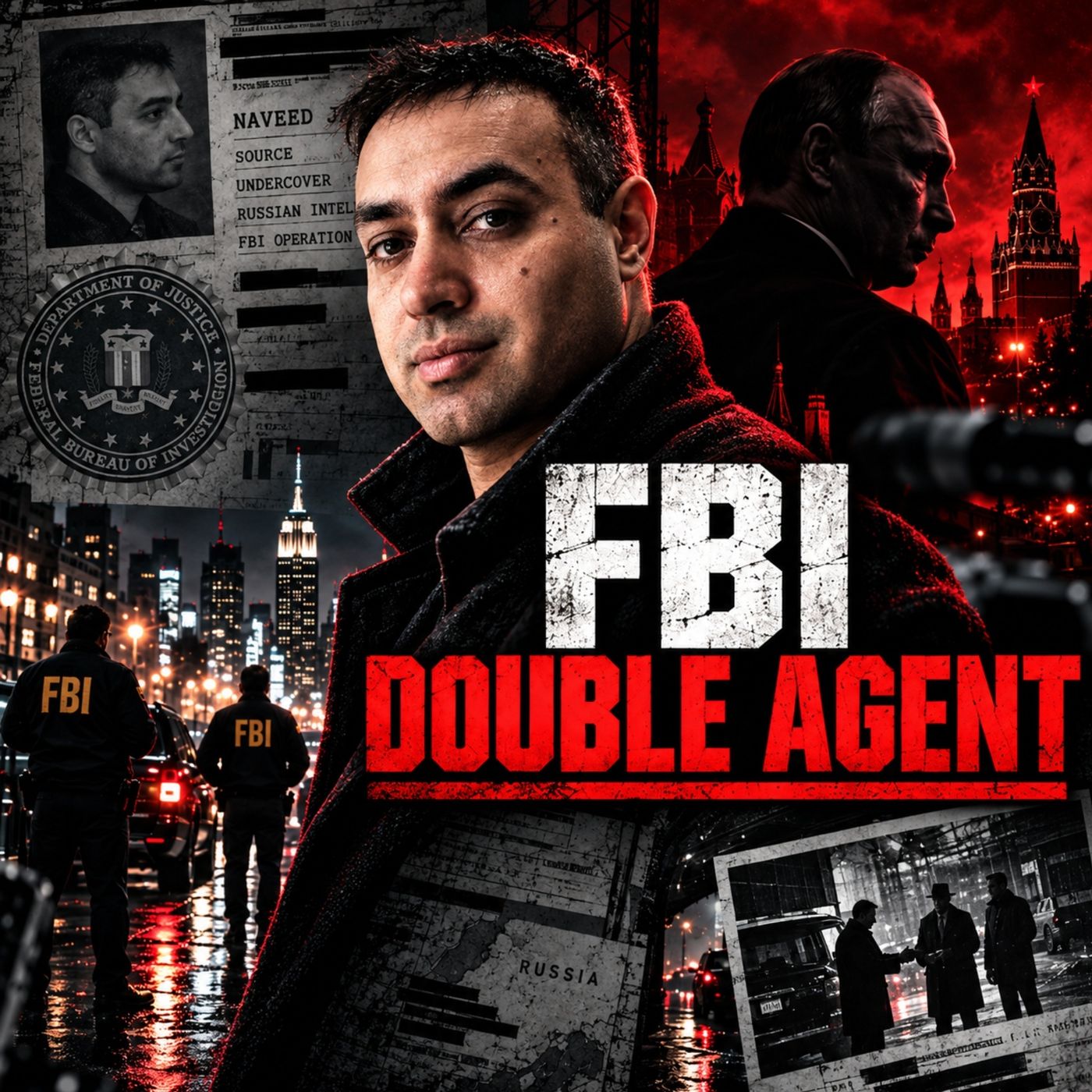
The FBI Double Agent Who Targeted the GRU | Naveed Jamali
Samstag, 10. Oktober 2026 · 2 h 14
Kapitelklicken springt direkt hin
Shownotes
Naveed Jamali tells the story of how he went from a family business in New York to working with the FBI as a double agent against Russian military intelligence before eventually becoming a Naval Intelligence officer. We also discuss how the Russians recruit assets, the psychological toll of undercover work, encounters with suspected Chinese intelligence, and why counterintelligence still matters today.
Today's Sponsors:
VAER Watches ⬇️
vaerwatches.com/theteamhouse
get a free watch roll with your purchase.
20% for active duty, veteran, leo, & first responders
GhostBed ⬇️
ghostbed.com/house
FOR 10% off!
Quince⬇️
go to: quince.com/house
for free shipping and 365 day returns
Housecall Pro ⬇️
Ready to save time and win more jobs? For a limited time only, our listeners get 50% OFF base plans for their first 3 months at HousecallPro.com/HOUSE
For ad free video and audio and access to live streams...JOIN OUR PATREON!
patreon.com/c/TheTeamHouse
To help support the show and for all bonus content including:
-live shows and asking guest questions
-ad free audio and video
-early access to shows
-Access to ALL bonus segments with our guests
Subscribe to our Patreon! ⬇️
patreon.com/TheTeamHouse
___________________________________________________
GRAB JACK'S NEW BOOK "THE MOST DANGEROUS MAN"
⬇️⬇️⬇️⬇️⬇️
penguinrandomhouse.com/books/803651/the-most-d…
Subscribe to the new EYES ON podcast here:⬇️
youtube.com/@EyesOnGeopoliticsPod/featured
Jack Murphy's book "We Defy: The Lost Chapters of Special Forces History" ⬇️
amazon.com/We-Defy-Chapters-Special-History-eb…
Or make a one time donation at: ⬇️
ko-fi.com/theteamhouse
Social Media: ⬇️
The Team House Instagram:
instagram.com/the.team.house?utm_medium=copy_l…
The Team House Twitter:
twitter.com/TheTeamHousePod
Jack’s Instagram:
instagram.com/jackmcmurph?utm_medium=copy_link
Jack’s Twitter:
twitter.com/jackmurphyrgr?s=21
Team House Discord: ⬇️
discord.gg/wHFHYM6
"Karl Casey @ White Bat Audio"
– Start
– How a Future Navy Intel Officer Became an FBI Asset
– Growing Up Around New York’s Espionage World
– Why New York Is a Hub for Foreign Intelligence
– How His Parents Became Involved With the FBI
– A KGB Officer Walks Into the Family Business
– Russian Surveillance & Sending a Message
– Meeting Oleg, the GRU Officer
– Why the Russians Wanted Open-Source Military Material
– Robert Hanssen & Rebuilding Russia’s Spy Network
– Russia’s Long-Term Plan to Cultivate an American Asset
– 9/11 & Wanting to Join Naval Intelligence
– Pitching Himself to the FBI
– Using Counterintelligence Work to Get Into the Navy
– Designing His Own Double-Agent Operation
– “Does Oleg Have a Gun?”
– The Psychological Toll of Living Undercover
– MICE: Why People Become Spies
– Convincing the Russians He Was Motivated by Money & Ego
– Taking the Relationship With Oleg to the Next Level
– Moving the Spy Meetings Out of the Office
– When Russia Started Tasking Him for Intelligence
– Walking Into Northrop Grumman for the FBI
– How Dangerous Was the Operation?
– Russian Intimidation After the Operation
– A Suspicious Encounter With Russia Today
– A Russian Approach Targeting a National Security Journalist
– Intelligence Agencies & the Press
– Influencers, Propaganda & Russian Money
– Being Surveilled by Suspected Chinese Intelligence
– A Surveillance Vehicle Outside His Home
– Why Chinese Intelligence Was Interested in Him
– The Counterintelligence Threat From China
– Showing Oleg a Sensitive Government Database
– The Russian Thumb Drive That Nearly Blew Everything Up
– The FBI Turns on Him
– Setting the Final Trap for Oleg
– The Arrest Plan Goes Sideways
– Finally Learning How Big the Operation Really Was
– How the Operation Disrupted Russian Intelligence Collection
– What Happened to Oleg
– The FBI Helps Him Become a Naval Intelligence Officer
– Telling the Spy Story Inside a SCIF
– How a Chance Encounter Led to How to Catch a Russian Spy
– Balancing a Media Career With Naval Intelligence
– The Mental Cost of Undercover Work
– When the Stress Finally Caught Up With Him
– Life After Intelligence & Journalism
– Flying the B-2, B-1 & B-52
– Why Deterrence Still Matters
– Flying on America’s Doomsday Plane
– Knowing When It’s Time to Pass the Torch
– Closing Thoughts
Become a supporter of this podcast: spreaker.com/podcast/the-team-house--5960890/s….
Transkriptvom Podcast bereitgestellt · Zeitmarken springen hin
Hey, Jack.
What's going on?
Guess who our new presenting sponsor is. Tell us about it.
We've heard a lot over the last few years about whether it's possible to build things in America. Our presenting sponsor today, Vera Watches, is putting that question to the test. Vera was founded in Venice, California in 2016 with a simple goal, to rebuild U.S. watchmaking while producing watches tough enough to withstand the toughest outdoor environments. Today, Vera is the largest independent watch assembler in America. assembling watches in California, Arizona, Rhode Island, and Alabama, while also manufacturing its leather straps in Illinois and Florida. Every rear watch is built for active use with a guaranteed waterproof warranty, scratch-resistant sapphire crystals, and high-quality materials and components throughout. That combination has helped
Vair earn more than 10,000 five-star customer reviews, including thousands from people who rely on their watches every day in demanding professional environments. All of us here at the team house have been wearing our Vair watches for a while now, and you can check mine out right here. This is the Meridian Diver watch in navy blue. It's a very classy watch. And this is the actual rubber dive watch band if you wanted to take it in salt water.
But it also comes with a normal silver band and a nylon band if you prefer that. And D, what kind of watch are you wearing there?
I have the C4 Tactical Field Watch. It's solar powered too.
I'm loving it.
And it's funny because I had this laying on my coffee table the other day, actually. And my homie came in and to watch football or whatever. And he's a watch guy. And he's like, Oh, is that that fair one? He, I'm not even making this up. Like I'm not even bullshitting. I'm like, Holy shit.
Yeah.
Like they're going to be presenting sponsor for the team house. And they sent us all a bunch of watches. Like, yo, I love this watch. And I, I literally sold the watch. I sent them the link, the team house link. And I'm like, yo, buy a watch from this, from this link. Because if you do buy a watch from that link, which is very watches.com slash the team house, you want, you purchase a watch, you get, A free watch roll that you could fill up with three watches so you could travel with your watches and stuff like that.
It's really cool. It's leather.
Yeah.
And I was so excited when he was like, yo, is that that Vare watch? I see it all the time. I was like so amped that he came up with that.
Yeah, it's nice.
I really like the like nice big watch face.
You can find them at vairwatches.com slash the team house. That's V-A-E-R watches.com slash the team house. And if you use our link, you'll get a free watch roll with $ 59 with your purchase. Also, Vair does offer a 20% discount for active duty military veterans and law enforcement and first responders. So you could check that out at any time if you are any one of those. Yeah, I'm excited about the sponsorship. So I really hope people go and check out Vair.
Yeah, absolutely.
Absolutely.
Hey, everyone. Welcome to the team house.
I'm Jack Murphy, and we are happy to have in studio another guest. Today, it's Naveed Jamali. He is the author of How to Catch a Russian Spy, which is about some of your misspent youth, I think, when you were working with the FBI to help them, help the counterintelligence guys catch a Russian spy here in New York.
And then you went on to have a career as a naval intelligence officer, and now you work in journalism.
Indeed.
Yeah.
It's the, I mean, that's the cliff notes. It's, it was, uh, we were talking a little before we started just sort of our path to the military. And, uh, mine was very much a non-traditional one. So I, I really, I didn't want to be, I don't want to be a spy, but it's this funny thing, Jack, where it's like, um, you know, I had wanted to get into the Navy as an intelligence officer. I applied once, didn't get in.
And I thought like, if I applied again, um, I had this great recruiter who was like, hey, you can apply again. You just have to show some growth in your resume. And I know there's a lot to go into here. But basically I had this harebrained idea that if I helped the FBI with the Russians, I could literally use it as something to put on my resume to show that I had intelligence experience. And to my surprise, that actually panned out for you somehow. It was a nightmare.
And I can tell you once– I mean I can tell you now once I got into the Navy– what I realized is that these agencies don't like to play nice. So my whole thing, when, before the book came out is if anyone asked and no one would, cause they would have no idea that I did this. I was very much, I was involved in this, this thing and I didn't disclose it, but the standard line was I was involved in a successful counterintelligence operation. And then I'd pull out an FBI card and said, if you have any questions, here's, you need to talk to. And that's all I'd say. And, um, We were just talking about SF-86s.
So when I got into the Navy and I was doing my TS, I disclosed foreign contact under official– but it was under official government direction. And the Navy, of course, was like, well, tell us more. And the FBI was like, we're not telling you shit. And so I got stuck in this ping pong between these two massive agencies. And it was this really funny thing in that when I was doing operational work– I'm sure it's like this in any special forces team. It's a small group. And so you have a lot of freedom. But then when you get to like back to headquarters, the big headquarters element, it's the exact opposite. And so I was not used to operating in this very structured. Yeah, yeah. And man, it did not. Yeah, you'd think that like counterintelligence experience
would pan out. But like my first assignment in the military was to handle merchant, like a merchant ship database had nothing to do with counterintelligence. So I felt like I had this vision that I was going to come in do like CI did not pan out that way.
So, uh, you know, to take it back in time a little bit, um, you and I are kind of from like the same area, which is interesting. Um, as I was reading your book this week, um, you lived on 112th street at one point. I lived on 112th street, uh, when I was going to school because your parents were academics.
I was going to the school to Columbia. So I, I lived in student housing and, You lived in Hastings on Hudson.
That's right. I lived in Sleepy Hollow. So like a lot of the places, like.
Your business was in Dobbs Ferry.
That's right.
I went to Mercy College my first year in Dobbs Ferry. So, I mean, yeah, it's just very funny reading about it.
It is.
And on top of that, reading from a new perspective, because these are like, this is like my hometown and where I grew up.
Yeah.
I didn't know that there was all this espionage shit taking place right where we live. So your book kind of shined a light on that.
It's funny. I think there's a part about this that I think a lot of people don't know, but it comes to– I'm sure someone will fact check now that there's an international law that dictates the movement of diplomats. And basically you can move within a 50-mile radius of your embassy or consulate without the host nation's prior approval.
So I mentioned that because the Russians that we dealt with were at the Russian mission to the United Nations, which is on the east side. And so my parents' business was essentially as a defense contractor. And they were supplying the government with books. And it was very unexciting. But because they were a defense contractor and because they fell within this 50 mile radius, I think that's why the Russians targeted us. And They can move and come and go without obviously asking for prior approval from the U.S. government.
And so, yeah, Westchester falls within that zone. So if you look at where the embassies and consulates are and just draw a 50-mile radius, you can assume that there are going to be foreign intelligence officers that are operating within that radius.
And, I mean, it's worth pointing out to people who aren't aware that U.N. mission is like spy central.
Oh, gosh.
Because obviously all of these different diplomats from different countries are there. We have all these consulates in New York City. And I mean, it's also the CIA has a huge station. They won't talk about it.
Of course not.
But they have a huge station in New York. And by law, they can't spy on Americans. They're not there for that. They're there for all these foreign nationals. And that's a great place for them to try to recruit people, to stop them from spying, as you know.
Uh, lots of things that they're involved. New York city is a cosmopolitan place. It will always, you know, they say that's espionage is the second oldest profession and the days of AI and technology. I don't think, you know, it's going to go away. I think tactics will change, you know, the, but the profession of like meeting someone in person, it's becoming more and more important, right? Because with AI, with someone being behind a computer screen, you don't know who they are. Yeah. And so the Russians were trained in like really this old art of every time I met with them, they were assessing me. They were trying to determine whether I was legit, whether I was lying. And, you know, Jeff, one of the fascinating
things about this is that people always assume when they hear I was double agent, I was a spy, that like you're inherently a liar. And the fascinating thing for a lot of people is that, no, I never lied to the Russians. In fact, if they had asked me if I was working for the FBI, I probably would have told them yes. They just never did because they were really good at assessing if you were lying. And they would do these things where they would ask a question, a mundane question on this form. Who was your sponsor?
And then six months later, it asks the same question. On page 12, block C, who was your sponsor? And the way that I look at this is that if you're lying about that really small thing, or there's a like perceivable difference in your answer, then they can't trust you. And all they'll do is– I mean they'll just– that's it.
You're done with them. They're just going to walk away. So it was really challenging in doing that. And for me, taking even a further step back, so we talk about Westchester, right? So my parents, both immigrants. Father is Pakistani. Mother is French. And I always assumed later on that like the reason the Soviets actually targeted my parents was because– They assume here in this country that someone who's a new American is more malleable to be, right? But I grew up hearing these stories because my dad, I think, downplayed it.
Can you tell us the story about your parents were academic? The first time, yep. They started a research service, essentially.
And this is prior to the internet and everything.
This is like the 1980s. This is like the... height of the cold war height of rayon right and so my my dad was a phd in philosophy of all things and my mom was also an act up and they dad had worked with the nypd done all these like um they decided to start this research business and it exactly as you started said like back then people would law firms would pay people to go to libraries and they started moving out to selling books and selling books as a federal contractor so west point or any any federal agency that wanted to train would buy books.
And rather than going from a syllabus to like 15 different publishers, they'd come to them because government work is always like incredibly bureaucratic and in order to play, you have to be certified. Anyway, so there's this interesting book selling business of the federal government in, they were on 59th Street, so Midtown Manhattan. And one day in the late 80s, This man walked into their office and they weren't a bookstore. They were like an office. So they didn't really get foot traffic. Traffic coming through. Yeah. So this guy walks in and he says he wants to speak to my dad and sits down with my father and says like, you know, my name is Alex Tomikin.
I work at the UN mission. I work at the UN. And it was sort of vague, showed my father a business card, but then the way my father would tell it with like took the card away. It wouldn't actually give him the card, showed it to him, like a, which is already weird, right? Yeah. Yeah. And, um, it basically says like, I'm at the UN and I want to buy some books. My father's like, okay, well, what kind of books? He's like, Oh, nuclear, uh, disarmament, things like that. And he's like, well, what do you do at the UN? He's like, Oh, I work on, on those types of issues. And he's like, well, how's business going? Like, so they're just kind of BSing. And, um, guy gave, uh, Tomikin gave my father a list of books, looked academic,
you know, wasn't anything classified, anything that would like raise any suspicions. And I said, oh, okay, great. I'll get these. Where do you want me to ship them to? And he said, no, no, I'll come back in a couple of weeks. And with that, he left. And my dad's just thinking, as he would tell the stories, like, you know, they had to hustle to get a customer. And here they just had someone come in and literally throw cash on the table. And he's like, oh, this is great.
And he went back to work and then literally like 10, 15 minutes later, there was a knock on the door and two more men came in dressed like literally like in trench coats. And they're like, uh, they showed my dad a picture of the man of Tomikins. Do you know this man? I was like, yeah, he was just here.
They were like, well, this is a, this guy's a KGB officer. What did he want? And my dad was like, just to buy some books. And they're like, and he's like, do you want to see the list of books? And I said, yes. Show him the list of books. And he said, what do you want me to do? And they said, get him his books. And he said, if he comes back, we'll be back. And so that started this wild relationship, Jack, where it was like between the FBI, the Soviets, and my parents. And my parents, they'd been hippies.
They wanted to help their new country, but they didn't want to help too much. I found it funny when you mentioned in your book how your dad is a trained actor. In ethics. Yeah, yeah. But he had no problem with it. He's like, ah, fuck, I'll help the FBI. But to a degree. Because the whole thing with him is, in his mind, as long as, like, they would be like, can we take you out to dinner? And he's like, no, no, it's okay. Like, I will help my new country, but only this much. Like, I'm not going to form a personal relationship. And the Russians, too. Like, they would offer, and listen, it was this wild thing. He just sort of found it, like, exciting and funny. He found this whole thing, like, ridiculous. And so, like, he would tell
me Like we would sit around the dinner table and be like, this is what just happened. And we'd be like, this is absurd. It just seemed like a comedy of absurdity. I learned later that like there was a, you know, sort of a sinister element to it, which is I was a young kid. And like, again, the Russian, the Soviets had come to my parents' office. And they're pre-internet, no, you know, how you found information out about people back then is I can only imagine. But like there are times where we would, My father, I remember very famously being at our local A & P, little supermarket in town, walking in with, you know, the cart. And one of the Russians just walked right by him. And then there was other times when we'd be outside like raking and
they drive by the house. And my father would point it out and make fun of it. But I understood much later that that was like a way of them telling us, we know where you live.
They want you to know that they're there. They're very purposefully harassing surveillance.
Yes. Yes. And also the Russians, again, as, as I learned, I've dealt with the Chinese intelligence as well in later life, but very different modus. And the Russians, you know, it's all about posturing. It's all about mind fucking people. And it's all about leverage. And there, um, there's some scary motherfuckers to be honest with you.
And, As this relationship went on, it survived the fall of the Soviet.
That's right.
Continued on through, survived. 9-11 happens and everything else. And I think you say in the book how obviously these KGB officers and then later probably GRU guys are being cycled in and out of the UN mission every three years. And you point out that most of them were like pretty personable, articulate. They could talk to you. They had some culture.
Yeah.
But then this one guy comes in, Oleg.
Oleg.
Who is like the opposite of that. Yeah. I mean, he was very smart. The way I explain it, Jack, I think it's important for people to understand that if you're in Russian intelligence and you're, you know, you're, even though we were focused on the war on terror, the Russians never lost sight of us. The main enemy. Yeah, the main enemy. That's exactly right. And so if you were going to climb up the latter for the GRU or the SVR or any of that, you're coming to the United States. Like the best of their best are the ones that come here. So again, kind of moving forward, you're right. Like the relationship with the Soviets, once the Soviet Union collapsed, it was a few years, but then the GRU just came right back. Same thing, just different,
like same salad, different dressing, right? And the GRU is Russian Military Intelligence Agency. And the books that they're buying, they're interested in military content. You know, they're buying maps and shit.
The way that relationship kind of panned out, at least initial, until you came around, I guess, they really were looking for, like, open source material.
Yes, yes.
And maybe they'd try to slip something classified in there and your parents were like, hey, we don't have access to this.
That's right, that's right. So they would, you know, I think people would want to know why wouldn't they just go to Barnes & Noble or Amazon to get this stuff. And Back then there was export control. So this material was not allowed to be sold outside the United States. Again, it might sound silly, but again, pre-internet or early internet days.
And again, learned much later that, you know, that there's a saying, which is your enemies may know what information you want, but your friends, you know, what your friends know is what you need. And it's that fact that like, if they're looking for a book on meteorology or like aluminum welding, whatever it might be, our intelligence community can look at that and say, well, this is a gap.
This is something they're trying to do because they don't have it. So just, you know, there's two things. One is by doing it with my parents, they believe that what they were looking for was being protected from the U.S. intelligence. But I think it's the second part, which is probably much more likely, is that intelligence as I learned is like, you know, it's like being a cop writing parking tickets.
If you don't bring in X amount of sources or X amount of pieces of information, you're not doing your job. And so my parents were easy to get books that could mark as like, we talked to a source and look what we got. Yeah. Yeah. And even though it was like, I did something exactly. Even though you could just go to freaking Barnes and Noble back then and just buy the book. Um, it was viewed as like, I'm sure, you know, like check the box. um interestingly enough and it's low risk low risk yeah and uh you know um the whole thing with robert hansen which was right before so robert hansen was a fbi special agent who worked in counterintelligence who was famously working one of the worst turncoats working for the russians we think
that because my parents were so relatively low level that when hansen was arrested and I'm sure disclosed a lot of the Russian, the assets the Russians were using. And even the time when he was feeding the Russians who were U.S. assets, my parents were so low that he probably never disclosed who they were. So there was this point in early 2000 when Hansen came in with, again, the Russian network had to be rebuilt. Interesting. And so I think I came in just on this all, I knew none of this, right? So, but I probably came in at that time. It was the right time that they were probably hungry to rebuild their network. Oleg, who was very smart, but like you said, very rough. He came from Vladivostok, I think. He was not probably the
son of some oligarch. He was more... He was like a... Was he a submarine officer? I mean, he wore the submarine pin. He'd been a submariner, but I think... But he'd also been like Turkey. I think he'd been an intelligence officer a fairly long time. And he was very good at what he did. I mean, there were some really impressive... You know, it was like mental combat when you're talking to these guys. But he was also super fucking arrogant. And I think and he was so excited that he, you know, they knew that the Russians knew that I was applying to the Navy. And that became a really big thing. They were like, you know, you use that to kind of sell yourself. A hundred percent.
And I remember they'll have this crazy chart that the Russians gave me. It was handwritten. that showed every clearance up to the president. And they're like, this is where you'll be. This is where you'll get, you.
Know, because when they recruit an asset, the first thing they want to do is get him promoted up.
The higher 100%. It's a long-term relationship, right?
That was one of the most, I think like impressive things that I read as far as what the Russians were trying to do, that they're trying to cultivate you as a very young man.
Yeah. Yeah.
With the idea that you would go places in, you know, 20, 30 years down the line.
It's crazy to think that, but like, that's what I say is in this, In this world of AI and all this other stuff, basically the way the Russians looked at this is that it's like becoming a made man in the mob. You're going to go through this whole process. And if you watch The Sopranos, when they talk about Chrissy becoming a captain, basically this moment where the Russians were assessing me, once they had assessed me, they don't have to necessarily meet with me in person. They just have to know it's me because they've already made their assessments.
And so this part is really, really important because, you know, with technology, there's just a lot of ways to obviously move things around and do so in a way that's, you're not like doing necessarily loading dead drops and being with people in person. And I think that is something that has changed. Although we can talk about tactics down the, you know, it's the risk of catching someone in person is, Obviously, that's what the FBI wants, what the Russians want to do.
And we do the same thing in Moscow, right? That's where you're at the most vulnerable is you're actually meeting with an asset. So it's the most dangerous part of this. And so I think both services, the CIA, other intelligence services- Want to keep their distance. Yeah. But that assessment of understanding and unpacking, A, if you're real, and B, understanding what your motivation is, that's perhaps the most important thing.
Because There's a lot of things you can fake, but sitting down with someone, unless you're a freaking pathological liar, you're a complete sycophant, most people can't lie, especially after three years like that. If you're good at that, there's something not right with you. Right, right. And so they're really good at just sussing out lie. And so the wild thing is like, I didn't have a cover name.
I used my name. Everything about me was real.
Thanks Housecall Pro for sponsoring this episode. Housecall Pro helps the home service businesses stay organized and win more jobs. If you own an HVAC, plumbing, electrical, or any other home service business, there's a lot more to the job than doing the actual work. Communicating with customers, scheduling, dispatching your team, marketing and sales, invoicing and collecting payments, which I know could be tricky. Housecall Pro helps bring that all into one place. So if you ever had a home service experience that felt remarkably seamless, there's a good chance that they were using Housecall Pro behind the scenes.
For the business owner, that means less time bouncing between different systems, less paperwork waiting for you at the end of the day, and fewer things falling through the cracks. With everything in one place, Housecall Pro actually helps you grow your business and shrink your to-do list. And all of that can save you a serious amount of time.
On average, pros using Housecall Pro save more than eight hours per week. That's how you can get back to growing your business, taking care of customers, or just getting some of your life back. And saving time isn't the only benefit. Housecall Pro can help you win more business too. On average, pros grow their monthly revenue they generate through Housecall Pro by more than 35% in their first year.
And when everything runs more smoothly, your customers get a better experience too, helping you build your reputation and keep people coming back. Housecall Pro is already trusted by over 200,000 pros. It's top-rated software across 50 trades, including plumbing, HVAC, electrical, handyman services, contract and cleaning, and much more. Ready to save time and win more jobs for a limited time only, our listeners get 50% off base plans for their first three months when you head to HousecallPro.com slash house. That's HousecallPro.com slash house for 50% off. After you sign up, they'll ask you what you heard about them. Please, please, please support our show and let them know that we sent you. Thanks,
Housecall Pro. And thank you guys for continually supporting the sponsors that can support us. Thank you. Shopping for a mattress can get overwhelmingly fast. Too many options, too many opinions, and no clear way to tell what's actually right for you. That's why Ghostbed built their online mattress quiz. It's quick, it's simple, and it helps narrow down the right Ghostbed mattress based on how you actually sleep. You answer a few questions about things like your sleep position, whether you tend to sleep hot, and the feel you prefer. And the quiz gives you a clear recommendation from the GoSpec collection.
And if you're shopping with a partner, you could take it together. The quiz factors in both of your preferences, so you're not guessing or compromising blindly. It's an easy way to land on a mattress that works for both of you without overthinking it. Behind the Quiz is a family-run brand with more than 20 years of experience making high-quality mattresses. Plus, you'll get these best deals with GhostBed because the mattresses are priced up to 50% less than comparable brands. And there's no pressure either. Every mattress comes with a 101-night sleep trial and long warranty and fast, free shipping. Most orders arrive in two to five business days.
Right now, as a Team House listener, you can take an extra 10% off your order. Just go to GhostBed.com slash house and use the promo code house at checkout. That's ghostbed.com slash house, code house, for an extra 10% off site-wide. Some terms and exclusions apply. See site for details. Ghostbed, we love you. Thank you for sponsoring this show.
You know those pieces in your closet that you find yourself wearing on repeat? The sweater that goes with everything, the perfect pair of pants, or the tee that somehow you always reach for first? Those are the pieces that make getting dressed easy, and that's what Quince does best. Quince focuses on high-quality wardrobe staples with premium materials like 100% Mongolian cashmere, organic cotton, and merino wool. The styles are timeless, versatile, and designed to become the dependable pieces you reach for every day. Their 100% Mongolian cashmere sweaters start at just $ 60, giving you the softness and quality you'd expect from a luxury brand without the luxury price tag.
Quince also makes premium pants, fitted tees and polos, and breathable activewear, quality basics designed to work across your wardrobe and hold up to everyday wear. Everything at Quince is priced 50% to 80% less than similar brands. They work directly with ethical factories and cut out the middlemen, so you're paying for high quality, not brand markup. And I also want to point out that I'm wearing today all fours.
material from quince so this sweatshirt comes from them and so these sweatpants you see here very comfortable very uh very stretchy um so they're great you know wearing around the house or even as like athletic gear or whatever it is that you want so um highly recommend you guys check it out it's not just clothing quince brings the same approach to everything they make from hotel quality bedding and bath kitchen essentials, and thoughtfully designed furniture that make well-designed pieces for everyday living. Find your next fall favorites at Quince. Download the Quince app for app-exclusive offers or go to quince.com slash house. Get free shipping on your order and 365-day returns. Now available in Canada and
the UK, too. That's Q-U-I-N-C-E dot com slash house.
So you know from growing up in the stories you hear from your dad that this relationship with the, you know, exists and not the FBI is kind of watching over their shoulder. Um, tell us about like why you kind of got involved in their business, your parents' business.
Yeah.
And like how, like you had, you had like a motive yourself. Of course.
Yeah.
And there's got, listen, no one, no one is altruistic. Like we're always doing something for that. That's going to benefit us. And, um, you know, uh, We're at 25 years of September 11th. I was in Boston at the time of September 11th. But obviously, like you, growing up in New York, I went to NYU. New York City was a very important part of my early life. It's this...
I don't know how to explain it to an outsider, but it is a place where the son of a Pakistani philosopher who's an atheist and a French... Jewish Catholic mom can come together. There's not many places where I think I can... New York is one of them. So September 11th, obviously, I think, for many of us, but it felt... It really redefined my priorities. At the time, I was working. I was at Harvard. My wife was doing her PhD there. And I was just kind of aimless, maybe.
It just felt something was missing. And then 9-11 happened. It was really... We were back in New York. I saw the pile. It was– I mean it's just all seared into me. It's like really the first time that I felt something big and that this feeling that I was– wanted to be part of something bigger. And that's where I sort of found this intelligence program with the Navy.
The funny thing about intelligence is like everyone thinks it's James Bond, but 90 percent of it is just like PowerPoint, right? Yeah, for the officers especially. Yeah, especially. I mean it's just– even for the poor enlisted. So I had no idea what it really meant, but it seemed intriguing. I applied when I was in Boston. Like I said, didn't get in.
And I came up with this harebrained idea that the relationship with my parents and the FBI and the Russians, maybe I could use that to have the FBI write me a letter of recommendation. And in fact, when I moved back to New York, came back to try my hand at the family business– I met with the FBI agents, and I'll never forget, I met at a Dunkin' Donuts across from 26th Fed, which is the big federal building in downtown New York. And I told them this. I was like, yeah, I'd like to help you. And they're looking at me, and they're like, they're waiting. What am I going to ask for in exchange? And I imagine FBI agents are like, ask for like, I've never paid taxes ever. You know, right? Like, can you help me
out with this? Like, I'm wanted for... crossing like if.
That was yeah if that were the case i'd be asking for their phone number maybe you can help me like are transported sheep across state lines god knows where it is so but like i'm asking them and they're like waiting i'm like can you you know i want i asked him i literally asked him jack for a letter of recommendation for the navy.
And they're like think about the fbi and they're like they're very super withholding it's weird like parental relationship and um very manipulative and they're like I could tell they had like a reaction or face or like really surprised. This is all I was asking for. And, um, but they, their answer was like, we'll look into and get back to you. And like, that's how this whole thing started.
I was like, okay, I'm going to do this. They're going to help me get in. I'm going to be able to go to the Navy and be like, look, I worked on real intelligence. And it was just the most in hindsight, like this, I was young, you know, like what are you early twenties? Um, didn't know any better. But that's how it all started. And then I realized that it turned out to be a really wild adventure that, yeah, that just turned into something a lot bigger than I really understood until much, much later.
And so you didn't get into the Navy the first time.
No.
So the second time, you know, like you were pointing out earlier, you need to show some growth in your resume.
And so what was... your idea how to go about that. Well, so of course the FBI being the FBI, they're like, we're going to help you, but this is, we can't like put anything in writing. We can have like high level to high. Like they just made it so much more difficult. So, um, you know, when the army just like in any, there's promotion boards and there's, you know, so what they would do is I had to meet with, um, I can say it now, uh, a board in Fort Hamilton.
And it was like, they made their assessment here in Brooklyn. Yes. Um, Defense Intelligence Agency was there for many years. So I met with these three Navy captains. Those are 06s. And the FBI, trying to help me, they met with those same captains before I went in to meet with them. I had this great recruiter, Julie Schmidt, still around. She's retired.
Love her to death. I've actually reconnected with her. So she facilitated this meeting. So I was supposed to– I don't remember what time. Let's say it's 1 p.m. I'm going to meet with them. the two FBI agents that I'm working with, met with a group at noon. And while they never told me what they said, this is what I assessed they said. They said, they went up to these captains and they're like, we got this guy.
He's really good. We can't tell you what he's working on, but his name is Naveed Jamali. And then they left. And so I walk in and there's these captains that are looking at me like, what the fuck was that? And I'm like, I realize that these fucking FBI agents, these these captains think I was involved in like some terrorist thing. They thought that I got like arrested trying to buy a rider, like ammonia nitrate in a rider van because everyone's about counterterrorism right now. Right. You're Navin Jamal and they assume you're working.
Yeah.
Counterterrorism. They assume terrorism. And so I had to tell the FBI, I was like, guys, you got to stop doing this because you're really making it a lot harder for me. People assume I'm a fucking terrorist. And they're like, oh, but yeah. So that second time, you know, I don't know exactly what happened because again, a lot of this was, opaque to me. Um, but we, we worked with it and it wasn't until the operation ended that I got my commission. So I did this for, uh, for three years.
I mean, it was really an intense three years. And the, the dangling carrot for me at the end of this was to get into the military, which again, in hindsight, Jack, like, man, I should have asked for like one federal crime, like regicide or something like there's should have asked for something, something more, but, um, Yeah. It, it, and then of course, uh, again, small team. So you really don't understand how like secret and sensitive what you're doing is because it's just you and two other guys. And, um, once I got out and kind of got into the real intelligence world, I realized this is something pretty unique. Um, and you know, that, uh, listen, there's a lot of people obviously do some pretty amazing
things that can never be told for a lot of reasons. I'm lucky enough that I was able to, you know, not only come off, come out of this on top, but also be able to share the story. It really is an insight into what I think there are a lot of people on a daily basis that, you know, not just, not just CIA officers and FBI agents. They get all the glory, but they're not the ones that, you know, they're meeting with the people that are actually doing the work for them. It's the assets that are risking their lives, risking their family lives. And, you know, there's a lot of people that are just now are helping our country because they, for whatever reason, they believe...
It sounds quaint, but they believe in this idea of democracy. They believe in this idea of America. And they're not doing it for money. They're doing it for some higher personal reason. Sure, some of them are doing it for money and other things, of course. It's an easy thing, but there are some true believers. And yeah, I just...
To me, though, it's all comedy. I look at some of the stuff and I'm like, how the hell were we able to do this? How did they just let us just do it?
I mean, it was interesting in this case that it wasn't really the FBI pitching you. It was more you pitching the FBI.
Oh, God.
I was so into it.
At least in the initial part of it. What was your pitch to them?
What did you want to do? It's a really good question, man. So, you know, it's all innovation, right? And... I was trying to come up with an idea that would make sense for what I'm doing.
Right.
So the only direction the FBI would give me much of their credit was like, if you were a real spy, how would you do this? And I, I ran with that. Like I ended up going to like state department training and all this other stuff. And you know, it was, so I came up with this idea that through the company we had access to certain material and ended up going to North Grumman at one point and in Long Island to get, I remember getting these giant NATOPS for the F-14 back then and giving them to the Russians.
So a lot of it became getting information and access to stuff that would make me valuable. And the FBI was like, yeah, man, just do what you need to do. We'll let you run with it. And I think it was so harebrained that when the Russians looked at this, they were like, this is so wild that it can't be the FBI because the FBI is so unimaginative. They're like, you know, this. In fact, funny footnote years later I ran into a colleague actually someone I went to high school was a few years older turned out to be an Apache pilot and the FBI had pitched him this many years later the same idea to basically for him to set up a book business because he had contact with a Russian intelligence officer in D.C. So like they
wanted to repeat the form. Yeah. And it's like, come on, guys, like that's not going to work again. Yeah. And of course it didn't. So it was.
Yeah.
Again, much the FBI's credit, they really let me run run with this. And I think because it was so. Non-traditional, man, they just Russians didn't know what to do with.
Some of the conversations between you and the FBI. Very funny, because. Well, for a couple of different reasons, but one of them is like, I get the sense, especially initially, they didn't want to direct you.
Yeah.
So they're just sort of like asking a question and leaving like your imagination here.
Like, yeah, yeah.
You know, how would you go about this or that?
Yeah.
So, I mean, one of the big questions I would always ask, I'll be like. Hey, does Oleg have a gun? Yeah, yeah. And they'd be like, well, what do you think? I'm like, no, no, no, no. Yeah, well, who gives a shit what I think? I want to know. Like, if I'm going to go into a fucking building with him where there's no one around, I'm going to get shot.
And they're like, well, what do you think he'd do? And I'm like, it was like, it was. So, yeah, I mean, clearly, again, now understanding two reasons, obviously. Interestingly enough, I was creating intelligence. I was an actual producer of intelligence. Even though I was producing that intelligence, once it was handed to the FBI, it now became classified intelligence. So even though I had no clearance and I was producing this, there's things I couldn't see or know. And obviously one of them was the tactics and some of the classified information about how the Russians operate. There's a second reason.
I remember one time sitting with the FBI and we were talking about Oleg. And they mentioned that he was a really big, he was really big into swimming. Like that was his workout thing. And there was like a pause. And the agent said, he never told you about that, right? And I was like, no. He's like, you can never repeat that. Because how would you know, right? So everything was so, it was wild, Jack, because it's like having an uber mother-in-law. Because everything you say is going to be taken and examined in context and what does it mean.
And I imagine the Russians did the same thing. I'm sure they're recording everything. And I'm sure that they're looking for any changes. They're looking for any variation in what you're saying. And again, it's the little things. If I had mentioned that Oleg was a big swimmer, he would have been like, well, how do you know that? Or even if he said nothing, he would have just taken that back and they would have picked up on it.
And you, I mean.
Like you said, not a pathological liar, but you did play a character with him.
That's right. Yeah. That's right. So you couldn't lie, but like he didn't know why I was there, right? I was there because I wanted to get into the Navy, but that's not– and there was– like I was telling him that. There was truth to that, but that's– you know, that was really my end game. And you start doing stuff, Jack, when you're working undercover. It's like it's really easy to get lost. Like it's really easy to lose that center and that direction. And so that like North Star for me was always like, hey, at some point I'm going to get out. I'm going to get this career and I'm going to do this like above board and legitimate.
But what I figured out very early on is the Russians knew who I was, right? They'd see me as a young boy because of my dad. So they knew I was a real person. It wasn't just someone that just magically appeared. Right, right. Out of Quantico. Exactly, exactly. What they didn't know was like why– I was doing this.
Why did I want to do this? And, you know, I, at the time I'd consume a lot of books about a lot of information about this, trying to understand, watch a lot of movies. And, um, I came across this acronym called mice. Yeah. That mice has to do with like the motivation for why people generally buy really interesting thing.
Why someone will betray their country. Why, you know, there's a whole psychology behind that, but my stands for money, ideology, coercion, and ego. And what I found is that the coercion part, people think that if you blackmail or threaten someone, you're going to do just enough to kind of- I've.
Talked to CIA people who are like, we don't really do that. Yeah, it doesn't- Because, I mean, the problem is if you're coercing a person, is that asset.
Going to lure you into an ambush? Yeah, 100%. Yeah. They're not loyal. There's got to be a benefit to them.
Right.
So the much more beneficial, like I've talked to- People that were recruited by– what the hell was his name? He's long since gone, but he was in the first Trump admin. He was a former naval officer. Carter? Anyway. But he turned out to be crazy. They have a lot of people that show up and are like, we want to help you. And the Russians are like, nah. Yeah, we don't– if someone approaches us– Oh, like walking? Yeah, yeah. Yeah.
And there's just people that are not actually from the FBI, but they're just fucking crazy. Yeah, we do that too. Yeah, of course. 100%. We have crazy walk-ins. Yeah. It's just intelligence, the White House, these are beacons for people.
And the walk-ins set off all the red lights because this person is a dangle, that they are.
A civil agent. Exactly. So it's either Dan, but the other part is that there's actually people who are fucking crazy.
Right. Right.
Like legitimately crazy. I mean, arguably fucking when I hear some of the stuff these guys did, like some of the stuff Hanson did, it's fucking crazy.
Oh yeah.
I talked to, we were interviewed a retired FBI agent, counterintelligence guy who is on the periphery of that. And like his whole part of that was they knew an FBI guy came to the consulate. I think it was a consulate, not an embassy. In like 1985 or whatever like that and was sitting there in that room. And this journalist had seen this FBI agent sitting there. So like they knew that whoever that guy is, that American, he's the one that's spilling these secrets.
Yeah. So they had to identify him. But I mean, again, he walked into the consulate.
No, it is.
I mean, that's nuts. It's this, you know, there's this weird thing where. Again, it's like so much ego is in this, especially for dudes. Yeah, yeah, yeah. And the funny thing about intelligence and counter- Narcissism. Narcissism, absolutely. It's like, I think when you're playing a game where the game is to never actually win, right? You can like, it's like to be constant stalemate, right? Because if the whole thing with this is that- Unless you're going to defect, I mean, what the hell are you doing? Yeah, but like the whole thing with intelligence and counterintelligence is that unless you're going kinetic- you're just trying to keep status quo, right?
If you push too hard, then, especially in intelligence, then it bleeds through intelligence and becomes like now the Russians are going to fucking like launch a missile, right? There's this careful balance. You want to stop, but you don't want to go too far. And they know that game too. And I think like playing that where you, and I talked to FBI agents who spent 20 years like watching their Russian adversaries from like a mile away. And it's like, the fact that I got to sit down and talk to them and touch them and like, you know, do all sorts of crazy shit with them, it's like, it's like a wet dream for them because they never, they, it's a shit, but they never get it. Yeah, they don't use them as like the undercover guy. That's right.
And I think that fucks with people.
I legitimately think that at a certain point, like you pointed out, the CIA, I mean, the case officer, you're like the social worker for the asset.
That's right. It's a great way to put it. But yeah, and I think that, I think for some people, that's really hard. Like, it's really hard to be The coach and not the player. Oh, yeah, absolutely. Right. And so for someone like, like I said, the psychology stuff is fucking fascinating. For someone like Hanson, who has this giant, who has this giant ego, I think that like it was probably really hard for him to not, you know.
And Ames also, giant ego and an alcoholic. And they all think it's funny. They all think that they're doing, they're actually helping someone. They justify their helping the agency. Well, when you become a snitch, like the mentality, there's something that happens inside their brains. Well, they justify. The mental gymnastics. Yeah.
And it's like, so getting back to your question, like for me, I'm none of these things. But I know that the Russians have a profile of like what makes sense. And so what I came up with from that MICE acronym was, again, I can't use coercion. I think Oleg asked me once. I'm not like religious. he asked me once about ideology about like, he's like, Oh, how do you feel about God? And I was like, yeah, man, I'm not, what's your stance on communism? That's right. Exactly.
And I was like, I'm not fucking talking to you about that. And, and then I realized, you know, again, I had this Corvette, I was this young kid. Yeah. It was really easy to just focus on the last, the first and last money and ego. Right. And so a lot of my conversations with the Russians were like, and it was awesome. I'm not going to lie. This is one of the best parts would be like, fuck you pay me money now. And as, and I felt that as long as, they probably had some profile that, you know, young Americans are only care about money. Yeah.
Yeah.
Yeah.
And so as long as I kept playing that for them, they're like, yeah, yeah, this is fucking real. We understand this. This guy just wants money. And the Russians are so fucking cheap. Like I remember going and being like, I want $ 40, 000 a month. And they're like, I'll give you $ 3, 000 right now. I'm like, fuck you. Like, I could go to jail for this. I want 40 grand.
It was really funny, too, how and I didn't know it was done quite like this, but it makes sense when I read it in your book that Oleg would pay you. Then you would have to give the money to the FBI. The FBI takes a receipt.
Yeah.
And then they pay you the money. They pay FBI money to you. Because and I think that was for your protection. Yeah, it was because I can't actually be accepting money from a Russian.
Yeah. But it was so funny. The funny thing about this, Jack, is that the Russians were completely funding this operation against them.
Right.
Which is hysterical. But yeah, that is it is this in the middle. That was like a taste of the bureaucracy that I didn't get. to see, which was so amazing about this. It was basically me and two FBI agents. And who else was involved in it was completely... I had no idea. But then shit like that, you get a sense of like, hey, it's not quite that easy that you can't just do this shit on your own. Um.
So how did you evolve your relationship with Oleg as, you know, trying to provide him with intelligence? He wants intelligence. How did you kind of like take it to the next level?
So there was this moment where... Can I tell you about the joke? Like, this is how I knew... Do you remember the story about the joke that I told Oleg? Oh, yeah, yeah. So I was young and dumb. And again, like, I thought everything was just like this big joke, right?
And.
I remember Oleg would come to my office and my father was still there and he would introduce me to my dad. And again, coming into the office, like people would see him. You know, we had moved to Dobbs Ferry at this point in Westchester. And this is the funny part, but there's actually a really important part of this about like how relationship change and move to the next level. So my dad introduced me to Oleg and what possessed me, but I'm like, let me tell this guy a joke. And so the joke is as follows.
It's Glasnost, and there's two Soviet grandpas standing in Red Square waiting for their daily serving of borscht. And one of them turns to, Yuri turns to Pavel and says, you know what, this is bullshit. I thought now that Gorbachev was here, we'd be done with these lines, like everything with capitalism would be changed. He's like, you know what?
I'm going to go fucking shoot Gorbachev. Can you save my spot online? So Yuri goes. Gone two, three, four, five hours. Comes back. And he goes up to Pavel. Pavel says, oh, thanks for saving my spot online. Pavel says, did you shoot Gorbachev? And he says, no, there was a line for that too. And like, you know, you laugh.
Oleg looked at me and he looked terrified. Because basically it's like– have you seen the videos where there's like the North Korean guys applying for jobs and they try to get– Yeah, yeah, yeah. They try to get them to say, did you say Kim Jong-un is a fat bastard? So he's probably thinking– I didn't know any of this at the time because there's rules. I didn't know any of these rules. This is very early on in the relationship with Oleg. He's thinking if I'm recording him, if I get Oleg saying something negative about the Russian government, we could use that. Right, right, right. So he's like, oh, I don't know anything about that. I don't, yeah, I don't know what you're talking about. He makes a very
public display. But in that moment, what Oleg, we had this conversation and basically what he said to me is like, next time we meet, can we meet at a restaurant? And so that subtle thing of moving the relationship that had been going on for 20 years outside of the office directly with me and like him getting my cell phone number, it made it a, um, It really changed things.
And that was... It's funny, Jack. At the time, I didn't realize this, but it was a subtle shift to move. And that subtle thing really set everything in motion. And he really liked meeting at Uno's Pizza. And Hooters. Hooters. Hooters are like Hooters. I mean, yeah. Except that it was so... Can't blame him. No, but... The only thing with him is it's like... It's like if you're a 25-year-old kid... And you're going with your gross, like, curve uncle.
You're like, oh, man, this is just uncomfortable. I remember him being at Uter's and there's like this black waitress. And he looks at me and he goes, oh, look, they even have black ones here. And I'm like, I don't even know what to do to that. Like, I don't know.
Yeah.
With Russians, you don't really want to talk to them about black people, Jews.
Yeah. You know, a lot of the Eastern Europe. Yeah. You don't.
No, no.
Just don't talk to them. No. And I was told also, like, under no circumstances was I to drink with him. Oh, yeah. Then I was like, oh, dude, that like, yeah, that's you annihilate you. So but that was a big shift. And from there, it really did. You know, I think it kind of removed this barrier of him being like much more honest of what they wanted from us. And I think what the FBI said, it moved from like.
He's coming in up until that, they're giving lists for books and it's very standard. Are they do anything wrong? It's not really like it's low level. But here now they're tasking an American citizen to collect intelligence for them. And they really want you to get classified. Yeah. And that's what they're... And it's a long game. I don't think people understand how patient... They will wait years to do this. And then when they feel like it's run its course, they're done. They're gone. Yeah. Walk away. That's it. And, you know, it's really a wild thing. I....
But you mentioned the whole part about Northrop Grumman.
Yeah. Was kind of amusing.
And I thought it was very, very funny because the FBI had obviously orchestrated this entire thing.
And you were like nervous as shit. Like, oh, I go in there and what do I say? You tell that story.
Yeah.
So again, like Jack, I knew none of these rules, right? Right. So the FBI, I clearly, like you said, orchestrated this. They drive me out to Long Island. They get in the park and I'm like, all right, you can just walk in there and just get what you can get. And I'm like, okay do they know i'm coming like yeah probably and obviously what had happened is they were not going to come in with me because they didn't want to be seen with me and like if something went south yeah they're letting you be the guy yeah exactly i'm fucked right but none of this so they we they had to their credit they'd arrange the meeting i forget the guy's name but arrange a meeting with like a one of their librarians or one of their
like archivists and i was able to get documents and we were able i was able to use my traditional credentials to get that and The Northrop Grumman– it's funny. Years later, Northrop Grumman was our sponsor for– at Newsweek for one of– I flew the B-2. I had a good laugh with them about this. I actually talked to their CEO. It was, again, these are the risks. Like the FBI was not– the FBI could have gotten me documents and been like, here. But instead they wanted to make it believable. Right. And so they took me out there because, again, Oleg would ask, how did you get these?
Right.
What did the building look like? Who did you talk to? But again, if something had gone south, like Northrop Grumman security had got– the FBI would have been in the wind. But I mean obviously someone at the company knew what was going on. I don't know that they knew what was going on to the extent of it, but they knew that I was coming. They were willing to play ball with the FBI. Yeah. Again, I don't know who contacted them. The FBI was– listen, to their credit, it's the circle of trust. If anyone– it's hard to understate this, but if anyone found out what I was doing– Like you're risking your life. Literally. I mean, the Russians, they don't think take things personally, but they're all about sending
messages and it's a fucking nuclear armed state. Like they're not, I'm a nothing to them. I'm a, I'm a fly on the, they're probably not going to whack you, but you didn't really know that. No. And, and the funny thing much later on when I, uh, got out and got into the military and I wrote the book, we're talking to some friends who were in various agencies and like one of my good friends, Chuck, um, he was with, he's with a bunch of agencies and talking to like, he's very dead pants. Should I be worried about the Russians?
He's like, no, he's like, if anything, they probably just subcontracted out to the Bulgarians. So, so when I would go do my book tour in Eastern Europe, in Europe, I was like, just make sure that no fucking Bulgarians that show up.
With the Russians really get, uh, but heard about is their defectors.
Yeah. Um, You know, you've seen the polonium. Yeah, yeah, yeah. That's the sign of message.
Yeah.
You're not safe. No, they won't. I mean, that's exactly right. And the thing with me is people say, aren't you worried? And the reality is... You might not want to go to Russia. No, I... Even my... I have a 17-year-old son. He's like, do you think I could travel to Russia? I'm like, probably not. No, dude. That's not... But, like, what they... You know, from Russia's... And I can tell you some, again, some postscript of what the Russians have done since the book came out, but Um, I've definitely had run-ins with them. Um, but what they want to do is like you said, they're all about sending messages, but also in all about checking in to see what's going on even now. And then, but thirdly, they understand
that if I walk out of the studio, Jack, and I get hit by a bus, 90% of the people are going to assume it's the Russians. So what they don't want to do is they don't want like, what they'd rather do is like, you know, make sure I've had.
Assassinating Americans on American soil is an escalation, a huge escalation.
And it's not worth it to them. Yeah. But what they will do, which is really interesting, especially in this day and age, is, like, way back when Twitter was first a thing, like, I'd see things, like, I'd go on cable news and talk. And suddenly I'd have a huge amount of followers that would follow me. And then the next day they'd just, like, so they would fuck, like, they'd troll me in that regard. Like, there was definitely shit that they were doing, like, reputationally. I'd get, like, you know, pictures of, like, poop and stuff, like, all sorts of funny stuff. They were definitely doing stuff online and like, you know, like they'd bomb your book review and stuff like that. You can never prove it, but
like you assume that that's, and that's like, that's safe for them. I had things with like Russia Today would try to get me to come on and like. Oh, that would have been hilarious. Oh yeah. That was, dude, that was, you want to hear a crazy story about that? Again, postscript. I was living in Seattle at this time. I was still in the Navy and I went to the Westin and I did a talk at the Seattle Rotary Club.
and they had this huge banquet hall. And prior to that, Russia Today was trying to get me to come on like crazy. And I would just ignore them. And then finally, they said something. I can't remember what it was. And I responded. And I was like... And I remember talking to my old FBI case officer, old ASAC. He was like, dude, why would you do that? You just gave them a piece of information. Now they know if they ever want to rattle your cage, this is what they have to say.
He's absolutely right. Like I let my emotion get into that. So anyway, fast forward, I'm doing this talk in the Westin and there's probably like a hundred plus people. It's all blue, old blue hair. Finished my talk and a couple people are asking me and I noticed how the corner of my eye, there's these like really attractive women and this one dude who looks like He's got a long pony. He just looks Eastern fucking European. Don't belong there.
Yeah, right.
And I'm like, no one under 40 just came to talk, to listen to this talk, right? So I'm talking and walking, might make a way out. And I'll never forget, there's an escalator. And I'm with the guy who brought me there. He's walking. And this woman, these three people are pointing at me and obviously talking about me. And she's like, beautiful, green, bright green dress, walks in right behind and starts talking to me. He goes, I had a question for you.
I just didn't want to ask in front of him. And I was like, sure, what's up? And she starts going on about like, how come you don't criticize America? Like you talk about Russia's doing this, but America does the same thing. And I'm thinking, yeah, she's fucking recording me. Like she's trying to get me to say something out of school. And immediately I knew who, which this was. And, um, she, uh, So we go down, we're walking and there's a bar.
She's like, do you want to get a drink? I've got a room here. Jesus. And I'm like. Weighing it on.
Yeah.
I'm like, yeah, no, I'm good. I'm like, I'm like nice to meet you. Natasha. Oh, I know exactly her name. I won't say it, but we got her name. But she, these were people with RT? No, I don't know who, I mean, no, but I assume that there was a coordinated thing here. I don't think it was coincidence. You can never be sure in this world, but you can be sure like, The whole thing that we would say is when there's doubt, there is no doubt. Yeah, yeah.
They wanted to discredit you.
So, yeah. But, like, we got– we pulled– again, I was in the military. So we went– I, of course, reported to NCIS. Had a friend who was one of the federal agencies. Got the video. I still have it from the West End. Got her name. And, dude, she has a– she's still, as far as I know, in Seattle. I periodically look at her Facebook profile. She showed up in 2013. There's nothing before 2013. Her husband says that he works at Microsoft, but who knows? It's just, it's like, you know what she is. I have a couple weird stories about that myself. Yeah, I mean, people are surprised that that shit goes on.
And I have been approached by RT and Press TV in the past.
And I'm like, I just don't respond. You can't. I'm not going on. And the thing is that even you say anything, Anything you say, they just fucking twist it. Yeah. So you can't give them anything. But, like, the Russians are fucking– I mean, people don't realize this, but they've been doing propaganda since they were, you know, since fucking Stalin, right? Yeah, since the Bolshevik revolution. Yeah, exactly.
Well, before that even. I mean, during the Tsarist times, they had a pretty fearsome intelligence.
They fucking invented it. And so they're really, really good at that stuff. And it's just– yeah, it's really hard because you can't let your emotions– But like that gives you the sense of the scale of what you're playing with. My one misstep of like being like, fuck you. If I'd said nothing. Yeah, they knew they didn't get inside your head. Now they knew they're like, we know what can fucking rattle his cage. And I remember it was this woman writing me. She's like, what are you scared to come on? I was like, fuck you. I'm not scared.
And I, and that was like, I immediately regretted it.
I had one that's quite clear where I received an email from I was working in journalism and I was reporting a lot about the war in Syria at the time. Got an email from a woman named Natalie who claimed to be working at Interpol. And this long email detailing all of this, you know, basically what she was saying was that the CIA is giving guns to terrorists in Syria.
Yeah.
And she kind of said all of the right words, but there's no specifics. You know, there's no names, there's no dates, there's no places.
Yeah.
And I'm like, this is interesting. She said the right words to me, right? But nothing tangible.
Yeah. So I asked her, you know, can you tell me more? Can we meet somewhere? Can we have a cup of coffee? Nothing.
And I had a friend trace the email and the email address pops in St.
Petersburg. Of course.
So it was like, yeah, that one's very clear what they were trying to do. And it just makes you wonder, like, And, man, there's some things that I shouldn't say. I'll get sued immediately if I say on air here. But I have a strong belief that the Russians specifically target, amongst other people, journalists in the national security field.
Of course they do. And I.
Could potentially point to two or three that.
For sure are playing that game.
Name names it's not a joke i mean it'll be an instant lawsuit and i could improve it in a court of law i don't think.
But that's the way you know that's the thing that people don't understand is that when it comes to counterintelligence like you know when i was at msnbc um so i know we're kind of bumping all over the place but when i got out of uh i was finished doing that stuff with the fbi so in the military one of the reasons i actually left is i got a i got hired by ms It was now MSNBC to do like intelligence analysis. We're looking for, you know, one of the few people that have real experience with intelligence, Russian intelligence. And one of the things I kept explaining to MSNBC was like, guys, counterintelligence doesn't work in the way that the criminal division works. They're not looking to make arrests and having perp walks and shit like that.
In a lot of cases, like with Oleg, they can't. They can't. That's right. And honestly, something as subtle as being like, hey, we know what you're doing. And that's frustrating for a cop who their entire life is to make an arrest. Absolutely. So the kind of people that do this, the temperament is really interesting and it's really– the ones that are really unique and good at this, they can take some very specific temperament. But it's all about the subtlety and you could tell the– you could tell the Russians are like– so something as simple as like showing a picture of someone or leaving a phone number.
That's enough to blow an entire operation. Now the Russians or the US, whoever it might be, has to assume that that's compromised. And so do they go on. You don't actually have to arrest someone, right? Because you're never going to stop Russian intelligence completely. They're a fucking state. So it was really hard for traditional media to understand that this isn't like, Even with like Hanson, right? Like this stuff has never seen the daylight in court because there's just too much national security. So they plead guilty to avoid a trial.
That happens within the CIA all the time. So many times people would be shocked if they knew. Oh, it's, and it's for the good of the country, right? Because you can't, you don't want, There's no national security. It's also just embarrassment.
Oh, well, that's two. But there is a legitimacy that– Yeah, that stuff can't come out in open record. That's right. And if someone is going to go to a jury trial, they have a right to– Right. For information for the defense, right? Right. The constitution. We live in a constitution. You know, constitution of democracy. So again, like that was something that all this stuff when you talk about like not understanding, you talk about journalism, you know, listen– It's the same way, I think the U.S. government doesn't pitch journalists in the same way for certain reasons. I mean, I know I've been on the receiving end of it. I don't think they're supposed to, but there's waivers for everything. And it's not, okay,
but it's like, hey, this guy or gal is going to write a story that's much more pro. Why don't we go to them first? Back during the Cold War, for sure, the agency was placing stories in newspapers around the world. Yeah, I mean, but even now it's like, well, look, I mean, the other thing is journalists, journalists, let's be honest, as I'm sure you know, Jack, it's like the least, like most mistrusted industry at this point. Yeah. And I mean, not without good reason.
The thing is like, you know, the little anecdote I was telling you before we started recording is, you know, the relationship the intelligence community has with the press in America. I mean, they don't need to recruit you.
No.
I mean, journalists will like do it out of love yeah because yeah feed me information and i'll i'll write this access journalism baby right it's a it's a thing yeah 100 it is and you know it's it look i mean that's a whole other topic and and but the other reality is that like one of the funny things is um.
When i was doing hard i don't do hard news for news week anymore i obviously host a show which is it's journalism but it's storytelling so we don't do But there was a point when we were doing that and it was really funny to talk to the Taliban, to talk to their press officers. They had fucking press officers.
And we were still in Afghanistan at this time. And, man, they were so well-spoken. And I remember very– there was a great reporter. He's still at Newsweek. His name is Tom O'Connor. We would do some crazy stories about you know, um, Americans be taking hostage. And like, we got some really great scoops. Um, in fact, I'm the journalist of record that reported the first one to report that the last plane had left Afghanistan, um, with Donahue. And, um, but anyway, so we're talking to the Taliban and there was a point to tell them, basically we'd go to them and be like, Hey, do you want to give us comment?
And they actually said, no, thank you. Uh, Like, very politely. Because they realized that with Twitter and social media, they don't need the press to talk to the general public. And it was this really, like, leveling moment where you realize that, you know... The world is changing. The world is changing. Even now, like, you have kids. Like, it's...
They all watch. They're all on Instagram. I'm there, too. And, you know, it's really challenging because I don't think people understand... Like if you look at what's going on, I'm not making this as a nonpartisan statement, but a statement of fact, but you look at what's going on in Gaza, like there is, I think, absolute, or Ukraine, right? Like there's absolute manipulation of, you know, you're not, journalists and news outlets, we have standards when we report things. Not saying that there can't be wrong, can't be biased, but there is a process. We can't just go out and say, as you know, You can't just go out and say there are things I'm sure that you know to be true, but they don't meet that journalistic standards. You can't. Of
being triple sourced. Exactly. Yeah. And so you can't say that. And just the way it is. But if you're Joe Schmoe, the influencer. Right. You can say what the fuck you want. Maybe it's true. Maybe it's not. You know, who cares? And also, who knows? Does it even matter in their case? And look, I mean, in the first Trump administration, I very much know this to be true, which is like you're an influencer. You have a way to make money.
And what you realize is when you start talking about certain things, you get more donations. And so you keep talking about that.
I mean, our boy Tim Pool was like directly taking money.
100%. There you go. I mean, but that's fucking wild, right? But it shouldn't surprise anyone when that came out. And, you know, for Russia, like a few million dollars. Nothing. It's nothing. Who cares? They make that. And they can... why wouldn't they go and start indirectly paying influencers to carry their message? I mean, you've seen, like, why not, right?
It's funny about Dimitri. We've never been approached, even.
That you know of. I feel left out. I feel like, you know what, am I not an eligible bachelor? Well, that you know of, right? You must get pitched. You know, the whole thing with the Russians, what I noticed after Oleg, is that the FBI is so good at, like, watching these people that I suspect that they move to more non-traditional, plausible, deniable, like people. And so you don't fucking know. I mean, you can suspect, I'm sure you're a smart guy.
Yeah. And they, and exactly, they're illegals, but they may actually be here legally.
Right.
Um, there are people that, you know, it's like, um, the CIA will do this. They will actually do defensive buys of defense companies or companies that the Chinese will try to, that are going public. Oh yeah, that's a thing. That is a thing. And you work for a company and you get acquired by another company. You don't know who owns it, but it's a Chinese entity. And suddenly they start pulling, you know, your IP. They'll, I mean, look, there's a whole host of cases where there was a Marine Harrier pilot who was recently arrested because he was, In Australia, but then he got recruited by the Chinese. Oh, I remember that, yeah. And it's this really gray area.
I've talked to it. There's one of the big problems. Well, that's like a pretty clear ITARS. Yeah, yeah. ITARS, absolutely. But then there are places, like there's a lot of former agency guys that get hired by the Saudis and shit like that. I know, yeah. And it's like, eh, they're trained. But like what tactics are they disclosing? It's a messy gray area.
That gets very weird where you have like a former NOC advising a UAE.
Yeah, that's probably weird. It's like... Yeah, but there's money to be made. And so, like, this shit happens, and it becomes... I think what the Russians are really good at, and the Chinese, too, is, like, that layer. Who are you really talking to? Right, right. You don't know, right? If it comes to you with an American face, you know, do you really know? So one of the crazy stories I can tell you about the Chinese is... So Newsweek does a lot of reporting. We had a lot of reporting about China. And the Chinese are not fans of ours.
I live in Seattle. And it was the height of the pandemic. So kids are home. And we had this great neighbor that had kids the exact same age as our kids. And so every day we would take our kids to school. the schoolyard and let them play together. Just like, it was very structured, like same time every day.
And leading up to this incident, I'll never forget. I was, you know, just going out for a run and I'm coming back to my house and I pass a Tahoe white guy in it, but he had a screen, like a computer, like it looked like a fed and it looked like a police car, but it was unmarked. And I happened upon him. And he looked at me and smiled.
And the minute he looked at me, it just– those old instincts. I was like, yeah, this guy is here for me. And it was just super weird. I was looking at him. I was like, why are you here? He's right by my house. But I knew just the way he reacted that I kind of caught him off guard. But he knew– again, the sense that it was for me.
I go home, just file in the back of my mind. It might have been a few days later. I don't remember exactly how long. We're back out with my neighbor, her kids– And our kids are playing. What we would do is we would just, while they're playing, we'd walk around the periphery of the school. And there's streets running on both sides. And as we're coming around the corner, again, the school's closed. There's no one there. But the playground's open.
I'll never forget this. It was a white Jeep Cherokee, like completely stripper, like basic model. But it was idling, and it had two wheels on the curb. And as I pass it, I see this Asian guy in the front And on his dashboard are all these cell phones. What the fuck? And then I see in the back there's a fucking cage. Like a Faraday cage. And I'm looking at this. And again, like just my old spy instincts.
I'm like, yeah, that's not fucking right. To say the least. And I'm like turning around. And as we're walking, he gets off the curb and starts following me. And I go to get my phone and try to take a picture of him. And it takes off. And I'm like, immediately I'm like, I put the other incident, put this together.
I'm like, what the fuck is going on? Yeah, yeah. So my neighbor is like, what was that? We're just both like weird out. Whatever. Life goes on. Kids kind of go back to– so the next day she comes down. She comes to our apartment and she's like, it was really weird. I go out for my morning run. I'm taking the trash out. It's like 4.30 in the morning.
And the way that the houses are is we have– in Seattle, there's all these alleys. And so behind the alley is a shared alley. It's basically like a street. We put your garbage in. And she comes out and she goes, that truck that we saw was parked in the back alley. And I was like, what the fuck? And I was like, okay, that is 100% Chinese intelligence.
And the white guy, what the Chinese would do is they have a target list and they'll hire local detectives who have access to records. And they probably gave him who I was and he was going to find where I lived specifically, assess my pattern of life, and then what the Chinese were doing, because I have some friends who are former whatever, but they do like tailored access operations, which is like, and they're like, oh yeah, they're pulling up to your house because they're dumping your phone. They've got, they've got a target list. They have to be within this much distance. My, my bedroom kind of overlooked the back alley. So where he was, was probably in distance to connect to my phone while I'm fucking sleeping. So
I remember, and they're actually able to break into your phone wirelessly. He was like, he was like, They just– they explained it to me. They're like, they establish your pattern of life. They can just– you go to a– tables over and within minutes they can just grab everything they need. Holy shit. Yeah. I mean it's a fucking state agency. The resources are unlimited, right? So the way that I called up one of my FBI former colleagues, I was like, what is this? Do I need to be scared? Like is this them sending a message? And it's like– because it was so– like they weren't trying to hide. Yeah, yeah. It was so overt. He's like, no, man.
You got to understand, they have a fucking list of targets. They just wanted to finish with you and move on to the next one. They don't give a fuck. There's no consequence. Because what's the consequence going to be to them? And so we had this whole plan that if I saw them again, I was going to call 911 and be like, I think I saw a guy with a gun.
Why do you think the Chinese got on you to begin with? I think it probably was more of my affiliation with Newsweek as a reporter. Okay.
And we'd written about China. About intelligence services, Target. National security reporters.
Shocking.
Because what they want to do... So, different perspective, though. What they probably want to do is want to see who we're talking to in China. Oh, I see. That would make sense. So, I mean, it's not that they were targets for... There was no contact. They just wanted to... Are you talking to dissidents? Yes. Yeah. And literally, are we who are we talking to I mean and it's it's it's fucking freaky but that's not the only time I've had run-ins with the Chinese I had another run-in with a Chinese intelligence officer when I was covering the inauguration literally we're sitting at breakfast and this young Asian woman like put walks it's next to us and gets really excited when she sees me starts taking pictures and
like all the Newsweek people are like, what the fuck is going on? At first I thought it was like a fan, but it was super weird. And so eventually I was like, let's just get the fuck out of here. And we left. Literally, Jack, the next morning, I'm coming out of my hotel room, open the door and she walks by my room. And so again, talk to intelligence folks that I know. And they were like, look, what you are is you are a targeted, like a targetable asset.
But because you're a public figure, they know that there's low risk. You don't have any security. It's like you're easily accessible. And for someone... There's the A team, the B team, the C team, the D team. You're going to see the D team because that's like... They're just starting off. And for her, she got excited because she's like, I got someone I can collect on. I can go back to Beijing and get a big shiny star. The A team, you're never going to fucking see. In fact, if you see them, you're fucking dead. Like.
This.
This shit goes on here in our country because there's not, like, laws. They're not specifically breaking laws that you can go after.
Yeah, because they exploit the freedoms we have in this country. And right now, I mean, counterintelligence has been dismantled in this country. People don't really get that.
I was hearing from friends that, like, you know, for the agency, people are going home at 4 p.m. in the afternoon.
Like, there's no work for them. It's really that bad. I was talking to someone today about how they... purged Mandarin-speaking FBI agents.
We don't fucking need that. That work in CI.
Yeah.
You know, the Russians are still at it, but the Chinese are... Aggressive. Aggressive, and they have... They basically have endless funds and endless people.
Yeah, 1.5 billion people in China itself.
Right.
And then China, the PRC regards all the overseas Chinese as being their people also.
Yeah.
Which is bullshit, but... Oh, dude, well, and listen, my opinions on, like, ICE and immigration, obviously, have a lot of very strong opinions, but here's what I will say. The birth tourism thing... Is bullshit. Is bullshit, and it's a national security concern because what happens and what's happening now is you have someone who shows up from mainland China and they're like, I'm John Yoo. I was born here 18 years ago. Here's my passport. You have no fucking idea who that person is.
Yeah.
And it's frightening because there's... You know, again, when I was at Harvard, one of the things we had to do post 9-11 was they started doing things tracking international students. And listen, no one's going to come to Harvard and disappear. But there are other schools where people get a student visa.
You don't know who they are. I mean, again, they can say they're a U.S. national that was born here but never lived here. And they just show up with that passport. Yeah, no, I agree. That needs to be shut down. I mean, that's like, to me, that's a really... But that is like a minority of what we're talking about.
It's a sliver, yeah. Yeah, but it is... I mean, you can imagine that there are probably people here who are using a passport for someone who was born here, and they're not them. And they're a U.S. citizen. They're entitled. When we go on to a military base, you have to be a U.S. citizen, no dual citizenship. That person can present that American passport. They can join the military.
They can get all sorts of things. It's kind of a frightening prospect. So to circle back to OLEG. We went completely the long way, huh? You give them the aerospace documents, and then the next step sort of is, it was like the DTIC database. Yep, yep, yep. Damn good memory, man. These are like details that I think a lot of people might miss. But back then, DTIC was the Defense Technical, I forget what it was, Internet Information Catalog or something. But basically it was, if you got a grant from the U.S. government to do, like, in research for the Department of Defense, the agreement was that there was an IP transfer that the DOD got to use. So basically, every report that was funded by the U.S. government would end up on DTIC. And then
there was another one called STIC, which was the classified version. But back then, DTIC was just like a database that once I had credentials, because I could apply as a, you know, because we were a government contractor, we could get access to. And This is how quickly small things can go, like unplanned things can go south. So I gamed it with the FBI that we were going to try to– I wanted to get Oleg and the Russians to get like a monthly salary essentially. And they started giving me like taskings of things that they wanted to collect on. And so they would give me search phrases and things like that to search for DTIC and print out.
articles or reports based on whatever they're looking for. For the FBI, it was a nightmare because none of this stuff had been approved for release. Right, right. And, you know, the FBI, like... Yeah, I mean, you can't just give the Russians shit, right? But none of it was classified, even though it was, like, F-O-U-O, for official use only. Like, no foreign... Yeah, yeah. Which is not a classification level. Right.
So– but anyway, I had– back then I had a Wi-Fi card on my laptop, which is a big deal. And I was like, I'm going to meet– next time I meet Oleg, I'm going to bring my laptop and I'm going to show him. And so we met at– was it Vinny's Clam Shack? It's shittiest food, Jack. I don't know if what this says is about the Russians or it says it's about me. But– and I was like not feeling well. And Oleg had– I remember like he had just been giving me a hard time. At one point, I got up to go to the bathroom because I was really feeling, like, not great. And I get in the bathroom and this, like, heavy set, like, guy, like, bursting in to see if I'm, like, you know, making a phone call or, like, changing the batteries on my...
Who knows? They're quite clumsy. Yeah, yeah. So, anyway, we get back to the table and I'm like, look, I've got this database. Do you want to see it? And so we go to my car and we're seeing some parking structure and I'm showing the database and the agreement I have with the FBI is that It's a closed system, meaning that there's no way to get stuff off. He can look at it. He can download it to the computer, but it's my laptop, right? So we're letting him browse stuff.
And I opened up some article just randomly because he's like, can you open this up? And obviously he's testing to see if this stuff is real. Just choose a random thing. And it's like some article on linguistics, the most benign, boring shit you can possibly imagine. And he's like, can I get this article? And I'm like, no, there's no way for me to get it off here to give it to you. Because we thought this through. He'd ask for my credentials. Can I get your login credentials? I said, no, I'm not going to give you my fucking login. And so he looks at me and he goes, ah, I've got an idea. And he pulls out this thumb drive that I'd just given him, which had information from Northrop Grumman on it. He goes, can you put the document
on here? Now, I had a split second to decide what would be the reason to say no? Right. You're on the spot here. Yeah. So I made the decision to put the document, this benign, what I thought was a benign document, onto this. And he was very happy. Put on the thumb drive, gave him the thumb drive back.
Went on his way. The FBI was like, live it with me. They're like, you know, you should have said no. And I was like, and they're like, well, at least now we know. He knows it's real. Within days, I had a voluntary warrant that I signed turned over my laptop so they could go through it. Fucking got that laptop back. Dude, I fucking smashed it up. I never, I don't know what was put on it. Between the FBI and the Russians putting a Russian thumb drive into it. Yeah, yeah.
And I just remember it was this moment. I remember sitting on the lawn in my parents' front yard just like lying down just feeling like, oh man, this is just, I mean the FBI completely turned on me. I went from being like a trusted like, you know, superstar to being like, the fuck did you do? And that kind of signaled the end, the beginning, the end of the operation.
And basically at that moment, again, like I suddenly realized there's all these people that I don't know that are involved in it. They all have a fucking opinion. And this thing has been going on for like three years. Three years at this point. Yeah. So, I mean, it was fucking long in the tooth, you know, right? Like you, you know, it's, I started taking unnecessary risks to see if I would get caught. I mean, it's just, it's like a mind fuck. But like, yeah, that was, and it was Oleg's, time to leave anyway so that sort of precipitated the decision by the FBI to basically shut the thing down at this point because they didn't know if his subsequent replacement was going to have the same relationship or would even make contact with me and so
they figured that they had a chance to kind.
Of spring a trap yeah so tell us about the trap the trap so everything with the FBI was like gamed out.
Just like with that thumb drive so You know, the Russians had this whole thing where, like, they would give me a menu of a restaurant. Like, next time I call you, I'll give you a date, and this is where we'll meet. but i won't they won't say the location so they gave me a menu to pizzeria uno's in jersey some like i forget the uh um but some like big mall and so i remember sitting down with the fbi and being like we're trying to game this out they're like okay when you sit down with ole we're gonna come arrest you in the restaurant I'm like, that's a fucking terrible idea. This is pre-cell phones where everyone recorded. But I'm like, what if someone fucking recognized me?
You want to make a big commotion in the middle of a restaurant? That's a bad idea. So we came up with this idea that I was going to get them to my car. And when I took my hat off is when they would close in. And so gamed it out. Everything's planned out, right? Meet, Oleg calls me. And the FBI is like, you cannot go meet with him.
I was like, why the fuck not? They're like, you just can't. And what I realized is that they were... I'm guessing they were arguing with the State Department about what the FBI could do with Oleg. And there's all these people weighing in of who should be in charge.
That or they just couldn't get enough guys to come into work to serve a warrant.
That wouldn't surprise me either. Nothing would surprise me. But it basically... You're right. It was just basically big... FBI. Everyone was now fucking involved. Yeah. And it was just like this giant, like no one I'm in charge. No, I'm in charge. Right. So once there's some action to be had, everyone wants to get their hands on it. Yeah.
It was like, it was wild. So the FBI made me wait in this parking lot with them until Oleg left the restaurant and they had to watch me until just to make sure that I wouldn't go meet with him without them knowing. And of course, in the course of action, course of this like whole thing i uh i politely declined to go to a good friend's wedding that day and guy named larry kazilla if any of you guys watch he's ammo new york city he's a big car detailer is very well known larry invited me to his wedding and unbeknownst to me um the night before his wedding the church he was supposed to go to had a fire so he moved to a different church and And it just so happened it was the church that I drove by. And I had the Corvette.
And I'll never forget looking at my friend. I look and I see them all coming out of the church. And there's my friend Mike Musso looking at me like, what the fuck are you doing? You said you were out of town. And for years, I couldn't tell Larry or any of those guys. They all thought that I was just skipping out on this. Meanwhile, I was driving to meet these two FBI agents to sit in a parking lot under 125th Street under the West Side Highway until Oleg left.
This restaurant oh yeah over where I you mentioned the dinosaur barbecue yep that's right yeah and the cotton club was over there.
Which is now gone but it's so I'm sitting there in a fucking parking lot with these and I'm already like you motherfuckers like how am I going to explain this to the FBI and so Oleg I've imagined left and then he calls a week or so later meet it and you know let's do this again so I come out I walk into pizzeria like walk there and I'm getting ready to go inside and he where the fuck he came from but he like walks up and he's like so we're outside about to I remember my hand on the iron handle of this big like wooden door like hey Naveed how's it going I'm like and he pulls his hand out and he's shaking my hand and he goes without and this is all them like this interrogation thing so while he's holding my hand looking
me dead in the eye he goes yeah so where were you next last week and I was like oh my sister-in-law I can't give some bullshit excuse He's like, oh, okay. Hey, do you mind if we switch to a different restaurant? And he's still shaking my hand. I'm like, fuck yeah, I mind. This is the whole plan. I mean, that's tradecraft too, right?
100%.
Yeah. And so I'm like, oh, I don't mind at all. And so he's like, why don't we go to fucking Uter's, which is across the street. And so I'm like, it was like the longest walk. between those parking lot. Cause I'm, I imagine cause the FBI SWAT team. Yeah. They're like, Oh no. They're like, what the fuck is going on? And, um, later on, like when I saw there was obviously FBI agents in the pizzeria, who knows? Because I know at the end when this all kind of finished, there's agents and they come running up after we'd like met in this parking lot to like cheer that we just done this.
And they had fucking doggy bags. So they'd gotten their food.
Yeah.
So we, anyway, we go to, we go to Hooters. Oleg is like, I got to tell you, this is my last time meeting with you. I'm going back to Russia, but everyone loves you. They're so excited. And I was like, well, I have some documents I want to give you. They're in my car.
He had a fat envelope, fat envelope of like 50 or 40 grand.
I can't remember what it was. Um, And he, you know, we're walking. So we leave Hooters and we're walking to the car.
He, I remember before we get there, I mean, he also told you like, you're going to be a legit Russian spy.
Yeah. You're going to have a retirement plan, like the escrow account, like all of that shit. So we were like, I'll never forget this. We were on the curb, Jack. Like, and I knew the minute I stepped off the curb and walked to the car, that was it. It was on. And so he's sitting there. He's like, and he's exactly, he's like, I'm going to, To this day, he was really stroking me, man. Really going off on this. And he's like, people back in Russia are so excited. They want to have a lobster dinner with you. And I'm like, the one thing I regret is I want to know what that dinner would have been like. And so he's in the same thing. He's like, we're going to have a retirement account for you. Everything you said. So that
was it. I just become a made man within Russian intelligence. And I was literally standing on this curb. And I could see the car. I knew... And we walked. And by the way, you don't have these documents. No, it's all fucking bullshit. So we get to the back of the Corvette. I pop the trunk. He leans in and looks at the documents. And I think at this point, he knows it's over. And I take my hat off.
Just like Cinemac, these three FBI cars, kind of Bu cars come in. And they get out. And they're like, they grab me. And they're like, start like, patting me down and like i guess this real pissed off some of the agents that they were like treating like he i don't think he don't think he handcuffs me but he was like treating me like i was being arrested and um puts me and these are people i've never seen before puts me in the back of the car and the whole time i'm looking at oleg all he does is turn And walk away. Like all through the years.
All this like... Literally five minutes ago. You're like... You're the best boy in the world. And we're gonna give you all the... And then fucking... Gone. Cold professional. Cold professional. So we're sitting in the car driving away. And these two FBI agents I've never dealt with before... Turn around and look at me. And they start high-fiving me. And I was like... What the fuck? What is going... And then we drive to this parking structure. And there's like 50 guys there. And they're all like... High-fiving me. And it was just... It was... It was surreal. It's pretty interesting.
I mean, first off, I think you're a madman for placing yourself between the FBI and the GRU. That's completely insane. Um, but I thought it was very interesting and actually very cool to see in your book that, um, The FBI actually did take care of you.
Yeah.
And they did even offer you some closure, I think, to that experience, bringing you back. You got to go inside the CIA office and like the direct. Oh, that was wild.
Yeah. So at this time, my wife was pregnant with our first first kid. You're a New Yorker, so you can understand the FBI was like, we're going to take you out to dinner. And no, no big deal. Just show up at 26 Fed and, you know, 6 o'clock. And so we're taking a cab, and there's traffic. And so we get there, like, late. And one of the FBI agents that I'm working with, worked with for three years, you know, meets me downstairs. And I get into the lobby.
The building's empty, which is wild. It's a giant. If you know 26 Fed, it's a giant fucking building. I think I may have been in there to dispute parking tickets. But so it's a federal building so you can imagine that you don't just stroll into it. And so the first sign that something was amiss was that we just walked into it and they bring me to this elevator.
And I'll never forget it was like a capsule with an FBI crest on the floor. And I'm looking at the FBI agent. I'm like, this is a cool elevator. Do you take this to get to the office? He's like, I've never been in this elevator. I'm like, huh. Well, that's weird. So we get up. to whatever floor doors open.
It's cubicle land everywhere, but there's not a person to be seen. And, um, then there's this at the time, you know, probably like 50, but to me, he looked like he was like, you know, ancient. Right. And he's just like super cool looking bald guy from the future. He meets me and, um, He starts talking to my wife.
He's like, she's very proud of your husband. He did, you know, did something amazing for the country. And I can't remember, but things like that. And it was very, for me, it was very awkward. I never really thought of it that way. Uh, they take pictures, which I have after the pictures, like, Oh, the, something must've happened with the film. They weren't developed and we don't know where it bullshit. Um, so yeah, he met with, you know, there's like a grip and grin. They hand me a check that Oleg, the last bit of money. And of course I reported on my taxes. Cause I'm like, I'm not fucking like me. So I had to pay 32, whatever, 30% on, on, uh, whatever he gave me on the gift. Yeah.
The gift. Right. And like, thanks a lot guys. Um, and then we go out to dinner and I'm walking with these like FBI agents. Again, I've never seen them, including the head of the New York office. And the guy's like, what did it feel like to meet the assistant director of the FBI? And I'm like, what? I, I had no idea who that was. And, um, they give me, I get a, um, a signed letter of commendation, which is at the New York, at the, uh, spy museum in DC. Um, one, one signed from him. And the other one was, Oh God, was the former director of the FBI who recently passed away, Robert Mueller. So like, those were really cool to get those things. And it was only at that moment after three years that I
sort of understood that this was, I mean, to me, Jack, it just felt, it all felt kind of absurd. Right. And kind of like ad hoc. Yeah. And like, how can anyone give a shit about this? It turns out they did. And as I learned, here's the kicker to the story. Oleg, um, just pure chance, he was not supposed to be in that position that he was in the UN. Something had happened where his predecessor had been sent home early. So he kind of got a bump up.
And Nikolai Yurov, General Yurov, so they have a real job, these spies, for the Russian mission. And it's to sit on what's known as the Military Staff Committee, which is an actual organ of the United Nations. And it's made up of the military members of each of the embassies to the UN. So if you look today at who's part of the military staff community of the UN and you look at Russia, you can assume that those people are fucking spies. And the head of the MSC was this guy named Nikolai Urovov. And Urovov, as I learned much later on, was the senior GRU officer of the United States. So he was in charge of all GRU operations.
And because he never left the residentia, he went from his house to the mission, to the UN, the FBI could not get to him. What Urvoff had was this guy, Oleg, who was his right-hand man, his lieutenant, who was basically his deputy. And when this person left early, Oleg got, I guess, his old accounts, one of which was my parents.
I had no way of knowing this. And he was not happy to do the shit work, basically. And so I think that because he saw this, he wanted to turn this into something bigger. And the reason the FBI was so intrigued about this is that they knew by getting Oleg, they got Irv off. So what I heard much later on is, because I met people who were tangentially, they didn't understand the full breadth of it, but on our side, were part of this operation at the end.
And my little operation actually impacted Russian collection in the United States from an estimated... three to eight months. Like, they had to shut everything down. All their networks. Yeah, because they don't know what's compromised. They don't know what numbers, what safe houses.
So, did they, like, actually PNG Oleg and his boss there?
His boss never got PNG because his boss never met with me.
Right?
I don't know what... I've been trying to find out what happened to Irv off. There's a... Who's the New York Times reporter who's a former Marine who I love?
Um.
There's... Yes. Um... Neffs. Yeah, I think that's right. I was talking to him and trying to find out what happened. I can't find any information about him. I don't know if he's like dropped dead from alcohol. Assassinated in Donbass or something. Yeah, exactly. Oleg we found on Russian dating sites. I don't think he had a very happy life. I think, you know, he was on the plane to back to Moscow literally the next day. The FBI followed him to JFK and, you know, I expect it was not a very pleasant couple of months being debriefed. They told me that he was not actually PNG'd because that would have required disclosure of certain things, and I don't think. But for all intents and purpose, he's never leaving Russia ever again.
And I'm sure that the Russians have some training that they do for all their GRU and SVR officers that talks about this. I'm probably a case study somewhere. But yeah, I hold no ill will to him. He was doing his job. He was doing his job. He was a patriot for his country. You can't fault him for that. Um, the only thing I'll just say is he thought he was good, but we were just better. I mean, we really, you know, being like a young kid with literally off the street, like making this up as I went along and we were able to, to, to, to.
Be, as you point out, this is sort of the culmination unintentionally, maybe of a 25 year relationship with your parents and the FBI, uh, Um, and then you coming on there, the three years, uh, doing this.
Yeah, no, I mean, it's again, like people need to understand that it's, this was a unique, the stars had to align, right? Like I think if I just showed up and they had no idea who I was, they would have never trusted. Right. Yeah. So it's that it was an opportunity in that regard. Like you can't make that stuff up, right? You, Ash Carter. That's the guy's name.
I don't know if you remember that name. He was in Trump orbit one. He's this weird guy. And there's all these records that were released of him trying to work with the Russians and they wanted nothing to do with him. He's a perfect example of like, you're a loser. Go away.
Exactly.
Like you're such a loser that the Russians won't even. Yeah, that's right. But because they, they have an assessment, they don't want crazy people. And, you know, if I just showed up and been like, I want to work for you, that'd been like, nah, that's cool, bro. Yeah. Yeah. Like, They want to choose. It's all got to be about them controlling it. So you're right. It's not recreatable. That opportunity, that 25 years is what was able to have this happen.
It's also why they trusted me. And I think to the FBI's credit, it's probably why it was so damaging to the Russians and that because they trusted. Like every time Oleg would call me, that number that he was calling me from, that's a piece of information. Like is that the only number that he's using for just me?
And Oleg was tied to other operations. And I mean, one of the things I can disclose also is that the director of national intelligence came down and I was never part of this, but they presented the team, the national intelligence medal for this work.
Wow.
So, I mean, like this was, again, to me, none of this was apparent at the time. Like the significance of what was going on was, I just, all I saw was Oleg.
So the FBI did help you out with your Navy application.
I did. I, I, That's right. So I did get in. I remember the book. If you read the book, I mean, the joke is like, obviously I'm alive. I'm still here, but it ends with, I can say his name now, Scott, who was the ASAC, SAC or ASAC, I can't remember. But I get commissioned in 26 Fed, a small little ceremony.
And he says like, that's the same oath of office we take. Welcome to the team. And it's true. That's literally what happened. And, you know, it was, I was really excited and, you know, I kind of, Again, here's another footnote. I started my Navy career. I was like, okay, I'm going to transition. I'm going to put this all in this footlocker and move on. And in true military form, there was a school that I was avoiding. This is 20, so this ended in 2009, 2013, 2012. There's a school that the Navy wanted me to go to. And I've just been avoiding it and avoiding it and avoiding it.
And it was called, it was like a capstone course. I can't remember what it was. But it was in this place called FITCPAC, Fleet Intelligence Center Pacific. And so I fly out there. Finally, they're like, I get caught. I have to go. So I fly out to San Diego. It's like every skiff I've ever been to. It's windowless.
But in this case, it's like downwind from the San Diego sewage treatment facility. So you have, The added benefit of having no windows, but it still smells like shit. So we're sitting day one. We're sitting in this windowless room. We don't have access to any of the computers. And it's just a bunch of people who never met each other.
And we're in a skiff. So people start trading stories about shit. I can't recount some of them, but they're wild. Some pretty fucking wild stories. And for whatever reason, Jack, I don't know why. I don't know if it was like this cathartic moment. Maybe I thought I was in like a safe space. But I told the story about the Russians. And people were like, oh, it's cool. And so fast forward, this is like day one. I don't know what possessed me to do this. And then in the process, I had been applying for a particular three-letter agency.
You know, again, I was trying to like come full circle, come above board in the intelligence community and kind of move on. And I was applying to this intelligence agency. And so it was like an online app. The first step is an application packet. And that evening, go down to the Gaslamp District with a bunch of classmates. And we're drinking. It's a beautiful San Diego night. And one of these guys, one of the guys, Jake, who is my classmate, we're walking. Like, he's from LA. And so he'd driven up. So he had his car. He was going to take a cab back. And he's like, hey, man, I'll give you a ride to your hotel. You want to ride? I'm like, sure. I've known this guy 12 hours.
So we're walking. And he goes, hey, that story you told, that was really cool. He's like, can I confide something in you? And I'm like, oh, fuck. You know, because you've been there. You're like, dude, I just met you. He's like, I want to tell you a story, but you have to promise not to freak out. I'm like, too fucking late. He's like, no, no, I tell people this, and they freak out, and you've got to tell them, promise me. And I'm like, he's really laying it on.
And I'm thinking... we're building it we're we're bearing a dead prostitute in the desert yeah yeah right like this is i just got here how can this fucking be over already like i'm going to jail right and so i'm like i i can only imagine the worst scenarios that he's about to disclose he's like that he's fine i'm like dude enough just what is it you want to tell me he's like look that story you told that was really cool so i don't tell a lot of people about this but i used to be the head writer for jimmy kimmel And I was like, oh.
He's like, I don't offer this, but if you ever want to write a book, let me know. And true to form, I began applying to this particular three-letter agency. And I came to that moment where it's like the idea of writing a book was really appealing. And I knew that if I progressed forward, I would have that agency built. They'd have to review everything. Publication review for life.
And so I called up my friend Jake. And I was like, dude. here's a, here's a chapter I've written. I wrote this whole chapter and he's like, he introduced, he gave it to his agent, literary agent. She was like, I love this. And he was like, I won't tell you his name. I can't like, and finally at a meeting, the agent was like, I want to do this, but there was no way to validate any of this because it was not a public story. So we went out, um, so that chapter, uh, I had a great co-author because I never read anything more than a college paper at this point. I was not a journalist. I was not a writer. And we wrote a little treaty. It got picked up by, at the time, Simon & Schuster. But what was wild, Jack, is that pitch to the publisher
got leaked to a bunch of directors. And suddenly we had this bidding war with all these famous directors for the movie rights. So before I'd written one page of the book, we had it sold as a movie, which never got made. Cause that's, I'm sure as you know, like the whole media thing is, but like this wild moment that I happened to be going to a school that I'd fucking tried not to go to wildly told the story. This guy, Jake, who happened to be the head writer for Jimmy Kimmel happened to be there. You can't plan the shit out.
Yeah.
And that's honestly, I mean, there's a lot of work I put into this, but that pure happenstance chance is, That moment is literally what propelled my entire media career. If those two things hadn't happened the way they did, I wouldn't be here.
In the book, How to Catch a Russian Spy, we'll have links in the description for folks who want to go check it out. So how does your media career versus your career as a Navy Reserve intelligence officer, how do these two things interact?
Very badly. So as you can imagine... it's, there's a weird thing where I was, uh, you know, I got picked up by MSNBC. Um, the book came out while I was still in the Navy and, um, again, went through the publication review. The Navy couldn't do anything about it. They were actually pretty cool about it to believe it or not. Um, I remember that it went through, we were about to publish and we were waiting for the entire Navy to like different branches to sign off on.
And I think it was like the medical core had to sign off on it too. It's like the last one we got. So, um, It's funny. I think the military is much more savvy with influencers now, but this was pre that. They didn't really know what to do with me. But what I will say is that some– I ended up working at– taking my last billet was at Defense Innovation Unit Experimental, DIUX, which was Mattis' brainchild.
I got to meet him. It was really cool. And they actually saw the value of someone like me. believe it or not, Jack, there's a lot of similarities to being a spy and being a journalist. You're cultivating sources. The CIA has this manipulation, but they don't look at it as a negative thing. I mean, there's a lot of similarities in trying to, like, how you manage things and how you do sources, how you protect things. It was, by the time the book came out, it was sort of like the military was split. Some people were super, like, supportive, super impressed, super cool about it. Others were just like, they didn't fucking like that I was coming out here and doing this. And I was like, it's a good story. Like,
what do you, yeah. Why do you even care? Yeah. But you know how it is. Like you become a lightning rod. I had people, literally I had people calling up saying I was a PR on TV in full uniform, which of course is like easily disprovable. But like I had, it was wild. I had people that would just were so angry that I was doing this. They were trying to, launch investigations, trying to get my clearance pulled. And it just, it became too much of a spectacle, too much to balance.
And at this point, I was like, I kind of had deviated from the traditional, like, career path to promote. And I was like, I think I'm done. I, you know, it was, I'm really glad I did both things. I got a really unique view into the traditional intelligence world. Mm-hmm. And the completely non-traditional talent world. And I'm glad I got to do both. Being an undercover asset like that, dude, there's a fucking shelf life on it. For sure. You can't do that indefinitely. It's just, there's no, I mean, like the joke is there's no fucking dental plan. There's no actual retirement plan.
Well, I mean, we've even interviewed like ATF guys that went undercover in motorcycle clubs.
Fucking nuts. And you can do that once, maybe twice. Yeah. On opposite coasts. Yeah. But that's it. Yeah, and it's also just the mental, like, it's really hard to get that shit straight. And, you know, you start to... I have a lot of respect for those men and women that do that. I mean, it's legit. Like, it's fucking dangerous.
It's scary. Like, I, you know, I downplay the risk, but I've had FBI agents that have talked to people, and it's really uncomfortable for me to say this, Jack, but it was like, you know, there's... I mean, it's the Russian government. Like, they kill people, you know? It's... it's not that the, it's not that they're interested. There's no, they're not looking, it's not personal.
Yeah.
But if I was just business, it's right. But if I got in the way of something that was more important, they wouldn't think twice, you know, Oleg wouldn't have thought twice to put a, you know, I'm sure you've talked to people like this, but I have talked to people where, you know, these are fucking stolen cold killers and they're laughing with you. And you just know that if, if they had to, they'd put a fucking bullet between your eye.
It's the same sort of thing. Like they wouldn't hesitate. Um, and again, it wouldn't have been personal. Like, So there's a level of danger. Every time I walked into a place, I didn't... Your safety's not guaranteed. And you have to trust that the FBI was there, and if something went south, they would have your back. I generally believe that that's probably true. I did actually trust them. But there wasn't, like, a SWAT team in the van standing by. I mean, if there was, I would never know. Until that last day, anyway. Yeah, that's right. That's right. No, I mean, that's not what they were going for.
Right.
Yeah, but I mean, like... Who's that Navy chief? What's his name's wife? The guy in Washington who met with meeting with an asset in like the in Iraq and like some marketplace. And it was like low level risk. And, you know, I detonated. Oh, you're talking about Shannon Kent. Yes. Yeah. I can't believe I forgot the name. But I mean, listen, that shit is dangerous. I mean, obviously, that's a war zone.
But like, you know, these are not you're not dealing with like normal people. Yeah.
Yeah.
And like normal situations are part of a large organization. And if that organization decides that you need to go because it benefits them, you're going to go.
Yeah.
I mean, it's, there is like this clandestine intelligence. Like it is this thinking bureaucracy, but you're not privy to any of that information.
No. And that was the thing that really fucked with me. It was, it's funny. Like I don't, I've never really talked about this too much, but there was a point also where, I remember, again, I had been sent to another school by the FBI. We were in some vault in a classroom in Crystal City with another agency. And we were just sitting there doing an analysis course. And I got like this really bad eye infection. And I went to, this was years later. I just went to the, like, you know, sick hall. And there was something about the nurse.
You know how they just do your vitals and put the blood pressure sleeve on? It's about having my, like, sitting there and sort of being restrained and not being able to move. I had a complete, like, panic attack. And I realized at that moment, like, holy shit, the stuff that I did, like, it caught up to me.
You can only repress shit for so, it's like not a natural thing to, like, I would walk out and I'd be like, there's a black van there. I've never seen that before. Right. What is it? And I'd be like, I don't have time to think about this. I just got to go.
Yeah.
Soldiers get post-traumatic stress, but spies inherit this like strong sense of paranoia a.
Lot of times.
Yeah. Like it is something to this day when I go to a restaurant, I always want to have my back against the wall. Like it's, it's, it's, it's not combat, but it is like this intense feeling. I don't like being in like crowds. I don't, you know, there's like, it's, it is, it fucks with you. And, and just like with, I imagine being in combat, like the only way you can function is to repress. And it's like, not a natural thing.
You disassociate from it. You compartmentalize it, but you, that only works.
Yeah. For so long. Right. And it just, and I think that was like that moment where I'm like, Yeah. Like I'll never forget that. It was just sitting in the, the nurses like looking at me like, what the fuck is wrong? The doctor comes in and goes, Oh, it's white lab coat syndrome. And I'm like, fuck, what is happening? Like, but you know, years of just not like being terrified. Right.
But like trying to turn it off so I could function. Eventually it's like not a natural thing. And that's what I'm saying. We talked about this, like he, normal people can't do this. They can't lie. They can't live like that. It's not a normal thing. And eventually it all, it all, you know, for normal people, it all comes fucking catching, right?
You know what I'm talking about in where, uh, where are you at today? I mean, you're still working in media. Yeah. So, um, I'm lucky enough, you know, I got out of the military and I was lucky enough to kind of do the two things that I love, which is tell stories, and do so with the military. So I host a show for Newsweek called Unconventional. You can find us on YouTube.
I've been able to do some really amazing things. I've actually got to fly a B-2 stealth bomber, which is wild. So I've been flown in all three Air Force bombers, the B-2, the B-1, the B-2. I've been in every leg of the nuclear triad. I've gone on a ballistic missile submarine for 68 hours. I've seen, gone down to Minutemen, ICBMs, got to touch one, got to see one launch. Obviously no nuclear warhead. And yeah, I just, I'm really, you know, the military for me is like, I'm not going to say it's like the most, you have, we all have our criticisms of it. Sure. But I think it is probably one of the most American things you can do. Yeah.
And I'm lucky enough to get to cover it. Most importantly, I'm lucky enough to tell stories of these young people, which is really what, I don't care about the generals or the admirals. But when I sit down and I talk to a 20-year-old kid working on a Minuteman ICBM, and I ask him, this is wild that you're doing this shit. What do you want the American people to know?
And he looks at me, this is not a rehearsed line, he looks at me and he goes, I want them to know that I worked really hard to get here. And that's an honest answer. And for all the criticism that the military faces, there's a lot of people that They're very proud of what they do, and they've worked really hard. It's a social and economic mobility tool for them. Sure. Yeah, but show unconventional, really cool. If I can plug it. Yeah, absolutely.
Go to YouTube on Newsweek Unconventional. Check out some of our episodes. It's good stuff. If you like espionage, the background of having this intelligence... I think has given me access to a lot of things that most people don't get to. Like, you know, like I said to fly B2, which was again, a wild moment when they were like, you can fly it. And then I landed on the air force, like, Hey, the part of the non-rated pilot flying the one to 20, $ 20 billion aircraft. Could you maybe not post that? So, but yeah, um, no, man, I'm, I'm really, I'm really, really grateful that, you know, life has turned out. Okay. I really can't complain. It's been a wild ride and I would not recommend if you want to join the military, there are easier ways to
do it. I would definitely go that route. You don't have to spend three years doing this. Yeah, dude.
I mean, when the Iraq war was pumping, you know, you showed up in the recruitment office. Oh, we're not saying no.
Yeah.
You're not kidding. And it's, it's, yeah. I mean, it's now it's, listen, it's a different world for people, young people joining. I mean, you know, there, there are, we can talk about HAGSAB and all that, but like, listen, the motivation is still the same. There are still people out there that just want to do. Oh yeah, absolutely. And, um, I don't know if that's like, you talk about Russia and you talk about China. I think that's a pretty amazing thing about America. Like there are people that legitimately you can disagree with policy, but they want to do that job and they want to do that job for what that job is. Yeah. Yeah, exactly. Like they're not forced into it. They're not drafted.
Um, As you point out, for some people, it's a way of upward mobility in life, which is totally fine when they serve honorably, as the vast majority of them do. But there are people who just actually want that job.
I know. It's surprising to you and I. Yeah, yeah, yeah.
You want that challenge. Not everyone wants an easy job.
No, no. I mean, when you meet a 20-year-old Marine and you're like, this looks miserable. And they're like, no, I really want to be here. I want this challenge. Like I, yeah, it works hard to get there.
Yeah.
Yeah. And you know what? Like this country is better for having people like that. You need people like that. And, and, you know, what I hope is that, um, what the experience of the Russians left me with is a deep sense of like how important national security is, how important deterrence is. We, You and I can talk about the negatives and I completely agree. There's a lot of shit out there right now that I'm not cool with. A lot of people in power that I don't want them to be making decisions about our national security. But all that aside, I'm 100% behind the young people that join.
We need them. And if they weren't there and they weren't lethal and they weren't good at what they do and they weren't committed, this country wouldn't be what it is. It's wild for a lot of people to think this. But I fully believe that every day Beijing and Moscow, they wake up, they look at us, they look at our military, and they say, today is not the day.
I absolutely unequivocally believe that. Oh, yeah.
I mean, you don't think the Pacific would be like World War III if we weren't around?
Exactly. Come on. Taiwan would not be Taiwan. I think that's one thing that I realized, that the reason the Russians are here collecting intelligence against us, and they're doing it today. Yeah. is because they fear us as a threat. And if they didn't fear us as a threat, they'd be a lot past further than Ukraine.
Just the fact that we exist, that we are a democracy and that we make it work is a threat to their system of governance.
Yes, that's right. Because people in their country look at it like, maybe that could work here. Yeah, yeah, that's right. And yeah, I mean, so even on our worst day, I'd rather be in the United States than anywhere else.
Right.
Like, um, and you know, again, it's just, I am, I'm immensely grateful. The torch has been passed, right? The next generation who are the uniform today and politics have nothing to do with this. It is strictly national security. And if they weren't doing the jobs that they did, and some of them are hard, some of them are mindless.
Some of them are just like, you're just sitting there watching a piece of grass, right? Like at a car chat. Right. Yeah. Um, but it all matters. I really believe that. I think that if we didn't have that, you know, what would stop Russia or China from doing their shit?
Is there, uh, anything else you want to talk about? Is there any other books on the horizon here?
There's no books. Um, we'll see. I mean, I think, you know, I think, um, we have some really cool stuff coming out on the show. Okay. Um, just flew in the E-4B, which is the doomsday jet. Oh, yeah. We were just talking about that on the last interview. Oh, you were? Really?
Yeah, because the gentleman was a survivor of the attacks on the Pentagon in 9-11.
Oh. And he was like.
I'm trying to remember the position he was in. He was like the deputy... deputy joint chief secretary guy like he was right there so like he knew about all that stuff and that they sent up the doomsday plane that day um so we got to fly in that that's coming out at the end of the month that'll be a really cool and i gotta tell you that thing is like a cult thing jack like we were flying in it and people were sending me pictures of it like over their statement like is.
This you and i'm like how the hell did you know that we are we were flying that so um If you like stories, check out our stuff. It's completely apolitical. It's really something that will make you feel proud. There are just some really good human interest stories. We just did one on Artemis, which I think was probably one of the most beautiful stories we told. Artemis, of course, is the return to moon. We did something about– we did a story about how the Navy recovers. As long as there's been manned missions to outer space, that's splashed down.
Navy's not– and it's a really cool thing. People don't realize this, how important that– If the astronauts don't splash down and aren't safely delivered, the mission fails, right? Yeah. It's the pararescue guys that go in. Yeah, and EMTs. We interviewed everyone, including down to the coast. and like the cooks were like i'm a cook you know i'm a cook on a boat on a ship like we have a lot to do with morale but when the astronauts came back, one of the first things they said is, what do you want? What can we do to make you happy? And they're like, we want a burger. And I got to cook them a burger. And it's like, that's a story that I'm going to do, live on for the rest of my life. And it's like, yeah, man,
that stuff's cool. It's just, you know, I don't know. In this day and age, man, it's nice to see people who like this idea that they can belong to something that's bigger than them. Especially young people. I think, you know, we rag on the younger generation, but I actually think they're going to, you know, And at some point they're going to be taking care of us. Yeah, no, for sure.
I mean, there's this like, there's a whole sidebar, but there's like this interesting trajectory because I do a lot of these interviews. I meet a lot of people. Start off as a young soldier. You're very, you know, go-getter, very excited to have these like formative experiences. And then guys spend the entire rest of their career chasing that initial experience they had. You know, they want to be back on a team. They want to be, you know, in the mix doing that. And that's very hard to do, actually, as you promote up through the bureaucracy. And then eventually what sets in is you become jaded, cynical, like, I'm done with this shit.
Get me out of here.
I'm ready to retire. But as you are there, there is an 18-year-old kid joining the Army at that same exact moment. And this is his moment. He's having this big experience that you had. I think as you get older.
It's important to, like I said, literally pass the torch. I know guys that are, like you said, that are still chasing that. It's like, dude, you're 58 years old. Yeah, it's over. At least that part of your life is over. Yeah, and that's okay. I think as dudes, especially if you've lived that life, it's really hard. It's very hard, yeah.
But I don't know about you, but I'm really happy. Dude, my knees hurt just getting out of bed. Chasing 26-year-olds... climbing down missile silos or submarines. It's like, dude, I can't. In my mind, I can still do it. Yeah.
But I know intellectually on some level that if I went and.
Did, like, I'd last like two or three days. Yeah. And you're like, there's a reason I got out. And that's okay. So, I mean, look, it's, I think, for dudes we all want that sense of adventure that sense of accomplishment.
And you just have to find something else to yeah fill that void but let's.
Be honest there's like a shelf life physically for you to be able to do that oh yeah absolutely and i'm really grateful i'm sure you feel this too you know grateful that i got to do it when i physically could do it.
Yeah you can't be a soldier forever yeah uh even these federal um you know the fbi the cia there's mandatory retirement ages like Real life is going to hit you.
You can delay it for quite a while, but eventually you're going to have to figure it out. I'll say this to the camera. One of the biggest things I'm sure you can agree with is there's a point you're going to hit in your life where you're too old to go do something. And while you're young is the chance.
I don't want to tell anyone to join the military. It's a very personal decision. But there are things you can do when you're 18, 20, 30 even 40. There are caps.
I mean, to become an NYPD officer, I mean, there are age limits. And even if it's like just go travel to the Amazon or travel the world, there are things that you can do when you're young. When you have a wife and kids and a career, it becomes a little harder.
That's right. And then you reach our age and you're like, it's that moment of regret. Like, I wish I had done that. You don't ever want to be that. You don't ever want to be 40 or 50 years old wishing you had done something that you can't do. Yeah. No, 100%. Well, thank you, Naveed, for coming in and doing this interview.
This is great.
I love the book. People can go and check it out. Again, it's out there, How to Catch a Russian Spy.
That's it, man. I really appreciate you coming in.
Of course, Jack.
I really appreciate being here.
Yeah.
And, yeah, for everyone else out there, we'll talk to you next time.
Thanks for tuning in.
Hello everyone, if you're hearing this, you are not a member of the Patreon. You can get your hands on ad-free episodes that come out early, and you can ask us questions, maybe we'll answer them. You can also watch the Teamhouse podcast completely ad-free and early, and you can also watch it live as we interview our guests. And it's the best way to support the channel. So if you can, if you're open to it, you can go to patreon.com slash the teamhouse. That link is in the description.
We appreciate the supporters and we hope you would consider being one. So it's patreon.com slash the team house. Thanks guys.
