

Kapitelklicken springt direkt hin
Shownotes
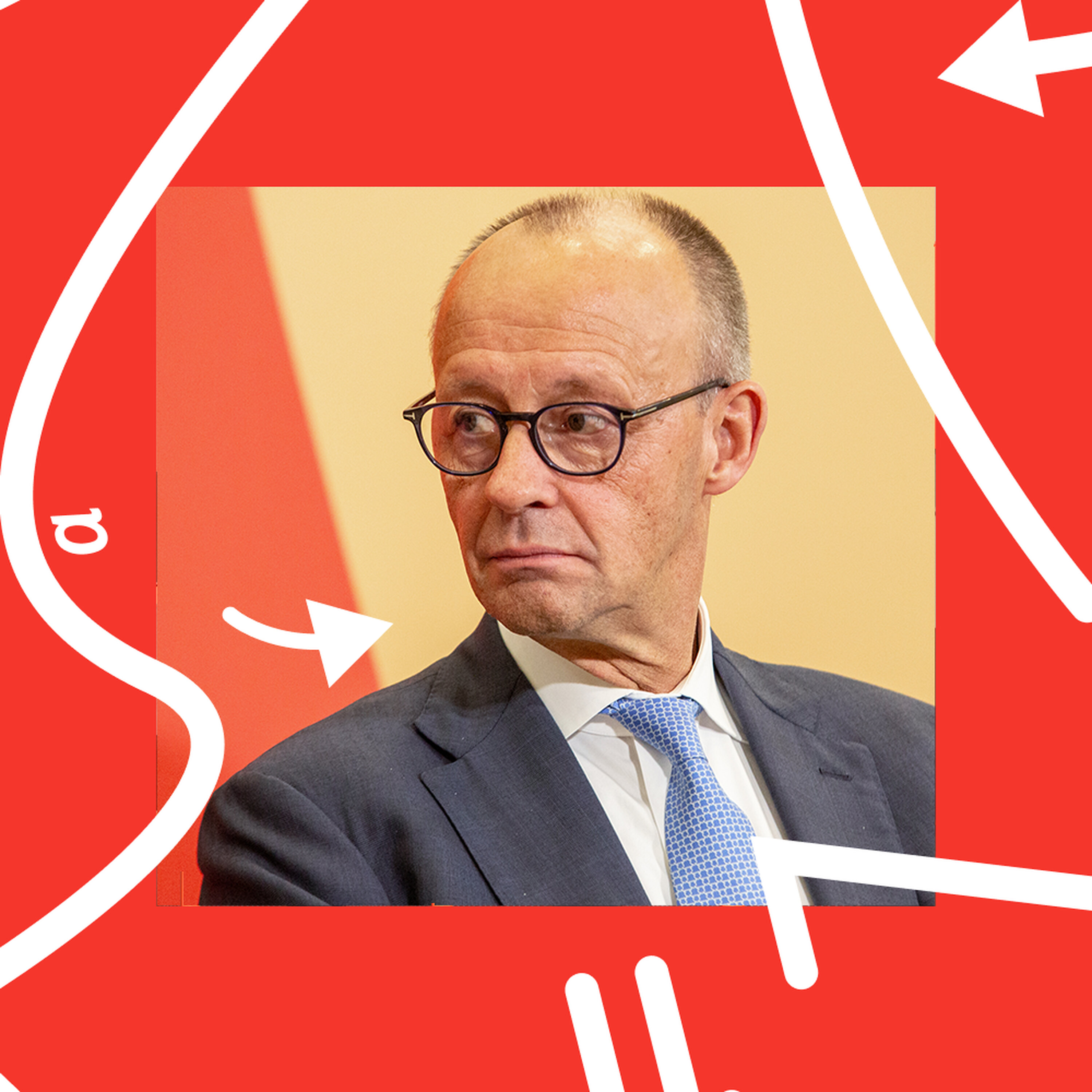
What does Germany’s economic strategy tell us about the shifting global order? Stephanie Flanders is in Germany at the Berlin Global Dialogue, where she speaks with Chancellor Friedrich Merz about the pressures reshaping Europe’s largest economy, why he supports a tougher response to Chinese imports and how he intends to handle the Trump administration’s harsher line toward Ukraine at the upcoming G20 Summit in Miami.
Setting the scene for the Chancellor’s comments is Bloomberg Senior Geoeconomics Analyst for Europe, Antonio Barroso. Flanders and Barroso unpack what Merz’s comments reveal about Germany’s changing approach to trade — and what that shift could mean for Europe and the wider global economy.
See omnystudio.com/listener for privacy information.
Transkriptvom Podcast bereitgestellt · Zeitmarken springen hin
Bloomberg Audio Studios. Podcasts. Radio. News.
I'm Stephanie Flanders, Head of Government and Economics at Bloomberg, and this is Trumponomics, the podcast that looks at everything in the economic world of Donald Trump. It's Wednesday, 21st of October, and I'm in Germany for the Berlin Global Dialogue of Business Leaders and Policymakers. Our super loyal listeners may remember I was here a couple of years ago, and then I got to interview on stage President Emmanuel Macron of France. We actually put that rather wide-ranging conversation on the future of Europe on this podcast. This time, I had a slightly shorter onstage chat with the German Chancellor, Friedrich Merz, in what has been a pretty tough few days for Europe, with violence on the streets of Paris
at the weekend, followed by curfews. And on the face of it, a just as shocking turn in US policy towards Ukraine, firmly in Russia's direction. Now, in my conversation, which you're going to hear a bit later with Chancellor Mertz, he stuck to a hard line against Russia, talking up the risk that President Putin posed to European democracies. But as you'll hear, on the subject of Chinese imports, he sounded, at least to my ears, shockingly like Donald Trump. So I wanted to get a little scene setting in with Antonio Barroso, our senior geoeconomics analyst, temporarily in London. Antonio, thank you very much for joining us.
Pleasure to be here.
And I should mention that you also moonlight as an adjunct professor at Sciences Po in Paris, and you co-launched the geopolitical risk unit for the consulting firm Teneo. Now, Antonio, the last time that I was on that same stage of the Berlin Global Dialogue, when I was talking to President Macron... I actually ended, I think, by saying, could it be the best thing for Europe to have the re-election of Donald Trump, which of course we didn't know what was going to happen then. And he kind of admitted that it would wake everyone up and maybe galvanize the much needed reforms in Europe. It certainly had a galvanizing effect. But on the ground, how much has changed in Europe?
So I'm going to give you a very Macron answer. He likes to say yes and no. And yes, he has galvanized Europe, for example, in the area of defense, because the uncertainty around the security provision, the historical arrangement that the U.S. had with Europe has significantly increased that uncertainty, and that has led to a material increase in defense spending.
We see the numbers. Countries such as Germany are spending way more money in defense. Ukraine is having some financing difficulties, but even on that front, European member states were able to agree to actually issue more common debt to support Ukraine, right? So there have been a couple of areas where President Trump and his rhetoric has definitely galvanized Europe into action.
But I said yes and also no, because it's not like Trump has given a massive impulse to European integration. And actually, when you think about the reaction of European decision makers to some important episodes, It was much more a timid reaction. So, for example, in the trade confrontation with the US after the famous liberation of the tariffs, the EU ended up having to accept a very lopsided trade deal instead of actually pushing back, right? So we can say that, yeah, on certain areas, it has galvanized European into action, but it's not like European integration has experienced a massive push as a result of Trump's policies.
One of the things that I talked about with Chancellor Mertz was How much has he really managed to push through the domestic reforms? But I guess the other thing that has changed significantly in the last two years is that we've seen a rise in the extreme parties and particularly support for the far right in many countries and not least in Germany where we had some pretty historic results in the last few weeks.
Absolutely. I mean, even during the current year, you had five state elections and the far right alternative for Germany party, the AFD, did exceedingly well. It actually won in two of them, right? So historic result. Now, I think the most important thing here when we think about the far right is true that it's rising across Europe. But normally, the far right, when you look at the actual electoral weight that they have, it tends to be around a third of the electorate, right? So Yes, it's true that it's an important force, but I will actually zoom out and look at what one of the main problems is when it comes to Europe decision-making, which is fragmentation. If you look at the five state elections in Germany, what
you can see is really fragmented regional parliaments that actually complicate the formation of governments and complicate decision-making. And you're seeing this all over Europe, even in France, for example, that has a semi-presidential system with a very majoritarian electoral system. You have a very fragmented parliament. that is really complicating even the adoption of budgets, right? So, as I said, yes, the rise of the far right is a complication for European decision-making, but really is in tandem with the massive fragmentation of political party systems.
That's a very interesting point. Someone pointed out to me that Mertz, before he was leader, I think eight years ago, he said he vowed he would cut the AFD's vote And then people were quite quick to point out in that recent election, at least the Saxony unheld one, that it was the Christian Democrats share of the vote that had halved. And actually, the AFD got almost as much as all the other parties together, and it was 44%.
So at least there, it was even greater. But I think people are just waking up to the fact that we have a string of elections coming down the track for the next 12 months. The one that we probably have paid most attention to and is in people's minds is the French presidential election. How much could things have changed?
You mentioned the mother of four elections, which is the French election, right? Even though you do have a string of elections over the course of the next 12, 13 months, for example, in very large European countries such as Spain in November, but also Italy and Poland, right? So the equilibrium of power in Europe could change significantly, but really the one that matters the most here is France because nothing gets done in the European Union without France. Marine Le Pen is leading all opinion polls and at this point is her election to lose. Now, there is still a lot of time left before the election. If you look at the date of the last election, around one third of the electorate decided their vote in the week
leading up to the election. So things can change significantly. Also, the landscape of presidential candidates can change still because the center is still divided across a couple of candidates. So a lot of stuff can happen between now and the election. But if Le Pen wins, I think there are two main questions. The first one is, how radical will she be?
And secondly, How much of her program could she implement? On the first question, I think people underestimate sometimes, you know, they think, well, but look at Giorgia Meloni, the prime minister of Italy. She moderated her stance. I've been very clear on this. Marie Le Pen is no Meloni. I think particularly on the European Union, she doesn't want to leave the European Union anymore for France to leave the bloc.
But she really wants to stop decision making in the EU, cut the French contribution, budget contribution to the EU. So that will really create a problem. But it will all depend on what type of majority she can get in Parliament, because it's not a given that after the presidential election, a subsequent legislative election will give her a Parliament majority.
And she needs a majority in Parliament to implement her policies.
One thing you've pointed out, things could change very much in the last few weeks, if memory serves, at this stage in the... presidential election where Emmanuel Macron was ultimately elected for the first time, he wasn't even a candidate. So, you know, things can change very quickly. But I think it's a fair bet that over the next year and a half, we will be paying much more attention to not just the far right in these big economies, but also the differences between them. And that was really brought home to me. I mean, the fascinating interview actually by my friends, Annie Misenbello, the editor of The Economist this week, of the AFD leader, Alice Fidel. I mean, They are not the same, these far-right parties, whether it's Maloney or
the Rassemblement National in France or the AFD. The policy shifts that they would represent would be distinctive in quite a few areas.
Absolutely. And I think one area of European politics that people normally don't pay attention to on the member state level is European Parliament. You can see actually how far-right parties have behaved in the European Parliament in And it's not like they're all together in the same political groups. Actually, they are divided. This actually has to do with the different positions on things like Russia, on things like economic policy.
And I completely agree regarding, for example, the EFT. I mean, the EFT right now has a way more radical program that's somewhat like Meloni in Italy, that's somewhat like Vox in Spain. In the case of Marine Le Pen, the main problem is that, unlike the EFT, which, for example, has a flooded idea of actually Germany leaving the euro system, leaving the euro and going back to the Deutsche Mark, Le Pen doesn't want to do that, but at the same time, there are doubts about what her economic policy will be. Even when they try to moderate, to appeal to a wider basis of support of voters, it's unclear whether they actually have the numbers to back those proposals that they are actually floating.
Antonio, we should touch on the big topic of the week, I guess, second only to Ukraine, which is trade. And the Europeans really, finally, you could say, grappling with the challenge of the flood of Chinese imports. I mean, when I was here two years ago, the Chinese cars were about 2% of the EU market, and now it's 9%.
and keeps growing. There was a lot of discussion around this at the EU summit a week ago. What did they agree?
So actually, most of the important action happened before the summit because the European Commission was in negotiations with the Chinese government for many weeks over the summer. And it agreed several concessions, but the most important one was for the Chinese to restrict the export of hybrid vehicles into the European Union, right? And the summit was essentially the confirmation of the validation of the Commission's approach to the negotiations, but also potentially even a stronger tool to basically push back against unfair trade practices. So overall, I think EU member states interpreted their approach as the correct one to follow.
And I think it was key that There was a Franco-German letter that was sent by the main leaders to the commission and to member states saying, you know, we need to pursue a much more forceful approach towards China and proposing mechanisms. I think that was a signal to the Chinese government that Europe had changed, that it was ready to push back. So I think that's the approach that they're going to continue implementing. For me, the key question is, okay, let's just say that they extend safeguards to other sectors. What does the Chinese government do? Is the concession on the hybrid a one-off concession or on it's actually, you know, they're willing to give more concessions, because if not, you could well be into a trade
war in some weeks or months time. And remember that the Chinese have a very powerful weapon is the weaponization of the supply of critical minerals, right? So I think that's the main question going forward.
And we've talked about that on this program before, also the fact that the Chinese now have an informational advantage that they know exactly which European companies need which rare earths, what flexibility they have, something that often the governments themselves have struggled to get their hands around. You'll hear in the conversation with the Chancellor. But I mean, for me, it's a very striking change of tone and policy from Germany.
I mean, France has often reached first for protectionist tools. But even just a few years ago, Germany and Chancellor Scholz, as there was, was opposing the tariffs on Chinese EVs. And now Germany just feels a kind of existential challenge to its car industry and is really on side with France.
Absolutely. And I think this has to do with the fact that, look, Germany did or made three geopolitical bets that sustained the prosperity of its economy. It was cheap Russian gas or cheap Russian energy. open markets based on multilateral institutions, and security provision by the U.S. You can claim that one of them, cheap energy, is gone, and then two of them are being challenged, right? And essentially, it's not that Germany is going to change its economic model from one day to the other. It's an export-oriented model.
Maybe it might benefit from a little bit more of domestic consumption, but still, that's the core economic model. So it has to adapt it for it to survive. And I think that's what Mercer realized. Right now, China is producing things that they used to produce, but particularly higher-value products. So I think at this point, Mercer realized that it needed to act in order to preserve that model. And this is exactly what we're seeing these days.
Before I let you go, the other area the world has changed is the relationship with the U.S. And we've talked in the past, Antonio, about how Chancellor Mertz, you know, he's got very good English. When he came in, he was felt to be, you know, someone who was, you know, who's worked in the US, was someone who might find it easier to talk to the administration. He's talked about the old order being gone, but he's trying to be quite pragmatic about managing the relationship with Donald Trump. It's quite a test of that, this shift from the US on the approach to Russia that we've just seen in the last week or two. And we're going to see the Chancellor continue to have to keep up that balancing act at the G20 in Miami.
I think he doesn't have any other option because I think when you're confronting Trump as a leader of a country, you have two options. The Mark Carney route, the Prime Minister of Canada, you push back trying to gain respect, but at the same time, you need to be willing to contend with the negative effects of such an approach, meaning in terms of the economic costs of actually pushing back, or you try to please Trump. And I think European leaders have opted for the second route. They're trying to please Trump. But that creates a problem in itself is that in every single summit where you have to deal with him, it all becomes about making sure that Trump doesn't get angry and he doesn't start threatening tariffs on
removing military support from Europe and so on. So I think he doesn't have many options. And I think the longer term question is clearly European leaders are increasingly talking about being more independent from the U.S., while at the same time trying to please Trump. So this could mean two things. It could mean that basically they are buying time for Europe to develop capabilities so it can really be independent and try not to anger the US too much.
Or it could be that they're just expecting for the next administration to be possibly a Democrat that will be much more friendly to the EU, right? I think at the end of the day, if he's the first one and they're trying to gain time, that's the main problem that the European Union has right now is that history is going a little bit too fast for the European Union, right?
Everything goes faster than the European Union.
Everything indeed. You know, one could argue that, you know, it's an advantage, the fact that you have that system of 27 member states, because every single decision has more buy-in, right, from such a diverse constituency. But one could also ask legitimately, is the current rhythm of history and geopolitics, actually, is that system fit for where we are right now? And the answer is probably not.
Well, I'm sure we're going to come back to this, but I appreciate the sort of whistle-stop tour of some of the issues facing Europe and a good way to talk us into the conversation I had with Chancellor Mertz. I started by quoting back to him a line from the speech he'd just given at the dialogue. We won't pursue our security by shutting ourselves off. Because it seemed to me that for the survival of the car industry, he had accepted the need to cut Europe off from Chinese imports.
Well, first of all, I mentioned our debate which we had last Thursday in Brussels. We didn't mention one country in specific. There are some, and there is one in this group, which is really increasing their, from their side, their trade surplus towards Europe fundamentally. And I give you a simple number. In the meantime... Not one single member state of the European Union still has a trade surplus with China. We all are having deficits. And accumulated, this deficit is up to far more than 300 billion euros a year. That means almost 1 billion every day. And this is something which is, of course, due to competitiveness, strength, R & D successes in this country. For sure. And we have to respect that. But this is as well
due to overcapacities, high subsidies on the automotive sector and others, and, as I said, an artificially undervalued currency. And this has to be addressed. I know that the responsible commissioners was in China last weekend. The talks there were relatively successful. China agreed to reduce the number of cars imported to the European Union at a first step. So we are making progress, but we are taking the responsibility for our own, for our industry, and for a balance in trade. And that is our goal. Not a conflict, but to have a new balance in trade with China, which is a reliable partner, which is an important partner for many companies in Germany and beyond. So we are not looking for a conflict, but we are taking account of our own interests.
You told my colleague Francine on Monday that you didn't want a trade war. But if we think about the measures that you've just mentioned, some of the tools that were agreed on last week, plans for maybe broader caps, we already have a trade war, don't we?
No, we don't have it. And we are not looking for that. The right opposite is true. We are looking for a fair trade with China. Our conviction is and remains open markets, In a rules based order. So China has become member of the WTO in 2001. We all have to play by the rules. And that is what we are looking for. And we are having instruments. We are opening the toolbox. We are showing the toolbox. But we don't want to make use of our toolbox. So this is. how we are ready to defend ourselves against unfair practices. And the dialogue has already begun. It's more deepened than ever before. And this is one of the effects of our discussion and our proposal, which we tabled last Thursday. And as I said, was unanimously agreed by
all the members of the European Union, because we are all faced with a change. the same challenges on this.
So what does Beijing need to do to prevent those tools from being brought out.
Of the box?
Well, the head of the Eurogroup and the president of the ECB have already started a dialogue on currency and exchange rates, which is the right way to do Second point is we have to discuss over capacities and imports to the European Union. We have to discuss subsidies. So we want to have a fair trade with China in our joint and mutual interest. That is our goal, not to create a conflict. But at the same time, we have to be ready to defend ourselves, to defend our industry.
And as far as I can see, we are getting a lot of public support, a lot of support from the industry, that they are saying this is overdue, that Germany, France and the entire European Union now come to the point where they are ready to defend their interests, and that's what we are doing.
Forgive me, Chancellor, but as an economist, I find this a very... You sound very much like Donald Trump now in talking about... Trade balances. Stay with me. No, because those of us who study economics.
Everybody's waking up in this room now.
We had many years where we would have a lesson, sometimes from German chancellors, from others, that you don't judge the fairness of trade by the size of a surplus or the deficit. That was a reflection of the competitiveness of industry. I seem to remember even Germany explaining the massive size of its trade surplus... by the efficiency of its industry, and yet now the goal seems to be we should have a balance, just like Donald Trump talks about trade balance.
No, well, trade balance is not the only point we refer to. The critical point is we had a surplus from Germany to the world for decades, but this was the case because our competitiveness was so overwhelming. Our R & D was great. Our companies were and are still Great. And they can compete. But what we are seeing now is currency undervaluation. We are seeing subsidies. We are seeing overcapacities in a dimension which is not just meant for a global market, but what is meant as an unfair competition to those who are producing under normal circumstances. And that's the reason why we are starting a new debate.
This is no more. We are starting a new debate. We do not close our markets. This is the opposite from what the US is doing. The US market is closed for most of the Chinese companies and products. This is not the case in Europe. We are open and we want to remain open. We want to keep on having open markets and trade, but fair trade under the same Conditions and that's a difference between Europe and the US but.
One of those tools that you're talking about is to shut off access Completely and there are some sources of greater competitiveness of China not least a low cost of energy which comes from Enormous investment in infrastructure, which has not happened in Europe. So it isn't all there are some real advantages.
You're completely right. And that's the reason why two-thirds of my speech was an own competitiveness and German competitiveness, European competitiveness. We have to do our homework. We are far away from being competitive enough to these global challenges. We are doing our homework. But we are seeing at the same time unfair practices. And we have to talk about that.
That's the reason because we presented our proposal on Thursday. This is not the beginning of a war, of a trade war with China. We are looking for peaceful solutions, but the level for that is fair trade.
So you've been very clear on that. One of the things that's happened in the last few years, and we're about to run out of time, but obviously the big change in the political environment is a rise in the support, even greater rise in the support for the extremes, particularly the AFD. In retrospect, do you think that the centre parties have overcorrected in wanting to listen to concerns around immigration and other cultural and social issues and not focused and not on the economic roots of that support. If you think about even in Berlin, the housing crisis is what's really driving that support.
This is true. But it's true that you've overcorrected. Well, we have to listen at least more carefully to the people, what they are faced with in their daily life. We are seeing that consumer prices are rising. We are seeing that housing is becoming more costly. So we are addressing all these issues. And I very much hope that in the longer perspective, people will see that this government in the center of our political scene is able to resolve the problems and to meet the challenges. And that is the proof we have to deliver. We have to deliver.
And that's the reason why we are so engaged. We are very intensively at work. And at the very end of the period of legislation, we have to come to results and then to elections. And that's the reason why I'm not nervous, but I'm engaged, committed, and really optimistic that we will achieve those goals who are laid down in our coalition agreement.
Finally, Chancellor, where you didn't sound optimistic, and I think this was also echoed in your comments on Monday, we were quite struck by the strength of your language on Russia. Should we be worried, given the strength of your words, that you are seeing things and hearing in your security briefings things that we do not yet see in terms of the hybrid warfare of Russia and the other forms of threat?
Frankly, there is no secret about the threats we are faced with from Russia. I mentioned that in my speech. This information is in this country here every day. By the way, powered and fueled by one party which is strong in the German Bundestag as well. We are seeing attacks on our infrastructure. We had this drone attack on our airport in Leipzig. So this is happening daily. Interferences in our internet system and our communication systems every day.
So that's the reason why I said on Monday in your studio that my biggest concern at the moment is not our economy, is not the European Union, is not America, is not China. My biggest concern is the impact of Russia on our society and how they are succeeding to destabilize our societies. And we have to do more on that to come back to a country which is resilient enough against these attacks. And these attacks are happening every day.
This is not... something which I know from intelligence. This is something what you can read every day in the newspapers. And my view is that our people are still underestimating this big threat on our society. And this is not just a war in Ukraine. This is a fundamental attack against the entire political order we achieved after 1990.
It's the biggest risk, you say, in your mind. You mentioned the G20. There is no prospect of that featuring prominently in the discussion or the communique from the G20 in Miami, surely?
Frankly, I don't know yet. There was a meeting in Oslo last night with Zelensky, with Witkow, with our representatives from Europe, and we've made some progress on this debate. And we are always ready to talk. And we are not giving support to Ukraine to prolong this war. We are doing that to bring this war to an end as fast as possible. But this is a surrender or even an unconditional surrender. Surrender for Ukraine is not an option because this were a surrender of all of us.
And that's the reason why I'm giving so strong support to Ukraine. This is in our own interest. This is in our entire own interest.
Chancellor, thank you very much and good luck in Miami. Thanks for listening to Trumponomics from Bloomberg. It was hosted by me, Stephanie Flanders. I was joined by our senior geoeconomics analyst, Antonio Barroso, and by, of course, the German Chancellor, Friedrich Merz. Trumponomics was produced by Summer Sardin. Moses Andam, and Jennifer Seeley, with editorial guidance from Megan O'Neill from Bloomberg Economics. Sound design was by Blake Maples and Kelly Gary.
Amy Keene is executive producer of Talk Podcasts, and Cheryl Brumley is the head of podcasts at Bloomberg. And to help others find Trumponomics and enjoy it, please visit Rate and review it wherever you listen.
