

Medieval Militaries 2: Johnny Appleseed for Gunpowder
Mittwoch, 14. Oktober 2026 · 1 h 21
Kapitelklicken springt direkt hin
Shownotes
folks, we are back for part 2 of this woefully short series on Medieval military evolution in the Old World and it's time to talk about gunpowder. probably the single most important invention ever but it didn't follow the normal formula for these things, instead sitting on the shelf as a elixir for eternal life before being adopted for military application by increasingly desperate Chinese states. however, it would be the Mongols who spread the message of gunpowder across all of the Old World and it would change the face of Medieval society along with it.
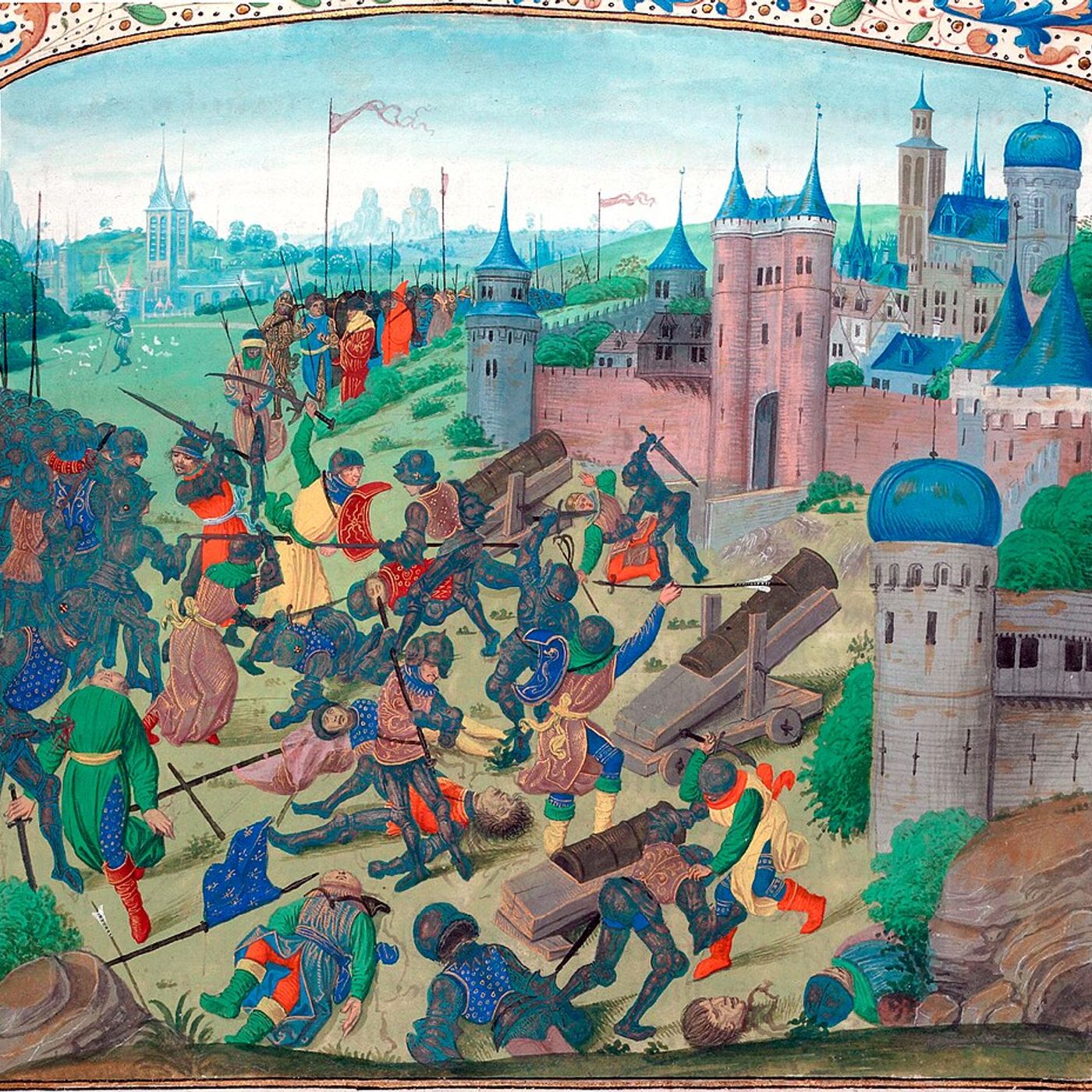
cover image is from a 1398 series by Jean Froissart, this one showing cannons being used during the Battle of Nicopolis
Transkriptvom Podcast bereitgestellt · Zeitmarken springen hin
Hello! Welcome back to We're Not So Different. A podcast that is not the podcast blowback. But is nevertheless about how we've always been friends. My name is Luke. That's Dr. Eleanor. I'm so mad. I'm fucking, I hate everything and everyone right now. Anyway, today we're going to finish up our short series on war, by talking about gunpowder, I can't believe we're only doing two episodes on this. Actually, yes, I can, because I don't want to do more.
Because, listen, it's too military.
We'll do two gender studies ones.
Even if I was going to do, like, even if I wanted to do, like, a big thing on military history, like, it would, like, it would be more about, like, discrete battles and stuff like that. Because stuff like this, like, as we're going to talk about with gunpowder today, is, like, like, the actual spread, like the actual spread of how gunpowder went from one place to the, to the other. And like the unevenness of how it came about is just like putting, putting that story together is just like this giant pain in the ass because it's like, is this a description of gunpowder or did someone, you know, did, did fire just get too close to like something? And then, you know, like what happened?
Very difficult to say. Very difficult to say.
Yeah anyway uh yeah but before we get there we got a couple questions uh first one is from all my grand homies hate henry the eighth who says speaking of humorism do the beatles represent different dominant and i'm pushing this question across the table to you because while i like i love the beatles music i personally um i am not deep in enough on their, like the little lore battles that happened between the Beatles that people have.
The only thing I really think is that, uh, John really got on my nerves for reasons that don't have anything to do with the Beatles really. And also that the story about Paul, where he talks, they talk about recording octopus's garden like five times and it's the longest thing ever. And, and then they interview Paul about it and he's like, I had him record it twice. They'll live.
It's fine. Like, yeah. So Eleanor, um, John, Paul, George, and Ringo. Do they represent hot, wet?
Have I talked about how Justin and I spend our time in the pub doing alignment charts ever on this?
Did someone just guess my hobby is my question?
I think you have. I think we've talked about that a couple times.
Okay, we've got a theory for the hot, hot uh, cold, dry, wet matrix.
Right. Now the first thing we did it with is, um, ways that you could pronounce Sean Bean. Okay.
Sean Bond.
Yeah.
So we have like a, also a corresponding feeling about, um, what it means in terms of capacity to act. Right.
Okay.
So it's like, we think that hotness is capacity to act versus, um, Coldness being an incapacity to act, and then we see wetness to dryness as being more emotive versus being.
More kind of reserved, right?
Right, right.
So obviously within this, Sean Bean is cold and wet, obviously. Then you've got Scene Bean is hot and wet. You've got Scene Bond is hot and dry. And Sean Bond is cold and dry.
Okay.
So this is, this is important. This is an important contact. Um, uh, so I think that we got to think about capacity to act.
Um, I feel like, first of all, I'm just going to say this.
John Lennon's cold and wet. John's Lennon's cold and wet and you fucking know it. And you fucking know he's cold and wet and he's cold and wet because he's a woman beater and he's like a little bitch man. Um, And he's always like, oh, oh, I could do it better than that. I'm going to go, like, make, imagine, like, oh, I'm going to be defined by the fact that, like, I've got a Japanese girlfriend.
Like, and quite right, too.
We get it, man. We've all had a weeb phase.
Like, listen, justice for Yoko, to be clear. Like, she did nothing wrong. Possibly the only good person in this story. But John Lennon's cold and wet. Like.
Fact of the matter. Done.
I think Paul is hot and dry. I think Paul is hot and dry. I think that he's the one who's like, come on, guys, you've got to do it again.
Like, we're just doing it again.
Like, he's got this thing where, like, of the doing-ness of it.
Where he's hot and dry.
I think Ringo is actually hot and wet because he's just so, like, this motherfucker's on Thomas the Tank Engine.
You know? Like, motherfucker's just, like, he's just goofy with it. He's just goofy with it.
He is. He's standing behind Thomas the Tank Engine with his arm, like, Jesus Christ pose with his arms out. Like, what are you doing, Ringo?
Like, I just think that he's a little goofy with it, and that's kind of, like, what's going on in the hot and wet quadrant.
Where you're just, like, a little, like, silly. You can be silly with it. You can be a little emotive with it.
And then that makes George cold and dry, which I'm not trying to dislike.
We all know that George is, like, very good. Okay.
Mm-hmm.
We all know that George is very good. This is not what this conversation is about.
But he is kind of like, I would say, the more forgotten Beatle. The Beatle that we don't bring up the most.
And that's why. It's been done. Yeah.
Exactly. Exactly. Kind of a thing. So that's what I'm going with. Cool. Yeah. This is a great question.
Please ask me this question every.
Week, people.
I don't.
Yeah.
I don't.
Bring me your sets of four. I will sort them.
Yeah, I got nothing on this. Respect all of their individual careers. That was fine. Every time I think about the Beatles, I'm like, how the fuck? Rubber Soul is just... God, it's such a good fucking album. It's so fucking good, G.
It's so fucking good, G.
I'm not a huge... I have to defend them.
I'm not really like that with any....
Musicians i don't think i i kind of am with radiohead but it's more like look i get all the issues you have with them i completely understand however those albums are fucking fire like i don't know what to tell you um but like uh i'm.
The only person my age who doesn't like radiohead because they make me feel anxious.
No, no. There are plenty of people who don't like a video.
And I'm not saying it isn't effective art. It just makes me really fucking anxious.
Oh yeah, it'll do that.
I'm like crawling out of my fucking skin every time I hear it.
Yeah, Karma Police and Paranoid Android. I mean, they're both singles, but those songs, like Karma Police is like, and that video where it's like the guy who's, they were like chasing someone in a car and all you see it is like a car cam. And they're chasing a guy who's clearly like going to be run down and they're like laughing like, oh, we're going to get this guy.
And then the car runs out of like fuel and they notice it's leaking gas. And the guy who they were chasing turns around and like lights a match and like throws it on the ground and catches it on fire. And you're like, God damn, this is this is anxiety inducing. But it's not the one.
You know.
That's what we needed. That okay computer was what we needed in 1997. No, but yeah, the Beatles, great. Do great things. If you like the Beatles and are very annoyed about this, come at us.
Yeah, I would love to hear how you feel about their alignment and why you're mad at me very specifically about.
George. I know that that's what people are going to be mad about.
George is cool. Everybody likes George. Everybody loves George. He's the most memorable Simpsons role. He's like, to me anyway.
Listen, I'm unfortunately, I was talking to my mates here about this literally yesterday. I am a Ringo Stan for the very specific reason that I was raised by hippies and shown Yellow Submarine. at a very impressionable age and he's the first one who comes on screen.
Yeah oh no the campy the campy drawing of queen victoria oh.
And so i was like oh well here you go he's like the protagonist of the beatles the protagonist of because he's the first one who came on screen and that's like and listen you pick your stick it's like it's like your team Just whatever beetle you have, you just got to.
Go with that. That's your job now, I think.
You got to go with the first one that you like. And since I only knew them as a group, I didn't like any of them directly. um i guess maybe paul he was the first one i remember like having like forming like a specific idea of um but.
Like interesting okay.
That might have been from my mom because she always liked him.
I don't know i don't know yeah moms love paul.
They do love paul And they do love the band Wings for some reason.
Yeah, moms do like Wings. Yeah, that's true.
She also loved his version, his Live and Let Die song that he did, which was really good. And I can't remember, did he write it first or did Tina Turner write it? One of them. It doesn't matter. He did a great job.
They're both good. That's fine.
They are.
We love it. We love it.
All of the stuff in my head just screaming at once. Anyway.
Anyway.
All my grand homies, thank you very much for the question. We got one from MG in your face who says it's well documented by the early modern period that wealth inequality was such that the wealthy had to spend money on stuff like menageries, automatons and mechanical devices. I assume wealth disparity was less extreme in the medieval period, but still obviously they're there. What were the rich buying that no one else was?
Okay, yeah, so the wealth disparity is still there.
It's just not as grandiose as in the early modern period because we haven't invented colonialism yet, so we don't have this kind of extracted method of ways to get more gold. And you can understand this. The minute you see a Baroque building, you understand exactly what the access to commodities from overseas are because you're gonna start just seeing gold on everything and it's like that's where it's coming from yeah so in the medieval period.
The stuff that wealthy people have it's.
Like there's certain things that are you know like some jury laws and things like that that'll say well only they can wear ermine or whatever only they can wear certain furs that's a big thing and furs are a thing so it's like if you're really wealthy you're getting your furs in from russia for example um The other big things that they have are glassware. Like, glassware is a big thing that they're going to have that ordinary people are probably not going to have.
Books.
Books are very, very expensive. You know, handmade on animal skin, et cetera, et cetera. So books is going to be a big one. Maybe like their own religious images and art, like their own art, that kind.
Of a thing. A lot of the things will just be about scale. Like, you know, they've got a very big chest that you can't move. And you have, like, a kind of smaller chest that you can't move. You know? Kind of a deal. That type of shit going on at the time.
And they're going to have better access to spices than you, so they're just going to have more spices in everything. You're still going to have a lot of spices in everything, but they have more, like, sugar.
They've got more spice. They might have Chinese pottery. You don't.
They might have silk.
They might have silk, velvet, that sort of a thing. And also they eat a lot more meat. They also eat a lot more meat than you. That's one of the major indicators is just the meat thing. Because people would if they could, but they can't.
Dietary stuff is big.
Every giant building... every big fuck off church and, and castle and endowed house and, and all and, and hospital and everything like that is just another form of conspicuous consumption because you could see, you know, this was endowed by Louie, the whatever this was endowed by. So, you know, and, and you see that and you're like, Oh, that means they had the money. to do this and they had the money to like try and buy their way, you know, uh, uh, save theirself some trouble in the afterlife, uh, get massive.
They're feeling really guilty.
Yeah. Yeah.
And I mean, I would argue that in a, in an, in an extremely religious society like that, that them, uh, having masses sung for them is one of the most conspicuous forms of consumption you can do because of how ever present the fear of hell is. And by doing that, it also, um, it presents the wealth disparity in such a way that, uh, is going to cause problems regardless of anything else. Because, um, like when somebody finally goes, wait a minute, they can just endow their way out of purgatory, but I have to sit there because I don't have money. Like, That's a really huge idea. What I.
Will say in defense here is that regular people do not believe that they're going to be in purgatory as long as rich people.
Rich people have to do it.
Now that was their own fault for being nice.
Rich people are seen as being much more inherently sinful and more needing a religious intervention because what they're doing is evil and bad. Mm-hmm.
Whereas peasants, you know.
You're probably going to go to purgatory for a little bit, but, like, what could you have really done is kind of the thing, whereas I would say that there is this intrinsic understanding of, like, the position of the wealthy in the Middle Ages as being, like, I guess, spiritually unviable.
Would be a way of putting it. Like, they know they're.
Evil, which is an interesting thing. Isn't it weird how they have how between like, I don't know, like 1400 and like 1520, that idea either goes away or becomes so attenuated and alienated from people that they are, that they, they turn to the, they turn to the complete other side and they say, because one of Martin Luther's things is the indulgences and like how like offensive and scandal, even though he loved the nobility, like how offensive and scandalous it was that a person could just simply buy their way into heaven and, and that, that they could bypass God's will in that act. And it's just wild to me, like how quickly that turned because, you know, like they're like, Oh yeah, well like I can't go.
And then, and then by the time Martin Luther comes around, he's like, yeah, we're all going to hell. And they're like, Oh wait, we are. Well, why can't we have indulgences? Wait, the Bible doesn't say, and it's just like, and you just like get this like escalating.
I think that it's because the indulgences escalate too. Because it's like medieval indulgences are not, hey, give us some money.
Yeah.
And, and you're like, it's like, it's a specific Renaissance thing, right? Like the, the one-to-one give us some money and you'll be good to go.
Like that would not have flown in the medieval period. Like, everyone is like, wait, let's fucking calm down. Like, a little bit. I don't think it goes that much.
So it's like, I think we see this massive escalation because of the works at the Vatican in terms of just how much cash the church wants.
And so they're much more willing to just be like, yeah, it's all good. I wouldn't worry about it. Like, you'll be fine, brah.
And I think it's that, like, again, it's the conspicuous consumption of it. Like, again, it just becomes too fucking obvious. That, like, yeah, okay, babe, like, you're just saying that any rich person can go to heaven, because very clearly you need to pay for those, like, what are they, the, it's the tapestries that were commissioned by, from, I forget which one of them, it's not Donatello. Anyway, there's this series of incredible tapestries that they have commissioned that cost more than the fucking Sistine Chapel. And the Vatican goes into terrible debt. And there's the fucking Sistine Chapel.
Everybody wanted to jack off about the Sistine Chapel. Nobody wants to make the connection between.
The two things. And so it's like, it just... When you have the medieval way.
of relating to wealth and stuff it's like this is evil and you're bad and you're going to hell you better fucking have some masses said bitch like because you you know you've done wrong and that turns in the modern period to i wouldn't worry about it.
You got money right and it's like and it's.
This thing that we definitely see that we see this this turning point in this change but then i mean like It's only a couple hundred years.
Till the Great Revival, G, and that's what starts the real problem, you know? So that's how you get into the mess that we're in now, which, listen.
Here we are. I can't just keep going on.
Sorry, I'm just ranting.
No, no, it's fine. We should have destroyed... Yeah.
Yep.
We should have destroyed public religion when we had the chance, and now here we are. But anyway... Thank you very much for the question. If you want to ask us questions like these, please do subscribe to the Patreon. Patreon.com slash WNHCPod. Five bucks a month. You get access to bonus episodes, ad-free episodes, all that shit. We'll have a new bonus out on Friday. God only knows what it'll be about, what we decide to rant about tomorrow. But, you know, we'll see. But yeah, all right, here we go.
I don't think I've ever had writer's block like this for an episode intro before. Gunpowder is simultaneously the single most important invention in human history, but begins its existence as little more than a historical footnote. Gunpowder equalized warfare and made men tall. It paved the way for our travels to the stars and built the modern world in its wake. It is so consequential that no less a saint than Karl Marx said that gunpowder was a necessary prerequisite to political, social, martial, and cultural advancement as we understand it, blowing the old manorial and chivalric ways apart in the 19th century after coming into its own. But how did that happen? In 808, the first record of gunpowder appears in the official histories of the Chinese Tang Dynasty,
but It was then listed as a medicinal compound to extend life, one of the many ineffective immortality elixirs the Taoist monks had created over the years. It then sat untouched for a century, with its military applications going largely unknown, until in 904, the first fire arrows were created, and.
You know, you'd think that this would set off like an arms race like we had in the 50s. But it didn't because we didn't have states like this back then. And it would be another 175 years before the recipe finally broke containment from medieval China. And even when it did, it was still a far cry from the substance we know today. Later, the Song and Jin dynasties of imperial China would need to invent the fire lance, the grenade, the rocket and more. as they competed with one another for supremacy before the rise of the Mongols, who adopted gunpowder technology from each and conquered China out from under them in the process. But there is a decided gap in the historical record after this, as we don't know
exactly how knowledge of gunpowder was transferred from East Asia to the Middle East, where the first recipe for saltpeter appeared in 1240. One year later, vague descriptions of a powerful explosive chemical likely gunpowder, appear in European chronicles as they describe Mongol battle tactics during the Battle of Laenika.
Though the Mongols are the most likely and probably the only realistic vector for the spread, given that they were uniting lands from China to Hungary at the time, we don't have direct evidence of this as European descriptions of gunpowder are quite vague. And, you know, you'd be like, wow, that shit's scary. What the fuck is that? I've never seen anything like that before.
Yeah.
Before it could break open the walls of Constantinople by force in 1453 and usher in the early modern period, gunpowder would have to spread across the old world and be adopted and iterated upon by various peoples many, many times in a sort of proto-arms race that we can only vaguely see in the historical records. It took the peoples of the Middle East to invent the large-scale gunpowder artillery cannons we know, but even then the recipe for gunpowder was still weak and not yet revolutionary. It would need the... It would.
Further need the limited land in dynastic wars of Europe to be refined through a process known as corning, which dried the gunpowder out into smaller clumps and made for a better, more even burn, and also really turned it into an actual explosive, but we'll talk about that later. By the end of the 14th century, the recipe for gunpowder was over 300% stronger than it had been coming out of China, according to chemical analysis and gunpowder is finally ready to revolutionize the planet and take the world by storm during the early modern period. So yeah, um, folks, uh, I would love to say that there is more, uh, to, uh, medieval military evolution than gunpowder. Uh, but that would be a lie.
Um, No, there is a little.
There is a little. In technical terms. But I mean, no, this is the....
Okay, wait. So I've got a question then. How do you feel about this then?
So for you, do you think that the precipitation of the standing armies through the state apparatus itself, you find that to be intended upon gunpowder?
No, no. I mean, no, I mean, I mean, in terms of, no, no, no. I mean, in terms of like just technology itself, like actual advancements in technology and things like that. Like, no, like the attendant rise of the state as it were. I mean, that is like, that's the thing that has driven history since like, since we really started it. But I mean, like in my mind, when I think about like gunpowder as being like, this technology, it's not just, it's not just that it like creates war that it, that you can prosecute wars with it.
It's that it opens up so many other things. Like this is how we get to the, this is how we get to the, the, um, the combustion engine and, and the solid state engine and, and, and, you know, the, how we, how we fueled to like go to the start to, to send spaceships up into outer space and everything. And so, um, but it's also like.
I just, I like it. I like it. That's all.
I'm just like, no, it's yeah. It just, it kind of drives. I think it kind of drives stuff in the background. And then like when the Mongols get it, the Mongols, like, because they like applied it just so recklessly and then went on this like huge, like spree across like Asia and Europe and all that. And they were like, Oh yeah. Hey, like, this is this thing we invented and like before 1241, no one in Europe and maybe a few people in, in Arabia had heard of it. And then all of a sudden, like, I mean, you know, it's like by, by the battle of Cressy, they're like, you know, they have a, they have organ guns and like out there on the field that we, you know, we can see the, their scattered ordinance is
still there. It's yeah. It's just, it just, it just, uh, push development so rapidly. I feel like it's interesting.
Yeah.
Yeah.
It's like that. Um, you don't sound convinced, but I don't know. We'll see.
No, no.
I'm just like, I'm just like, no, I am convinced. I'm just kind of like, Oh, I see what you're saying. I'm just sort of like a sort of sorting my own brain because I'm just like, there's a lot to think about. Like, I think it's an interesting one because gunpowder is like such a, uh, You know, it's such a particularized invention.
And I think you're right, like in terms.
Of like what we mean, like by, I don't know, capital P progress. Yeah.
I think you're right.
It's like one of these things where it's kind of like an innovator and a drive situation. It's just basically, I think that like my teaching first year's brain kicked in immediately and I was all like, is this an essay about the military revolution? You know?
And I was like, okay, like what do you mean?
And it's like, no, you've.
Definitely, I just think it's an interesting way of thinking about it. And I'm like reframing.
So I like it.
I like it basically.
The way I think about the development of, of the medieval world into the early modern world is that like at the end of the classical period or the ancient period or whatever you want to call it, like state structure was basically broken everywhere. Um, and China was able to hold onto it to a degree by like, uh, you know, a lot of like historical happenstance and stuff like that, that was there. They had already had some kind of bureaucracy and all that sort of stuff. But, um, the rest of the rest of the middle ages to me, like if we're just talking broad strokes is the process of state formation coming to the rest of the world or being reintroduced to the rest of the world. Uh, from like Asia and going every and, you know, kind
of going everywhere like that. And it's obviously not that pat and not that cute because like China didn't invent centralization or anything. They were just the first and greatest practitioners of it that we know of. But, um, like, uh, so, so when you see that and because of historical circumstance, Gunpowder has just been glommed onto this. And so in my mind, gunpowder is part of the military progress that gunpowder allowed for and the amount of bloodshed that it allows you to ramp way up with above bow and arrow and cavalry charges and stuff like that. being glommed onto the state. Like I see the two as being extremely intertwined, even if it was, uh, on, even if it was, if it was a subconscious thing at the time,
I see those two things as being so intertwined. And like, even like in how quickly you get them, like you, uh, gunpowder is introduced to, to, uh, the middle East in like 1240 at the very latest. And, the Ottomans are becoming a gunpowder empire within, um, within 200 years. Like it's like, um, it's, I mean, you know, you just have that rapid fire state development that I think is triggered by a lot of things. And part of it is the Mongols and reaction to the Mongols and everything like that. And part of it is, that when you find this technology and when someone finally figures out what you can actually do with it, because this is the first explosive people have ever created. Things have exploded before this,
but this is the first chemical explosive.
We're doing it on purpose.
Yeah.
And.
The earlier version of it was like very weak, like it would catch fire, but that was it. And like, um, there's even a note within like 50 years, there's a note in the Tang dynasty. It says some have heated together sulfur, uh, arsenic and salt Peter with honey. smoke and flames result so that their hands and faces have been burnt and even the whole house burned down. So like, like within 50 years of the first recipe, people are like, you'll shoot your eye out. You'll shoot your eye out. Yeah.
And I mean, I just think that the, the monopoly, the scale of violence that that creates above what was possible for medieval militaries normally, or what had previously been possible for them, And the state's ability to agglomerate and centralize itself enough to monopolize that violence is, I think, a very superseding tendency that works like at the same level as state formation towards the end of the Middle Ages when you've got like Europe rapidly ramping everything up, like trying to like. figure out what it's going to do. Like, are we just going to be like this big, like HRE forever? Or are we all going to be ruled by the church or like, are we going to be ruled by the Orthodox church or whatever? And then like,
they eventually have to fight wars with that stuff. And I mean, that's how I see it. I don't, I, I'm sure there's probably an issue with that, but I just cannot for the life of me separate state formation from with violence yeah i i have to associate state formation with violence and i when you have a something like it's like when you have nukes now and how we all fight wars differently even though we all think about world war ii like all of our like um pop culture and everything about war and violence is all calling back to like world war ii and maybe like a little bit of vietnam but like We all think about this stuff and we think about these like insane battles from World War Two, like Midway, Stalingrad, Battle of
the Bulge, all this sort of stuff. And it's stuff that like if you have nukes, you're not really going to fight the battle like that anymore because we don't fight battles like that anymore. And it's not the same scale of a jump in violence, but it is, I would say, commiserate to like the amount you can kill before.
And after, and I don't want to sound so crude about it and have people just be like, oh, well, this is just like how many people you could kill. Because if that was like the end all be all of a state, then like we would, you know, we would have all turned into 1950s America and the world would have been destroyed a hundred times already. But yeah, I just see it as, I don't know. I was kind of, maybe I was kind of nervous about this because I like, I see gun battle as such this important development. But I do not agree with any of the military history memes or ideas.
He's shaking his head the whole time.
I'm shaking it so you know how offended I am.
That's really interesting, and I think you're right, because I do think that, especially the modern state, I think it completely hinges on this ability, and indeed the monopolies.
The monopoly of this form of violence.
And I think that it is one of the huge differences that we see between the modern period and the medieval period. And one of the reasons I guess I get so worked up when people just think that if anything is bad or brutal or violent, they call it medieval. Because things are about to get so much more bad.
This is the thing about gunpowder.
I think it actually speaks really well of the medieval people who had gunpowder where they were like, yeah, this is kind of fucked up. I didn't think to be like, we could weaponize this. I'm like, that speaks well of you as a person. If you're like, oh, this shit's fucked up, you could really hurt yourself. Be careful, homie.
Instead of being like, you know what?
You know what?
I think we could kill people with this, right?
And it's like, getting to that, like, what's going on with you, homie?
That's where your head goes.
And I think that it really speaks well of medieval people to an extent.
And, you know, this is what we're going to see.
Like, I mean, Hundred Years' War, you know, even though we've definitely by the end of it got guns involved, compare and contrast that with the Thirty Years' War.
Thirty Years' War kills a lot more people.
In a lot quicker time.
Less than a third of the time.
Right?
And it is the gunpowder, right?
Yeah.
And it's so much easier to kill someone when you're lighting a fuse.
Yeah, it is.
Because they're over there and you're over here. You don't have to walk up to them and stab them.
It depersonalizes the violence to a degree that it makes... That it enables people to be able to go to war and kill 10, 20, 40 times the people they would have killed before that. And I mean that's before you get like planes and bombs and everything. But like just the ability to have a gun and stand 20 yards or 50 yards from someone and just pump them full of bullets, that's a much more– attenuated act than like going up to someone and running them through with your saber and i mean i don't think yeah i think the idea that like there is some noble good to like cavalry and like sore and like one-on-one sword fighting and stuff like that i think that is incredibly stupid um but it but it but i mean there
you it's really hard to deny the fact that like it's a lot easier to shoot someone with a gun from, you know, across the street than it is to walk up and cut their throat. Like just, I mean, think about me talking about that. Shoot someone with a gun, you know, like, okay, well like I may not, I may not be into violence, but like, okay, slit someone's throat.
That's a fucking, that's, it seems in your mind, it seems more of a violation, even though they're, they, you know, you end up with the same thing. If you shoot a guy in the throat and you cut it, like, You know, so the, the outcome's almost certainly the same, but like, and so I see it as one of these things where you have people like, I do think a big thing, and we were kind of talking about it earlier, but a big thing with the middle ages is like when people in the old world, like there was some kind of shift where they decided that like, it's very like the shift that people have to have in order to go from thinking like, well, I'm not going to hell. So it doesn't matter if I have all said for me after the fact to, okay, not
only are those people doing it and they're wrong for doing it. It's also evil that like, I don't have at like, it's also evil because I don't have access to the same thing because I was not born with generational wealth like that turn in in the mind is very like.
It's interesting because i think it's quite bourgeois it is it's extremely bourgeois but it's also but but you all it also requires a level a tiny rudimentary level of.
Class consciousness to say because if you can't say that we should all be equal then none of that matters Like, none of the rest of the stuff, the edifice that you've built on top of it, it doesn't mean a goddamn thing. But when you could say, oh, like, we should all be equal. Like, when you could say, when Adam dealt and Eve spanned, who was then the gentle? Like, when you can say that, that requires a rudimentary class consciousness that from there, just all this other, like, stuff springs forth. Yeah. I think that the equalizing aspect of gunpowder, I think it has a way of equalizing, but the alienation that the, the alienation brought on by the amount of violence that a person can, can create and can
then internalize is something that we were never, ever prepared for. Just like we weren't prepared for everybody to take on like a personal God, a personal relationship with God and, even though that was born, especially like Bernard of Clairvaux was big into stuff like that, even though that was born then and it came to the fore under the Protestants, we were not ready for the insane problems that that does to your head. Because if you have a personal relationship with God and it's not intermediated by a clergy, then wait a minute, that means... I'm completely vulnerable to God.
And mom's not there to like, to to hold off the beatings for me anymore. And I don't mean to, to mock like domestic violence, but like, that's like, it's kind of like you're like, like someone's there to be like, no God, you know, I I'm dealing with, I'm dealing with this, leave them alone. You know, they're confessing their sins to me. I'm their intermediary to you. And there is a way that, uh, that puts everything at a remove.
But when that remove is pulled away, And regardless of whether you're Protestant or Catholic now, that remove is completely gone. You have a personal relationship with Christian God, whether you want it or not. Um, I just think it, I just think it does. And I, and I don't, um, I just think it, I think it's really hard to like, to put all of this together because none of these things make sense on their own. Like, How do you go from combining like bithwart herb and salt Peter and like, you know, something else and, and something else to like, now you can, you can do, you can, you can plant a mine that'll kill 50 people when it blows up.
You can drop a bomb out of a plane. That'll kill a hundred. Like, and we weren't ready for like the PTSD and like the horror that comes along with that. No one was true.
True.
I guess, I love where I'm completely derailing the episode by like asking you questions.
No, go ahead, do it. No, keep going.
I find it very interesting because I'm like, I find it interesting because I think one of the big things with modernity, as you say, is there is to an extent like this, you know, this idea of like, we all have equal rights, but I'm like, but what happens as a result of like this tech is first, everything's going to get like, Right. Because I think that what happens, especially because this is happening within, you know, the birth of capitalism and like neocolonialism is what sort of happens as a result. Like, you know, I guess that I consider sort of like. the Martin Luther thing to be like the specifically bourgeois thing, because I feel like it's like the petty bourgeois are sitting there being like, Hey,
how come rich people get access to these masses? I've also done a bunch of horrible shit and I'm going to hell. And like ordinary peasants, right. Who Martin Luther famously fucking hates, um, and like despises, um, They're sort of like, oh yeah, but I think mostly their relationship, the way that I tend to read when, for example, the peasants revolt and Martin Luther throws them all under the bus because he was like, oh, I don't mean you.
To be clear. Fuck you.
But I think that it's quite interesting because what we kind of see there is them being like, to an extent, no, I need your ass to be going to hell for a while. Because sort of what happens if it all turns into this personal relationship with God, in theory, in theory, it's like Oh, yeah, okay, so you should know that you're doing bad things and that, like, God doesn't like that, blah, blah, blah.
And, like, you know, I'm getting back to the gunpowder. The gunpowder gets there in this.
But what ends up happening, I think, as a result of the idea of the personal relationship with God is, like, oh, well, what my money is doing over there or what the weapons are doing over there, whatever that is, is there's, like, this alienation of, from the inherent violence in capital, the inherent violence of gunpowder. So it lets people say, oh, well, actually, I'm fine because I go to church and I pray.
Whereas I think the direct violence that we see the nobility having to wield in the medieval period, it's like there's no getting out of it.
It's like, oh, yeah, you're going to hell for a while. You better be like fucking praying.
Whereas there's, like, something about the alienation from the violence that I think allows you to also have a commensurate alienation from the concept of, like, what your actions are doing. Yeah.
Do you know what I mean?
But, like, the entire thing is also, like, modern generally. It's, like, it's so difficult to, like, unravel this fucking piece of string, right? Because it's just wrapped around all of these really terrible fucking things. Yeah, it's... The worst period to ever do it, the early modern period.
Like, really.
Abysmal.
Just a bad time to be alive, you know?
Yeah. Yeah.
But, I mean, like, it was, like, the problem, like, the problem with, like, like, trying to argue around some of this stuff is, like, we do, like, the importance of gunpowder has, like, as just, like, as an instrument of has been proven like a million times. It has, it completely equalized, like it has completely equalized, um, like the ability for people to do war against one another, like States to be able to do war, like in a, in a different world, like there, you know, what, what, um, what Iran is doing now to America and frustrating, like everything that we try to do, um, by shutting down, uh, the, the straight and making things worse is that, um, like that, that is because they have gun, but that is because
they have gunpowder and they, and it, and it has evolved to the point where now we can use drones to do these things. And you can like put together a drone for like $ 80 based on shit you buy on like Tim, you or whatever. And, and, you throw some gunpowder in it and you know, there you go. And, you know, I mean, Kalashnikov was right. Like it did like the AK 47 did equalize there. You know, he was like, I was, I wanted to be an agricultural engineer, but you know, they, they made me do this. And, and he was right. Like that is, it puts them on a level that like, it puts just normal people on a level that, with like trained armies that we've never had in the history of this planet. And I mean,
we're still dealing, I think with the effects of it because like, we can't like, we, we, we have no answer for it. Like we've been doing this since world war two and we have no answer for just equalized warfare where no one has the advantage in, uh, like, cavalry and and the nuke advantage doesn't matter because mutually assured destruction means that we will not you know we're not going to use them and so it's like i i don't know how to pick that um i don't know how to pick that apart i really don't it's not um it's not an easy it's not an easy thing to do yeah but let's just talk a couple, let's just talk a little bit about gunpowder in China.
And like, why that, why, why the Chinese having gunpowder so much earlier, did it mean that they could just take over the rest of the world easily? You know, because like, if you give anyone nukes and you go back in history, I mean, like, I don't know what to tell you, but like, if you go back before, you know, 1900 and you've got two nukes, you know, you use one as a demonstration and then, you know, you hopefully don't have to, you know, you can, you could do a lot with that, but it's like, why didn't, you know, why didn't the Song or Tang dynasties, like, why didn't they take over everything like the Mongols kind of did? And the answer is because, I mean, it was before the year 1000 and there, there was only one,
one or two real like state, what we would call state level entities in the world. And China was going through one of its long, just like fucked up periods. Like, Oh, here we go. Six dynasties and 10, whatever.
Yep. Well, I mean, I guess that my thing here is that like, again, like it speaks very well of them. Yeah. They're like, here's this thing that explodes and really burns people. It seems kind of dangerous to work with. Anyway, back to the rice field.
I think it.
Actually recommends them as a group of people that they were like, damn, that's crazy anyway. Because what we're seeing here is an actual concern for human life.
Yeah.
Like not a get back in the lab and set yourself on fire. They're like, you will burn down your house.
Right? Like this, this seems kind of dangerous. I don't know. I think we gotta be real careful with what we're doing here.
And, you know, I think that there is this kind of tendency that we have because of the way that history works. And we like to make these connections because that's the entire point of history, right? It's like making these connections and saying like, okay, this happened. So then this happened like blah, blah, blah. But the issue that we face with it in this particular circumstance, I think is that, we have like this latent thing that's in there where it's like, well, yeah, like sometimes progress quote unquote, such as it is like takes a really long time and things just don't happen. This, then this, then this, then this. And it's like here, I think we don't see that happen because it's fucking dangerous. It's fucking dangerous.
And I think that like, maybe if they knew like that, you could eventually turn this into a weapon or something. They might work with it a little bit more, but at the minute they're just like, dog, You're going to blow your head off, right? Like, don't do that. And also, you live, it's China, so we have a real dense population.
If it's burning the house down, burning the house down is a serious and existential threat for the city, right? Like China and Japan around these points in time do kind of have something like approximating a fire brigade, like at times. And it's like one of the biggest things that you have to do is try to get the city to not fucking burn down all the goddamn time because they're constantly doing that.
It's a huge goddamn problem.
So obviously you don't want to be encouraging people experimentation with it. Now we already know that like, they've got like research laboratories and stuff in China at this point in time.
So it's something that they.
Can work on, but they would need a research laboratory that is outside, right. Outside of major urban centers in order to ensure that like people are not going to be harmed by this because we definitely know that it harms people. Yeah.
Yeah. So we're clear on that.
So it's like, it's all these things that are like a huge ask for something where it's like, If you accidentally, like, lit your entire house on fire and suffered horrific burns as a result of fucking around with this stuff, you wouldn't be like, hmm.
Anyway, back to it, right?
Like, it makes a lot of sense from a human level if what we're seeing is that it's like, these are much more individuals.
Yeah.
It's a lot less kind of, like, serious state. Like, I mean, like, the state isn't going to ask you to do this either because, like, there is.
There's a danger here. There's a danger for the state.
And I suppose also the Chinese state already has some more understanding, like as opposed to Europe, for example.
That like the state kind of owes you something.
Yeah. And like one of the things that they want to, that they will give you is like, well, we're not just going to let the joint burn down. Like that seems like it would be bad.
Right.
So it's quite interesting, I think, because there is this restraint that we see as a result of the fact that there is an understanding of the state as a potential actor on behalf of.
People, I think.
Yeah. Yeah. Yeah. I mean, I think that, I think that in a different world that probably would have just stayed as something they used for fireworks, but the problem for China was that the Tang, so the Tang dynasty after, after the Han break apart, you enter the three kingdoms period. Um, and then there, after that, like China's kind of like broken into various parts that now comprise modern day China.
But for the most part, like it's, it's basically stuck up against the Pacific ocean with a corridor that leads out to what, uh, to, to where like, uh, the Uyghur tribes live now and, and towards Mongolia and, um, and the step. Um, And so they were trying to hold that together. But the Tang, as they were doing this, the steppe horse tribes began to come into their own.
And this is when you start to get– this is when you start to get these huge invading dynasties that are not ethnically Han Chinese. Yeah. like the Jin, the Song were Han Chinese and they, and I've talked about them a few times. They're like probably compared to the rest of the world, the most like technologically advanced civilization that has ever existed comparatively at the time. But the problem is, the problem is that they have to fight the Western Xia and the Liao and a group on the Korean peninsula known as the Goryeo who were fairly powerful in their own right. But then at the same time, they have a, they have a, another party just swoop in and it is the gin who are horse nomads from the step who just sweep in, they wipe out
the Leah, they wipe out the Leal, they help the song wipe out the Western Shia. And then they start fighting the song and it breaks into it. First you have the Northern song and then the sudden they're all consolidated and they're pushed down into the South. And, um, So at this time, the song were searching for anything, any possible military advantage they could find that would alleviate this problem. Because how do we deal with these djinn horse nomads? Because they've come in and they've now adopted gunpowder to the very limited extent that the song had.
So how do you deal with them? And so they're going through everything they could find. And a lot of these like early first inventions of gunpowder weapons are things where the song court was like materially rewarding people for being like, if you bring this invention in and it works, we will give you money and lands and all this sort of stuff. And so like some of this stuff does work, but some of it was also like, they, they saw the first fire lances, which are the first like handguns. And I mean, those wouldn't be really viable for like, like more than a century after they're first introduced. And, It's not just like, what if you got your dad's gun?
Like you were a little kid and you got your hands on your dad's gun. It's like, what if you were a little kid and it was 3000 BCE and you got your hands on your dad's disassembled gun? gun and you're like trying to figure out like what to do it you're like i don't know but part of it explodes if i do stuff to it so like i'm gonna use and they just keep throwing shit against the wall to see what sticks and so you get like you get like early stuff like you get uh gun you get uh grenades and early rockets and um just like i mean every all all of these different like you get all of these different um And one of the first uses for gunpowder in warfare is that they have these loud things called thunderclap bombs. And they
figured out that gunpowder could make an incredibly loud explosion and scare the shit out of people. And then starts a fire after the fact, which is also scary. And they're like, oh yeah, cool, that works. And they just have all of these. Like all of these things, it took the, the first fire Lance is invented in, uh, or is introduced in nine 50 and it took until like the 1160s and they finally were able to like attach it to the front of something. And you're just like, huh? And this is after the fact that like, um, uh, the Byzantines have had Greek fire this whole time. And while it's not, it doesn't explode technically. Um, it, they've had like, they, yeah, it burns and they've had projectile shooters that worked on
pumps like this before. And so it's like, okay, like they had to like iterate and evolve these, these gunpowder weapons and, and the song and gin fought against each other. And they had like a lot of, um, a lot of very like profound battles and, and they took it from like, um, land-based armies, and they took it to the navies, and they did all this sort of stuff, but the Song were inherently trapped by the fact that they were fighting off these invading forces, the first being the Jin, and then when the Mongols came in, and Timmy Jin started his group up, and they defeat the Jin by 12 34 uh and they use like gunpowder and stuff to do that it's too late for the song they've been relegated down into southern china they cannot
like burst out from that and you know they had uh you know they they met the unstoppable force and they could not handle it the the the mongols pushed all the way down there it took them forever to finally wipe out the song but they finally did it in like the 12 70s um and then they took over but like it's a con it's a step conquest dynasty so the first thing that they did after they took over was they immediately got um they immediately got uh readopted back into the major cultural underpinnings of Chinese society. And, and they became, and, and Kublai Khan just became another like Chinese emperor. Like he was, you know, he was just another Chinese emperor in, in a long, in a long, like in a long line like them. And he, you know, they,
when you are at the mercy of these, of these huge things that are happening, You can't just pull out of them and be like, okay, everything's fine. We have this technology. We know how to use it. There's a vast difference between doing that and like, oh, here we go. We've got the atom bomb. We're going to drop the fucking atom bomb. Because when you drop the atom bomb, whether people want to or not, everybody's like, whoa, okay, something has changed. We have completely changed warfare here in some way, but you don't have that same thing when a guy goes to the song court and shows off like a fire lance. like it's like you can't not everybody can see that it doesn't create the same spectacle as warning if you want to call it that and
so yeah the song entered a an arms race and it was an armed race where they were surpassed by time and these other dynasties that came along after them. And that is like the, when the Mongols got it and the Mongols were the ones to take it westward from there, like that's just a completely, if the Mongols are there, there is some debate on whether it was actually the Mongols or not. I don't really think it's much of a credible debate, but like the, the basic gist of it is, The historical records for China are such that we know that the Mongols had adopted gunpowder weaponry and siege weapons by like 1215 or so. They used them to defeat the Jin Dynasty by 1234 and to defeat the Song by like 1268. And then they
used them in their attempted invasions of Japan and But the records further west, like the records that you get in the Middle East at that time and the records that you get in Europe at that time, they don't really know how to describe gunpowder or anything. So you get stuff that could be references to it or could not be. And it's a big question. There's a big question about how does it get there? We know that At the very latest that it had entered the Levant by 1260 because of the Battle of Ayn Jalut, the Mamluks fought the Mongols who were using it, and the Mamluks won a surprise victory there. It was probably used in Europe at the Battle of Laenica in 1241, though that's not definite. And then the first definite... reference to
it is Roger Bacon wrote, uh, in Opus Magus, he mentions, uh, like gunpowder as a, uh, firecracker form of firework. Um, and then it appears later, um, as well, but, uh, yeah, he's, um, yeah, it's, uh, 1280 is the first time the formula for gunpowder appears in Europe. And so there's really like a question of like how it got from, from China to, to, to the rest. And I mean, the most obvious vector is of course the Mongols. Like, yeah, they're the ones who united that.
They control Central Asia. Like let's be so fucking for real.
Right.
Like that's, that's who, that's who that is. Right. It's like, they're, they're the ones that control.
That particular part of the continent and like i'm not saying that it's not possible to transport gunpowder in other ways but again you've got this.
Thing that fucking lights on fire.
And like you know not not to put too fine a point on it but we are a historical materialist podcast how do you want to put that on your boat yeah right like you're not fucking shipping that like it's not going on the maritime silk road babe like that is not going through malaysia Right. You're going to want to carry it in a way that it's like, yeah.
Okay.
Worst case scenario is you lose some horses, not the entire ship goes down.
Right.
So I think you're right. It has to be kind of like via the Mongols because otherwise, like, why, like, what are we doing here? People like, you're just not going to carry that shit around with you.
It's too dangerous.
Right.
Yeah. And I mean, how does it, how does it get from like, what other, uh, way does it go from them from from no one outside of China like even basically knowing what it is around 1200 and then like within 60 years they have it in in the Middle East and then another 20 years they have it in Europe and it's like the only thing that unites those locations at that time is either the Mongol conquest or the Silk Road itself. And I mean, either way, it still came from China. Like the, the, the problem that, that, that some of these historians are keying on is that you don't have outright, an outright link where like someone in the Middle East is like, okay, like they came over and they showed me how to, yeah.
Yeah.
Yeah, like, look, everybody, we got it.
Yeah, we don't, they don't have a paper trail or anything like that. And, and that is true. But the problem is that, like, you did, as the Mongol court went on, they had people who visited, they had people came in from outside who were, who were trying to, what am I trying to say? via people who came in and they, they came in from other cultures, you know, the people from France and the HRE and, and everywhere.
And they would come over and they, they would write and they would, they would become parts of the court willingly or not. And, and in doing so, like they, they talk about things and they, they would have written stuff that we have no record of because not everything they write would have survived. And, There's a guy I've talked about before named William Rubrick who, who did go to the Mongol courts and he was a known acquaintance of Roger Bacon. So, I mean, there is like a, you can, there is some kind of paper trail there, but it's very thin. And so the actual transmission is not known, but like, this is the only way, because again, it's not like, you could have like come up with this thing in other parts of the world first, but
you would have needed the state infrastructure to do that, that, that the, the, the emperors of China being like, Hey, I want to live forever. Hey, I want to live forever. And that's like, Oh, ha ha. You silly child. That's so cute. But like, they're trying to do alchemy there. And, You know, one of the side effects of alchemy is that you do a bunch of goofy shit and then you change the fucking world.
Listen, like, as we learned the other day, you know, alchemy can happen at any moment during the process of scientific inquiry, right?
Yeah.
You don't know, right?
Yeah. And all of a sudden, like, now you've got this huge, like, revolutionary military technology that, is attached to states at the very moment when they are trying to build themselves up and you have the first like real like grasping empire like that we can see in history there were empires before that but like the mongols are really like the first like ones trying to make that huge just massive land grab and when they do that they transmit you know just like they learned from having it used on them everybody else learned and once they.
Figured out like yeah.
How do yeah how do i how do like you you have all this other stuff you just got to figure out how to make salt peter and once you figure out how to make salt peter you can make the you can make the fucking gunpowder and it's like you know and there you go and like uh europe gets it and since europe has since european proto-states are doing this like insane buildup where they're just trying to get any advantage on anyone. They immediately jump to the gun as a historical necessity and grasp onto it because it does, you can tell that it equalizes things. Like you can tell that this is, this is the thing that unlocks the Mongols and makes them so terrifying because like before that they didn't have gunpowder siege weaponry. And
so they couldn't breach the, a really well-made castle unless they starved you out of it or something. And now, now that they've got this, fuck.
I've got one weird technique I learned about the other day. Have I told you about this weird technique I learned about the other day? No.
This is interesting.
Okay, so that siege warfare thing, like specific to the Mongols, where they would.
Do this thing where they would just.
Like have guys take one or two sandbags and run up to a city walls and drop the sandbags and then go back.
And they would.
Create fucking ramps of sandbags to ride their horses into the city. And I'm like, what are you talking about?
And that's why it does.
It does actually pay to speak to military historians sometimes because I was like.
Okay, that's fair. I've learned about this. Thank you very much. And I was like, you can't just fucking ride your... And they're like, oh, I'll ride my horse up there.
Oh, no, no, no.
Okay.
What are you going to do? You're going to ride your horse into here? Yeah, I fucking am. How about that?
And they're like, oh, shit.
I'm going to ride it over your fucking cousin's body. How about that, you dumb bitch? Yeah. Like, it's crazy.
I'm like, that's just crazy.
Anyway, I don't want to derail the conversation.
I just fucking heard that the other day. And I was like, that's too much.
That's incredible. It's an incredible thing. The thing that they're combining, they're combining like, okay, we just got to go out and hunt these fucking gazelle. Plus like, oh, we figured out how to explode walls. Plus just them, like their like innate love of these little horses that were the size of fucking ponies to everyone else. And they're just like, yeah, yeah. Anyway, we're the most feared fighting force on the planet. Imagine if they understood, like really understood gunpowder. Like, I mean, they would have still fizzled out at some point, but holy shit. Like, it's just like, I just, I find it like, I find it so fascinating that like you did this cause you just like, you gave like the
most feared fighting force on the planet, like extremely advanced technology and, Yeah, they did exactly what you thought they'd do with it. They rode roughshod over. They rode roughshod from fucking Karakoram to the Atlantic. Do you think?
Also, I think there's something there's something here, I think, where it's like, you know, when I'm like, oh, yeah, well, you can see why. Like, maybe the song don't want to fuck around with gunpowder too much. Whereas, like, because of the fact that they're, like, steppe people and they're nomadic and they're moving around, I think that that allows you just a little bit more free reign if you're a Mongol because you're like, I don't know.
Give it a go. What's worse that can happen? Like, it's... Whatever.
It is.
What's the worst that can happen? Like, if it blows up, it, like, takes out, like, a tiny part of our train. But, like, I mean.
I'm like, obviously we don't want that, but it's like not the end of the world. It's not going to burn the city down.
Right. Because they don't have a fucking city to worry about. So I do think that there's like something there, if that makes sense.
And you could mix, yeah, you could mix gunpowder like on the spot. You didn't have to keep it like, uh, you didn't have to necessarily keep it all together. You could like go there and mix it and then put it in your bombs and like do that. And it's like, of course, of course they did that. Like, of course they did. And like, and Timmy Jen, Timmy Jen just like attaches it to this idea of like a, a perpetual, like nomadic band. And I mean, that couldn't fucking last for a whole host of reasons. It was never going to last outside of the step regardless, but like you can't, uh, can't do that. And I mean, it's just like, Yeah, of course they took it across the world. The old world.
They fucking loved horses, and they loved war, and they loved going and drawing you out of your city on a nine-day race, and then turning around and bombarding the city after they get done massacring you in the woods.
Yeah! Yeah!
You guys got fucked. And anyone who's like, oh, well, this isn't like materialist analysis. No, this is a very materialist analysis of what gunpowder did. I'm not saying gunpowder was so important, intrinsic of itself, or that the first person, or that the Taoist monk who first wrote it down is like a great man of history. I'm saying that once they had an understanding of what this substance was, and they needed it in order to survive... or they thought they did, which the song clearly did. The Mongols thought it unlocked the world to them. And who's, and you know, who's to argue with that?
Yeah.
Yeah.
Like, and I mean, and the Europeans and, and of course the, the, the Ottomans and stuff in the middle East, they saw it as the key to like unlocking Constantinople or defeating, like finally defeating the French in battle. So I don't have to like keep warring with them over and over again. And then once, And once the Mongols take that from Song China all the way to the Atlantic, everybody's thinking the same. It's the same thing. If you launched a nuke and then you left spare nuke parts scattered across 15,000 miles and everybody's like, wait a minute, uranium?
Wait a minute. I could do... Wait, hold on. This creates a much bigger explosion. And they're just like, yeah, and like... They're like Johnny Appleseed for fucking gunpowder. Not Johnny Appleseed for gunpowder. Johnny Appleseed.
Oh my god, I love that.
They're like... They were like... I mean, that's what they seem to me. I don't know. Maybe there is... The alternatives for the Mongols spreading it are just not feasible to me. Like, they don't make any sense because... the Mongols are a much more direct in line way that you can get there. Like you don't have to be like, Oh, maybe they did this and maybe they did this. It's just like, no, like we know the Mongols were using it in China before they went further West. And we know that like within 10 years of contact with the Mongols, the people further West had developed it.
Hmm.
Hmm. So what is it?
Something post hoc, ergo proctor.
Yeah, exactly.
Yeah.
Post hoc, ergo proctor. It's, it's just, you know, it is what it is. That's, and I mean, that's the line. And I think like the reason that like, I was nervous about this episode is just like how, like how to put this together because it doesn't make sense. Like, like, to us, like the songs just be like, yeah, we got it. We, we were the first ones with all this stuff. So we should take over everything. And it's like, I mean, I guess like if, you know, somebody showed up with like a rusted out, like a pistol with no firing mechanism and you didn't understand what gunpowder is.
And they were like, look, I have the first pistol. It's like, okay, but how do we recreate? I don't know.
What's that do for us? Yeah. Yeah.
I don't know. I have the first, like whatever, like it took, they, they didn't develop like big, until the 1300s. Like, that was like, you know, the term bombard doesn't come into use until 1350. Anyway, yeah, folks, that was a lot. That was a scattershot episode. Hey, that's a gunpowder gun.
Listen, we're doing historiography, babe.
Like, this is actually, this is real history where we're sitting here being like, we don't know and we're going to have to suppose because.
It just be like that sometimes, you know?
Yeah, and I mean, I think I think like you can, you can draw that line from the Mongols taking it West. And then you see the Ottomans go, wait, this is our, this is our key into Constantinople into unlocking Europe. And you see European powers go, wait, this is our key to like defeating our rivals or this tiny patch of land that we have. And I mean, when you combine that with like growing, like, uh, religious insecurities and and anxieties that especially europe was having at the time and you just get like the they they're going to immediately adopt this thing because a they either think it's going to give them that leg up on their competition in an existential zero-sum game or they think that their competition
already has it. So they have to adopt it regardless as a way to stay alive. And yeah, I just think that is the, uh, I think that's the way you go about it. And also that, uh, people who don't think the Mongols, uh, transmitted it from China. Uh, it's probably because they're, um, they're Eurocentric and, uh, they're like, Oh no, we couldn't have gotten it from them. Like, yeah, you fucking did. Where the fuck else did you get it from?
We got everything else from them.
Calm down.
You guys had your fun. Europe had its fun from 1453 to 1915.
Oh, Europe.
Oh, we all love Europe. It's so great. And now, now we're all living in the aftermath.
Um no it's uh that was bad and when.
I say europe of course like that i of course mean america too because uh yeah we as the owner said north we learned it we learned it from watching you dad um yeah no it's um folks that is uh gonna do it for us today i don't know how much more um all over the place my brain could be but here we are um Yeah, we will...
That's going to wrap it up for Medieval Military Evolution. The reason we did Gunpowder Second is because....
We like it.
It doesn't matter what the size... It doesn't matter the size of the Battle of Lechfeld if they're fighting with cannons. Well, it does, but it doesn't matter near as much as it did when they were just fighting a normal military battle. But yeah... I think I like, I like the postmodern world. I like a lot about it, but the early modern.
Oh God. A terrible, terrible way to have to get through.
Terrible way to have to get through. And yeah. And then we had the French revolution and we, yeah. Anyway, folks, we're going to be back on Friday with a bonus episode. As I said, God only knows what we'll be talking about. We were going to talk about princess die. We might still do that a little bit.
I'm just trying to like, ruin Luke's life by giving him deep British lore.
Is impossible to more likely than you think that it's currently being ruined by by America right now and pissing me off but um no and I don't mean to sound down I'm just particularly annoyed today but um yeah we're gonna be back with that on Friday next week We're going to have an oft-requested episode. We're going to review Evil Dead 2, Army of Darkness, a.k.a. the 80s horror movie where Bruce Campbell and his girlfriend go back in time to the Middle Ages and save everyone from the Deadites. It is the most historically accurate medieval movie there is. Um, and, uh, we won't take any guff about it. No, uh, we'll be back with that next, uh, week folks. Uh, that'll be fun for, uh, for Halloween
and all that. Um, but yeah, Eleanor, uh, you're in the States. What's going on?
I'm in the States. I'm not doing very much as a result.
I'm, you know, clearly I'm on what counts as holiday for me, which is to say, you know, working less.
Uh, I love late stage capitalism. Uh, yeah.
So, uh, not doing a whole ton. Um, that is out of the ordinary for me. So pretty much just, uh, the usual places are the usual places and.
You'll find me there. Cool.
Yeah.
You can find me. Luke is amazing. Uh, you can find me on, uh, I don't know, whatever social media sites exist. They're all fucking awful. Um, uh, Luke is amazing. Uh, yeah. And, um, You know, you can find my old show, People's History of the Old Republic, if you want to hear me yap about Star Wars, wherever you're listening to podcasts. But anyway, yeah.
Thank you all very much for listening, and we will see you next time.
Listen, bitches, you better keep it sloppy, okay?
All right?
Keep your dick up.
