

Weekly Spooky | Scary Stories for Halloween
Terrifying & True | Hex Hollow Murder: Killing to Break a Curse
Montag, 12. Oktober 2026 · 49 min
Kapitelklicken springt direkt hin
Shownotes
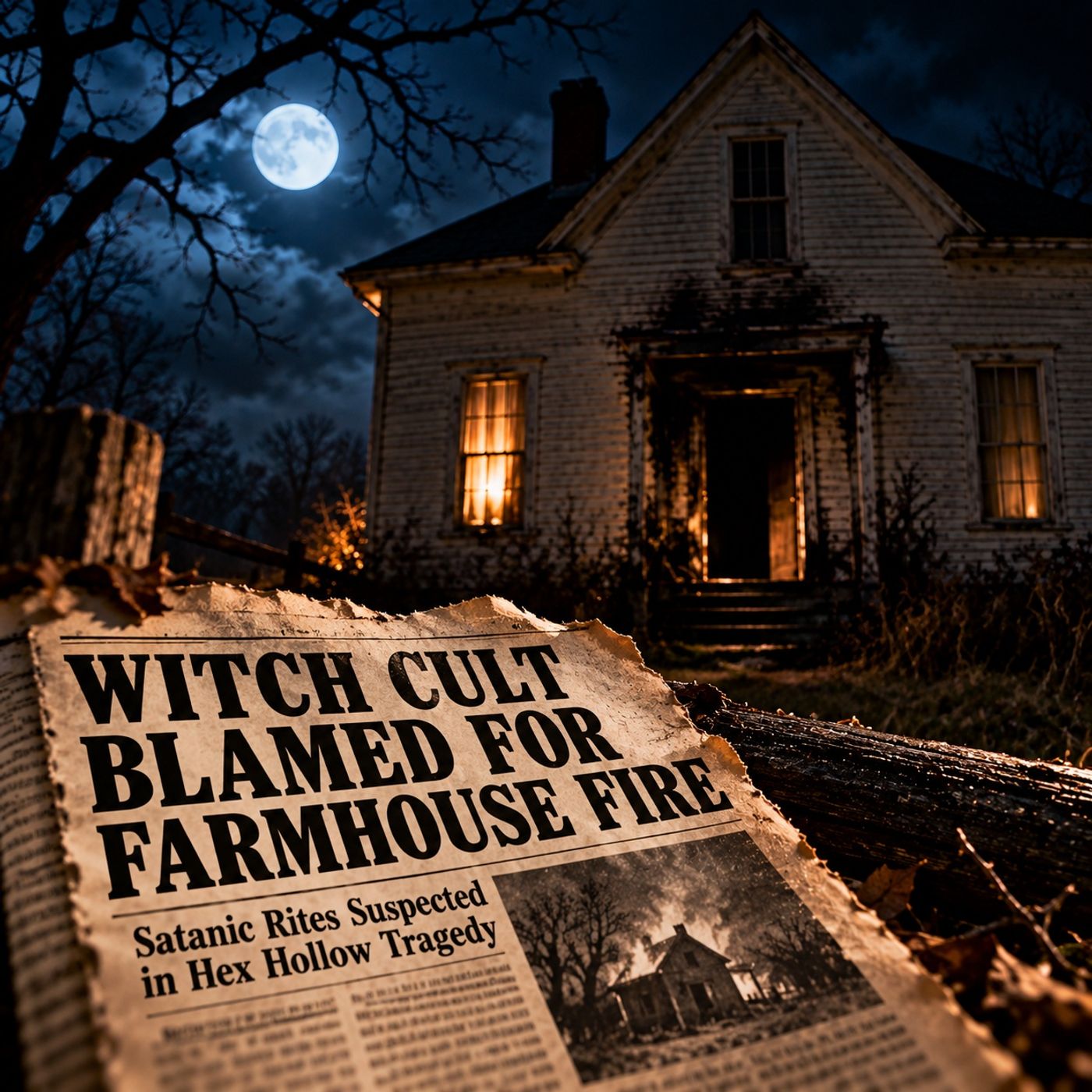
The Hex Hollow murder began with a search for a book and a lock of hair. In 1928, three attackers killed Pennsylvania farmer Nelson Rehmeyer, believing he had cursed them. Their attempt to burn away the evidence failed. Follow the York County investigation, the trials, and the headlines that turned a folk healer into a sinister legend. With voices from the Hex Hollow documentary, we separate Pennsylvania Dutch powwow traditions from accusations of harmful magic and return to the man behind the story. How did fear of a curse become permission for violence?
We're telling that story tonight.
Bonus episodes & support: weeklyspooky.com/join
More scary stories: weeklyspooky.com
Story submissions: WeeklySpooky@gmail.com
Transkriptvom Podcast bereitgestellt · Zeitmarken springen hin
They came for a lock of hair to break a curse. They left a murdered man and a burning farmhouse. But the flames went out before the evidence disappeared. What convinced three people that this neighborhood simply had to be stopped?
What you are about to hear is believed to be real. Based on witness accounts, testimonies, and public record, this is Terrifying and True.
Tonight, in York County, Pennsylvania, a farmhouse has survived a fire that was meant to conceal a killing. It's Thanksgiving week, 1928. Inside lies Nelson Riemeyer, a farmer and folk healer, whose name will become inseparable from a story about witchcraft. Three people have attacked him. They came looking for a book, and a lock of his hair. Believing these things could free them from a curse, one of them, John Blymeyer, had known Remyer long before that night. On an earlier visit, Remyer had given him and a young companion a place to sleep. In the morning, he made them breakfast. They came back with help. The trials would expose... A terrible crime.
The headlines would turn it into a spectacle, and somewhere between the testimony and the legend, the man who died would become harder to see. What happened in Hex Hollow asks us to look beyond the scorched floor and the supposed spellbook into a world where healing prayers and accusations of harmful magic could become... dangerously confused. Tonight, we follow the evidence behind the legend and the family voices trying to bring Nelson Remyer back into focus. So make sure you're subscribed as we tell that story tonight. Thanksgiving Day fell on a Thursday, November 29th, 1928. Around noon, concern settled over a farm in North Hopewell Township, roughly 15 miles from York. Nelson Remyer's animals had not been properly attended.
Their noise carried far enough that neighbors went to investigate. Oran's trial reconstruction names neighbor David Vanover as the man who entered around noon. Some later accounts instead name Oscar Glatfelter. They agree on what drew attention to the property. The ordinary rhythm of the farm had ceased. Inside the house, the kitchen had been scorched. Riemeyer lay face down on the floor. His ankles bound, his body and clothing badly burned.
The fire had gone out before consuming the house. The room still held the story the killers had tried so hard to erase. Investigators recorded pieces of a broken chair, an oil burner, a flashlight, a metal halter snap, burning bedding material, and lengths of rope. Some of that rope would be connected to a 25-foot clothesline bought in York only days earlier. Medical witnesses described bruising, cuts, and a compound fracture of the skull, severe enough that it might have caused death. They also documented extensive burning. What the accessible medical record does not establish is whether Riemeyer was alive.
when the fire was lit. The later claim that he was burned alive goes beyond what the evidence can prove. Years later, Jeanette Harvey, who had known Nelson as a girl, remembered how the news reached her.
The lady across the street, she said, did you know that Nelson Raymar was killed?
Nothing supernatural had protected the farmhouse. The attempted arson simply failed. But that failure changed everything. The burned floor, the ropes, the shattered furniture, and the body remained available to investigators. Whoever had done this had not made a victim disappear. They had left a room full of evidence. and a trial leading backward through two visits, one printed book, and a belief that Nelson Riemeyer was responsible for hardships he had never been proven to cause. Before the headlines converted him into the Witch of Hex Hollow, Nelson D. Riemeyer was a 60-year-old farmer. Patrick Donmire's research describes a modest 45-acre property where Riemeyer raised potatoes, corn, apples, and chickens
with comparatively little livestock. He was married to Alice Riemeyer and had children, although he and his family were living separately. Later scholarly accounts connect that arrangement in part to the stream of people who came seeking his help. But the surviving record does not tell us enough to turn a private family arrangement into either scandal or sentiment. Riemeyer was known as an outspoken man. Historian Owen Davies identifies him as an active socialist, a position that could make a person conspicuous in rural York County. He was also associated with Pennsylvania Dutch folk healing. Neighbors knew he practiced what English speakers called how-wow. Some apparently regarded him as helpful.
Others considered him peculiar. Neither reputation proves anything about a curse. The most important documented fact about his relationship with the men who killed him is painfully simple. When two of them arrived at his house on their first visit... He accepted them as guests, allowed them to stay overnight, and made them food in the morning. To understand why they came, we have to separate a living tradition from the lurid category imposed upon it after the murder. Pennsylvania Dutch Powwow is also called Brauw Keraai. Its roots are primarily European and Pennsylvania German. and its customary purposes were healing, blessing, and protection. Practitioners used Christian prayers, passages of scripture, gestures,
spoken or silent formulas, household objects, and knowledge passed through families or teachers. A person might seek help for bleeding, burns, fever, pain, a sick animal, or the fear that some harmful influence had settled over a home. In Shane Free's documentary, Hex Hollow, one practitioner explains the tradition this way.
Powwow is Pennsylvania German folk healing. In itself, it is a very simple thing. It's what one of my teachers called act of prayer. Some people will call it magic, folk magic, and to a certain extent it does fall into that realm, but there are many practitioners who shun the word entirely.
The English word powwow creates some confusion. It was borrowed from an Algonquin language used dismissively by English colonists for ritual practices they didn't understand and later attached to Pennsylvania German healing. Brauchairi itself is not an indigenous ceremonial powwow. The shared English label does not make the traditions the same.
Pennsylvania Dutch is also broader than Amish. It refers to a diverse Pennsylvania German cultural population that has included Lutheran, Reformed, Moravian, Mennonite, Brethren, Amish, and Catholic communities. Treating all Pennsylvania Dutch people as one secluded religious group repeats the simplification that helped distort this case in 1929. Within the tradition, Braukeirai, often referred to beneficial or protective work. Hexairai usually carried the darker meaning of harmful magic or the accusation that someone had caused illness or misfortune. The vocabulary was never perfectly uniform. A healer could be asked to counteract a supposed hex without claiming to practice any harmful magic. That distinction is central
in this topic. Rehmeyer's association with healing did not make him a person who placed curses. There's no reliable evidence that he hexed John Blymeyer, the Hess family, or anyone else. The accusation came from people trying to give their own suffering a human source. Printed books could accompany an oral practice, and none became more famous in Pennsylvania than Johann Georg Hohmann's The Long Lost Friend. First published in the United States in 1820 and issued in English by the mid-19th century, it gathered remedies, prayers, protections, and folk procedures for people and animals. It was sold commercially and circulated widely It was not a unique handwritten manuscript belonging only to Riemeyer,
and it was not a satanic field manual. One famous protection promised that whoever carried the book would be, quote, safe from all his enemies, visible or invisible. Other entries addressed bleeding, burns, illness, livestock, and daily hazards in language saturated with Christian belief. A modern historian may call The Long Lost Friend a grimoire, a handbook of procedures intended to influence events through supernatural means. That useful scholarly category does not erase the book's local function as a practical collection of blessings and remedies, nor does it mean every owner believed every promise within. For Riemeyer, the book appears to have belonged to his practice. For John Blymeyer, it
became something else. An object that seemed to concentrate both Riemeyer's supposed power and the possibility of escape from it. John Blymeyer's surname appears as B-L-Y-M-Y-E-R instead of B-L-Y-M-I-R-E through much of the court era record. On the witness stand, he gave his age as 33, although some newspapers called him 32. He had grown up close to powwow practice.
His father, Immanuel Blymeyer, was remembered as a healer. and John had attempted some practice himself. He therefore did not approach Riemeyer's world as a complete outsider. He knew the language of cures, hexes, and countermeasures well enough to make it the framework through which he interpreted his own life.
That life contained genuine hardship. Blymeyer had recurring physical complaints- difficulty settling in to work, and periods of acute psychological distress. His family endured the deaths of two children, and his marriage to Lily Bell Alloway deteriorated. In 1923, his father-in-law arranged for him to be evaluated through the York County Almshouse, and Blymeier was later committed to the Harrisburg State Hospital.
A period description used the diagnosis, quote, hypochondriacal melancholia. That is historical language, not a diagnosis we would be able to safely translate into a modern condition. It came from an era with different institutions, categories, and standards of care. Blymeier later escaped during a baseball game and returned to York.
His marriage ended in divorce. Mental distress did not make murder inevitable, and it does not remove the choices that followed. Many people endure illness, grief, and psychiatric crisis without harming anyone. What shaped this case was Blymeier's developing explanation for his suffering. Restlessness, failed work, family loss, and physical discomfort ceased to be separate events, he increasingly treated them as evidence of a single hostile act. During his trial, he reduced that belief to three words, quote, I was bewitched. Blymeier consulted practitioners, including Andrew Lenhart and Sam Schmuck. According to the trial-era account, They reinforced his conviction that a hex existed, but did
not name the person responsible. Blymeier kept searching for a face to place behind the idea. Riemeyer was not a stranger to him. Blymeier testified that Riemeyer had treated him about a year earlier, and that he had once slept at Riemeyer's home. Later retellings moved that treatment into Blymeier's The trial-era version is a safer one. A prior healer-patient relationship had become, in Blymeier's mind, a relationship between persecutor and victim. The final identification was attributed to a woman near Marietta, Pennsylvania, whose name is one of the case's persistent problems. Contemporary newspapers called her Emma Knopp. Modern scholars often call her Emma Knapp. A near-contemporary trial reconstruction calls
her Mrs. Knoll. The familiar name Nellie Knoll belongs securely to later retellings, not to a single consistent court-era identity. Rather than pretending the sources agree, it's more accurate to call her the Marietta Practitioner, Blymeier consulted. Blymeier testified that she used a dollar bill in a simple visual procedure.
He stared at the portrait. The bill was removed from his palm, and he interpreted the lingering afterimage as the face of Nelson Riemeier. That testimony tells us what Blymeier experienced. It doesn't independently establish what the woman intended for him to see. and it certainly does not establish that Riemeyer had done anything to him. It supplied the name Blymeyer had been seeking desperately. Her supposed prescription changes depending on the source. In some trial-era testimony, Blymeyer needed a lock of Riemeyer's hair or Riemeyer's copy of the long-lost friend.
Clayton Hess remembered an instruction to bury the hair six or eight feet underground. Other reports say eight feet. Later versions combine every element into a ritual checklist. Steal both hair and book, burn one, bury both, or destroy the book, bury the hair, and be sure to get it at the exact depth. The record does not justify that precision.
What remains consistent is that Blymeyer believed physical objects connected to Remyer could break the curse. He did not pursue those objects alone. John Curry was 14 years old and frequently in Blymeyer's company. Later historians have described him as Blymeyer's young sidekick or protege. Wilbert Granville Hess was 18.
the son of a York County family suffering its own run of illness, crop trouble, livestock losses, and stolen chickens. The Hesses believed their farm had been hexed and turned to Blymeyer for help. Wilbert, therefore, entered the plan through a family fear that Blymeyer was already validating. Curry and Hess were young and susceptible to an older man's certainty, but neither was an object without agency. Each took part in decisions that became progressively more deliberate and On Sunday, November 25th, Blymeyer met with members of the Hess family and outlined the effort to obtain something from Riemeyer. The following day, Monday, November 26th, Blymeyer and Curry bought approximately 25 feet of cotton clothesline in York. They cut it
into useful lengths. Clayton Hess then drove them toward Riemeyer Hollow and let them out near the woods. The rope was already with them. Whatever language they used for curse-breaking, they were preparing to restrain a man. At about 7.45 that evening, Blymeier and Curry visited Alice Riemeier for roughly half an hour, then crossed the fields to Nelson's house.
Nelson knew them and admitted them. They said they were visiting, and the encounter lasted late enough that he allowed them to remain overnight. The two slept in the kitchen. In the morning, Riemeyer prepared breakfast. They left without attacking him, without cutting his hair, and without taking the book. Bleimeyer later explained that they considered Riemeyer too strong for the two of them. Hospitality had given them access. Their own calculation postponed the assault. That first visit is sometimes presented as harmless reconnaissance that only later became violent. The rope makes the truth less comfortable. The possibility of binding Riemeyer was already present, yet the men still had another chance
to stop. after leaving his breakfast table. Instead, Blymeier sought additional strength. He brought 18-year-old Wilbert Hess into the return trip. On Tuesday, November 27th, Clayton Hess again drove them toward the hollow. The three completed the journey on foot. The reliable record establishes the rope, but it does not establish that they arrived carrying the collection of clubs, axes, or occult equipment, added by later storytellers. Riemeyer admitted them again.
The Pennsylvania Supreme Court's later account says the evening was cold and that after letting the three into his kitchen, he turned to tend the fire. Blymeyer's own testimony said he asked for the long-lost friend. Other evidence led the appellate court to conclude that no effort was made to obtain Hare, and no particular search for the book occurred before violence began. Those versions are not identical. They agree on the decisive point. The visitors had planned to overpower him, and within moments, the visit became an assault. The exact choreography cannot be recovered cleanly because the defendants shifted responsibility among themselves. Blymeier admitted using his fists and swinging a chair,
although he said the chair missed Riemeier and broke. He attributed blows with wood and kicking to Curry. Curry's alleged written confession described striking Riemeier with a block of wood, but the trial judge excluded that confession after questions about how it had been obtained. Hess later argued that he played the lesser role and acted under the domination of the others. Physical evidence established a violent struggle, broken furniture, binding, and a fractured skull. It did not assign every injury to a particular hand. Riemeyer was beaten down and bound.
Rope was placed around his ankles, and evidence described a rope halter or ligature around his neck. The men went upstairs and searched. They did not obtain a lock of hair. They did not produce Riemeyer's copy of the long-lost friend afterwards. Blymeier later suggested that an object passed to Curry might have been the book, but no book was recovered, and the appellate account said the search was limited. The object around which so much of the plan had formed remained beyond their control. They did find money, about three dollars, and divided it. They poured water around the scene in an apparent effort to remove fingerprints. Blymeier and Curry had worn gloves. Bedding or ticking was placed near or over Riemeier.
Oil from a lamp was poured and the material was ignited. The Supreme Court later treated the purpose of the fire as the destruction of the house and the evidence inside it. Some later accounts fold the burning into the curse-breaking ritual itself. The surviving legal evidence more firmly supports concealment, although ritual motive and practical cover-up may have overlapped in the defendant's thinking.
The assault occurred on the night of Tuesday, November 27th. It may have continued after midnight into Wednesday, November 28th. The accessible record does not fix a trustworthy minute. The clock stopped at 12.01. The full moon overhead and the claim that this happened on Thanksgiving night belonged to later storytelling.
Thanksgiving was Thursday, November 29th, more than a day after the men had entered the farmhouse. Preserving that chronology, does not weaken the atmosphere of the case. It restores the sequence the evidence actually supports. When the three men left, they believed the room would disappear in fire. Instead, the flames consumed material around Riemeyer and damaged the floor before going out. The men had neither the hair nor a confirmed copy of the book. What they carried away was a small amount of money and the knowledge of what they had done. What they left behind was enough to turn a missing routine on a farm into a homicide investigation.
Alice Riemeyer gave authorities a direct starting point. Bleimeyer and Curry had visited her before crossing to Nelson's house, and she could identify them. The rope at the scene corresponded with clothesline purchased in York. The separate statements of the suspects supplied overlapping facts even as they contradicted one another about the violence. Within a short period, Blymeier, Curry, and Hess were in custody. Newspapers announced confessions almost immediately. although the courtroom later excluded at least one of the most important statements. That distinction became especially important for Curry. The prosecution possessed a written statement in which the 14-year-old reportedly admitting striking Remyer with wood. Judge Ray Sherwood excluded it
after testimony that Curry had been promised help. On the witness stand, Curry denied robbery as his purpose, but admitted that he had gone to obtain the lock of hair and to witness what he described as witchcraft. The jury therefore heard his participation in the plan without receiving every dramatic sentence printed outside the courtroom. The defendants demanded separate trials.
That legal choice is the reason there was no single hex murder trial, despite the phrase appearing in documentaries and later summaries. York County tried three people in three successive proceedings. Together, the trials occupied six consecutive court days in January of 1929. The legal question was not whether curses existed. It was what each defendant intended, what each had done, and what degree of murder the evidence proved. John Blymeyer's trial began Monday, January 7th. The Commonwealth had evidence of planning, the rope purchase, the first visit, the decision to recruit Hess, the return, the gloves, the search, the stolen money, and the attempted destruction of the scene. Prosecutors could argue premeditation and robbery,
even while the defense insisted that Blymeier's fixation on a hex was the true route into the crime. His lawyers raised insanity and presented his institutional history, long distress and consuming belief that Riemeier had bewitched him. The defense did not simply need to prove that Blymeier held an irrational belief.
It had to persuade jurors that his mental condition met the legal standard for avoiding full criminal responsibility. The prosecution answered with his organized conduct. He had consulted people, selected a target, bought rope, tested access to the farmhouse, recruited help, returned with gloves, helped search the property, and participated in efforts to remove fingerprints and burn the evidence. A jury could regard these steps as proof that he understood both his goal and the criminal nature of the axe used to pursue it. The testimony about his condition may explain why the idea of a curse dominated him. It did not compel the jury to excuse murder. At 7.30 on Wednesday evening, January 9th, the jury found Blymeier guilty of
murder in the first degree and fixed the penalty at life imprisonment rather than death. The verdict rejected the insanity defense as a complete answer. It did not establish that every prosecution theory was correct or that every confession detail was reliable. It established that 12 jurors considered Blymeier legally responsible for a deliberate killing. John Curry's trial began at 9.30 the next morning. His age was impossible to ignore. He was 14, yet he faced an adult murder prosecution and the possibility of death or life imprisonment. His defense emphasized his youth, background, and impaired responsibility, while the Commonwealth placed him inside the planning before the second visit. Curry had
gone with Blymeier to buy the rope. He had spent the night in Remyer's kitchen, left, returned with Hess, and remained through the assault, search, theft, and fire. The excluded confession prevented the prosecution from relying on one of its clearest claimed admissions, but it did not remove Curry's own testimony or the surrounding evidence. He acknowledged the supernatural purpose of the visit. The prosecution argued that a belief in witchcraft did not cancel the preparation or participation. After deliberating for two hours and fifty minutes, the jury returned. at 1.42 on Friday afternoon, January 11th. Curry was convicted of murder in the first degree. Like Blymeier, he received life imprisonment
rather than execution. The Pennsylvania Supreme Court affirmed his conviction in January of 1930, holding that the admissible evidence supported the verdict. Wilbert Hess went on trial immediately after Curry. His defense separated his responsibility from that of the other two. He denied delivering the fatal violence and portrayed himself as a younger participant pulled under the influence of Blymeier and Curry.
Yet Hess had joined a planned return with Rope after Blymeier concluded another man was needed in order to subdue Riemeyer. The jury had to decide whether that made him equally responsible for a premeditated murder or guilty of a lesser degree. At 7.25 on Saturday evening, January 12th, Hess was found guilty of murder in the second degree. He received a term of 10 to 20 years in The difference did not declare him innocent of the killing. It showed that his jury distinguished his intent or role from the first-degree culpability assigned to Blymeier and Curry. Six days had produced three trials, two first-degree verdicts with life sentences, and one second-degree verdict with a lesser term. At least 100 Metropolitan
reporters arrived for the proceedings. Judge Sherwood refused to turn the courtroom into a stage. No telegraph instruments allowed inside. No courtroom photography. No special performance for the press. Many reporters left before the week was over. Yet the restraint inside the courtroom could not control the story. outside of it.
Newspapers across the country had already discovered that witchcraft sold more papers than a careful account of motive, evidence, and Pennsylvania German folk religion. Headlines announced, quote, York's voodoo cult and declared, quote, York County held in grip of black art practices. Reports used witch doctors as though it were a neutral job description. One presentation placed the defendants beside occult symbols from the sixth and seventh books of Moses, whether or not those images explained anything about Riemeyer's healing work.
A murder committed by three particular people became evidence against a region. The vocabulary invited readers to imagine a culturally primitive enclave surviving untouched inside modern America. The comparison to voodoo was not merely inaccurate. It drew upon racialized language long used to portray African and African diasporic religions as sinister.
Journalists transferred that language to a largely white Pennsylvania German community because it supplied an instantly recognizable insult. In the process, they blurred Braucherei, the healing and protective tradition, with Hexerei, the feared practice of causing harm. Riemeyer's work as a healer became Black Magick, while Blymeier's accusation was treated as proof of what Riemeier had been. This pressure did not begin with the murder. Protestant ministers had criticized powwow during the 19th century. By the 20th, medical societies and public officials challenged practitioners as superstitious, fraudulent, or illegally practicing medicine.
Some criticism addressed legitimate questions about payment, delayed medical care, or exploitation. Much of it also carried cultural contempt. The 1928 murder offered opponents a national spectacle through which a varied healing tradition could be judged by its most sensationally misrepresented case. The consequences were real. but should not be exaggerated into a clean extinction story. Publicity strengthened calls for investigation and regulation. Practitioners and families became more guarded. Knowledge that had once been discussed openly could retreat into private homes, family lines, and quiet consultations. Donmeier describes a silencing produced by the press, medical opposition, religious pressure, and fear of
legal scrutiny. The murder contributed powerfully to that climate. It did not create every form of opposition, and it did not destroy powwow by itself. The tradition did survive. The press also changed the position of the victim. Nelson Riemeyer was no longer primarily the farmer whose animals had went unfed, the husband and father living apart from his family, the man who had welcomed two visitors and cooked their breakfast.
He became the Hex Doctor, whose supposed powers made the story marketable. His unproven role as a cursor received more attention than the documented decisions of the men who bought rope, returned to his home, and set the room on fire. Sensation did not merely misdescribe a tradition, it displaced responsibility.
The sentences did not end the story of the defendants. Curry's life sentence was commuted in the 1930s, and he and Hess were released in 1939 after roughly a decade in prison. Blymeier remained incarcerated much longer. His life sentence was commuted in 1953. Their later occupations and private lives have accumulated their own stories, some well-documented and some polished through repetition. They are important as legal aftermath, but they don't require us to convert the killers into redeemed protagonists or let their later years occupy more space than the life They ended. The mythology continued to expand. Arthur H.
Lewis's 1969 book, Hex, brought the case to a wide popular audience through a highly dramatized narrative. It remains influential, but its dialogue, names, and reconstructed scenes cannot be treated as if they were a transcript. Later accounts popularized the mysterious woman as Nellie Knoll, although the court-era sources reviewed here do not securely establish that identity. A name repeated for decades can feel archival, even when the archival record remains divided. In 1988, Apprentice to Murder carried a transformed version to film. Its credits accurately said it was inspired by a true story. The production changed the principal names, created new character relationships, and supplied a fictional, dramatic ending.
That is what historical fiction is permitted to do. The danger begins when the details created for narrative travel backward and become accepted as evidence about Nelson Riemeyer. The farmhouse acquired its own legends, A clock supposedly stopped at 12.01. The murder supposedly occurred beneath a full moon. Riemeyer supposedly moved or cried out within the flames. Apparitions appeared in later stories, and the house's survival became evidence that his magic had defeated the fire. None of those claims is required to explain what happened, though. The clock and moon do not appear in the court-era evidence reviewed for this episode.
The medical testimony does not establish consciousness during the burning. The house survived because an arson attempt failed. Over time, tours, autumn hayrides, and seasonal retellings drew the crime toward the Halloween season. The connection is... Understandable. A hollow, a scorched farmhouse, accusations of curses, and a book that promised protection from invisible enemies. But the calendar should remain honest. Blymeier, Curry, and Hess went to the farm on November 27th, 1928.
Neighbors found Riemeier on Thanksgiving Day, the 29th. Halloween entered later. when history became local folklore, and local folklore became an autumn attraction. The surviving farmhouse is private property and is no longer open to the public. Its continued existence does not invite trespassing, nighttime visits, or attempts to test a haunting.
The historically meaningful place is already available in the record. A working farm disrupted because its owner was dead. A room preserved because the fire had failed, and a community forced to watch while national coverage turned one man's murder into a caricature of their culture. The evidence supports a conclusion more disturbing than any ghost story. John Blymeyer became convinced that Nelson Remire had authored his suffering. He recruited two much younger companions, returned after a night of accepted hospitality, and converted that accusation into deliberate violence. No reliable evidence shows that Remire cursed him. The men did not obtain his hair. They did not successfully take or destroy the book.
They saw it. They did not burn away the crime. All three were convicted, though the law distinguished their degrees of guilt. The fire went out before it could erase the room. The book remained beyond the killer's hands. Beneath nearly a century of headlines, the hardest thing to recover has never been a spell. It has been Nelson Remire.
In the documentary, Nelson's great-grandson, Ricky Ebaugh, describes what that reputation has meant for the family.
How has it affected your life in any way? Have people looked on you with suspicion, thinking you're descendant of a famous witch and hexer?
Not sure. The house, they think this is like an evil house. It's supposed to have, you know, bad things happen back here.
People point at you and say... That's the great-grandson of the witch. Anybody give you any trouble?
The younger people, whoever approaches me with that and says, you know, hex and witch, you know, evil, that's not, you know, try to explain that to people. It's not like that. There's got to be a turning point somewhere here. It has to start going, that they find out the real truth as to say this evil, bad person made out to be from the night they murdered him. So it's got to happen in time here somewhere.
Terrifying and True is narrated by Enrique Couto. It's executive produced by Rob Fields and bobbletopia.com and produced by Dan Wilder with original theme music by Ray Mattis. If you have a story you think we should cover on Terrifying and True, send us an email at weeklyspooky at gmail.com. And if you want to support us for as little as $ 1 a month, go to weeklyspooky.com slash join. Your support for as little as $ 1 a month keeps the show going. And speaking of, I want to say an extra special thank you to our Patreon podcast boosters, folks who pay a little bit more to hear their name at the end of the show. And they are Johnny Nix, Kate and Lulu, Jessica Fuller, Mike Eshkewi, Jenny Green, Amber Hansford,
Karen Wemet, Jack Kerr, and Craig Cohen. Thank you all so much, and thank you for listening. We'll see you all right here next time on Terrifying and True.
