

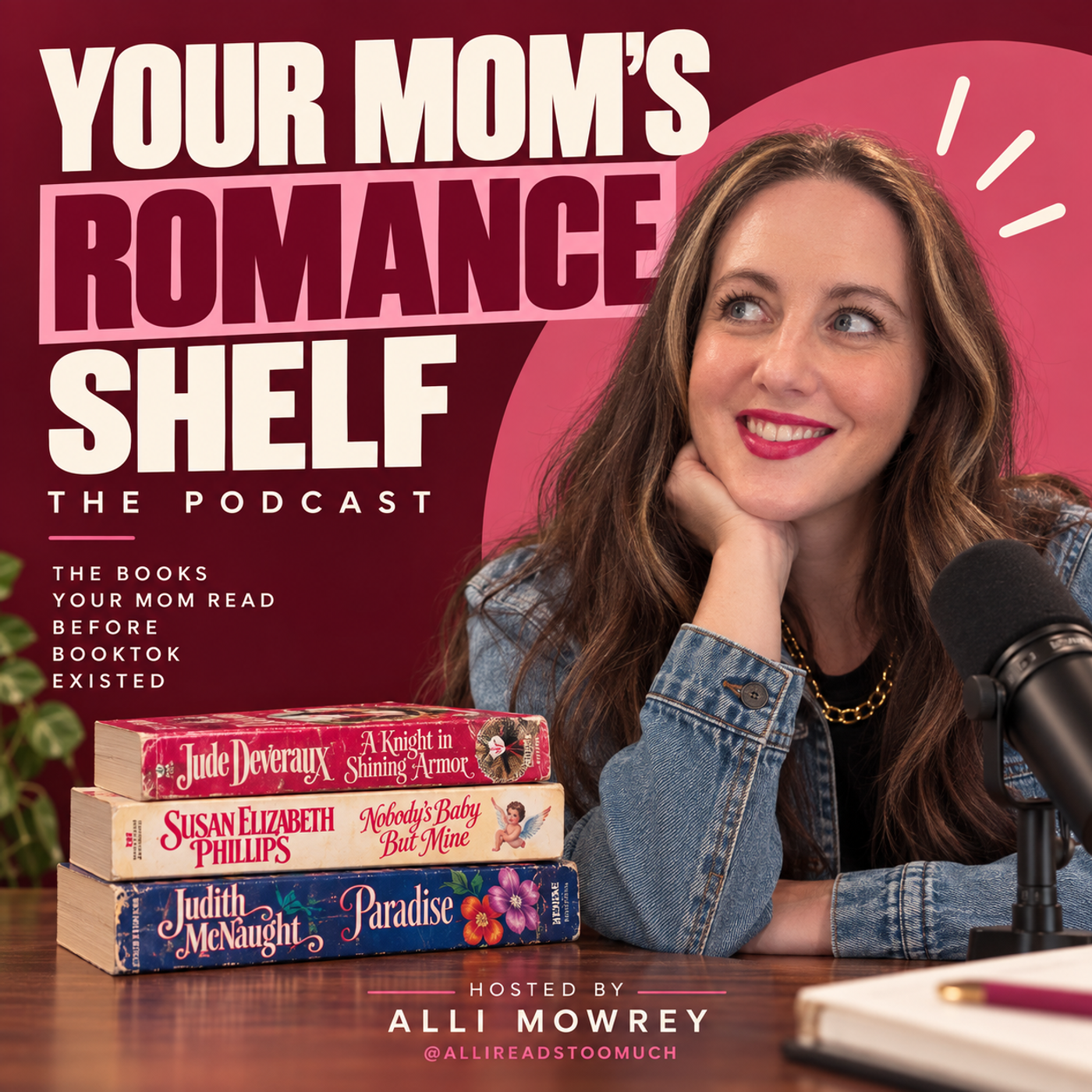
Your Mom's Romance Shelf· Staffel 1· Folge 1
Romance, Sexism & the Books That Shaped the Genre with Jodi McAlister
Mittwoch, 7. Oktober 2026 · 58 min
Kapitelklicken springt direkt hin
Shownotes
Why has romance been dismissed for so long—and what can the books of the past tell us about the genre today?
In the first episode of Your Mom’s Romance Shelf, I’m joined by romance author and scholar Jodi McAlister to talk about the history and evolution of romance, from bodice rippers and bonkbusters to dark romance and the books that shaped the genre.
We talk about sexism and the stigma around romance, why older romances were so wildly popular, how the genre has changed, and what we can learn from the books readers loved decades ago.
Learn more about the podcast:
allireadstoomuch.com/podcast?utm_source=chatgp…
Follow Alli:
Instagram (instagram.com/allireadstoomuch/?utm_source=cha…) · TikTok (tiktok.com/@allireadstoomuch?utm_source=chatgp…) · YouTube (youtube.com/@allireadstoomuch?utm_source=chatg…) · Facebook (facebook.com/allireadstoomuch?utm_source=chatg…)
Follow Jodi McAllister:
Instagram (instagram.com/jodimcalister/?utm_source=chatgp…) · TikTok (tiktok.com/@jodimcalister?utm_source=chatgpt.com)
Join theYour Mom’s Romance Shelf book club:
Fable Book Club (fable.co/club/you-moms-romance-shelf-with-alli…)
Books Mentioned in the Podcast:
Jodi McAllister
• An Academic Affair — Jodi McAlister — Amazon (amzn.to/4hAsxue?utm_source=chatgpt.com)
• A Study in Sparkling — Jodi McAlister — Amazon (amzn.to/4yDlUgw?utm_source=chatgpt.com)
Books Discussed & Recommended
• Welcome to Temptation — Jennifer Crusie — Amazon (amzn.to/4zcETi2?utm_source=chatgpt.com)
• The Flame and the Flower — Kathleen Woodiwiss — Amazon (amzn.to/4yy28mJ?utm_source=chatgpt.com)
• Scruples — Judith Krantz — Amazon (amzn.to/4i8XK7S?utm_source=chatgpt.com)
• Hollywood Wives — Jackie Collins — Amazon (amzn.to/4rQvWZ8?utm_source=chatgpt.com)
• Lady Boss — Jackie Collins — Amazon (amzn.to/4jJj5Ga?utm_source=chatgpt.com)
• Paradise — Judith McNaught — Amazon (amzn.to/4zoPExW?utm_source=chatgpt.com)
• Bet Me — Jennifer Crusie — Amazon (amzn.to/4y5eQbm?utm_source=chatgpt.com)
• Lovelight Farms — B.K. Borison — Amazon (amzn.to/4zjRJLl?utm_source=chatgpt.com)
• Devil in Winter — Lisa Kleypas
Transkriptvom Podcast bereitgestellt · Zeitmarken springen hin
Alli: Welcome to Your Mom's Romance Shelf, a podcast about the romance novels that shaped the genre, the readers who loved them, and what those books can tell us about romance today. I'm Allie and I'm behind Allie Reads Too Much on Bookstagram and Book Talk, where I talk about all things romance. And I started a series this year called Books Your Mom Never Told You About, where I dig into the older romance novels that paved the way for the books that we're reading today. And now that series has its own podcast. And for our very first episode, I'm talking with Jody McAllister, a romance author, scholar, and longtime romance reader. Jodi writes and researches romance and has a really fascinating perspective on how the genre has changed over the decades and why some of those older books were so wildly popular and what they can tell us about where we are within romance today. So let's get into it. Here's our chat. So we have Jody McAllister on the podcast today, we are gonna start with the personal connection because without Jodi and her novel An Academic Affair, I don't know that this journey would have started. So Jodi, I read an academic affair last year, got it as my book of the month, and it was a really beautiful story. And what I found myself doing after I read the novel was there's there's several both contemporary and slightly older romance works mentioned in the novel. And one of them, I was so fascinated and How you discussed, I know B.K. Borison was one Lovelight Farms, and then Devil and Winter was one that was referenced at least a couple times throughout the book, that I couldn't help but pick it up because I wanted to just kind of continue the journey. And then
Jodi: Yeah.
Alli: I read Devil and Winter, and I was just enamored with the writing in the book and the way the hero was written, the heroine you could tell that she was Lisa Claypis, the author was trying to write consistent with like some of the time period, but it was also this really strong-willed, feisty heroine, who had like a deep sense of self. And I found that absolutely fascinating. And then I was immediately on to Tessa Dare after that, 'cause I was like, I want to read else something else like this. and after that it really started getting me thinking you know. These books seem to be written quite differently than what we read in contemporary romance today. And I wonder, you know, even if I go a little bit further back, do these books hold up? And so the first like official book in the series was Linda Howard's Perfect, which is a romantic suspense. it was really thrilling and I enjoyed it. And since then it's now evolved into like a whole social media series and book club and I've just had a ton of fun reading these older authors. I would love to know what really got you started in the romance space, both as an author and as someone who has studied romance novels throughout your academic career.
Jodi: Yeah, yeah, absolutely. So I got my start as a romance reader in a way that I think a lot of people got their start, which is I would steal my grandma's Mills and Boons, so Harlequin you would call them in the US.
Alli: Yeah.
Jodi: she was very fond of Betty Neals in particular, who wrote a lot of very stern Dutch doctors in particular, extremely sensible romances. and so I used to kind of read these voraciously. They felt very forbidden when I was twelve. I drifted away from romance a little bit during my teens. I got really into fantasy for a while there. But I came back to it in a big way just after I finished my undergraduate degree. So I always knew I wanted to go back to university to do a PhD. This was always on the cards for me. But I PhD students don't make a lot of money. So I was like, okay, I'm gonna go and get a proper grown-up job for a few years and then I will go back to university. And I thought I was going to be an early modernist. I was going to work on Shakespeare and Friends. And actually, in my book, An Academic Affair, Jonah has the career that I thought I would have. He he works as a kind of Renaissance Jacobean specialist. But in this office job I had, I was Absolutely miserable. And Allah you told me the story of how you got into these books kind of before we started recording, and I was like, that's actually really quite similar to
Alli: Yeah.
Jodi: my story. Because I was miserable in this office job. Like it was not for me at all. And what I found myself doing was going to Big W, which is a department store here in Australia, kind of like Walmart, I guess, and cleaning out the romance section. Like I was absolutely Chewing through romance. All I wanted to read was romance. I really needed the promise of the happy ending, not just the joy of it, but the stability of it because I felt so kind of so at sea in my own life. And then I discovered, I was living and working in Canberra at the time. I discovered a sadly now defunct romance bookstore called Intrigue. Australia was actually really far ahead of the curve on romance bookstores. The first one here opened in 1997. But this, so this was the sort of mid-2000s. And they had collections of kind of new and old romances. And this is where I discovered probably one of the most important romance authors to me ever, which is Jennifer Cruzy. And when I read her book Welcome to Temptation, it really, really crystallized to me. All the things that a romance could be, all the things that a romance could do. It was a book which really opened my eyes creatively. But this experience of doing all this romance reading, I remember this so clearly walking home from work one day and being like, could I study this actually? Do I have to talk about Shakespeare and Friends or can I write about this? Am I allowed? Will anyone let me? And it turned out the answer was yes. And now quite a few years down the track, I'm the president of the International Association. For the study of popular romance, and there are quite a few people all around the world who have made their scholarly careers studying popular romance fiction.
Alli: I love that. And that's a really good segue into something else I really wanted to ask you about. I think romance, maybe not taken as seriously as a genre as other literary works. And it's one of the most widely read genres. So why do you think that is and do you think that that perception is changing at all?
Jodi: So the answer to your question is both quite simple and quite complicated. the reason that romance has been so looked down on for so long is d sexism. Like it's it's That simple, really. there has been a perception for a long time that romance is by women, for women, about women. In reality, it's more complicated than that. Romance is for everyone, romance is by everyone. but certainly this has been the way that romance has been imagined and positioned. And it's been, I guess, associated with some figures who have become figures of mockery. Think of figures like Barbara Carland wearing all the pink things like that. and the tradition of like mocking what women read is Very, very old. The tradition of being very worried about what women read is also very old. I came across a letter to the editor from 1730 when I was writing my PhD that said that romances, by which they were referring to the books of authors like Apri Ben, Eliza Haywood, Delarier Manley, romances ruin more virgins than masquerades or brothels. And so there
Alli: yeah.
Jodi: has been this concomitant sort of fear about what women are reading, but also denigration. And we see women's media being kind of denigrated all the time. This is very, very common. Look at the way that say fangirls of literally anything are treated. But what we are seeing now, I think, in the 2020s, particularly with the rise of bookish social media, is a bit of a reclamation of romance. I get really frustrated when people talk about how romance became suddenly popular out of nowhere in 2020 when book talk happened. That is not the case. Romance has always been popular. I don't want to say that there was no associated sales spike, but really the biggest shift here was in terms of visibility in the mainstreaming
Alli: Yeah.
Jodi: of romance. In romance getting Dedicated shelf space in mainstream bookstores, in people being more willing to talk about romance openly, in people casually reading romance. It for a long time was quite an insider, outsider genre because it was so looked down on, you had to kind of know people were safe before you would talk about their romance reading with them. So I do think we're seeing a shift, which is good. I think because romance still is so associated with women, we still see a lot of old like silly smuddy books for for the girlies kind of discourse, but I I do think the needle is moving a little.
Alli: I agree, concur. I'm curious how you feel about the term smut. I posted something recently and, you know, asked people in the comments, do you like it, not like it? And I I understand both perspectives, but I personally really don't like calling romance smut because I feel like it it it undermines the other Components of the novel. And it's more than just intimate sex scenes. Like there's really wonderful romance books out there with really great plots and emotional intimacy and character depths and trajectories within the novel that are like any other, literary fiction work that you would read. And I worry that like by continuing to perpetuate that like it's smut, you're like only looking at one element of the novel. And I mean, we don't, you know, refer to movies that way or T V shows I mean, pretty much any movie has some sort of intimate scene in it if it's made for adults. So I I personally like have trouble with the word, but I also understand the argument that some Women are trying to take the word back and own it. but how do you feel about it?
Jodi: So I feel about the word smut the way that I have historically felt about the word trash. So I for a long time used to describe myself as Australia's trashiest academic, yet to be defeated. And I was using trash in this very affectionate sense, in the same sense that a website like Smart Bitches Trashy Books uses it, where
Alli: Mm.
Jodi: it's a little bit winking, it's a little bit knowing, it's coming from a place of love. but what I sort of eventually found is that people were would hear me say this and they'd go, you you mean trash in the kind of derogatory sense. And I'd be like, No. I think a great deal of the literary value of the romance novel. Can you not tell from the fact that I've devoted not one but two careers to it? And I think the word smut is starting to play the same role that that trash
Alli: Yeah.
Jodi: historically has, where it is a word where there is an element of reclamation, but it is also used as a term of denigration. And so yeah, I probably I would never go out there and describe my own books as smart because I don't want to kind of participate in this kind of derogatory discourse. But I really do understand why people also seek to reclaim this word. And to that I say like, go off. More power to you.
Alli: Yeah, you you do you, you know? It just but yeah, I I very much agree and I I think that's a a good analogy and hopefully we continue to get more understanding. there's a lot of book talkers, bookstagrammers, a a lot of men that are coming into the space. both heterosexual men as well as, gay men. it's just becoming a lot more of a diverse genre where you're seeing a lot of people talk about it. And I think that's a really, really positive thing for the genre. My goal, I talk about this on my channel a lot too, is to get my husband to read a romance novel that he reads five stars within this year. So we'll see. but I love that, we're trying to progress the genre, hopefully forward and and get more romance readers and More representation of who romance readers are,
Jodi: Yeah.
Alli: let's delve into a little bit of nostalgic romance. So when you think about the romance novels of the eighties, nineties, early two thousands, even back into the seventies, what do you think feels the most different from The romance shelf that we have today.
Jodi: So I think there are a few things. And one thing I want to point out is that when we talk about kind of the romance of the 70s, 80s, 90s, often our default here is American. And there is a lot
Alli: Mm.
Jodi: about these books that to me, as an Australian, feels deeply, deeply American. And I think we often neglect some of the other things that were happening, particularly in Britain at this point, where there was quite a different trajectory to the modern romance genre and kind of your scare quotes. Bodice rippers were not quite so big. We were there participating
Alli: Interesting.
Jodi: more with the Blockbuster, which something I with Amy Birch have written a book about, which are think of
Alli: Yes.
Jodi: authors like Jackie Collins, Jilly Cooper, Shirley Conran, Judith Kranz. Several of these were also big in the US, but I think these are perhaps more foundational for the genre outsider America, where we have perhaps sometimes more of a comic tone and occasionally we flirt a little bit more with irony. But when we think about the kind of classic 70s, 80s, 90s, well, I think 70s and 80s are kind of one thing, and then we start to see this shift in the kind
Alli: Yeah.
Jodi: of late 80s, particularly into the mid 90s, into the 2000s. in their book Beyond Heaving Bosoms, Sarah Wendell and Candy Tan talk about this as old school versus new school romance, school with a K. And it's not that binaristic, it's a little bit of a spectrum. But I think what we see is those kind of 70s, 80s books, your scarequot Sweet Savage romances, which is a riff on Rosemary Rogers' Sweet Savage Love, which was sort of the the big blockbuster follow-up to Kathleen Woodowis's The Flame and the Flower. What we see there is spectacle. We are getting incredibly heightened emotion. We are getting massive kind of soap-operatic swings. We are seeing epic in a way where I don't know if we necessarily see epic in a lot of the kind of more modern historical romance in particular. We tend to draw more on the legacy of Georgia Hayer, particularly when we're in the Regency and we see something a little bit more Bridgetiny-y. So think Julia
Alli: Yeah.
Jodi: Quinn's The Duke and I comes out in 2000. There we are, we are in we are contained in London and perhaps we go to the country a little bit. What we're seeing though in something like The Flame of the Flower, Sweet Savage Love, those authors that are playing around this time at this time are these massive sweeping historical epics where everything is extra. We are traveling over a lot of ground. We have huge feelings. We have huge betrayals. We have heroines with purple eyes. Probably we have pirates. Like yeah like it's it's yeah yeah absolutely
Alli: Yes. Violet eyes, yep. There's there's usually always a near death experience. One of my favorite plot devices for the third act. Yeah.
Jodi: And then I think we we sort of see a, I don't want to call it a retreat. We kind of we tone it down a little bit, we get a little bit more restrained, we think a little bit more about the romance sometimes rather than the drama, as we kind of pull back into something a little bit more arguably Bridgetany-y, and we see something that is a little bit more light and bright and sparkling, a little bit more funny, a little bit more frothy, as opposed to the kind of high melodrama that we see in the 70s and 80s.
Alli: Yeah, that's that's really interesting. One of the the big questions that I ask myself when I read these books, and I think the flame and the flower really got me thinking about this because that one, it's so important to the genre, but there are so many problematic parts of it. one of the questions that I come back to is does this book still still hold up? and that's what I've tried to answer as I've read all of these, but is that even the right question to ask when we're rereading some of these novels from thirty, forty years ago.
Jodi: I mean, it depends really. The Flame and the Flower is what I would call an iconic text. It is really
Alli: Yeah.
Jodi: important to the history of romance, but if you were approaching it as a modern reader, it is virtually unreadable now. It is so rapey, my goodness. Like I
Alli: Yeah.
Jodi: think in the first chapter alone, Heather is almost raped or successfully raped five times. Like it is that is in chapter.
Alli: Yeah. No, that's right. I think three times where she is successfully raped by the main male character and then almost raped at at least once by, another side character. I felt like I had to read it because I I did research and it was so important to the genre. and as someone who has gone through sexual assault, I had a very difficult time reading it. And then I it took me about three weeks to actually write anything down about my review because I felt so conflicted about how I started to like the main male character halfway through the book as much as I hated him early on. I just had really conflicting feelings about it Like, I I don't ever anticipate reading it again, but I appreciate what it did for the genre. And
Jodi: Yeah, and I mean this is the The Flame of the Flower is not a unicorn here. So if we go earlier back,
Alli: Yeah.
Jodi: we look at a book like The Shake from 1919. This was similarly a huge, huge blockbuster. Like there was a movie made out of it with Rudolf Valentino. This book is is foundational for what the romance novel will eventually become. It deeply influences what happens in the 1920s and 1930s in romance. Virtually unreadable now. It is extremely rapey and extremely racist. And I think we see this a lot with blockbuster text in many different genres. Like, is this how we're going to be talking about Fifty Shades of Grey in fifty years? Maybe, you know. it was a similar blockbuster. We could, you know, trace a line from the shake through to the flame and the flower through to fifty shades, maybe.
Alli: Yeah.
Jodi: in fifty years will we be like, yikes, important text, virtually unreadable, maybe. And so I think things can be iconic without necessarily being books that we return to time and time again. Not not everything is going to be Jane Austen, you know?
Alli: Yeah. I think that's a really good point. and one thing that I was really thinking about as I was trying to parse out all of my feelings on The Flame and the Flower that I think about today is and and this is a newer kind of subgenre for me 'cause I hadn't really read any dark romance until relatively recently. I don't know if reemergence is the right word but there's a lot, within this particular subgenre of non-consensual sex called non-con, dubcon. I guess as someone who has studied this historically and and you know is also writing books in today, how do you feel about like some of these elements that are being worked into some of these darker romance texts and, you know, are they problematic or is it really up to the reader to decide as long as it's, accompanied with a trigger warning? Or is there any concern with darker romances getting darker and darker and darker to kind of continue to like kind of progress the the shock and awe factor.
Jodi: Yeah, so there's I mean there's there's like five different questions there. Let me let me see if I can kind
Alli: Yeah.
Jodi: of draw them together. look, I am not particularly interested in policing what people read. I think there is
Alli: Mm.
Jodi: enough people try to tell women what's good for them and what's bad for them and what they should read and what they shouldn't. And that is just like a sort of not a position I'm particularly interested in occupying. which is why I like one of the scholarly questions I find the most boring is like, is this problematic? And I'm like, yeah, probably, maybe. What I am more interested in is Wha why now? What w what is
Alli: Mm.
Jodi: this doing? Why is this interesting? Why is this hitting? Like that that to me is always the most interesting question. Why? And so if we look at sort of your Flame in the Flower era bodice rippers There I I I think we make a mistake if we read that literally. That if we're like, okay,
Alli: Yeah.
Jodi: what women want is you know, is what Heather gets with Brandon in that book, which is like a relationship that
Alli: Yes.
Jodi: begins with with sexual assault, that you know, continues on into forced marriage and to him kind of bossing her around until eventually she kind of caves and falls in love. I I think we are all pretty clear that this is not what women are actually after in real life. And so kind of approaching them as cultural artifacts, as historical artifacts, we think about that in its historical context. This was a period where we are kind of fresh in the middle of the sexual revolution, where the scare quotes rules around sex are really, really up in the air.
Alli: Yeah.
Jodi: Are you allowed to have sex as a woman? Are you allowed to desire as a woman? What makes you moral? What makes you immoral? What makes you good? What makes you bad? And What we see worked through a lot in those bodice rippers is this anxiety about women's sexual desire. That if you are kind of an active desiring participant, that might make you bad. But if this is kind of foisted upon you, so to speak, then you can have the sex but still maintain your reputation. And so I think this is why we see the the prevalence of a lot of kind of particularly sexual assault plot lines in those books. But yeah, I It's it's more complicated than that. But I think there is there's a really good
Alli: Yeah, understood.
Jodi: article in the Journal of Popular Romance Studies by Angela Toscano about the role of rape in romance that I highly recommend people take a look at that that thinks through questions like these in more details. When we're thinking about kind of dark romance now, it's like, okay, why why now? Because As with the bodice ripper, no one seriously wants these things to happen to them in real life. This is not a one-to-one relationship of depiction on the page real life fantasy. And so, what is that depiction doing? What is the kind of oblique psychological need that this extremity is meeting? And in the 2020s, we have been in a period of great uncertainty in many ways. So the pen. Pandemic is a kind of big cause here. I mean, I think there is a reason that we saw kind of romance explode on TikTok in 2020. That year is not coincidental. But there have been all other kinds of instabilities, whether those are political, about kind of the role of women in the world. Like, I mean, we now that's kind of the big one that I'm getting at here.
Alli: Yeah.
Jodi: And what we see in dark romance is some of these questions being thought through in a space that is safe because you know in the end
Alli: Yeah.
Jodi: everything will be alright. That is the great promise of the romance that no matter how bad things get, love will win. And if you're a woman reading a kind of straight romance, you will win. The woman's
Alli: Yeah.
Jodi: worldview will triumph. You could have the worst man in the world. He could be a stalker serial. Killer, murderer, maybe he's also a vampire, I don't know. list your like, you know, list of dark romance tropes here. He's a mafia boss as well. And you will bring him to his knees. His power will be yours
Alli: Yeah.
Jodi: to command. I think a lot of what we see in dark romance is actually a fantasy about power, about kind
Alli: Yeah.
Jodi: of obtaining power. And there is a great article also in the Journal of Popular Romance Studies by Catherine Roach called Getting a Good Man to Love, where she talks about kind of the appeal of the romance more broadly. And she says that in the romance, patriarchy ends, yet patriarchy continues, and you get a good man to love. You can't defeat the system, you can't bring down Patriarchy entirely, but you can bring down one patriarch, and then his power is yours to command. Or there was a great book of essays in 1992 called Dangerous Men and Adventurous Women by a bunch of romance authors, speaking back to a lot of the 1982 wave feminist criticism of the romance, where Daphne Clare, in a piece called Sweet Subversion, says that at the end of the romance, if the heroine places her foot upon the hero's neck, it is only to invite him to kiss it. And so I think there is an enormous amount of of things about power that is being worked through both
Alli: Yeah.
Jodi: in the kind of bodice rippers of the seventies and eighties, but also in the kind of more extreme kind of dark romance that we're seeing the rise of today.
Alli: Yeah, that really tracks for me. I I had a conversation with one of my friends recently and I was in like a big mafia romance kick and I was like, I don't know why I'm so obsessed with mafia romances lately, but like I just keep reading one after the other. And that has been kind of like my favorite way to read dark romance. I've read quite a bit over the last six months, but she's like it because it feels safe. Like it feels like a form of escape and really exciting, but like You also know that it's A gonna end happy and B these types of situations are never like going to appear in your real life. but it feels like a form of like safe escape.
Jodi: have fantasy fiction. Like it's
Alli: Yeah.
Jodi: it's so clearly not real life. Like the the world of like if we use mafia as an example, that is essentially the same as saying wizards in a lot of places
Alli: Yeah.
Jodi: or dragons. And there is a concept that actually comes from the scholarship of science fiction from a guy called Darko Suven called cognitive estrangement. The idea that you can sometimes work out things better about your own world and your own situation by examining them out of remove. So he's talking about science fiction where you've got some aspect of the present taken to its logical conclusion, like Capitalism in the Hunger Games, something like that.
Alli: Yeah.
Jodi: But I think we can see the same with these very spectacular forms of romance, because the situation is so different from your own world. It becomes a safe space to think through some some issues about power, desire, whatever.
Alli: Yeah. I love that. I wanna ask you about the bonkbuster a little bit, which you brought up earlier. when I dug into your research, I was really interested in this this term bonkbuster, which feels really relevant to what I'm looking into with a lot of these nostalgic novels. Can you describe what a bonkbuster is and what like kind of drew you into this research.
Jodi: Yeah, yeah, absolutely. So the bonkbuster has if we kinda break that word down, you can get some really core components of what this genre is. There is a lot of bonking. They are full of sex. they were extremely popular. The Buster is obviously from Blockbuster, and they are bunkers. Like these are big, soapy melodramas with lots of sex. they are sort of generically different from the romance in that you don't necessarily have this promise of a happy ending. And also it is it's more helpful to think of them like soap operas, I think, than than romance, because they've
Alli: Yeah.
Jodi: usually got quite big ensemble casts. We're usually set in the present or there can be some historical elements, but there's that you'll usually get a kind of dual timeline situation if that's the case. So the the past will speak to the present in some way. And they are often set in worlds of like high luxury. So with someone like Jackie Collins, we're often in kind of Hollywood elite. with Judith Kranz, we are often in kind of New York elite. Julie Cooper will give you many people might be familiar with the TV adaptation of Rivals, which is a classic 1988
Alli: Yeah.
Jodi: Bunkbuster. We've got kind of posh English people. Shirley Conren gave us a lot of kind of jet settings. So wealthy. dramatic people having a lot of sex. Often it is bad sex, which is really interesting. The sex can be played for comedy, it can be played for disgust, it can be played for scandal, in ways that are I think quite distinct to the romance novel. And there is often more of a an ironic bent. Romance is at its heart a deeply sincere. Genre. You can't really approach the romance novel with too much irony in your heart, not saying we haven't tried here in Britain and Australia and other Commonwealth countries, because we sure have, but the kind of romance is quite earnest, I think, in some ways. The Bonkbuster is not earnest. The bonkbuster is quite an ironic genre. And I've been interested in these books for a while, but this research project arose out of a conversation that my research partner Amy Burge and I had at the International Association for the Study of Popular Romance Conference in Sydney in 2018, where we were a little bit frustrated with how so American many histories of the genre are, and we actually theorized that the bonkbuster was kind of the forerunner to chiclet in in the UK, sort of coming before Bridget Jones. I don't think we were necessarily right about that. I think it is a little bit more complicated, but it is this kind of piece of the women's fiction puzzle that has been a little bit understudied until now. We wrote a book about it. It came out this year.
Alli: Can you give some examples of bonkbusters, maybe some of your favorites that you've you've studied throughout your your research?
Jodi: Yeah, absolutely. So probably the kind of classic bonkbuster, and we did a book club on this with some of the participants in our research, is Lace by Shirley Conran, which is the story of four women who grow up at Swiss boarding school, one of them gets pregnant, we don't know who, and the book begins with the daughter gathering these four women who are now in their 40s together and uttering the iconic line, which one of you bitches is my mother? And so we kind of get the the history
Alli: Ha ha.
Jodi: of these four women who all, you know, go on to be kind of high powered in their various fields and have a lot of messy sex and love affairs, as well as Lily, the daughter, who has it's quite a bleak story, poor old Lily. This book is otherwise most famous for having a very upsetting sex scene involving a goldfish. there is yeah,
Alli: gosh, okay.
Jodi: you don't want to know where the goldfish goes. I
Alli: Okay.
Jodi: I wouldn't say that this book holds up now. There is a ton that is like very problematic in it, but it is a page turner, my goodness. if you can kind of like just put yourself in the 1980s mindset. The 80s is a period of of excess in in many ways. That kind of greed is good mentality, and this is a very excessive book. And I think it is one of those classics that is Is it readable now? Who could say? But deeply important to kind of women's fiction. And so we we talked in our research project to people who were reading Bugbusters in the eighties and Lace was one that came up over and over again. what else came up a lot? Scruples by Judith Krance came up a lot, which is
Alli: Yeah, that's when it's come up.
Jodi: the The titular scruples is a department store, and we've got kind of three lead characters
Alli: Mm.
Jodi: in that who eventually collaborate in this kind of it's it's deeply consumerist. Judith Krantz loves a label. Jackie Collins is another Hollywood Wives, is probably the book that came up the most for us, or perhaps the Lucky Sant'Angelo series, which I am very fond of. I'm particularly fond of Lady Boss from 1990, which is sort of a Me Too novel in a way. So Lucky is the daughter of a she's a mafia princess who's gone clean and now runs this kind of business empire, and she decides to buy a movie studio for her actor husband, who's been complaining about the studio he's working with and the condition of the sale is that she has to go undercover for six weeks. And so she does as this kind of lowly secretary. And there's then there's this fabulous scene where she walks in and fires all these like asshole sexist men. It's
Alli: I mean you're convincing me to read this right now. This sounds like it's right up my alley.
Jodi: Yeah, like I have a very soft spot in my heart for for Lady Boss. yeah, d don't like hold up is such a problematic term. You couldn't publish this
Alli: Yeah.
Jodi: book now, but it Like I also love it very much with all my heart. And then Jillie Cooper, who never really made it to America until now, really, with kind of the Rivals TV series, but was deeply important in both Britain, Australia, other Commonwealth countries, who writes these very kind of writes about a lot of kind of conservative posh-British people. And anyone who's seen the two the TV series will now be familiar with her most famous creation, Rupert Campbell Black. I remember reading. Her book Riders as a Child, in which Rupert is kind of sort of the villain, and there is, that book opened my eyes in many ways.
Alli: Wow. Yeah. The I mean these are some new names for me too, so I'm gonna have to to check out. But that's I I love the the term bonkbuster and how it very succinctly describes the appeal, the mass appeal, the drama, sex scenes, all of it. so that's very interesting. I'm curious what you think made these books so enormously popular, if we go back to the 80s, it was a time where even like looking back at like 80s movies as someone who was like born in the 80s didn't really live it, feels like, it was a time of excess. I've seen that in some of the the novels that I've read too. I was thinking about Paradise literally as you were describing Scruples, and all of the the drama that we entertain as readers there. But what do you think made them so popular?
Jodi: So in our book, we talk about them as being a product of what we call the long 1980s, which we we've
Alli: Mm.
Jodi: kind of mapped from about 1977 to about 1995, which is the publication of Jackie Collins's Lovers and Gamblers through to the publication of Bridget Jones's diary, basically, which is marks that real turn into chiclet, and we see bonkbusters start to fall down the bestseller list. So there are a lot of things going on. This is an excessive time. It's really helpful to think about these books alongside the television of the time where you have big. Soap operas like Dynasty and Dallas. Imagine those, but for the page
Alli: Yeah.
Jodi: and for more sex, and you've kind of got the bump buster basically. So this is a period of excess in many ways. We also see this in kind of the publishing trajectory. This is peak conglomeration in the publishing industry where we have more money, we have authors becoming brand names, and authors like Jackie Collins and Judith Kranz were becoming brands alongside authors like Stephen King, for instance. but we also have these big political shifts. So in the UK we have Margaret Thatcher, in the US we have Ronald Reagan, and the kind of attitudes that they bring along with them, these like the these are books arising very, very much from that political moment. And as that political tide starts to turn so too does the bonkbuster gradually start to lose its relevance. We we move into a period where we're less about extremes. And we could even kind of map the bodice ripper, the kind of
Alli: Mm.
Jodi: like American erotic historicals we were talking about before, kind of along these lines. It's the early to mid-90s that we start to see this sort of more bridgittony shift away from that excess. And that is a kind of broad culturally attitudinal thing. There's A lot of kind of political influences here.
Alli: That's really interesting. I really wanna follow up with another question. Something that I had thought about quite a bit as I read through like Judith McNaught, Jude Devereux, gosh, I'm missing some others. I think Garwood might have done this too, but these authors started really in historicals and then like late eighties, maybe nineties, moved into romantic suspense. And I'm really curious, you know, I I I noticed it as a reader, but I'm curious about like and maybe that all ties back to what was happening politically, like on television, and and those types of things, but I'm curious on your take, on that as as someone who's studied kind of the trajectory of a lot of these novels and and authors.
Jodi: I mean it has to go somewhere, yeah, all these feelings. This
Alli: Mm.
Jodi: is the s genre is cyclical. Like we can see this now as romanticy sort of starts to
Alli: Mm.
Jodi: splinter into different subgenres and horror is kind of coming in to take over some of the different elements. This is a sort of natural genre evolution because one genre or one subgenre can't be at the top forever. And what romantic suspense gives you is some of that those heightened feelings that we might get in those more extreme genres. But coming from a more grounded place, perhaps. I mean, some of the things that happen in romantic suspense are not very grounded, but but we understand the the life or death stakes of there is a serial killer chasing me. perhaps a little bit better than the life or death stakes of, no, I've been kidnapped by all these pirates, you know? it it's a little bit more true to life that way. So I think this is It's it's a natural kind of genre evolution and we're just seeing the kind of heightened elements move into different spaces.
Alli: Yeah, that makes sense. all a pendulum in a way. or cyclical. We talked about fifty shades very briefly, and I know that you did some research on that, particularly in really looking at this way that fifty shades blurred the lines between romance and erotica and how it doesn't fit comfortably into to either category. And I think that romance changed so much after Fifty Shades. And even if you are reading like early two thousands, the dialogue, the language that we use to describe intimate scenes has changed so much I was really thinking a lot about the Sierra Simone's and the Katie Roberts of the world and how they have written these romance books that have a lot of explicit sex scenes and and kink in them, but also have substantial, at least in my opinion, plots and complex characters and emotional relationships and and how do you think erotic fiction and erotic romance has evolved since you wrote that article? do we still have erotica as a standalone genre?
Jodi: I mean, I think erotic romance really came off the boil since
Alli: Yeah.
Jodi: I since I wrote that, particularly in that Fifty Shades form, anyway, where we were getting these long series about the same characters. So, Fifty Shades is obviously a trilogy and it's about Christian and Anastasia the whole time. If we look at someone like Sylvia Day and Crossfire, those books were about what were their names? Ava and Gideon the whole time. I think we've we've moved away from long series about the same characters in erotic romance. We've moved into what we might think of as romance's more kind of comfortable serialization mode mode, where you've got the same world but different characters with each book. And so that gives you the opportunity as well to explore like, you know, different sexual dynamics, different kinks, diff different forms of of boundary pushing. Because I think audiences started to get a bit a bit exhausted with introducing false jeopardy into these romances. Like look at the response to some of those later Sylvia Day books when what was supposed to be a trilogy clearly got extended to five for money reasons. Don't sue me, Sylvia Day, sorry. allegedly.
Alli: Mm-hmm.
Jodi: It's what it looks like to me. And it it's it's hard when you've got those kind of dual impulses of erotica and romance, because the impulse of erotica is more sex all the time, all the time. But romance is a genre where the momentum is towards closure, the momentum is towards the happy ending. So if you have to keep introducing jeopardy into your romance narrative to keep the story going, you eventually end up really frustrating your audience. So this kind of mode of serialization where we are one couple per book and then different couple but shared world, I think works a little bit more neatly. But also we've seen the kind of extended subgenrification of romance. So both Sierra Simone and Katie Robert, I think, would be talked about as if not dark romance, they're certainly moving in that direction.
Alli: Yeah.
Jodi: And so we see some of that kind of the extremity of those books, the taboo of those books, like Priest by Sierra Simone, for instance, being located in that as as a form of darkness rather than a form of of kink, necessarily. so
Alli: Hm.
Jodi: I think it's a a shift in branding, a shift in marketing, a shift in how readers are perceiving and understanding and categorizing things. I would have to do some more
Alli: Yeah, I think
Jodi: research to answer this question really authoritatively. That is vibes-based, but yeah.
Alli: Yeah. totally fair. I do think that we have developed a complex language with which to talk about a lot of the subgenres, tropes, microtropes that that appear within these books, which is fascinating in its own right. I wanna ask you Some questions about your romance preferences, books that have made an impact on your life. so let's start with what is the first romance book that you can remember really making an impact on you? one that, either changed your life in some way, changed your trajectory, or is one that you continue to keep coming back to over and over again as a as a comfort read?
Jodi: So I mentioned this earlier, but the answer here is Welcome to Temptation by Jennifer Cruzy, which is the book that really it is the book that made me want to write romance. So if you haven't read this book, it is from 2000. It does hold up. I will go to bat for Welcome to Temptation. I reread it all the time. the heroine of that book, Sophie, is the daughter of a con man who's trying to go straight. She and her sister have this business where they make like wedding videos and they've been hired to make this not a wedding video, but like a film and this. town called Temptation. The film turns out to be porn. the hero Finn
Alli: Okay.
Jodi: Is the mayor of this town. He's quite a progressive mayor. he doesn't want to be mayor really, but he feels like he has to because his family has been mayor for a long time. But he's quite progressive. The city council is quite conservative and they're trying to force through this anti-pornography ordinance. so there's a lot in this book about like what counts as pornography, which is very interesting. And Finn and Sophie collide in the most delicious way. They're two people that have kind of good friction, could banter, but also really like each other. From the beginning, which is something I find really compelling in a romance. There's a scene involving a lamp, which remains one of the hottest sex scenes I've ever read, even though it arguably isn't one of the most explicit and is one that I think about all the time when I'm writing sex scenes of my own. And yeah, I I love this book. This book was deeply, deeply formative to me.
Alli: Mm.
Jodi: I think you mentioned before that the cruise you've read is Bet Me.
Alli: Yeah.
Jodi: do welcome to Temptation Next. It's really good.
Alli: I you've convinced me people have mentioned that one in the comments. I always get a lot of recommendations on the nostalgia videos. and I I really enjoyed Bat Me. There was great banter and both of the characters were just they felt honestly so real and likable, but at the same time, you know, tangibly flawed as well in really authentic ways. And so I loved bet me, but I will definitely check out like more of her catalog and that'll be the next one that I read. are there any others like Jennifer Crusey that you're like you absolutely have to read this author from the nineties, early two thousands?
Jodi: Cruzy is the really, really big one for me. Like she is the I don't want to say she's the only author from that time period whose catalogue I ate up. Like I read a lot of Lisa Clapus, I read a lot of Julia Quinn, but as a writer I've always gravitated to the contemporary. And so Cruzy for me was the kind of big, big formative author. Like who else was I reading? I read some Susan Elizabeth Phillips, but yeah. For me, it was all Jenny. All Jenny Cruzy. She she was my
Alli: Yeah.
Jodi: my number one shining star idol.
Alli: One thing that I'm I'm really curious about too, and this might be just me being very young back in the nineties and early two thousands, but you know, Daniel Steele is a household name, Nora Roberts household name, Jackie Collins household name. When I started this, I was shocked, I had never heard of a lot of these authors before. I'd never heard of Judith McNaughton, I mean, Paradise and Perfect are some of my favorite books of all time. I'd never heard of any of them, honestly, outside of maybe Jude Devereaux, maybe Susan Elizabeth Phillips. And like I even like polled my mom, who's a big reader, and she's like, you know, I think I've read some Linda Howard and some Sandra Brown, but none of the other ones sound familiar. so that's something that's kind of astounded me is, you know, obviously these books could be found, you know they were mass market paperbacks, but were these like authors more popular, I guess, than I realized, or were these very popular within romance readers? But again, kind of coming back to what we talked about earlier with like romance not having the same kind of footprint or respect that some of these other genres had, is that really what's feeding into to some of this?
Jodi: I mean, I think there is three words you just said there, which I would need to check the publishing histories on some of these to make sure this is right, but mass market paperback. these are for the most part authors that are not going into hardback first. So
Alli: Yeah.
Jodi: someone like Judith Kratz or Jackie Collins, you know, arguably serving the same market, but they go into hardback. These are like airport fiction in some way. So we start
Alli: Yeah.
Jodi: in hardback and we have this paperback release a year later, the same way that a a Stephen King would. To the best of my knowledge, noting I really would need to double check this, a lot of the romance from this period went straight to the A format, to that mass market paperback format. And much as that is a deeply convenient format, and the death of it I think has been really banned from romance, it's also a form that communicates a certain set of cultural values. Like if we think about this in terms of the Bordugian idea of cultural capital, the mass market paperback does not hold a great deal of it. And so what you you don't get. Are the authors being treated as these big household names, even though they might be very, very famous in that kind of romance insider space? you don't get quite the same splashiness. And it's, you know, because of that cultural
Alli: Mm.
Jodi: position of romance. It's selling a lot, but it's also you know, you have to be in the know to talk to to so the way that,
Alli: Yeah. It it's the yeah.
Jodi: yeah, like I've heard it expressed, and did I write this myself or am I quoting? I can't remember. Romance is both everywhere and not to be seen. Like
Alli: Yeah. is it fair to describe it as like a niche and if you are in that niche, like you you know these authors, but it just doesn't make its way to to household name potential and yeah. Yeah.
Jodi: Yeah. I mean and it's a big niche. And perhaps part of the puzzle here was A lot of people were reading, but they may maybe weren't really discussing something we found in
Alli: Yep.
Jodi: our Blockbuster project really interestingly, particularly because people were reading them as teens a lot of the times, is they were all reading them. They all knew everyone else was reading them. They were passing them around with underlines and dog ears, but they would not have a conversation about them. And so what we see now in the 2020s is people being delighted to talk about what they're reading. And there is an interesting
Alli: Yeah.
Jodi: shift there.
Alli: That yes. I started this, you know, a year and a half ago, my obsessive romance reading is is what I call it. And I was afraid to tell people like, you know, what I would started my new job and I was like, yeah, I've I've read, you know, 200 books this year. And they're like what do you what do you read? What's your favorites? the first time I told someone it's like contemporary fiction. you know, and now I'm open with it to like everyone because I was like, I don't have anything to be ashamed about. These are wonderful books and they've given me a lot. But even when I first started this, I was I was scared that I was gonna be judged you certainly see that that play out certainly historically and hopefully we'll get to the point and social media has really brought it to the forefront, I think, for a lot of us. Is there there's a lot of things in romance that have evolved in a positive way, right? I think the the genre from the outside looking in, it feels like we like responded fairly quickly to like the Me Too movement. And consent is something that is worked well into, I mean, nearly every romance novel that you read today unless it's otherwise noted and in that dark, subgenre. But is there anything that you think older romance did particularly well that contemporary romance has lost in any way?
Jodi: Gruveling. older romance
Alli: yes, I love a gravel.
Jodi: did really, really good groveling. Like you would have heroes do terrible things, really bad things, things that we're like, no, no, no, no, no, how are you a hero? and indeed, I still think that about most of them, but whoo, they groveled. And I think sometimes
Alli: Yeah.
Jodi: we brush over the groveling portion a bit now when there is deep satisfaction in a really good grovel.
Alli: I would agree with that. I love a really good grovel. I love a grand gesture. I will remember if there's a really great, unique grand gesture, I will remember that years afterward. I still remember one of my favorite grand gestures. from a one of Amy Daw's earlier works, and it the female does the grand gesture, and it was just it was really beautiful. so agree there. I have to ask what's your opinion on the third act breakup? That's another one that's gotten a lot of flack, lately. I don't always need a third act breakup. I I certainly w don't want it to be superfluous, but do you have a strong opinion either way?
Jodi: I mean think it needs to be earned. And sometimes it's right
Alli: Yeah.
Jodi: for a story and sometimes it is not. So for instance, in my book, An Academic Affair, I made a really deliberate choice. not to have a third act third act breakup because these characters had really just got together. Like it's quite a slow
Alli: Yep.
Jodi: burn book. And if I broke them up immediately, it would be like saying, well, this was flimsy, wasn't it? You know, they were together when it was convenient and not when it's not. But there are times when you like your romance needs to come to a climax at some point. And it makes sense that breakup is often what we we go to. There are times where that isn't and when that does have to happen. So my most recent book, A Study in Sparkling, That it it had to have a third act breakup. That story wouldn't work otherwise. It would be, look, these two people who are nice are slowly getting together and figuring it out, and they figured it out, you know? Like they they needed to have this rupture to get where they needed to get. So I understand why people don't like third act breakups because we we want things to be happy, but sometimes they are narratively necessary.
Alli: Yeah. I I agree. I and it as long as it's earned, I love it. but I do like that this morning. Yes.
Jodi: I mean anything in a narrative has has to be earned.
Alli: Yes.
Jodi: like that is kind of a foundational rule of storytelling. If things just happen and there's no reason, like the the governing logic of narrative is not chronology, it's not X happens, then Y happens, it's causation. I think I actually put these words in Jonah's mouth in an academic
Alli: Mm-hmm.
Jodi: affair. it's Y happens because X happens. Everything
Alli: Yeah.
Jodi: has to be earned. And in romance where you've got such a strong emotional logic, a breakup needs to be earned and a decision to stay together also needs to be earned when you
Alli: Yeah.
Jodi: come to that kind of crossroads. And so, like in an academic affair, I was like, okay, no, Jo Jonah and Sadie have earned this decision to stay together at this moment. Because if they don't make that choice, then there was nothing there in the first place. And with the study in Sparkling, I'm like, no, Fiona and Satoshi have earned this breakup because there are these these things percolating in their relationship that they haven't dealt with and they need this rupture to give them the shove to actually deal with them.
Alli: I agree. I've actually just started a study in sparkling, so I'm excited to see how that progresses. I have another question on that, the idea of this bookstore slash wine shop. And I I have to ask, is that exist like or did you create that as a figment of your imagination and creative license? Ugh.
Jodi: a very like lovely but also very sad Instagram message a few weeks ago from someone being like, okay, I'm in Tasmania. Where's the bar?
Alli: Mm-hmm.
Jodi: And I was like, honey, it's in my mind. I made it up.
Alli: Well, someone should go out there and create a business plan and open something like bibliophile because yeah. Yeah.
Jodi: I mean, did I write it in the hopes that, you know, if I if I put the idea out into the world, someone would make it for me? Like maybe.
Alli: I would be on board. all right, I have two more for you. favorite contemporary that you've read this year or within recent history?
Jodi: Hmm, this year. so it's that isn't out until next year, but I read it in ARC. Homeground by Darcy Green, who is an
Alli: Okay.
Jodi: Australian author. Their first book after The Siren came out last year. What if Heated Rivalry was about Australian rules football is the premise of of After the
Alli: Ooh.
Jodi: Siren. And it's it's a really, really good book about these two footy boys who don't like each other who end up on the same team and have to work together and learn that maybe they don't like each other because they like each other a little bit too much. And it deals really thoughtfully with the kind of homophobic culture of Australian rules football. And so in the second book, Home Ground, we have the captain of the team who has done his best to support these two queer boys on his team, but feels like he's kind of, you know, tripping and falling and not doing as well as he should. he's one of the the protagonists, and the other is the club's new LGBTQ consultant who's been hired to kind of you know deal with their their culture. And he ends up he needs somewhere to live, and so the captain's I've got a spare room, come stay with me. And they fall in love, and it's it's really, really good. It's yeah, story about yeah,
Alli: that sounds great.
Jodi: two bisexual men falling in love, and it's like I loved after the siren, and Home Ground is even better. I think it's one of my favorites I've read this year.
Alli: And you said twenty twenty seven is when it comes out?
Jodi: Early 2027. I hope it will be available in the US, but if not, you should order it from Australia, because it's really, really good.
Alli: No. I will check it out. Yeah. Awesome. all right. Last question for today. I want to talk a little bit about a study in Sparkling. just came out last week, right? September fifteenth. Yeah. Okay. okay.
Jodi: Yeah, it's been out here in Australia for a little while. It came out at the end of July here, but yeah, September fifteenth in the US.
Alli: tell me a little bit about it and what made you want to write the story. It exists in the same world as an academic affair, which I'm
Jodi: Yes.
Alli: I'm excited to continue that that story, but tell us a little bit about it.
Jodi: Yeah, so this is the story of Fiona Fisher, who is the sister of Jonah from an academic affair. And she has been through this devastating divorce. Her husband left her for his secret second family, so abandoned her and her kids, and she is just slowly trying to put herself back together. she is very hurt, she's very betrayed, and she's also really embarrassed. She feels like everyone is looking at her, that all that they see when they look at her is the woman whose husband left her for his secret second family. Satoshi is the owner and proprietor of the local wine bar, and he's been friends with her for a long time. He's also been catastrophically in love with her for a long time, which he thought was hopeless because she was married with children. But whoa, now her husband's gone. I wonder, I wonder, I wonder. And
Alli: Hot twist.
Jodi: yeah. As Fiona's trying to put herself back together, he offers to help her in a very Particular way. And he's like, Yeah, low stakes, we can keep it casual, it's fine. When he is never being casual about anything in his life. So she is slowly learning to trust again. He's desperately not trying to scare her by coming off like too emotionally intense. They are both very, very kind, very lovely people who are trying to do their best by each other, but sometimes accidentally hurt each other anyway. But they get there in the end. So this is my book about embarrassment, really, about what how you can put yourself back together after something truly mortifying has happened to you and what it means to have someone who sees you and not just the your reputation or the way that the world is talking about you.
Alli: I love that. That yes. Yep.
Jodi: It's also about wine. you know, it's set in a wine bar. There's a great deal of wine. Satoshi is studying for the Master Sommelier exam. I went and did a bunch of wine education for this book. If you like wine, there's lots in here for you.
Alli: Yeah. I do I do enjoy a glass of wine on occasion and I'm looking forward to to finishing it. I think I'm just a few chapters in so far, but I'm excited to continue that world. And thank you so much for sharing your stories and these characters for us and for taking the time to talk with me about romance books and your research and nostalgic romances. I wish you the best. And again, thank you for for your time.
Jodi: Absolutely my pleasure. What an awesome podcast concept.
Alli: The first episode of your mom's romance shelf. A huge thank you to Jody McAllister for joining me and nerding out on all things romance. If you liked this conversation, make sure you follow and subscribe so you don't miss the next episode. And you can find me on TikTok, Instagram, YouTube at Ali ReadsTooMuch, A L L I. You can also join our Fable book club. We read a nostalgic romance every month and discuss it on the Fable app. There will be a link in the show notes and you can also find it. Via my link in bio. Thanks so much for listening, and I'll see you back here at your mom's romance shelf every other week.
