

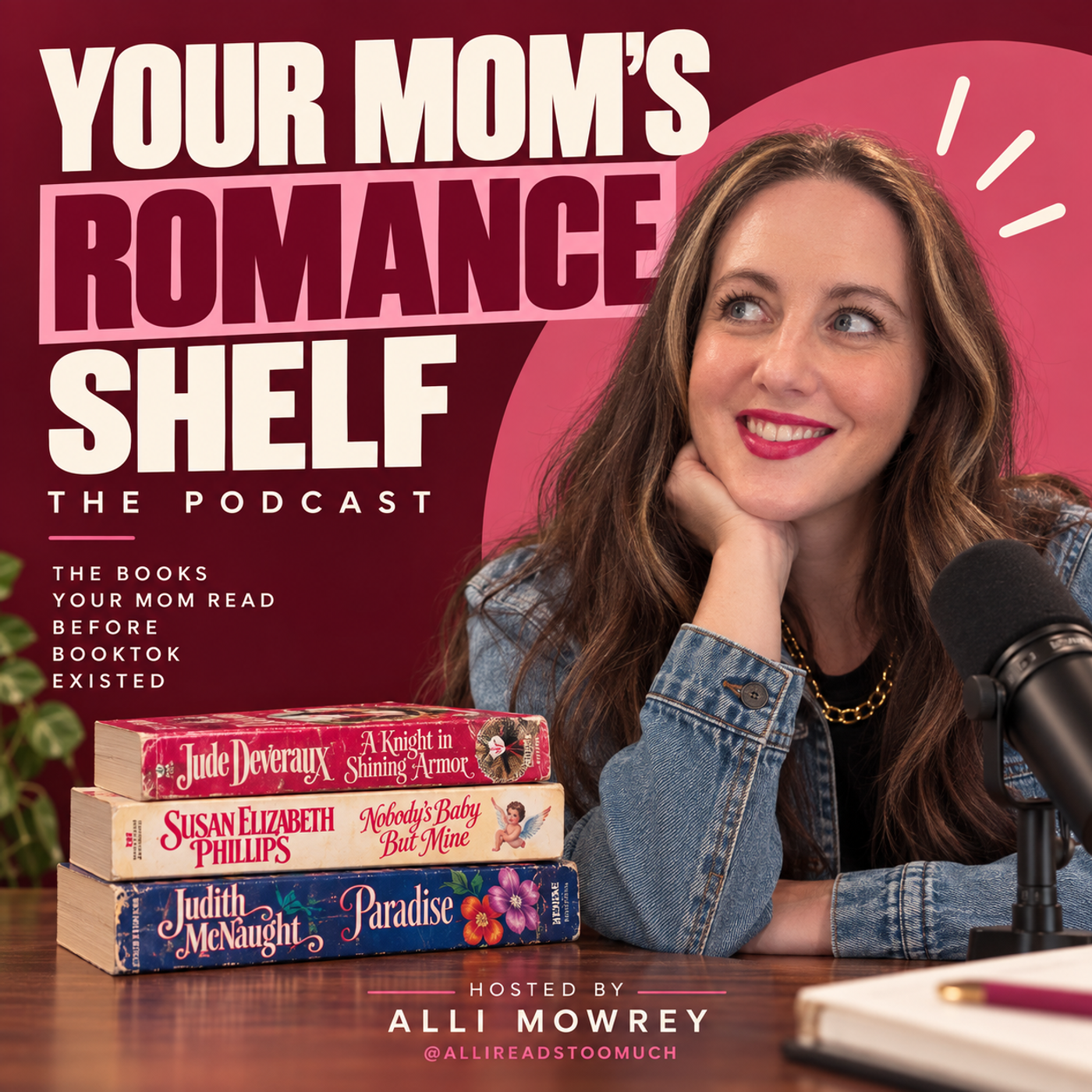
Your Mom's Romance Shelf· Staffel 1· Folge 2
Susan Elizabeth Phillips on Sports Romance, Alpha Heroes, Epic Grovels & the Evolution of Romance
Mittwoch, 21. Oktober 2026 · 53 min
Kapitelklicken springt direkt hin
Shownotes
On this episode of Your Mom’s Romance Shelf, I’m joined by Susan Elizabeth Phillips, New York Times bestseller, RWA Hall of Fame member, and the Queen of Romantic Comedy. Susan has been writing romance for more than 40 years, and her Chicago Stars series is widely credited with launching sports romance.
We talk about why Kiss an Angel has one of the best grovels of all time, what it was like to read bodice rippers in the ’70s as someone raised in the ’50s, and how The Flame and the Flower was pulled off a slush pile and changed the genre forever. Susan also shares how the Chicago Stars series happened completely by accident, the unwritten “rule” that once kept athletes out of romance, and why she thinks the NFL owes her an award.
Chapters
Cold open
Welcome and introducing Susan Elizabeth Phillips
A Cincinnati connection and sports romance fandom
How Susan started writing romance
Kiss an Angel and the art of the grovel
Why alpha heroes are harder to write today
“A book about your marriage would be kinda boring”
Nuance and flawed heroes in older romance
Bodice rippers, the 1950s, and “good girls didn’t”
Bodice rippers and the rise of the feminist movement
How The Flame and the Flower was pulled off the slush pile
Sweet Savage Love and the missing grovel
Before bodice rippers: Victoria Holt, Phyllis Whitney, and more
Alli’s nostalgia reading list and Susan’s recommendations
Rewriting Risen Glory as Just Imagine
Reading older romances in historical context
Sandra Brown’s “way of getting even”
LaVyrle Spencer and Laura Kinsale
Pacing and point of view, then and now
Why romance history matters
Why we reach for romance in hard times
How the Chicago Stars series happened by accident
Strong heroines ahead of their time
Writing secondary love stories
Will the Chicago Stars kids get their own books?
Sports romance today and Susan as its pioneer
The “rule” against sports romance and why the NFL owes Susan an award
Golf romance: Fancy Pants and Lady Be Good
What Susan is reading now
What Alli is reading now
The one older romance everyone should read
Learn more about the podcast: allireadstoomuch.com/podcast
Follow Alli:
Instagram: @allireadstoomuch (link) · TikTok: @allireadstoomuch (link) · YouTube: @allireadstoomuch (link)
Website: allireadstoomuch.com
Follow Susan Elizabeth Phillips:
Website: susanelizabethphillips.com
Instagram: @sepauthor (instagram.com/sepauthor)
Facebook: Susan Elizabeth Phillips (facebook.com/SusanElizabethPhillipsNovels)
Join the Your Mom’s Romance Shelf book club on Fable: fable.co/club/you-moms-romance-shelf-with-alli…
Transkriptvom Podcast bereitgestellt · Zeitmarken springen hin
Susan Elizabeth Phillips: I have had so many readers internationally say to me, I watch football now because of you, and I think the NFL should give me a prize or an award. Right.
Alli: I I think so too. Yeah. Yes. I mean, look at how many females you have probably brought, not only viewership, but I'm sure, merch and all of that.
Susan Elizabeth Phillips: And you know what? one of the younger writers because they won't know about me. So life you know, life is not always fair.
Alli: Yeah. Welcome to Your Mom's Romance Shelf, a podcast about the books your mom read before Book Talk and the readers who loved them. I'm Allie and I run Allie Reads Too Much on Bookstagram and BookTalk, where I talk about all things romance. Through my series Books Your Mom Never Told You About, I dig into the older romance novels that paved the way for the books that are being written and read today. Today's guest started out writing a book on a yellow legal pad with her neighbor, riding bikes in the evening with a toddler in the baby seat, and that book. The Copeland Bride sold to Dell in 1983, and 43 years later, Susan Elizabeth Phillips is one of the most beloved names in romance. She's written more than two dozen novels, from the YNET Texas books to the Chicago Star series, which began with It Had to Be You, the story of a woman who inherits a pro-football team. And that book is widely credited with launching the sports romance subgenre. And her newest Chicago Stars novel, And The Crowd Went Wild, came out this year. Her shelf is packed with honors. She won four Rita Awards for Best Novel, is the only five-time winner of Romance Writers of America's favorite book of the year, and was introduced into the RWA Hall of Fame in 2001. She's a New York Times bestseller, and fans know her as the Queen of Romantic Comedy. Susan Elizabeth Phillips, I am so excited to have you on the podcast. Welcome and thank you so much for agreeing.
Susan Elizabeth Phillips: I've been looking forward to talking with you because you certainly have fi highlighted a lot of books that are really important to me from that point in my career.
Alli: I'm so excited to dive in. I wanted to start with a little bit of a personal connection. So as I was doing some research and getting some information on your background, I saw that you were from Cincinnati, which is where I've lived for the past nineteen years. So that was fun. And then I read that you moved to New Jersey, which is where my my mom grew up and much of my family still lives.
Susan Elizabeth Phillips: Yeah, Cincinnati's a great city. I I you know, I was just there, I was born there in my early years I don't remember it, but I used to go back and visit my aunt there and and I loved it and I love Joe Burrow too, so there you go.
Alli: Yeah, there we go. I am a big fan of sports romance. I still know nothing about sports. you know, it even married for
Susan Elizabeth Phillips: I don't either. No.
Alli: but I enjoy being a fan and all things that with the fandom.
Susan Elizabeth Phillips: with sports romance what we're dealing with is another archetype of a hero. do I do I know football? Yeah, kind of, but I've always been much more interested in all the back room stuff and how these teams the business of it. but in terms of being able to dissect what's going on in a football game, even though I watch and go bears, it's it it I fake it a lot and then I have my husband check any scenes that actually involve football, which really in the Chicago Stars books, we're off the field a lot. We're usually in off season.
Alli: I I don't know anything. I and I will sit down when my husband is watching and I will usually read a book or be doing some sort of multitasking. And I do get into it when there's like a really dramatic play or when the game is really close, but that's about the extent of my interest in it. But I agree. There's something about just the setting the sports heroes that is very, enticing. know not only as a millennial who grew up with, this huge era of the cowboys were huge when I was growing up, the Bulls, basketball, but like also there's a little bit of a fantastical element around it too, because of like I think the archetypes and personas that you get around, you know, sports heroes and the fame that goes along with it. So I think it kind of feeds into a lot of like female fantasy aspect too, which I do have some questions around when we when we get to that. But
Susan Elizabeth Phillips: Mm-hmm.
Alli: I wanna ask you a little bit about how you got your start and who inspired you. I had read that you started writing almost by chance and would love to hear how that happened and what made you decide to write romance specifically.
Susan Elizabeth Phillips: Boy. I write wrote romance because that was what I loved reading. I mean, I've always been a wide reader, but I love these stories where the heroine re emerged victorious. And there's a long story about how actually I got started writing with a friend that's all on my website, SusanElizabeth Phillips.com. Basically, a friend and I decided to write a book, a romance together after we'd read a bad one. And we talked about the tropes that we liked. Of course, we didn't know the word trope at that point. And I'm honestly I'm so sick of hearing it, but we love the girl disguised as a boy and all those kinds of things. So that's how we started out writing. We just wrote one book together, she took off for law school, and then I was on my own and wrote another historical romance by myself that still had the things I love, the girl disguised as a boy. The hero who has all the power, the heroine who has no power, and at the end she emerges triumphant. I could write and read that story my whole life. I just love that of a woman coming into her own power.
Alli: I so agree with that. and I I think you have told that story beautifully in the wor in the books that I've read. I Kiss an Angel is one of my favorite heroine
Susan Elizabeth Phillips: Yeah.
Alli: transformation arcs that I have seen. I also I really, really love the heroine in Dream a Little Dream. she was my favorite part of that book.
Susan Elizabeth Phillips: In in Dream a Little Dream, I mean you talk about a heroine who has lost everything. But Kiss
Alli: Yeah.
Susan Elizabeth Phillips: an Angel is a book actually I'd like to talk about for a few minutes.
Alli: Yeah.
Susan Elizabeth Phillips: this is all I hear from readers is another Chicago Stars book, another Chicago Stars book, and they say, but my favorite book is Kiss an Angel, which of course is not a Chicago Stars book at all. I think readers will either really respond to that book or it won't be for them, because this book contains a real alpha hero. He's the master of a circus. He he his act is a whip act. He goes around with this whip as kind of the symbol through the book. The heroine is one of my favorite stories is the poor little rich girl who has no skills at all. And he really hates her at the beginning. When you have a book These older books with these really strong alpha heroes who are so mean. the hero that's kind of hard to do now in contemporary romance, but that was so popular in the 80s and even into the early 90s, well starting in the 70s. to make that hero work, you have got to have a good grovel. If you don't have the hero grovel,
Alli: Yes.
Susan Elizabeth Phillips: the book is never gonna work. that's my favorite grovel in that book.
Alli: It is an amazing grovel, the grand gesture. And I loved her arc so specifically because she is someone who like she really doesn't know who she is at the beginning of the novel. And her life has really been in her everything that she's done has been kind of architected by the people that were around her. You know, her mother and her, challenging family dynamic with her her father and stepmother, and she's used to having a lot of money, being at these parties, was taken in and out of school. she's never had a work, never had a job, and now she's slumming it at the circus, you know, doing all of these menial chores and living in, a somewhat dilapidated trailer. very, very different lifestyle.
Susan Elizabeth Phillips: Yeah,
Alli: and forced into this, you know, marriage of convenience and she finds her own in that environment and finds out who she is, what she actually gets her energy and passion from, at the same time that she's developing this relationship with the hero. And I totally agree with you. It's one of my favorite grovels, of all time. I, you know, yeah.
Susan Elizabeth Phillips: It's a good gravel, right? It's a good gravel. know,
Alli: I miss that in some contemporaries. and I don't think that every book needs that third act break up but we don't have as many really great, dramatic third acts with a really good grovel.
Susan Elizabeth Phillips: Well, and the reason we don't is because readers are especially I mean, younger writers are not gonna write these kinds of men. we I think earlier in my generation, we were very clear that these were not men we wanted to be married to. These were fantasy heroes. And I think with younger readers and even me now going back and reading these books. Times have changed, and we're not really willing to accept that in a man. But what happens if you're a fiction writer is if you're in my books, pretty much the villain of the book is the hero.
Alli: Yeah.
Susan Elizabeth Phillips: And if you're if he's not going to be the hero, well, what is the conflict going to be? Yeah, it can be things like you know, he's a wanderer and she's a homebody or something like that. But that doesn't tend to be always a really strong dynamic. It can be. But a lot of times the conflict has to be external or it has to be something that's made up internally. And that's a real challenge for people writing contemporary romance now. It's one of the reasons romanticity is so popular, because in romanticy you can do these strong alpha heroes, and everybody will accept it when they won't accept it in regular contemporary romance. And the thing about Daisy that I loved in Kiss an Angel is she has no skills beyond applying makeup and putting on and doing her hair. And to take somebody who's in so in so many ways so helpless and put her up against this extremely strong hero. It's pretty much the same kind of dynamic that Catherine Wood was created in Flame and the Flower. you have
Alli: Mm-hmm.
Susan Elizabeth Phillips: a pretty insipid little virginal hair heroine and this. Very, very strong hero.
Alli: Yeah, I'd never thought of it that way, but I can totally see how it feels like, an analogue of that type of dynamic. And I do I think about this a lot. my husband is like the most, understanding, docile, like partner and just like, Yes,
Susan Elizabeth Phillips: The man you want to be married to.
Alli: we have been together for like almost twenty years. He is the most hands on father. I always joke that if you were to ever say who wears the pants. It's like 60 40, me, him, you know? And we both have an equal partnership for the most part, but I have just a little bit more say. but I love reading these alpha heroes. But I think that there's something about the transformation of like it in a fantasy for women of, being able to take this very dominant, alpha hero personality and bring him to his knees by the gravel point.
Susan Elizabeth Phillips: And
Alli: Within the novel.
Susan Elizabeth Phillips: you know, with all respect, your a book about your love affair with your husband would probably be kinda boring.
Alli: Yeah. Yeah.
Susan Elizabeth Phillips: Right? Because the conflict isn't gonna come between the two of you because he's such a great guy. You are a fully actualized person. So the conflict has gotta come from some stalker or something way out outside
Alli: Yeah.
Susan Elizabeth Phillips: reality, which may not give us the most adrenaline producing love story, but that's what you want in real
Alli: Yeah.
Susan Elizabeth Phillips: life.
Alli: And I think something that I love about some of these, older heroes too is they feel during a time where like if we think about movies and like I'm thinking specifically about like Disney heroes, where you were presented with the protagonist and the antagonist in a very non-nuanced way. These books did a great job of offering nuance to sometimes the extent where like you feel guilty for liking the hero who has behaved really badly. I mean, I certainly felt that when I read The Flame and the Flower.
Susan Elizabeth Phillips: Ooh, yeah.
Alli: It was such a very like nuanced and multifaceted portrayal of of some of these, both heroes and heroines, where they were flawed and felt very real and tangible, even in like a setting that was very fantastical or with plot elements that were very fantastical. And I do think that, dark romance is doing like it certainly romanticity, but there's some authors in the dark romance space that are still doing like very alphabetical. it's you don't see as much of that nuance anymore.
Susan Elizabeth Phillips: Yeah.
Alli: It almost feels like you're getting more of that like kind binary view of like yeah.
Susan Elizabeth Phillips: Yeah. No, I know I know what you mean. And another thing that when we talk about these early romances and we talk about these really strong alpha heroes, we have to talk about the rape issue because this is something that is
Alli: Yeah.
Susan Elizabeth Phillips: so difficult for modern readers to understand how this happened at that particular point of time. But I will tell you that as someone who was raised in the nineteen fifties, the only way you could have sex Outside of marriage is if it wasn't your fault. And
Alli: Yeah.
Susan Elizabeth Phillips: that is why those rape fantasies were so prevalent at that time. This was, you have to remember, this was before the age of any kind of women's sexual liberation. Good girl didn't. And in these real bodice rippers, the good girl didn't, it wasn't her fault, and yet she had amazing sex.
Alli: Yeah.
Susan Elizabeth Phillips: And we have to look at history through a historical perspective, that's tough for a modern reader because that's such a trigger. Do I want to read that fantasy now? No. But at the time it was absolutely thrilling. it's just so easy to pass judgment on those books, and I understand it, but it is, I think, worthwhile to look at them through the perspective of what was going on in that time socially. and we also thing
Alli: I think that's really a helpful perspective. go sorry, go ahead.
Susan Elizabeth Phillips: that we have going on then is Flame and the Flower came out in nineteen seventy three, I think Sweet Savage Love came out about three years later. And that's a category by itself. But the rise of those so called bodice rippers happened right along the same time as the rise of the feminist movement. And
Alli: Yeah.
Susan Elizabeth Phillips: I remember I always regarded myself as a feminist, yet I was perfectly comfortable writing sort of these rape fantasies. once we found women really coming to their power in the 90s, well, we don't need that anymore. But again, We need
Alli: Yeah.
Susan Elizabeth Phillips: to l we need to look at the romance genre in a academic way, we need to look at it in its place in the literary canon, in its place what was happening in historical times in terms of the women's movement. And that is where I think those books have a really strong place in literary history.
Alli: Yeah. I appreciate like all of the perspective because I certainly like can apply my historical knowledge, what was going on at the time. And I had read that Kathleen Woodowis did include what happened between Heather and Brandon at the beginning of The Flame of the Flower as a plot device to have a way to show premarital sex because it just was not shown prior to that time. It was actually, I from what I understand, one of the first novels to include open door scenes of any kind. But even prior to that, like closed door whatever,
Susan Elizabeth Phillips: The door closed.
Alli: historical novels did not include premarital sex. And so, I think it's helpful just to have that, qualitative example that you shared because through today's logic and frame of reference, like it's like, well, could couldn't she have done that in a million other ways? But like hearing
Susan Elizabeth Phillips: Not a
Alli: it from you as someone who lived through that, like I think that's really interesting. And I I agree with you. I think I I love going back and rereading these novels almost as just a a way to understand. like women during this time period.
Susan Elizabeth Phillips: Yes.
Alli: And I also think that the writing is really beautiful. Like one of the things that was most shocking to me when I started this is everybody I mean people dismiss romance in general, but especially these bodice rippers, the perspective that you get from both media and people you talk to is that they're very, gratuitous and there's not a lot of substance. And I have found the opposite. I think the writing in many of the books that I've read is in many ways eloquent and lyrical, beautiful, well researched. I think there's so much character development and world building. And it just makes me sad that they have been so often dismissed and I love going back and rereading them. as a historical artifact. Like I knew going into the flame and the flower just from what I had heard from people. And you know, I'm a big listener of of Sarah McLean's Faded Mates podcast and so I've heard her talk about it many times. Like I knew
Susan Elizabeth Phillips: Yeah.
Alli: that I was going in and like I can't judge this by today's standards because certainly not from a like qualitative perspective. this is a book that's important to the history and it was written This way at a time when there was no precedent for this type of novel. So
Susan Elizabeth Phillips: Yeah.
Alli: I think it's
Susan Elizabeth Phillips: Do you know the story behind the publication of Flame and the Flower and Sweet Savage Love?
Alli: So what I know about the flame and the flower, and I'm not sure if there's more to it, is that there was a deal with Avon and it got a pretty big advance and it was, I believe,
Susan Elizabeth Phillips: Before that
Alli: the first before that I do not
Susan Elizabeth Phillips: Okay. So there
Alli: So
Susan Elizabeth Phillips: was an editor at Avon named Nancy Coffey, and one weekend she just randomly picked up a book off the slush pile, just came in over the transom and she took it home, and she couldn't stop reading it. Never had seen anything like it before. Open door sex, all of the big, big emotions, and that book was flame in the flower. So All of this goes back to Nancy Coffey picking up that book and realizing what a strong emotional response she got from it. So that book came out in 72. Then in 74 she picked up Rosemary Rogers' Sweet Savage Love. Now that's an interesting book that I don't think can stand the test of time. I remember when I read Sweet Sav have you been able to read it yet?
Alli: haven't. I am in the middle of prisoner of my desire though.
Susan Elizabeth Phillips: okay. In Sweet Savage Love, the hero, it's a series. the hero is brutal and that's fine, but we never get a good grovel from him. And that always
Alli: Mm.
Susan Elizabeth Phillips: made me uncomfortable with those books. and so it's interesting to me you don't hear a lot about the Rosemary Rogers books, but you still hear people people talking about the Woodowist books.
Alli: Yeah. And I'm still she's still on my list to read, just to again, you know, get it
Susan Elizabeth Phillips: You'll be uncomfortable, I think.
Alli: I yeah. I do you think that's the best one to start with?
Susan Elizabeth Phillips: yeah, that was the first of the series. Jimmy and I can't
Alli: Okay.
Susan Elizabeth Phillips: remember what his name was. But ooh yeah, that was a barn
Alli: And I know you mentioned Prisoner of My Desire in our emails as well, Joanna Lindsay. And I've read Gentle Rogue, which I enjoyed, and then I'm about thirty five percent of the way through Prisoner of My Desire. And I mean it's it's kind of a similar reading experience that I had to the Flame and the Flower so far. I've just gotten to the point where he kidnaps her. I again, I went into it. you know, a historical artifact and there's going to be problematic just the even reading the plot in the back, that there's there's going to be rape in it on both sides. but it's an interesting story and I'm I'm locked in. but that one was written later. I I think if my Goodreads you know, research was correct, it was nineties, which kind of surprised me. Like I'm interested in your point of view on, you know, this still being written. And let me look up
Susan Elizabeth Phillips: Yeah.
Alli: Whether it was I think it might have been early nineties, but
Susan Elizabeth Phillips: I I don't remember when, but Joanna Lindsay was one of the authors who lasted longer. And of course Wood was Tid too, but I don't think her later books had that same kind of emotional churn that the earl the early ones did. And you know what was interesting to me, I took a look at at Amazon and Flame of the Flower still has a four point four rating from Goodreads. Yeah, I mean
Alli: It does. Yeah.
Susan Elizabeth Phillips: and Sweet Savage Love has a 3.94, which surprised me. I thought it would be, I thought it would be much lower than that, but no, it didn't. Before these books came out, you know, I was just such a big reader the whole time. Before these books came out, if you wanted a woman as a central character, you were reading Anya Seaton, Victoria Holt, Phyllis Whitney, and Nora Lofs. But what I can't remember because it's been so long, I cannot remember in those books whether the heroines saved themselves or whether they had to be saved. I think I'll put up an inquiry about that on my Facebook page because somebody will remember. Can't remember that. But everything the door closed, it was so, so frustrating. But they were our pioneers. So I give
Alli: Mm.
Susan Elizabeth Phillips: those women huge props.
Alli: Yeah, I Victoria Holt is and Phyllis Whitney are definitely on my list. I have not read any of theirs yet. I've done sixteen books so far in my like nostalgia series. I'm on my seventeenth and eighteenth because I'm reading right now Prisoner of My Desire and then Almost Heaven. But I've read a few Judith McNaught, now a couple Joanna Lindsay, Woodwiss. I've read Four of your books. I've read who else am I forgetting about? Sandra Brown. I've read Elinda Howard and I have some more on my my shelf to read of her Laura.
Susan Elizabeth Phillips: Did you read Linda Howard's Mackenzie Mackenzie's Mountain? That was
Alli: No, I've just read so far Mr Perfect, so Romantic Suspense. Yep.
Susan Elizabeth Phillips: Okay, this is earlier. Mackenzie's Mountain, I think, is one of her series books, maybe with Harlequin or so, I don't remember. That was another book that was just like, what is going on? and there was somebody else she mentioned I wanted to comment on. flew right through my brain. yeah, Jude Devereaux. Judith McNaught.
Alli: Jude Devereaux, I forgot to mention. Judith McNaught.
Susan Elizabeth Phillips: You where did you start with Judith McNaught?
Alli: So I started with Paradise. So one of her later ones, because I actually found it. We have a romance bookstore here in Cincinnati called Poor Charlotte's, which I love it. And they have at the front, they this shelf of old novels that you can just take. they're free. And I found it there, and it took me probably two or three months to actually read it because it was so long, I just kept putting it off. And I think it was 750 some odd pages. And I sat in that chair, it was a weekend, and I needed to be doing laundry, and I could not put it.
Susan Elizabeth Phillips: yeah,
Alli: it down.
Susan Elizabeth Phillips: yeah.
Alli: I read it in 24 hours. and then I immediately read perfect right after. And then I went back to Kingdom of Dreams after that. So
Susan Elizabeth Phillips: You the book when you get around to it, read Whitney, my love. That was the book that McMahon that was her first one.
Alli: That one I have, yeah.
Susan Elizabeth Phillips: And I think that's another one that you'll find is a little problematic for modern readers. But we love that book.
Alli: So I'm interested in that one. I haven't read it yet. I do have it. but I have heard that she rewrote the problematic scene later on, which I think is really interesting.
Susan Elizabeth Phillips: yeah, yeah. I'm not I'm not surprised. Yeah.
Alli: I think that's a really interesting take and I wanna read both versions,
Susan Elizabeth Phillips: Yeah.
Alli: just to familiarize myself, but thought that that was interesting.
Susan Elizabeth Phillips: I did that with with two of rewrote them. I did a a historical by myself called Risen Glory. And I revised it and rewrote it many years later, and we republished it as Just Imagine. But I didn't leave the problematic things al I left them alone. We still have, you know, the girl disguised as a boy and the really strong, the guardian, right? But what I did at that time was tighten up the writing. I remember I
Alli: Yeah.
Susan Elizabeth Phillips: took out a hundred pages of that book, added all kinds of new scenes, and you wouldn't know the you wouldn't know the difference. It just became a better book. But I I left the problematic stuff in there. I mean, I I don't there's no rape in it, but it you know, he's a pretty tough hero.
Alli: I think in a lot of these books, like what I've noticed, even if they don't have super problematic scenes, a lot of times you have dialogue that is, I think, emblematic of the times. And it's interesting to me just to see where we've come. and obviously we still have a long way to go. I absolutely consider myself a feminist too, but I th I think it's really interesting to look at a lot of these books that way again and kind of think about what was going on at the time. You know, what was the male-female dynamic for people that were in relationships? You see a lot of like grabbing arms really like hard enough to bruise and stuff like that in a lot of these old books. I think at one point in Kingdom of Dreams, like he I can't remember what
Susan Elizabeth Phillips: Yeah.
Alli: he calls her, but it's something terrible, like a slut or something like that. And it's just really charged language. But again, like he d I mean the grovel
Susan Elizabeth Phillips: He's gonna pay for that. He is gonna pay for that. Yeah.
Alli: talk about another great grovel. That is a great grovel. so I still like very much enjoy. Again, and it you just you take it with the context
Susan Elizabeth Phillips: Yeah.
Alli: that like that was acceptable and that at the time that that was written, and you wouldn't find anybody probably writing that today, outside of maybe the very dark, dark romances where everything is kind of trigger warning to out in the beginning of the book.
Susan Elizabeth Phillips: Yeah, yeah.
Alli: but I do find find that part interesting. And even, you know, the the Sandra Brown that I've read, I have a lot more that I have to get to by her. But it was one of her earlier works that was originally written under a pen name. And I think it was written in like the early eighties. And you can really tell a difference, I think, reading the books that were written in the seventies, like a Woodwiss,
Susan Elizabeth Phillips: Absolutely.
Alli: the eighties, and then the nineties. and and it's just it's fun.
Susan Elizabeth Phillips: Sandra Brown is such an interesting writer. I've known her for years and years and years. And she wrote tough, tough heroes. They were always drinking, all this kind of thing. And Sand Brown was growing up the ultimate good girl. And didn't drink. I don't even know that she she probably doesn't even drink now, the ultimate good girl. And so she would write these really strong, trashy heroes. I said, This is your way of getting even. She couldn't act any of this out in real life and so she did it on the page and did
Alli: Yeah.
Susan Elizabeth Phillips: it brilliantly.
Alli: I think there's so much of that from a reader perspective too in reading the types of people that you wish you could be or just you never could be. I get in these deep mafia romance kicks and I love the danger of it all and I'm like the most like you know, type A person, risk inverse. I always have a plan B, plan, C to everything I'm doing. But it allows me to like fully escape. It's a it's a fantasy, so
Susan Elizabeth Phillips: Yep, absolutely. One hundred percent.
Alli: So I think that that's a really interesting element of it too. So those are who I've read so far. I'm trying make sure I haven't forgotten. And then I have a lot more. I mean, I think I have about twenty-five physical copies that are like on my TBR that I need to eventually get to. I haven't fully read a LeVoral Spencer yet. That's another one that's recommended over and over and over again. But I have several that I need to get to. And I have Hummingbird. It's just it's not they don't have it on Kindle and I have the physical copy, I just can't like my eyes, it it's such small print. It's really hard to read.
Susan Elizabeth Phillips: Now Laverle never she never wrote the the really tough heroes. Her books are very those early books very lyrical, very deeply emotional. Morning Glory,
Alli: Yeah.
Susan Elizabeth Phillips: I remember that one. Morning Glory, I think, was the first no. I don't know. I may be misspeaking. She her book was the book that had the first floral cover. instead of a clinch on it.
Alli: Mm.
Susan Elizabeth Phillips: But maybe it was the gambler. I don't know. I've kind of forgotten. But she did not do, she never did that. she just had these wonderfully developed heroines and really pretty much very kind heroes and it served her very, very well.
Alli: Yeah, I have Morning Glory. I need to read it. Hummingbird, I'm about halfway through that one. And he he's like a little rougher around the the edges.
Susan Elizabeth Phillips: think it's the first issue
Alli: he's like a he's a vr at the be at least right now, they think that he's a train robber and she's been nursing him back to health. interesting setup.
Susan Elizabeth Phillips: there has been a problem with getting some of Laverol's books and it's a shame because a lot of her books younger readers will find really appealing.
Alli: Yeah. So who should I like wha who are others that I should add to my list? I have Rosemary Rogers. I have some Laura Kensale that I have earmarked in my on my shelf. I've definitely
Susan Elizabeth Phillips: Laura Kinsale Laura Kinsale has a book. I can't believe I've forgotten the name of it, The Hero's Brain Damaged. He's in a prison. And this is another deeply emotional, the the ultimate wounded hero book. I gave it to a reader, I suggested it to a reader who likes historical romance, a more younger reader. And they found it a little tough going because it's very descriptive. It's not literary, but in their mind, because everything wasn't coming quick and fast, it was a little slower read. But I always remember I mean, that book is powerful. I cannot remember believe I've forgotten the name of the name. But Laura Kinsale was a A writer who experimented a lot, and sometimes it served her well, and sometimes it didn't in terms of finding readers, but she was always an excellent, excellent writer.
Alli: I do think that that is probably one of the biggest differences I've found between a lot of these older novels and contemporary ones is I think that younger readers want like instant gratification from a pacing perspective. and so the fact that you did get so much character development setup world building, I think is is very different from a lot of contemporaries. I think you get it in romanticy for sure, but still the style is very different.
Susan Elizabeth Phillips: Mm-hmm. You do. Yeah.
Alli: The point of view is always very interesting to me too, that a lot of these older novels use more of a narrative point of view, or omniscent, as opposed to like a third person or a first person. And it's that part is very interesting to me too, because you always know a little bit of what each character is thinking with that type of point of view.
Susan Elizabeth Phillips: Mm-hmm. Al, I really appreciate
Alli: But you just
Susan Elizabeth Phillips: that you are shining a light on some of these older books because I think it's important in our literary canon to make sure these books don't go unread, unnoticed, and unappreciated. We have a very, very powerful genre. Our history is rich and deep and I love the fact that you're shining a light on it. You and Sarah McLean. Maybe somebody else is doing it, but you're the two that I know. Sarah's the sh Sarah's the the grandmother of it all.
Alli: Yeah. Yes, I have loved listening to herd podcast and I think it's just really interesting to see how it's evolved and how these books have given women an outlet, agency. I've always been a reader. I've never read as much as I've read over the past year and a half. I was very eclectic reader before. especially like post grad school, I always had a non fiction going, I always had a fiction going. a lot of historical fiction, a lot of literary fiction. I read some romance. I would, do occasional mystery, but it was very eclectic and ad hoc and then I went through a really, really tough career transition and all I wanted to read was romance. after I read one I picked up another and by the end of that year I had read a on average a book a day. And I've slowed down a little bit since then but it it truly like gave me I think a very healthy way to cope with depression and a way to escape. there's certainly worse things worse vices, outlets, addictions. That's what I told my husband every time he's like, Another book is coming I'm like, Well, it could be it could be worse. this is a healthy outlet.
Susan Elizabeth Phillips: Yeah. Well, what what we have with romance and really with popular fiction in general is we have that optimistic outcome. Not just the happy ending, but the fact that justice is served, that there is order in the world. And I think that's one of the reasons we reach for popular fiction when we're having not just whether it's just
Alli: Yeah.
Susan Elizabeth Phillips: daily stress or whether you're really having dark times, because you know there will be order. and that justice will be done and and right will prevail.
Alli: Yeah. I think that's a great way of putting it. it's not only the happy ever after, but the antagonistic characters too, like the the problematic, side characters, they always kinda get theirs.
Susan Elizabeth Phillips: They're gonna get theirs.
Alli: the the ex-boyfriend always like comes back and grovels and then the new guy's there and like he gets
Susan Elizabeth Phillips: Yeah.
Alli: his, I wanna ask you, I definitely wanna delve into a little bit of sports romance. I I wanna ask you about the Chicago Star series. I have read a couple from that series so far. I love Nobody's Baby But Mine. it is still one that like I remember so vividly and I think about it. I feel like once a week. I just keep telling my mom, you have to read this book, mom. You're gonna, you're gonna cackle, seriously. It's gonna make your like you're gonna get abs from how much you laugh with this book. And I wanna ask you about where the idea came from. So you were writing historical romance when you first started, which was very much what was popular I think in the seventies and eighties and then the nineties things really did start shifting, but where did the idea come from?
Susan Elizabeth Phillips: I had I did three big books before that, three contemporary big books, Glitter Baby, Hotshot, and Honeymoon. But I all the time I was writing, I had this idea in the back of my mind. I thought it would just be hysterical if a woman who knew nothing about sports inherited a professional football team, an NFL team. and it just tickled me. So I finally started to write it, and that was the book that became It Had to Be You. where where we have this blonde bombshell who presents herself as a sex pot and of course she isn't inherits the Chicago Stars from her abusive father. And the head coach Dan Calebow all of a sudden has this woman he regards as a bimbo as the owner of the team. And I was about in the maybe fifth or sixth chapter when this wide receiver out of Tela Rosa, Texas, named Bobby Tom Denton came along. And he was so arrogant and full of himself, such a pretty boy. I thought, he's gotta have his own book. So I went on and I paired him up with a woman who worked for a nursing home, little Gracie Snow. That was Bobby Tom Denton and Gracie Snow, and that book became Heaven, Texas. Then, you know, I I'm not gonna write a series. I just had those two books in my head. So that's when I went around along and wrote Kiss an Angel. And when I was writing about that, I thought, wouldn't it be interesting if this woman, who is like a brilliant, she's a genius, she's a particle physical physicist. it's her third 30th birthday, she's never had a child, she wants a child desperately, but she's always been an outsider. always felt out of step with everything, but she wants a child of her own, but she doesn't want to risk. having a child as brilliant as she was because her upbringing was so was so upsetting. So she needs to find somebody stupid to father this baby. And the minute I thought that I went, that takes us right back to the Chicago Stars. So that was the way that happened. never planned on a series. But like the book would I'd be writing a Chicago Stars book and then maybe a character would come in that I would get interested in. And I think when I wrote This Heart of Mine, I don't know which maybe that was the fifth book or something, that was it. I had a big curtain call at the end with all the characters from all the books. And then I got another idea. So the whole series has, I as you can tell, I'm not an advanced planner. I'm a really intuitive writer. So the whole series invol unspeaked. kind of unspooled accidentally, ending with and the crowd went wild, which is the last Chicago I've said this before, but this is the last Chicago Stars book. I think I it's basically because I cannot write another sports agent, wide receiver, or quarterback. I'm just done. I can't bring anything new to that. So unless I could, then then no more Chicago Stars books. And I'll tell you, the frustrating thing about this series is Every book stands on its own. But like if I have a new book come out, readers think, I have to start at the beginning. No. No.
Alli: I went in with number three and I still I need to go back and do the first two, which I will at some point. but I mean they all can be read as standalones.
Susan Elizabeth Phillips: Any place. Yeah.
Alli: you definitely see the other characters show up in the in the novels,
Susan Elizabeth Phillips: Their side.
Alli: as side characters, but it's yeah. one of the things that I love i and you know, I've I've just done four so far, but in nobody's baby but mine and the first one, her being a pro football team owner, these are women in the early mid nineties, with a lot of agency who are strong and know who they are. And even Dream a Little Dream, I mean, talk about Rachel, you know, she is just been through it, as we talked about earlier. But she is so resilient. And so astute, she is strong in who she is and what she wants. And Jane from Nobody's Baby, I feels like she was written before her time. my millennial self, we, you know, got very into STEM, right? And then you had all of this media come out around there. Obviously STEM romance is kind of its own subgenre now, but even thinking about other forms of media, big bang theory, where being smart, you know, once we got into like the mid 2000s, was a was a cool thing. And this feels like kind of before its time and you were writing these really strong female characters who were in the boardroom or like had these, very important jobs and you know, with Nobody Baby like the fact that she's like, I want a baby and I'm gonna find my own way to do it just felt very progressive and forward thinking.
Susan Elizabeth Phillips: I think the books have all I've always been just a little ahead of the curve, which sometimes has served me well and sometimes has not. But because I, you know, I'm not a writer who says, this is the next trend, I gotta jump on it. I just kind of follow my heart or whatever weird inspiration I get. but yeah, these have got if I'm gonna create these strong heroes, I have got to create strong women to deal with them, even though they may not initially seem that. They've gotta be strong. Now, the heroes I write now, they're still
Alli: Yeah.
Susan Elizabeth Phillips: they still can be such jerks, but they are a softer hero. They're not gonna be pulling out whips. But that was fun, you gotta admit,
Alli: Yeah.
Susan Elizabeth Phillips: with the with with an angel.
Alli: it was so fun and I mean the third act conflict and then the grovel, I mean I was already on the edge of my seat and just loving the book and then like it was just like you can feel your heart pounding and you just have this visceral experience to what's going on. I love that when a book literally like I feel like I'm in the story and it's happening to me. And that it that's a gift to be able to to write that kind of experience. I want to also ask you about the other one of my other favorite things about your book, which I have not found a lot of other writers that I feel like do this well. But you write a lot of secondary love stories in your book, And I often have found in like other books that that sometimes takes away from the character development of the main character or the kind of pacing of their relationship and its trajectory. But in every book I've read so far, the The secondary love stories are just so well done to where like they offer so much color, but at the same time don't take away from the main characters and their relationship. And nobody's baby mind you get the the love story of the parents who they're at a crossroads in their marriage, and then in Dream a Little Dream, you have the secondary love
Susan Elizabeth Phillips: Yeah, easy.
Alli: story with Ethan, the other brother who is a pastor. and kind of like the good girl who has always followed the rules, they're friends, she works with him, and you know, she's been in love with him for years and he has no idea. And then she has her glow-up moment and he notices her. how do you do that and write it in a way where you get this rich kind of secondary story, but at the same time, it doesn't take away from the the character the main characters and their story.
Susan Elizabeth Phillips: The secondary story has to
Alli: Okay.
Susan Elizabeth Phillips: be interesting. I do that again in my Wynnette Texas book, Lady Be Good, where I have the nerd and the social light in a in a secondary love story. and how to do it, I don't know. You j I just have to figure it out as I go along. It can't take away from the main story. But sometimes your main story you need a little teen of break, and if you can bring in a really solid conflict and fun with a secondary story then you do it. Actually I'm working on something now. I mean I'm just still in the beginning stages. but I'm I've been thinking it see you you said this at a at a really crucial time because I've been thinking of a really fun secondary love story to bring in this one because I haven't done it in the last few books. So maybe it'll work out. It just can't take away from the main story and it has to go somewhere. It it it has to be a story you can tell pretty simply,
Alli: Yeah.
Susan Elizabeth Phillips: but it has to go somewhere and you gotta have that churn.
Alli: Yeah. I agree and I just I loved them so much and I'm sure you get this question all the time, but Cal and Jane's daughter. I we get peaks of her in the epilogue and I know that there are some peaks of her in other books. Would you ever do a spin-off where she gets her own love story?
Susan Elizabeth Phillips: I'm asked about the kids in a number of the books doing stories. the only well I've done two of the spin-off stories. Lucy's story, Lucy First Appears in First Lady, and then I did The Great Escape. And what was the other one? in this heart of mine, I do her story. In what book? I'm I'm blanking, but anyway, I've done it twice. and They was that was because I had a solid story, not because I wanted to all of a sudden, you know, I've got to do this story. I just can't do it. I wish I could do Rosie's story, but it just hasn't. For one thing, a lot of my heroines have weird childhoods and these characters have good childhoods. So that kind of always gets in my way. But I like the fact that readers want these stories
Alli: Yeah.
Susan Elizabeth Phillips: and and that those they've connected with those children.
Alli: Yeah. I think it's it's symptomatic of the fact that they've developed such a deep parasocial relationship, with the main characters and the parents and she certainly like the little glimpse that you get of her in the epilogue, so precocious and you can just see her, having a great personality in her own story if she ever gets one. I wanna ask you a little bit about like how the genre has evolved in sports romance today, because obviously like we're seeing this huge surge just in romance in general with with book talk and bookstagram but specifically sports romance and it's really come into like the the mainstream in the forefront I think this past year with all of the press around heated rivalry and the off campus series and now we have so many adaptations that are coming and do you pick up any contemporary sports romances? How do you think about like kind of how sports romance has evolved and and the fact that you one of the first, if not the first, really writing it and certainly at a at a mass scale.
Susan Elizabeth Phillips: think somebody told me there was a silhouette romance with a with an athlete before it had to before well actually the first sportsman's was my book fancy pants where the hero is a golfer the single most boring sport in the world but the hero isn't which was the key somebody said there was a silhouette romance before that but in terms of consistently sticking with that I do proudly claim the title of a pione the pioneer. in terms of what they're doing with sports romance now, I don't read it. because I have my
Alli: Yeah.
Susan Elizabeth Phillips: take on it and it's just I stay in my lane. I cheer them all on and stay in my
Alli: Yeah.
Susan Elizabeth Phillips: lane. But originally I think the reason that we didn't have a lot of sports romance is there was some kind of a rule. Which I as always assume goes back to Harlequin, although it may not, that women we were not allowed to write about sports, actors, or rock stars. And sports I kind of understood
Alli: Mm.
Susan Elizabeth Phillips: because they Harlequin sold internationally, they're figuring American football is not gonna translate. Boy, were they wrong about that. I have huge audience in Germany,
Alli: Yeah.
Susan Elizabeth Phillips: for example. And country I mean, I've the books are in 30 different languages. So they were wrong about that, but I do understand it. But nobody told me there was a rule because I didn't come out of series romance. So I was very, very lucky then. I have had so many readers internationally say to me, I watch football now because of you, and I think the NFL should give me a prize or an award. Right.
Alli: I I think so too. Yeah. Yes. I mean, look at how many females you have probably brought, not only viewership, but I'm sure, merch and all of that.
Susan Elizabeth Phillips: And you know what? one of the younger writers because they won't know about me. So life you know, life is not always fair.
Alli: Yeah. Yeah. I think that the genre like I and you mentioned I I have to read fancy pants here soon. That's one of the ones that people mention to me a lot. But one of my favorite sports romances, in my top ten is actually a golf romance. it's Fangirl Down by Tessa Bailey and I just picked it up, I didn't expect anything, which are sometimes some of the best experiences when you just go in completely blind with no expectations and I just fell in love with both of the characters, but I'll have to read that one now too, because I I love sometimes just getting some more of those like lesser known unique sports out there too, 'cause I w I n I love the hockey romance and football romances and baseball romances, but there's so many of those now and you don't get as much as you certainly don't get very much like golf or tennis or soccer, although I think there's there's more now, especially post World Cup. I feel like I've been seeing more soccer.
Susan Elizabeth Phillips: Probably more. Yeah. Yeah, well with golf, Fancy Pants was the first one in that one we have this good old boy Texas golf pro. Grew up on the public courses and the heroine is a British beauty. aristocratic British beauty. And then I did that again with golf in Lady Be Good, where the heroine he's another Texas good old boy, and the heroine is the headmaster of a British Girls boarding school. Those both just tickled the heck out of me. Yeah. So I've done actually
Alli: That's fun.
Susan Elizabeth Phillips: three books set with that golf thing. There's one more. It it's with Ted Bodine, who's a kid who goes all the way through three books. But I do like golf is only fun if you can play against the stereotype.
Alli: Yeah. It's definitely a different archetype personality, for sure, I think, and and
Susan Elizabeth Phillips: Not if you play against the stereotype at all. He Same I mean, with these Texas good
Alli: okay.
Susan Elizabeth Phillips: old boys, that is that's fun. But if you do the preppy kind of golfer, it's a problem. Unless you do the female golf pro, which I have not done. But I think that would be fun too.
Alli: Yeah, that would be fun. I know you mentioned you kind of stay in your lane, not reading contemporary sports romance. What are you what are you reading right now? What are you enjoying? is it romance? Is it something else?
Susan Elizabeth Phillips: I knew you were gonna ask this, so I wrote down what I have read and it is the weirdest mishmash. The closest thing I've got to romance is The Road to Tender Hearts by Annie Hartnett. which I thought was lovely. And Hilary
Alli: Okay.
Susan Elizabeth Phillips: Yablin, Sylvia's second act with an older character, love both of those. Otherwise, John Green's first adult novel, Hollywood Ending, was kind of interesting. Not a lot happens in
Alli: Mm.
Susan Elizabeth Phillips: that book, but stylistically, it's just a very, very warm book. I enjoyed it. Emily St. John Mandel's Exit Party, which I didn't like as much as I like Station 11, but she just takes you on the weirdest ride. Calamity Club, I've just finished that. And Richard Osman's new series, We Chase Shadows. So that's where I am right. I actually I'm reading We Chase Shadows right now. And it is kind of a mishmash, but I like reading widely. Have you read Road Road to Tender Hearts yet?
Alli: Yeah. I agree with that. No, I've
Susan Elizabeth Phillips: Sweet.
Alli: I'm gonna make sure I write it down. And I I need to do Calamity Club. It's on my list. It's just the length that has kept me so far. I have a deep T BR right now, but
Susan Elizabeth Phillips: It's long. of course you did. Yeah.
Alli: I've heard nothing but good things. and then I do have Hollywood Ending as well to read. I'm in so
Susan Elizabeth Phillips: Yeah, it's a sweet book. It's a nice character study and he's stylistically interesting. I never read any of his YAs, so it's my introduction to him.
Alli: I read The Fault in Our Stars and loved it, like when it came out and he is somewhat local. He's Indianapolis, so I always love like those stories too. But I'm reading right now. I mentioned Almost Heaven, Prisoner of My Desire, and then I'm also I we had a big book crawl in Cincinnati last weekend. So 26 participating bookstores, and so I got way too many books, but but I'm so excited about them. And I'm listening and reading to Lady X. So that's kind of my non-romance one right now, and it is actually very salient. but it is historical fiction takes place between 1977 and then the other like part of the dual. Timeline is 2024. our 2024 heroine. she has just found out that her famous actor husband, there are a bunch of women who have come out and claimed he sent unsolicited nude pictures to them, solicited nude pictures. He definitely cheated with a couple. she has one daughter that's still school aged, and she takes her back to her childhood home where her sister lives, and they go. Into the attic to clean out their mom's stuff and find like that their mom had this life that they didn't even know about. So she lived in New York, which they never knew, worked at this club that would be like a studio 54 type club. and then you get like the 1977 side of the story. I forgot to mention in the the present-day timeline, they find all these newclaper clippings about this vigilante lady X who was known for creating graffiti. and vandalizing businesses where at least this is where I'm at in the novel so far. painting like rapist on businesses where, there is someone who has raped women, conducted themselves badly, Then she goes on and it it escalates from there. And then the 1977 story you find out like you don't know who it is, but there's three friends. They all live together. One of them is the mother of the woman in the 2024 timeline. And she has two friends, one of them is raped and they decide to go and spray paint the the bookstore of the owner who is the culprit. And because the police aren't gonna do anything. you get the whole like, well, did you did you fight back and that type of thing? And there's no evidence and just all of the things that we we know as women happen in in these situations certainly decades ago and and even still today. But you're kinda getting that like historical p perspective of this vigilante heroine and symbol, but nobody knows who she is, what happened to her. There's like rumors that she died and so they're trying to find out her how their mom was connected to all of this and it's quite gripping. I've enjoyed that and just break from all of my romance reading. But Let me let me ask you this. If there is one older romance that you feel really changed your life that you wish readers today would pick up, what would
Susan Elizabeth Phillips: Mm mm.
Alli: one of those romances that you would you would say everybody should should read this because it is so transformational?
Susan Elizabeth Phillips: Yeah. I can't. I mean, from a historical perspective, I would say the flame and the flower. But I was reading so many of those romances during the seventies and the eighties that I it's just I can't even I can't even single them out. How's that for a really weird answer?
Alli: That's still a great answer. And I agree. I think the Flame and the Flower, because of how important it was to the genre, I still think that, as long as you know going
Susan Elizabeth Phillips: What's your guess?
Alli: in what what what you're getting, I think it's still absolutely worth reading. And I I've read it in twenty four hours. I could not put it down. So I I do think that there's still merit to it. Of course, if you're, you know, like everybody, you should make sure that you, you know only read what you're comfortable with. But I think if you're interested in how the genre has evolved, I think it's a very both interesting story and and a book that provides a lot of perspective on that. So I agree. anything else get to that you wanted to talk about?
Susan Elizabeth Phillips: it's been lovely talking to you.
Alli: Likewise, thank you so much for your time. keep in touch and hope to
Susan Elizabeth Phillips: Thanks, Sally.
Alli: That's it for this episode of your mom's romance shelf. A huge thank you to Susan Elizabeth Phillips for joining me and sharing so much about her career and the history of this genre. You can find her and all of her books at SusanElizabeth Phillips.com. That's Phillips with two L's. You can also find her on Facebook and Instagram. I'll put the books we talked about, her website and her social media handles in the show notes. If you liked this conversation, make sure you follow or subscribe so you don't miss the next episode. And you can find me on Instagram, TikTok, and YouTube at Ali ReadsTooMuch. That's A-L-L-I. And you can also join our Fable Book Club where we read a nostalgic romance every month and talk about it on the Fable app. The link is in my show notes and in my bio. You can also find more book reviews. And nostalgic romances that I've read on my website, allyreadstooch.com. Thanks so much for listening, and I'll see you back here at your mom's romance shelf in two weeks.
