

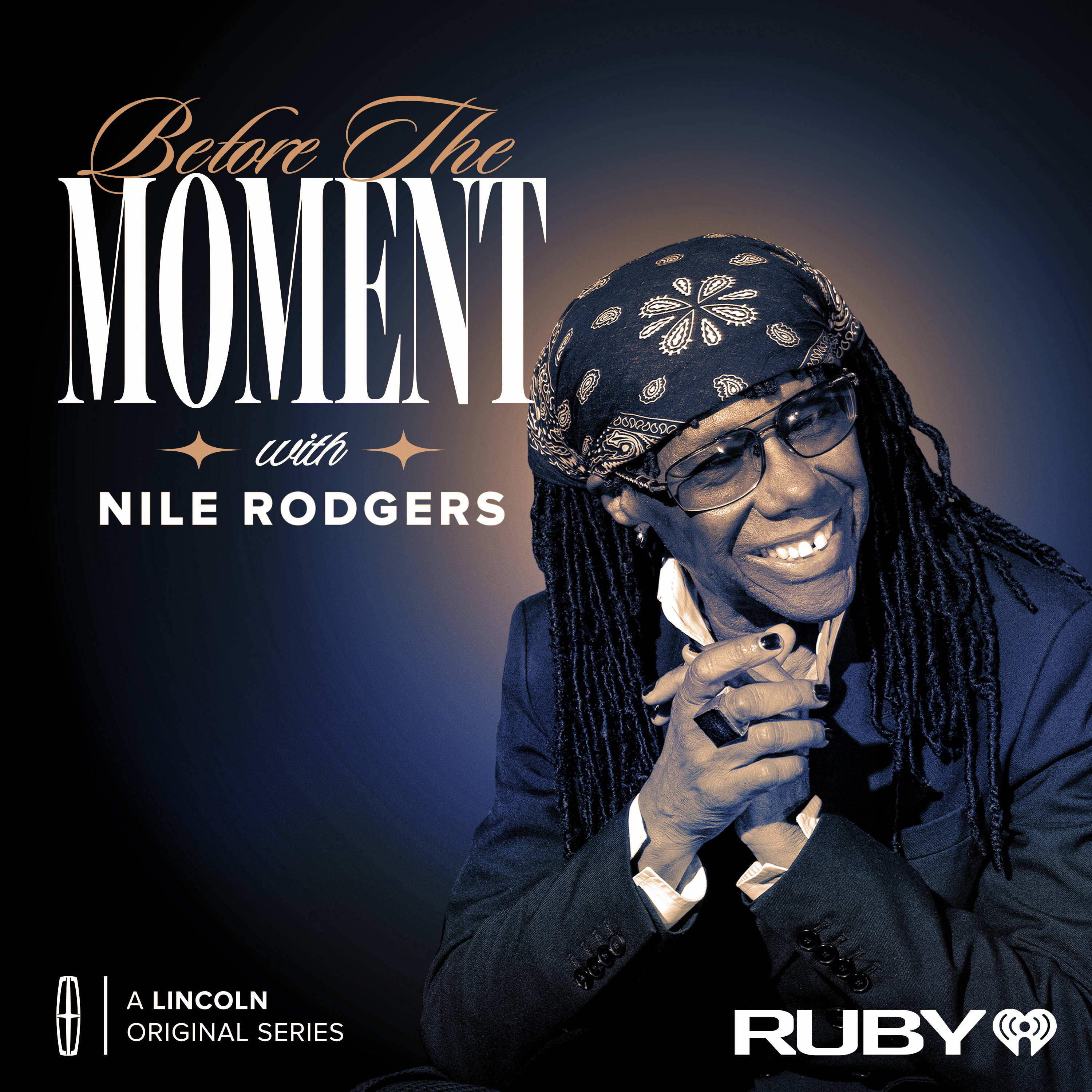
Before The Moment with Nile Rodgers· Staffel 1· Folge 3
John Legend: How a Voice Breaks Through
Dienstag, 13. Oktober 2026 · 35 min
Kapitelklicken springt direkt hin
Shownotes
John Legend has always been ahead of the curve. He started playing piano at 4, graduated high school at 16. He grew up with a family surrounded by gospel music, and became a prodigy. After graduating from UPenn, he did what so many aspiring artists do - he hustled. Working a consulting job during the day, singing in clubs at night. Hoping to get someone to notice, to believe in him and to cut him a record deal. Funny to think about because it’s hard to imagine a world where John Legend isn’t a household name, but just goes to show that even the greats started somewhere.
See omnystudio.com/listener for privacy information.
Transkriptvom Podcast bereitgestellt · Zeitmarken springen hin
A lifetime spent making music is a lifetime made up of individual moments. And no moment is more important than the one before the big change. That turning point where a hobby becomes a profession, when struggle becomes success, when pretty good becomes legendary. I'm Nile Rodgers. co-founder of the band Chic and producer of pop hits with some of the industry's top artists. I'm driving around the country in my Lincoln Navigator SUV, talking to some of the coolest, most interesting people in music to discuss their journey before the moment. John Legend has always been ahead of the curve.
He started playing piano at four and graduated from high school at 16. And growing up with a family surrounded by gospel music, he became a prodigy. And after graduating from college, he did what so many aspiring artists do. He continued to hustle. And just like all of us artists, he wanted to find somebody to believe in him, somebody to sign him. somebody to take him to the next level.
And isn't it ironic and funny to think about because it's almost impossible to think of a world without John Legend being a household name. And that's exactly why I am fascinated by his story. Hey, I'm Niall Rogers, and I am so proud to welcome John Legend to our show. This is Before the Moment.
How you doing, Niall?
I'm so good, brother.
I'm so happy to be here. Oh, man.
I'm like laughing. When do people see me laugh?
I'm excited to be here. It's an honor that you invited me to be a.
Part of this.
You have no idea, brother. When I first heard your voice, and this is the kind of thing that musicians know. And I don't mean to alienate the regular people, but I heard this voice, and I heard this voice a lot. And it was on different records. And I'm like going, who is this haunting me on all these different records?
And I just, in a wacky way, I compared you to myself because I said, I'm playing on all these records. A lot of them are not hits. You just do it because that's your job. Come in and try and make it as good as you can make it. And I would hear your voice all over. And I'm like going, he can't be in that band as well as that band too, as well as that band too.
Well, you know, we're here in Midtown Manhattan. And a lot of those.
Records were recorded around here. I moved to New York in the year 2000. And I started working at a consulting firm called the Ballston Consulting Group.
That was my day job.
At night, I would play gigs around the city, had my own band, and performed under my real name, John Stevens. And my roommate is a guy that I went to college with.
His name is Devon Harris.
And his cousin had just moved to the New York area from Chicago. And his cousin's name was Kanye West. And Devon introduced me. me and Kanye at a show I did at Jimmy's Uptown in Harlem.
And I played the gig.
And after the gig, Devon brings Kanye up to me and introduces him. Kanye wasn't well-known at all at the time yet. He had just started producing for the folks at Rockefeller Records, Jay-Z, Beanie, all those guys at Rockefeller Records.
And he was about to have a big single with.
Jay-Z called H to the Izzo.
Oh, man.
Devon was like, you guys need to work together.
We started working together late 2001, early 2002.
I was putting together my demo.
I had already been recording songs and writing songs with other producers and writers. But then Kanye, he significantly improved my demo with his productions and co-writes. And then I was also singing on his demo, which eventually became the college dropout My demo eventually became my debut album, Get Lifted.
Kanye would just find opportunities for me to sing on records that he was producing. So Jay-Z, I sang on Encore. Dilated Peoples, we had a song called This Way together. Slum Village, we had a song called Selfish together.
I even sang backup for Alicia Keys on You Don't Know My Name. I'm the one doing the.
So whenever he could find an opportunity for my voice to be heard on a record, he would call me up and say, hey, can you come up to Quad or can you come to Hit Factory or can you come to whatever studio he was working at? And I would come through. And a lot of times I was coming from my consulting gig. We were both trying to get our music out there, trying to be heard, trying to make an impact.
And We were scrappy, man.
Like I said, we really believe in ourselves more than anybody else believed in us. And so we just had to keep trying to convince people that what we were making was special and worth their attention.
You got to have a partnership. Somehow when you try to make it alone.
Yeah. You need that collaboration. You push each other. You challenge each other. Collaboration requires humility. It requires.
Everybody.
having the same mission and goal where it's it's not about your ego it's not about winning the argument it's about the music winning it's about the art winning and uh everybody focused on that as the as the goal is that we make the best art we can make together and you need trust yeah you do when you go into it with somebody and you try to make something beautiful together.
So you were to Kanye as Luther was to me. Because people don't know that almost every record I did as a Luther Vandross singing all those. Yes.
And I think people know now because the documentary on Luther that he was singing on so many of those records back in the day, writing jingles and doing all those things.
And in a lot of ways, I was doing that too.
So what's amazing to me is that I hear your voice on all of this music. And I didn't know you were in. Like here in New York, like I could have walked down the block and knocked on the door and said, yo, brother.
Yeah.
I was living in the East Village at St. Mark's and 2nd Avenue. You know, the Orpheum Theater that had the stomp show.
I know it all, brother.
We were right next door to that building. And I started playing gigs all around town.
So what was your smallest show? Because we all started doing shows. Little things.
Yes, my smallest show. I was actually not living in New York yet, but I commuted down. I took that job at Boston Consulting Group, and the first year they placed me in Boston. So I was living in Boston, but I still wanted to play gigs in New York. So my friend and I booked an acoustic gig for me at a place called The Living Room down in the Lower East Side. You probably know it.
Of course I know it.
And it was around happy hour on a Friday. And when I tell you nobody came to that show, it was maybe four or five people in that room while I was playing. And it was disappointing for me. It was humbling for me. But I continued to just keep trying. Once I moved to New York, I really in earnest started booking more gigs in the city. And so I just put together an email list and started inviting more and more people to the shows. And I played SOBs.
I played Joe's Pub. I played Iridium. I played Knitting Factory. I played Elbow Room, Downtime, Sugar Bar, so many bars and clubs around the city. I recorded a couple of live albums. So I was doing all of that. And most of that time, I was still holding down a consulting job during the day. And then as we would do the shows, we would pass the mailing list around, just build and build and build. And it got to the point where, you know, hundreds of people would come to see my shows and I would invite record labels to them as well and kind of make the shows not just a performance for the audience, but a showcase for potential suitors at record labels. And eventually I finally got signed in 2004. But It took a while. I
thought I was going to get signed in 99, 2000, 2001, 2002, 2003, but it did not happen until 2004. So many of the things that we did were exactly the same, but because of our age difference.
The same spots were there, but you were of a different generation.
Yeah, you didn't have an email list back then. No, I did not.
But yeah, and you know, the kids now that are coming up, everything's different. For a lot of them, the goal isn't to get signed to a major record label. because they can self-distribute, they can have that relationship with their audience without the record label.
There's a lot of things that have changed.
In a lot of ways, the whole industry is democratized because everybody can release their own record, they can have their own relationship with the audience. But I think the challenge for everyone is, How do you cut through all the noise? Because everyone has access. Everyone can make a record. Everyone can put it out. So how do you stand out?
Right.
That's the challenge, I think, now.
So let's just go back to the basics, because it's really about songwriting, right?
Yeah.
How does music actually enter your mind? Check that out. How does it enter your mind? And how does a song develop?
How does music enter your mind? You know, it's an interesting thing.
I'm not sure why or how the music comes to me, but I think our brains, people who love music and write music, our brains are just.
Filled with music.
We have listened to so much music.
We've been a part of so much music.
All these different patterns and chord progressions are in our head.
I just sit at the piano and see where it takes me sometimes.
I think of the story that I want to tell, the mood that I want to create with the music, start playing chords, see where they lead me, start mumbling those melodies, and eventually I figure out what I want to say over those melodies.
All right, I'm going to ask you this, because this, you know, sometimes I'm just, not even thinking about music, right? There's something going on in the background, and I hear this little thing, and I go, oh, that could be this. And I run. I got to go pick up my guitar and start playing it.
Sometimes it's watching a film.
You'll hear something in the score, and it'll inspire a melody idea. And I just always have my phone on deck, voice recorder on deck, And, you know, before we had phones that were so sophisticated, I would just carry the little tape recorder around town. I remember I would go to work on the subway every day, take the four and six train up the east side.
Yeah, on the east side. Yes.
And I would have my little tape recorder, and sometimes I would just write a song on the subway on my way to work. And, you know, you just have to be ready for when the inspiration hits.
It comes. Yeah. So I just got to bring this up because so I saw you perform once in like Sicily. Yeah. And we were at a big tech conference.
Yeah.
And the one thing I noticed is that music has this magic just component to it. You just had some of the smartest brains on this planet just sitting there listening to music and just listening to you do your thing. And I was watching them. I'm like going, these dudes are just, they're blown away. They didn't necessarily know the songs because they don't know all John Legend music. But it was just an amazing sight to see. And I see us on the rocks.
We had the ruins behind us. It was a pretty epic moment.
And I play.
all over the world, people that don't speak English, people who come from so many different backgrounds. And I just see the power of music. I see it everywhere I go. And it's something transcendental about it. We're so blessed that we have the gift of music that we can share with people. It's a way of connecting people, bringing people joy, making people more in touch with their emotions and their humanity.
And their spirituality. I think it's such a beautiful gift.
I feel so fortunate that I get to do it every day.
So before you got signed, what did you want your sound to be? Did you see yourself as Nat King Cole, a new version of Nat, a new Stevie Wonder or whatever? What did you want your sound to be?
Well, it kind of helps to go back to that era. So this is the late 90s. I arrived at Penn in Philadelphia in 1995. The Roots were hosting Black Lily. Neo Soul was ascendant. When I was in college, I was listening to D'Angelo and Erykah Badu and Tony, Tony, Tony and Mint Condition and a lot of these soulful R & B artists. And then there were a lot of soulful hip hop groups that we were listening to, like The Roots and Tribe Called Quest, et cetera. And then I played piano on The Miseducation of Lauryn Hill.
I played on a song called Everything is Everything. And when that album came out, it was like an earthquake for me. It was like, it really rocked my world. And it was also showing me more and more, with more and more definition of the kind of music that I aspired to make.
It was an earthquake for the world.
Yeah, because I think it was the perfect fusion of soul and hip-hop and a little bit of reggae as well. And it was the best example of what I was hoping that I could do with my career, make these anthemic songs with a hip-hop foundation and a classic soul foundation with nods to my... background in gospel music as well.
That's really what I wanted to try to do. And when I met Kanye, it all really clicked. It was like, okay, this is what I was envisioning for my career. Now we're able to really execute it in the best way possible. We were confident, man. We felt like we had something different, something fresh to offer the world. And we would go to these record labels, man, and we would Imagine me going and playing my demo with Kanye as my hype man, saying he produced these beats and he signed me to his production company.
We know we've got something special.
And they turned you down.
And they turned us down.
Of course.
And they didn't believe in him as an artist either.
Right.
So you have to remember during this time, he was really more known as a producer. Right. He was trying to tell them, yo, I can rap too. And I'm an artist.
I'm not just making beats for Jay and Beanie and Kim. I can rap too, and I am an artist. I have my own point of view. I have my own story to tell. And they weren't buying it for a while, but obviously eventually they did.
See, that's one of the main reasons why I'm doing this show is because There are thousands of people that want to break into this game, but there are millions of ways of doing it. And one of the most important ways is persistence and believing in yourself. And we have all these ways, I call it going in the back door. Unfortunately, because I came a little before you, racism played a bigger part in keeping me out of the game.
Or at least. Putting us in boxes.
Oh yeah, that was the whole point. When I was producing Bowie, I said to David, I said, wow, David, because he had written these interesting lyrics. And I said, well, David, do you consider your audience when you're writing a song? And he looked at me and said, absolutely not. And I said, damn, it must be great to be white.
I said, I have to think about my audience because I only got one lane that I can drive down. And so I hear that even some 20, 30 years later, you guys were still doing the same thing. We were doing playing shows, trying to convince people who supposedly have big ears that you are the next level of what should be happening, that you are the next thing. Buy into us. That's incredible, brother. Bravo. As you were working with artists writing hooks, you met Will.i.am, one of my favorite brothers in the world. You met Will.i.am and had a noteworthy session that would lead to Ordinary People, which brings us to Before the Moment, brought to you by our friends at Lincoln.
From the beginning, we were signed to the same management company. We were both managed by David Sonnenberg.
Old friend.
And David and a guy that worked with him named Seth Friedman, they both thought that I should connect with Will. I was still unsigned at the time. And so the first song we wrote together was a song that made Get Lifted, a song called She Don't Have to Know, one of my epic cheating songs that I wrote for Get Lifted. So She Don't Have to Know was the first thing we wrote. And then I wrote a couple hooks for Will. One was for his solo project. One was for the Black Eyed Peas. He wanted me to come and write some more hooks for the Black Eyed Peas.
And this was right after I had gotten signed in the spring of 2004. And my album was basically already written. And all I had to do was rerecord it with my budget. And I was just writing for the Black Eyed Peas. I wasn't expecting to write something for myself in that session. But I wrote the hook for Ordinary People.
I wrote it to a hip hop beat. I expected it to be a hip hop song for the Black Eyed Peas. but the more I kind of, thought about it and lived with the chorus, I was like, you know what? This would actually make a better R & B song. And I'm going to try to write a version of it for myself. And so I went on the road with Kanye. We were touring throughout Europe. And this was still early days for Kanye's solo career. And so we were playing pretty small venues, large clubs, small theaters.
And every soundcheck, you know, I was playing the keys and singing the hooks on Kanye's tour. So every soundcheck, I would take a little time on the side to keep writing the lyrics for Ordinary People. And soundcheck by soundcheck kept building the story. developing it, evolving it. So by the time we were done with the European tour, the song was written. I come back home after we're done playing those shows and I record a demo. And I'm like, well, you know, I decided I would rather keep Ordinary People for myself, but I'll let you produce it.
So I'm just going to record a piano demo of the song and then I'll send it to you and then you can soup it up and do all the things you want to do. So I record a really quick, rough piano demo of the song, send it to Will. But in the meantime, I'm playing the rough demo for the label and Kanye and different people in my life.
And everybody's like, oh, this song is amazing. This is one of your greatest songs of all time.
Right.
And what ended up being on my album was that rough piano demo. We didn't re-record it. We didn't edit it, do a new vocal, anything. We just put it out the way it was. it had even more unexpected moments because we, the first single was used to love you and it was uptempo. Uh, Kanye produced it to introduce me to radio and to the audience.
They made a sampler CD. You know, we used to do these things back in the day.
Uh, and on the sampler was used to love you first full song, then snippets of three other songs. And it was supposed to be a snippet of ordinary people as well. But, My A & R, KP, Kawan Prather, legendary A & R, he convinced the label to put a full version of Ordinary People instead of a snippet, but he didn't tell me. And so the sampler goes out with a full version of Used to Love You, three snippets of three other songs, and then a full version of Ordinary People without my permission, unbeknownst to me.
And I was upset.
I was like, how are you going to go behind my back and put this full version of the song out without telling me?
But it was divine.
Because the station in Chicago, WGCI, they were like, oh, this Ordinary People song, this one's special. They start playing it before we're promoting it. They just made a programming choice, a creative choice that they thought Ordinary People would work on their air in Chicago. And they started playing it on their air And it blew up in Chicago. It blew up at WGCI. People were requesting it. Every other radio station in Chicago started playing it, all their R & B stations. The song spoke for itself without us promoting it.
And it became the defining song for my first album.
It was powerful. I mean, it's one of those songs that I'll never forget. I mean, you know.
Well, people always tell me they'll never forget when they first heard it because it was so stark. the difference between that song and everything else that was on black radio, because everything else was crunk. And, uh, if it was R and B, it had a hip hop beat usually. Um, but it was a lot of hip hop and then everything would just stop. And this solo voice and piano would come on the radio. It was arresting for people.
It was, it would stop them in their tracks. A lot of people said they pulled over. They wanted to find out who's this artist.
Right.
And then, you know, the album kind of, uh, takes you through a relationship journey, and Ordinary People is right at the center. So early in the album, it's more kind of the bachelor, the cheating, the.
Conflict, the going back and forth.
Ordinary People is kind of the centerpiece where it's saying, you know, let's take it slow. We're going to go through problems. We're going to deal with challenges in our relationship. The end of the album is more about commitment and finding that person you really love. That song in particular really spoke to people in their relationship. So people would come up to me all the time talking about how it really ministered to them in their relationship and helped them through difficult times with their partner. The song just had more impact than I ever could have dreamt it would have had. I knew it was special, but you never know how special it's going to be and how much impact it's going to.
Have in people's lives.
And you never believe that you're going to actually change people's lives with a song. that the lyrics are going to change their relationship, change the way they interact with other people, and ordinary people do that for people.
Which is amazing. I wanted to tell you something about that. You know, when. This breaks my heart. I got to collect myself a little bit. So when D'Angelo first came to New York, somehow the friend Gary Harris... D'Angelo said, I have to meet Nile Rodgers. So he brought him over to my apartment, and D'Angelo sat down. We met. I had never heard of him before. He had a cassette. He played the cassette demo for me, and I sat there and attentively listened to the entire demo. And after I listened to the demo, he says, so what do you think I should do? Basically, like, what label do you think I should go to or whatever? I don't even know what he was asking me. But I said to him, I said, oh, you should put that out. He said, what do you mean?
I said, you should put that out. It's genius. It's great. He spent the next year of his life working on something. A year later, you know what he put out? That same demo.
That demo.
Wow.
So that was Brown Sugar?
Yeah.
Yeah. Wow.
He put that demo out. It was perfect.
It was so good. When I tell you that I played the shit out of that album, I....
Showed up at college the year it came out. And I had my first CD player. Before that, I was strictly cassettes. But I got this little CD player stereo that I put in my dorm room. My roommate had one, too. And my roommate, white guy from Cleveland. And I'm also from Ohio, Springfield, Ohio. But grew up on gospel and R & B. And so I was playing... D'Angelo nonstop, you know, all my favorite R & B artists. And then he was playing Jimmy Buffett. And so, like, it was like, whoever got into the room first got to play their.
Version of the music they wanted to hear.
I think growing up in the church, growing up loving gospel and soul music, I just heard so many of those musical connections in D'Angelo and nobody else was making something like that at that time. It just spoke to me and It was like one of my guiding lights as a musician during that mid-90s, late-90s time period.
So you're taking me to a spot. When a song becomes bigger than you, and I don't think you're this person, but when a song becomes bigger than you, is there any sense of longing in that? I don't think we even know.
I feel grateful whenever a song connects with people in that way.
I feel grateful.
Grateful and proud that my baby's out in the world doing what it's doing.
I love it, man. So after all these years, what still makes you just sit down at the piano and do your John Legend thing? You just sit down? Because there's discovery there. I guarantee you, you're still getting smarter. You're not that brother who just goes, I got this formula and I'm doing this and I'm going to repeat it.
I use that word discovery a lot. I say every album is a new discovery.
I hear it.
Every time I sit down to write a song, it's a challenge for myself. And it's a challenge that's thrilling because at the end of it.
It's a song.
And every song is not going to be a smash. Every song is not going to be your best work. But if you sat down at 9 a.m., And then at noon, you had a full song that you recorded and put in your voice recorder or you recorded at your studio. You just created something brand new that didn't exist when you woke up. What a beautiful feeling it is.
And I love that feeling. And I keep going back to it. I love the challenge of trying to make something that I'm proud of and excited for. And I love the feeling of being able to birth something new into the world. that didn't exist a few hours ago.
So, John, I mean, we've covered a lot of interesting ground. I just wanted to touch upon this. We're at a point in our lives where we can continue, we can bask in what we've created. I know you can. I mean, I looked at me, 13 Grammys? He's an ego. Oh, come on, man. Now he's giving me something to chase.
How does it feel?
It's no egotism. There's nothing but gratitude deep inside me. Because as I said, just being a little older than you, I come from where racism really played a huge part in my career. And I wouldn't change anything. At this point in your life, is there something that is still out there on the horizon that you are chasing, that you see and you want to go after? Because you've done so much.
Well, I refuse to just kind of sit back and say, well, I've got 13 Grammys.
I'm an EGOT. I can coast.
I could just go out and do shows playing my old songs, and I've been doing this solo tour. It's kind of a retrospective of my career, and that's fine, but I'm always excited to write something new and to make my next record my best record. I've been writing for Broadway, which has been a new challenge with new collaborators, seeing.
My work.
Through actors and And these amazing performers who are triple threats, who can sing and dance and act and do all these amazing things. And seeing my work through their voices, through their performances, is a whole new feeling that I've never felt before.
And I want to keep feeling that.
And so that means not resting on my laurels, but going out there and continuing to create something new.
That's incredible, brother. I just want to thank everybody for joining me today. It's been a pleasure from my heart. What can I say? Whenever I have days like this, these are days that I cherish. I make a joke saying, I'll lie on my deathbed going, damn, remember that day that John came in? I don't mean to be morbid.
No, I'm honored I get to be with you and not to be continually morbid, but I.
Love that.
We're songwriters, we're composers. We make records that will outlive us. That's the beautiful thing about being artists, being musicians. We get to create work that lives forever. And it's an honor to talk about.
That with you.
It's great that we think that way. Certain things, and you really understand it's not about ego. It's about accomplishment. It's about perspective. It's about focus and on some way being myopic. That's where I'm going.
Focus on the task at hand.
That's where I'm going. And the fact that on some level we've gotten there and it's incredible. It's my pleasure to be with you. It is a great day. You've made the rest of my day. Thank you.
Thank you, Niall.
Even though we're probably 25, maybe even 30 years apart, we did exactly the same thing. At the beginning of his career, he was selling mixtapes and things out of his car, playing the smallest shows. They were some of the exact same venues that we played. And that's why I always say that there's thousands, thousands and thousands of artists out there but there's a million ways to make it into the game. He and Kanye had a certain type of magic that just made them believe in each other.
Just like myself and Bernard Edwards, we had a certain magic that made us believe in each other. At his age and my age, we both want to see the same thing. We want to see what's around the next corner. The inspiration may come from ourselves, but The truth is we do it for people. We are artistic reporters. We chronicle life and we tell you how we see it and we tell you what we'd like to see. It's been such a joy talking with John Legend about the big moments in his life. On our next episode, we'll talk with Sienna Spiro. She is a genius and I can't wait. This has been Before the Moment, And I'm Nile Rodgers. Come along with me for the ride. See you soon. Peace. This has been Before the Moment, a
Lincoln original series, a Ruby production by iHeartMedia, brought to you by Lincoln. Be sure to follow the show wherever you get your podcasts. And if you liked what you heard, leave us a rating and review. I'm Niall Rogers. Thanks for listening. We'll see you next time.
