

Was the US Republicans' Redistricting Effort a Texas-Sized Mistake?
Mittwoch, 28. Oktober 2026 · 15 min
Kapitelklicken springt direkt hin
Shownotes
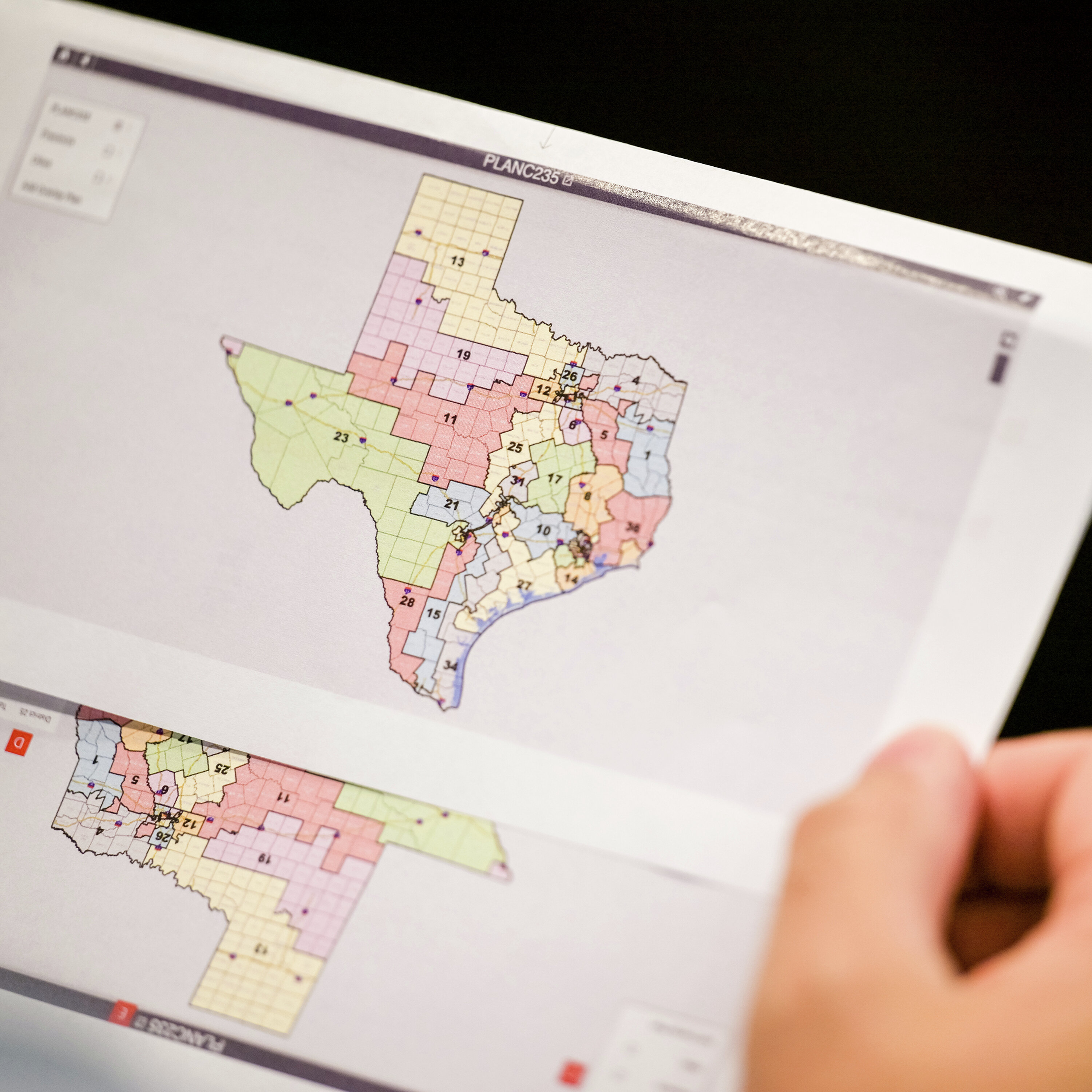
Republicans in Texas, hoping to lock in more seats in Congress, kicked off a redistricting frenzy that saw several other states redraw their congressional maps. Today on the show, host David Gura sits down with Bloomberg Texas Bureau Chief Julie Fine and Senior White House reporter Josh Wingrove to talk through why that gamble may not pay off.
Read more:
• Trump Calls for Peltola to Be Banned From Alaska Senate Race (bloomberg.com/news/articles/2026-10-28/trump-c…)
• Joe Rogan’s Microphone Goes Quieter on Trump Ahead of Midterms (bloomberg.com/news/features/2026-10-28/joe-rog…)
• Economic Pain Turns Nebraska Into Unexpected Senate Battleground (news.bgov.com/bloomberg-government-news/econom…)
We have a special Bloomberg subscription offer for podcast listeners at Bloomberg.com/podcastoffer. (bloomberg.com/subscriptions/podcasts)
Host: David Gura; Guests: Julie Fine and Josh Wingrove; Produced by David Fox; Edited by Nicole Beemsterboer and Naomi Shavin; Engineering by Sean Carter.
See omnystudio.com/listener for privacy information.
Transkriptvom Podcast bereitgestellt · Zeitmarken springen hin
Bloomberg Audio Studios.
Podcasts. Radio.
News.
I should also note that for Americans listening to this, every other country thinks this is bonkers, by the way. You know, that we have these maps that look like insane shapes and wind through whatever, drawn with like some PhD in mathematics, locked in a basement for three days. So it's sort of a uniquely American experience, shall we say.
I'm David Gurra, and this is The Big Take from Bloomberg News. Today on the show, Republicans in Texas, hoping to lock in more seats in Congress, kicked off a redistricting frenzy that saw several other states redraw their congressional maps. On the eve of the midterm elections, why that gamble by the GOP may not pay off. All right, let's get going here. I'll intro you two, and then we can jump right in. Julie Fein is Bloomberg's Texas bureau chief.
Josh Wingrove is a senior White House reporter and our guide here at The Big Take. As we get to and through the midterms, he's going to be back with us next week. Let's make sense of the results. We have seen a handful of states redraw their congressional districts, most notably, I think, in Texas, where you are, Julie.
So let's start there. Let's go back to 2025. Governor Greg Abbott calls this special session of the legislature in Texas. What did he and his fellow Republicans set out to do?
First of all, they set out to do what President Trump wanted them to do, and it was pick up seats in a very critical election. What they will do may turn out to be extremely different because they were hoping to redistrict five seats. We've seen shifts already with the Hispanic vote. There are a lot of the Hispanic vote in the areas that were redistricted. That could end up backfiring on Republicans. So when you start talking about redistricting and looking at it, you can call Texas here ground zero at basically set off what you saw happen in the rest of the nation, but it might not even work in the spot where Republicans were really counting on it to. By the way, they had just been redistricted after the census. Like I know people that have
been in three different districts within a mile of their home in the past seven or eight years. So obviously there was a redistricting on top of a redistricting.
Josh, pick up on that because I'm old enough to remember when this did happen every 10 years. It was something that naturally followed the U.S.
Census.
That's something that's changed, hasn't it?
Texas was sort of the starting pistol, and that was because Trump started there, and it prompted all these other states to get moving. And at the time, everyone thought that would really benefit Republicans because there were way more states where Republicans had enough control, including in state legislatures, that if Republicans were successful, there were more maps that they could redraw. There were more districts they could gerrymander.
But Democrats did respond, in part, with the California measure. And there are, were sort of a, you know, smaller number of democratic states where they could take steps of their own to carve out a seat here, carve out a seat there, but it's, you know, sort of rippled across the country and probably over a dozen states, uh, certainly.
And in, in the end, it's kind of all been closer to a wash than a tectonic shift really. Um, but I think it shocked people at the time that was so unconventional to do this in a partisan manner, mid decade, you know, out of cycle. And so it seems like now that we've broached that issue once again, that this will be fair game going forward or could be fair game at least going forward. And I think that is just going to be the reality of it.
Julie said a moment ago they did what President Trump wanted them to do. To what degree was the White House guiding this? Were party officials, Republican Party officials guiding this process, watching it all play out and kind of looking to create something that could be replicated in other states across the country?
I mean. As is so often the case with Trump, you know, you have situations where staff and officials and allies take steps to at least create an illusion or impression of being arm's length. And then the president comes out and wraps both his hands around it and makes it clear that's where he wants to go. And that was very much the case here. But, you know, for instance, James Blair jumps to mind. One of the president's top political operatives was White House deputy chief of staff is now Trump's political pack. He had a big role and was a big advocate. for this, including publicly calling on states to, you know, get up and go and do this.
Some states were more reluctant. We certainly saw in Indiana, of course, the president directly involved in threatening primaries or engaging in primaries when lawmakers there seemed reluctant to, uh, you know, go down this road, which was sort of seen as off limits, not sort of, it was seen as off limits in many states and still is. And so, yeah, I think, I think Trump was clearly behind this, you know, whether he signed the paper that would get him in trouble down the road. You know, it's not clear to me, but he was calling for it. He was pushing for it.
And to some extent, it did succeed at first. But as I say, then it went kind of sideways in particular because of California.
Because of California. So we're seeing this have a catalytic effect, certainly in red states. It does cause a reaction in blue ones as well, principally in California. Josh, what happened with Proposition 50, with what Gavin Newsom proposed on the heels of Texas doing this?
Yeah, he proposed proposed fighting fire with fire, essentially, and sold that to the voters of California and did a sort of corresponding move. It was designed to be proportional to Texas that the two big states would kind of cancel each other out. And it was essentially successful in swinging five seats towards them. Now, the big question, of course, is like, does the math still work in some of these states? It seems like it does in California. No one really thinks there's going to be giant Republican breakthroughs, although California's primary system did have a couple of races that got close where Democrats almost got locked out of the final two spots in what would otherwise be safe districts.
In Texas, it looks like it could backfire, in part because the Latino vote has eroded so sharply for Republicans that a lot of the districts that they thought were pretty safe took into account Latinos voting the ways that they did in 2024, and there's not a lot of signs That's going to happen right now. And there's sort of other things happening in the background in other states where, you know, there were sort of mini gerrymanders, in particular with the court ruling on striking down majority-minority districts, essentially black house districts throughout part, you know, all through the South.
That was in April of this year, we got that decision from the Supreme Court.
That's right, the Calais decision. And that one is pretty significant and sort of part and parcel with all of this. And it too is kind of a complicated story. For instance, we're seeing quite a spike in particular in the South in Black turnout early on so far in voting. And so it looks like that decision, which did take away in several states, Black-majority districts, is driving Black voters to the polls. And of course, polls show that Black voters overwhelmingly still favor Democrats. And so there could be an electoral impact on that as well.
What I do want to point out, too, is if you remember when the Republicans decided to redistrict in Texas, the Democrats actually fled the state to avoid that vote happening. And that's when they went. Some of them flew to meet with Gavin Newsom. They met with the governors in other states. So even though they couldn't stop it here, what they said their goal was, was to raise awareness of what was really happening in redistricting. And in that, they succeeded because other states, I think, really woke up to what was happening. And when you stand there and you go see Gavin Newsom or you have You have a news conference and you're with Governor Pritzker. They were able to at least draw attention to, hey, redistricting might
come to your state as well. And so I think that's where the Texas Democrats were able to flex their muscle a little bit. I think they realize in this state they were not going to be able to stop it, but they could at least get some other states involved in it as well.
Julie, we've got less than a week until these midterm elections. How are Texas Republicans feeling about this latest round of redistricting?
I think with redistricting, they have some questions. I think the real question right now, though, for Texas Republicans is, will Ken Paxton win this race?
The Senate race.
I mean, you cannot turn on the television here for more than five minutes and not see 10 commercials. And I've always said all along that, yes, James Tallarico is in the lead, but you do have to leave some space for people that are voting for Ken Paxton and just simply don't want to admit it, whether it's on a poll, whether it's to their friends, whether it's period.
So I think somebody, I always say I'm not in the prediction business. I think that's borne out to not always work out very well for me. So I'm going to go out and say, I think it's a real slip of the coin, guys. You just don't know.
More from my conversation with Josh and Julie after the break. Josh, to what degree does the White House, does the Republican Party recognize that what they had planned for Texas or what they expected to come out of Texas in this cycle isn't as sure a thing as they might have expected?
I mean, you're seeing Republicans say on the record that they don't expect to keep the House. That was something they were expressing optimism about. We should note that all this really got started like a year ago-ish, you know, depending on the state that you're talking about. And since then, The bottom has fallen out for Republicans in a lot of places, either with, you know, specific districts or races or voting groups or what have you. So the math has sort of changed. It feels a bit like someone sort of fussing around the edges while like a structural change, you know, like a box store arguing with the mall over something while the internet is coming to chew them up.
You know, it's like they were very focused on like really getting into the nitty gritty to carve out one seat here, one seat there, one seat there. Polls showed the voters were crying out for stuff on affordability, still are crying out for stuff. on affordability. So I think it's an open question about whether the administration would have been better served focusing on that instead of trying to redraw the maps. But, you know, I guess time will tell.
And of course, let me just also note that most everyone expects the House to flip. And for anyone listening outside of the states, we are talking here about the House. The Senate remains complicated and probably a coin flip as well. I think some people are getting ahead of themselves and making predictions on the Senate for Democrats to have a big breakthrough in the Senate. They need a ton of things to go right in states that Trump won by huge margins and where the undecided voters are probably people that voted for Donald Trump three times. And so I think everyone should maybe take a breath and avoid big predictions on the Senate.
Josh, like Julie, not in the predictions business, declaring himself not to be.
I've been burned too many times.
Yeah.
Josh, stepping back, I just want to assess or try to assess the effectiveness of redistricting in this midterm cycle. So some of it was meant to help Democrats, as we've discussed. Some of it was meant to help Republicans. As you look at the two parties in complement, how does it net out? Who has the advantage here when it comes to redistricting having made a difference or seeming to have?
It helped the Republicans a bit in the end, I think, in the wash. You know, the analysts say, you know, it's kind of a bit of a moving target, but it sounds like a single digit number of seats maybe gave them an edge after all this back and forth. That would have been negated or even pushed in Democrats' favor had Virginia gone differently. They, of course, passed something there that got struck down. And so, you know, in the end, it hasn't really made all that big a difference as compared to, for instance, the general electoral environment that we're in. And we're seeing Trump campaign just in like deep ruby red places. And I'm not in the prediction business, but I will say that the Senate, the
reason Texas is so interesting and why Tallarico has raised so much money i think it was 140 million dollars when i checked a day or two ago huge more than any other democrat in the cycle is because like democrats who have their hopes up are really trying to find that fourth state to flip and it's hard to find and so that's why texas is so is even extra interesting to people because it just you democrats keep trying to count to the number four and iowa doesn't really seem like it's going to get there maybe who knows But that's why it's like if Tallarico pulls off Texas in the Senate, the math of the overall map just totally changes. And that's part of the reason why he's raking in so much money and why so many
eyes are on Texas. But one Republican told me that like that's basically a state where money can solve the Republican turnout problem and they are pouring money into it. Elon Musk in particular, pouring money into it. And that has given Republicans a bit of breathing room, I would say, maybe in the last week or two that maybe Paxton is going to be able to pull it off.
Julie, Josh is talking about what a Blue Texas would mean at a nationwide level. In Texas, what would it mean were that to happen if James Tallarico were to pull off this win against Ken Paxton?
Let's say James Tallarico wins. It's not a blue Texas unless the legislature is blue. The laws of the state go through the Texas legislature. And OK, let's just say it's not going to I'd be very surprised if it happened. But let's just even say the Texas House flipped, which is the way it's it's districted is about impossible. let's say the Texas House flipped. The Texas Senate's not flipping.
And the lieutenant governor in Texas is arguably as important as the governor of Texas because any legislation and laws only get to the Senate through the lieutenant governor. So if James Tallarico wins, it gives Democrats hope. It may give them more money to get more people registered to vote. It may get more attention on this Texas. Like, okay, maybe the demographics are really flipping as opposed to oh, Beto O'Rourke came within three points of Ted Cruz. So a blue Texas is not James Tallarico winning. A blue Texas is there's a lot more for Democrats to do here.
Josh, you mentioned this process is still playing out in some states. We're looking ahead to the 2028 presidential election, but there is redistricting that's still in process. Do you expect to see more of this maneuvering ahead of the 2028 election?
I think it's a certainty. The impact overall is unclear. It could be relatively small, but I think we'll continue to see this sort of bubble up and along heading into 2028. One takeaway from having more and more safe districts is that those lawmakers don't ever really have to run in competitive elections. Their only concern is being primaried, and therefore their only concern is sort of passing the purity tests of their party at the moment, and that will make Washington less interested in collaboration and makes the sort of swing district lawmakers in either chamber like an endangered species.
This is The Big Take from Bloomberg News. I'm David Gurra. To get more from The Big Take and unlimited access to all of Bloomberg.com, subscribe today at Bloomberg.com slash podcast offer. Thanks for listening.
We'll be back tomorrow.
