

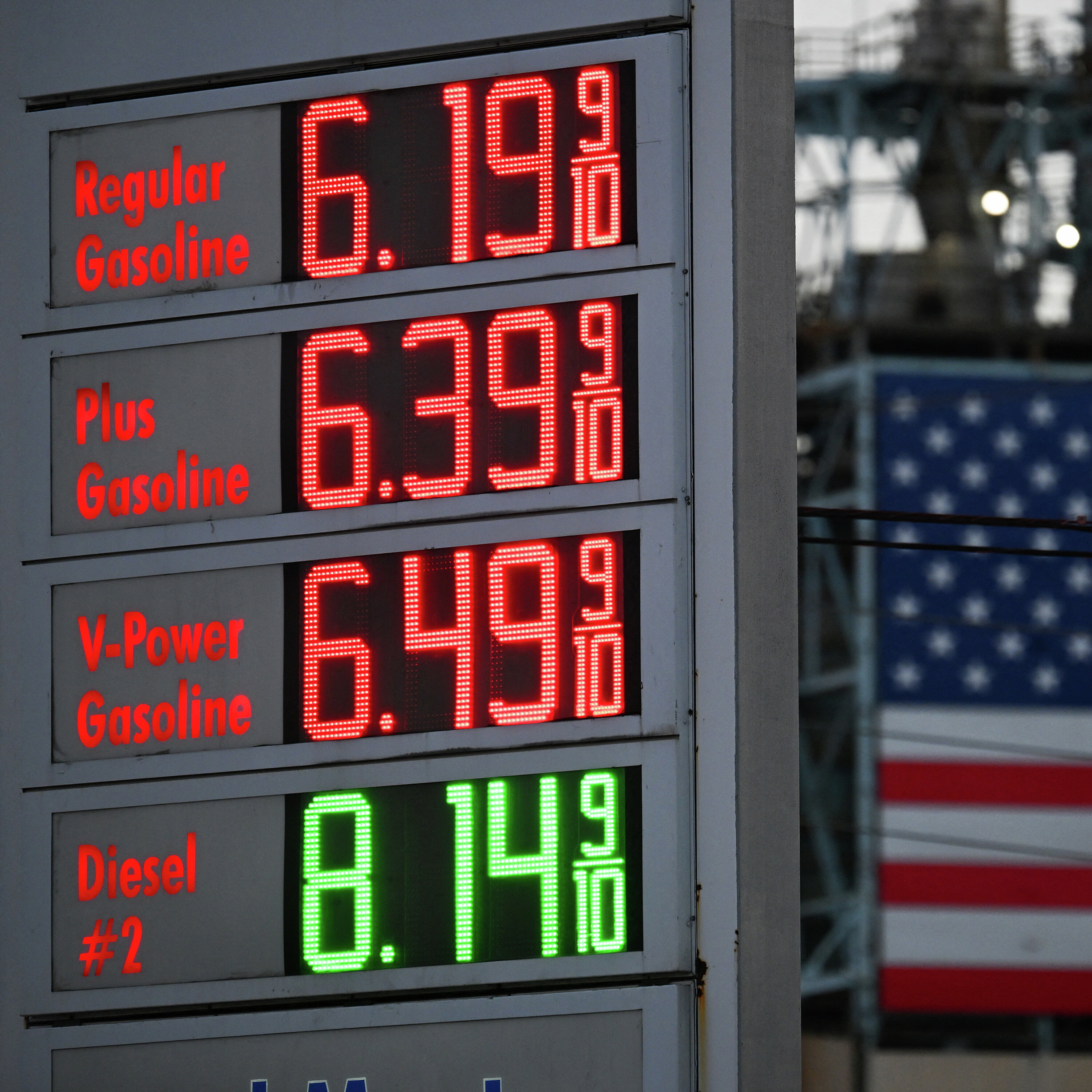
Diesel Prices are Hitting Records Just in Time for the Midterms
Dienstag, 20. Oktober 2026 · 18 min
Kapitelklicken springt direkt hin
Shownotes
Energy prices are up — and President Trump is out of time to bring them down before the US midterm elections.
On today’s Big Take podcast, David Gura breaks down the factors keeping prices high and how much it could cost the Republican party with White House reporter Josh Wingrove and Will Kubzansky, who covers gasoline, diesel and jet fuel.
We have a special Bloomberg subscription offer for podcast listeners at Bloomberg.com/podcastoffer. (bloomberg.com/subscriptions/podcasts)
Host: David Gura; Guests: Josh Wingrove and Will Kubzansky; Produced by Julia Press, David Fox, Julia Weaver; Edited by Naomi Shavin; Engineering by Sean Carter.
See omnystudio.com/listener for privacy information.
Transkriptvom Podcast bereitgestellt · Zeitmarken springen hin
Bloomberg Audio Studios.
Podcasts. Radio.
News.
How much nuance is the president, is the White House using in talking about the drivers of these higher energy prices?
Well, off camera, they will make some of the same arguments. You know, inflation adjusted, it's not as bad as it used to be. $ 100 oil isn't $ 100 oil the way we used to think about it. But in reality, it's a five alarm political fire for them. And it is not only seemed to have put the House further and further out of reach in these midterm elections, but expanded the Senate map into fairly jaw-dropping places like Kansas and South Carolina, where the president is campaigning. Gas prices are very closely correlated to the president's approval rating. And so you've seen Trump go around, kind of knock on every door, open every cupboard, try to find every gallon of gasoline and diesel he can find anywhere, including from Vladimir Putin.
I'm David Gurra, and this is The Big Take from Bloomberg News. Today on the show, energy prices are up. Will they take down Trump's party in the midterms? I'm going to start by having you both introduce yourselves, first name, last name, and what you do here at Bloomberg.
Josh, let me start with you.
I'm Josh Wingrove. I'm a White House reporter here at Bloomberg.
My name is Will Kubzanski. I cover refined products for Bloomberg. So that's fuels like gasoline, diesel, jet fuel.
This is a classic Bloomberg beat. Very niche. It is so Bloomberg, yeah.
Will, before I sat down, I checked Brent Crude. It's at $ 106. 50 a barrel, thereabouts. In the U.S., the average price of a gallon of gasoline, according to.
AAA, $ 4. 33 a gallon. Diesel's about $ 6.
30.
Put all of this in context for us.
How high are energy prices right now?
They're high.
Energy prices... at least on fuels, are at the highest point for this time of year that we've ever seen. $ 6 diesel was something that was unprecedented until this year alone. To be fair, right, you can go back and you can do inflation adjustments and you can say, well, in 2008 and in 2022, maybe it was more comparable. But in terms of the absolute number drivers are seeing at the pump, it has never been higher for diesel. And this time of year, it's never been higher for gasoline.
How much of this is directly.
Attributable to the war in the Middle East, the war with Iran?
This is a question that we have spent a while trying to sort of get a solid answer on. The White House has said Russia is to blame for diesel prices. Look, if you go back to the chart of Brent crude and you go to, you know, February 27th and then, you know, first week of March when the war began, the cost of oil spiked. And that was certainly the cause of higher gas prices, higher diesel prices in the first months of the war. The amount of supplies that we lost coming from the Middle East through the Strait of Hormuz is much larger than the amount of supply that we lost from Russia. With that said, as Ukraine has picked up its drone strikes on Russian refineries, the barrels we have lost from over there have risen, and
that has also contributed to rising prices.
Will, we got this reading of the Consumer Price Index, the latest read of that index this morning. Gasoline prices, that index up 9% in September, made up over half the monthly increase for all items. situate energy in kind of the broader U.S. economy, the degree to which these rising prices are affecting the overall economy?
I mean, look, gasoline and diesel, I think, are actually two really good ways to look at the economy because gasoline is, you know, a personal consumption item. You're a driver, you know, you live in Michigan or Wisconsin or Iowa and you see the price every day.
You're feeling that pain every day.
You're feeling it every day and you fill up your car and you say, I'm going to put X amount of money into the tank. With that said, comparatively, if you think about your expenditures as a broad picture, there's obviously a lot more than just gasoline. Diesel prices seep through into everything else. Diesel is a fuel that is primarily used for, aside from agriculture and industry, it's used for trucking.
The workhorse fuel.
Workhorse fuel of the global economy. We've said that a lot. Diesel prices... push inflation higher. We might not be seeing the impacts of higher diesel prices right now in the inflation print because it takes time. There's pass-through from agriculture to truckers to grocery stores, but it's sort of a squeeze on both ends that is making the economy really feel this.
Josh, you've spent a lot of time with the president recent weeks. You've been on the campaign trail with him as he's been stumping for Republican candidates. How much is this in energy prices How much has it turned into that?
I think it is very substantially that under a broader umbrella, this is a cost election. This is an affordability election like the last two were. We're seeing that in particular in a lot of polling that shows certain demographic groups. Latino voters, for instance, swung to President Trump substantially in 2024 over concerns about prices. They're now swinging back in such a jarring way that some of the gerrymanders that Trump did to try to cling to the House majority are maybe even backfiring. And so I think for Trump, The question is, you know, what can you do to calm voter concerns on that? We've seen him do things like announce checks, both $ 90 checks to certain people, as well as the promise of a $ 5, 000 check that not
a lot of people think is ever, of course, real. But he's trying to respond to it in some ways. But then he's also Donald Trump, and he can't kind of help himself, but like veer off into other topics, including renovations and this and that. And so there's not been a consistent message from the administration on what they're doing on this. And that's, you know, where it's sort of landed. Now, Trump's administration right now is sort of holding out hope that things won't be bad. Republicans still have a lot of money. It's possible that they can sort of thread the needle, you know, treat the Senate in particular as sort of a last ditch effort. One official telling our colleague, Catherine Lucy, it's now sort of
a firewall. But the polls on that don't look good either, because if states like Texas and Iowa and Ohio and Alaska are going to flip, or at risk of flipping, that really changes the math. This wasn't supposed to be a very good cycle for Democrats, but if, you know, that they even have a hope of flipping the Senate at all is an indication of how bad things have gotten for Republicans.
We're like two weeks out, Will.
I'm not going to make you opine on the politics, but let me just ask you about the time horizon here. Is there any hope or likelihood that in that period we could see these prices of gas, of diesel, of oil come down at all substantially?
It's a good question. I mean, there is sort of an upper bound on how much prices can move within two, three weeks before election day. You know, the dynamic everyone always talks about with gas prices is rockets and feathers, which is when crude oil goes up, prices for gas go skyrocketing up right with it. And then feathers, when it comes down, it sort of trickles down slowly. Right now, what we're seeing in sort of the gasoline and diesel futures markets doesn't really seem to indicate that we're getting a massive price relief anytime soon. The other thing that's going on right now is right now the U.S. has seasonally really low stockpiles of both gasoline and diesel compared to sort of normal fall months. So that means that
whenever there's a refinery that has an issue, if there is a pipeline that has a problem, if there's a storm that means you can't ship fuel from, say, the Gulf Coast to the Northeast, that is going to meaningfully impact the price of fuel. So yeah, two, three-week horizon, you could certainly see prices decrease, but not by blockbuster margins.
Josh, I was going to ask you what levers the president has to pull and indeed has pulled in recent weeks. I'll take your cupboard metaphor, though, as he's kind of rooting through that cupboard. What has he found?
Well, the Europeans agreed to release some stockpiles, although I think there are questions about how much and how quickly that will come. The most controversial deal, of course, is the deal with Russia to release diesel. The administration has not really been clear on what that means. There's a bipartisan group of senators who've objected to that, saying it's against the law. There's a 2022 law banning direct Russian energy sales into the U.S. The administration has seemed to signal that it won't come to the U.S. and instead would hit the global market and then, you know, maybe bring prices down generally, including here in the U.S., but that will only expand the criticism that Trump is giving
a lifeline to Putin. You know, why are you doing this if it's not even directly coming to the U.S. in the first place? I mean, you know, this has come up in other calls, including over the weekend with the Canadian prime minister, according to Carney's office. They discussed diesel as well. So it seems like he's Basically mentioning it in every call, calling anyone he can to try to shake loose what he can. And this is part of a pattern of him, you know, not being afraid to use the administration and its policies to an electoral end in a pretty aggressive way. I think right now he's just kind of running out of cupboard doors. Time is running out. And their question is, can they reallocate money fast enough in particular to keep states like Kansas
not affected? a swing state when it comes to the Senate, although they do have a Democratic governor, from flipping. And if they can do that, if they can sort of cling on to maybe like a 51-49 or a 50-50 Senate with J.D. Vance breaking the ties, then, you know, they think that maybe that's a better case scenario than the alternatives that are in front of them at the moment.
Will, I'm going to ask you to level set here. So the president announces this diesel deal. Russia's going to supply the global market with around 36 million barrels of diesel. What's the impact of that likely to be if, in fact, it does happen?
The short version is, at least in the short term, pretty limited. Analysts are pretty underwhelmed by the amount of diesel that Trump announced and then that Russia later confirmed. And I should just say these numbers are moving targets. We're sort of getting changing numbers from the Russians on how much they're going to release. We don't know when those ships are going to load. There are legitimate legal hurdles to getting those cargoes to the U.S., as we discussed.
But the initial shipments, especially pre-election, are not going to be anywhere close to large enough to move the price of diesel. Look, 36 million barrels at the margin, and this is sort of over. multiple months, and we're talking about maybe a resumption of monthly exports sort of into the winter. Anything helps. The diesel market is incredibly undersupplied right now. Any additional barrel is helpful to a farmer in Brazil or someone looking to heat their home in Europe.
With that said, Compared to where Russia was, Russia is normally the world's second largest exporter of diesel. This still leaves the market pretty short. I would actually say really quite short of where it needs to be to sort of resolve those supply issues that it's facing right now.
Coming up, more of my conversation with Josh Wingrove and Will Kosansky. Josh, a busy weekend. So we had this announcement about diesel exports from the president, announced that the Treasury Department was issuing a waiver to Russia to be able to do this, ending sanctions that had been in place effectively. And then he announced this so-called energy truce between Ukraine and Russia. What has that meant, if anything, in actual fact, over the last few days?
I mean, he has said that it is a truce that exists because he declared it to exist. And so, by extension, he's admitting that they didn't agree to it. or at least both countries haven't. It is tenuous at best, and it is not only sort of fueling questions about the president's lifeline or olive branch to Russia, but renewing all these questions about what, if anything, the U.S. will do to support Ukraine to sort of drive the circumstances to force some kind of a ceasefire or truce between Russia and Ukraine. Europeans They don't like this. They think that it is a hurting and undercutting efforts to reach a deal of some kind and to support Ukraine. Because, of course, the question is, well, if Putin gets all
this revenue from oil. and from diesel and just keeps hammering along in the war. And Trump tries to clip the wings of Zelensky to fire back and use drone strikes or whatever to limit Russian energy production. Then that tilts a pretty, what already is a pretty precarious sort of balance a little bit towards Russia or perhaps more than a little bit.
So there's like the questionable or dubious legality of this. There's the blowback that the president has gotten from his peers, many leaders in Europe pushing back on this. And then there's domestic pushback as well, Josh. And I wanted to ask you about that and sort of what it says about the political moment that we're in, that you have lawmakers speaking out against the president for doing this. You have legislation in the name of Ronald Reagan pushing back on this as well. What does that tell you about the president's ability to consolidate power in this very immediate run up to the midterms?
Yeah. And also this seems to fly in the face of the Lindsey Graham Russia sanctions bill that was, you know, passed not that long ago. We are starting to see Republicans more comfortable speaking out against the president in some cases because they have to, because they're seeking reelection in either swing districts or what they hoped weren't swing districts, but suddenly are because the tide has come out 10 points.
Or they just are trying to send public warnings to the president and they're fearful that he's getting poor advice from his inner circle. which has remained sort of unchanged but shrinking since he took office again for the second time in 2025. And so I think sort of overall, you kind of sense among Republicans certainly that they expect to lose the House and that now, you know, this sort of despondency that the Senate might flip.
Will, as you know so well covering this, and as the president I think is learning, there's an intractability to the global energy market. And we've seen this string of attacks everywhere. It's taken place in Saudi Arabia. The Houthis have attacked the airport in Riyadh, Aramco.
Facilities as well. What effect is that having on prices globally?
Yeah, any additional conflict in the Middle East adds to what is called the risk premium for oil. Any expectation of increased fighting, of pipelines being attacked, of increased attacks on shipping adds to the price of oil. And the price of shipping through the Strait of Hormuz right now has gone up. There's still a lot of oil that's making its way out. but the risk of attacks from Iranians has risen. And so that's risen the price of freight.
And in turn, the price of freight all around the world is going up. So it's this sort of chain reaction that's pulling different parts of the string and you're seeing the price react in turn.
Josh, how is that shaping the president's calculus when it comes to the Middle East? I mean, it's really been kind of a back and forth. Would he get involved again in the Middle East or not?
Yes, he will. No, he won't. Maybe he'll wait to the midterms.
Kind of classic Trump uncertainty or projected uncertainty about that when it comes to these attacks that we've seen in Saudi Arabia. He has floated the idea that he might be willing to support Saudi Arabia in going after the Houthis.
Where does that stand?
What's your sense of his thinking when it comes to further engagement or additional engagement in the Middle East?
I talked to a White House official yesterday and asked them, hey, is this on the table, both the question of helping the Saudis with targeting information, for instance, or actually more broadly joining the war with U.S. strikes in particular? they really didn't want to bite on that. The source indicated that it really wasn't top of mind. I think the broader concern is the president would see this as a risk of looking like he's getting further into a foreign entanglement at a time when there's a lot of concerns in his base about this already. He's, of course, declared victory several times over the course of this conflict with Iran.
And so right now, the signals that they're sending are not a no, But very, very cool interest about getting dragged further and further into this. And of course, there's good reason with that, right? Trump has reshaped the Republican Party in part with a sort of message of not getting involved in these foreign wars. And I think it just remains one of the thornier forks in the road facing them about whether they decide to double down and get further involved. Into this, we might see that potentially after the election or if they just leave it to the Saudis to try to deal with it and, of course, risk the Saudis getting frustrated that the U.S. isn't there to help them deal with the collateral fallout of all
of this.
Josh, I'm going to pick up on something you said there, which is what happens after the midterm elections. How are you thinking about that? You know, if control of Congress changes, for instance... Do we have a president who is as engaged with this issue of energy prices, more engaged, less engaged?
How do you think about that going forward?
In the past, a sort of cornered Trump has been a more unpredictable Trump. And so I think it's really difficult to know. He's, of course, teed up the prospect of reengaging with strikes on Iran after the election. He's sort of spoken on both sides of his mouth on that. So I think sort of basically anything happens. is on the table. But the dynamic is going to shift here in Washington. At minimum, if the House flips, Trump's going to be facing a range of investigations from the Oversight Committee, among other committees about, you know, family business and any conduct of the administration. I mean, the list will go on and on and on and on. And all that will be playing out in the context of the 2028
race ramping up, his own vice president being increasingly ensnared by these questions. And so I think the domestic politics are going to get messy pretty quick for him. As we see it here, Trump's first goal is get to the midterms with the best outcome possible. After that, I think a lot of things are on the table, but he will be increasingly confined to executive power and not congressional power. And that could manifest sort of either way.
Either he's focused more domestically and dealing with whatever's going on politically, or he decides that this is a legacy issue and he wants to engage in it. No one knows which way he's going to go.
This is The Big Take from Bloomberg News. I'm David Gurra.
To get more from The Big Take and unlimited access to all of Bloomberg.com, subscribe today at Bloomberg.com slash podcast offer.
Thanks for listening. We'll be back tomorrow.
