

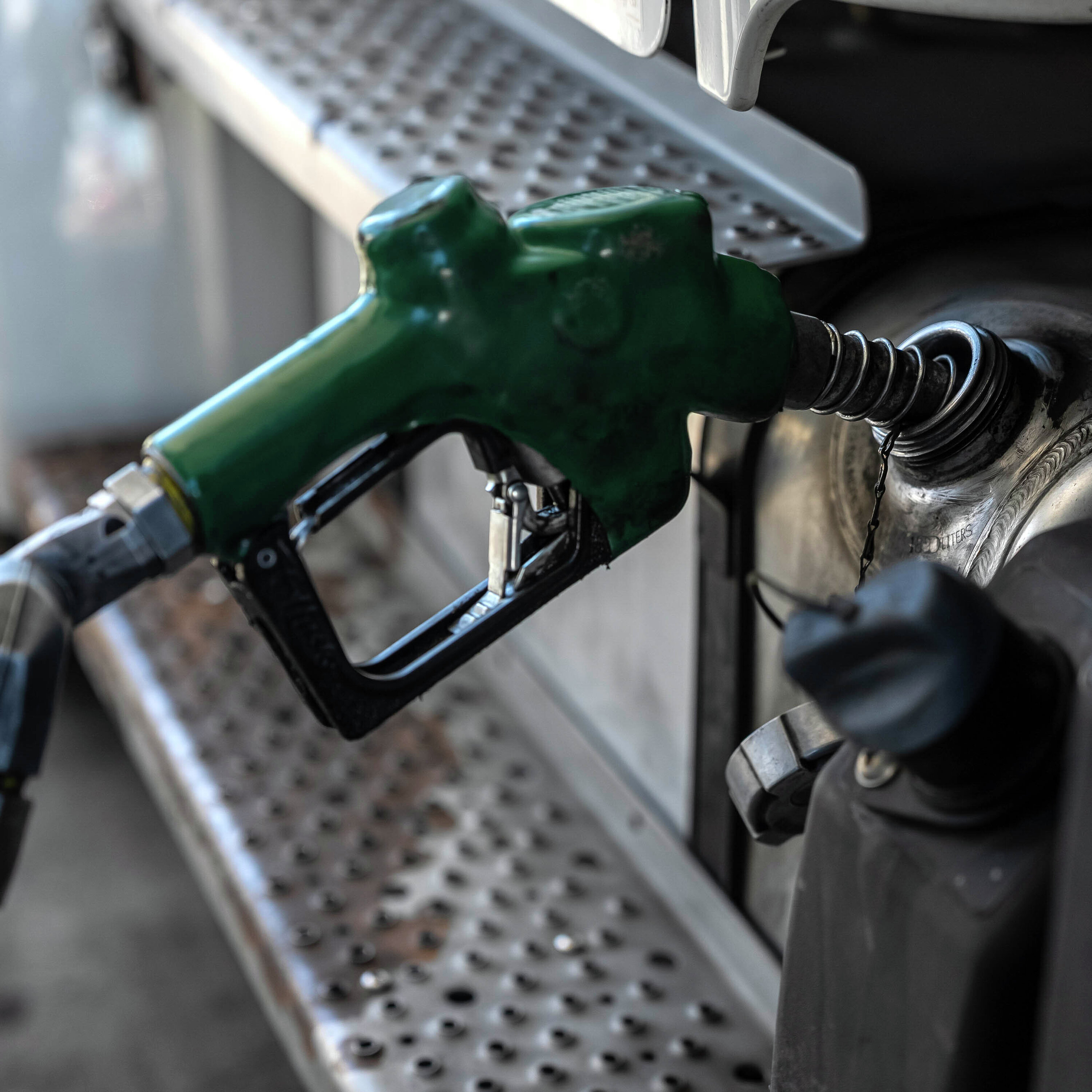
Why Everyone Is Talking About High Diesel Prices
Dienstag, 20. Oktober 2026 · 17 min
Kapitelklicken springt direkt hin
Shownotes
Diesel prices are hitting new highs, and voters aren’t happy. With the midterms approaching, the Trump administration is trying to find ways to curb fuel costs, including a potential US diesel export ban.
On today’s Big Take podcast: The political fallout of sky-high diesel prices. Bloomberg national economics reporter Mark Niquette and host Sarah Holder break down what’s driving up costs, why prices are hitting battleground states particularly hard and whether an export ban could backfire.
Read more: Record Diesel Prices Hit at Worst Time in Key Battleground States (bloomberg.com/news/features/2026-09-16/midterm…)
We have a special Bloomberg subscription offer for podcast listeners at Bloomberg.com/podcastoffer. (bloomberg.com/subscriptions/podcasts)
Hosted by Sarah Holder; Produced by David Fox; Reported by Mark Niquette Edited by Tracey Samuelson; Engineering by Alex Sugiura
See omnystudio.com/listener for privacy information.
Transkriptvom Podcast bereitgestellt · Zeitmarken springen hin
Bloomberg Audio Studios.
Podcasts. Radio. News.
The expectation is a lot of pain is still ahead, that this is not a short-term situation, particularly if we don't see a quick resolution to the war in Iran.
This week, diesel prices hit $ 6. 50 a gallon. That's a record high. Today, Politico reported that in an effort to push prices back down, the Trump administration is preparing a plan for a 90-day ban on diesel exports.
Diesel touches all aspects of the U.S. economy. So when the price of diesel goes up, it just affects all aspects of the pricing.
In the U.S., The high price of diesel is starting to affect all kinds of industries, from farming to shipping to tourism. Because diesel powers tractors, trucks, home heaters, and fishing boats. Rob Gudgel captains a 43-foot charter boat in Washington state. He takes passengers out on fishing expeditions into the Pacific.
Fuel is one of the number one costs that we have to endure. The other day, fuel jumped up 85 cents a gallon.
For a 130-mile trip, Rob's twin engines burn about 130 gallons of diesel.
I was paying around $ 600 for a trip.
And now.
It's closer to $ 1, 000. Not quite $ 1, 000, but it's darn close. We try to eat some of it because everybody's going through a tough time. The cost of fuel drives the economy. It doesn't matter if you're going to the grocery store, the clothes you buy, it's plane, train, ships, whatever it is, that's what drives the economy is the cost of fuel.
And with the midterms coming up, the cost of fuel is also driving politics.
Voters are inclined to blame President Trump and Republicans who are in control and power right now for high diesel prices. While they have seen price spikes in the past, they do not think that diesel or home heating oil would be at record levels if not for the Iran war.
I'm Sarah Holder, and this is The Big Take from Bloomberg News. Today on the show, Bloomberg National Economics reporter Mark Nickett on how record high diesel prices affect everyone in the global economy and the impact they could have on the U.S. midterms. So, Mark, help us understand, what's been driving up the cost of diesel? Why has it been rising faster than the cost of gasoline?
Well, there's a confluence of events for increasing diesel prices. We've had Ukrainian attacks on Russia refining of diesel, and Russia has also banned exports of diesel. And Russia supplied previously about 10% of the world's supply of diesel. So we've had declining exports from Russia. But it's happening at the same time that we've seen the shipments of diesel and refining of diesel in the Middle East constrained because of the Iran war. So sort of the combination of those two things has really driven up the price of diesel.
And diesel is more expensive than gasoline because it costs more to refine diesel because of environmental standards. And the global demand for diesel is higher. So The price of diesel tracks higher than gasoline typically.
And you're describing some compounding factors that have led to the rise in the price of diesel. President Donald Trump, for his part, has said that, quote, the world's diesel price rise is mostly caused by the Russia-Ukraine war, not Iran. That was in a Truth Social post earlier this month. Is it possible to tease out how much impact the war in Iran may be having versus something like the Russian war? What are you hearing from the exports you're talking to about how to weight these various causes?
It's hard to tease out exactly how much of the increase would come from the Iran war versus the Russian export reduction. I mean, the administration wants to blame this all on Russian refining capacity being affected by the Russia-Ukraine war. And also, you know, reduced refining capacity in the U.S.
under previous Democratic presidents. But the experts we talked to say, you know, diesel would not be at record prices if not for the Iran war and the constraints on shipping in the Middle East.
When most people fill up at a gas station, they're not choosing diesel to put into their car, for example. But the cost of diesel has this huge, far-reaching, sort of rippling economic impact for people. Why is it so important and what does it touch?
Diesel powers the trucks that we use to deliver products across the country. Diesel powers the tractors that farmers use to plant and harvest their crops and also deliver their crops to silos and grain elevators. And diesel and its close derivative, home heating oil, heats homes and businesses and particularly in the Northeast U.S. and Alaska and rural areas. So, you know, when the price of diesel goes up, the price of home heating oil goes up. And that means, you know, heating bills go up for homeowners and businesses that rely on home heating oil for their heat.
We're just over 40 days away from the midterm elections here in the U.S. You've dug into how diesel and Take us around the map of battleground states. What did you find?
Well, let's start with farming because the price of diesel has a huge impact on agriculture, particularly now because we're heading into harvest season. So farmers have no choice but to buy diesel to power their combines to get in the harvest. So the farm states that have tossed up Senate races right now include Iowa and Nebraska and Kansas.
And the issue of high diesel prices are paramount in those Senate races because of how important agriculture is to those states' economies. And it's also very impactful in Maine and Alaska right now, mostly because of the price of home heating oil reaching record levels. In fact, the price in Maine last week was just posted to be 74% higher than this time last year. Right at the time that, you know, a lot of homeowners are filling up their fuel tanks for the winter. And we're being told that, you know, some customers are holding off on filling up their tanks, you know, hoping that the price will come down. But, you know, winter's coming and they're not going to be able to hold off forever and have to bite the
bullet to pay the higher cost for home heating oil. Another area is Alaska and Maine fishing because diesel powers the boats that the fishing industry needs. The Democratic candidate in Alaska, Mary Patola, has cited the impact of diesel costs on the fishing industry.
Every day, that diesel is getting more and more expensive for our fishermen, more and more expensive to make ice, more and more expensive for our processors. We need a break here. We need some help. We need somebody in D.C. fighting to lower our costs, not to jack up our costs.
And we're seeing this anywhere where, you know, fishing is a big part of the state economy. And this is having a big impact on the Senate races in Maine and Alaska in particular, because they're both toss up races. And the candidates are talking about the price of home heating oil and diesel in those states and blaming the Republicans who control Congress and the White House right now for creating the circumstances that are pushing up the price of diesel and home heating oil.
The fix that candidates, members of Congress, and President Trump is calling for. And whether it could work. That's after the break.
I've said let's not send out the diesel.
We make a lot of diesel.
Speaking at the United Nations this week, President Trump said his administration was considering a diesel export ban. And today, Politico reported new details on the plan the White House is developing, which, if imposed, would ban U.S. diesel exports for 90 days. The idea has been floated by some U.S.
lawmakers and midterm candidates who hope that keeping U.S. diesel for domestic consumption might lower its cost. But it's also gotten a lot of pushback from the oil and gas industry and from some energy analysts and experts who warn an export ban wouldn't actually bring prices down, and could even backfire.
Well, I think you're seeing it primarily right now in Iowa. Just yesterday, the Republican candidate for the Senate there, Representative Ashley Hinson, came right out and called for a ban on exports of diesel. And the Republican senator in Iowa, Chuck Grassley, has also called for an export ban. And it's a little controversial because the industry does not think that a export ban would In fact, they think the opposite, that an export ban could actually help drive up the price even more because banning exports would mean, the refiners would have to store more diesel and would not be able to produce as much diesel, could drive up the prices in that way. But like I said, in Iowa, you're seeing the Republican candidates even come out against the
war in Iran as a primary cause or a factor in the rising price of diesel. But, you know, the Democratic candidates are also calling for an export ban and blaming the president in particular for the rising costs of diesel. So if you see this kind of happening in a Republican-leaning state like Iowa, it just sort of gives you an idea of how salient the issue is in that campaign if the Republican candidates feel the need to address it in this way.
And, Mark, you've been doing a lot of reporting talking to voters about their concerns about What do we know about how prominent the cost of diesel is for these voters who are deciding to go to the polls or stay home or vote for a particular candidate? And what are you hearing from them about how this is affecting them?
It's very prominent for farmers in particular. I mean, this is a constituency that generally supports Republicans in Donald Trump, certainly voted for him in his elections and are inclined to support Republican candidates in the Senate races. but they're sort of up against it now when it comes to high diesel prices because it's a cost that they can't mitigate.
They can't, you know, not harvest their crops, so they have to pay the high cost of diesel. I've talked to a farmer in Iowa who said he, you know, leans Republican, he gravitates toward Republican politics, and he's been holding off buying diesel, just hoping that the price would come down and, you know, He's at the point now where there's nothing he can do about mitigating the high price of diesel, and he has to do his harvest.
And the problem is that just cuts right into the bottom line. It's not like his farm operates at a high profit margin. So when you introduce higher costs on that side of the equation without the ability to really mitigate those higher costs, that just means less profits for him in this harvest.
Who or what does he— hold responsible for these higher diesel costs?
He blames President Trump and the war in Iran. I mean, his view is the, you know, the price of diesel might be higher because of market forces right now, but it certainly would not be at record levels if not for the war in Iran. We also talked to a voter in Maine who is dealing with high home heating oil prices right now. They're not exactly the same, but it's essentially the same product refined from crude oil. And he's frustrated because this is the time of year he normally fills up his fuel tanks. And he generally buys like 150 gallons a month through the course of the winter heating season. But he's looking at cost or he's calculating at current prices an additional $ 300 a month for home heating oil. And he just can't afford that. That
means having to dip into his savings to pay that. or putting off repairs on his farmhouse. He's a 75-year-old retiree, and he blames the Republicans for this. He correlates us with the war in Iran. And if the U.S. had not attacked Iran and affected the Middle East refining capacity and shipping, he would not be seeing as high of home heating oil prices this winter.
So, Mark, we've talked about a few of the proposals to address this issue, export bans being one of them. Talk me through what Other mechanisms are available to bring the cost of diesel down. What can be done about this?
The problem is not a lot. You know, it's sort of a supply and demand situation. French President Emmanuel Macron is called on the European Commission to, you know, relax rules on oil products like diesel and kerosene. saying the EU should examine relaxing the rules, recovering fuel quality, the idea that we could produce more diesel for the global economy.
But as I said, the problem is we still have Russia setting to extend a diesel export ban beyond September. So if we have no more Russian oil coming onto the Russian diesel, I should say, coming onto the market, you know, changing the refining rules in Europe is not going to affect the global supply situation.
So there isn't enough in reserve collectively, globally to ease these shortages? Right.
We're at a time when global supplies and stocks of diesel are depleted for all intents and purposes with no real, you know, significant additional supply coming onto the market.
And what has the Trump administration and what have members of Congress sort of proposed here? Is there a plan in the U.S. to tackle this?
Well, there's talk of trying to increase the refining capacity for U.S. refiners. There's talk about trying to ban exports on the gasoline side, do like a gas tax holiday to charge the gasoline tax. for a period to bring down the price for consumers. Part of the reason that diesel is more expensive generally than gasoline is taxes are higher on diesel than gasoline. But these things all, the experts think, wouldn't have a dramatic effect on prices given the supply constraints we have right now in the market.
I feel like I always ask this when we have a conversation about high gas prices, high diesel prices. But are there alternatives that people in industries can turn to? Might this spur more investment in green energy infrastructure? Is this a sign that the reliance on diesel is unsustainable?
Perhaps. I mean, you're seeing reports that there's more interest in electric vehicles, but that's sort of on the gasoline side. And the problem is, It's not like there's a lot of alternatives for diesel, particularly in the commercial sector. I mean, there's, you know, different blends that can perhaps be refined for diesel.
But at the end of the day, you know, a lot of these businesses in particular, you know, have no choice in farmers but to buy the diesel at whatever price it is at.
This is The Big Take from Bloomberg News. I'm Sarah Holder. To get more from The Big Take and unlimited access to all of Bloomberg.com, subscribe today at Bloomberg.com slash podcast offer. If you liked this episode, make sure to subscribe and review The Big Take wherever you listen to podcasts. It helps people find the show. Thanks for listening. We'll be back tomorrow.
