

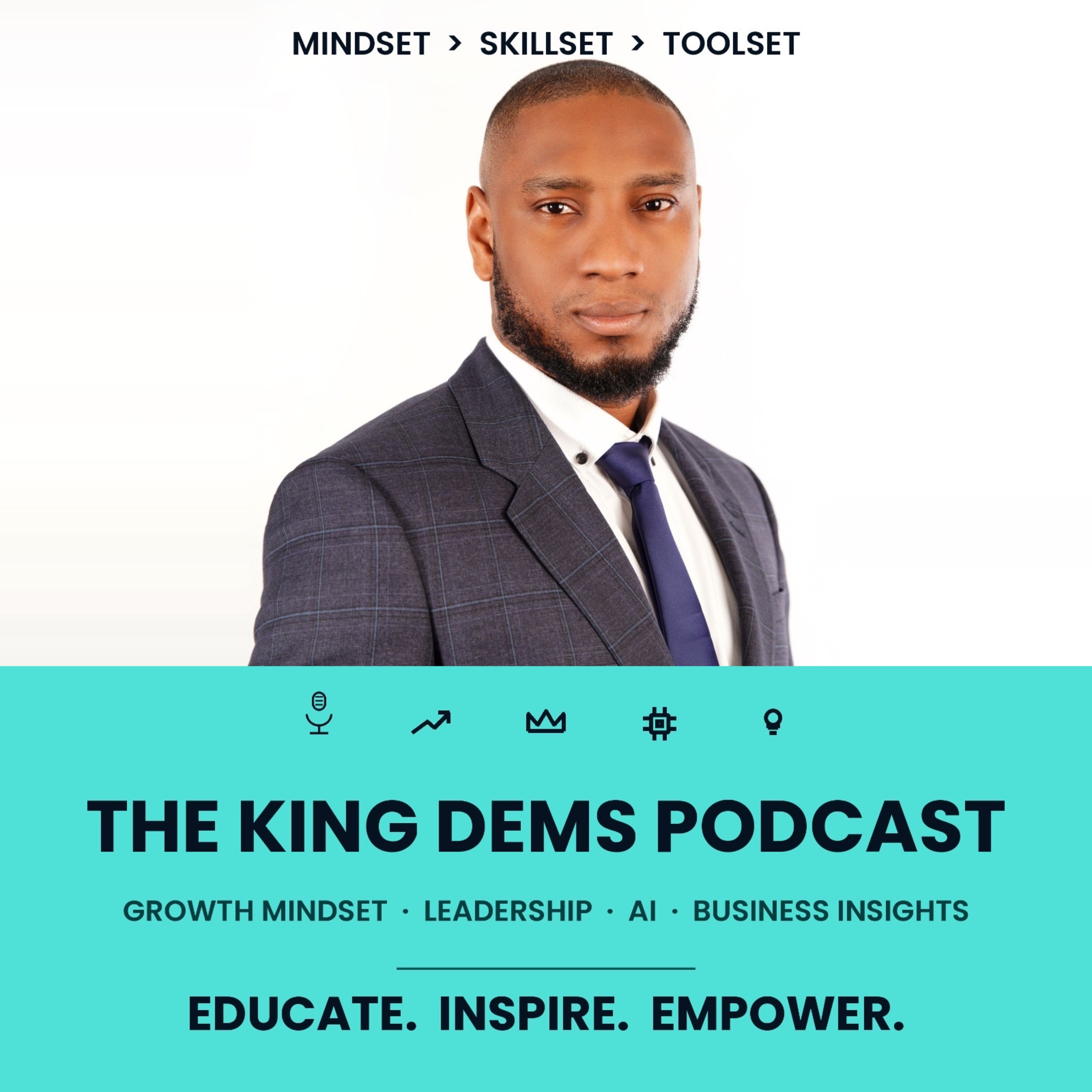
King Dems Podcast | Growth Mindset, Leadership, AI and Business Insights· Folge 132
Boring Investor Secrets: Paul Moore on Wealth, Growth Mindset and Smart Business Strategies
Dienstag, 9. September 2025 · 41 min
Kapitelklicken springt direkt hin
Shownotes
Fuel your wealth with growth mindset strategies: Paul Moore reveals how boring investing, AI in business insights, resilience, and leadership principles create lasting wealth, mental health, and business growth.🔑 Key Insights You’ll Learn:
Paul Moore, ex-Ford executive turned real estate mogul, shares how he lost millions, rebuilt with boring investor principles, and now helps thousands achieve financial literacy, personal transformation, and enduring wealth.
• How Paul went from $2.5M debt to debt-free in 13 months
• Why boring investor strategies beat speculation and hype
• The mindset shifts behind resilience and personal growth
• Commercial real estate secrets: self storage, mobile home parks, recession-resistant assets
• How AI in business supports due diligence, smarter investing, and innovation
• The fight against human trafficking and building wealth with impact
• Mistakes high-income professionals make and how to avoid them
🌍 The King Dems Podcast is ranked Global Top 2.5% on ListenNotes. Join us on the journey to Global Top 1% before 2025. Subscribe, review, and share this episode to help us grow.
📚 Guest Links & Resources:
• Wellings Capital: wellingscapital.com
• Books: Storing Up Profits, The Perfect Investment, How to Lose Money
• Upcoming book: Warren Buffett’s Rules for Real Estate Investors
• Follow Paul Moore on LinkedIn & Facebook
🚀 Affiliate Power Partners (Growth Tools We Trust)
📧 Email isn’t just a marketing channel — it’s the foundation of your business. Grow your audience, automate workflows and boost revenue with Kit: partners.kit.com/x3j2zt8uz3i3 — start today
✅ Design stunning presentations that wow clients and investors with Gamma: try.gamma.app/KingDemsPodcast — create now
🎙️ Book interviews fast and expand your influence with PodMatch: joinpodmatch.com/kingdemspodcast — join today
🎧 Record studio-quality podcasts from anywhere with Riverside: riverside.fm/?via=ademola — get started now
🛒 Partner with us through Stan Store Affiliate — earn by sharing premium tools and growth systems: join.stan.store/k-demsconsulting — sign up today
🛒 Shop our official Stan Store — access premium resources, digital tools and growth bundles built to help you scale smarter: stan.store/k-demsconsulting — shop now
Smarter tools. Better growth. Bigger wins.
Transkriptvom Podcast bereitgestellt · Zeitmarken springen hin
I was not a boring investor. I was an entrepreneurial investor and I made a lot of mistakes. I thought investing should be exciting. I didn't know the truth. The truth is that economist Paul Samuelson, who was the first Nobel Pie Prize winner in economics. Wow, Paul Samosi and I, I did read some of his work because my first degrees in economics though that that's that's out. Samuelson said investing should be boring. It should be like watching paint dry or watching grass grow. If you want excitement, take $800 and go to Las Vegas, Yeah. Casino.
I didn't know that. I thought investing should be exciting and fun, and I lost a lot of money. I had excitement, That's first. The household is means. I've lost a lot of money and so I made a vow to become the boring investor. Welcome to the King Dems Podcast, where we share the stories of extraordinary people and dissect hot, relevant topics that shape our world.
From visionary leaders to trailblazing creatives, we uncover the mindset, strategy, and grit behind greatness. Whether it's business, culture, or personal growth, we ask the real questions. This isn't just conversation, it's transformation. The Kingdom's podcast, Your next breakthrough starts here. Music licencing reimagined.
Ladies and gentlemen, we are live. And of course, you are once again welcome to the Kingdom's broadcast. And today I've got with me a very, very special guest fighting out of Virginia, United States of America. Mick Walker, Paul, the board investor Moore, how are you? Hey, I'm doing great and it's fantastic to be here. Thank you.
Wow, I love your name because you can actually play on words with it. Paul Moore. Everybody wants more in life, but are you willing to do more like Paul Moore? OK, we will find out. I appreciate you very much as a person because you are a symbol of hope, a symbol of inspiration. And by the way, I tell people this, I would never say behind you what I cannot say in your presence, right?
So let me report myself to you. I said to somebody when life gives you lemons, make lemonade. Was a person then that person would be Paul Moore. So today I'm chilled to welcome an extraordinary guest, Paul Moore, a former Ford executive turned real estate mogul, three time author and the founder of Welling's Capital known as the Boring Investor.
What a moniker. Paul has flipped the script on what it means to build wealth. After selling his company and making millions, he hit rock bottom going 2 point. By the way, U.S. dollars. Shout out to the Australian dollars in debts before rebuilding with a rock solid philosophy. Slow, steady recession resistant investing. Paul has completed over 100 real estate deals, hosted the Heat podcast How to Lose Money, contributed to Bigger Pockets and Fox Business, and helped raise over 800 thousand U.S. dollars to fight human trafficking. Today, he's here to share how you can build enduring wealth while staying aligned with your values. Let us dive in.
And once again, ladies and gentlemen, big welcome the man, the myth and the legend. Paul Moore, your, your story's actually inspiring. I think that's an understatement anyways. But you know, from millionaire, you know, to millions in debt and back is nothing short of remarkable. But what might have shifts helped you turn your financial crisis into a comeback story?
Well, you know, I'm just kind of backing up. I sold my company, my staffing firm in 1997 and I thought I was a full time investor, but you know what I was not? I was a full time speculator is what I was. More like gambler. I made a lot of mistakes and I lost a lot of money. I made a lot of money as well, but I went into exactly 10 years after I had about $2,000,000 in the bank from selling my small company.
I had two and a half, $1,000,000 in debt and my business partner said I can't do this anymore. It was late 2007. We didn't know we were plunging off the financial Cliff into 2008 and. Whoa. We knew there was, you know, we knew the economy was on shaky ground. We just didn't know how bad it really would be. That was a part time.
It was a bad time and so we had had to decide what to do next. So I called together my family, I called my CPA and her husband and a couple friends and I said, we've got an idea. I've got an idea. I feel like God wants me to start giving our way out of debt. And they looked at me like. Reverse psychology, Yeah.
As Jared, we're, you know, I said our back is against the wall. We're in really big trouble. It looks like the economy is in really bad shape. We own all this real estate. Let's we're going to start giving aggressively. We already were giving generously, but we said we're going to give a certain amount every single week. And if God bails us out, so be it. And if he doesn't, then I I'm in his hands. Ladies, what we're doing?
Yeah. So January 1st, 2008, we, we gave a certain amount of money that week and then a same, the second, third, the 4th, the 5th week. But the 4th week of that, in January, I met a real estate developer at a restaurant and he gave me an idea. And that little idea exploded in my mind. And I went to the county planning and zoning board the next two days later with my surveyor and I said, hey, I've got this idea. I want to do this, to subdivide this 5 acres of waterfront land into 5 parcels.
And it was not subdividable, but I said I want to use your law to subdivide it anyway. And the lady looks up over her glasses. She was an older lady and she said. Speaking of glasses, I need to get my glasses as well, yeah. She said Mishka Moore, no one. I am. I've been here 30 years and no one attempted to use our law against us like this.
And then she laughed. She smiled. She said, But you did. She said you figured it out. She said you can do this. No one has ever come up with such a crazy idea, but you can do this anyway. So I had a lot of hard work left a lot of meetings with attorneys, and I had meetings with real estate developers and soil contractors and surveyors. But we were able to subdivide that land and 13 months later I was completely debt free.
I even paid off my house. Wow, wow. I you know, you just reminded me of a book I read growing up in Nigeria. It's written by He's a pastor motivational speaker. His name is Sam Adiemi, and the title of that book is Ideas Rule the world. It's interesting how a person's life can change in the blink of an eye just by way of an idea. And some people call it your lightning rod moment. Some people call it your aha moment. But the hearts of kings and Princess is in the hearts of the Lord and it's always very important to to pray for that wisdom, you know, to make wealth because it's it's scriptural that it is he who gives us, you know, the the wisdom and of course the power to make wealth.
But something really strikes me when it comes to you and that is your moniker, the boring investor. I have only said that one thing that the success that I, I personally have in, in my life is attributable to a couple of boring things. And that is consistency, hard work. Yeah. And would I say still consistency, consistent faith, you know, in, in God and, and myself.
So that aligns with my values. So I I want for you to talk about why you embrace that, Monica, probably the boring investor. Well, the problem was when I sold my company at 33 years old, I thought I should get the same excitement out of real estate investing and out of investing that I did out of being an entrepreneur.
I was not a boring investor. I was an entrepreneurial investor and I made a lot of mistakes. I thought investing should be exciting. I didn't know the truth. The truth is that economist Paul Samuelson, who was the first Nobel Prize winner in economics. Wow, Paul Samuelson I I did a read some of his work because my first degrees in economics so that that stands out.
Danielson said investing should be boring. It should be like watching paint dry or watching grass grow. If you want excitement, take $800 and go to Las Vegas, Yeah. Casino. I didn't know that. I thought investing should be exciting and fun and I lost a lot of money. I had excitement. That's first all. This means.
But I lost a lot of money and so I made a vow to become the boring investor. Boring investors don't get excitement out of their investments. Warring investors have to wait a long time. Warren Buffett said that the the true profit is not in the buying and selling, but in the waiting. Yes. Boring investors avoid hidden costs they don't have.
I had a friend named Kevin who he always watched his stock market his, he was doing short and long positions and he was always watching it go up and down and up and down. He was always excited and tense and he lost sleep over it and he lost productivity and he lost relationships. He was always on his BlackBerry and now iPhone.
You know what? He didn't make any more money. He lost money doing that. He didn't make money. You know that. Those are hidden costs. Now he goes sailing through the Puget Sound in Seattle and he has his investments in passive investments and he's trusting other people to do the heavy lifting. He invests with my company, he invest in other passive investments, and he doesn't try to manage his money.
Boring investors lose money sometimes, but they use those lessons to make a fortune later. Bring investors focus more on protecting their principal and not losing money and not making repeatable mistakes. Then they do bring brilliant and making money. Charlie Munger, Warren Buffett's partner, was the most brilliant investor in the world, according to a lot of people. And his obsession was not on making money. His obsession was on not making repeatable mistakes. And did you know if you take the, if you Berkshire Hathaway over the last 60 years, Warren Buffett's company, if you cut the share price by 99%, if you took their share price today, let's say it, let's just say it's $100 and you cut it down to $1.00, it still beats the S&P
500 by about 40%. So they're the boringest investors I know. Warren Buffett's life is boring. Charlie Munger, he read 500 books a year. His life was boring was very, very. Their life would be hard to replicate because it would be so boring. But they were able to pave a way and show the world what it looks like to be a boring investor.
Boring investors were often misunderstood. Absolutely. Absolutely. It's the fact of life, right? And that's the exactly one thing I appreciate about you. You are not afraid to be different, you know, owning it as well. It's a bold move. It is a bold move. Yeah. Wow, the boring investment. Absolutely. You know, it's more about the, would I say, tested and trusted principles.
Life actually works on principles, right? If you apply with these principles, right, that have been tested right, and trusted over time, often than not you would be successful. But it comes out of cost and that cost has been boring, right? But absolutely being great on life requires you to be different from, from, from other people.
And Speaking of real estate, right, investment, you've actually been able to complete over 100 breed estate deals. We're not talking about small deals. We're talking about multi $1,000,000 deals. All deals. What did he say? Some of them were small deals, too. OK, OK. But what is small to you is is big to me. So remember I'm actually an ex big for auditor and there's something that is very, very important to our work. We call it MATI reality, right?
Materiality basically talks about significance, right? That is an item is said to be material if it's inclusion or mission in the financial statements is significant enough to influence the decision making of the users of the financial information. So for you, absolutely, what is small to you is actually still big to me.
In the meantime, we're looking at flipping homes, you know, to building funds. So why did you ultimately shift your focus to commercial real estate and recession resistant assets like self storage and mobile home packs? Yeah, well, Adam, all, we flipped a lot of homes, flipped 50 or 60 homes. I flipped 20 or 30 waterfront lots at Smith Mountain Lake and Virginia, and I realised, you know, a lot of the deals we were doing, we were just making money and then going on and making more money and making more money, but we were just pouring money back into the next deal, Warren Buffett said, And this is another boring investor principle. He said unless you learn to make money while you sleep, you'll have to work until you die.
Absolutely. And so we weren't making money while we slept. We were making money while we worked, but we weren't making money when I didn't. And so I wanted to find investments that actually made money while I slept, but I also wanted to find investments that allowed us to force appreciation. Now, in residential real estate, your appreciation comes.
You know your value of the real estate is based on comps on comparable properties in the neighbourhood. But in commercial real estate, your value is based on math. Now that's related to comparable properties, but the math is that the value of the real estate equals the net operating income divided by the cap rate or the capitalization rate.
Therefore, if I increase net operating income by 20%, I increase the value of the property by 20%. But if I'm using leverage, let's say 50% debt, then I can actually increase the value of the property, the the equity by not just 20%, but maybe 40% in that case. Well, this is very predictable and this is very much easy to track and it's easy to understand.
So when we buy properties with baked in intrinsic value, that means there's value that's in the property that the previous owner has not has not tapped into. We can increase the value by increasing the income. Warren Buffett said price is what you pay, value is what you get. And when you buy commercial real estate properties from mom and pop owners, you can sometimes see opportunities to increase the income, increase the value and increase the returns for investors.
And I like that. I like commercial real estate because we can increase the value based on math on based on we can force appreciation. I've got examples if you would like to know. Yes, I, I definitely would love examples, right And for me being an ex BIG4 auditor, I've seen like some of these things play out in real life, right?
You have an organisation that is selling out or probably being taking over. You have mergers, you have acquisitions, especially acquisitions, right? And you see the company right, that is buying this new subsidiary paying heavily, paying heavy premiums for that target company that they are acquiring.
And this is sort of what I say relatable to to what you're explaining that premium right is driven by certain factors. So in your examples a lot for you to. Would I say isolate or identify the factors that drive the premium of these commercial real estate properties? Up Well, let me just give an example.
So I wrote a book called Storing Up Profits. It was published by Bigger Pockets in 2021, and the book was about self storage in self storage. You know, most of self storage is in North America, but it's starting to take hold in England. Yeah, we have. We have. We have those here. And self storage, you can buy a self about half of the self storage assets in America.
There's about 50 or 60,000 self storage facilities. About half of them are run by mom and pop owners. These mom and pop owners do not have the desire or the knowledge or the resources to upgrade the facilities to increase income, to maximise value and shareholder returns. So for example, you might buy a self storage facility and the owner might say, yeah, there's 5 or 6 acres Outback we don't use.
Well, the smart buyer will say, OK, what can we do with that 5 or 6 acres? Well, they can gravel that or pay pave it and they can put, they can store heavy machinery and equipment there. They can use it for RV and boat storage. They can put a cell tower back there. They can put a billboard on the front of the property and get revenue from the Billboard.
They can add a showroom and an office where they sell locks, boxes, tape and scissors. They can expand the facility. They can add climate control buildings. They can maybe they can build on. I know somebody who add one story building. They made it into a three Storey building. They can add. They can add an ATM, they can add a propane filling station. There's a lot of things that a good buyer can do. They can start renting U-Haul rental trucks out of the. Purpose in.
Yeah, and they can do all kinds of things to increase income and maximise value. And so the original owner, the mom and pop owner, doesn't know or care about these things. And that's why there's tremendous intrinsic value in that property that the buyer can unlock for their investors. That's what we love about a lot of different commercial real estate deals. Wow.
You know, there's that possibility to unlock an exponential increase in not just value, but in revenue. Yeah, right. Because it's interesting how sometimes you have certain factors that drive the value up. And this is what I say very common in the text space. One day the value goes up the course of some speculations, and the very next day it's it can be on the floor.
But what would you say about the obsession that a lot of investors have about value? So, so some of them would I say place more premium on valuation than revenue. Well, I tell you, I'm not sure about that because we're in the real estate space, but I'll, I'll tell you the something that may be similar. A lot of operators place all their focus on AUM. That's assets under management.
They want to grow, grow, grow and get to a billion dollars in assets. That's valuation, right? We are focused on profits, we're focused on return. If we can focus on ROI or profits, the AUM will take care of itself. If we're focused on growth and AUM first, then we'll probably have lower profits and unhappier investors and we won't be making the difference that we want to for our investors. Exactly, you know, investors, the, the average investor wants to have a return on their, their capital. But what I see a lot of wheels in in, in the industry are just about that valuation because it makes them look really fancy to, to, to to the public.
It's just a little difference between being a multi millionaire and a billionaire. So some people get lost in that obsession of having their net worth grow instead of having, you know, the net income grow consistently over time. So I think that that's a good way to segue to my next question, which is about high income professionals.
What are the top three mistakes that you see high income professionals make when getting into private real estate investing and how can they avoid them? Yeah, One mistake they make is they quickly, they make a quick decision on who to invest with. Somebody at their office said, hey, I invested with ABC company and they go pull up their website that evening and they wire them money a few days later. They haven't done the due diligence. They don't have the time to do the due diligence. They don't have the knowledge to do the due diligence. They don't have the resources to really do the due diligence. They can do a few things, but you can't do that really quickly.
If I'm going to wire somebody $100,000, I'm going to go get on a plane and go see them in person. I'm Warren. Buffett style. I'm going to get a gut check with seeing what they if I really believe their story. I'm going to see how they talk about their waitress or their waiter at the restaurant.
I'm going to see how they talk about their investors and their spouse. I'm going to want to know their criminal. I want to know a deep dive criminal check and background check and reference check. I want to check out their debt in detail. I want an attorney to go through their debt, you know, structure and see where they're vulnerable.
I want to do death by Google Now. Any investor can do that. You know where you just go through and look at very deep dive at the what people are saying about them online. So due diligence is the number one mistake I see people make. And the way around that is either to do the due diligence or to invest with somebody who has done due diligence and you can do it yourself.
It just takes some time to do it right. Last year our company looked, our fund looked at 745 operators and deals and we only invested in five. But you know what? All 745 look good at first. They all look good. And if we would have invested quickly, we could have invested in any of those. But we only invested in five because the more we looked, the more we realised this was usually a no, Warren Buffett said the best investors say no a lot.
The very best investors say no almost all the time. That's the biggest mistake I see investors make. A second one is lack of diversification. Now, most high net worth individuals aren't full time investors like Warren Buffett and Charlie Munger and others. And so they need to diversify to protect their assets.
And you know, if I see one deal, this is a mistake I made early in my career. If I saw one deal that looked like a sure thing, I took all the available money I had and I ploughed into that one deal. I didn't always do that, but I did it a few times and that was a mistake because anything can go wrong. There's always a potential that an employee at that company will commit fraud.
There's always a potential that something could go wrong. Maybe a law would change, maybe the economy would change, maybe that owner, maybe the operator would die or quit. There's all kinds of things that can go wrong, nothing certain. And that's why it's really important for almost every investor to diversify broadly. And so those are two mistakes.
A third one would be, you know, I think actively managing and I'm going to step on some toes here probably. But you know, if I'm a busy professional who can make really, really good money in IT or as a doctor, And I think, oh, I saw this real estate show that would be real fun to go flip a house or have some rental homes. Chances are they're only going to make like $20.00 an hour on the side doing that when they can maybe make 100 or 200 or $300.00 an hour as a professional or more. And so doing this on the side, it drains their time, it drains their energy.
It, it, it, it zaps their emotions. Because it's really frustrating to get a call at 2:00 in the morning to come clean out a toilet and have all kinds of baggage with it. And so I think another big mistake, the third big mistake is actually trying to do real estate on the side. Why not send the money to a professional and let them do the heavy lifting?
Let the properties, let them do the property management and you collect a paycheck. Now there's problems with that too, but I think that's a better way for most investors to go. I know that's the way I do it. I don't actively manage any properties anymore. Whoa. Talking about the tech side of things, I wanted to pick your brain real quick on the role of AI in guiding investor decision making. So what what?
What's your your take on AI on a general note and like how is it useful in the investment space? I'm continually amazed at how well AI does. I use it for all kinds of personal things. I do a lot of morning meditation and study of ancient scriptures, and I use AI to help me understand the Greek and the Hebrew texts and all kinds of things. I'm continually amazed.
I think in AI can be really useful to help us do due diligence on an operator to quickly go through a contract or maybe a mortgage note and look for problems or look for highlights. There's so many things AI can do and I think most people by now know that it has incredible potential. Now it has incredible.
My wife thinks it's evil. She thinks it's horribly evil. And I said. What I said? Anything. No way. Anything in the wrong hands can be evil. So the Bible is the greatest book and the biggest selling book ever. It can be used for incredible good in the right hands, but that same Bible in the hands of an evil person could be used to justify evil as well.
Anything can be used for good or evil. It depends who's using it. Oh wow. Speaking of, who is using it? Just a quick joke here. Do you know what my initials are? What AO right? AI. I/O. So I don't ever entertain any, any defamation against AI because it sounds special. Yeah, right. Well, we know you're very, very busy, man. And of course we need to let you go very soon, but we want to get, you know, quick Nuggets from you as much as possible because we don't get to meet great people like you every day. So it's a Christmas coming very, very early in August. So we have an August visitor on the show and I'd love to ask you 5 quick fire round power questions. Are you ready to rumble?
Let's go, OK. So what's one book that changed your mindset on money or life? The one thing by the word and J Papazam, the one thing it taught me to that every time if you want to say yes to your main calling in life, you have to say no to 10,000 distractions. I love that. I, I love that nugget. It sort of aligns with something I, I used to say that be careful about side attractions.
That OK, Be careful about distractions that pose as side attractions. Yeah. So I love that very much. So #2 What's 1 mistake you will never forget and what did it teach you? Let's see, well, how many hours do you have to talk about these mistakes? You know, I didn't follow my gut. I had a gut feel that something was wrong with this $100,000 investment I made.
But it was, it was returning 2 or 3% per month. And I thought, well, what can go wrong? And my head said do this investment, but my gut, my heart said something's wrong here. And that guy is now, he's been in prison for 24 years and he's got 158 year prison term because he was. And I wish I would have listened to my gut. Is that another Benny made off?
Of this he was too small to be Bernie Madoff, but he. Yeah, OK, OK. So #3 passive income or legacy impact which motivates you more today? Well, I love passive income and I create, I, I hopefully create passive income for 1030 investors with Wellings Capital. But a legacy is something that you know, it's going to live on past your lifetime. And I want to create a legacy.
If you took the record profits, the record profits of Walmart, Exxon Mobil and Nike, and you added up those record profits and triple that number, that's the approximate profitability of human trafficking every year. And there are more enslaved people on the earth than anytime in human history. There's about 50 million. And so my company is trying to raise awareness of this horrible thing called human trafficking and also to try to raise funds to combat human trafficking.
We've raised over $800,000 so far and we're looking to continue that effort. Here, coincidentally a few episodes ago, we had somebody in that space that's the CEO of the Meccan Club, Matt Friedman, come talk about human trafficking. It is very, very horrific and I think words are inadequate to appreciate what you do in terms of passionately contributing towards the fight of this menace.
It's it's difficult because the prophets, like you rightly said, are outrageous and it's difficult fighting people with money. May, may make good, always win over evil. But I'll leave you there, SO44, if you lost everything today and had to start over tomorrow, what's the first investment move that you would make?
I would definitely invest in commercial real estate. If I had little to no money I would actually consider. I would consider leasing or buying or getting a rent to own. A rent to own on maybe 5 acres near a lake and I would start doing boat and RV storage and if it was successful I would add a fence, I would add security cameras, I would add an office, I would maybe even add self storage.
I would execute on the rent to own. So I owned the land and that's where I would start again. Wow. And of course, the very last question, but not the least what's 1 bar in habits that has made you widely successful? Honestly, it's I stopped chasing shiny objects. I used to get so excited about side gigs all the time. I used to get so excited about chasing this, chasing that, chasing something else, and now I just say no. And it's been.
Wow. Yeah, there's a lower power in saying no. And whoa, it's, it's it's hard to say goodbye as well because it's been a highly, highly impactful having you today. So Paul, thank you very much for such a thoughtful and purpose driven conversation. And of course, the listeners, be sure to visit www.wellinscapital.com. That's going to be in the description. Show notes below.
And of course, to explore Paul's funds, download resources and then more about how Wellness Capital is helping investors build wealth with impact. And of course, do not forget to follow Paul on LinkedIn, Facebook, and explore his books like Storing Up Profits and The Perfect Investment. Before you leave, do you want to talk about the book you're working on and give a shout out to anybody you appreciate?
Yeah, Well, I really appreciate my wife, my kids, my business partner, Ben. And the book I'm publishing next is Warren Buffett's Rules for Real Estate Investors. I am taking Warren Buffett's principles and I am translating them from the stock and equity world into real estate, and I'm almost finished. Oh wow when I say congratulations in advance, I cannot wait for that to be completed published and let's have a read and it's not just enough to read. We need to go out to do the grind and of course execute so to the least there's a thank you guys I'm. Really, really grateful for the support that you show before we started the episode.
We're looking at the chats with Up or more and I see that we are in more countries we're in today #4 in Iceland. I don't know a single person in Iceland. It's quite, it's quite, I say, humbling. Of your number 8 in the United Kingdom, we number four to two in Tanzania, Nigeria. Shout out to Nigeria and my people, we're #60 Uzbekistan, 9 to 6, Saudi Arabia 104, South Africa, Machamis a shout out to you guys, 136 on the chat.
Czech Republic. Wow, interesting 153. It's it's really, really great seeing the impact of the body of work. And of course, a big shout out to Liberia as well beyond the charts in Liberia. So from me to you guys, it's love and respect. And of course, do not forget, always go for something in your life, conceive, believe, strive to thrive and go and achieve.
God bless you guys. And of course, thank you for once again Paul Moore. And from me and Paul it is goodbye.
