

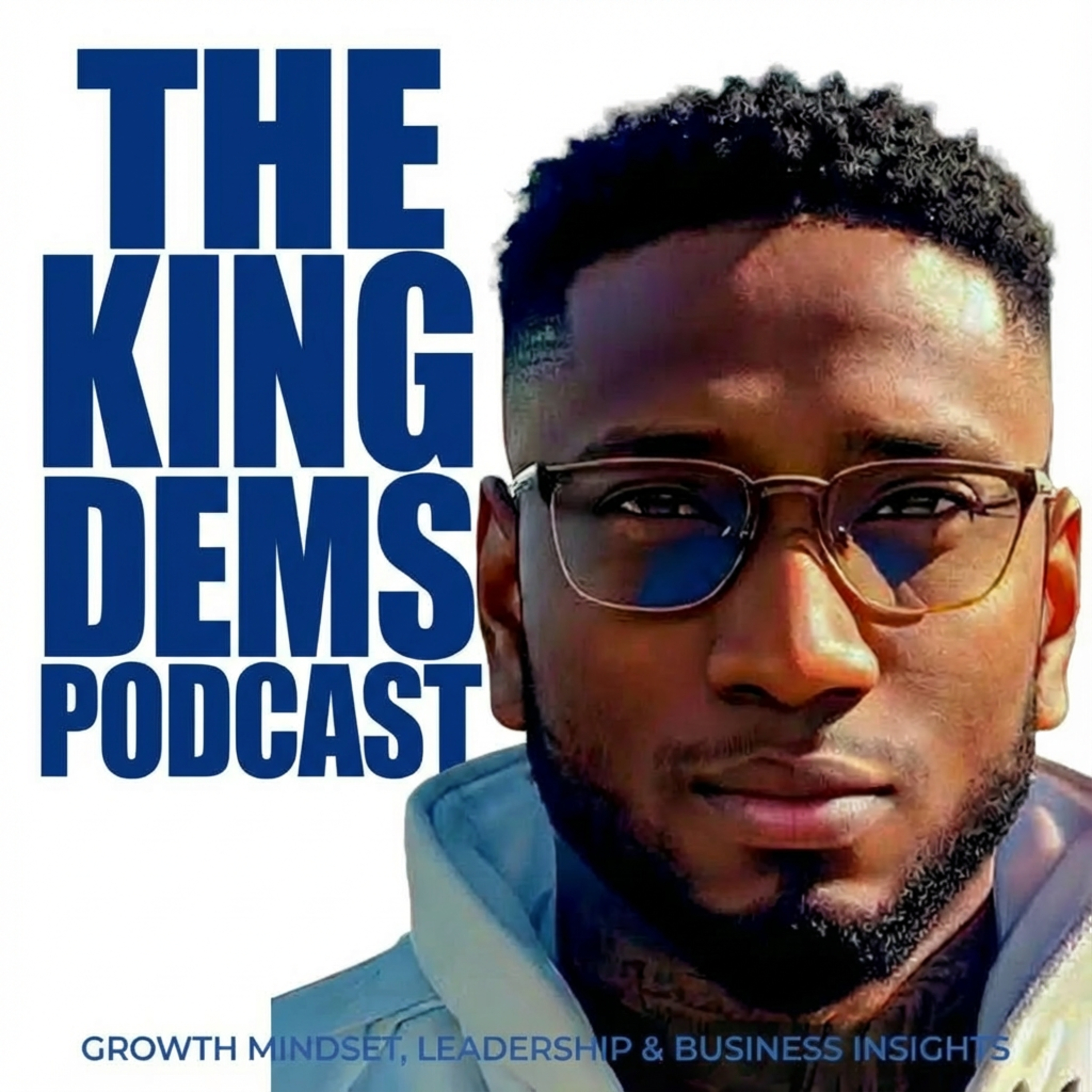
King Dems Podcast | Growth Mindset, Leadership, AI and Business Insights· Folge 151
Growth Mindset Strategies That Transform Leaders ft Yuan Yufeng
Dienstag, 25. November 2025 · 2 h 33
Kapitelklicken springt direkt hin
Shownotes
This content includes a paid partnership with BetterHelp Online Counseling. Get matched with a credentialed therapist and start your growth journey today at betterhelp.com/kingdems for 10 percent off.Fuel your wealth with growth mindset strategies as Yuan Yufeng unpacks AI in business, leadership resilience, financial literacy, self improvement and the inner world that shapes unstoppable business growth.Summary:
This episode pulls you deep into the inner world where belief becomes destiny and identity becomes the engine of global impact. Yuan guides you through a powerful journey of mindset, mastery and human evolution that rewires your future in real time.SEO Keyword Takeaways:
• Growth mindset strategies• AI in business mastery• Leadership identity and resilience• Wealth creation and performance• Therapy insights for founders• Business growth and innovation• Self improvement practices• Financial literacy for leaders• Founder psychology shifts• Smart business strategiesGuest Links:
LinkedIn: linkedin.com/in/billionsofbuddhas/Skool Community: skool.com/@kaikaiThe King Dems Podcast ranks in the Global Top 2.5 percent on ListenNotes. Help us reach the Global Top 1 percent by leaving a rating on Spotify and Apple.Prior Episode Cross Links:
Humans First AI Next with Mark Andrewsyoutu.be/UcTv-2D7ZoUBreakthrough Strategies and Growth Mindset with Ted Santosyoutu.be/ey-OHZlMIUU?si=ck97j5Oq9vVPzwXUAFFILI… ROCKET SHIP:
🔥 Power Your Growth with Our Affiliate Partners📂 Google Workspace: referworkspace.app.goo.gl/Gj7H📧 Grow your audience with Kit: partners.kit.com/x3j2zt8uz3i3✅ Create stunning presentations with Gamma: try.gamma.app/KingDemsPodcast🎓 Join School of Mentors: skool.com/schoolofmentors/about?ref=d62314d3cf… Book interviews with PodMatch: joinpodmatch.com/kingdemspodcast🎧 Record with Riverside: riverside.fm/?via=ademola💬 Streamline client chats with Timelines AI: timelines.ai/?red=kdemsc💼 Track team productivity with Insightful: insightful.io/?red=kdemsc🎥 Run webinars with WebinarGeek: app.webinargeek.com/?red=kdemsc💹 Simplify investing with Tykr: tykr.com/?red=kdemsc🤖 Automate workflows with BotPhonic AI: botphonic.ai/?red=kdemsc⌨️ Save time with TextExpander: textexpander.com/?red=kdemsc&utm_source=kd… Shop tools via Stan Store: stan.store/k-demsconsulting📊 Engage audiences with AhaSlides: ahaslides.com/?red=kdemsc&utm_source=kdems… Boost affiliate revenue with Irev: irev.com/?red=kdemscSmarter tools. Better growth. Bigger wins.
Transkriptvom Podcast bereitgestellt · Zeitmarken springen hin
Let go of that which no longer serves you and know that what once served you might not serve you right now and might not serve your highest self. I carry things and I use. I used to carry things so much. I was that junior monk man. I wasn't the senior monk, bro. I didn't set the woman down at the river. And one of my bad habits in the past was holding on to things too long.
And it's something that I'm working on. And with everything that I'm able to let go of, I'm more free, I'm more happy, got more peaceful. So what I would say to myself is if it's past, if it's in the past, just let it go. If you can make it right, make it right. If you can't or if there's no need to, let it go. Where attention goes, energy flows and reality grows. So focus your energy on what you want to grow, not on what you don't.
That's that's what I'd say. Before we dive back into today's conversation, I want to share something important. This episode includes a paid partnership with Better Help, a platform designed to make starting therapy easier. I know from my own journey as a leader and entrepreneur that life can sometimes feel overwhelming.
There are seasons, severe stress, uncertainty, and pressure build up, and you need a safe space to process it all. That superior therapy comes in therapy isn't only for people facing clinical challenges. It's a space to reflect, grow, and find better ways to manage stress, relationships, and personal goals. It takes courage to seek help, but it's also one of the smartest investments you can make in your mental and emotional welcoming.
That's why I'm proud to highlight Better Help With Better Help, you simply fill out a short questionnaire and get matched with a credentialed therapist in just a couple of days. If the first match doesn't feel like the right fit, you can easily switch the therapist at no extra cost until you find someone who truly connects with you. Inside the platform, you'll also find tools like downloading and group sessions on different topics that can support your growth.
And with over 7000 reviews and a 4.5 trustpathry reason, Better Help is a platform you can rely on. So if you feel like you'd benefit from talking to a therapist, visit betterhub.com/kingjames. That's betterhub.com/kingjames to get 10% off your first month of therapy. Once again, this is a paid partnership with Better Help, and I encourage you to take that first step. If you've been thinking about it, sometimes the best investment you can make these in yourself. Welcome to the King Dems podcast, where we share the stories of extraordinary people and dissect hot, relevant topics that shape our world.
From visionary leaders to trailblazing creatives, we uncover the mindset, strategy, and grit behind greatness. Whether it's business, culture, or personal growth, we ask the real questions. This isn't just conversation, it's transformation. The Kingdom's podcast, Your Next Breakthrough, starts here. Music licencing reimagined.
We are live, ladies and gentlemen, once again, welcome to the Kingdom's podcast and Diary of the CFO. And today I've got. With me a VVVIP fighting out of Beijing, China by way of California, United States of America. Beck Walker, you are, you fag. Let's go, brother. Adam Ola, thank you bro. I I love the the very passionate.
Welcome bro. It's a pleasure to be here bro. Bro I guess you you'd be like. Oh man, man, man. I'm a fighter now. Let's do this. Let's do this. Let's do this. Whoa, you know, I, I love the UFC a lot. And what a lot of people don't know about me is, you know, a lot of people think, oh, he's a finance guy, He's a finance bro, Marty. Martial artists as well.
So growing up, growing up in Lagos, Nigeria, I was a skinny kid. A lot of people used to think, oh, we can believe this one and that. That forced me to get into martial arts. So I got into Taekwondo. From Taekwondo I moved to karate and karate, did a bit of judo and ended up with mixed martial arts, mixed martial artists, just everything.
That's the best thing in a street fight, you know, you have your striking, your wrestling and the grappling. So that is why I'm very, very, very big on the UFC and the UFC has produced a lot of champion and you are also a champion brother, and that's why I have you here. So sit back and let me give you your flowers.
So our champions today we are joined by a man who embodies global legacy leadership at a level uranium, a communicator, A poet, a teacher, a community builder, a linguist, A storyteller, and a connector of millionaire and billionaire mentors to the next generation of change makers. Yuan Yufeng is the founder of Billions of Hooters and the head of community at the School of Mentors, the world's number one entrepreneurship community. He has lived and worked across China, Indonesia, the United States, and beyond.
He has taught to, LED, written, performed, coached, and created systems to elevate thousands of entrepreneurs. This episode is a journey through self mastery, identity, communications, leadership, and global citizenship. Joran is the man who sits at the intersection of wisdom and execution. Today pull the curtain back on the mindset, skill set and the tool set that shaped him.
Joran, we honour your presence on the Kingdom's Parkas and Diary of the CFO. You are welcome, Rasha. Wow, sure. Thank you Introduction is is a mouthful because you know your. Your journey is a globe fool. Yeah, I appreciate you dedicating the the oxygen to the intro bro. Thank you. Whoa brother, where? Where do we start from?
You know, like you love to see. You were made in China but raised in America. You're just like Apple Brother. You're designed in in America, but but made in China. Talk, talk, Talk to us about it, brother. Yeah, so as as Adam Ola said, and as I often say, I was indeed made in China, but the quality is good.
I was born 1995 I think I'm dating myself a bit, but I was born 1995 in Wuhan in the Hubei province of China and. Wuhan. In Wuhan, dude. Wuhan. Hey bro. The notorious Wuhan. Before 2020 nobody knew Wuhan. After 2020 everybody knows Wuhan dude. So it is what it is. It is what it is. I'm not going to say anything I don't want.
I don't want to get cancelled. I love China. I love China. That's. Funny, dude. So yeah, I was. I was made in China, in Wuhan, and I grew up in Wuhan a little bit in Changsha, another town in China, and then in a small provincial city called Songzhu in the Hubei province. And then I moved to the States at age 6.
Yeah. And at the time, it was a huge change, man. I changed my language. I changed my name, my identity. I wasn't able to stay in touch with some of my loved ones who had raised me from birth till age 6. So it was just a time of enormous, enormous change, and it had a massive impact on me moving forward in my life. So yeah, that's that's the origin. Wow, so you live in China, Indonesia, the US and of course you operate across several languages. So when you look back at your early life and global upbringing, what woman planted that seed for self mastery and, you know, positive global change? It's interesting, I think growing up switching languages at age 6 is very difficult.
You, you pick it. I, I picked it up pretty quickly, but I always felt like I wasn't able to express myself. You know, I had all these feelings and all these emotions. And when the, the language level is not sufficient to express myself, like there's frustration, there's anger. And also I looked around and I saw like, hey, throughout history, all the greatest leaders have all been amazing communicators. So I really just focused in on that, honed in on that. And I'm not sure I, I think everybody's born into the world with their own unique karma.
I'm very grateful to have been born with a more altruistic direction. I like helping people. I like positivity. I want to see a better world for everybody. And that's, that's always been a part of who I am, but I've definitely leaned into that more and more throughout the years. So I wouldn't say that it was, it was one exact moment, but it's definitely been a very intentional honing and elevation of what I'm naturally born with.
Natural born leader and it's interesting switching languages at the age of 6. So I, I can't remember where I read this, but I read that kids are, would I say children find it easy to learn multiple different languages, especially before the age of five, but six, OK, Yeah, you're still, you're still pretty much there, right? And I look at myself, for example, I grew up in Nigeria and in Nigeria, we have multiple different ethnic groups, multiple languages.
Nigeria is a country of over 220 million people and people don't realise that there are over 250 ethnic languages in Nigeria and my father is from one ethnic group, my mom is from another ethnic group. And that's why I have AI, you know, have a good have a good hybrid. So people who? Understand the demography of Nigeria and the geography of Nigeria would understand that my first name is Adimala. Adimala is a Yoruba name and my middle name is Isima which is and Edo name is an Nishan name, right? So growing up I had to learn Yoruba. I had to learn my mom's language, Nishan. I think that was the first local language I learned. And in Nigeria we also have a Creole called Pigeon English. Right.
So it's it's like English scattered. Yeah, I don't know how to explain it, but like you, you would feel like this person speak English, but it's not. English. If you don't understand the semantics, the syntax, the language structure, you'd be. You can't literally get sold. By people speaking something that sounds like. English and also you not even learn the proper English so I had to get master of like 4 languages. So I understand like understanding. Four different languages, code switching. You know, sometimes you're speaking to somebody who is speaking one language and you need to switch to another part of your brain.
Like, OK, we're not, we're not doing the English right now. We're doing maybe Yoruba, we're doing another language. And you need to flow and express yourself, right? So, but then there's always that primary language. And I tell people, your primary language is that language that you think in. So what language do you think here? Do you think in Chinese?
Do you think in English? It's, it's interesting because I've till six I thought in Chinese and then from from 6 to like 29 1/2 I thought in English and now I'm very intentionally thinking in Chinese. So what? What language do you pray in? What language do what? Do you pray in? What language do I pray in both?
But recently it's been more and more Chinese and let let me just dive into why, because I mean, that's that's the big question, right? Like why, Adam? I'll, I'll share an incredible experience I had. Dude, I I was working for a start up. It was called Atlas back. It was a posture correction device and I was looking for investors for the company.
I walked into a water shop, an alkaline water shop in Thousand Oaks, CA and I met this local physical therapist. His name is Dan Kinney, you can look him up. Dan Kinney physical therapy. And Dan used to work with Olympian athletes, bro, and he focus on posture and posture correction. And me and Dan, we hit it off in this water shop and Dan was collaborating with the owner and doing giving like free posture correction sessions as Li Jen, I think. And he gave me a free posture correction session, bro. And when I stood up from his table, I felt this whoosh, this like primal rush of energy just shoot up my spine. And accompanied with that, there was a voice in my head that started saying my Chinese name
you. And you, you phone which I hadn't used since I moved from China to the US So bro, I'm hearing in my head, your new phone, your new phone, your new phone, my Chinese name chanting itself over and over again. And I'm feeling strong, bro. I'm feeling like the strongest I've ever felt in my body. And I'm like, what is this all about? You know, like, why does fixing my posture, why did it activate this energy?
Why am I hearing my Chinese name? And I decided to go on a journey to relearn Chinese. After that point, I'm like, there's something here, I need to relearn Chinese. And what I realised is that there was a lot of my power that I am now able to access because I've relearned Chinese, because Chinese was my mother tongue.
A lot of people have the mother tongue and they learn extra languages on top of that mother tongue, but they still have the foundation of the mother tongue. For me, my foundation, I had no way to access it when I moved to the States. So a lot of energy and a lot of different patterns were still running. Bro, there was a point in my life where I'd rewired my mind completely in English, but I still wasn't getting the results that I wanted.
And I was like, why? And when I started rewiring my mind in Chinese, rewiring some of those thinking patterns, dude, my life changed for the better very quickly. And like it is only getting better the more I think in Chinese and work through some of those old patterns that I wasn't even able to access until I relearned Chinese.
You know, you might be of the conversation I was having with a doctor friend of mine, I said a lot of people suffer from identity crisis. How can you understand the environment around you if you don't even understand yourself? How can you know what to do if you don't know who you are? How can you know who you are and if you don't even know where you're coming from? History is a template for people to operate in the present and the future.
And that's why it's really, really important for people to know their history and for people to have a deep and rich understanding of their culture. And a very big part of culture is language. You know, language, food, you know, various practises, religion, politics. But language, I think language, food, music are very, very fundamental in the framework, in the fabric of culture and identity. And I love the fact that you're very proud of your boots, you're very proud of your identity.
So that journey is a very sacred journey, but a lot of people do not take it very seriously. And during the introduction, I touched on the pack that you were actually for it, right? So your journey crosses poetry, communication studies, acting, community leadership and entrepreneurship. So when did you start to realise that you were actually meant to build people and not just projects?
And of course, beating people start to beating yourself. I think the, the more I went into my Buddhist practise, the more the shift went from projects and accomplishments to people because what, what are the achievements for? What are the accomplishments for? They're to get the love and respect and attention of other people. A lot of us operate in that way.
And I will say that I operated in that way. And when I loved myself and I realised, hey, I can be the source of everything that I need. And when I felt better and better and better and was able to heal myself and find peace within, I realised one that I'm suffering, I was suffering and a lot of other people are suffering. So by going through my own suffering and transforming it and realising that a lot of other people are also suffering, it's like, hey, no, it's, it's all about people. And at the end of the day, man, like the things that bring us the most joy, at least I can speak for myself, are my relationships with other people.
It's how have I impacted this person's life? It's not, it's not like, hey, like what did I accomplish in this business? It's like, no, like how many lives did I touch and to what level did I touch it? How, how much was I able to help this person grow? I think that's really what brings true fulfilment for me personally. And it's a huge aspect of fulfilment for, for humanity, just being able to help other people and add value to other people's lives.
I think that's where the joy, the true joy of life lives. Yeah. You know, for people who really follow this podcast, they would have heard me say this most of the times. I'd rather impact a billion lives than make a billion dollars. That's powerful. That's powerful. And you know what? If you impact a billion lives, you will definitely make a billion dollars, I think.
Absolutely, as long as you get your monetization for point out correctly, yeah. Hey, you know, they're, they're for me, the framework is balancing being a Buddha and a businessman. And we need to have both, you know, that's the balance right there. And it's, it's OK to be a Buddha and a business person at the same time. You know, it's OK to be rewarded and paid for the good work that we do.
That's 100% OK and should be embraced actually. You know, one thing that really drew me to you from the School of Mentors was what I say the impact of your Buddha stories. For me, I'm a Christian, but I respect other religions and I strongly believe that all roads lead to the top of the same mountain. And people have created too many divisions, you know, especially in religion and politics.
They're very, very sensitive, you know, areas. But I have learned to respect, you know, every other religion. And yeah, coming from Nigeria, you know, people practise different religions. I think by default, if you are a learner, educated, enlightened Nigeria, you'd one of the very first, you know, lessons you are taught in your early life is religious tolerance. So for me, I went above the tolerance to appreciation, right.
Go study what other people are about because if you don't understand something, you cannot appreciate it. If you don't understand something then you stand under it. So you have like this really, really life changing, life impacting stories, you know, from the Buddha, right? And I'd like for you to share some of these, you know, stories, especially from a mindset skill set, tool set perspective, because that is what we stand for here, the stand for growth mindset and the belief that in order for you to collaborate with anybody, the very first thing you need to evaluate is their mindset, right? But you are very big on self mastery. And there are a lot of these, when I say anecdotes, these stories that connect with the
concept of self mastery and self identity. So I'll leave the floor to you to, to to educate us because, you know, the two goals of this broadcast are to educate and to motivate. But you know, let's deal with the education aspect right now. Sounds good bro. I, I appreciate the, the invitation and the respect and know that it is offered Likewise for me, I respect all religions.
I respect all faiths and belief systems, and I know that like, these are the foundations upon which people build their lives, you know, So I have massive respect for it. And for me, anything that helps humanity, that helps humans live healthier, happier, more empowered lives, I'm for that. That's what I'm for. I'm against anything that divides us, that weakens us and do.
That's a very easy way to tell what to consume and what not to consume. Is this piece of information creating more division? Is it creating more conflict? Is it sowing more discord? Is it saying negative things that are not empowering? Then I just don't listen to it. I don't give it even a cent of my time, bro.
Zero of my time, zero of my attention. The best way to kill something is to just not pay it any attention. And with negativity, that's what we got. That's what we got to do. Now for the other side, Anything that unifies anything that empowers, anything that makes humans happier, healthier, stronger, gives us hope. That's what I'm for.
So yeah, that's just a quick thing on the consumption of information. Good paradigm to work through that. But back to the Buddhist stories, man, one of my favourites. And the more I study Buddhism out of MOLA, the more I'm feeling that the Buddhist path is the path of learning to let go. And the Buddhist believe that attachment is the root cause of all suffering.
And it's usually an attachment to an idea of who we think we are or who we think we have to be in order to survive. There's there's so many subtle attachments in my experience that I had attached to that once I let go, dude, so much of my suffering, I'm able to let it go as well. So let me, let me tell you this, this story about letting go.
So this is the story of the two monks with the woman at the river. Now, Buddhist monks, they're not supposed to, to have physical contact with, with ladies. And there was one day there's a a senior monk and a junior monk. They're walking through the forest and they come to this river. It's a very fast flowing river, kind of scary. And there's a, there's a beautiful lady there and she doesn't know how to cross.
And she asks the two monks, hey, can you guys help me across this river, please? And without thinking about it, the senior monk just goes over. It's like, yeah, sure, hop on, I'll carry you over. And he picks her up, carries her over the river, sets her down and moves on. Now, at this time, the junior monk is like, dude, what are you doing? You're the senior monk.
Like, you're not supposed to have physical contact with women. Like, what are you doing, bro? And he crosses the river after them, but he doesn't say anything at that moment. They keep walking. The senior monk and junior monk continue on their journey. They're walking. And the junior monk, he can't stop thinking about it. He's like, dude, like, why did this guy touch this lady? Like we're really not supposed to do that. And after like a couple, a couple miles, he just couldn't help himself.
So he asked the senior monk. He's like, dude, like you're the senior monk. Like, why did you why did you have physical contact with that Lady? And the senior monk says, hey, brother, like, look, I picked her up. I brought her across the river and I set her down. Why are you still carrying her? Why are you still carrying her? And the lesson there, bro, is like, there's so many things that we attached to that we're carrying inside of our hearts, carrying inside of our minds.
And for the senior monk, he wasn't attached to the rules per SE. He was more concerned with the human, with helping the human in the moment. And a lot of Buddhists like that, that's the true way to practise, put the human first, you know, like if it breaks the rules, but it benefits the human, do that action.
And then this junior monk, he was holding on to convention. He was holding on to the rules and he was carrying the lady inside of his head and inside of his heart. And there's so many things that humans carry for so long that drag us down, hold us down in lower energetic states that if we could just learn to let go like the senior monk, that we would feel so much lighter immediately, bro.
So that's the story of the two monks with the woman at the river. Wow. You know, you've actually shared the story on the School of Mentors and really he did touch me. And right now it's sinking in Defran again. Like it's a story that when you hear it or you tell it, it does heat with a new energy every time, letting go.
Very, very important. You know, I've said this before, that people are too attached to constructs, to concepts, to ideas, to philosophies. You're not your idea, you're not your philosophy. And you know, for a very long time people believe in things that are wrong, right? And would kill or fight to defend that wrong position, right? And a lot of people don't realise that rules are made for man, not man made for rules.
Wow, that's a great perspective. I like that. A lot of people are attached to convention, but you need to think about the greater good. I love that story very much. The woman was in need and you know, he did what he had to do and let her go. And you know, just from that moment where he drops her off, he's off his mind and he's continued on his journey or he's impacted her own journey positively. Yep.
And this speaks to even every other religion. In Christianity and Islam, there are people who judge other people. You know, we sometimes we call them cooler than doubt. You know, individuals like, OK, you want to be holy, No problem. You be holy. Leave me. Just leave me alone. Let. Let me do my own thing, right?
But why do people want to feel like they are better than the next person? Why do they want to feel like they're better than the next person? They want to feel that way because they're insecure about who they are and like it. It's, it's just a a lack of self love at the end of the day, I think. I mean at any time, any there's any reaching that is external, it's it's a lack of self love I think.
And. You know, because if if you truly love yourself, then you'll be confident within yourself. And it also comes with experience because it's only after going through certain stages in life do we understand the experiences of others. If we don't have those experiences and those challenges, we truly cannot understand them. There's no way to imagine your way. You can't imagine, you can't envision. But there's certain things that you have to experience to truly understand it.
And the correct way to practise on the path, I believe, is to transform it with compassion. And I think compassion is always the answer, dude. Zen Master tick not on. He said. Compassion is invincible. It is the only thing that is worthy of us. And hatred will not let you face the beast in man, but compassion can. And compassion can help you transform that. So that's my perspective on it.
Wow, compassion, they're very important. If you've ever seen my my core values or heard about my core values, my core values to just three of them, kindness, respect, hospitality. You know, compassion is a very, very big part of kindness. I like to tell people I'm a kind guy, but not a nice guy. You know, I I generally care about people's welfare, but I feel like niceness is about seeking people's validation or trying to act like you're kind so that people would say, oh, that's, you know, that person is good. So from that Buddha story, we could see the senior monk is actually a kind guy.
He genuinely cares about the human. Yes, right. And that is what kind people do. They don't care about the frameworks, they don't care about the rules. They care about the welfare of the people, Right. And you talk a lot about self mastery. And, you know, self mastery is, you know, a theme of the mind. It's intrinsic.
It's about your internal engineering. And in this age of time, people seek validation too much. And you know, I tell people I don't really care about what people say about me or what people try to lead on me. If you said I'm stupid, I'm crazy and whatever, that's, that's, that's on you. Thank you very much.
Because I use this analogy. When you take $100 note, right? Take that $100 note. You squeeze it, you, you know, you grumble it, you put it in the mud, you step on it and say, oh, you're not $100, you're $50. OK, no problem. Straighten it out and take that mint one, the fresh one and take it to a shop. The the.
The rugged. Rackety 1 you know, and that mint fresh one are going to buy the same exact things. So I tell people my value is not determined by whatever you call it, is determined by what God has, you know, quoted. So it's more like the central bank actually printed this thing and you know, you credit 100, right?
So whatever it is you want to try to call it, it doesn't change it. So our value is intrinsic, is determined by God. Until people get to realise the fact that your value is actually predetermined right and cannot be changed by people's validation or people's expressions, they might not take themselves very seriously.
Yeah, no, that's a beautiful perspective and I think it's true. I mean, we, I think all humans have inherent value. And I will say too, that that humans are also capable of elevating their own value. That that's that's a beautiful thing. We're all born with inherent value, but we can also learn to increase our value by learning to increase the level at which we can help other people and, and service other people and provide solutions to their problems.
It's interesting, 'cause there's, there's like, there's worth and there's value, right? Like inherently, like we all have worth just as human beings, but value is, I'm starting to think of value in terms of like what I can do for other people, the, the pain that I can alleviate, the problems that I can solve. I'm curious about your, your perspective on that, Adamola, because we all have value as human beings, just base basic human respect, you know, And, but what, what's your take on that?
The the dichotomy of worth and value or or is there a separation for you? So I'd say in terms of value, I'll link it back to that analogy that I gave, right? What's the value of $100? Note, you can buy certain things, right? And that value is intrinsic. It's not determined by, you know, the aesthetic.
So it's, you know. You know what it is, bro? It's determined by our belief in it. That's what it's determined by. Because if nobody believes. You believe in the you believe in that $100 note, right? That is why you're. Going to collect it and give some of the value. Yes, I, I want to bring it back to, to the, to belief. Now, bro, let's, let's talk about belief for a bit. Because what is it that literally gives that $100 bill the power that it has?
It's the investment of our belief in it. It's our acceptance of it, but without, without our belief in it. Like if an alien just came to Earth and they didn't know anything about the $100 bill and they didn't believe in it and like it's just me and the alien, just us 2 left in the world. And it's like they don't know what it is, they don't believe in it, then it has no value because they haven't invested their belief in it.
And it's the same with people, bro. I think we're valuable to the level that we believe we are valuable. So I think it's belief at the end of the day. I've got a quote. Belief is the catalyst that transforms thoughts into reality. Belief is the catalyst that transforms thoughts into reality. And you know, think about it from this perspective, talk about belief. The reason why somebody's going to accept $100 note is because they believe in that note.
I come from Nigeria. We don't spend dollars or spend naira. If you go to some rural areas and you give a local businesswoman give $100 notes, she's never seen $100 in her life. She will not accept it from you. She wants a local currency. Man, this, this is so interesting because now it brings up like, hey, if you have something beautiful to share but people aren't familiar with it, then you have to introduce it to them in a way that feels familiar in order for them to accept it. So like, let's say you have some beautiful Christian messages to share with people, but these are people that have never heard about Christianity or anything like that. I guess a good way to communicate those values would be through adopting them in a
format or through subjects that these people are familiar with. So yeah, it's my, my mind is kind of racing with ideas now. So I appreciate you man. You're, you're inspiring, dude. Let's. Know. Modern day business. Philosopher for reason, brother. Let's go, Let's go, the Joe. Letters. Oh, the Joe Rogan of Africa right here with you, brother.
We're calling it global. Top 100 Barrister and the barrister in your faces, from your mouth to God's ears, it's. Going to happen, you know. I feel like I was, I was put on this earth. I was born just to be a podcaster. Like everything that I've done in my life is just pointing towards that purpose, OK?
I have been viewing this guy to become, you know, a global podcaster, you know. A global elite level. The best in the world. In order to be the best, you have to be to the best, and the best is blessed. You know, we are blessed, brother, We're blessed. It's quite interesting, you know, like, I love the fact that I'm able to connect with the brightest minds of my time.
I grew up reading a lot of books in my father's library. Books and philosophy, psychology, sociology, history, geography, political science. And, you know, reading the ancient, you know, Greek philosophers and you know, some Oriental ones as well, lacks of Confucius. I used to think, how wish I could have a conversation with these guys and know what's happening in their head and trade perspectives. And no matter how brilliant you are or how much of A genius you are as a person, connecting with another genius helps you to expand the horizon.
There's something I learned in physics, you know the angle of elevation and angle of depression. So it's about your perspective. So your perspective is limited to what you can see, right? And it's based off the angle. So if you, if you have a building, for example, you have this and you're standing here, you're only limited to see what is here. You don't know what's at the back. But if you're standing here, you can see what is down, right? If you're standing here, you can see what is here and you know what is here.
So having conversations with people, right? So I am here and you're here, for example, so I can tell you about what is here. You can tell me about what's here. I will focus on better individuals. I love it, bro. And like, do you think that that's what happens like let's say when we, when we pass away, right?
Like the Buddhist believe that we're just a drop of water returning to the ocean. So what if like when I pass, I'm able to go back with that information and say, hey, here's what I've learned about life. Here's all of these different angles, take it and run. You know, I'm, it's just so cool. I'm thinking about the matrix now. I'm thinking about some very interesting ideas like universal consciousness.
But no, I I love it, dude. And I think when great minds get together, I'm not saying that I'm a great mind, but you are a great. You are, you are a great mind, brother. You are a great mind. There's no, there is no argument about it. You know, You know, one thing, one thing I've learned. Is, you know, yeah, it's beautiful, humble, right.
But it's also good to accept our privileges. Yeah, we have certain privileges based off our journeys in life, right. So it's it's not your fault that you're a great mind. You just have to accept it. You don't have to be humble about it, right? Yeah, you can be humble about it. Yeah, but. I. I think probably a way to be humble about it is.
You know, maybe framing it as I'm grateful. You know, to be one of the great minds. You know of my generation, I think, yeah. What here, here's something that I take pride in is communication. And I think it's even better to have a friend give you the compliment for you. So that's why I deflected it because I do help you out with that bro. So I I appreciate your assist in that dude. Jeff Bezos said something really interesting. He said we can't be proud of our gifts, but we can be proud of our decisions.
And. I'm proud of all the decisions that I've made with the cards that I've been dealt, you know, with the cards that I've been dealt. I'm very proud of how I'm showing up. I'm very proud of how I'm allocating my time, energy and attention in the world. And I'm proud that I'm I've chosen to be a good person or do my best to be a good person and make a positive impact in the world.
So another thing that you on right there. You know, you talk about Keith's right, the Bible. Actually in the book of Proverbs chapter 18 verse 16, it says a man's gift make up room for him and bring up him before great man. A man's gift make up room for him and bring up him before great man. Think about it. It reminds me of what our director of our higher ticket communities, Rob Fajardo says.
Rob has a great networking thing because a lot of people say it's not what you know, it's who you know, right? A lot of people say that. But Rob's spin on that is actually it's what you know that allows you to connect with The Who you knows and allows you to provide the value to them. So it's the what you know that allows you to get in the room and stay in the room. So actually it's our gifts, as the Bible says, and it's the what that allows us access to The Who before we become The Who.
So. Yeah. You know, that's something that the Bible says that I really appreciate. It says study to show thyself approved or workmen that need not be ashamed. Study to show thyself, approved a Workman that need not be ashamed, rightly dividing the word of truth. What does that mean to you? That is, we have that responsibility to study. We have that responsibility to study for our self growth, our self development, and that is what's going to make you not to be ashamed.
I love it bro because. Rightly dividing the word of truth. That's beautiful. Humans were blessed and humans also a lot of people forget. Maybe, maybe it's just me that forgot, but we're also organic beings. We're not just observers of nature. We are manifestations of nature as well. We're a part of nature and anything in nature that is not growing is dying.
A tree is either growing or it's dying. There's no, there's no two ways about it. If the tree is not growing, it is dying. And it's the same with humans, bro. So like every single day, it's good to study, it's good to learn something new, it's good to get new things in variety. It's good to grow every single day because if we're not growing, we're dying. And the Buddhists believe that the the reincarnation as a human is a super, super blessed chance and opportunity to actually dive into the waters of truth, you know, to learn about the nature of reality, to transcend suffering. And just the Buddhist really Revere this opportunity to be human, to have human intelligence and to study every single day, man.
So I love that quote from the Bible. Let's go a. Lot of respect. Brother, you know speaking to the full concept of self mastery, right? And that internal engineering that you very, very much appreciate. So you talk about holistic success. So what does self mastery mean to you in a world full of noise and pressure? And how does somebody begin that journey to self mastery? Damn bro that's a great question. I think self mastery, there's there's a lot of different elements to it. 1st it's it's a willingness to take a look at where you are currently and accept that honest with honesty. I think my the biggest turning point in my own self mastery journey was when I decided to be 100% honest. OK, honesty will get you super
far. It'll get you like 80% of the way there. And here's how it happened for me. In the past, I had a really bad habit of telling little lies to people to get them to like me more. I don't know why, bro. I'll just confess that it was something that I did. And I went to UCLA and I joined a fraternity called Lambda Chi Alpha there. And it was like my rush, my rush term. And we were picking our Big Brothers inside the fraternity to be our mentors, right?
And I put these five guys as 54321. But I told number one and #2 that they were both my number one. I still know their names, Bro Austin, Austin Kopp and Adam Hakeem. Those are my two guys. They are my top two guys. And bro, throughout the process of figuring out who is going to be my big bro, this lie came out and it was exposed in front of the whole fraternity dude and I. Had to get.
Bro it was terrible. I felt so ashamed, I felt embarrassed. And it really, 'cause we do these, I, I did this instinctively just try trying to survive. I think like everything that somebody does, it's a survival mechanism that we feel we have to do but we don't have to do. But Long story short, man, I had to give an apology in front of the entire fraternity and I had to take a good look at myself, man.
And this is life gives us opportunities to take a good look at ourselves and change. And after that I decided, man, I need to be 100% honest and not just to other people, but also with myself. Like how am I feeling? What are my genuine thoughts right now? And then creating space for that. So I think honesty is an incredible first step in self development and self mastery. Honesty.
Honesty and the search for truth about ourselves, about the universe. I think those are two very, very good things. Honesty is the first step. Truth is the direction. You know, in, in Nigeria we have we have a saying that's quite popular. They say honesty is the best policy. I agree with that. I agree with that bro, because telling lies is like weaving a spider web that you have to navigate yourself and it'll eventually catch me inside of it if I, if I tell it, you know, it's just, it's not, it's not worth it bro. It's not worth it bro.
My, my good friend Akon, he, he's from Ghana, he says anything that cost me my Peace of Mind is too expensive. Anything that's going to cost me my Peace of Mind is too expensive. And I agree 110%, man. So those are my thoughts on that bro. It's interesting you're actually aligning with a proverb from from Nigeria. So I'll say it in Yoruba and Abu translate it so they say T Yoruba lofo Guangdong putito Yoshi buria meaning are if a lie is told and it exists for 1000 years, the truth will still eventually conquer it or be revealed. I agree with that 110%.
The truth will always come up bro. Because the the experience of life is truth. We're experiencing truth everyday man. Like life itself is truth. And if if I have a misperception or a misconception about how life is, life experiences will show me that I am wrong. Like like there's certain universal principles that are just so true that even if I believe they're not true, my life experiences will prove them true to me over time. So I agree with that.
Speaking of universal truths, right? Yeah, I think about how in the past people used to think the world was flat for overtime. Scientific discoveries proof that the world is spherical, so. There are some people who see believe. In the Flat Earth concept where you stand and you know, like how did that concept of changing from the universal Flat Earth concept to the universal spherical concept, like how does that evolution play for you?
It's interesting, Adam, I, I only speak about things that I feel I have some level of expertise or skin in the game with. I've never dove in very deep into that conversation. Just off the bat, I'm I'm feeling that the earth is spherical, that that's, that's my take on it. But like for me, I'm, I'm only concerned with the things that will improve human life.
That's that's where I put all my energy and attention. I love that. That's just true. It's just true. It's just who I am. But with with things like that, it's like I will support whatever gives you the most Peace of Mind because I care about the human. Like at the end of the day, we're all going to die. And does it matter?
Does it matter if it's spherical or if it's flat? Or does it? Matter, I'm telling you, does it really matter? Because some people will fight you to define the concept of the Flat Earth. And I'm like, OK, do you think it's flat? It is very flat. No problem, let's move on. Just there's some Tele facts that are just like suckers of energy that don't need to be there.
Like if you have time to talk about Flat Earth or spherical earth like do something about the water problem like purify water on earth. OK go, here's the order bro. First, purify the air. Spend your time purifying air, finding solutions to purify air because without good air we're all dead instantly like 3 minutes.
Second, find a good way to purify water. If you have still have time after solving the air problem, solve the water problem 'cause if we don't have water, we die in like 5 to 7 days. Then solve the food problem 'cause if we don't have food, good clean, healthy food, we die after like, I don't know, 3-4 weeks, you know?
So that's the order that flat versus spherical earthers should take and allocate their energy. That's what I believe. I love that. I love that, you know, water. Food, in the words of Bruce Lee, be like water, my friend. Be like water my friend. Dude. Dude it's the basics man. People have to think like, what is keeping us alive at this moment?
It's air. That's the most important thing. We need clean air. What's secondary water? What do we die without the fastest, without water? OK, after water, food. We need to make these three things healthy and good for all of humanity. And then education, because it's food of the mind. With education, bro, we can change the entire world with a single generation. We just need to get one single generation right and humanity is good bro.
Very, very important. And that actually reminds me of a philosophy that I have. I said the the capacity of a human being is determined by 4 ease number one, education, number 2 enlightenment #3 experience and #4 exposure. I'll take that again. 4 ease the capacity of a person as an individual is determined by 4 ES.
Number one is education #3 is enlightenment #3 it's exposure #4 is experience. So in no particular order, right, those are four ES. I like to take this is. Bro this is beautiful and I I agree. I'll give you some sauce there. Bro I'm I'm, I'm gonna go in. Bro I'm I'm going in, dude. So all right, let me let me organise this and let me go in on this.
So First off, exposure, one of our mentors that we had on his name is Will Rivera. He is a became a millionaire at 23. He's a great quote. Ma'am, You can only grow to what you've been exposed to. You can only grow to what you've been exposed to. And dude, I I think that's super true. So I think exposure and choosing to expose yourself to the things that you want. Go and see the dream, go and touch the dream, go and taste the dream.
Whatever your dream is, that environment is so important. Put yourself in that. You might want to add environment to those ease bro. Environment, yeah. Let's go there. Let's make it 5. I like the. Concept of five. Let's go. Let's go, bro. So yeah, you can only grow to what you've been exposed to.
And that education is not just school, bro. Like I think I I want people to not think of education as just school. And that's why we've been enlightenment, Enlightenment. Is education on steroids? I love it. I love it for me for me enlightenment. I do go by more of the Buddhist perspective, which is like. Let me think about how to structure this. It's about seeing the nature of reality as it is and experiencing that for ourselves, because it's the experience of the nature of reality that really frees us. OK, so there's a great example of like a researcher and the Buddha.
OK, there's the researcher and the Buddha. They're both researching and experiencing impermanence, right? So the researcher will use his micros or telescope, microglass, whatever it's called, microscope, and he'll look at an atom and he'll see how it fluctuates so much in every single second. It's not the same. It's, it's impermanent.
The, the state that it's in, it's always changing. But the researcher will not become enlightened just by looking at impermanence. You know, the Buddha, the purpose of the meditation part of it was actually to experience the reality of impermanence using his own body as the tool. Because when we meditate, we're able to experience, oh, here's this sensation right here, 0 and now it's gone.
Here's the sensation right here, 0 and now it's gone. Here's the thought that I'm experiencing 0 And now it's gone. Thoughts are gone as soon as they come, and every single phenomenon in the entire universe is impermanent to varying degrees of impermanence. Speeds that the speed that at which it changes.
So I think it's important to have the experience of enlightenment, not just an intellectual understanding of it. Because if we don't experience it first hand, we won't truly know, I think. And you know, in terms of education, a lot of people make the mistake of what I say equating education to lead to racism, but education is more than just being literate.
Like for you to speak to that and don't forget our five, our five ES enlightenment, education, exposure, experience and environment. So. You've spoken to, Let me see now, enlightenment. So we're talking about education now? Yeah. Yeah, I I love that, bro. Literacy gives you access to the flow of information.
That's what literacy does. Literacy is, is, is. It's a very beneficial thing to have, but it's not everything. I think there's education in terms of learning, like what to actually consume. That's a key part of education, and that's an intuitive thing. It's like as we live our lives, we know the things that are beneficial to us and harmful to us by experiencing those things, right?
Like I had to drink this Coca-Cola and this beer to understand that the next day I feel like crap and boom, the output of drinking too much alcohol is feeling like crap. So that's that's experience. And experience is a key part of education. It's all interwoven, but literacy gives us access to other people's experiences.
But it's that first hand experience that will convince you one way or the other of whether or not to, to take this thing or to not take this thing. The fastest way to succeed at whatever your chosen pursuit is, is to put yourself in the environment where that thing is the norm, where achieving that is the norm. So for me right now, my goal is to relearn Mandarin Chinese for the reasons that I've told you and, and more. And what did I do?
I decided to come to Beijing. I'm here in the capital of China. Immersion, bro, There's immersion is the best way to learn in my opinion because it's the you're getting the most possible reps in and quality. Quantity breeds quality, quantity breeds quality. Got to get the reps in and it's all about reps, bro.
I'm convinced that as long as anybody puts the requisite amount of reps in, they're going to succeed at whatever their chosen pursuit is. Absolutely. 10,000 hour rule. Malcolm Gladwell. Yes. I I really appreciate what that guy said about 10,000 hour rules and I think that's in his book Outlier. Outliers. Yeah, the Outliers.
I think that guy is reading a couple of books that I really appreciate. Outliers. David and Goliath. What about the book? You know him, right? Malcolm Blaber. Yeah, I know. I've heard of him. I think T pinpoint as well, like very, very great storyteller. I think he is one of the greatest storytellers of our generation. Like yeah, to to put some respect on his name. He he's one of the greatest and the way he analysis, you know, concepts and brings them to when I say association with reality, I think, yeah, I, I rated very, very highly. He should be on the podcast one of these days. Let's get him on board.
No, still, bro, I'm. I'm speaking it for you, man. Malcolm Gladwell's coming on. He's coming. On Malcolm. Gladwell, this is an open invitation to you. We appreciate your body of work, and of course, we'd love to have you on The Kingdom's podcast. Yeah, we said he here first. Let's go. And Adam all, I wanted to compliment you too, man.
I think if you read The Tipping Point, which I haven't even read, I think you're an amazing maven and an amazing connector. So you're an amazing curator of knowledge and you're an amazing communicator of and, and connector too, bro. So giving you your flowers, Ben. Thank you. Thank you very much, Larry. Take the flowers.
Thank. You I. Appreciate it. I appreciate it. Thank you. Very much, you know, like in this age and time, people are very, very, would I say, stingy with compliments, you know, and appreciation. And I always say something, gratitude is good attitude. When a person shares their time with you, they share their life with you because the SI unit for measuring life is time.
So when you appreciate it for something, it gives you more motivation. You know, I don't see validation for the truth is we are all human beings. When you appreciate it, it gives you more energy, more motivation. And I always say, do not go to where you're tolerated, go to where you're appreciated.
I love it, bro. I love it, bro. I I love it, dude. Yeah. Don't go. Don't go where you're tolerated. Go where you're appreciated and celebrated. Absolutely. And of course, you know what a great way to segue into the next segment. I want to talk about communication superpower, you know, the linguistic freedom. So you wrote the Diamond Quarter Sutra. That is freedom through linguistic mastery. So how does language shape destiny, and how can the average person use communication to elevate their lives? What do you think is the most important conversation that we have every day?
The most important conversation we have every day. That has to be the conversation with yourself. Absolutely, bro, absolutely. Lao Tzu. He has a great quote. Watch your thoughts, They become your speech. Watch your speech, they become your actions. Watch your actions, they become your habits. Watch your habits, they become your character. And watch your character because it becomes your destiny. And it's so true, man.
It all begins with thoughts and the way that we think and we perceive and the thoughts that we're choosing every single day, brother. So there's 3 levels of karma in Buddhism and the three levels karma is defined as intentional action, anything done with an intent behind it. And thinking is also an action. And there's 3 levels of of intentional action and the fruits of said action.
The 1st is thought the fact, the second is speech, and the third is physical action. Of the three, which one do you think is the most important to control right off the bat, or to guide, or to pick? That has to be your thoughts. Like, yeah, because that's intrinsic. You're right, bro. Thoughts are the seeds of speech and physical action. Thoughts are the seeds of both speech and physical action. Let me break down manifestation real quick for people. This is how manifestation happens in the world, bro. We have a thought.
It's a seed, right? It's the seed of both speech and physical action. And when a thought comes into our minds, we have two choices. We can either allow it to go, or we can choose to act upon the thought. If I choose to act upon the thought abstractly, metaphorically, I'll plant the seed in the ground, put it there, water it, and the plant will grow and the fruit will grow. In real life terms, what that means is let's say the thought is, hey, I want some pizza.
Pizza sounds good right now. OK, I plant the seed, I put there, I water it. What that means is I'm calling up 7 or I'm calling up Pizza Hut. Bro, I've taken it to the speech level. Hey, I want a double cheese stuffed double sausage pizza. Boom, communicate. We went from the thought level to the speech level. And then I drive over there, I grabbed the physical pizza and I come back, I'm sitting here with this physical reality, bro, this physical pizza that began as a thought. And look around you, bro.
Every single thing in your room that you're using, your glasses, the sweatshirt that you're choosing to wear right now, all of those physical realities began with a thought. It began with a decision to whether or not to act upon this thought or to let it go. Also, another quick thing I have on thoughts. I have a saying, thoughts are just like advertisements. They come up all the time, but that doesn't mean you have to buy what they're selling.
And I say that to give people freedom because thoughts come and go. As soon as soon as they come up, they go. So like, if you don't attach the thought, it has no power over you. It's our active participation and decision to plant that seed that manifests it into reality. So in terms of communication and using it to master our lives, the most important conversation that we need to master every single day is the communication with ourselves. And it's the way that we communicate with ourselves that leads to how we communicate with other people as well. So mastering the internal dialogue is what will help you master the the external dialogue as well. Wow.
The Bible says in the book of Proverbs chapter 23, I think verse 7 as a man thinketh in his heart, so is he. Absolutely, brother. Now here's the beautiful thing. The Bible could not be more correct, dude. It's not about what we can think in our minds, it's about what we believe in our hearts. That's what it is.
I could think a certain thing with just my mind, but if it's not fueled by the engine of my heart, if I don't believe it, then it's, it's not going to manifest, dude. So I, I love that bro. And I love how you can just quote the Bible instantly and know exactly what it is, bro. That, that shows a level of mastery that I, I respect a lot.
Dude. Not a lot of people can actually quote the exact proverb and tell me where it's from, dude. So kudos to you man. Thank you very much. You know, it's as though you knew that I was loading up another one for you. Hebrew. Chapter Hebrew. Chapter 11 Verse one. Faith is the substance of being spoke for, the evidence of things not seen. Faith is a subpense of things hoped for, the evidence of things not seen.
And that actually leads to that belief of, you know, what you're hoping for. Faith is a subpense of things hoped for, the evidence of things not seen. And of course, down in that Chapter 11, it went on to say Abraham had faith and he was counted unto him unto righteousness. But without faith, it's impossible to please God. It's powerful, bro.
Faith is so I I come from a family of scientists. My my dad is a PhD physicist, my mom's APHD chemist, and my Chinese dad. My parents split up. He, he's got a PhD in, in history and all of them are very sceptical, right? It's a, we are very sceptical family. So growing up I had a lot of Christian friends and the faith element of Christianity was always difficult for me, brother, very difficult because it asked me to believe without any evidence.
It's like you just have to have faith in it. And it's something I still struggle with. Like faith without evidence is very difficult for me. But for me, what I've, what I've come to learn is faith, or that I can have faith in is the principles that I've tested over and over again with my own life experience that hold true no matter what situation I'm in. So for now, I have faith in the universal principles that I've experienced and I have faith in the teachings that hold true no matter what amount of pressure is I'm under. But I'd love to hear your perspective on faith dude. You know, for anybody who's been following the podcast, you know, overtime, and by the way, we're recording this on November 18 and the forecast actually
started November 19, 2023. So it means tomorrow we're going to be clocking. Two years in the game. And. Let's go. Let us go, you know. Thank you very much, brother. Thank you very much, brother. You know, I'm grateful two years. In other two years we were able to climb to global top 2.5%. Like I'm grateful, I'm grateful.
You know, when put that into perspective, a lot of people who are at that global top 2.5% ranking actually started three years, four years, five years before me. And yeah, we're grateful. You know, while speaking about faith, even this podcast has been a brainchild of faith. You know, when I was going to start, a lot of people were like, oh, why should a finance guy start a broadcast, right?
You are a finance guy. You're not a communicator. You're not, you know, a broadcaster. So sit with your finance. Do your finance people like to put people in boxes? But I always believed that, you know, I would do excellent things. I would do great things with this thing. So it was just an idea, right? I had the faith that I can, you know, tell the stories of ordinary people doing extraordinary things and go global with this thing.
But I think a lot of people did not believe it until, you know, they started seeing a lot of great interviews and seeing the rankings, the chats, you know, in multiple countries. Today we're in 92 countries and you know, started with being global top 10%. I think we earlier this year around May, and I think that's when some people started believing in it and at some point became global top 5% people, top 3% people top 2.5%. You know, people start believing more that OK, this is no longer a joke, right?
But when it was just an idea, people could not wrap their heads around it, right? So and that comes back to faith is the substance of things hoped for, the evidence of things not seen. Conceive, believe, achieve. You have to conceive it, you have to believe it, then you need to strive to thrive before you can achieve it.
So like you said, everything that we see around us was at first of thought. So there's a difference between thoughts and thinking. So thoughts are like the advertisement and thinking. It's processing those thoughts and you can decide to act on it or not act on it. So that's why our intentions sometimes are different from our actions because it all depends on what you act on.
So for me, faith is and you know, science. I'm also a science person, of course. You know, in high school, before the secondary school, I was a science student in physics, chemistry, biology. So I understand the empirical concept. So if you cannot observe A phenomena, right, you cannot believe in that phenomenon. That's the empirical concept, right? You create laws, you create theories around what you've been able to observe, right?
And it's, it's sometimes a conflict managing being a science person and being a person of faith. Science is, you know, very rigid about the observation and faith is, you know, very deep on believe in what I say blindly, right, that actualization. But you know, as you go on to study faith more, study science, what you discovered that there are actually synchronies, right? There are synchronizations between faith and science. You have neuroscience, for example, that's the study of the brain.
I've had a couple of neuroscientists on the broadcast this year. We've had Doctor Ben Rain, the Stanford University neuroscientist on the broadcast. We've had Doctor Anjani Chakala, he's the neuroscientist advisor to Think he incorporated. And these guys explain the complex concept of the brain and how the brain works with the prefrontal cortex, for example. That is like the CEO of the brain and the way the neurons are wired.
You know, the way the brain controls the body, it couldn't have been created by God, right? But you know, when you come back to that empirical construct, you observe phenomena, for you can trust and believe in that phenomena, right? And that's why I always say that you cannot force faith on people. The reason why I'm a Christian is not because my parents are Christians.
The reason why I believe in God is not because my parents believe in God is because I've been able to observe God come through for me personally. I've been able to experience God personally. You know when you pray and God comes through for you, you've been in difficult situations and you express yourself with God and finds a way where there's no being. You know the Bible says he created streams in deserts, right?
So if you're able to get on your faith journey and experience God for yourself, that would help you to achieve a good balance between science and faith because you've been able to observe on your own God doing things for you, God, you know, making things real for you. So that way you don't need any more proof to prove that God really exists.
And I think that's what makes faith stronger. So that balance of faith and science is actually very, very much, you know, needed. But a person cannot achieve or unlock a higher level of faith if they've not been able to observe, you know, in their own personal journey, but coming through for them. So it comes back to our own lived experience, right? I love that.
And I'm definitely open. I'm definitely open. You know, I think I'm open with everything. And one thought that I had about science real quick was science should not be used to define the boundaries. Science should be used to explore. I don't think science should be definitory. I think science should be exploratory and science that is used to set the boundaries is is not creative enough, I think.
But yeah, just some thoughts on that. And it's interesting 'cause let's go back to linguistics, right? There's, there's a higher level cause the, the way that I see the human journey of self mastery is you go from potentially having, having some negative right? And then you transcend all of that. You rewire the mind.
All your minds has become positive and now you're on the positive. But there's something even beyond that. And that's transcending positive and negative that, that duality. It's going beyond the yin and the Yang. And at the end of the day, it's going beyond all of language all together, because let me ask you this first. What?
What came first, humans or human language? What came first It? Has to be humans. It has to be humans. Exactly. So every single word is just a sound, right? It's a sound that we've been taught to connect this sound with this image. Like when I say cup cup, you hear that sound? We both have this right?
But Adam Allah, brother, if me and you are the last two humans on earth and we decided to call this a watermelon, could we? Let's call it a mug. Well, people call it a mug, but let what? What if we called it a beanie? Could we call it a beanie? Could we? It is whatever it is you call it. Exactly. So the truth of The thing is not in the name, right? So the truth of God is not in the name itself, or else it would only be God.
That activation phrase, that combination of phonetics that would give it power. But Chinese people call it Shen. It's that's God as well. It's the same concept. So back to the language thing, man. It's like all words are just empty, Empty sounds that we've empowered with our belief and we've been conditioned.
It's like a, it's a spell essentially in Harry Potter that creates an output of an image, an energy, and all of our emotional attachments to that word. But all of these can be rewired. So what is left after we've destroyed all of that conditioning, after we've let go of all words? Because all words are human creations. They're relative truths.
They we use them to communicate, but they don't actually contain the truth. Let me give another example. Let's take the example of a flower, right? We call it a flower, but is is it truly a flower? First off, let's look at the physical phenomenon of the flower, the material aspect of it. Bro, if you look deeply in the heart of a flower, you can see that the flower is only made of non flower components.
It's made of the soil, it's made of the seed, it's made of the rain, it's made of the sunshine that that nurtured it right? And if I took away the rain, could this flower be no flower? Is there rain or sorry, no rain? If there's no rain, is there a flower? Yes or no? If there's no rain, definitely there's no flower because you know, whichever way you want to process it, water is, you know, is important for that equation. So let's let's take rain as water. So it's impossible.
Exactly. And then for the rain to be, we need the clouds, right? For the clouds to be, we need the whole atmosphere of Earth. For the atmosphere of Earth, we need the perfect alignment of everything in the entire universe to be exactly where it is, to have the right temperature, to have our atmosphere.
If the sun was a bit closer, it'd be too hot, no atmosphere. If the sun was a bit further away, it'd be too cold, no atmosphere. That's why there's a phrase like you can see the entire universe inside of a single flower. You can see the Buddha inside of a single leaf. And that's the physical dimension, right?
So all phenomena are only made of things that are not that phenomena. And that goes for flour, that goes for organic things, that goes for inorganic things. But let's take it to the linguistic level. Even flour FLOWER, it's composed of these letters, right? But if we took away the R at the end, take away the R at the end of flower, what is it? Flow.
Flow. Flow flowy. What is it that that doesn't that doesn't evoke the same concept? It doesn't evoke the same image and the same feelings as flower, right? So we can see that all of all of our conditioned responses are just that. They're just conditioned responses to certain sounds that we've codified into different languages. Bro.
So language is the magic of humanity. It's what we used to communicate, but it's it's not what we should anchor our identities in. That's why in my book, I say that we need to transform our relationship with language from an anchor of identity to a tool with utility. And it's been very important for me on my journey because I was born this name, Yuen Yu Fong.
And then growing up, my friends and family called me Kai. Kai. That was my nickname. Then when I went to the States, they chopped off one of the Kai's and left out the tone. They just called me Kai. That's my English name. Cobra Kai. Cobra Kai, man. And at that time, bro, I remember feeling like an actor. I was like, who's Kai?
Like I don't know who Kai is. So I became like a chameleon, like an actor almost bro, like method acting. This identity of Kai and these names that we have, they're one of our strongest attachments. And now I'm realising that my whole entire life I'm able to see it from a different perspective. I'm not seeing it as a victim.
I'm seeing it as, hey, this helps me understand these Buddhist truths and these universal truths and an even deeper level so that I can help people at a higher level. So that's how I'm choosing to transform it. There's a great Buddhist concept, no mud, no Lotus, no mud, no Lotus. This beautiful Lotus flower can only grow out of mud. And it's the same with humans.
If we're able to transform all of our challenges, transform all of our sufferings, then we're able to create beauty and truth from what we're we're able to create beauty and no truth from that. And when we know the truth, the truth will set us free. Know the truth and the truth just that Use me. Wow, you talk about language for utility and it made me remember the fact that you are a poet.
I feel like you. The language for poetry is a form of utility. And I, I, I love to, when I say, get a deep dive into any one of your poems, especially one that relates to the concept of mindset. Let me, let me do you one better bro. First go, I'll, I'll, I'll sing you 2 songs. I'll sing you 2 songs because. Wow, I love music.
By the way, did you know? I did not know. But no, you know. Let's go. There was you don't know. Now you know. Now I know, dude. So I think music is some poetry. That's what I believe it is. Music is poetry that is some and the first song, it is first song I wanted to sing for you is to commemorate your podcast, bro. I want to I want to sing you my way by Frank Sinatra. So let's do it, bro.
Let me get some water first. Let me, let me top up my my my mug. Sounds good. Jesus Christ. Cheers bro, I'm topping up mine too. Don't copy me, don't copy me. I'm not your role model. You know it's a Nigerian joke by the way, you see, you not copy me. I am not your role model. I am not your what?
I am not your role model. Role model. Got it. I'm not. Your role model? Yeah. How about don't copy me make your own Jol of rice? Whoa, you know about Jolof Rice, right? Wow. That, that, that's. Great Jolof rice is Jolof rice is our national meal. That's that's, that's, that's the most famous thing from Nigeria. Basically, you know.
Yeah, I have done that. I had a a friend who's Ghanaian and a Co worker who's Nigerian and they always argued about who had the better Jolf Rice man. Oh, not yeah, That's that's that's the. Rivalry between Nigeria and Ghana, but Jolof. We call it the Jolof War, yeah. Dude, it's so funny, dude. Yeah, that's funny, right?
We we call it the Jolof War like always. Arguing about who has the better Jolof Rice. I love it. It's it's a nice playful banter. It's it's crazy, right? Who's got the better to law Price but. Do you know who even? Has the best to law prices. It's not Nigerite, it's not Ghana, that's The funny thing. It's actually Senegal.
Senegal, OK. Yeah, of course that is where that is where to law price basically originated from or because Nigeria is a very big country, 220 million plus people. So they just snatched the the meal and made it their own. Got it, Got it. I'm refilling my pop. You mean your watermelon? Yeah, my watermelon. There you go.
Let's go. Oh, I think we have about 30 minutes left. Cheers bro. Yeah. Whoa. Cheers, man. Cheers. Cheers. Wow. Hey, so now I'm in a good place to listen to a song. All right, let's do it. No2 Song. Alright, I haven't done this for a while, give my best shot and now the end is near. And so I'll face the final curtain, my friend. I'll say it clear, I'll stay in my case, of which I'm certain I've lived the life that's for.
I've travelled each and every highway. And more. Much more. Than this you did it your way. My guy. Woo, love and respect. Very, very, very much appreciated brother. Wow, you did it your way. OK, OK, OK. Respect to you man. A top 2.5% podcast and going going even higher, 1% top 0.1%. That ain't easy man, so celebrate.
That is a goal. That is a goal, brother. Whoa now. Now I'm curious. What is the? What is the next one? What is the next? 1. The next one, you asked about one of my poems, so I will actually share with you one of my songs that I wrote. You know what? I have my guitar. I'll play it for you. Let's go, Let us go.
Actually this is my upstairs neighbour guitar, so shout out to Sue Hung upstairs. Shout out to Sue Warren, God bless. Yes. Can you hear that? I love the guitar. I love the guitar that is acoustic. Hold on. Let me tune this thing. Can you hear that? All right, Cool. This song is called the song is. It was actually inspired by the the flower example that I shared with you and I call it the flower of you the. Flower of you, Yeah, sounds amazing. Let's go.
seem like just a flower. Yeah, but I see the sun. I see the moon. It is their light within her bloom. A flower may seem like just a flower. Yeah, but I see the sun. I see the bees. It is their kiss that makes them breathe. but I see. I haven't played this for a while bro, I can't remember what it is. Let me think.
Sorry man. I see the flower. But the, the message is, you know, we're, we're all like that flower with there's so much more to us than just our name than to anything that is contained within the name. So the, the lyrics, let me try to remember it. Let me put this guitar down 1st. OK, I had actually kind of paused my musical journey for a while because the Buddha said the Buddha advised practitioners that because if there's still desire within someone, music will fan the flames of that desire. So he advised practitioners to avoid a certain sensual stimuli, to focus more on the path.
But I also think that music can be a vehicle of truth and that's that's my intention for it. So the lyrics of this go a flower may seem like just a flower, but I see this. Hold on, let me think. But I see the sun. I see the moon. It is their light within her bloom, so you can see the light of the sun and the moon in the blooming of the flower, in the flower itself, just like the rain without the sun, there is no flower, man.
It's just without that nourishment from the sun, there is no flower. And it's the same with us, man. Everybody's just like this flower without this water, this tea, like without the liquids that we consume every day. It just goes to show that we are not islands. And that we have to be really careful about what we consume, what we allow in, because all of it is actually going in and it will create a corresponding output.
And it's also the song. My hope is to show people that we are so much more than anything that we can be called. And to know that you are beyond what language can express. And it's beautiful. Beautiful, absolutely beautiful. And of course, Speaking of languages, you are a global citizen. You speak English?
Chinese. I guess that's Mandarin, Indonesian, Japanese, Korean. Just a tiny bit. Just a tiny. Bit you know, very levels. Keyword very levels. So how deep operating across cultures and languages change the way you see humanity and leadership? Wow, man. Every language carries with it its own unique energy and its own unique concepts. And I think part of part of the longevity of China, part of the reason why it's lasted for so long, is because within the language itself and in the culture itself. Like if I if I were to see an older gentleman on the street I could call him uncle.
Like we do that. Like we literally just say uncle to any people dude on the street. Is. That Shifu. It's not Shifu. Is that shifu? Yeah, shushu, Shushu. And there's AI and there's gugu Mei Mei, these concepts of like you, you can call anybody a Big Brother, anybody a little sister, anybody an auntie, anybody an uncle. And it's through that lens, I think that the language determines the energy and the longevity of the culture. I kind of feel.
And like with Japanese, there's some incredibly beautiful concepts that guide how they live. There's a concept called Kai Zen. Have you heard of it? Yeah, I've heard of Kai Zen. I've heard of our that's that's one. It's a haiku. Yeah, Hikigai, Hikigai origami. That's the art with your papers. But then haiku haiku, the poem the. Haiku is.
The poem. The 17 syllables. Yep, I think so. Faraguchi. What's Faraguchi again? I'm not sure about that. Yeah, yeah. Just like different concepts. But like, the samurai culture is something that like really, really would, I say is amazing to me. The samurai culture Death before the sauna. It's like. Man, these people view life from a different land. They do and it's it's very powerful to learn from every single culture, from every single country with from every single language.
I think there's merit and there's beauty and there's truth and all of it. The concept of Kai Zen is the art of continuous improvement. That's what it means. It's essentially the 1% better. 1% better every day. I love it. I think that's what I do, you know, just 1% every day, hey. I'm more interested.
I think you're doing at least 2.5% every day. Thank you very much brother. That's why we're global top 2.5% right now. Let's go. 2.5% every day. Whoa, brother, you know, let's talk about community leadership. And you are at the heart of building the world's number one entrepreneurship community in the world.
That is number one. I've, I've been privileged to have people that are #1 in the world awarded you on this broadcast. For example, I've had Brett King, right? Brett King is the founder of the world's first diesel bank, right? More than so before we had the likes of Beverly Monzo, you know, we had Morgan and Breaking is the host of the world's number one ranked fintech podcast, which is Breaking banks. We've had guys from Money 2020, for example, Zach Pettit. Money 2020 is the world's largest fintech conference. So number one in the world is not a joke. In order to be the best, you have to beat the best and the best is blessed.
So you need that number one school of entrepreneurship in the world, right? What does it take to build trust? The longing momentum at scale for over 5000 entrepreneurs. Yeah, we're, we're, I think we're at like 6700 now brother and and growing. Yeah, that's what I said. Over over 5K, you know, that's the milestone that I decided to, to, to eat the milestone.
No, I, I appreciate it, man. I appreciate it. I, I say it because I want to. I want to really celebrate my team. I want to celebrate the school of Hard Knocks guys, Jack, James and Josh. They've put incredible work to build this. Amazing, amazing, amazing individuals. Amazing. Shout out to them.
Shout out to them and for those who don't know that the School of Mentors is the entrepreneurial community that they founded based off of the School of Hard Knocks and I think 1. Yeah, and they have their own podcast as well. They have their own. Podcast as well. Like they do. Their podcast is so great that I have recommended it on my own platform. Like, I appreciate their work, you know, Shout out to Jack James.
Yeah, we should have James Doc on the podcast as well. Yeah, I think I. I, I'm going to reach out to James like I really appreciate. You know, his philosophies and what he's building, you know, big shout out to him. Up next, James, this is the second person we have manifested. Right. James, see you soon on the podcast.
Let's go, let's go, bro. Yeah, bro. I would definitely include Jack and Josh too. The Co founders are incredibly sharp guys. Yeah. Bro bro bro Yeah. Include Open invitation. JJJ, Jack. JJ. James, we won the three JS on this podcast. See you guys soon. See you guys soon. The interesting thing is, you know, anytime you hear me quote the Bible, I'm always.
Quoting in King James Version because that was what I grew up region. That's cool, man. Yeah, I so yeah, I won. Huge shout out to the guys, the energy of the school of Hard Knocks and the people that they tend to attract. I want to just say like are some of the kindest, most positive, most empowered, most, most growth oriented people in the world.
And it's really my pleasure to to head that kind of community with those kinds of people. Now in terms of leadership, I think what's beautiful is it's, it's about creating space for people. I think of course we have the, the weekly calls with millionaire and billionaire mentors. We got billionaire day coming up like in an hour and 15 minutes, we got 3 billionaires coming on.
And the level of mentorship that people get access to inside the school of mentors for the price point that we offered at is absolutely unparalleled, bro. It's unparalleled. And, and dude, we're building, we're building 1 of the greatest curriculums for entrepreneurs at every phase of the entrepreneurial journey. I'm heading that project.
I'm incredibly proud of it. And basically the mentorship calls with the millionaires and billionaires, those live calls are what you want. But the self development contained within the curriculum is what you need to succeed and to continue putting in the hard work to actually make it, to make it work and to be successful.
But all of that aside, aside from those incredible resources, I think the key to our success has been the culture that we've created inside of the community. We've created a go giving culture. This is taken from the book The Go Giver by the great John David Mann, and it switches up that classic go getter paradigm with the go giver paradigm.
So let's take the example of a pie, right? Everybody looks at this pie and the go getter is like, hey, how can I go and get my slice of that pie? It's good to be a go getter. You know, in life, sometimes you got to be a go getter. But the go giver thinks, hey, how can I make this pie even bigger for everybody else?
How can I contribute more value to this pie? And the go giver is someone that always leads with value 1st. And we've created a beautiful culture of go giving inside the community where we lead. And we give as much as we can so that everybody can level up as much as they can as quickly as possible. And we've built that culture.
And thankfully, we have amazing members who like yourself, are giving opportunities, are giving platforms, are sharing insights, takeaways, knowledge. And the momentum is just building and building and building and building. And I think another amazing book to draw upon for creating community is called The Culture Code.
The Culture Code, I think his name is Daniel Coyle. Yeah, amazing guy. And what Daniel says that it's really important to create what is called a vulnerability loop. OK, what is a vulnerability loop? It's a loop created by the first two people. There's a leader that starts the loop that opens up the realm of vulnerability by sharing maybe their own doubts, their own securities, their own challenges.
And then the the second person is also key in continuing that loop. First they accept and then they start sharing their own vulnerabilities as well. And with those first two leaders, you've created what is called a vulnerability loop. A loop and a space where people feel safe enough to drop their guard, where they can be themselves, where they can breathe inside the space where they feel safe enough to contribute from their own unique experiences. And that is the online community that we built. And it's something that I'm super proud of. And for me, one of my key core values is include inclusivity, inclusion and compassion and creating space and also listening.
That's a key component of it. Learning to listen with the intention. Exactly. Brother and Zen master take not Han. I go to him a lot. He's one of my spiritual fathers. He's the founder of Plum Plum Village, a monastery in France, and he's basically the godfather of mindfulness. He brought mindfulness in Buddhism to the West. And one of his quotes that is like the foundation of my life is understanding is the foundation of love. In fact, it is Love's other name, understanding. And that's a core principle that I operate with and that I teach my team to operate with, which is come with the intention to understand, come and understand the client, Come and understand our members.
What are their pain points? What do they actually need? And then listen and communicate in such a way that makes them feel heard, that makes them feel understood. And then also deliver the tactical thing that can actually help them. If you can do that, bro, you've covered the mindset, the skill set and the tool set and you're good. Wow.
You know, you talk about love, right? And about what love is about. It's interesting that the Bible actually aligns with that philosophy. First Corinthians chapter 14 verse 4 says love suffers long and is kind. Love does not envy. Love does not parade itself. It's not puffed up, does not behave really, does not seek its own, is not provoked, thinks no evil, does not rejoice in iniquity or rejoices in the truth, hears all things, believes all things, hopes all things, and hears all things. That's beautiful.
But love is. That's beautiful and the by bro, as as a Buddhist practitioner, I literally could not agree with the Bible more right now like that is that is such a beautiful essence that it's that it's communicating and it's it's very, very true. It's very, very true. Wow, you know, I love the fact that you you aligned with my philosophy of mindset skill sets.
Also, you know, and your career has actually spanned teaching, acting, teacher, being songwriting, marketing research, leadership. For what skill would you say has given you the greatest return on investment and why? It's communication, man. That's. I was expecting that I was that as well. You don't disappoint me. Bro, it it is, it is what it is and it's why I'm here and it's why you're here.
And let's, let's go back to Malcolm Gladwell, the tipping point, right? There's people who are mavens and people who are connectors and they're salesman, the maven and the connector archetypes. The maven is someone who is an amazing curator of knowledge and can communicate that and can teach that, and the connector connects people together.
Now, I think if you have a very high level of skill and communication, all of these things that you pick up, you're able to share with other people at a very high level in order that they can understand it as easily as possible. For me, I optimise my communication for understandability. I want to make it as easy as possible to understand. I think that's the sign of true mastery. It's not.
Hey, how many SAT words can I pull out of my, my, you know, to impress somebody? No, because my, my intention is not to impress you. My intention is to communicate things that are truly valuable, that can actually help you move forward in your own life's journey. And in order to reach the maximum amount, amount of people, communicating with simplicity is the best way to do that. So the number one ROI thing for me is definitely communication. And it goes beyond, of course, communicating with others. Like we go back to the importance, what is the most important conversation we're all having every single day? It's the one with ourselves.
And if we can learn to communicate with ourselves, with love, with patience, with peace, with compassion, then we can learn to do that for the others, for, for the world and for for others in the world. And Adam Olem, everybody, a lot of people are focusing on collective change, right? Let's get collective change. But dude, collective change is just the aggregate of individual change on a big scale.
So dude, I really believe these kinds of conversations that we're having right here, this kind of education, this kind of sharing, this is the most important thing that we can be doing to help move humanity in a better direction. It's sharing valuable consciousness, bro. So I think communication is absolutely key.
And it's also important for personal relationships as well. Like there can be so much love. Like, but if I'm unable to express my love, then the other person won't feel my love, you know? And I think mastering communication allows your love to be felt at the maximum impact, which I think is a worthy motivation for pursuing and mastering the art of communication.
Wow, so scaling people, not just platforms, actually involves communication? So you are responsible for hiring, for training, for onboarding, you know, for the curriculum, for customer success and communication. So what systems or frameworks do you use to keep the community engaged, aligned and to continue to grow?
Yeah, there's, there's two ways to help people grow that I focused on. I I used to be a teacher in China. I taught English in a city called Yuyang in the Hunan province. It's a Tier 3 city, relatively smaller, still like a million people. So that's a that's a small city in China. And I learned from from teaching kids aged 4 to 15 that the power of praise and the power of challenge cannot be understated. And there's a saying that goes, the feminine grows through praise and the masculine grows through challenge. The feminine grows through praise and the masculine grows through challenge.
So for me, praise is a huge key aspect of me helping people grow, as is challenge. So anytime anyone does something that I know to be good for themselves, for their own personal development, like showing up to a call, doing an exercise, bro, I, I heap abundant praise on that person because it takes a lot of courage to reach that point.
You know, it takes a lot of momentum and I never, I didn't get as much praise as I would have benefited from potentially. So I know that like, hey, that's something that I wish I would have had. So I try to give as much praise as I can and I do it specifically. Like I, I do my best to connect. It's not a general praise.
It's like, hey, like I really want to celebrate your amazing communication skills. I'll praise something specific and praise them in public. You know, if there's a conflict, address it privately. If there's something you're dissatisfied with, train that privately, privately, sorry. Anytime like you see potential for improvement in somebody like never have that conversation publicly.
Have it privately as as often as you can and praise publicly. And then issuing challenges, brother, is a great way to help people grow as well. It's not a challenge in that I want conflict. No, it's a challenge in that I believe in your potential and let's set a time frame for you to achieve this. So like a challenge might be brother, like I challenge you to breakthrough the top 1% in the next three months, you know? That's a goal.
And and boom, it becomes a goal, right? So the power of praise and the power of challenge, those, those are essential and making people feel appreciated for the work that they do, man, for everything that they contribute. It's, it's, it's key. It's people want to be people want to feel seen, they want to feel heard and they want to feel appreciated. So anytime someone contributes to the community, I always do my best.
I train my team to, you know, appreciate to accept and to connect on that thing and to encourage and to praise and to challenge. And those are. Kind of the tools that I use to help people in their personal development, to help the community continue growing because the community is just a bunch of people coming together.
So if I focus on the people inside the community, then I'm going to help the community itself. Wow, so Speaking of mindset, the Buddha within, we founded billions of Buddhas. What does it really mean? Thank you for asking, brother. So the dream of billions of Buddhas. Buddhism believes that everybody has their own inner Buddha. Every human being, every, all life has an inner Buddha. Now it's not trying to convert people to Buddhism, it's helping them tap into their own inner Buddha, that centre of peace within them, that peaceful stillness, that joyfulness. And I just see so much in the world. There's so much chaos and the chaos is growing and the world is accelerating and people are
stressed out and depressed and anxious. And I know that I was like that too. And now that I found a system for peace, I want to help share that system of inner peace with everybody so that they can enjoy that peace, so that they can live life at their own pace. And even if life is moving fast, they have an eye of the storm that they can abide from and operate from.
Because that's the truth. Like once, once you see the truth of how reality is and how our universe is designed, peace just washes over you. That's been my own personal experience. So for me, it's my wish for peace for the world. Put into 3 words billions of Buddhas and I also think, hey man, 1 Buddha did so much good one Jesus did so much good. What if we had billions of Buddhas? What if what if we had billions of Jesus's man And the what why I say that is I, I don't think it's possible to become Jesus in, in Christianity.
I think that's sacrilege. There's Christ consciousness that we can embody. I've done my own research into Christianity and I definitely believe in that. But in Buddhism, the belief is that the, the, it is a possibility within human potential to actually become a Buddha like that is within human potential.
I, I can't become Jesus because that'd be sacrilegious, but I can bring my level of self development and self mastery to the level of a Buddha. And I am fascinated by that potential man. And I think that's what we need. And I just think that's what is good for the world. So that's the direction that I'm, I've dedicated my life to.
Did you want to know an interesting parallel to what you're saying about Buddhism and Christianity? So it's pretty much the same thing. In Christianity, the word Christian actually means Christ to like. That is you should be Christ like like Christ. So that's also the intention. If you can have multiple billions of Christ unlike individuals on earth, it would be a better place.
It'd be heaven on earth. And in in many ways it already is, depending on your perspective. Like right now, brother, sharing this beautiful conversation with you. I think we're already in heaven on earth. I think we're already in Nirvana. We're already in enlightenment. In that experience. It's because I'm grateful.
You know, as you said, time is life. Our life is just composed of time and I appreciate you sharing your time and your life with me man, so thank you. Absolutely, you're welcome and you know when you think about it, I said something if you don't understand something, you stand under it and study to show myself a Workman that need not be ashamed, quietly divided the word of truth.
So the problem with a lot of Christians is they are not even studied treating even more Christianities. Many Christians don't even know that the meaning of the word Christian means Christ. Like when the purpose of something is unknown, abuse is inevitable. So you need to understand what you're practising. 100%, bro, I think there's immense beauty in, in the Christian path, There's immense beauty in the Buddhist path.
And anyone that really dives into the truth of their tradition will find truth. They'll find peace, they'll find love within and without and above and below. And I, I love what you said about understanding, bro, that if you don't understand, you're, you're standing beneath, you're standing under it. It makes me think because there's there's two paths for Buddhist practitioners, right?
You can go the monastic path and become a monk or a nun, or you can go the lay lay path become just a secular practitioner. And the Buddha said for the secular practitioner, there's only one thing to focus on and that is all-encompassing understanding. If you live with the intention to understand all, you will attain enlightenment as a secular practitioner. And brother, like if, if, if we come into the conversation with our own ideas set, then there's no point in having the conversation.
And if if we both come in with open minds and a willingness to change and a willingness to understand, which is the willingness to love, then we're already there then because there is no like path to love. Love itself is the path. There is no way to peace. Peace itself is the path, and it's in every decision that we're choosing right now.
So choose. Choose it, don't chase it. Absolutely and you know, and that's what a book mindset is about, right, Deciding to learn, you know, so, so for me, I love to learn. I love the pathway of being a student for life. The day, you know, there's a proverb where I come from, it says the day we die is the day we stop learning. Oh, that's good, man.
The day we die. The day we stop learning. I agree. And of course, you know, Speaking of learning, you went from the school of Hard Knocks to the school of mentors, right? Literally. So what was the hardest season of your life and how did it shape the person that you are today? Oh man, man, we're getting deep, OK.
The hardest season of my life was was during COVID for sure. And. Wuhan. Wuhan So a lot of people don't know this. I've only shared this with a few people, but I'll, I'll share it here publicly for like kind of the first time on your podcast, man. I actually went to, I actually went to gaol for five days and it was, it was an accident.
I had done something with a good intent, but I did it under the influence of marijuana and the, the outcome turned out bad. So what, what happened was it was like the middle of COVID. I just had a fight with my mom and I went out with my buddy Chris to go and, and smoke some marijuana to try to relax a bit and chill. And this was the time where I had just seen a lot of like that Jeffrey Epstein stuff and like child abuse and like, like, I had just dug into the child trafficking issue globally. And it's, it's really terrifying. It's really terrible.
And I was chilling with my friend at the park and we were just meditating there, bro. Like, he drove his car. He took us with his car. And then I saw this, this mother and her child walking into the park, man. And the child was shirtless and I saw her take the child and pose the child against the tree and start taking pictures of the kid. And it just didn't look right to me. Dude.
I don't know. Just this woman taking pictures of a of a shirtless kid at the park. I was like, what is going on? And my mind was kind of primed with all that Epstein stuff, dude. So I told my buddy, I'm like, dude, that doesn't look right. I'm going to go check that out, make sure that kids. OK. So I go over and I ask, hey, excuse me, is this your child? And the mother says yes, it is.
But she shook her head no at me when she said it. So she said yes, it is. And I was kind of confused. So I looked at the kid. I'm like, excuse me? Like, do you need any help? And I thought I saw him give me a little bit of a nod. So I'm like, OK, like, I don't know what's going on here. Let me call the police.
I called the police, bro, 911. I called it like, hey, I don't know what the situation is. Like there's a mom here with a kid, I think. But like, it looks potentially be some child abuse. Can you guys come and check it out? And it might, it might have been like, you know, I was under the influence of marijuana.
Maybe I didn't sound completely sober. But nobody came. They didn't send anybody. I don't think they believed me. And I was kind of, I talked to the police for like 6 to 9 minutes, bro. It's on their record. And by this point, the mother and the child were leaving the park. And I was really worried for the kid.
And I was kind of starting to panic. I'm like, what is going on? Like, is this child abuse? Like what is happening? Am I going to just let this happen in front of my eyes? And I, I decided to spur the moment. Instinct just kind of took over. And I ran over there and I tried to get the kid away from her just to figure out the situation.
But in the States, if you move anyone's kid from point A to point B without their express permission, that's. Technically, he'd not. Been exactly bro. So just this whole situation played out and I was arrested for kidnapping. I, I, I moved the kid like, I don't know, like 10 feet and yeah. And it just like it was the, the, IT was terrible because in that moment, I'd spent my entire life trying to be a good person, you know? And in that moment I was still trying to be a good person. But I could see this, the movie of my life flipped from hero to villain in that instant.
And it broke my heart, bro. And then went to gaol, had crazy experiences in gaol, like still on marijuana. And I think from the shock of the event that had just happened, my mind kind of just lost it, dude. Like I was hallucinating. I saw things on the walls and like it was, it was a terrifying 5 days in gaol.
But I did have a beautiful moment of peace. My friend Cyrus, he had introduced this concept of the God spot to me. He was making a joke. He's like, yo what? What's the G spot? And I was like, dude, what are you talking about? And he said, dude, it's, it's, it's actually not the, it's the God spot. And in my hallucinations, bro, I saw this, this G on the ground of my, of my gaol cell.
And I decided to put my head on this G. I'm like, oh, this is the God spot. Let me just put my head on this God spot. And when I did, dude, and I laid down on it, bro, I felt just, I think I had an ego death experience where I just completely let go of my idea of who I was. And I was in amazing bliss just feeling connected because I had set down the concept of myself and I had fully believed in the complete immersion and unity with God.
And I found great peace in gaol. But then the aftermath of that were very difficult. You know, I had to go through, I think it was a A2 year, like probationary period because they saw my case. They were like this guy tried to do something good. The law is like the letter that it's iron. We can't change it.
But if you go through this mental health recovery programme, we can get this completely off your record. And it's completely off my record now. But hey, it's my story. So I decided to share it here with you. I'm not ashamed of it, but I, I do believe now that one don't, don't act under the influence, right? And even even if there's good intention, we have to execute at a very high level of skill or else it can turn out bad. Even the most beautiful intention can turn out poorly if there's no skill behind it.
And in that moment, yeah, it was, it was a difficult call, man, it was a difficult call. And I'm being very vulnerable right now, but I thought I'd share it. And that was the most difficult time of my life. But one beautiful thing that I learned too was that we are protected by our good intent. Even at the hardest times.
I, I knew in my heart that I did it with good intention and that that is what saved me. You know, like just knowing that I acted with good intent. And then that process also taught me patience. You know, two years is a long time. And patience is a virtue. Patience is at a great virtue. So I learned patience through that. I learned compassion, I learned radical acceptance 'cause there was a part of me that was still clinging to like, hey, like, I know I'm right.
I know what I saw, but hey, I was under the influence, man, I'm, I'm not certain now. Maybe I saw it incorrectly and, and it's, there's a high probability that I saw it incorrectly. So it's a hard lesson, but yeah, that was the hardest time of my life. That was my rock bottom. I had broken my shoulder in gaol as well. And I guess I'll just say I'm very glad I'm past it and I'm I'm grateful for the lessons.
I wish it hadn't been as hard of a knock as it was. But hey, man, we're we're past it and that we made it through. So that's that it's. A hard knock life. You know, you talked about mental health recovery and this podcast stands family and strongly on the side of mental health. You know, our major sponsor is better Health and better health is the world's leading online therapy tool. You know they take mental health very seriously. I'd love for you to speak on the importance of mental health and the resources of tools like Better Health and help them with mental health.
Dude, mental health determines everything. I mean, I think what happens in our society is that if kids are too sheltered, that leads to mental weakness. So there's mental weakness and there's mental strength. And when those kids that are mentally weak go out into society, they can't cope. And then we diagnose it as mental health, mental illness where it's actually mental weakness, I believe. And if we see it as mental weakness, that's something that we can actually work on.
Of course, that it, it does go into mental illness at a certain point. But I, I, I do think that mental health is absolutely vital to success, is vital to living a good life. And when I was at my lowest, man, I just did one small action every day to start building momentum. I hit the treadmill every day.
I, I just had to dude. And that small win every single day started rebuilding my confidence. It started rebuilding my confidence. And because I had acted with good intent, I could lean into that aspect of it as well and just know that like, hey, like you're dealt a hard hand, but you acted with good intent.
So at least I know that you're this kind of person that will do the right thing, that you believe is the right thing under pressure. But make sure I do it correctly next time and make sure that I'm not under the influence. Make sure that I'm perceiving it correctly. But at least I knew that I had the courage to act.
But brother, mental health is so important. And I think mental health can be diagnosed by the contents of our thoughts, by the way that we're talking to ourselves, by our internal communication. That's easily diagnosable. And what I learned is that I don't think that we should label people. I don't think that people should accept labels as identities because once we accept something as our identity, the identity is the most powerful manifestation concept that we have. Who we think we are is what we attract. Who we think we are is the lifestyle that we build. And if we accept an identity of I am depressed, I am a depressed person like I'm an anxious person like that, It's it's going to be very hard to climb
out of that loop because once you attach to an identity, this is my personal opinion, by the way. But once I bought into an identity that perpetuates that loop, that cycle. Instead of doing that, I advocate for people going to the gym, get moving. You have to change something. I believe that the feeling of depression is evidence that you're not living the life that you want to live. I don't think there's anything wrong with people. I think all emotions come up for a reason, and I think depression is there to tell you that, or it was there to tell me that, hey, I'm not living the life that I want to live. Let me change something because insanity is doing the same thing over and over again, expecting
different results. Now I, I've created a, a philosophy out of all of this, which is curation is the cure. Curation is the cure. So a curator is the person in the museum that gets to decide the art that gets to go into the museum. So you curated your entire background right there. You're the curator of your home and we're all the curators of our, of our lives.
And if something is going wrong in our lives, it's because we've curated something, we've allowed something in that is creating that non optimal output, or we're missing something that we need to have in order to be healthy. So I believe humans need movement. Movement is medicine and movement is what helped me climb out of rock bottom. We need extreme ownership.
Shout out Jocko Wheeling. We need to take responsibility for our own lives. Growing up, I was kind of entitled, and there was a lot in my life that I wasn't used to having responsibility for. So coming out of college and having to be responsible for my own life, it was a tough transition. So I always advocate for parents giving more and more responsibility to their kids as times as time goes, Even financial responsibility, give that to your kids earlier so that they can feel the weight of it and they can get accustomed to the weight of it.
But yeah, movements and we, we need to remove every negative thing that we're consuming. If you think about it, what is the point of consuming negative news? What's the point of consuming news? I mean, like there's a point in educating ourselves on how global events are playing out. Consuming good news, yes, but the negative news that is portrayed and there's a lot of it, there's no point in consuming it because one, it's already in the past. You can't influence it.
You have no influence over it. So why are you giving it your time, attention and energy? What we consume, it grows within us and it's what we will produce. You know, as the seed is, so too is the fruit. So remove the negative, add the positive, keep the momentum going. That's kind of the three steps.
Remove all negative things, curate out all negative things, negative self talk. Stop doing that brain rot stuff. Stop consuming that negative news. Stop consuming that crappy food. Stop eating it crappy beverages. Stop it, you know, and then move in the direction of health. Add all the positive add in movement, add in exercise, add in millionaire and billionaire consciousness.
Add in the Kingdom's podcast. Add in, you know, add in the diary of ACFO, dude, add consume positivity and you will become positive. We are what we eat, bro. And then there's certain ways to keep the momentum going because momentum is created by reminding ourselves that we're making progress. I think so.
I have all these mantras, which is like every little bit counts, you know, every step is one step closer. Gratitude is its own reward. And the the attitude of gratitude will take you so far, dude, because gratitude for the good attracts more of the good back to us. Gratitude magnifies the good. And I can prove it because if I'm grateful for this cup, right, I cultivate gratitude for it. I will take better care of the cup or the watermelon as we had established, and I will attract, you know, I'll, I'll make sure that it's in in good condition because I'm grateful for it. That shows that will invest care into the upkeep of it. If we are grateful for the money that we have, we'll care for that money.
We'll take care of that money. We'll invest it wisely. So gratitude for the good attracts more of the good to you. And gratitude for the challenges immediately shifts you out of victim mentality and into that growth mentality that we were talking about. Hey, I just got out of gaol. What can I learn from this?
You know, hey, I tried to do something good. I tried to help this kid. I misjudged it. What can I learn from it? Well, bro, don't smoke marijuana if it's not, if it's going to have those effects on you, you know, like, like just don't do it. So gratitude, man. It's, it's an invincible frame of mind. And what I've seen out of Mullah with all of the millionaires and billionaires that come to the school of mentors, they all have invincible frames of mind that allows them to perceive life in a way that is always beneficial to them no matter what the situation is.
And gratitude is one of those invincible mindsets. You know, that's something I always see on the podcast every time. Gratitude is good attitude. And when a person shares the time with you, they share their life with you. Because inside, you know, for measuring life is time. You know, I'm really, really grateful having you on the show today.
There's a lot we, you know, have spoken about, and there's a lot we should speak about in part, too. I know you have very limited time today because it's Billionaires Day today, right on School of Mentors and you need to run pretty soon. So I'll take you through the big fire ground and guys, expect the Part 2 and of course expect the three J's on the podcast pretty soon.
That is Jack, Josh and King James. So Are you ready to rumble? Yes, yes and yes. Let's go. Okay, okay, So what is 1 habit that has changed your life forever? The Pasana meditation bro, that is the top habit. The Pasana meditation translates to insight meditation. They offer free retreats internationally.
Go to a Vipassa meditation. It will change your life. It's one of the top skills that any human can acquire. It will sharpen your mind. It will de stress you. It will elevate your stress tolerance. It will give you great self-awareness. It'll help you understand yourself and understand the nature of reality. It'll make you happy and peaceful. Vipassana meditation.
Interesting. So what language do you want to master next and why? Still, Mandarin Chinese, man, because I realised manifest in your mother tongue, that's the most powerful way to manifest. And my programming language for the first six years of my life was Mandarin Chinese. And when I use Mandarin Chinese, I feel more powerful.
I feel more rooted. I feel because it allows me to connect with that sense of safety that that language gave me because my caretakers from zero to 6 used it with me at that pivotal age. So Mandarin Chinese. Fantastic. What is one book everyone should read before the 10:30? I'll give you 3 How to love by Zen Master TIC, not Hong. It will teach you love in the truest sense of the word. It'll help you love yourself and love others. How to win friends and influence people. It's the Bible on communication.
Dale Kanegy. Dale Kanegy. That was the first book I ever bought. In my life. Let's go, brother. Hey, we're, we're connected on that. So how to win friends and influence people? It will take you so far because people will take you places that money cannot. People will take you places that money cannot. Third book mastery by Robert Greene. Think with the goal of mastery and you will become the top 1%. You will be able to achieve your potential and you'll be able to move mountains Because Robert Greene says once you've attained mastery in one specific discipline, the entire world opens up to you.
And we've seen it happen again and again and again. So Mastery by Robert Greene is my third recommendation. So what do you think is the most underrated life skill? Most underrated life skill? Who most underrated life skill? The ability to rest. So a lot of people, they don't know how to rest. They literally don't know how to stop. Like people think that watching the TV is resting, but no, it takes processing power still in your brain to actually watch and process the TV show.
That's still stress that you're taking on. The most underrated skill is resting. Go to a park, lay on your bed, don't go on your phone, just lay down there and be with yourself, be in your body. The body's always, the body is all it always wants to heal you. It always wants to heal. And with every breath that we take, it's always rejuvenating. And if we can learn to rest and stop and relax without consuming 24/7, man, like everybody's going to be so much happier, so much more peaceful.
So resting is the number one most underrated skill. Rest and recovery very, very, very important. I think athletes actually do understand that better because they have to perform with the body. So if you could give your younger self one sentence of advice about, what would it be? Let go of that which no longer serves you and know that what once served you might not serve you right now and might not serve your highest self.
I carry things and I used, I used to carry things so much. I was that junior monk man. I wasn't the senior monk, bro. I didn't set the woman down at the river. And one of my bad habits in the past was holding on to things too long. And it's something that I'm working on. And with everything that I'm able to let go of, I'm more free, I'm more happy, I'm more peaceful. So what I would say to myself is, man, if it's past, if it's in the past, just let it go.
If you can make it right, make it right. If you can't or if there's no need to, let it go. And where attention goes, energy flows and reality grows. So focus your energy on what you want to grow, not on what you don't. That's that's what I'd say. I think that's powerful. Reminds me of a private conversation is having with my Co host and Co founder a couple of days ago. And he said I don't want to grow older. I know grow wiser.
That will be a very, very big shame. And you know, one thing I've learned this year as I grow older and grow wiser is the importance of letting go and letting God let go and let God add a deal. That's powerful, man. That's that faith, right? That's that trust. And I think when I'm able to let go of cause for me, the, the Buddhist practise, what I'm working on right now is letting go of my attachment to all language and all the concepts that we cling to 'cause we had already established that language there.
It's, it's all just sounds right that we've conditioned the response. So for me, I'm, I'm learning to let go. And I think trusting what comes intuitively without strategizing, trusting and leaning into that faith is the letting God aspect of what I'm working on right now, dude. So I appreciate that.
And I know James loves that too. Let go and let God. Oh wow. Really interesting, great minds thinking like wow. So thank you very much once again. And of course, to the audience, always go for something in your lives, conceive, believe, start to thrive and of course, achieve, say it will come your way next. It's love and respect.
And of course, a very, very big thank you to you and your fan. Wow. See you in Part 2. Let go of that which no longer serves you and know that what once served you might not serve you right now and might not serve your highest self. I carry things and I use. I used to carry things so much. I was that junior monk man.
I wasn't the senior monk, bro. I didn't set the woman down at the river. And one of my bad habits in the past was holding on to things too long. And it's something that I'm working on. And with everything that I'm able to let go of, I'm more free, I'm more happy, got more peaceful. So what I would say to myself is if it's past, if it's in the past, just let it go. If you can make it right, make it right. If you can't or if there's no need to, let it go. Where attention goes, energy flows and reality grows. So focus your energy on what you want to grow, not on what you don't.
That's that's what I'd say. Looking for expert legal support you can trust? At Grayfield Solicitors, we simplify complex legal issues for both businesses and private clients across Essex and beyond. From pensions and insolvency law to construction, conveyancing and commercial litigation, our experienced team is here to help.
With clear, practical advice and a commitment to results, we put your Peace of Mind first every step of the way. We're proud sponsors of The Kingdom's podcast, championing voices that enlighten the world on growth mindset, leadership, and business insights for entrepreneurs. Visit grayfieldsolicitors.com today to book your free consultation.
