

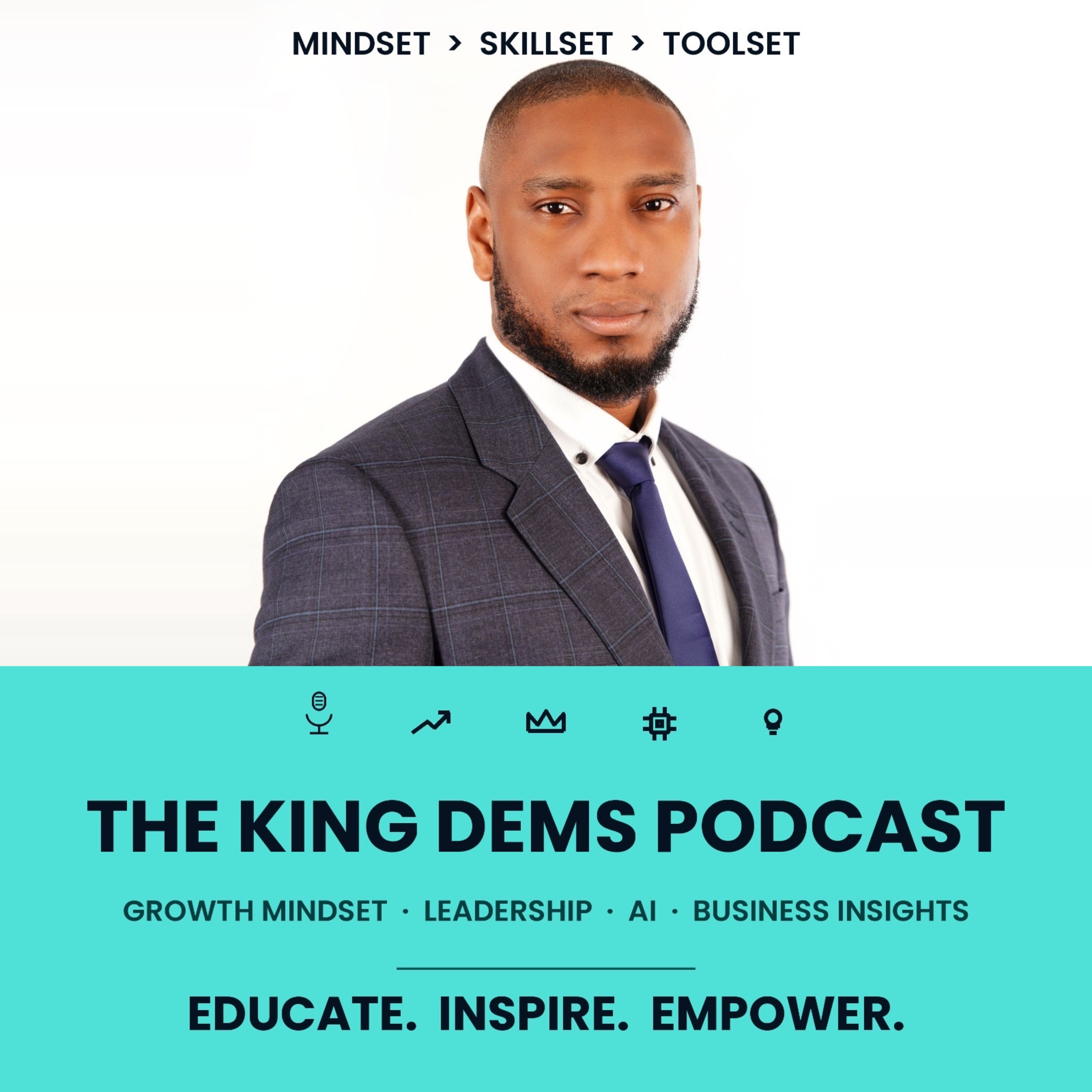
King Dems Podcast | Growth Mindset, Leadership, AI and Business Insights· Folge 139
Neuroscience, Growth Mindset & AI Strategies w/ Dr. Anjani Chakrala
Samstag, 4. Oktober 2025 · 1 h 08
Kapitelklicken springt direkt hin
Shownotes
This content includes a paid partnership with BetterHelp Online Counseling. Get matched with a credentialed therapist and start your growth journey today at betterhelp.com/kingdems for 10% off.
Fuel your wealth with growth mindset strategies: Dr. Anjani Chakrala reveals neuroscience insights, AI in business, leadership resilience, and self improvement tools for unstoppable business growth.
On The King Dems Podcast | Growth Mindset, Leadership, AI and Business Insights, Dr. Anjani Chakrala — neuroscientist, biotech strategist, and human transformation advisor — joins to explore the neuroscience of performance and business growth.
We dive into brain science, leadership psychology, AI-driven strategies, and resilience tools for entrepreneurs and executives seeking growth mindset breakthroughs.
Key Takeaways:
• Neuroscience lessons for business leaders and entrepreneurs
• Growth mindset, neuroplasticity, and resilience in leadership
• AI in business, innovation, and decision-making
• Self improvement through therapy, mental health, and wellbeing
• Wealth strategies rooted in psychology and science
• How BetterHelp makes mental health accessible globally
Guest Resources:
• Connect with Dr. Anjani Chakrala on LinkedIn
• Learn more about Thinky Inc. (neurotech & brain training tools)
🚀 Affiliate Rocket Ship:🔥 Power Your Growth with Our Affiliate Partners:
📧 Grow your audience with Kit: partners.kit.com/x3j2zt8uz3i3
✅ Create stunning presentations with Gamma: try.gamma.app/KingDemsPodcast
✅ School of Mentors Skool Community – Join global mentors: skool.com/schoolofmentors/about?ref=d62314d3cf…
🎙️ Book interviews fast with PodMatch: joinpodmatch.com/kingdemspodcast
🎧 Record studio-quality podcasts with Riverside: riverside.fm/?via=ademola
✅ Auto-boost SEO with Alt Text AI: alttext.ai/?red=kdemsc
✅ Simplify investing with Tykr: tykr.com/?red=kdemsc
✅ Run high-converting webinars with WebinarGeek: app.webinargeek.com/?red=kdemsc
✅ Track team productivity with Insightful: insightful.io/?red=kdemsc
✅ Streamline chats with Timelines AI: timelines.ai/?red=kdemsc
🛍️ Shop premium resources via Stan Store: stan.store/k-demsconsulting
Smarter tools. Better growth. Bigger wins.
🎙️ The King Dems Podcast is ranked in the Global Top 2.5% on ListenNotes. Help us reach the Top 1% by 2025 — subscribe, share, and review.
Cross-links:👉 Listen to Shannon Michelle on trauma, growth mindset & resilience: youtu.be/zjaN5SjJdwY
👉 Hear Cauvee on passion-to-profit and AI-driven success: youtu.be...
Transkriptvom Podcast bereitgestellt · Zeitmarken springen hin
Why should people listen to the episode? Yeah, I mean, if you are curious about a girl who just kind of left everything behind and moved across the country to study veins and later realise that she wants to bring it back to the society and maybe take it back home as well. That's, that's how, that's why you should listen to this and to all the women and people of colour too.
I think this is I hope I I you are a presentational story here. That's interesting. You're actually a very, very big, I say figure inspiration, a beacon of hope, right? And yeah, I really think your story and your body of work is inspiring. That is from me to you, and that is actually as authentic as you can get.
What you do is actually inspiring. And of course, I appreciate you very, very, very much before. We dive back into today's conversation. I want to share something important. This episode includes a pay partnership with Better Help, a platform designed to make starting therapy easier. I know from my own journey as a leader and entrepreneur, the life and sometimes feel overwhelming.
There are seasons severe stress, uncertainty and pressure build up and you need a safe space to process it all that severe therapy comes in. Therapy isn't only for people facing clinical challenges. It's the space to reflect, grow and find better ways to manage stress relationships and has no goals. It takes courage to seek help, but it's also one of the smartest investments you can make in your mental and emotional well-being.
That's why I'm proud to highlight Better Help. With Better help, you simply feel out of short question there and get match to the credential therapist in just a couple of days. If the first match doesn't feel like the right field, you can easily switch therapist at no actual cost until you find someone who connects with you.
Inside the platform, you'll also find tools like Donnelly and group sessions on different topics that can support your growth. And with over 7000 reviews and 4.5 trusted reason, Better Help is a platform that you can rely on. So if you feel like you'll benefit from talking to a therapist, visit datahelp.com/contains. That's dot com forward slash King James to get 10% off your fest mother 30.
Once again, this is a key partnership with their help, and I encourage you to take that first step. If you've been thinking about it, Sometimes the best investment you can make easy yourself. Welcome to the King Dems Podcast, where we share the stories of extraordinary people and dissect hot, relevant topics that shape our world. From visionary leaders to trailblazing creatives, we uncover the mindset, strategy, and grit behind greatness. Whether it's business, culture, or personal growth, we ask the real questions.
This isn't just conversation, it's transformation. The Kingdom's podcast, Your Next Breakthrough, starts here. Music licencing reimagined. Your life, ladies and gentlemen, will once again walk out to The Kingdom's podcast and today I have got with me Beauty and Brains and Mick Walker fighting out of Chicago, IL by Warrior Johnny the Super Euroscience journey to Crawler. How are you today, Doctor and Jenny? Wow, Yeah, thanks for that.
That that sentence, right. That that definitely put a smile on my face. I am pretty good. How are you? All good, all good. We, we've been having, you know, a super wholesome conversation. And guys, you're gonna be jealous because this is just Part 2 of the podcast. We did not record Part 1 of the podcast. Exactly.
Right, so hope you're not repeating ourselves here. I was telling you, and of course, you know, by the way, Dr Jenny, she is just like myself. She's not photogenic. She looks better in person that the pictures you'd ever see of par on social media. So just so you know, it's on the promise, but over the lever. Yeah.
I like. That, you know, yeah. Like I like to do, you know, all the podcasts I love to give people their flowers. Your body of work is actually highly, highly impressive. I think impressive is an understatement. But in the absence of a word that is more impressive than impressive, let me just see that your body of work is impressive. I hope you accept that, so see back while I read your carefully curated introduction.
So today on The Kingdom's podcast, we're joined by a super brilliant mind at the intersection of neuroscience, AI and human transformation. Doctor Anthony Chakrala with a pH D in Neuroscience, years of postdoctoral research on brain function, and her current work translating brain science into real world clinical tools. Her journey is on a mission to make neuroscience practical for everyday lives.
From decoding neural networks to driving neurotech innovation, her work inspires hope that science can truly change the way we learn and heal. I'm honoured to Welcome to the Kingdom's broadcast Doctor Anjani Takala. Let's dive in. Wow, once again. Thank you. Thanks for that. I'm honoured as well. I think it's not oftentimes that scientists get to go on podcasts and talk about their science and their journey. And so this is very special for me. So this is actually my first podcast so. Wow, fantastic.
So I'm really happy. I'm really happy to be the first you feels cool to be the first I want to be. I want to be #1 in a country someday. I said, well, we're speaking. I'm number 3IN Cyprus on the Apple broadcast ranking. Are you able to make me number one? Yeah, yeah. Let's try. Let's let us try we're.
On to the mission. OK, OK, so yeah, let's start from the origin and of course your your motivation. So what first inspired you to pursue neuroscience and dedicate your career to understand how the brain really works? Yeah. So I would say it's mostly like curiosity. How did I get curious is through reading a Popular Science book. So it's funny.
It was actually an assignment for one of the classes that I took in my undergrad in India at Indian Institute of Technology Madras. So the book is called Phantoms in the Brain by VS Ramachandran. So basically it has this bunch of like weird neurological cases like phantom limbs, like where the amputees have like sensations in their missing limbs and they're, they're like cases of these patients who they who thought their parents were imposters and then their other like out of body experiences. So basically what all of these cases kind of came together to show that what an astonishing role that the brain has in your sense of reality and in your sense of self. So that was like, that was very
cool for me. I was just like this, you know, sophomore or like second year undergrad, like reading this book and it was just, it was mind boggling for me. And I was like, OK, let's. So it was one of those things I just everybody around me was, I think it was like the peak of the research, the undergrads going into research, wherever I was from. So I, I kind of got on that wave of research going into research after undergrad.
So and then I just moved from India to the US to do my PhD at University of Wisconsin Madison. I was I was studying brain and behaviour. How does like brain contribute to what we do day-to-day? The specific question I was looking at was how does our brain help us see things and make sense of what we see? A lot of us think that seeing happens in the eye, but there is a lot of processing that happens in your brain that actually lets you see colours or recognise somebody's face and, you know, be able to absorb that information and act on it. So all of these processes are, we all know this, we all experience this day-to-day, right? But what we don't know is how does the brain do with it? So what are the mechanistic
insights we can pull from looking inside the brain about some of these outside processes? How are they mapped into the brain? So those are the questions I was talking about. I was looking at when I was doing my pH D research. So that's kind of what inspired me really the reading and also kind of, you know, knowing about the research towards the end of my undergrad and like really kind of seeing some of the researchers do research in my own institution at Indian Institute of Technology.
So it was kind of inspiring for me to take the next step and go to grad school. So what was that aha moment? The epiphany? You know what? You now realise that it is your calling to bridge science, right, with real world solutions instead of just staying purely in research. Because I I know you have a background in engineering and I always tell engineers on this podcast that engineers are solution oriented individuals.
They bring real world solutions to real world problems. So would you say that engineering background also inspired you to be on this pathway? Absolutely. I think absolutely that is part of it. So I was like I was very entrepreneurially minded even in my undergrad. I just, I used to participate in like startup pitch competitions.
I was doing my engineering training is in biotechnology, right? So it's a broader field. It includes neuroscience as well, but I was doing other aspects of biotechnology during my undergrad. So I would say when I moved to grad school, I'd really like for the first three years, right? It was intensely reading the literature and trying to pilot experiments as to kind of come up with hypothesis testing day to my day-to-day would look like I would, I would wake up, I would read scientific papers and I would I would have discussions with my team and then I would be trained on doing experiments. So most of the time was spent in the lab doing that. So what I was starting to miss really was the human interaction with outsiders.
So then I found this opportunity of doing like community outreach about neuroscience. So we used to have science nights at these high schools in Madison. So and then we were from our university side, there's a team including me who would go there and have set up a booth and just to talk to public about neuroscience, talk to public about what we do in the lab, You know, just because these are.
Yeah. So these are some of the things that are really important to create platforms for that dialogue to happen because you scientists are not just somebody who are like sitting in an ivory tower just doing their own isolated, siloed work, right. So I think that was that was when I had the aha moment. I would say that I actually like talking to people and bringing the science about science, right? I mean, I like people.
I like talking to people about other things too. But talking to people about my life where like not many people are familiar about what is research, what do researchers do and things like that. So it was also like we got to do like some fun, you know, games that kind of for kids, right. So where we had like the drunk goggles, where you, if you put on the goggles, you, your vision is distorted and we would have a game for them to like eye to hand to eye coordination.
What happens when you put on that those distorting goggles, right. So I'm kind of kind of making public think about the inner workings of if your senses were to be distorted, what really happens to your behaviour? So the sensing is so closely related to behaviour that we take it for granted a lot of us, right?
So that was when I was like, OK, this is this is good. And then that after I graduated, I took on post and things like that. And then I got to work for another startup where I, I could develop like some kind of evaluating a scientific fit for a technology that can regenerate neurons in the eye to restore vision with the clinical need.
What is the need in the clinic for a technology like that? So we have the and what can this technology do, but what is really needed by the people in the clinic? So those are two different things. A lot of times when you do cool things, develop cool technology, it's kind of developed just for the sake of the pureness of the technology, right? So you're trying to achieve something, but when you try to take it to the real world, it's a part that you have to go down where you do a lot of you try to fit this technology with what's actually needed in the clinic.
What is the reality? There has to be a use case. Use. Case and really finding the use cases was what I was doing at that startup that I really enjoyed doing. So I was like, OK, this is this is cool. So this maybe this is what I want to do. So that's kind of where I'm at right now. So you have actually described yourself as driving where science meets strategy, right?
So can you share like how you've been able to balance that deep research with the practical translation in biotech and of course, neurotech? Yeah, Yeah, I would say like, like I just mentioned my journey in like this tagline, right. Science meets strategy is relatively new, but so how do I balance deep research with practical translation, right.
So I think it takes a team. So one person cannot do all of it. So when you are, it's a mindset shift when you're doing. Teamwork makes the dream work. Teamwork makes the dream work. Yes, exactly. So it is definitely a teamwork. So we need a lot of interdisciplinary collaborations and dialogues that need to happen for somebody. Because like, even for one person, when I'm on days that I'm really doing like deep research, right, like in the lab, testing out things, doing research, clear research, I really don't have the mental capabilities to be able to think about anything outside that because that's, that's the first step in the pipeline.
So, but if you imagine a scenario where this person who's doing the deep, deep research can communicate with somebody who's also on the same team, but they're more interested in thinking about how does this fit in and how it's like a feedback loop, right? Like, hey, this is what researcher A goes and says, this is what I've found and this is where it's headed. But then there is a person that is actually doing the strategy side of things where trying to see where this actually fits in the real world scenario use case. But what's very important is this person, the second person we're talking about, the strategy person, I think it's important for them to have scientific training as well. That's, that's what was very
unique about my experience working with this. The retinal neuron regeneration startup for vision restoration is all of us. There was one MBA on the team, so good for business fit. That's why I passed it. Yes, we need, we need business people too. We need business people too. So but I think. You need to bring out your team. Yes, yes.
But if you put a business person with a purely research minded person, that's not gonna connect really well. So we need a third. I feel like we need a third entity that is kind of that understands that has the science background, but now is very interested in trying to bridge them together. I think that's kind of where I I see myself. I see myself as that entity so.
So. That's yeah. So that's my experience. And now I am, I recently got this scientific advisor role at this eurotech company called Pinky Inc. So basically this company is has a product that lets you train your brain through games and neuro variable device. So you get neurofeedback as you're playing the games to real time feedback to show how much of cognitive load you're taking as you're doing.
They have like variety of games to improve different things like processing speed, how quickly are you, how reactive are you and how your working memory and things like that. So, so they have a cool technology, but we still there's a lot to be done in terms of like bringing this to the public, making the message clear, making sure it's a scientifically grounded message, not over promising something, but also not understanding the potential of the technology, right. So all of these things is what I'm up to right now. So I'm also trying to make content for people to understand what when when you play a game like this, when you train your brain like this, what is really happening in your brain and like how, what is the mechanistic
value that you get or changes that you get in your brain that might be important for, for your outcomes from doing this training. Oh, interesting stuff. You know, for me on a personal basis, I've noticed like playing certain games have actually helped me with like and eye coordination. Like playing these games consistently do help, but I don't know how it works out for other people. Playing word games, for example, like help me get sharper in terms of vocabulary, even reading speed and understanding, you know, verbal communication at a faster pace, right? So I would like to see neurological research that speaks to these, you know, observations that I've had. I've not been privileged to be
on, you know, that research side. I have a science background. Actually, a lot of people do not realise the fact that in high school I was a science student and it gave me that empirical background, the physics, chemistry, biology and understanding, you know, the basics from a scientific perspective.
Applying the empirical method helped me to smash the social sciences. Ended up starting economics, for example. But it is a social science. If you apply the science principle to the management sciences, to the social sciences, it helps you to excel, it helps you to be pragmatic, it helps you to be neutral right?
And it helps you to have a higher level of an analytical mind. Right. Because when you follow the data points, you're able to make well informed observations and well informed conclusions, right? Just like we have in philosophy, your premises lead to all conclusion, right? So if your premises are logically valid, your conclusions will also be logically valid, right? And of course, with those conclusions, you're able to make resourceful recommendations, right? So yes, I'll talk about your research work, right? So in accounting, it's something that you, when it comes to accounting for research and development, R&D has become like a real buzzword.
But a lot of people don't really realise what R&D is about, right? Research is different from development, but a lot of costs goes into research. A lot of research never even see the light of day. Parts of the difficulty in finding a use case for that researcher, It's very fancy. You document it, right?
It might not even have a use case until years later. But from the business side, from the business side, you're like, OK, what does this do for us? Yeah, yeah, exactly. So it might be just like put on a back burner, right. Like it's so it's not relevant now, maybe let's revisit later. But it's one of those things like is it an incremental value that you're adding to your business or is it a completely revolutionary thing like Steve Jobs did, right.
So, so you it's all about that mindset. And I think we need people who like MBAs, business minded people who have some science training as well. You're talking about me. Yeah, yeah. So definitely, I think I think it helps like like for all the reasons that you just mentioned, I think it's it's highly, it's highly important for all of us to acknowledge the importance of science to form the foundation of our decision making as well.
So yeah. Absolutely. So for people outside of the lab, what does your science actually reveal about attention, memory, decision making that could help us in daily life? Yeah, yeah. I think that that's a loaded question, I would say. But my short answer to that is what has been happening is neuroscience has been largely confirming what we already know about human behaviour from psychology, right?
But what is the value it's adding is it's bringing the crucial evidence about the brain activity and, and, and underlying mechanisms. So let me give you like an example, right? So we have known over like a century from behavioural studies that humans have severe information processing limits. Like for example, we cannot pay attention to everything at once. We can't remember everything we see, most of us anyway. So there are some gifted individuals who probably can do better than.
Outliers, Outliers. Yeah, which is also, which is also so beautiful. All of us vary in this ability. So that itself, that's a whole different topic of discussion. But so what's happening is we know about our limitations behaviorally, but what we don't know is where or why there are these bottlenecks that occur. Just we are not able to tell from the behaviour alone, just from studying the behaviour, we are not able to tell where in the brain or why these bottlenecks are occurring, right.
So, and this is exactly where neuroscience helps us in that it helps us localise these, these distinctive bottlenecks. It just uses like more mechanistic insight into these limitations. And what we do with those insights is, is when things breakdown, it is very important to well, you might say, why do I need to know why?
I can see the behaviour, right? I can, I can learn everything just from the psychology side standpoint. Why do we need neuroscience? Why do we need to measure brain activity? So there's a whole debate on that front as well. But what where this is really crucial, this knowledge of knowing why what happens in the brain is when things breakdown, for example.
So I have so we know there's like a perceptual like at the level of sensation, for example, when you see things. So you literally cannot process too many things in your in your field of vision, right? Like for example, you have a clutter. A lot of times it's hard to find something when the clutter is increasing.
You're getting distracted by too many things at once, right? And there is, there is So there where when you think about it, maybe it's your attention that is actually failing, right? So at the level of the working memory might not yet come into play at this level. Does that make sense? What what I'm trying to say? So there is, there is, there is memory and there is like senses, the sensing, there are, there are there are some limitations on the sensing capabilities.
And then once you have sensed everything, you something goes to your working memory. So you can actually access those objects and be able to address them. So so I hope I'm doing a good job explaining this. OK, let me try to, would I say break it down for the lead man, Right. So yeah, we'll talk about the senses. We're basically talking about the five senses. We talk about sights, feel, taste. Yeah.
Touch. What else do you have? Hearing, right. So if you take a touch, for example, right, you touch something, you have nerves, right? You have neurons that are going to transmit that information, that data to the brain, right? However, for for like some individuals, due to certain sensory limitations that they have, right, they might not be able to transmit that to the brain or to the working memory in quick real time. So when I have a blocked nose, for example, right, my sense of smell is limited, right?
So I'm not able to process the smell that I have in my environment as quick as what I would do on a normal day. Is that is that correct? Is that like a good? Yeah. Yeah. So, yeah, that's a good. So you're talking more about when the senses are gone wrong. Yes, that will put a lot of limitations on how much you can sense right, But even even you have a perfectly normal nose, you have a perfectly normal touch sensing, right. So, but when you're presented with too many sensing stimuli, I see, for example, when you're presented with too much information, maybe for vision, it's it's easier to explain as a vision case, right, because I I'm also biassed because I study vision.
For example, you open a screen and like you these days, like there's just too many pop ups, let's say coming up, right, like ads or whatever. So there is there is a limit to how many you can sense at the level of the sensory part of the brain, if that makes sense. What yeah, what we experience is is a mixture of sensing attention and also memory.
So inside our experience is just a mixture of everything. Like I'm. I'm saying this because your question goes back to attention, memory, and decision making. So our ability to make decisions is very, very much limited by how much we can absorb, how much information we can absorb, how much information we are able to pay attention to, and how much information we are able to put in the working memory.
I think I was just trying to say where make an make a use case of neuroscience where it has provided some mechanistic insights and why that was important. So the example that I wanted to take was a clinical example. For example, you can take ADHD, right? ADHD. Whoa, you are entry by gadget? I'm actually an ADHD person. Are you wow, OK, so maybe you can correct me if anything I'm behaviorally what I'm saying is not, but from your subjective experience, I think but so I think what what people thought of ADHD as an attention deficit, right? So that's what it is famously known for. But is it so then there is there is a nuance to it, right? The picture is more nuanced where many individuals with ADHD don't have like pure perceptual
bottleneck. Like they're able to perceive. For example, if you were to measure their brains and measure their vision, vision areas vision, yes yeah, just put on a EEG head cap or like put them in a F MRI machine, right. If you're able to measure their sensing brain areas, you're able you maybe they're able to see all of it.
They're able to see it at that level, but what's really happening is they're not able to maybe put a lot of them into their working memory. Here is why working memory is important because whenever you have whenever you are like trying to do have a behaviour like trying to interact with information, you to pull the information from your sensing capabilities. But there's a filtering that happens by memory. So your memory, your working memory is able to only hold some of that information and then you need to pull that from the working memory.
So do you, do you see what I mean by there's a sensing philtre, there is a working memory philtre, the sensing to working memory. Maybe it goes through attention. Attention is the one that is helping you philtre out what you want to hold in your working memory. So with neuroscience, because the brain is does everything in a modular way, because there's some areas of the brain that are dedicated for vision processing and there is the prefrontal cortex like we discussed and it seems.
To be that's the favourite part of the brain. Yeah, that's your favourite part of the brain and that's many people's favourite part of the brain. I think because it's so interesting. It has, it does a lot of different things. It's it's for decision making. It has some, you know, attention related executive attention related signals.
It has it also has some sensory signals it actually responds to. Yeah. So cuz I for my post doc work, I actually went inside this prefrontal cortex, put electrodes in it and recorded from it and actually got like the brain activity. So it has all of these sensory, whether you're seeing an apple or an orange, it might have a distinction between those two. So it has, so it's a, it's a very interesting and very complex area.
So people are still trying to understand. I, I wouldn't say I have all the answers to it, but what I want to say is neuroscience really gives you the, the break from through the window of the brain activity. What can you tell about these different behavioural process that you already know through psychology or you just use every day, right? Like, hey, your memory is bad or your attention is bad. What does that really mean when it comes to the brain? So that's what neuroscience really use. And I, I wouldn't be able to answer what neuroscience has found uniquely about these processes. But behaviourally, I think we know about all of these things, but I think neuroscience kind of like hits the nail on the head with, with giving some clarity
into what these processes. I I would say I want to end this question with one thing. One area where neuroscience has added a lot of value is sleep. Sleep. Wow, tell me about sleep. Yes, sleep is sleep is. I highly recommend the book Why We Sleep by the scientist called Matthew Walker. So it goes into the neuroscience of sleep as well. So anyway, so sleep, we know from the outside, we all know just from personal experiences that sleep improves memory, but we did not know exactly how it was done. We didn't know the states of the sleep or things like that. So it was with.
There's a lot of attention on deep sleep lately. Deep sleep, yes exactly. And all of the what that what those stages of sleep mean to your day-to-day, like quality of life has not been known before, but I think neuroscience has helped us understand those stages of sleep and exactly what role they play in the memory consolidation.
So, yeah, so I think that is one example where actually measuring brain activity has changed our point of view so much. I'm going to ask you the same questions that my friend Maya dropped for the neuroscientist from Stanford University with Doctor Parent Brain. SO the very first question is, does the prefrontal cortex develop differently depending on a gender? Gender I actually am not aware of this. I I haven't read any literature, any like research studies that is related to this.
So I don't I don't want to give a wrong answer. So I'm not I'm not. And this is something that is a little like that we need to do consciously in the in, in whole of science is like being able to balance your sample sizes with both genders because yes, we don't completely understand the gender based differences in many, many aspects of biology.
So that's something. All I know is I'm all up. I'm all for being able to study in both genders in a, in a equitable fashion, you know, but I don't. Know, I think, I think that would make sense, yeah, yeah. But that absolutely makes sense thinking about you from a data analytical, you know, perspective, you know, if the sample size is not large enough, you are not able to extrapolate, you're not able to perform that, you know, regression and correlation analysis, you know, that ascertain that OK, is there actually disparity? Are there variances between the patterns that are identified for the resource that we have based on gender, right? So we're just picking it based on humans, right? Or what happens to that sample
size, right? And I think this is something the scientific community need to, you know, take up very seriously, ensure that there is gender balance in research work so we are able to identify the patterns, you know, across our genders. And yeah, I think that could make for some very important decision making.
So #2 question is, does stress or trauma inhibit the function of the prefrontal cortex, particularly before it is really developed? Definitely yes I do. I do know this just from like my interest from my friends who work in like adolescent mental health area. I haven't done any research directly in this, but I do know that stress and trauma changes your brain.
I think most of your brain. But like most likely these very executive function areas that are especially developing, still developing into late days, right? So I know that it's an S, but I am not aware of the mechanistic insights into how it does. OK. The third question is how is the prefrontal cortex different from other parts of the frontal lobe? The parts of the frontal lobe, yeah. So you want to you just want to talk about the function? How?
Yeah. So, so basically you know, you have the the what I say the suborgans in the frontal lobe of the brain, right. But what is the differentiator of the prefrontal cortex? Prefrontal, what is the differentiator? OK. Yeah. So I would say prefrontal cortex of the other compared to the other parts of frontal lobe is more involved in like decision decision making.
There is also something called like frontal eye feels that are very important for like movements because your your eye movements are really closely related to your decision making as well. So, so the frontal cortex has heavy connections to the motor part of the brain, part of the brain that gives you body movements because every time when a decision is made, it needs to be executed with a body movement most of the times, right?
So now because of the digital age, maybe your decisions are just made with a click of a button, right? But for example, I see an apple, I want to make a decision whether I want to eat an apple or not. So how do I make a decision? I actually make a decision by making a motor movement, by moving my arm, reaching out for the apple and things like that. So what we really need to remember is like there is sensing.
You see an apple. When you say you see an apple, your visual cortex is firing up and then it's sending signals to the prefrontal cortex. It's not just none of these brain parts are just acting in isolation, right? They're always talking to the other brain areas. I would say prefrontal cortex is one of those things that have, it's known in the literature that it sends out a lot of inhibitory signals to the rest of the brain as well.
So that maybe comes into play into, you know, impulsion control or, you know, just kind of cutting down on unnecessary signals that might not need to be happening in the brain, things like that. So these are all the things that I am aware from my own research that it contributes to. One of the findings that I made in my own research is that when you disrupt the prefrontal cortex function, you for example, like somebody is doing a task and they're making decisions, right? They might still be able to make a decision correctly, but their response times are much slower.
They might be slow in making a decision. So prefrontal cortex also heavily is involved in the processing. How sharp your brain is, like how how quickly you can make decisions. So when you think about decision making, these are all the things that you, it's not just about accurately making decisions, especially in like leadership positions or in sports, for example, a lot of people, a lot of athletes, they're so good at quickly making decisions. If they have a bad shot, basketball shot, they're they're moving ahead or moving on and trying to get the next best thing right.
So how do you quickly make decisions is also there is prefrontal cortex has definitely a role in that? So, so how about your muscle memory? Is that linked to the free frontal cortex? You mentioned sports, right? So I believe muscle memory helps a lot, you know, in sports. I have been involved in sports at an amateur level but not at a professional level.
And I understand from martial arts, for example, if you make certain repetitive moves, if you train certain repetitive moves, it comes to you very naturally. So making that decision are the beaks of the moves you want to make. Is that also links the prefrontal cortex or is it just a reflex? It's a very good question.
Why you think about that? You know, you mentioned about the apple and reaching for the apple. This is the apple I have here, but I cannot eat this apple, that's what. That's what we all reach our rich for, right. These days, that's the apple we reach for. Yeah. Yeah. So to your question, I think so it might not be as whiter for those the way I imagine this is this is not so not that might not be accurate here.
Don't take my word for it, right. So I'm just throwing out some ideas. It's like some of the ideas that I LED is it's about when you're having a reflex, it's about really short cutting a lot of circuits in your brain and going from sensation to motor movement quickly. So what does that mean is I would think 1 hypothesis we can make is like maybe if the prefrontal cortex is not no more involved because it's learnt, it's a response, right? So you're not, you know how I don't even think about it when I'm doing it.
So people say things like that. You know, if you have to, if you have to map that phrase exactly to the brain activity, I would say prefrontal cortex would be less engaged when your muscle memory is formed. Is it important for forming the muscle memory? Yes, but once the muscle memory has been made, once you're the expert, you might actually engage less of prefrontal cortex.
Yeah, it just cause the second nature. Yeah. So that's kind of the one part of line of thought, right. I think he's headband too. That's kind of what they're they're trying to show is like they have some research showing that. So they are mean the sensor is on the prefrontal cortex. So what they really measure is the node how much of blood flow is going to the prefrontal cortex when you're doing a certain task. And they have some research showing that with time as you're getting becoming an expert at the task, your node is actually going down.
So your engagement of the prefrontal cortex is going down. So if that makes sense so. Yeah, that does make a lot of sense, but it makes me think about another thing, you know, from our scientific perspective. So what you look at athletics, you know, sports, it's something that's very close to my heart.
Now, do you think that genetics, you know, plays a role in terms of the efficiency, the speed, you know, the acceleration of this, you know, reflex action? So for example, some people, especially like people from Eastern Africa have fast twitch muscles based on their genetic viewed up right and as against those supports from West Africa. So that's why they are more, you know, built for longer distance races and we are built for, you know, springs, right? So your genetic makeup actually does contribute to the kind of athletic abilities, right, or the sports you'd be properly conducive for to participate in.
So in terms of the reflex, do you think fast tweets muscles is like the genetic cheats that code for you for the reflexes? Yeah, that is. That's a very interesting thought. I honestly don't really know what like what research is out there to test that. I'm not I'm not sure about that. But it, it is very interesting that you say so. So the the, the muscle itself, the nature of the muscle itself is sort of different based on what your origin is, I guess genetic origin is.
So that's, that's very interesting. But then does it mean, does it also mean that because this muscle is fasted twitching, you have the you have the mechanism in place that actually gives you an advantage, right? So does that mean that can you learn more naturally? Can you be a natural at the sport?
It's quite possible. But can you, can you beat somebody who's a natural with brain, with training, muscle training and body and brain training? Yeah, that's also possible. I would say so. I so, yeah. And that's that. I'll leave it at that. Yeah. Because you know when you think about it like when somebody who's a natural doubt puts it that consistent hard work into their training and you, that is not a natural.
It's like it's an all fair competition already. Yes, yes. Yeah. That's how you keep seeing these guys are the Olympics. They keep winning, you know, the long distance races and like the rest of the world, you just give it to them. Let's focus on other things. I don't. Even want to try Hands down. This is getting interesting.
Science is fun and you know, we need the persons like yourself and myself, you know, to make it highly relatable to to the public. And I think over time, people become more interested in science and, you know, how to study it. And that way we're able to have solution providers in the world at large.
So talking about human transformation, like you've actually worked on brain reporting and, you know, neuromodulation platforms like how do these techniques help us understand or even reshape cognitive function? Yeah. So before I answer how or like how I think they have reshape cognitive function, I just wanted to show the distinction of what a brain recording platform is and what a neuromodulation platform is.
OK, because you brought up two things, right? So brain recording platform is something that just records from the brain. It just records the neural activity and it's up to you to do whatever. You can do anything with that activity. You can analyse the data, see how it relates to the real time, real life behaviour of the person.
On the other hand, well, with the brain activity, you can tell the correlations between the brain response and the behaviour. So that's that's where it stops. But if you really want to show causality of a brain area, for example, you asked me a bunch of questions, right? Like the questions that before this, does prefrontal cortex do this, you know? So for a question like this, well, if you record from the brain, most of the times you will get some signals from all of the brain areas.
But if you want to pin down on the like how essential is a brain area for a particular function, that's when neuromodulation is important. So neuromodulation basically is you're modulating the neural activity using a certain technology. So there's a whole different way of gamut of ways of how you can modulate neural activity.
There is invasive ways, there is non invasive ways. In the non invasive ways there is magnetic stimulation, there is electrical stimulation and there is more invasive you can have like D brain stimulation, but again electric stimulation I have done cooling of the brain, you can cool the brain area.
So essentially what all of these modulations do is they either increase the brain activity or decrease the brain activity of a particular area. So what happens? So how do these shape cognitive? So once we have these technologies in place, we are able to study the importance of a brain area. And if I decrease the activity of brain area like prefrontal contacts using any of these technologies, what happens to the behaviour?
What is the essential function that's getting, you know, that's for example, maybe you see the person doing the task wrong, accuracy is going down, or I mentioned that the reaction time is going up and I decrease the brain activity. So all of these things are something that we can study with these techniques and how do these technologies shape the way we understand cognitive function is we are able to accurately map breakdown the cognitive function into the whole process of having what does it mean to have be cognitively able, right like you have self. It's a gamut of behaviour.
It's not just being smart, it's it's about paying attention to the right thing, making the right decisions, being able to have a good memory and all of these are part of cognitive functions. So we are able to in pointedly study which brain area maps to which function or is more essential for which function. And sometimes a lot of times the same brain area might map to different functions.
So, but all of this is only possible when you have these technologies of being able to study the correlation of the brain activity with the behaviour and also the causation. When you disrupt, intervene and disrupt the brain activity, what happens? It just is tough. You talk about technology. The technology that is closest to my heart is AI, because I am AI and people, I only see that my parents.
But first use something everybody did not know. Yeah, yeah. Yeah. You know, I talk about mental health, you know, cognitive performance. You know, these are global challenges. So how do you see AI, you know, combining your tech to play a role in tackling these issues? You know, like burnouts, memory decline, trauma.
Yeah, AI, you know, tech so I so AI has been around. It depends on like all the ChatGPT, all the LLM stuff is is generative AI, right? That's a whole different thing. But AI, when you think about AI like machine learning and other computational techniques that you use to crunch data, crunch numbers and be able to get like insights from it.
So that's a different side of AI and that has been around and that is something that I have used in my own research to be able to understand this neural data. Because when you think about this neural data, it's very complex. Like when you go and record from like, yeah, billions of neurons at once.
Well, we don't really have that fancy technology, but we're able to record from like hundreds of neurons at once now as it stands now, Right? So and you have when you try to read like it's like a doctor reading EEG patterns, right? Like you go and like you have so many channels and like as a normal. So very moving lines.
Yes, so many moving lines and it's changing with state with where you're in the brain and it's changing with time. It's rapidly, it's a dynamic system. It's not just sitting there, It's a lot of things are happening in there. So how do you make sense of something like this? You don't need methods like machine learning, you know, like the simpler methods of machine learning to the most complex ones.
So we it's already been in the field. One of the things that I wanted to mention that is very side by side to AI deep learning and all of that is computational. The just modelling the brain, modelling the brain networks and in fact deep learning, you know, the deep learning that neural networks, the neural networks that we, you probably have heard about that actually run behind all of these like that are basis for LLMS as well. So they are all inspired by how brain networks are organised. The hierarchical, like if you learn, if you had taken anybody who is, who knows a little bit about neural networks, there's like layers of net neuronal layers that feed the feed inputs and get outputs and there's some
learning happening and all of that. So all of this is inspired from neuroscience. So that's one side of it. So that I just thought I'd just like, I always thought that's a fun way. There's a two way connection. It's not just AI helping understand the neural neuroscience, but what we learn about the brain architecture. The structure of the brain is very, very, very amazing. That's a whole different.
We can have a separate session on the structure of the brain. You read, you read, you read my mind. You read my mind because I was thinking about to like, OK, OK, It means we definitely need to have a Part 2. We definitely need to have a Part 2. You want to listen, hear about it. I can make it more fun to hear about as well.
But but there is a hole. It's beautiful. You put like a brain slice under the microscope. You it's amazing to look at. Don't be spooked with. It's really pretty. But yeah, yeah, yeah. What was I saying? Yeah. So a lot of these things are like it's a two way communication. The more we learn about the brain because these LLMS are basically mimicking a person, right? They're mimicking somebody's brain. At a very fast rate.
At a fast rate, at a very energy expensive rate, right? Our brain is doing all of this. You just eat 1 hamburger and you're good for a few hours and you can be like an LLM, but the LLM needs a lot of lot of lot of lot of energy that goes into it, right? So anyway, so I think there's A to answer your question about mental health and AI.
So that's a whole different gamut, which I'm also kind of personally interested in building some digital tools for mental health. Wow. Speaking of Speaking of digital tools for better health, the best major sponsor of this podcast is Better Health, right, Better Health. And they're number one in the world when it comes to online therapy.
So I'd really like to peak your brain on, you know, the digital mental health revolution, like giving your expertise in neuroscience and human transformation. So what do you see as the most important advantages of online therapy platforms like better health, right, in making mental health support more accessible, especially for underserved communities, right? And of course, those who might otherwise avoid the traditional therapy settings.
Yeah, I would say like I am one of those people who used online therapy sessions and I was, I found a lot of value in that just from a personal experience. Yeah, it is nice because it was, it's always hard. It's it's so much easier. It's so accessible and you can do it from your living room, right. It's, it's also one of those things like you just maybe sometimes you feel more safe from speaking from your home. So that's, that's another concept of it. But some people might not have the privilege of it, right? Maybe home is not as safe as they think it is and things like that.
And of course, like the fact that you can find a private space and be able to talk to somebody at your own convenience is, is pretty good. I'm hoping it also increases the the frequency of the visits because it's all about consistency. Mental health is a lot about consistency, how consistently you do the therapy sessions or how you do your homework well and things like that.
So that's kind of my take on it. I think it's, it's very helpful. But there are there are in a low resource study, right? Then there is the Internet is not reliable. What do we do is still a question. And I did like I speak, I spoke to somebody who is a mental health care worker who's originally from Africa but now lives in the United Kingdom. And she had many.
She had amazing ideas about how we can even bring this down to a level of text or in a very low resource setting where SMS to SMS or things like that. So those are all the things that are people are trying to innovate in a lower resource setting using community health workers and things like that.
But I think at the end of the day, it's also important to speak to people in person and have real life connections. Absolutely, yeah, it's interesting, you know, better help. They're doing quite a great job in getting it as brand new as possible. The app is actually quite lightweight and doesn't consume so much on the Internet. And of course you can chat with your therapies. There are journaling sessions, there are group sessions, right. So it's, it's quite interesting.
I, I really appreciate what what you're doing. And I was really glad when they reached out to me. I said I would like to partner with you. Like for me, it was like a validation of what I preach. So I'm this kind of content creator. I don't like to represent a brand that I don't believe in, right? So it's more about relationships over revenue. The money will always cost, but you have to stand for what you sincerely believe in.
And that is what makes your authenticity to remain strong as as an individual. So talking about how neuroscience meets the digital Wellness, you know, from a brain science perspective, how can the convenience and of course, these reduced barriers of online therapy actually enhance the therapeutic outcomes? You know, it's not just about the activity, right? I like to say activity doesn't necessarily generate productivity, right?
What we are most concerned about is the outcomes, just like a scientific research, what are the conclusions? What are the recommendations, right? So from that neuroscience perspective, how can that convenience, you know, help to enhance the therapeutic outcomes? And of course, are there like any specific neurological benefits to having consistent, accessible mental health support that people can access from the comfort of your devices? Yeah, I the immediate thing I can think about when I think about being consistent like online therapy being making it easier to be consistent with your therapy sessions, right. And what do you get out of that consistency if at a brain level would be like neuroplasticity?
So you. Your brain is always like changing based on the environmental factors and therapy supposedly is, is, is to make changes at the neuronal level, right. So that's behaviorally things will change, but really a lot of would be wonderful to see the change at several different levels behaviour at the brain level. So to really make to really be able to penetrate with this intervention, right.
So I think that's the consistency can map to neuroplasticity. But I that's, that's my hypothesis. But is there like real life evidence that I'm not aware of? But it would be interesting to see. I I would I would strongly think that this consistency is helping the brain to form the connections that you want to form in a quicker fashion probably. I think I strongly agree with that sentiment because you know, when you compare it to physical health, for example, we go to the gym, we work out that routine, right? We build our body consistently.
How about building our minds as well consistently? That's a, that's a great analogy, yeah. Yeah, if you don't ever think about that, that parallel, you know, wow. I'm going to see the other questions I have for you for our Part 2, right? So I've got to jump right into the quick fire route. Are you ready to rumble? Yes.
Of course. So it is five questions, quick answers, right? So one myth about the brain you wish people would stop believing. That brain doesn't develop after you're 21. That's a myth, yeah. I don't. I don't know what the exact myth is, but that it stops like in your 20s is not 100% true. Oh really?
So the prefrontal cortex keeps developing over time way beyond your. Trances. Yeah, a prefrontal cortex keeps developing. And also you, it's like, it's not like your neurons are not. You know how there's another myth that you don't regenerate neurons after a certain age? But that's also not true.
There is evidence that's coming up from research that you do. Adults do generate neurons near neurons. What does it slow down? What does the rate slow down? It, it, it does, it does slow down, I would imagine. But can the interventions like working out right and being mindful, being really taking care of your mental health, can it change this rate of development is different.
So that's a whole different interesting area. Well. I guess we can delve into that in part too. So coffee, meditation or the brain game? What's your go to focus booster? I would say coffee, but. Coffee here. Yeah, actually the second one is focus. Sorry, music, not focus. Music too. Yeah, music. Music.
Music is a big thing for me. I love that. Do do you ever use stuff like white noise or? No, no, I have. I've used but I've never. Tried one. Noise. But yeah, I love your eye. It's just that stuff. It's good. That's good. If you could collaborate with any scientist or entrepreneur in history, who would not be? That's a tough one.
Maybe the old neuroscientist Ramoni Kahal. Yeah, he's like, he's from Spain and he's, he has done like really beautiful drawings of the neurons, the architecture within the brain slices, and he's done several other things in neuroscience. So yeah, he's, he's quite, his work is quite remarkable. So since this is a neuroscience podcast, I have other people too, but I'm I'm gonna keep it that way for now. Whoa, from Spain.
Interestingly, we we are on the Apple podcast chats in Spain. I think we're in like the top 50 in Spain. Interesting shout out to our people from Spain. This is yeah, Como estas. Yeah, como estas the amigos. So a book of film or resource that changed how you think about the brain. Yeah, like I mentioned Phantoms in the Brain is a great book and thinking fast and slow from a psychology standpoint. 2 books. And of course, the very last one is in one word. What does a growth mindset mean to you? Neuroplasticity.
It's just this stuff, you know, the, the Key Devs podcast, right, is about growth, mindsets, leadership, AI and business insights. So we are talking about the mindset. The mindset is the first thing. And you know, I, I tell people this, if you're hiring a person on your team, you need to go in this order.
You need to evaluate their mindset, their skill set, and then the tool set. So if the mindset is right, you can always teach the skill sets easily, right? And of course, if the skill set is right easily, you can teach them how to use the tool sets. So the most difficult thing to teach, in my opinion, is the mindset about what?
What are your thoughts? Yes, I, I completely agree. And this is something that I'm still learning as I grow evolved in my professional and like personal life, right. So I think to me, I, I just wanted to be snappy and like kind of fun to say neuroplasticity. But if I have to know, if I have to move away from, from neuroscience and say what growth mindset is, it's it's being open minded and being open minded to change.
I think there won't be a growth if you're not open minded. Absolutely. So that's that's my take on that. Absolutely, I very much appreciate you. So from me to you, it is a very big thank you. I always say this that an attitude of gratitude is good attitude and when a person shares their time with you to share their life with you because the SI unit for measure and life is time.
So love and respect to you for being on the Kingdom's podcast. And of course, I think I should share this and I obviously as well to the audience. Guys, always go for something in your lives, right? Conceive, believe, strive to thrive and achieve. For me, it's another goodbye. It's see you again because we're coming back with episode 2 of this series and of course, Dr and Journey.
Do you want to leave a shout out to anybody? That, of course. What would your last words be before you say goodbye to the audience? Yeah, sure. I I just wanted to thank my parents for, for trusting in me to do to be a scientist and for be always being there for me. And I also want to thank Nick White, the CEO of Stinky Inc, who has encouraged me to be on this podcast. Yeah, I did.
I did interact with Dick White. Shout out to you, brother. Yeah, we hope to to collaborate more into the future. Yeah. But yeah, just to audience, thank you for listening and feel free to reach out to me with any questions that I might be able to answer. OK, we have the best social media platform to reach out to your LinkedIn, Instagram. Yeah.
LinkedIn would be good. OK, so we'll have your LinkedIn in the description section for the forecast. So once again, thank you and press love, respect and press goodbye.
