

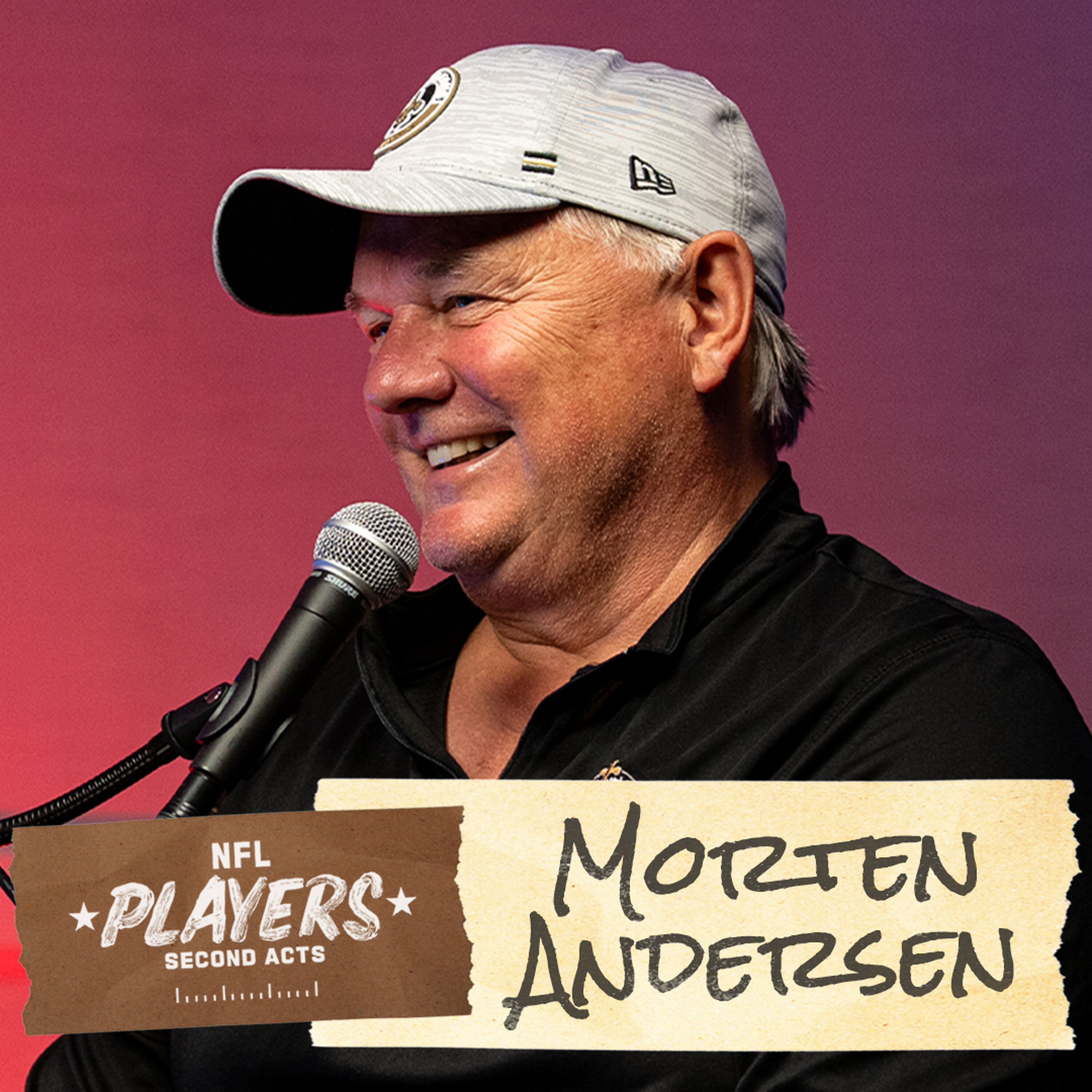
Hall of Fame kicker Morten Anderson | NFL Players: Second Acts Podcast
Mittwoch, 28. Oktober 2026 · 1 h 07
Kapitelklicken springt direkt hin
Shownotes
On the latest NFL Players: Second Acts podcast, Hall of Famer Morten Andersen joins Peanut and Roman for an incredible conversation spanning three decades of NFL history, his journey from Denmark to Canton, and the second act that helped him transition after football. Andersen reflects on starting his career alongside players who weren’t even born when he entered the league, kicking through two strikes and three commissioners, and the wild early‑NFL days — including teammates smoking at halftime.
He shares his “welcome to America” moment, how a botched center‑QB exchange made him want to become a kicker, and how he taught himself the craft by studying Jan Stenerud. Andersen breaks down the evolution of kicking, ball prep, narrow goalposts, his four levels of learning, and the student exchange program that brought him to the U.S. He also opens up about choosing Michigan State over returning to Denmark, getting hurt on the opening kickoff of his NFL career, living through the 1982 strike, and the birth of free agency.
The guys dig into his meticulous practice habits, his years in New Orleans, the infamous beefcake poster, and the “pink slip” he sent the Saints after they released him. Anderson reflects on the mental side of kicking, the emotional Katrina game, returning to the NFL after a year away, and the difficulty of retiring before breaking George Blanda’s record — including how therapy helped him through that transition.
The episode closes with his personal Mount Rushmore and his thoughts on Adam Vinatieri’s Hall of Fame future. A global, thoughtful look at one of the most iconic specialists in NFL history — and the second act of a man who kicked his way into immortality.
The NFL Players: Second Acts podcast is a production of the NFL in partnership with iHeart Media.
See omnystudio.com/listener for privacy information.
Transkriptvom Podcast bereitgestellt · Zeitmarken springen hin
Three, 99.
How do you say 22 in Danish?
Tortuven. Three, two, Tortuven. What's up, everybody?
I'm Peanut Tooman, and this is the NFL Players Second Acts Podcast. And with me, as always, is my trusty co-host, Roman.
I'm serious.
I'm ready to go to work. Harper.
Yes, even though we're not going to be serious at all in this podcast, I'm telling you right now, not at all.
This next guest, he's a legend. I've known him for many years. No, no, you got it.
This is you.
This is you. No, no, because I want to ask the first question.
I want you to do it. He wasn't my teammate.
I'm not.
Y'all teammates. I'm declaring that right now. This is your teammate.
Y'all look like y'all played in the same era.
All right, fine then. All right.
That's not true.
He was a kick in the NFL until he was almost 50.
Mm-hmm.
A couple years away.
He's a Hall of Famer and most notably known with the New Orleans Saints. Shout out to who that fans out there. He played in the most games in NFL history. And after football, he became an international businessman and he runs his foundation among his many other ventures.
Give me a shout out to Morton Anderson.
Yeah.
We just became best friends. He's a prankster.
He's a big prankster. I love that.
No, not that big.
Well, Peanut is.
I pick my spots.
Yeah, and Peanut, how did you learn how to say Morton's name in Danish?
Peanut's already forgotten. I did. Morton Anderson.
Morton Anderson.
Morton.
Morton Anderson.
That's still pretty good. This is what we've been doing the whole time before.
So, Morton.
Did you know, I just want you to understand, because I didn't realize this until we were looking up your stats and your career.
Yeah.
Dude, you started kicking the year I was born, like in the NFL. Yeah, I know.
In 82. Well, yeah, so I had guys in 82. 2006 and 2007 when I came back after 20 months in a public park. We can take that story too. Yeah, yeah, yeah.
We're going to get to 2006 too.
But kind of start there and move backwards maybe makes more sense because when I was playing, coming back from my 24th and 5th year in the league, I was playing with guys that weren't born when I started playing. That was weird to be like a 46, 47-year-old guy and playing with a 21, 22-year-old Yeah. Like a kid, you know. And them looking at me like, you're the equipment guy? You know, it was surreal. But also kind of cool. Yeah. You know, because it solidified that I had earned the right to be back again in this great game. And it's tough to hang for that long.
Especially if it's only one.
Well, three decades, three commissioners, all three of them. You know, not Burt Bell, but Roselle, Tagliabue, and Goodell. And went through two player strikes in 82 and 87. You know, played with Kenny Stabler, played with Archie Manning, and they shipped him off to Houston. Tony Fritz, smoking cigarettes in the locker room.
That was a thing.
That shit doesn't happen now. No, it does not. Well, you have a puffed one in the locker room? No. No, there's no, I mean, but that was normal back then. You know, with halftime, we would have guys run to Echo. They really must have to go to the bathroom. They ended up blowing like heaters, like lighting up. Unfiltered, too, like unfiltered keys. Things are strong. Yeah. That was the norm.
And then, you know, in the off season, they had jobs. They would sell cars or insurance or... work in a bank or work.
Yeah. Did you ever have a job?
Yeah.
In the off season?
Well, no, because I was like right there on the, still not making, you know, what kickers are making eight, 9 million now, 7 million. It's nuts. I'm just thinking like, I was talking to Jan Stennerud and he was like, and he was sixties and seventies, you know? So he, he saw maybe, I think his biggest salary was 300,000.
My first year salaries was 40 grand. And my signing bonus was $ 42, 500, right? Yeah. And we had a strike, so I didn't see much of that at all. Now, you know, it's handed to you. I mean, not handed to you, but, you know, if you sign, you're guaranteed $ 20 million, $ 25 million.
Yeah.
It's just different.
Totally different.
Trying to wrap my head around that, you know.
So you were a good athlete.
Yeah. yeah yeah i guess i was no you were gymnast and handball and.
Yeah so you all right i'll give you that come on that's you earn it i'm trying to give you some flowers so don't block your blessings baby all right so you went a hand you won a national handball tournament when you.
Were 16 great athlete in denmark did you have a welcome to america moment when you came.
Here yeah i did i was uh We were sitting at a jamboree. I got here my 17th birthday in 1977, and I was living with a host family. I was an exchange student. That's how I came over. I was supposed to stay for 10 months. And we were sitting at dinner my birthday on the 19th of August, and the next day was a jamboree, like a preseason high school deal. And they're like, hey, we want to take you to this thing and see if you're interested. We need a kicker. Our team needs a kicker. I go, I really want to play you. Football, meaning soccer. Soccer.
And they're like, well, the Ben Davis Giants don't have a soccer team. But we need a kicker. All right. So we go the next day. We go to this Jamboree game. And you got to remember now, I barely speak English. I'm 17 years old. I just came into the country. And I don't know anything about football. I can just, but what I'm seeing is a pile of bodies, you know. And then a stretcher, and then another guy runs in in the guy's place that just got carried out.
I'm like, this looks like nothing I want to be part of. Then my brother, my host brother goes, you got to understand the intricacies of the offense. For example, look at the center quarterback exchange. It's amazing. What my immigrant eyes saw was like a big guy in tight pants with a ball bending over. That by itself would have been fine. But here came a smaller guy in equally tight pants behind him, licking his fingers, pointing. And then put his hands up the guy's ass. And they stood there for a while like that was completely normal.
I turned to my host brother. I go, I don't want to be that guy or that guy. And they go, oh, you just got to go out and kick and run off the field. And that's what I did for the next 30 years. That was my introduction to football. So fast forward another day, and they want to see if I can put foot to ball. I don't know if I can do that. So I'm thinking the ball's going to be round. But it wasn't round. It was like, you know, we know what it is.
Oblong.
It's oblong, yeah. So I go, I don't know if I can get that thing in the air and I did, and then I was their new kicker. That was pretty.
Much how it went. Was that self-taught, like trying to kick it?
Yeah, it was just like trying to figure out what part of the foot, because soccer style, you come in and you kind of sweep around, and that didn't work. I had to figure out the plant foot in relationship to the ball and hitting it on the right part of the foot, not the toe, not the side, but up on top of the foot. So that took some time, obviously. But, you know, I grinded it and became pretty good at it. Self-taught.
I like that. So I looked at other guys. Like Jan Stennerud was a guy I studied. He was really, like, one of the first soccer-style guys, you know. You had the Gogolak brothers. And then you had Jan. Matt Bart mentioned them.
Matt Bart mentioned the Gogolak brothers.
And you had Matt and Chris Bart. Yeah, yeah, yeah. But you had Stennerud, and he really was the guy that kind of modernized it. And then we stood on his shoulders and kind of added You know, back in the 80s, man, it was a big deal to hit a 50-yarder. You know, now it's like a 30-yarder.
Why do you think that was?
Why is it that they're kicking it that far now?
Yeah, yeah, yeah. Is it because of the kicking balls?
Yeah, they're out.
I don't want to sound like a bitter ex-player who, oh, you know. I mean, I hit 76-yarder in practice, okay? I hit a 90-yarder in Denver to hit a guy's beer in six rows up. Yeah. So I had plenty of distance, too, when the balls were fat. But for us, they really weren't. They were right out of the box.
Now you can work the thing the whole week.
Yeah, you can.
You can do whatever the hell you want to them, and the sweet spot becomes bigger, and it just travels further. Now, did you work your own?
I'm careful how I say this. I don't want to.
We're blowing balls?
I didn't say it. That's why it started.
Footballs.
Footballs.
But, like, how do you– did you do that back in the day, like rubbing it on the ground, trying to brush it?
We were not allowed to really– the equipment guys would have them, and they were allowed to– they had, like, a brush that came with it from Wilson. Yeah. That you could brush the resin. There's, like, a white resin on the ball when it's brand new. That's about the extent of it, you know.
So I want to know.
I have ball envy, man. It's fine.
There's nothing wrong with that.
No.
Especially the way they're hitting it now.
It's crazy.
You know, you've got guys in Dallas, a guy in Jacksonville.
And it looks like.
Effortless. It just looks like, and I'm sure they're better now. I mean, of course they are because they, you know, back when I played, back when we didn't YA tittle, you know, we took the stagecoach away games.
Yeah.
You know, back then we, I mean, It was just a big deal to be able to come over from a foreign country, and most of the kickers were foreign born. Now they're all American born. But the notion back then was, oh, we can find a kicker anywhere. Go to the corner bar, and there's a guy. We can pull a guy out of the bar and get him sober, and he can kick.
It wasn't far from the truth. A couple occasions, that happened. Tim Mazzetti, remember him? I don't know if you remember him. He was a kicker for the Falcons. He was a bartender. They found him and he played for like four years, five years.
So he really did check the box.
He checked the box, not the drunk guy on the other side of the bar, but working in a bar. Yeah, working in a bar, yeah.
So I want to know.
Now they're all like American and they start like at five, six years old and there's better teaching, there's better coaching.
You also have Father's Day.
All of us who stopped are now coaching these guys.
Right, because I was going to say, oh my gosh, what's his name? He kicked with Carolina for us.
Casey?
No, it wasn't Casey.
Carney?
No, it was after. Don't worry about it. If you're going to get stuck on that.
It'll get me.
And so he's teaching his son how to kick as a young kid.
Yeah.
Booming 35 yarders and it's like.
And I did the same thing. You know, I asked my kids, You're going to be kickers, right? And they just both looked at me and go, no, we want to play a real position, Dad. Just crushed me, you know, because I was like, I couldn't believe the opportunity they were passing up. Yeah.
One of the great, like, I can teach you how to do this.
Yeah, but, you know, from the mouth of babes, I mean, you know, they just, if anybody humbles you, it's your family. I'm sure you guys know that. Graham. Graham.
Yeah, Graham Gannot. Graham Gannot.
Oh, Gannot, sure.
Yep, he's the one that's teaching his kid. I want to know the program, Mort, that brought you over. What was this for in exchange? I was called, you have understanding.
You pay like a couple of grand and then for the flight and some administrative costs. Then you go through like a selection process. Are you mature enough? Are you, you know?
Because what was your goal when you came over?
And then you try to match just 10 months and go back home.
What was your goal when you came over here?
Learn English. integrate into American culture and society for a year, learn the American way of life, go back, take that experience and go back home. It'd be kind of like a US student going over and doing international studies in France or Italy or same kind of thing, just except with the sport. And I was super interested in sport and I, in Denmark, it's on the club level. It's not involved like it is here with school sports. So I got involved in football in the fall, gymnastics in the winter, and track. I long jumped. And I ran the relays. I ran the 100, the 220, and the relays, anchoring the 880s.
Athlete the guy's a real athlete.
I jumped 22 23 feet in high school you know pretty good jump.
Yeah and so I want to ask you about the life-altering decision you made as a young man to yeah I mean to not go back to say you know what I'm gonna go play football and kick at Michigan State tell me why and was it received well at home.
It was not received well at all okay at all You know, Mom's like, no, really, you know, you should come home. You should continue your studies and play soccer. I was a pretty good soccer player, good team handball player. So I could have made the Nationals for sure, you know, and who knows where it goes from there. But I was kind of like there was a Danish kicker at Michigan State named Hans Nielsen. He had a cup of coffee with the Bears and it didn't work out for him.
But he recruited me, and he took me up to Michigan State on a weekend, and I fell in love with the Spartans. whatever, the university. And called mom and said, I'm going another four years. They're going to give me a full ride. And that was a big deal. This was no NIL money, but they're not. But you don't pay for your school. There was nothing. There was just me and an education in front of me, and that looked good to me. And I had no idea where the sport was going. where it was going to take me. But, you know, my junior year, I became– I was pretty good.
My rookie year, my first year at Michigan State, I led the Big Ten in scoring. And my last year, I hit a 63-yarder, still a Big Ten record against Ohio State. I became All-American. And so that changed the trajectory. Then I became the highest-rated kicker in the league in the United States. Was drafted first guy. Gary Anderson was drafted.
A little bit later, I went in the fourth round, the third pick, and kind of never looked back. Talk your shit more not like that. Yeah. Talk it. I love it. The first year was a disaster, 82. You got hurt. I got hurt. Yeah. Shit. First kick. Opening kickoff, I'm kicking, kick the touchback, and I'm kind of like.
Kind of jogging. There's a guy named Randy Love, number 40 for the St. Louis Cardinals at the time. He's just coming at me. He doesn't know the play's dead. So the only thing I knew about it, there's a bigger guy coming at me. I'm running the other way. So I started running the other way. I snapped my ankle.
And I was out for eight weeks. Tore my ankle. Tore my ligaments.
Very first kick.
Very first kick, yeah. Welcome to the NFL, kid. So was your kicking.
It was your kicking foot?
No, it was my plant leg.
Plant leg, okay.
But it wouldn't have made a difference. You rip ligaments, you're done for a while. Yeah. But then the player's strike came. So it was kind of a blessing in a way. It was hard to walk the picket line with a bad foot, but we did it, man.
So you want to ask about that? Because I would like to know about... The strike? Yeah. Yeah.
There was a line drawn in the middle. You were either scab or you were in or you were scab. Same in 87 with free agency. In 82 we went on strike for the Burt Bell pension. And I have now the richest pension in the history of the game because I played the longest. So full circle, whatever, but without that strike in 82, the players today, the players that came after us, would not have that situation. And free agency was even bigger, obviously, being able to move.
Because we couldn't move. We were stuck. Prior to 87, you couldn't move. Yeah, they owned your rights. They owned you. Yeah. You couldn't go anywhere.
It's crazy.
Yeah, it was unfair.
Did you even really understand the ramifications of everything that you were going through?
Free agency.
Very quickly came.
To the realization that this is a hell of a lot better for us than it was. And then the compromise was the salary cap, obviously, and we know where that thing's going.
Up, up. Continues to go up.
Up because of the deals, the network deals, the streaming, and just the way that everybody's watching sports now. Yeah. There's no more linear television, really. It's all streaming. Yes. Not all, but most. It is. You got Game Pass in Europe. I mean, that's a big deal. You know?
Well, I'm going to just say thank you for the strike. Like, I appreciate the benefits.
You're welcome, man. I didn't know that.
I don't think I realized that.
I will say this.
You're the first person that when you said it, I'm like, damn, I should probably say thank you because I mean, and I'm not just saying it because we're on this podcast, but like that's. No. appreciates you and all the other people in your air when you played that did that for us thinking about the.
Future risk yeah yeah and you know and and a lot of pushback from fans a lot of pushback from the cities we lived in because they thought we were making a boat of money when we weren't right you know we were relative to the time but again you can't compare 82 to 26. It's just impossible. Can't do it.
24 years later.
Never said this to another man before, but thank you for not being a scab.
You're welcome.
All right.
Now, Morgan, I've talked to you about this in just other times, and so I want to share with all of our viewers and listeners, you're one of the few kickers, maybe the only kicker I've ever had this conversation with, that controlled your own practices.
Yeah, that's true.
You explained this to Peanut and to everybody listening. Because me and you have had this conversation where I was totally thrown. Like how you control your own practices. You are in control. Kind of break it down for us.
Because I knew I had more information, I had more knowledge about the subject matter. I was a SME. I was a subject matter expert. And they weren't. Nobody else was. Nobody else knew the way I had to kick the ball. So everything was structured.
Year-round.
There's a rhythm to football, as you guys know, whether it's in-season, off-season, training camp, whatever. There's a rhythm to it. And how you structure that rhythm, that's what empowers you to go. There's two things. So I started with thinking about it. Really in 87 was when I really made a change and started incorporating making everything like mine and not waiting for somebody to tell me 38 right hash, 40 left hash. So I just broke it down and said there's two things as a good athlete needs to understand.
You control two things and everything else is white noise. The two things you control is effort and attitude. Everything else you can't touch. It's chance. It's white noise. So don't pay attention to it. So once I did that, I took those two components and I broke down into like my goals. Goals and objectives are just like signs on a road. It's like turn left here, turn right there, you know. stop. That was an important one, stop. I'll get back to that when we talk about cognitive intervention and the mental training that I incorporated with the physical, but I scripted everything, and I filmed everything, and I filmed it from the top in a, what do you call the thing?
Open the tower.
Yeah, a tower, so the kick's coming at me, and the kick's going away, and then I had a a shoulder health, so I had three camera angles on every practice kick all the time. And it was scripted, I would script everything. I would have a sheet, I had a goal post on it, okay, and then one through 20, or whatever, usually about 20 kicks. That was it. And then ball one went, you know, here, here. I would put a little ball with a number, and it would correlate to the script. And it would, like, Same in pregame, scripted, you know, knew exactly when to go out, you know, get to the stadium three hours before. But the thing about taking charge and running my own practice was skill before strength. So we would always, teams would try to
put kicking in like in the middle. Yeah, they would. I'm like, nah, nah, nah, we're doing, we're going to stretch, warm up, and then we're going to go right into field goal. I won the whole team there. I won the whole team there, and here's the script. Here's eight kicks, you know. Extra point, 28 left, 33 right, 38 middle, 44 left, 48 right, 52 middle, for example. But not only that, first kick of the game, no score. Sudden change.
And this, I would hand to those, you know, to the special teams coach, and he would.
Yell it out.
He would yell it out.
Yep, give out the situation.
And then I wanted noise. I wanted guys to yell at me and call my mother names, God bless her. And make it as real as... And we kicked on eight-foot goalposts. I only had eight-foot goalposts. Yep. And in my 25 years, I had over 600 guys try to take my job. Just rounded it off, kind of figured that was the number. And they all exited stage right. Why?
Why?
Well, you see, we have 18 feet, 6 inches. That's the NFL goalpost. But if you just kick on 8-footers the whole time, Monday through Saturday, when you get to Sunday, it's like, wow, all this room. And it also served another purpose when these guys that try to come in and take your job, they saw the 8-footers. They'd be like, get skittish and go, where's– Where's the rest? Yeah, so my equipment guys were trained to say, well, Mr. Anderson liked to kick on these. I like that. So it was a little psychology, you know. But the scripting was important because it left nothing to doubt. But it was as game-like as possible. And then I started rehearsing. I would do coping on Wednesdays early in the week. I
would introduce a distasteful situation.
What, when you said coping?
Coping mechanisms.
OK.
Most of your life is spent coping with something, not mastering it.
Got it.
Mastering is when there's four stages of learning. The unconscious incompetence, that's when you don't know what you don't know. That's not good. Conscious incompetence is when you know what you don't know. Conscious competence is when you are starting to become adept at it, but you haven't mastered it yet.
And you get to the highest stage of learning unconscious competence where you can close your eyes and you're Michael Jordan and you can make a free throw. Or you can go at 4 a.m. and make a 42-yarder from the left hash. Unconscious competence. So that was important. So how do I get to that highest level that we all want to get to that frees us up to be athletes and to be the very best? You have to train that. Your mind has to be trained to make your positive behavior the dominant behavior. Because any road will take you there. And that's why when I talk to kids and I talk to myself about goals, we're talking about goals being like a sign on the road.
You've got to make goals specific, motivational, and not threatening. I say now a lot of times I'll say I'm the best 80% guy there is. People are like, what do you mean 80%? I mean, we want to be at 100%. And then I hear this stupid thing. Oh, you gave 110%. You can't do that. All right? And what you can do is if you make eight out of ten kicks over 25 years, you get a gold jacket.
That's a fact. 80%. Now, if a receiver catches the ball eight or ten times, is that good? I don't know. It's good.
Yeah. What? I think it's pretty good.
What about if a quarterback completes eight out of ten passes?
Oh, we love that guy.
We love that guy, you know? Can I get on a pass rush eight out of ten? That's not realistic, but how about a shutdown corner? Can he lock it down eight out of ten times? Maybe. Pretty good.
On a good year.
I don't know.
Yeah, yeah.
So the standard is 80%, not 100% for me. That's why a goal window, like I would never have an absolute goal and say, before the season starts, I'm going to write this down. I want to make 100% of my kick. That's stupid. That's threatening. Because as soon as you miss one, you fail. That goal gone. Give yourself windows. Yeah.
Give yourself parameters. Yeah. That can be moved. I did that.
I think when I wrote my goals down, one of my goals was like, I'm only giving up.
Two touchdowns. Because I know it's going to, eventually, it's inevitable. It's going to happen.
Of course.
Human error. Human error, absolutely. So I would write down, like, I'm only giving up two touchdowns. So, yeah, I get that, yeah, 100%.
If you're an offensive lineman, you want to grade out a certain percentage, right? And that's acceptable. What's elite? I don't know what's elite as an offensive lineman. I don't either. Play it on the line. But whatever it is, grab that number. But it can't be the absolute number of 100. Right. Ever. Right.
You know.
But you're always striving to kick. Obviously, you're not trying to miss a.
You're not trying to miss. You're trying to make them all. On 1,000%.
Yeah. But you have.
To make everything 40 yards and in. That's a must. Cannot miss inside 40 yards. And then, you know, we can look. And again, I'm kind of contradicting myself because I'm an 80% guy. So do miss inside 40. but you got to make it up somewhere else. I got it. The 80% was like, that freed me up to not be like scared of failing. Yes. Because there's a lot of athletes that have tremendous fear of failing.
I know a couple. I want to talk to you about New Orleans.
All right.
What was it like to play in New Orleans? I mean, you spent your first 13 years there.
Yeah.
And you were a very popular guy. I played with the New Orleans Saints on technical ball. because you were the kicker.
I was on Tecmo.
Yeah, I know.
The offense wasn't that good, but Morton Anderson was the best kicker on the game by far. And so I would like, okay, I'm fine with not getting it on third down because I could just use Morton Anderson.
Yeah, it's weird now because I'm on Madden, you know, college and NFL, and my kids play me. They have to unlock something, a legends category or something. But you go from Tecmo to Madden and full circle, right? That's kind of cool.
Yeah, what was it like being in New Orleans at that time?
But New Orleans was tremendous. It was where I grew up, you know, and made my mistakes early on. You know, single, that helped, you know.
Yeah, for sure.
Helped, you know, mitigate the mistakes. But I was so lucky. I'm so grateful that there was no internet and no social media. No doubt. And no cell phones.
Yeah, and I.
They were just coming out with the big shoebox cell phones, you know, in the car, and you were the coolest cat because you had a car phone.
Did you have one of them? Oh, yeah, I did.
It was like two bucks a minute or something.
So I want to show you something because you're talking about how lucky you were that whole time in New Orleans and how special it was.
Tell me what.
You think when you see this.
One. Take it to the top, baby. Some treat a race like.
A love embrace.
Listen, we did a lot of crazy stuff. So Brian and I were good friends, and we were not lovers, okay? No, no, no. We were not.
This picture is so good.
We were friends.
That pitch was so good.
He was my holder. He held my balls. I can say that. Footballs. He did.
He frigging did.
He was the best. So we struck up a great friendship, and we did a lot of stuff together. I had a bar there named Champions. I had a goal post outside. And that's where I met my wife, Jennifer. Nice. Listen, New Orleans is, as you know, how do you explain it? It's a European town. It's a Caribbean town. It's got the vibe of even South America. It's just got everything that you, it's hard not to have a good time there.
Yes.
People are unbelievably resilient. They're unbelievably kind and loyal to their city. Most people that are born in New Orleans stay in New Orleans. They don't go anywhere. They stay right there because the food, the music.
The culture.
The culture. It's just in you.
And for those that are just listening to us and couldn't actually see what we just showed, Morten, it's a copy.
Get a screenshot and put it up there. Put a screenshot.
It's a copy of the front of.
His album cover. Of a 45. A little single. Yes. That was back when there was vinyl, man. Yes. Vinyl's making comeback.
Yeah, man.
You sold 5,000 copies. We had 10,000.
Oh, you had 10,000.
Shout out. So it's this 5,000 copies of Take It to the Top somewhere.
Take It to the Top was there.
We actually listened to it.
It was heavily synthesized, man.
Do you have the music?
We listened to it. Can we do like when you go to commercials? Play it out. Yeah, yeah, yeah.
We're going to put it back out there. It was really good.
I also did a poster. Can you find the posters even better? The beefcake poster? Beefcake poster. 1983, I think. It was We Three Promotions. We started a promotional company. And we made this. I sold about 18,000 of those for like $ 10 a shot. I remember going to Houma, Louisiana, down south of New Orleans to the Southland Mall. And there was 4,000 screaming teenagers there. waiting for me to sign my poster. It was good. You were living. I was living the life. Listen, man, I had a car deal.
I didn't own a car for 13 years in New Orleans. I didn't own a car. I had car deals.
You were living on a scholarship.
Yeah, every 6,000 miles, I'd get a new car. And then Crescent City Brewing Company, I don't know if we can say the beer, but whatever. It's Miller. Gave me a gas key, so I didn't pay for fuel. And then I had the beers. You were a superstar. I was like the local version of a well-known player that had a good time. I mean, it was Bobby Hebert. Yeah, it was a short list.
And you. It was a short list.
And you.
Because we weren't very good.
We weren't very good. I think we got the picture for you. There we go. Can we.
Show it to us. God.
Oh, yeah. Oh, yeah.
Oh, yeah, with the midriff. So this is what you went inside.
Oh, show it to the camera.
This is it. Oh, yeah. So this is what you signed. Yeah.
I love this, Mort. It's a big poster, too, man. Oh, you had all the soccer moms out there. The mesh shirt. Remember the mesh, the cut? Yeah. And I was never a ripped guy, you know. You can't pull fat. That's what I say, so. But I was never ripped, you know. I'm sure you guys are. Oh, my gosh. No rip. Yeah, the mesh ripped shirt was.
That's so good.
We've had a lot of conversations where you never brought this one up. So I'm glad we were able to bring it.
It's been a while, man. Roman, it's been a minute. I love that. That's funny. But New Orleans, just put a bow on New Orleans, if you will. Tremendous... Loyalty and a tremendous relationship with the fan base there. Because we were the only show in town, really, unless you were LSU footballers. Boo. Yeah, I'm just saying. That was it.
So New Orleans, the Saints were it. It was like Sunday in the Superdome was like church. That was a big deal. People dressed up and were with their team, win or lose. It was special. You know what else is a big deal?
Playing in 382 games.
That's a big deal. I tried to come back for one more. There was no takers. Yeah, 382, man, yeah.
You play in 382. Do you have a favorite game?
Just all of them for various reasons. The high-performance business is a weird space because it's, you know, the time you get to celebrate your successes are fleeting. Mm-hmm. You want to, like, save your– like a game winner, okay? And I had– you know, I don't know what I had, how many walk-offs. We can look that up, but whatever.
And how many game deciding in the fourth quarter. But when I was on the field, it was crucial every single time because there's points on the board. So it was never, like– it was never not, like, filled with intensity. It was always– So the experience for me was like always intense because it was always important. You know, it's like you're trying to win. Every play could be potentially a game-winning point, whether it's first quarter, you know, whenever.
So I was always like back to my mental stuff. Every kick has the same value, whether it comes in the first quarter or with two seconds to go. And not one kick good or bad defines your ability as a kicker. That was also important to understand. The 382 games comes because I kept reinventing myself and I kept modernizing my game and keeping up. I was doing stuff with Maggie Shillstone that was sports-specific training that nobody knew about back then in 87 and 89 and 90. And in 95, when the Saints said I was the declining player and I went to the Falcons, I played another 12 years as a declining player. Yeah. Not bad for a declining player. Not at all. But 95 was special because change sometimes is good. Change is good. Yeah. And
when you have a resume that spans three decades, there's going to be change eventually. Eventually. Somebody's going to say, you're not good enough. We can get another guy cheaper. That's better. That's what the Saints said to me in 95. And I don't know if you guys have ever been fired, but most of us have. You get a nice little piece of paper, and there's a box there, and they've got to check one. That's part of the CBA. You've got to check a box. And mine said a declining player, competition better. I kept that letter. I kept that. I went to Atlanta. And we played the Saints, I think, like the third game of the season. We had four field goals, one in overtime to win it. Didn't say anything too much. And then they came to Atlanta, and
I put 55-55-51 NFL record, single game. And I had eight in that season. That was a single-season NFL record. But I took that piece of paper when I got fired from the Saints, and I wrote 55 left passes. hash, 55 right hash, 51 right hash, I think it was. I faxed it to the Saints. The climbing player, question mark, faxed it. Because it completed, I had to do, you know, I wasn't talking about it, but I was just, completed it for me anyway. And I'm a Saint, you know.
I know that, I know that.
But it's important to tell the story because.
It's the change.
No doubt. And the change made me better. I could have folded up in a shell and believed what was being said. I chose not to.
They let me go because of a declining player, quote, unquote, check that box. And then when we went and scored 41 on them the next year.
Felt pretty good. It felt really good. You know what I mean?
I love that. I know. Yeah. That's just part of the competitive deal, man. No doubt. Absolutely, absolutely.
When did the mental aspect really come into play?
87.
87.
I hired a sports psychologist out of North Carolina, John Silva. He had worked with some Olympic athletes. And I just liked the way that the cognitive intervention was like attacking things that are distasteful. Most of my career, most of anybody's career in the high-performance business is facing... stuff, situations, situational football that's distasteful. And so how do you operate in the world of suck? You know, how do you operate there? It's a military term, you know. It refers to when you're in boot camp, you know, Paris Island, if you're a Marine and you're grinding and trying to become a Marine or Navy SEAL out in San... Coronado. Correct.
That's a world of suck. Yeah. And so is the NFL at times. Besides being a grind, it demands of you your full attention on Sunday for three hours. But it's all situational football that we're all plugged into. It's so specific now. The game has changed so much. Where in the past, you had dual players, you had playing offense and defense. We have one guy, I think, at Jacksonville that does both sides. Yeah, he does a little bit.
He does both. But I forgot what the hell I was talking about.
Oh, I asked you about the mental aspect, how that came to be.
Yeah, it's important to understand that the space we operate in, in the high performance business, it's a shitty environment. It's fun. But it's distasteful. Yeah. And if you can't wrap your head around it, that's not for you then. That's why a lot of– why the majority fail.
What was it like being on the other side, on the other sideline in 2006? Because you were with Atlanta when the first game back at Katrina.
I mean, it was an emotional place. That was my first game.
Yeah. So I was just so thrilled to be in it. Yeah. And I deep down wished that we would lose that game.
I did.
Because of what New Orleans had gone through. And I knew we were in trouble because I walked into the Superdome three hours before kick, and Bono, you two and Green Day were the halftime performers, and Bono's guitar tech handed me his guitar pick. It was like a red one. I had to set Bono on it. I said, you're going to need that today because you guys are going to get your ass kicked.
Yeah.
I was like, damn, that was harsh. I still got the guitar pick. I love that. It's cool. But what made that game special for me was the 20 months I had spent prior, not being able to get into the league. In 2004, I was with the Vikings, had a good season. And 2005 comes around, and the phone's not ringing. I'm thinking, you know, I still got some kicks left, you know. And so I had nowhere to train, and March came, and that's usually when I started training, getting ready for the season again. You know, it's a short downtime, man. Even kickers, you know, you don't want to take too much time off. And phone's not ringing, so March, April, I'm in a public park, and I kind of got to know the county workers who could
open the gate so I could train there. Because I didn't have access to the Falcons. I didn't have access to facilities that you normally have when you're on the contract. So I would go to a public park four times a week and kick and run and I would do all kinds of agility stuff. But I needed a field. And it was very humbling because I would have my, you know, Falcons, maybe Saints, Jersey on. I always kicked.
I always practiced the way I played. So full gear. Helmets, shoulder pads, everything. Because you don't go out in shorts and a t-shirt and and run routes, you got to wear your, you got to wear the stuff that you have on, on Sunday. So, you know, I'm there 20 months grinding, phone's not ringing and little leaguers would come and eat the field. Now I would have to defer.
You talk about like, that's humbling, humbling, man. But I was like, and people are starting to say like, Morton, you had a good run. Why don't you retire? Do something else. You got a lot of other stuff you can do. Um, I was like, no, man, I was 77 points, guys, away from being the all-time leading scorer in the game, in the history of the game. So I was like, okay, here's an occasion where chasing something that's so, not silly, but points, okay. I want to be the dude on top, man, with the most points.
But I can't get a job. So 2005 becomes 2006, and now we're back in like, 20 months later, it's the third week of the 2006 season. I still haven't gotten anything. And it started, like, guys are starting to look at me like, dude, you're weeding me out. You're still on the public park here, you know, doing your thing with the helmets and the giant pants and, you know, the different outfits from the different teams. It's a crazy thing to think back on. Yeah.
Yeah.
And I'm sitting in my basement and having a couple of pops and watching the Falcons. And the kicker for the Falcons was having a really bad day. And I turned to my buddy, Eric. He was my neighbor. I said, I'm switching to water now. He goes, why? Fucking phone hasn't rang in 20 months. I goes, ring it. It's going to ring. I know it, man. It's time to pound and Gatorade. Phone rang 20 minutes later. It was the Falcons. Can you come in tomorrow for a workout?
I said, yes, I can. And so I'm thinking they're just going to check my legs, see if it's attached to my hip, you know.
Yeah.
And we're good to go. Four guys half my age, flat bellies I call them, you know. And they're lined up, and they won that job too, and it's mano a mano. It's 30, 35, 40, 45, 50, 55 and back. There was an orange stripe on the net that signals the middle. I like the middle. I aim for the middle. Why do I aim for the middle? Because it never changes. Thirteen. Thirteen.
14 out of 15, 15 just barely graced that orange stripe. And I was like, hmm, hmm, hmm, hmm. Questions, anyone? So I was like, kind of leaned back, and they were all standing there, you know? Flat bellies, kind of knew the writing on the wall, and they exited. Joji Camela's my coach. I have one question for you, black or blue ink. I said, I'll take Black Ink. I signed a one-year deal. And four months later in the Georgia Dome, I did become the all-time leading scorer in the game. But the first game was Katrina. And that was after that journey.
I did not know. I didn't realize that.
That back story is important to tell. Yeah. To take us to Katrina and take us to New Orleans, where we did get our ass kicked. And Gleason made the famous block of the punt. I think I got a field goal block, too. It was just serendipity. Yeah.
You guys had no chance that night.
No chance. We had no chance.
I remember watching it at home and just like, oh, yeah.
Electric. I've never heard. It was so loud.
You could feel it at home watching it.
It was like a big exhale. New Orleans exhaled. Yeah.
I can only imagine being in the stadium.
You did.
I can only imagine being in the stadium.
It's a great story. Must have been cool to be part of that.
You know, I didn't realize it at the time. It was my first time in the building. It was.
I saw people crying. Like I didn't really understand it. Cause I wasn't there previous to see what New Orleans was before. And so, because I had no recollection of that, I don't think I appreciated it.
I appreciate it now.
I mean, 20 years down the road, I appreciate it so much more now to be able to say that I was in the building when that happened. And I played a pretty good game, but I was just more excited. Like that was Michael Vick and I've been playing with him on Madden. Like that was cool.
You know, I didn't even realize. Yeah, I'm like your kid. You know what I mean?
That was like, yeah, that's all we cared about. So for me, that was the highlight. And now I look back, you know, Steve Gleason, what he's all he's been through in his life, to him.
To be the MVP from that game.
You know what I mean?
And just, you know, if you go back and listen to the calls just from that TV copy, it was like the people that were announcing it were like, man, it just feels different in the building that night. And so Atlanta, you just, it could have been anybody.
Yes.
But it was Atlanta that night that caught it.
I'm glad it was y'all and not a team I was on.
Yeah, yeah, Doc.
It was bad.
I'm so glad.
It was intense.
So why didn't you try and kick when you were like 49 or 50 and beat George Blanda?
I was trying to get to 50. Again, one of these goals that were, but it wasn't an 80%er, so it didn't work out. Okay, okay.
You had to be the 80%.
It didn't work out, man.
Yeah, that's it. But I retired the day after I would have been the longest player. Tenured guy in honor of Blanda who had passed away.
Okay.
Nobody knows that. I'm just telling you that now.
I appreciate it, Mark.
So I held on to that secret, if you will, until then. And then, yeah, walked away, which was the hardest thing.
Yeah.
I don't know how you guys feel about it, but when that structure is like ripped away. Yeah. That's hard. Yeah. You know, that's hard.
That transition.
Yeah, it's like the death of something in you, you know, death of a career, and now you've got to, now what? Right. Even though I had had a lot of time to think about now what, when it comes, man, sometimes it takes other people to remind you.
You've got other things.
Yeah. Wife and kids, for example.
Absolutely, absolutely.
You know?
What were some of the things that helped you during that time other than like wife and kids?
Therapy?
When you stepped.
Away from the game.
Therapy.
Therapy. Yeah, therapy. Really. And then my wife suggested, you need to go just bounce things off somebody. And I did that, I don't know, for a couple of months. And then I ended up asking the guy more questions than he was asking me. He goes, you're good, man. You're good. But I think the hardest part was like the, it was not, there was no bitterness. There was no sting of regret, any of that. I think it was the structure and realizing every day you wake up, it's Saturday.
Like you can go play golf today again. I can't. Golf is cool, but not if you can play it every day. Nothing is cool if you can do it every day. It's not special. So to me, it was like how, Game day was special because it was different every time. Right. And it demanded that you embrace the world of sock. So how do I create a world of sock outside of football? How do I create something that's so difficult and so distasteful? How do I do that?
Do I start a new business? Do I start a foundation? Yeah, you can do all that. But how do I reintroduce, like, the environment? Yeah. When the environment has been ripped. Not ripped, that's the wrong word, but like. has disappeared, has ended, has died, if you will. The therapist said, go bury your kicking shoe and have a funeral for your kicking shoe.
I'm like, dude, you're losing me. I'm out on the burial of the shoe, you know? We cremate the shoe. What are we doing, an open casket here? What are we doing on the shoe? I couldn't, I couldn't, that got weird.
I think the biggest for, so when you said that though, like the structure for me when I retired and that you did it on your own terms.
Yes, I mean, I tried to come back for 26, you know, for 26 years. And it was just like the crickets, you know, there was a radio silence. Right, right. Which told me. It's time. I'm done.
Yeah.
You know, also my body, I couldn't prepare to be great again. Right. Same way because of my knees.
So, you know. I'd say.
I don't know if that, you guys, was it physical for you or was it just burn?
No, I tore my ACL in year 13. I was 34. I was a corner.
Yes.
No one's calling a corner at 34 to come back when he's 35 with a torn ACL for year 14.
No.
But you were talking about like it was like death. And the one thing I've learned about retirement or when you step away from the game and you're making that transition from, you know, football to your second act. And one thing I didn't do was I didn't grieve my career.
You know, I didn't either, man. I didn't take enough time.
Yeah. I didn't, I didn't grieve. Like you said, I got right back in.
I jumped right back into shit too. And it was a mistake. Yeah. 1000%.
Yeah.
1000%.
Yeah. I think we got to tell the young bucks, man, take, take it, you know, take your time.
Take your time. What you said earlier.
Think it out. You can put a plan together nice and smooth, man. Don't be authentic about it. You've got to be authentic. You've got to be totally honest with yourself on it.
Mickey told me that he's like, Roman, I want you to achieve the world, whatever. You play as long as you want to play. But when you're done, you should take a year. Like, I know you've done well with yourself.
Yeah. Financially. Yeah, yeah, yeah. Which is important. Right.
He's like, take a year and kind of decompress. Like, coming home from war. Not saying it's that serious, but you need to get to know who you are outside of a helmet. Because this is all you've been since however old you were.
Right?
Yeah.
And so for you, being from since 17, coming into a sport you didn't even know.
This is all you did.
Yes. And like you said, every March, I'm getting right back into it.
Yeah.
For me, it had been since fourth grade. I knew exactly where I was going to be at every August since fourth grade until I'm 34 years old. And it's just like, man, that is a long time. That's 20 plus years of your life. I'm only 30. So I'm in my 30s. So it's like, what do you do with that space? Do you even know that person that you look at in the mirror that's not getting ready to go play football, like you're saying?
And I didn't. I didn't know that person.
I don't think I did either. You know what I mean? I think the danger sometimes is when guys let the game define them instead of let it, like, it's part of you. I get it. It's part of the fabric of your life. But it can't define you. There's a broader human being inside all of us to allow other things to define us, whether it's our faith, our family, our belief in God. causes, anything like that. Our entrepreneurial spirit, you know. All of those things can mesh together and define us. But football can't be the only thing. And I think a lot of guys get in trouble when it's only football that defines them. And when that's gone, they have nothing to fall back on. That's what I think.
Well, I had something to fall back on. But I still didn't.
Or to immerse himself in it. Yeah. Maybe that's a better way to say it.
Yeah, I would say that. Because it's like you said, we've all played.
I was, I don't know, 14 and 14 to 34.
And I.
Didn't feel like football was the only thing I was good at. I was good at a bunch of other things. But I just, I don't know, I'll just do something else.
I'll be good. And I never just took a year, six months, five.
Months, a week.
I just got right back into doing something.
Because. Yeah.
I thought that was just what you were supposed to do. Like, I have a plan.
Cool.
I'm good.
I'm not going to be like everybody else.
Because you're a high-performance dude. That's why.
Absolutely. So I just keep it going.
We all are. And that's why we want to go and do it. Because not going means failure, which it doesn't. Right. It actually means growth. Yeah.
Not only going, but we're trying to accomplish. We're not just like doing something to do it.
No, we want to be good at it. We want to succeed. Yeah. But think how ridiculous that is.
Because when we retire, we are like baby business guys.
Yeah. We're studs in football, but we don't know anything about banking and finance. We know a little bit. But how about the cats that have been doing that since college and coming out of college? They've earned the right to be good at that. Right. You know? Mm-hmm. And so I think the misconception is that, oh, because I was good at football, I'm going to be a great financial genius. Or I'm going to be a great entrepreneur.
I'm going to be a great business guy. No, you're not. You have to earn the right to be great. That's why mentoring is so important. That's why getting somebody that's good at that, like get them on your team. I created Team Anderson. This is also part of why in football I created, like, I need a good chiropractor. I need a good orthopedic guy. I need a good massage therapist.
I need a good mental coach, you know, and put all those on team Anderson because they are really good at what they do because they've been doing it a hell of a lot longer than I am. How stupid of me not to take that resource and, and grab it. Yeah. That's why with the trust and all the things that all the resources we have available to us now is great. Yeah.
You know, because that, that, that, that, that leans right into the mentoring and into using resources and asking for help from people who are smarter than us in that field. There's no shame in that game. That's kind of what I came to. But it took me a couple of years to get there. And humility. And your wife saying, get your shit together or I'm gone. You know? Yeah, absolutely.
I'm going to get my shit right.
Got to get my shit right.
Yeah.
Acronyms. You got an acronym that you.
What does that mean? What's an acronym?
The acronym that you use that's successful. You got the acronym RICH. R is for respect. I is integrity. C is commitment. C, courage. H, honesty. This was something that... An acronym that you came up with?
Oh, yeah.
That are necessary traits to be successful.
I come up with a lot of stuff, man.
You do.
It's good. You know, I just think, and I write down. I write stuff down. Say that again. R-I-C-C-H?
R-I-C-C-H, yeah. R, respect. Yes. I, integrity. C, commitment. C, courage. H, honesty.
Yeah, courage is the most important.
And H, honesty.
Yeah, that's important, too. Can't have one without the other. Courage is probably one of the most. This also leans into the Hall of Fame and what they stand for, the characteristics and character traits of a Hall of Famer, but really of any human being if you really want to go. I keep talking about high-performance guys, and that's what it is. And courage to go to this place of distasteful is the most important. Also courage to go to the unknown because most of us, The fear of failing is because of the unknown. It's not because of the known. It's the what if. So we got to attack the what if. Well, what if I do this? Well, what if I do that? How about I'm going to do this? I'm going to do that. So we're driving
the car. And I think that's kind of what I'm meaning here. Again, the written word is much more important than the spoken because it can resonate. It resonates. It resonates. It takes on more meaning when you see it in front of you written. That's why a daily log was important for me. I kept a diary. I have stacks of books. I have stacks of performance feedback sheets where every kick was analyzed in categories. you know physical and mental i would have to go back and say how did i feel on that kick and i would always have like a clearer like a a thing that ended it a stop sign it says stop because your mind can just blow it can get in the way right so like a Let's say a missed kick, very first
kick of the game, and I miss it badly. Now what? You've got a whole game. Does that mean that I'm a failure here? No, let's go. Let's crumble up the Gatorade cup, throw it away. Done. Next. A physical manifestation of something that says, okay, I'm done. I'm done with that. It's there. It happened. The courage to understand, the courage to go and say, okay, that was really distasteful. That's why you do coping rehearsals early in the week. You do coping to learn how to bounce back from failure. Yeah.
And as we all know, because we're 80% guys, 20% of the time we fail. Sometimes more. Sometimes more.
Are these same characteristics, the, you know, I'm sorry, rich, respect, integrity, commitment, courage, honesty, you can apply these in fatherhood?
Yeah. In anything in life, I think, you know? Honesty and fatherhood and marriage, right? Yeah. Got to have it. Respect. Absolutely. Got to have it. Yeah. Integrity. Got to have it. Courage. Mm-hmm. To be a daddy, you know? That's hard work, man. That's a full-time job. It's not easy. No.
I make up as I go along.
You want the last one?
I'm going to give you the honor of doing it. This is your old teammate.
You do it.
He is my guy. All right, Mort.
So we like to ask our guest, because you've been able to achieve so much.
You are a high performer.
You are the highest performer at what you've done. Mount Rushmore, four people of influence that have Got Morton Anderson to where he is today, the man we see in front of him.
My grandmother would be up there. Why? What was her name? She was a midwife, so she spent all of her life serving others and birthing babies, you know?
Yeah.
She saw life start. What a gift that is. So I would have to put my grandmother up there. Her name was Anina. She lived until she was 89 years old. But we spent a lot of vacation. I have a twin brother. Him and I, we spent a lot of time with her. So I would have to put her up there. The other three, I would have to put Bum Phillips up there because he had the patience when he could have easily said more than my rookie year when I was hurt and when I came back and I wasn't very good. Really wasn't any good until about halfway through my second year. But he didn't give up on me. He said, okay, we drafted you. We're going to let you marinate. We're going to let you mature.
So he has to go there because he enabled me. He had the patience to allow me to mature into a real ball player and become an all-pro. Oh, you're the man.
Take it to the top.
Uh you know this is tough to to do the Mount Rushmore because it's not just in life I mean who influenced me I've had some mentors that have been great guy named Phil Hickey who who came out of from nothing and build an empire in the restaurant business you know and and and his wisdom I would have to he belongs up there but a lot of guys belong up.
There somebody asked me this question I it It's tough. It was really tough on me.
It's really hard, and it's interchangeable, and there's more than four. Yeah, there's 1,000%. It's more than four, 100%.
You know, there's more.
But you've got to give two more.
No, I gave you three. One more. Didn't I give you three?
You gave me three.
Man, that's so hard. I don't know. if I could put two guys up there, it'd be my two sons because they, uh, they clarified like the importance of like, why the wife of me. Yeah. So can we do like, can we do twins? Yeah. So it'd be Aiden and Sebastian. Yeah.
That's the first we've ever done.
Really?
That is a first.
You are the first. And then nobody ever said I was, you know, boring or normal for that matter.
All right, so why your boys? Because they're just your wife.
Yeah, you know, they're just real good humans. And I see their mother through that and see a little bit of me in there with some of the craziness they do, the courage they have, and the discipline. But they make me a better person on a daily. It's just cool to hang out with them now that they're older, 26 and 22 years old. One guy's selling. you know, packaging, and the other guy's a gemologist, and he's selling Rolexes, you know, and doing diamonds and emeralds and designing jewelry.
It's cool. It's cool to see these guys, like, mature and become their own, you know, their own brands. It's cool, man. How many kids?
We each have four.
But mine are older.
I have a 24.
Yeah, I got a 26 and a 27.
To go and have stages.
It goes so fast. From when they're babies to all of it. And then you volunteer in every sport. I didn't know about baseball, but I became a baseball fan. Because my kids played. They wanted to play baseball.
Boring.
Boring. And then you commute, you know, you're doing, how many years of commuting are we doing here? I'm in it. I'm in it. You know, it's all of that, but all of that is so worth it, right? and then you gotta figure everything else out cause now we're empty nesting you know it's hard sometimes hard but the world of suck is a place I like.
I'm gonna write that on my mirror the world of suck is a place that.
I like I was more honest.
I appreciate having me, you know. Long overdue, so. I appreciate you.
I learned a lot about you.
Thank you. I appreciate you guys.
Just some great stories.
Some gems. We just tapped the surface.
I know.
I know.
Oh, when they cut this camera off, I'm going to ask them about it.
That early reward.
Because I had an experience, too.
I just can only imagine.
Man.
From the 80s to the early 2000s. We had some good times.
Well, let's wrap this thing so we can talk off camera.
Hey, I'm Peanut Tillman.
This guy right here is Roman Harper and his teammate, Morton Anderson. Thank y'all for watching the NFL Players Second Act Podcast.
