

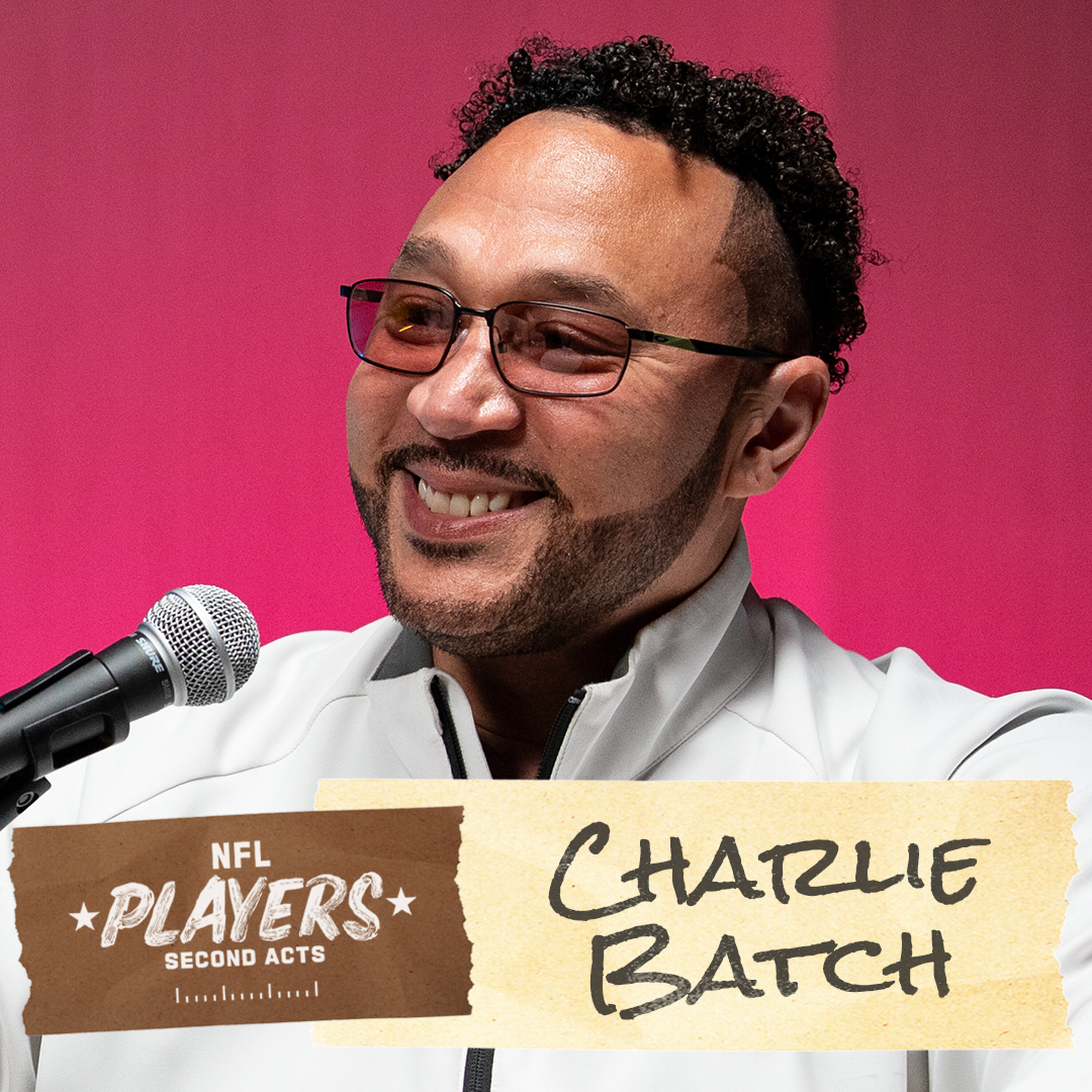
Super Bowl champion QB Charlie Batch | NFL Players: Second Acts Podcast
Mittwoch, 14. Oktober 2026 · 50 min
Kapitelklicken springt direkt hin
Shownotes
On the latest NFL Players: Second Acts podcast, Pittsburgh legend Charlie Batch joins Peanut and Roman for a heartfelt, hometown‑rooted conversation about his NFL journey, his role as the gold standard for backup quarterbacks, and the second act that’s made him one of the city’s most impactful leaders. Charlie reflects on growing up in Pittsburgh, playing at Eastern Michigan, and being part of the draft class with Peyton Manning and Ryan Leaf. He shares stories from Detroit and Pittsburgh: handing off to Barry Sanders, beating the Steelers on Thanksgiving, the infamous OT coin flip, winning a Super Bowl with his hometown team, and the sideline chaos during Jerome Bettis’ near‑disastrous fumble. The guys dig into the emotional moment Charlie heard he was on Robert Golden’s personal Mount Rushmore, the origins of his foundation after his sister’s death, and the thousands of kids it has served across Pittsburgh. Batch talks about his wife being his superpower, his legacy as a community leader, "Yinzer" culture, and the pride he takes in being known more for what he’s doing now than what he did in the NFL. A grounded, inspiring look at a hometown hero whose second act has become his true life’s work.
The NFL Players: Second Acts podcast is a production of the NFL in partnership with iHeart Media.
See omnystudio.com/listener for privacy information.
Transkriptvom Podcast bereitgestellt · Zeitmarken springen hin
What's up, everybody?
I'm Peanut Tillman, and this is the NFL Players Second Acts Podcast. And with me, as always, my trusty co-host, Roman Harper.
What's up, man? Really looking forward to our next guest. I used to, I mean, I don't know how many times I get to say this, but I played with him on a video game, so I'm excited.
Yeah. Okay, I'll get right into it.
He is a record-setting quarterback at Eastern Michigan. 15 years at quarterback. 15, 1-5, kid set. He is a two-time Super Bowl champ. He is a businessman, a public speaker, and now he's a media analyst. Ladies and gentlemen, please welcome to the pod, Charlie Byrne!
Yeah!
Ha, ha, ha, ha, ha!
Charles.
What's going on, fellas? What's going on, man? Not much, man. I'm glad to thank you for having me on the show.
I appreciate you coming out here on the pod representing we in your town, we in your city.
Yes, born and raised here. A lot of people don't realize that. Obviously, because I started my career in Detroit, they're thinking I'm from Detroit.
No doubt.
Literally, where we sit right now, I'm at mom's house in 15 minutes. So it was good and bad. Good part, I was home. The bad part was everybody wanted tickets. Hard to accommodate.
People do not understand the ticket hustle.
Logan literally said that the other day. He was like, it was a blessing and a curse. People think tickets are free.
Yeah.
Yeah, so I feel it.
That was tough, especially when I was in Detroit. We were in the Silverdome at the time, so you had 80,000 seats. There were a lot of seats available still up until game time. And then when you leave that to come here to Pittsburgh, where they only had 65,000 seats, it's a challenge to be able to do. And, of course, during that time, we were in three Super Bowls, so a very tough ticket. to get during that particular era.
But I wouldn't change it for the world.
Now, us being here right now in Pittsburgh, Pennsylvania, for the draft, the NFL draft, what is that like, your hometown hosting the draft this year?
It's exciting, and it's one of those things to where you don't see conferences this large here. And to be able to now put this on, you have to credit Dan Rooney, and he was leading the four. He was at the front of all of this as he was leading the charge to try to get this here to Pittsburgh, and credit to the Rooney family for helping to make that happen. It was a blessing, and when you see it and people get excited about it, and I had the opportunity to co-chair with Dan Rooney the Football Legacy Committee, right?
And we were shared, and our job was actually to now tell the stories about the players from Western Pennsylvania and share that rich history of the NFL. And it was tough because we had 750 players that were drafted from Western Pennsylvania. So how do you get the story and the best stories without truly focusing on your Hall of Famers, Because that's rightfully so. They do get the credit that they deserve. But there are so many other people that were doing some great things here. Tough challenge to do. But NFL Films, they were able to put together a film, 53 Minutes, called The Football Town, which was actually narrated by Pittsburgh's own Pat McAfee and had that story to be told and is actually playing at
the Cayman Science Center right now. So I know after we get through the draft, I know it will be streaming. So a lot of people outside of Pittsburgh can actually view that film.
You can tell this guy's a professional. You see how you get that plug in early, Peanut?
You see that?
That was great.
He's like, I don't know what we're going to talk about, but I'm going to get my plug in right now.
That is a professional right there. Man, that is good, Charlie.
I love that.
Oh, yeah, this next one's on me. So you go to Eastern Michigan. You set some records there. They ask you to switch positions. They want you to go play DB. You fight back, and you say no.
That's crazy.
Do you think college football prepared you– or, excuse me, do you think college football– the college football experience prepared you for the NFL?
It really did. And, obviously, you know, leaving Pittsburgh to go to Eastern Michigan, I just want the opportunity to continue to play at the collegiate level. But when I get there, there's coaching change. So the original coaching staff that recruited me, they were gone by the time I got to my second year. So here I was, new coaching staff, trying to figure out where I was going.
They were inserting the wishbones. Option offense. That's not me. And I get there, and the coaches are like, well, we're going to switch you to defensive back. I say, you ain't seen me run? I can't run. So this option is going to go nowhere, because I'm always going to give it to the running back. I will not carry the football. But it was a challenge. But lo and behold, they started kind of switching it up a little bit. I was trying to go out there, take every rep in practice. And then ultimately, when they started seeing me throw the football, they were just like, wow.
And lo and behold, when I thought I made it, coaching changed. I'm like, you have to be kidding me.
So you guys had another coaching change.
Had another coaching change. What year was this? This was 1995. No, I'm sorry.
What year were you in?
I was a sophomore. I was a sophomore year during this time. So I'm thinking to myself, okay, now maybe I have to transfer new coaches. They bring their own players in to fit their particular system. But lo and behold, that year they retained the receivers coach. So the receiver coach goes to the offensive coordinator, where the head coach at the time was Rick Rasnick. but the offensive coordinator and quarterback coach was Dan Henson. So as they're kind of getting ready and scouting, the receiver coach says, you might want to go check out this practice film, man.
This guy that had been playing, you might want to do that before you actually hit the road. They actually went back to review the film, and he said, no, we got our quarterback on the roster. And I credit that receiver coach, and I'll tell you in a minute. So as we go back and we're playing, everything started to evolve and getting to that particular piece. Now as we fast forward all of those years later, that receiver coach, Todd Munkin.
Oh, really?
The head coach for the Cleveland Browns at this particular point.
And I knew him when he was at Georgia. The OC really kind of jumped him off right there, too.
Absolutely, and that's how far we go back. So you're talking 1994, 1995 when I was introduced to Todd Munkin. I tell you, he was a young coach. He was very close in age to a lot of our players that were on the team, but everybody gravitated to him. But you saw early on that he had those leadership traits that can ultimately become a head coach, and we are so proud of him. I am proud of him.
And every time he comes to Pittsburgh, we're on the sideline. I say, man, we didn't came from Ypsilanti, Michigan, man. And we sitting here on the NFL sideline. Beautiful story.
Man, football is just a revolving door, small world, however you want to phrase it. It's like the connections that we build over time.
Oh, yeah, I was with him in 95.
Or I was with him back at this team. And now I'm on this other team.
He a coordinator and he's a head.
Like, I just love the circle in the football world, how.
Everyone knows everybody.
So tell me this. So you grew up in Pittsburgh. And you ended up at Eastern Michigan. Was Pitt like the team you wanted to play for growing up?
I did. And it was one of those things where literally I'm 10 minutes away from campus and I'm waiting for them to make an offer, right? And I'm like, this is it. But they were waiting on another quarterback on the other side of the state. And I'm just sitting there saying to myself, I don't want to be stuck with my hand in the cookie jar when it comes to signing date. And Eastern Michigan came down. They actually were recruiting a good friend of mine who was the receiver at the time by the name of Rick Walker.
And as he's running his routes– The recruiting coordinator comes over and says, who's recruiting this guy throwing the ball? And he said, hey, not many people are. He's one of those late qualifiers. You might be able to kind of get a steal for him. They brought me on campus in December of that year. How cold was it?
Well, I guess you're used to it because you're up here. I freak out when I hear about recruiting visits in December.
He's soft. Yeah, I am. I am soft. He's not lying. But leaving one cold environment to go to the other, right? I was used to that. So that didn't bother me when I went up there. Again, the connections were all there when I got on campus. They made an excellent offer when I was there. So they committed to me very early on. And lo and behold, when I'm trying to wait still what Pitt was going to do, and at that point I'm like, it's getting close to signing day.
I'm going to Eastern Michigan. And that's how I ultimately ended up there, which actually worked out because actually at the time they had Paul Hackett was the head coach. And at that particular point, there were rumblings that potentially if he had a bad year, then he may be gone. And then I would fall into that whole rotation of coaches.
But it all worked out. But the end goal for me was trying to hopefully play with this guy by the name of Curtis Martin. He just finished his freshman year. I'm thinking to myself, here I am having a chance to play with him. He only grew up 10 minutes from me. So I'm like, could happen, but it didn't.
But everything works out for a reason.
All right. So now you break records at Eastern Michigan. You're doing your thing. The NFL draft, your second-round pick, you went into class with Peyton, Ryan Leaf, then you, Charlie Batch, second-round pick. We kind of tend to forget about you were in that same draft class.
Yeah, it was one of those things where everybody knew who was going one and two. You didn't know what order it was going to happen, right? But who was going to be that third quarterback that was going to be taken? And at that time, I actually was competing against Brian Greasy, University of Michigan. They just came off the national championships. So, of course, as we're battling back and forth, I go to the combine. I had to truly use that as my job interview because we didn't have indoor facilities. So at Eastern, we were out in the cold. And then when we did need the indoor facility, we rented out the University of Michigan. facility. So we're only 10 minutes from them to actually practice.
How close proximity are y'all?
I didn't know y'all were that close.
Yeah, we're that close. So at that time, the combine was not the end of February, beginning of March. This was at the very beginning of February. So that was right around February 3rd. My first individual workout was February 9th. And I remember it because I had to get it in and out the way before you actually start getting to those bigger universities in March where those scouts, you know they were going to be there. So lo and behold, I'm trying to do my individual workout, and at the 11th hour, University of Michigan says, you can't work out here. Whoa.
I'm telling everybody else, because, again, I'm competing with their guy.
Their guy.
And I get it. I can't have an outsider come and use their facilities and outshine somebody else. I was 100% fine with the way that that went. So we actually had to scrub that particular workout, rent it out a golf bubble. So people were coming in trying to get the swings on it, and we had to clear it out for an hour. And they cleaned up the balls, and we actually had to just makeshift. Here's a cone.
I think that's about 10 yards. That's an out route. So we're kind of guesstimating of what those workouts would look like. But again, putting that together, and it was one of those things where we just had to improvised and we were able to make it work and it was really cool to be able to do and obviously being that third quarterback and Brian being so far we all are tied together because not only do you have Brian Greasy, Peyton Manning, Ryan Lee but our good friend Matt Hasselbeck was in that particular draft class as well so it was a pretty good class. That's awesome.
So what was your welcome to the NFL moment?
For me it was actually the first game I started and I started third game as a rookie and I received a phone call that week. I'm literally on Eastern Michigan's campus, which is only 40 minutes away from the Silverdome. So I'm en route back, and my phone rings. I'm like, why is Coach Ross, Bobby Ross, calling me right now?
And I'm saying, what's up, Coach? He said, Charlie, what's going on? I said, not much. I said, I'm getting ready to head back. He said, I need you to come in early tomorrow. We have some conversations. I said, well, Coach, what's going on? He said, actually, I'm preparing to start you this week. I'm like, yeah, OK, cool. And I hang up the phone. I'm like, whoo.
Whoo-wee.
And I called my mom. I'm like, Mom, I'm starting. And so now she's trying to scramble to see if you can get to Minnesota because we're actually going on the road. And we get to Minnesota. Of course, here I am at the line of scrimmage, one of the very first plays. And all I hear is some dude on the other side. Talk about Charles. John Randall. So I'm sitting there. He's intimidating my left guard. He's like, Chuck, you slide the protection this way. I'm like, slide the protection.
They were in the under front. You one-on-one, my guy. You got to take that. But all that to say, as we third play of the game, I remember we're handing the ball off to Barry Sanders. And, of course, all the attention was on him. So I go to hand the ball off to Barry Sanders. I'm supposed to boot away to hold the end. And I literally hand the ball off, and I'm like, man, I just handed the ball off to Barry Sanders. And the defense didn't come crashing down and makes the tackle. And I look over to the sideline, and the coach is like, you're supposed to boot. I said, but coach, I just handed the ball off to Barry. What are we talking about?
He said, but your guy made the tackle. And at that particular point, all details mattered because we don't know if I booted away, whether or not we would have held the end, Barry potentially could have broke the play. That was one of those moments that I'll never forget to make sure, do your job, carry out the fate. Mm-hmm.
You hear that, Lil' Rome? You hear that, Lil' Rome? It's always interesting to hear people's welcome to the NFL. I thought it was going to be some hit, something that happened.
You're like, no.
It's like, dude, I handed the ball off to Barry Sanders.
But you asked for the first, right? My second would be Thanksgiving 1998 and having the opportunity to play the Steelers on Thanksgiving. And that was one of those ones for me. As I walked into the stadium, I knew All of my family and friends were watching. We had 100 people that drove up from Pittsburgh to be part of this game. And lo and behold, I walk out of that tunnel for pre-game, and I see Coach Cower.
I see Jerome. I see Cordell. I'm like, this is crazy. Like, all these people that I watch, I'm getting ready to play against. And they're all coming up to me. Man, we know you from Pittsburgh, man. Great to see you.
Boom, boom, boom.
Good luck to you, but don't do too well. Yeah, yeah, yeah. We were able to win that game. And if you remember during the course of that game, this is history that happened during this game. So during overtime was the coin flip. So Jerome goes out, and it's been a long time, Bussy. We need you to admit this story.
But as he goes back, this is the last time that you were actually able to call the coin flip in the air. Yeah, because they– Heads, as they were coming down, it was tails.
Tails.
I remember.
Whatever that was.
Correct. Whatever it was, whatever Jerome said. Jerome claims he said tail. The referee said he heard heads. And as it went up, heads. Everybody else thought they heard tails on the way down. But he said he changed it. It didn't. Phil Luckett at the time was the referee. He awarded us the football. They're still complaining on the sideline about them not getting the ball. We end up getting the ball. Three plays. We're in field goal range.
We kick the field goal. Game's over. And they're still arguing about it. So that was my second moment. That literally got to the point where I was like, wow, I am officially in the NFL. And, of course, that's a game that a lot of people talk about, and that's one that we were all part of history but didn't know at the time. I remember that live, too.
I was just like, ah, he said it. Oh, they messed up.
This is going to be one of them plays that goes down. It's like, oh, where were you at when this happened?
Absolutely, and that was it because after that game, at the moment, now you have.
To say it.
You have to say it before.
Heads, tails. He said heads. He said heads. And then it all goes up in the air, so. Crazy to be part of history. So you were in Detroit for four seasons. They let you go.
You ended up going to a Super Bowl, Super Bowl 40, with the Steelers. What did it mean to you to win that game with the hometown team?
What did that mean to you personally? It was special for me because growing up and being part of Steelers Nation, but then now having the opportunity to come back. And I didn't know how long I was going to be in Pittsburgh when I got here. I thought 2002 was going to be my only season. And the reason I got here, because Coach Cowher would always say, man, I remember that Thanksgiving game. I remember that still haunts me to this day. But in 1998, as I'm preparing for the schedule of the interviews and you're walking in the hotel at the Combine, and I remember walking past the Pittsburgh Steelers suite. I'll go in, introduce myself. I'm just saying I'm big fans. They're like, Mr. Rooney at the time,
Ambassador Rooney. He walks up, Charlie, what's going on? As if he knew me all my life. So- I said, Mr. Rooney, Mr. Coach Cower, I said, listen, I know you all aren't looking for a quarterback at this particular point. I know you have Cordell Stewart here. I said, but if I ever get the opportunity to play for you, I don't care what capacity, I would love the opportunity to play for you. And lo and behold, in 2002, after Detroit released me, when I came here, that very first conversation when I had with Coach Cower at that point and Mr.
Rooney was right next to him, Coach Cower says, why do you want to come here? I said, Coach, you remember that conversation in 1998? Here's my opportunity. I would love the opportunity to play for you if you welcome me. That was when I got here. And lo and behold, three years later, we're going on that Super Bowl run.
And we didn't necessarily think that we were going to get there, right? We were 15-1 the year before. We stumbled a little bit. We lost the division. We got hot at the right time. But everybody knew it was Jerome's last game. And when he stood up and talked about in Detroit, we knew what the narrative was at the end. It would be one heck of a storyline.
But trying to get there was a challenge. And when we got hot in the playoffs and won that Super Bowl, and you could see Bussie saying, hey, man, last stop is here. You know, I'm done. It was a special moment because we knew how special it was for him to go out that way. But then to be part of it and when you have the Super Bowl parade and you have 250,000 people all downtown, it was a madhouse.
But it was a madhouse in a good way because we were all celebrating that moment. Because for 20 years, all we had to hear about was when were you going to win the Super Bowl? because we were still living in the shadows of the 1970s teams. And when that didn't happen, and 25 years later, we had that opportunity to horse that Lombardi trophy. It was special, and I knew at that point that I would always be entrenched in Steelers history, even being from here. So it was truly special that way, and our family truly enjoyed it.
Now, I got two quick ones for you, because I can't ask anybody else this question, because it's very unique to you. Number one, understanding, like, you saw. Did you see the Steelers win their early, like their last Super Bowl, like 20-something years before?
Their last Super Bowl, I was six.
Right, right. So being in the city, actually seeing what it's like, what it did for this city to actually bring that next championship home, how special was that for you?
I want to know that. For me, it was special because in a sense where everything all kind of, the way that everything kind of shapes out, right? I'm literally 15 minutes from where we are now. But that rich tradition that is all happening throughout Pittsburgh, it was special because you just didn't know kind of which direction people were going to go, how things were going to go.
And when you grow up in a steel mill town, you're just like, wow. And that was all Steelers Nation was. That's what we were embedded with, right? And to see the steel mills, and now you understand the rich history of my hometown and understanding that that literally was where the majority of the steel was actually produced. And we were considered a war zone that was a no-flyover zone.
You didn't understand that when you're young. You're just like, okay, I'm just here, happy to play for the Steelers, you know, to watch the Steelers. But when your family is all entrenched and they're watching it, it really was– I didn't even have an option other than to watch the Steelers. Why? Because the television deals aren't what they are. I either watch Pittsburgh or at 4 o'clock I watch Philadelphia and Randall Cunningham as he was getting ready to do his thing.
Not that early, though, but those are the only two teams I truly had to watch.
Yeah, and so then tell me this.
Where were you at?
Where were your emotions when the bus fumbled in the Super Bowl? Right there. How crazy was Roethlisberger making that play, that tackle? Like, I don't think at the time we understood the importance of just him just getting that shoestring tackle.
Correct. I think when you– you know, when we're watching that defensively, I mean, three straight plays they got after Peyton Manning. And that fourth down play, they're sacking him. Joey Porter's coming to the sideline. Defense is all amped up, ready to go. And we're handing the ball to Bussy. No question. We're on a one-yard line. Yeah, easy. Just in.
I don't care. We're going to hand it to him all four times. You know it's coming. Stop it. And when that play happened and we're all sitting there, everybody's celebrating, hand the ball off, and you saw the ball go up. Like, he fumbled. And sure enough, they caught that ball. And they started running, and I'm saying to myself, just retreat, Ben, because you had the slowest personnel group on the field at the time. Yeah, it's all goal line. It's all goal line. You are the fastest guy, and he just started retreating. And when you saw him just kind of running and weaving, and Ben is just trying to do it, and he literally perfect timing off of that particular play. Man, that was one of the plays that will go down
in history as far as Pittsburgh-wise because Ben does not make that tackle. They take the lead, right? They take the lead. They take the lead.
Oh, it was great. I just– I remember that, like, dude, you know, and the bus had to feel terrible at that time. Like, just– because he never really fumbled like that either.
He doesn't. And then when you look back, the next couple plays, as they're lining up, you got Reggie Wayne on one side, you got Marvin Harrison on his other. When they line up, you're like, they're throwing wherever Brian McFadden is. Why? Because he's the rookie. Yeah. And sure enough, two plays in a row, straight down. They either catch it or they're coping on the pass interference. But B-Mac, he stood up. And he was defending everything. neck for neck on everybody. And he made those plays. And sure enough, they're rolling out Vander Jack. And we're all sitting there.
Most accurate kicker in the NFL. He is. He ain't missing this. No way. And we're all sitting there. And all of a sudden, he kicks it. And just his reaction after he kicked it, we're all like, he missed it. He missed it. And we're celebrating. We all just run on the field. And as we're all celebrating during that time, we get to the locker room and everybody's excited. Coach Cowher's like, yes. And you could just hear him. almost a pin drop because Bussie never speaks like this. And he jumps up. He said, guys, thank you for having my back because this would have been the way that I went out and we got you. And you saw the defense rally around those guys. And man, it was a perfect moment as we get, I got ready to
now go from Indianapolis to head to Denver to prepare for that AFC championship game.
That's how you know you got a good team.
Yeah.
And y'all got my back.
I appreciate y'all.
And then they all kind of rally up.
I love that.
Here's what I would like to know. Um, You didn't set out to do this, but it kind of just happened. Leadership, longevity, reliability. You became the gold standard for backup quarterbacks in the league.
How did you do that?
It started my rookie year. And I say it started my rookie year because my backup at the time was Frank Wright. And the way that he prepared and understanding how him and Jim Kelly prepare game plans, they actually created the offense. They ran the offense in Buffalo. You could see him going back and forth the way that he was scripting plays, and he was always comparing and contrasting what the coaches were doing. But yet, he was now pulling me to the side and saying, here's little things that you need to do. That season evolved. And I said, man, obviously we all want to be starters.
But I said, if I ever get to a backup, that's the guy that I want to be. Because he showed me how to do it. And it helped me out of young career. And that showed me the importance of a veteran guy helping the young guy out. And at that particular point, when I shifted here to Pittsburgh, couldn't control how they were going to draft. 2004, they drafted Ben Roethlisberger. I had a choice to make. Either I'm out or I'm going to help this young guy out.
I'm going to help him out. I'm going to do everything in my power. that I saw somebody at a young age and a veteran guy like Frank Wright did to help me, and that's what I did. And, of course, building that trust with Ben, very similar. Mid-American guys, we know how tough it is to get to the National Football League. But I also said, and I felt like I was that pioneer because there weren't a lot of quarterbacks, especially black quarterbacks, coming out of the Mid-American Conference. So I had to go out there and show that I can perform to help the next generation of players that are coming out. As we fast-forwarded to 2004– That's how we were able to build the relationship because the things
that I was telling him was for him, but also betterment of the team. Because at that time, a lot of people were saying, putting in younger players' heads, hey, don't trust a veteran. They're not going to teach you everything they know. But yet it was almost too good to be true. And he was like, nah, it ain't happening.
But when he saw that, that's how we were able to build that relationship. So we took what we learned in the classroom onto the field. And as a young guy, he's trying to now evolve into the no huddle, into the hurry up offense. And during the course of the game, we would just have that nonverbal communication. And it got to the point where he would, no, keep the hot on.
That lets the defense coordinator know you saw the blitz. They ain't going to run it again. So little tips like that that I would just say, do that, boom, and it evolved. It got to the point where I looked at it as a badge of honor when other coaches would say, Charlie can't be on the field. So the referee would turn around as I would take two, three, four steps on the field. Charlie, get back, get back.
And the rest of the coaches are complaining over there. I'm like, it's only the first quarter. That means they must have went back and saw what I was doing. So the scouting was telling people what I was doing. So I alerted the referee to try to get me off the field. But it didn't stop me and Ben at that particular point. And just to see him go from year one to year two and ultimately winning that Super Bowl, it was a beautiful thing. And I love to see other people succeed. And that was a pure example of that. And that's why me and Ben are still close to this day.
Did you have a headset on?
Yeah, we had the little monitors. The little ones. You could only receive.
You couldn't actually speak.
Correct. You could only hear. And that's where I would go back. And literally, I was one of those guys to where I wanted to build a relationship with everybody on a team. So, yeah, it's just on the offensive side of the ball. But I was able to communicate with the defense. And people would say, how do you know?
It's because you hear the term so much in practice, but you don't know when it's called. So I'm like, man, everybody's talking about our great Dick LeBeau. I want to hear how he coaches, and I want to hear him doing it throughout the course of the game. So I would sit back offensively, listen to it. I would switch over on the defensive calls after we actually did our work preparing for the next series. I would shift and hear what the defense is doing. Sit back, hear different calls, tight-willed me to buster, you know, dime away we cover.
Right.
You know him.
After so many times you hear him, you know.
I would hear it. So, again, at that time, you know, you don't have a lot of players, especially defensive players, they weren't hearing the play call. So what I was doing to make sure that these other players who were now special teams guys were understanding the defense that we were running and why they were doing the things they were doing on defense. So while the coaches were all doing their thing, I had a group of players over here, and I was now relaying back what the play call was.
And I was just, listen, Chuck, what's the call? Here?
Here?
Go back to doing what I'm doing. Then all of a sudden I would sit back and you hear, you know, the diamond way we cover right was one. And then you hear something like zero. Once you hear that, you look eyes up ball coming out. Yeah. Here we come. Yeah. And people would, and that's where it got to the point where players were just like, wow, like you are on both sides of the ball, which was fine because at that time my role, yes, I'm helping Ben prepare, understanding my assignments, But also, when you're not playing, you're trying to do those little things extra to help your team.
And for me, I had to do that in practice. So, giving them the best look in practice, and they went out there and almost pitched a shutout, I did my job for the week. Yeah. Because I know I helped them and gave them the best look possible throughout the course of the week to hopefully make their job a little easier. We all win in that particular situation, and that's why I respect a lot of all the guys that I play with.
That's why he was the backup standard.
That– Is standard.
That's the standard.
That's the standard. The standard is the standard. I want to show you a video real quick. Thompson, bring it over. I want to show you this video, and I want you to react to it. We had Robert Golden on yesterday.
Yeah, he was a guy that really showed rookies. how to make an impact in their community. Seeing how he showed up to that facility in a suit and tie because he meant business, you know, on and off the field.
He really was an inspiration for me for sure.
Wow.
What's your reaction to that?
When you see I held many different roles throughout. And it didn't matter playing, player rep, executive committee, and just trying to feel and make players feel like they're part of the family. And they're from outside and making sure, hey, here's how you do the right things. And you never know who's watching. And it didn't matter if we were doing foundation events. He was supporting. We didn't necessarily play together, but he respected me enough to listen and be that voice. And, you know, for me, even doing little things like Thanksgiving, right?
Thanksgiving in Detroit, we always had 100 people that were there for Thanksgiving. We always hosted because I never wanted the family to be sitting there and tell me they didn't have a place to eat and they're eating pizza on Thanksgiving night. So we always open up our home, but we carried that tradition all the way through, and we still do this to this day. because my wife loves cooking. She cooks for all 100 people that were there.
Now we're only about 75 people. But Rob and his family was over, and we invited him to the house, opened our doors open for him and his family, and just talking about things in the community that he wanted to do. And he's saying, how can I continue to do this? And just continue to pour into him. And to see what he's doing now in Fresno, that's tremendous. remarkable.
It is truly remarkable. And I'm truly grateful that Rob thinks of me that way. And he is just like a little brother. We are part of family as we are sitting back. And actually, I think after this, he might be coming over to visit to take a tour of the building to say, Hey man, here's what we got going on. But I'm truly grateful that, you know, to be able to continue to pour into players all of these years later, even with many that I don't play with now.
I mean, that was powerful. I appreciate it. And clearly you are appreciated. And so all your work has not gone in vain. Could you maybe talk about– Hold on real quick.
So to give you a little bit of context, we asked him if you could put four people on Mount Rushmore, who would those four people be that have helped shape you, mold you into the man you are today?
Oh, wow.
Wow.
And he picked, I don't remember all the people he picked, but you were one of the four people that he picked.
Wow. Wow. He thinks highly of you. We're grateful. And, you know, I appreciate it. And, you know, we don't do this by ourselves. I include my wife in all of this because we put it all together. And, you know, when you hear that, you know, you never know who's kind of watching, who's listening, and the impact, the small impact that you may make on people. And don't forget that.
Those are things that I never forget because players who came through our locker room, right? And we didn't have a close team in Detroit. I was the young guy. Everybody was kind of scattered around. The revolving door always happened. This was one of the few places that I've ever been where it was not a revolving door. Your core, your veteran players were always there. They built through the draft, and those guys helped onboard these younger players. And when you have different roles... You're just trying to figure out how you can continue to do your part. But relationships matter to me. I build genuine, organic relationships. And I still talk to these players today because, yes, it was great to be a part of. We're all celebrating those accomplishments.
But let's talk about life. What do we have going on? At the end of it, we always talk about in Pittsburgh, football is the game. Our business is winning. And if you don't win, hey, man, popping doors. So we wore that with a badge of honor to make sure, yes, let's compete on the field, but ultimately– Being part of a family. And those are the things that we didn't take for granted, right? Because back then, we were able to report in the February, beginning of March. Off-season rules don't allow that to happen right now. You don't come in until the second week of April. But those six weeks were important because I got a chance to learn who you truly were. I get an opportunity to see how you operate. I get a chance to learn who
your family is. I understand what makes you tick. And those were part of team building. And that helped that particular generation of players that we had, and we still try to continue that on, even though the rules are a lot different as it relates to when you can and cannot report. It was just special because we truly feel in Pittsburgh, yes, it is a family, and we also want to make sure that we can continue to be a resource, and that's all that I try to do.
Well, clearly you did a great job. I want to talk about, and I want you to share, about starting your foundation, Best of Batch. In 1999.
Yes. So for me, it started when I was in college and almost 30 years to go to today and receiving a phone call from my mother. And she said I needed to come home. Now, I had no idea what I was coming home for. She's like, pack your bags. I'm packing a bag full of nothing. I'm like, Mom, tell me why I'm coming home. You know, back then you didn't have cell phones like you do today. You had these little beepers. and you had to wait until nights and weekends to call somebody. You know, y'all oldies are young. No, I remember that. I'm there.
I had a calling card my freshman year.
There you go.
So I didn't even have a cell phone.
So I'm like, Mom, I said, please tell me why I'm coming home. You know, I can't afford to get on the road and get on a saw how a turnpike to get to Pittsburgh. Please tell me why I'm coming home. And at that particular point, she said, Charlie, she said, your sister's been shot and killed. I'm like, what?
So I'm flying down the road. I get pulled over. I tell the police what happened. He said, Mr. Batch, you haven't seen me. Continue on with your journey. So I get to Pittsburgh. And when I finally get to the hometown, you know, I get to the spot where the road, where she was at. So I saw yellow tape. So I know this is surreal. And when I get there, I see blood. And I'm like, wow. And I get home.
All my boys are waiting on me. They're like, Charlie, let's go get them. We know who did this. And at that particular point, I said, if I, you know, if I'm going to make a decision, I may alter the rest of my life. I need to know what happened. And It was tough to get the information, but ultimately the information goes like this. My sister was walking down the street from a friend's house and she got caught in crossfire between rival gangs. And the guy that she was with used her as a body shield. And Daniel was only 17 years old and she never had an opportunity to live life. And at that particular moment, I said, if I was ever in position to give back, I would.
Being drafted in 1998, Starting the foundation January of 1999. And we did some one-off programs in Detroit, a couple here in Pittsburgh. But when I got here in 2002, I thought it would be my only season. So we redirected the foundation goals here. And for us, it was like, how can we now create a program that's going to tire some kids out and go to sleep? Let's create basketball league. And ultimately, we had 125 kids, 25 volunteers.
By year two, we had 350 kids and over 200 volunteers. So we knew we were on to something. And lo and behold, as we continued to grow and we needed this space. And it was tough because as we were kind of trying to scale the foundation, the challenge for me is it was a reminder every single day of what happened. Because to this day, the killer has never been found. But when you turn on the news, there's a house fire, stabbing, shooting every single day. And what we didn't want people to feel, we never wanted another family to feel the way that we did all of those years later. And it's still that continuous reminder every single year. So as we continue to ramp up programming, trying to create it, now here we are 27 years later,
and we now service over 4,000 kids annually in Southwestern PA. And it is truly, we are truly grateful for all the partners, support, sponsors, everybody who believes in the mission and vision, the best of the batch foundation. And we are truly grateful because we are over 22 different school districts throughout, and we love working with students. And those are things that ultimately we just hope that another family goes to doesn't feel the way that we did, but ultimately continue to work with people because we're all impacting kids.
So what, what type of programs have you done or like to raise money for your foundation? Like who all have you worked with?
Look, Mr.
Golden told us, he's like, bro, I've never seen a person that has the mayor, the owner, the people that you bring into these rooms and connect the way that you do. Nobody's better than you. That is what he said about you. And so that's maybe one of your superpowers is bringing people together, serving others. You clearly have found a niche at doing something great.
Yeah, I have an itch for bringing people together, right? When you talk about superpowers, my superpower is not my superpower. My wife is my superpower because early on she forced me to do things and get me out of my comfort level that I wasn't ready for. Example, Thursdays, as you know it, longest days in the NFL for players, right?
But afterward, my wife would always say, love to go to dinner, let's do X, Y, and Z. So I would go into work with a sweatsuit, and when I got out of practice, there was a suit in my locker. And everybody like, oh, here's Taj go again. What you got going on after practice? So I'm walking out in a suit. So now I'm getting clowned for walking out in a suit. But my wife said, no, it's important because there's an event going on that we need to go network and we need to go meet some people.
And she said, I'm only asking for two hours because that was my two hour dinner slot. So I couldn't be mad because I already promised the two hour dinner slot anyway. But Having her push me and building those relationships and allowing the things that we wanted to do to be talked about, it was just a vision. And as we continued to talk to certain people and just say, hey, how can we continue to do things? What are you doing well? What are you doing well? And collaborating. And people just was like, wow, how do you bring people together?
And when you have someone like Mr. Art Rooney showing up to your event, people are like, how did you get Mr. Rooney here? It's just one of those things that He's seen us outside of the building. We truly were able to have conversations with him, right? And when you have an owner like that allowing his son to come over to your house for a cookout, allowing him to be part of it because he trusted what we were doing, Art, Greta, and that person is Dan Rooney.
So when you look at little Dan, the one that ultimately will potentially take over the team, could be 20 years from now, but again, those are memories that he remembered. And I didn't realize that all the things that he remembered because we were just that Mel Blunt celebrity roast, and he roasted me during that time, but Dan was a roaster. And he talked about things that he remembered when he was in high school to where he is now and seeing the impact that we're still trying to continue to make and the support that he still gives us.
We're truly grateful for that. And as you continue to build and you're bringing the people together, we love working with the governor. We love working with the mayor. And those are things that it's like, what are you doing well? How can we collaborate? How can we continue to make an impact? And those are things that are special to us.
And literally, this week during the draft, literally, this is our 16th event that we had. And I've seen the governor eight times. And he's just looking at me like, man, I should have just compared and contrasted your calendar. I'm with you. So it was just, you know, it's just a beautiful thing. But again, it's just the work that people see us doing. And again, hopefully those people are speaking your names in rooms that you aren't in. And we've been a beneficiary of that because people are saying a lot of things about us that we aren't in those rooms, but yet we're able to benefit and collaborate from.
What do you think your legacy will be in the city of Pittsburgh?
For me, there's a lot of kids, especially now, that don't necessarily remember me as a player.
Mm-hmm.
But when they walk into our foundation now, which we went from 5,300 square feet to 33,000 square feet, and we are just celebrating three years of officially being open. And when people walk through that space, you're just amazed because they don't understand the depth of what's in it. And when you talk about a sound studio, you talk about Steam Lab, cafeteria, gymnasium, gamers, yeah, gaming and coding, all of these things that are in the room, podcasting.
these kids all remember that. And I think for me, the biggest thing that I want people to remember is not necessarily, you know, what we accomplished as a team. Those memories, you know, will fade at some particular point. I hope that people remember me more for what we've done after football than we did during it. And it's important because being from Pittsburgh, being a true yinzer and understanding what Pittsburgh, the Steelers mean to just the city of Pittsburgh, I just want to be one of them. And, To be able to be a part of it, I'm grateful and humbled because people have entrusted me with a lot of different things throughout. And I'm just grateful that people feel like they can trust me and be able
to do the things that I'm going to say. And the one thing I never wanted people to do was question my integrity. It's not going to happen. What I say is what I mean. And those are things that are special. And I don't care if it's a one-day relationship or a 20-year relationship. Those are things that people would say, like, If you're talking about Charlie, if they call me Chuck, they truly know me. And the things that we talk about doesn't have to be repeated. When it's repeated, it's only because you said it. Right, wrong, or indifferent.
Okay, I got a question. I know we got to go. But you have to break this down to me. I told you before this thing started, I still feel like I'm lost.
On the map. what is a yinzer?
Like, I've heard the yinzen, what's the other word? The yoy?
Yeah. Double yoy. Yeah, that.
What is all this?
Please teach me. I don't know. It's just a guy who, from Pittsburgh, you kind of create your own language with the slang and different things of those nature. And the beauty about Pittsburgh is, and this is the one thing that people always say, all Steelers fans travel everywhere. They do. Not necessarily true. And the reason being is the fact that when the steel mill shut down, everybody had to relocate.
So when they relocated, They all were in parts of the city. So when the Steelers get there and they're within four hours, five hours drive, they're going down to represent. So that's how you're starting to see it because it's expensive to travel to every single game. Right. That's unrealistic to have to have that happen. But that's the beauty of it. So when you get there, people always say, where are you from? Pittsburgh. And literally my boys are like, man, hold it, man. Everywhere, every city we go. People, they claim you because they were obviously Steelers fans. He's like, man, I never imagined that every city we pretty much go to, there's somebody from Pittsburgh. And then you talk about where
you're from and different connection points. And those are beautiful things. And I enjoy doing it. And this platform has allowed me to be able to do that and ultimately share some awesome stories as you're meeting fans across the country. Yeah.
Every time Pittsburgh plays in Carolina, it's almost just as many Steelers fans.
Absolutely. Absolutely.
Panthers fans there.
And it's always amazing when you see somebody for the first time experience that, right? You've seen players one thing, but the one thing for me even in 2007 was Mike Thomas' first road game. And we were playing the Arizona Cardinals. And we run out. As players, we knew what to expect. But when he walks out, young coach, he turns around. He took a moment to look this in.
He said, man, this is unbelievable. And I remember James Ferrier, everybody calls him Potsy at this point.
Potsy.
I know Potsy. He says, Potsy. Pa says, Coach, get used to it. It's like this every road game that we go. And everybody laughed, and we continued on with our business, but it was just one of those things that it is special to see it. And there's nothing more whenever the Steelers fans show up in the city and you turn on the news and they say, please don't sell your tickets to Steelers fans because they don't want the takeover to happen on the road. It happens more than you know. But you've got to give them a reason to take it over. But when it happens, by that third quarter, and those terrible towels are waving around the city– That's the most beautiful thing in the world.
It's cool.
It's cool.
You want the last one or let me get it?
No, you got it. Go ahead. All right.
So, again, we asked Robert this question. Four people on Mount Rushmore who've had influence on you in your life, that have helped you, shaped you, molded you into the man you are today, that loved on you, poured into you. Who do you think those four people would be?
Number one would be mom. So I'm going to exclude that because that's just kind of, a no-brainer for me. But I think it starts with Rick Razzick, my offensive coordinator, who believed in me at a time that I didn't necessarily feel back in 1995. The second one, there was a guy by the name of Bill Campbell. And Bill Campbell is a guy who was born and raised in Homestead, played football at Columbia, became a head coach at Columbia, and said, I don't want to do this anymore. Ended up going out to Silicon Valley in the early 80s.
Started some company called Intuit. Successful exit. sat on Apple's board for over 20 years, connected with him, and he truly showed me the way to connect, how you are able to bring people together to be able to connect.
And he's from your hometown?
From my hometown. And the way that he and Bill Campbell, there's Campbell Awards, all these names that you see all around the country, but he ended up passing away in 2016, and he passed away from cancer. And to go out to his funeral, we're out there on Stanford's campus, And they take the whole football field, and they put a whole cover over 100 yards. And 20-yard in was all VIPs.
And I literally look back, and my wife's sitting there, and she's like, who's this guy next to me? I said, his name's Tim Cook. Google him. You'll see how much he's worth. And to see what he did. But I say all of that to say he was a guy that ended up coaching a lot of people in Silicon Valley. He became known as the coach. And his claim to fame When Amazon, it was Microsoft. So when Microsoft was getting ready to fire this guy, this guy stood on the front. He stood up and said, you want to know if he fired this guy, you are wrong. He said, I will resign because you're firing the wrong guy. That guy just happened to be Jeff Bezos. And that was his claim to fame. He ended up becoming a coach for Silicon Valley for all startups. And when he passed away,
they actually wrote a book about him. And it's called The Trillion Dollar Coach. And at that particular, every body that he coached all has a trillion-dollar evaluation. So when people actually read the book, Best of the Batch Foundation gets two credits in there. And people ask me, how did you get involved with him? It was because he actually chaired our foundation for over 10 years. So he would be my number two on my Mount Rushmore. That's good, too.
Really good, too.
I think for me... Three, I'm going with my wife. She's on my Mount Rushmore because, again, challenging me and doing things outside the box here. You know, been together for 24 years. You know, I'm not going to say everything was great.
Can't be.
Especially at the time that I was transitioning. And I say that only because she said, you want to know what? You have three months to mourn the loss of something. And that something was football. And at that particular point, after three months, she said, get your ass off this couch and it's time to get moving. We talked. We battled and we only battled because because of her mental health background, I felt as if I was the patient.
Even though she was telling me what to do, I felt that I was being the patient. Now, I could tell the story now and laugh about it. But at the time that you're going through it again, you just don't know. But again, she didn't allow me to go through that separation anxiety long. Right. And then ultimately slip into that depression. And she was instrumental in making that happen.
to get me through. So I would put her ultimately on my Mount Rushmore only because we would not be at the levels that we are serving 4,000 kids annually without her being a part of it every step of the way. And then I think for me, I would probably say Art Rooney. I probably would. And not probably, I will. And the reason why I say that is because all the support that he has given us over the last 20 years has been truly remarkable. And there's things that he, I, that he'd done behind the scenes that not even worth mentioning at this particular point, but he helped us get to the levels that we are now.
And I will put him right up, right up there with anybody and to know what him and his family, not only means to the city of Pittsburgh, we are one of those families that are truly grateful. And we appreciate everything that he has done for the batch found for the batch foundation and the batch family.
Well, Charlie, man, you're off the hot seat, man. I appreciate it, man. Um, You know, I know you're a great quarterback on the video game for me, but you're an even better ambassador for the city of Pittsburgh, who you represent, the way you represent. Truly amazing. And you're going to continue to do great.
I appreciate that. You're going to continue to do great. I appreciate that. And obviously, you know, anytime you want to come over, check out the building, you can do that. And if there's any ways that we can collaborate or anybody out there that's listening that ways that we can collaborate, please let me know. We're not hard to find. Please go to BatchFoundation.org. You'll be able to see everything that we do throughout a calendar year if there's ways that we can collaborate. Let's do so. But also, if you are at your infancy stages of your foundation, trying to scale it to get to those levels. Because what you're seeing is 27 years later, we understand the challenges that you have at the beginning. And we try to help
smooth those hurdles out for that next player that's looking to ultimately do what we're trying to do. And a lot of that starts with relationships. And we're just trying to be that resource for folks. So if anybody wants, let us know, BatchFoundation.org.
Told you he's a professional. I told you he's a professional.
All right, you got anything?
Appreciate you.
I just, you know, you said it best. I'll piggyback what he said. No, I appreciate you just telling your story. And, yeah, thank you for coming on the pod, man. I was really looking forward to this. And you are the standard.
I appreciate you. Thank you. You are the standard.
No doubt, man. Hey, well, thank you for all our listeners and viewers. Wherever you pick up your podcast, you can definitely see us at Apple Podcasts, iHeartRadio app. Continue to check us out, man.
Like.
Share, subscribe, follow. Leave a comment or two and check us out on the NFL's YouTube channel. I'm Peanut. That's Rome. That's Charlie. And this is the NFL Players Second Acts Podcast.
We are out.
Be classy.
