

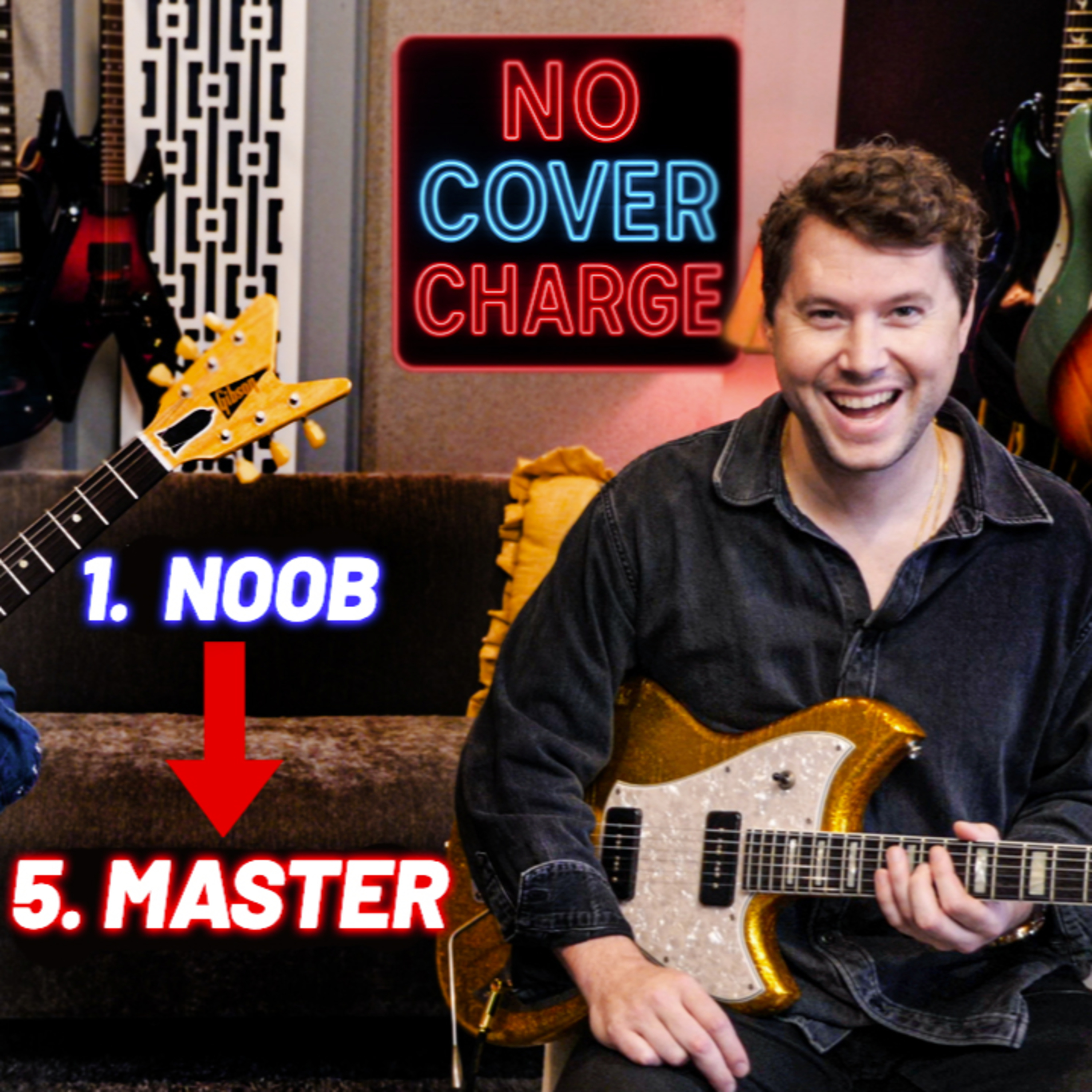
No Cover Charge Podcast· Staffel 1· Folge 15
Episode 15 - The 5 Phases of a Guitarist's Life
Montag, 8. Dezember 2025 · 52 min
Kapitelklicken springt direkt hin
Shownotes
In Episode 15 of The No Cover Charge Podcast, Tyler Larson and Jared James Nichols break down every phase of a guitarist’s life — from the first moment music grabs you to the highs, lows, gear spirals, plateaus, breakthroughs, and the reality of becoming a career musician. Expect hilarious stories, inspiring advice, honest struggles, and spontaneous riffing as Tyler and Jared reveal the universal stages all guitar players experience.
Whether you’re in the pre-guitar awakening phase, deep in the obsession phase, stuck in the plateau phase, overwhelmed by gear acquisition syndrome, or pushing through the practice and discipline phase, this episode will feel like therapy… with more overdrive.
Sit back, plug in, and enjoy a guitarist’s journey we all share.
Subscribe on Apple Podcasts (podcasts.apple.com/us/podcast/no-cover-charge-…)
The No Cover Charge Podcast on Spotify (open.spotify.com/show/1etwgleKExKzncMWSeSqe6?s…)
Instagram (instagram.com/nocoverchargepodcast)
TikTok (tiktok.com/@nocoverchargepod)
Facebook (facebook.com/profile.php?id=61579811813164)
TIMESTAMPS
– Opening Jam in D, the People's Key
– Introducing today’s topic: the phases of a guitarist’s life
– PRE-GUITAR AWAKENING PHASE
– Wanting to be a drummer first
– Getting talked into guitar instead
– Early sounds that “unlocked” the instrument
– Discovering open-string magic
– The Incubus/Mike Einziger influence
– OBSESSION PHASE begins
– Learning why players sound different
– Unlocking nuance and tone
– PLATEAU PHASE — when everything feels wrong
– Rut-busting tricks and new tunings
– Entering the GAS PHASE
– First pieces of gear that changed everything
– Gear expectations vs. reality
– PRACTICE & DISCIPLINE PHASE
– Berklee stories & formative experiences
– Leaving the comfort zone
– Jared’s Guitar Center “Horror Story”
– The phase of becoming a CAREER MUSICIAN
– Why we keep playing: the same feeling from day one
– Walrus Audio Melee joystick pedal demo
– Final jam & wrap-up
Buy a Walrus Audio Melee (sweetwater.sjv.io/melee)
The No Cover Charge Podcast with Tyler Larson & Jared James Nichols is your all-access backstage pass to the world of guitar—and there's never a cover at the proverbial door. Hosted by two of the most passionate guitarists you'll find, Tyler and Jared deliver a mix of electrifying interviews with legendary guitarists, laugh-out-loud tales from the road, deep dives into guitar culture, and no-holds-barred gear talk.
Whether you're a lifelong shredder or just love music, you'll find something unexpected in every episode—a hidden gem, a new perspective, an epic jam, or a story that'll stick with you. It’s always a good time, and best of all? No cover charge.
Plug in and hang out.
Transkriptvom Podcast bereitgestellt · Zeitmarken springen hin
Dee I feel like is the people's key, especially like songwriting wise. A lot of different sparks that come from different keys and different parts of the guitar that you find during different phases. 100% of your guitar playing life. Wait a minute. That brings us to today's podcast subject, the No Cover Charge podcast. Welcome here.
I think that we have some interesting through lines together, you and I. We may really do. We may have crossed over as a lot of guitar our players listening and watching will find there are differences and yet similarities that we all share on our path to whatever our musical endeavours yield for us. So whether that's a professional musician or a hobbyist or somewhere in between, we all come to these different phases of our guitar learning journeys.
And I made a YouTube video. I liked it. Years ago, but. What year was that? I think it had to be 2019. Made it for my 1,000,000 subscriber special YouTube and it was the only. It was like one of the only videos I ever got on a trending page on YouTube and it was totally off the cuff to definitely the most honest video I ever made.
Did that freak you out? Were you like this one? Yeah, you know what I mean. At the same time, I was like, oh, this one, this is the, this is so awesome that this is the one that got recognition because it was literally my life as a guitar player. From the moment you pick up a guitar and it's I sort of acted it out with some skits.
I think a lot of people resonated with different phases that they find themselves in. So we're going to dive into essentially that video, but you also add in your experiences and maybe invent some profiles of guitar players that we think may exist or we could have become. And I think it all starts with the phase of your pre guitar playing life when you hear music and maybe you hear the guitar as an instrument or just a force of nature and you get interested. Maybe it's the first time you pick up a guitar. But can you recall the moment when you were aware that maybe I'm going to try this guitar thing? Maybe you didn't pick one up right then and there, but you heard something.
What was it for you? For me personally, it actually started. I remember that at First off, like probably many that are listening or watching or whatever, I always loved music and I always loved like when I was a little kid jamming and riding around listening to the classic rock with my dad and my mom.
But the moment for me, I really thought, hey, I'm going to do something which I originally wanted to be a drummer. Oh. Because I thought drunk. OK, OK, nice. And it came from like Black Sabbath. The Who, John Bonham Zeppelin Because I would hear all these cool drum fills and I remember being in the car and like on the dashboard.
So the first thing you heard primally was the drum? The rhythm and it was like when I heard War Pigs, that thing was to me was like so sick. But going back, I remember I was in 8th grade, just about to go into high school, but we went to the high school talent show and there were kids in the talent show that were older and they were playing.
And I remember they played a Black Sabbath song. They played Paranoid and Listen. Were you having fun? Were you like I got to be up there? No. No, no, no, I remember watching and I was mesmerized because I was like at this point, like I hadn't even been to many shows yet or anything, but I remember being like whoa, like those dudes had like they had like long hair. The one guy had an SG and I was like, this is just cool. I remember.
And I was like, man, that would be really cool to play drums with this flash forward, my brother's friend had a drum set I brought. I conned it to get over to our house. And my dad, who was like a construction worker, he comes home day one and he looks at me and he goes, the only time he ever did this, he goes no drums.
He's like, I can't work from 4:00 AM, you know, come home and try and listen to you play drums. And I was like, oh, man. But he said, why don't you get a guitar? You can take it with you and it has a volume knob. He didn't play, but he knew. And I was like. Smart observation by your dad. You can take it with you. It's not so much stuff.
And I went, yeah, I guess I'll try that. Picked up a guitar and I was like this rocks. You do have a drum like quality to your guitar playing. I mean, that is a compliment. Well, thanks man. You know what I think it is though, for real is I love rhythm. I say that as like a guy who loves to play lead guitar well. You have to have good rhythm to play good lead. Isn't that the rule?
That is the rule. And it's like, man, the better your rhythm is. And also like, what's cool is if you just pick up a guitar and you can play 1 chord and maybe, you know, you watch someone in the crowd or whatever and they just go, Yep, they're in with you. So what was the chord that unlocked something for you?
It could be I'm trying to pinpoint something small, not even a riff yet or a lick, but what was like a sound that you could make out of the guitar? Where you it really in that early phase? Maybe you just picked up a guitar, but you're like, whoa, whoa, whoa. First it was just this. It was just that.
And I was going like trying to figure that out. But what really connected man is when I brought this this little guy to the mix and I just went like this and I went OK. And then I moved That was the connection and it was like, I can make music and I'm only using that one finger. That's where it all started for me.
Dude, open strings are what did it for me because I knew you were supposed to play a power chord with just two strings. Yes. I was like, look, I can keep, I can lock my fingers in place, baby. You're like, this ain't going nowhere. But then when I accidentally did this, I was like, whoa, what is that noise? It sounded way different than I was. Like that sounds like an orchestra or something. I remember I had a guitar lesson and I was trying to play AD chord and I went.
Oh nice. Oh yeah, the big old open D. And that guy goes, that's actually, I think he said that's actually DSS two, you're not supposed to know that yet. And I was like, what? But I remember hearing that sound and then going like this with my fingers going and you're like, what is this sorcery? Well, that look you just did, that's the look of, oh, I can move stuff.
And then I'm like, whoa, I am Adam Jones from Tool now and. Dude, best feeling. Ever, And this is before I even learn smoke on the water and stuff, because I could just put my fingers in places and move them around in the open chords. I realized how they were additive to the guitar way before anything. And you know, what's funny is all these years later, like I'm sure you would have the same kind of thought as that's still so cool.
It's like, take that, Asus. OK hold up though. Big shout out to Mike because what a riff Lord. He's my favorite dude. Master, I remember my brother was into incubus and he wanted to do yeah, I got pardon me then. Oh man. And I was like, bro, what? How did he do All right, public call out, dude.
Well, I want Mike on the on the pod. Mike Einzinger, please come on this show. I will do anything to pick your brain about licks, riffs and all the beyond. Yeah. So that brings us to the next phase, which we sort of teased with that whole Incubus conversation, which is the obsession. So this is after you've picked up the guitar, you've, you've had your first experience with it, you've experienced the power, you understand what it can offer you as just say, you know, an output device for whatever you're feeling inside, what have you.
It gives you a certain adrenaline rush. And now you're on to what music makes you excited. And these are becoming your influences. The difference that you start to see between yourself and your friends when you are researching guitar pickups at 2:00 in the morning instead of, like, playing Fortnite or whatever.
Yeah, yeah, yeah, yeah. And this is really, I think, the most beautiful stage of guitar playing because not only are you obsessed with it and it feels so good and you think about it when you're waking up, but you also are getting better at greater jumps than I think you ever do in your guitar journey.
Because you're so obsessed and you're spending so much time out of nowhere that you're seeing all these leaps and bounds in your skills. And it's unlocking new and new things every day. Like now with us, it takes weeks or months or years to unlock new things. And this is just like, here's this piece of gold, here's this sterling silver, here's this diamond you know well.
Dude, it's like it goes back to the same thing where it's like everything's so new. You're a sponge and you're so for me. And I know you felt the same way. You're so excited. You're like, you found this new universe. What is this wizardry that I can just unlock? And every single day it seemed like you were getting closer to unlocking. And right back with you, you're finding all these things out about your favorite players where you're going. OK, for me, it started with like, you know, when I got into like the old school Blues rock, but then it was like pure Blues and I was hearing all these guys play and I'm going, wow, so this is B.B.
King, this is for. And like figuring out how they are all so unique. It was your own thing and no one else was there with you. You know what I'm trying to say? Absolutely. And this is the stage also where you started to not only pay attention to music in general and practicing and being consistent, but also nuances of why guitar players sounded a certain way and why you couldn't sound like them when you tried to play in unlocking those things. And I remember in particular, there was this one riff, and I don't even know if it was exactly, but it was my interpretation and it sounded about right. And it was the concept of ringing strings together, OK, in a otherwise kind of normal pentatonic context. So we have this first position,
and I just remember listening to solos with that critical ear, even though, you know, I would end up at a music school. It was a very analytical approach to it. Yeah, dude. And I don't, I don't know it'd be at the same thing. I did. And also like going along with what you were just saying. It's like I started to differentiate where people were playing certain things on the net, on the neck. Oh really?
And it was like Stevie played in Albert King Rev right? went, I remember even at that time, I was like, it doesn't sound the same. So I started getting my guitar and I was going, oh, wait, if you play the same lick in different areas, I started to learn that. And then I was listening to Billy Gibbons say it was like a.
It was I was learning how like we were talking about earlier, where you play certain things on the neck. It was almost like the guitar was like opening itself up to. Me. Was there a lick that you remember nailing? First big one was when I was doing it's very simple, but Eric Clapton on a crossroads, right?
So doesn't sound like much really now, or even maybe to your ear, but it was getting that attitude. along with the record and it was like, that was when I was like, boom. Man, there was a Joe Satriani one that was a Hendrix And I was like, oh, there's actually two different ways I can screw it up.
And just learning that one technique made my guitar playing so much better. Just the basics of it because of that nuance that I was adding to my muscle memory. Simply by how you're striking the strings or your vibrato or where you're playing within the tone sets it all apart. It's like you listen to all these guys like you did that bend, or it's like you'll hear Eric Johnson play something or you know all these players the way that they play.
I remember hearing Eric Johnson do one of those that you did like A and I went, what was that? But it was that simple. And I went at first I was like, was that right? And I was like Oh no doubt he hit the major 3rd the way that almost activated that note before the beat and due to the overtones and maybe the neck pickup of how he's playing it, the delivery, it's like it blooms out from underneath those first couple notes and it's like, what are you doing? Whoa.
You know, it's a statement, a conversational piece. Yeah, dude. And I think genre, regardless of genre, whether you're, you know, heavy, heavy, Blues, country, jazz, whatever, that's the thing that us guitar players we pick up on and we go, you know it. It keeps you going down that rabbit hole. And as you continue down the rabbit hole, you reach, you reach an end, you might reach a dead end. And that's horrifying because then you got to turn around. It's like really tight.
No, back it up. I call this phase the plateau phase. Oh, buddy. It should be mentioned that all these phases are interchangeable. This is we're not necessarily going in chronological order at this point. So the plateau phase, it can happen around now because it's all been smooth sailing, baby. We've been, we've been rocking and rolling, picking up new skills.
Yeah, yeah. Just when you least expect it, you sit down and your guitar, you know, it starts off like you're like, what the what the hell? What happened? And this is a weird phenomenon and I'm over embellishing or exaggerating the feeling. But sometimes you pick up the guitar and it's just not quite sounding right. And maybe this doesn't happen for the masters of masters like you, man, like you, you play every day. But going up in life, you reach these points, whether it's a feeling of I can't really come up with anything new or it's like a physical, I'm just not feeling playing right now. I want to do something else.
There are so many different things that can prevent us from getting better that are on like the mental side of of picking up the guitar and getting inspiration. So what are some plateaus that you found along your? Guitar, my goodness, you have to First off understand that you are having this moment of like, you know, essentially guitar writer's block where you're like, nothing's coming out, right? It is just a phase.
I believe that plateaus are it's, it's just the right way to say it's a bad mental condition for us guitar players because you get in your own mind about like I remember having it, one of the first ones was I had this plateau about guitar tone and I remember going, I could hit anything, bro, I could hit.
And in my mind I would say like. It just sounds weak. Yeah, this sounds weaker or man, why do I sound like this? And it wasn't even about what I was playing. It was anything that I played I instantly hated and it was like I would play a lead and I just in my head I was just like I'm horrible, I suck. And it was this weird thing because I felt like I was starting to for forget about the excitement of what I was doing. And I was kind of almost like trying to overstep my bounds. One of the things I think when you're playing guitar, you have to be realistic.
You, like you said, there's so many levels of growth that once you start to hit these plateaus where you're like, man, you know, I don't know where to take it from here. That's when you have to push even harder. And the one thing I'll say that helped me break out of plateaus even to this day, you know, never going to go away.
Yeah, this is, this is a constant phase. Yeah, this is what we find ourselves in. Just remember, you'll always have these feelings, right when you have a guitar and you pick it up and you start rehashing licks. You start playing. You're doing your Blues thing, you're doing your rock thing, your shred thing. What's happening there is it's awesome. You're kind of reciting the vocabulary you already know, which don't get me wrong, that feels real good. But if you do that, then let's say you put your guitar down or you say, all right, cool, that's that. You ho on your phone or whatever, you get a distraction. Did you really practice?
Did you really do anything that is going to promote any sort of growth in your playing? And one of the big things I like to do still to this day is when I pick up a guitar, I'm not going to sit there and go, all right, let me, you know, let. Me break it back down. Let me break it down, baby. What I'll do is I'll sit there and I'll go.
How do I, you know, let's say it's like a thing where I'm like, what if I want to play this? How do I do that all over the neck? You know what I mean? Oh, wait a minute. Hold up. Wow, just right now I went, I've never played that. in real time. You're watching me work it out because I'm going, what am I doing? But what I'm saying is the biggest thing that helps me get out of ruts is get out of your own way, get out of your head and start to just look at the guitar from a different angle, just like you literally saw or heard me do right there. I went, how do I play that riff right there? Because I've never done it.
And now I guarantee you if I put on a backing tracker, I'm jammed with a band or whatever in my head, I'm going to go, wait a minute. You start to, you know what I mean? And just something as simple as that can just take you out of this monotony of I put the same licks all the time, I put the same riffs all the time.
It's really, really refreshing to just kind of get out of your own way sometimes. Another thing that busts. Ruts you need some rut Buster's. We get you coming over the rut buster's bust that run a great buck. We should do that Rut Buster's. Right, but it's our new guitar coffee table book. Yeah, if you want to bust a rut.
All I ever learned is changing your tuning is a rut busting method that I find quite dude quite effective. Yeah, you can. You can just change one string. I'll change 2. I'll do D. God I love that sound. Drop D and let's pick another string. I'll take that high E and I'll put it to AD. You ever do that?
Let's try it. Dude, we're rolling with 3DS my guy 3. DS. You are 3DS? And isn't that the default thing to go with the root? So let's see. The next thing I like to do when I change my tuning after you go with the obligatory where's the home cord is find chord shape. Oh, you're sick. Yeah, I like.
It so let's see if we can find a chord shape in this tuning. Recent point, literally I'm having a good time. I'm watching you, my lips are watering because I'm going Oh my gosh, those chords like you, when you start to alter tunings, you start to hear maybe certain sounds or certain vibes, but in a completely different way, right?
Like what you just did there this like ethereal gorgeous chord interplay. It's like that'll that'll bust your rut, dude. Yeah, because it gets you out of your tendencies, and that's what a new tuning will do for you. Sometimes that can be fabricated, I should say, with a new piece of gear. You think you need a new guitar, a new pedal, a new amp to be inspired doesn't always work if you're not literally putting in the time on the instrument to come up with new ideas, right? The gear can sometimes do that.
Like I have a pedal on here for example that just the moment you turn it on. What is that thing called Zelda. Zelda. OK but also yeah that puts you in a vibe bro. Well, it's literally a vibe. That's a vibe, dude. I think though, not to go off tangent like I'm going to, but new pieces of gear are some of the the coolest, most inspiring moments when you first plug it in and you go, what? Especially a pedal or like you don't get lusting over that guitar, that guitar and you're like, what does it do? What's it going to sound like?
And you hit your old familiar lick, and you go. It is, but it's different. We're getting pretty good at podcasting together because the next phase is the gas phase. Oh, here we. Go. This is gear acquisition syndrome, GAS. We all go through one form of it or another, some to great excess, some to debilitating excess where you're not actually buying anything, but you're suffering under these many, many options. You're literally just that's the the most lonely version. You're suffocating under gain act. And like reverb and like, you know, and you're just like someday.
If you have a bookmarks folder that is, you know, sorted by different modulation and ambience and distortion pedals, then you may have a problem and you may be in the right place. Rob Buster's hotline, dude. What was your first piece of gear? That and we'll bypass some of the nostalgic stuff, like obviously we all had Line 6, we had our starter guitars. I think of Crate, I think of PVI, think of line 6, I think of Washburn.
I think of that Squire Epiphone. But what really set it off for me First off, because I was such a nut, was getting the shape of a strap, having that shape and going, well, this is like what the guys use, right? So that was like the first bit. I remember I had a Crate amp with a Washburn guitar, but but I was like man. And I remember getting the TS 9 and I put that in there and I had it on the like distortion channel already. And then I put the TS-9 on and I went, good God, the gain is blooming.
It was as if like the seas opened up. After that it started to go in a different way. It was like, okay, well, all my heroes used tube amps. So I got a Fender Blues Junior, yes. And then it was like, now I'm a tube guy. So what you're describing here is the underlying element of gear acquisition syndrome that is healthy in my opinion, which is the passion for those who used it before you sounding like them. You're not seeking out this gear just to be like I had. Well, I have a $400.00 distortion pedal. So check this.
Check this out. It's because, well, this person used a green OverDrive pedal, so I'm going to get inspired by that. So that's what leads you down that path. It just happens to cost money. So you do anything you can to earn that cash. And that could be playing gigs or what have you. I remember my first piece of gear, just in general, that really changed my guitar playing.
Tell me. I'm going to tell you right now. You want to know what? You want to know? I'm going. To show you. Something Oh no, I see where your foot's going. Oh God, bro, there's something really special when you click a wall pedal on for the first time, right? And you go, I'm here, but also I'm down there and it's just like, there's this gorgeous thing. And I remember that feeling because when I just got a little tear in my eye watching do that because I'm like, I'm like, dude, that's so great.
The wah sound, just even being able to go. Absolutely. My dad thought I could play Voodoo Child when I was like, I need a wah pedal. I just need it. And he's and I'm more in the guitar store and he's like, why do you need this? It was like $80, probably Crybaby. And I'm like look, I can already check it out.
Dad, I'm doing it. It's the hair on the back of his neck stood up, I'm sure of it. And he's like, yeah, yeah, you actually should try that. And then way later I learned, I learned that way later, so timeless. It was just a new moment for me, a new Sonic landscape. Just like when we were talking about the A chord that we discovered. It was a new sound for me, just happened to be something that you got to buy.
But this is a hobby. This is a trade. You got to buy tools to operate in this world. So I approached gear always from how can I use it not I need this because it'll make me sound better or something. Well, now we're like, we're like the like little purity over here if you talk about the dark side. I'm I'm definitely not being a revisionist historian and telling it and telling that I'm definitely a St. when it comes to gear.
I don't buy anything I don't need. Bro but think about the other side. When you start like I've done it a million times where all of a sudden you're like, oh, Octavia, it's only 888 dollars. Yeah. And you're like. Must be good. Yeah, and you're like, dude, this is exactly what I need. Because once I have this, I'm going to sound like this. I remember the first time I got a Marshall, I I worked my butt off and I got a J TM45 and it was all messed up and it wasn't an old one or anything, but I remember going I looked at it and I went, now I'm going to sound like Hendrix or AC. This is like the amp, you know, in my mind. And I remember I was in my bedroom and I plugged it in and it was pretty loud already.
And it early I went and it was like that kind of tone and I was like, that doesn't sound like what the. Heck. And then I was like, how is this going to work? And then someone goes, dude, you've got to turn it all the way up to get the sound. And I'm like 16 and I'm like, I go in front of it and it's like Back to the Future. I went.
I literally flew through the wall bro. There's like a body shape in the wall. Little Jared dude in the wall with no ears anymore because I remember and I, I, I remember I distinctly no one was home and I went in there and I turned it up and I faced it towards like the wall and I went and I was. Like Dang.
But it's almost, almost like a gunshot going off. It was so loud. So I realized right then and there with a lot of gear, you have to beware of what in your mind you think you're getting out of it compared to what really happens, because it's like, dude, anyone that people hit me up, they'll go Jared. Dude, I just bought this killer 100 Watt plexi and I'm like sick.
Where are you going to play it? Like if you if you don't plan on like having like a power aux box, whatever it. Didn't exist in most of the time we're talking about it. We couldn't go to our parents, be like, hey, so I need the aux box. It's like 2 grand. It's an attenuator and I'm 16, I'm 16. Going through disappointment and frustration that's caused by your own doing, I think because a really important growth, you know, opportunity as a person, yes, it is.
So you, you, you got to invent problems and get out of them and find ways to be stronger. But gear can sometimes do that for you. It's rewarding, and it can The gear giveth, the gear taketh away. Would that be a good shirt right there? Ultimately, we have it coming down to practice and I feel like this next phase is what leads people into careers, which is the phase of this is my livelihood, this is what I want to do. I'm going to practice multiple hours a day. Well, what's funny is like I really got into guitar when I was like 15.
For me, by the time I was 16, I was obsessed and I didn't even think of it, what I was doing. But all of a sudden I remember it was the year in between freshman year and sophomore year, the summer. I was playing guitar at that time 567 hours a day, and it wasn't like I was tracking it all of a sudden. It was just like, I remember like my mom coming in and being like, hey, you should like go outside. And I'm like, what?
Why? And I'm in there. I am outside in my brain, yeah. And I'm like, I'm at live at Pompeii with Pink Floyd. What are you talking about? So that's when it started. And then I realized that this like the obsession was real. And boy, it just kept going up. Then I had a guitar. I remember wake up early before school and I get all my scales out of the way right and then and my chords and like, you know, whatever I was trying to work on so I could get my kind of my theory out of the way.
And then I'd bring the guitar to school during study hall and our home, we had like home, home class. It was like third period. We had like 30 minutes to chill or work on homework. Dude, I'd be in the back. They're going, I mean, just jamming in the back. Teachers were cool with it. Teachers were cool with it because I think they saw, they were like, they're like, this guy is really into guitar. And then it got to the point where, like, I remember my Spanish teacher, she was like, Oh, well, if you're going to bring your guitar, you've got to play us a song. Oh, Spanish teacher was down.
Yeah. So all of a sudden I'm in there and I'm going like, you know, And it just snowballed like that. And before I know it, I would. I was playing guitar like all day. Every day. My mom goes, hey, there's a school called Berkeley. You could go to a summer camp there. This was in between junior and senior year. Right.
And it was a five day program and I was like, I would love to. So I go there and the last day I was there, they said, hey, you should try out for one of our scholarships, like a partial scholarship to go to Berkeley. And I'm like, yeah, OK. But I went in there and they were like, just play us something. And I remember I played.
Yeah, yeah. But I was doing all my jazz each other. I could come. I could come to this esteemed establishment. I could be here, pick me no. And then I got a note in the mail and they're like, hey, Congrats. Like you get like $10,000 off per semester. And $1,000,000. Tuition off your $800,000, Yeah.
Yeah, it's good deal. I was like, shoot. And then my parents were like, well, did you like it? I was like, I loved it. So that kind of set me up that I was like, man, I'm going to go try this school. And although the school didn't work out for me at the time because I was a pump kid who wanted to play rock.
Preferred to be on the stage than in the practice room. Yeah, well, after about six months at Berkeley and, and the insane amount of talent there as far as like, you know, not just guitars, but like there be these dudes playing trumpet and stuff and I'm like, where am I and what's going on? Right. I was like, I just want to rock.
I want to RIP it like Stevie. So I got I got out of there. But with that being said, that's like that gave me though all of the, what's the right way to say it like that work ethic. Yeah. Because even after that, it wasn't like I was stopped. I was like, oh, I'm, I'm not learning guitar. It was after that I had all my Berkeley stuff. I was like I'm still working on all. This, well, that's what a place like that is for, is to you. You get out what you put in.
So I learned how to practice at Berkeley too, and it's just really a mindset and framing your time as this is valuable time. I don't get this back. Even understanding that at a younger age, which is lost on all of us, Yes. And so just natural phase of life. It's really sick to be young. I promise we're still in there. But the point is framing your time in a way where this time is valuable.
And if I spend it smartly, I'll actually give myself more time to do whatever I want and I'll feel good as opposed to like mindlessly being like, I got to practice for two hours today because I got my proficiency exam coming up, you know, And the cramming element I never equated definitely in high school, like with regular academics, physics, environmental science, you know, I was a cram.
There was some cramming going on. It did not yield great results for me. But musically, you can't cram. I learned that first. And I was just like, well, if I ever want to be successful also, and I don't want to be embarrassed, there's an element of musicianship where OK, you're you're here and you can't do the thing, you know, that's the worst nightmare.
So there's an element of accountability that you develop in a place like that. And I think a lot of people don't really get to that phase. Maybe they do in a certain discipline and soon one way or another. But I think it's really valuable just not only for learning guitar, but just structuring your life with some sort of.
Dude, 100% sort of way you you nailed it right there. And it's, and it's like one of those things where it's like there's no judgment. But I remember when I grew up, where I grew up in East Troy, WI, I was going to all the Blues jams and doing all that stuff and I thought I was Stevie Junior dude, like at the time. Stevie Ray J.
Stevie Ray Ji call my SRJ. Stevie Ray, JJ. NSRJJN because at that point it was the classic, dude, I was a medium sized fish in the smallest pond ever. Great. And I say medium, SH medium. But I remember like when I went to Berkeley for the first time and all of a sudden I was around all these other players and stuff and I went, whoa, OK, cool.
I got out of the comforts of my little world and now I'm actually out here and it's like I'm kind of like in open waters. And I think that anyone listening or watching, challenge yourself, even if you don't, if you say, man, I'm good. I just like to play the guitar and stuff. Put yourself in situations where you are either like sink or swim, like go in front of people and play or go jam with people that you've never met. And it's like, what are we playing? And they're like, ain't no sunshine. And you're like, like being in those situations. I feel like I've learned more in a 10 minute jam session about like, OK, I have to get my shit together dude. Or it's like, like you said, like falling flat on your face where you're like wow, OK,
that's sucked. Like I'm embarrassed. That's that's reminds me of a quote. Embarrassment is the price of entry. It's you put yourself up against the for very a wall and you learn a lot bro. For better or for worse, it is so valuable. I remember all right, so. Give me a Horror Story. I know you're boiling one up.
Like an SRJJN Horror Story. I drew one. No, check this out. I remember after the Berkeley thing, I joined a band. I ended up moving to LA when I was 21. I worked a landscaping job to pay for the move and I moved smack dab into Hollywood. And I remember when I moved there I was like, man, this is crazy. Like this is a crazy place, but I'll among the million stories I could tell you, the one I'm going to tell you that really set me straight was I joined the King of the Blues contest at the Guitar Center in Hollywood.
So the King of the Blues, if you don't know, it was like a Guitar Center promotion with like, Marshall, I think Gibson, Vander Good, you know, Oh. Yeah, I think I went to the Boston one. There was a drum one as well. Wasn't it? Oh yeah, a drum. Off drum, off the Guitar Center, drum off. One of my friends won that one in Boston.
That's killer. But the king of the Blues, I remember seeing it in like Guitar World magazine or something like that, and there was promotions. So dude, I, I entered and I remember at this time I had just met like some people I was like, hoping to work with, you know, maybe join a band. And I thought it was cool.
I was like, yeah, man, I'm doing this thing in Hollywood. They're like, oh, what are you doing? I'm like, oh, it's a Guitar Center, king of the Blues. I signed up and they're like, oh, cool, we'll come watch you. And I remember producer came to watch me, Jack Douglas and Jack Douglas, who is now, we've become friends and it's great.
He did. John Lennon, he used to work at the record plant in New York. He did, he was there. He did all Aerosmith cheap trick, you know. But at this point he was just in LA doing a record. And I remember he came and watched me. Well, the first round, I did the first round and I won. So was it like a jam over a backing track?
Jam over a backing track and I remember my backing track. I was like Alba, you know, like I really, really just basic backing tracks. So the first round I won and then I had to go for a next round. That's when Jack and some of these other people came to see me play, right. And I remember there was a guy there. So at this point I was 20 years old and there was a guy there I had to you have to play over the same track. And I thought I did pretty good, Like I felt good after it. But there was a guy there that went last and I remember dude he like.
He put on like, let me turn on all these overdrives. I remember he went like this. He was like woo. Freaking out right now in case you're listening, yeah. Oh, yeah, oh, yeah. Breaking things. But he, like, went to the crowd, like, come on, let's go. Look what I did. That one unplugged. Did it unplugged. Oh, my bad.
But everyone was like freaking out and they're like, yeah, this is awesome. And I'm sitting there and I'm going and the judges were all like, wow, man, look at this guy how he did the crowd. He's flinging his guitar around. That must count for something. Yeah, he's like making people clap along and stuff. And I got runner up and he won.
And I remember I looked at that, the dude Jet Jack, and the guys in the band that were there, you know, that I was hoping to play with. And afterwards that dude Jack's like, hey, man, it was good. He's like, you know, takes more than just guitar licks, though, to win over a crowd. Just got to remember that. You got to remember that He's like, just got to keep working on it, man.
And I remember. What a shithead. Yeah. And dude, I remember the feeling I had of like, literally someone just sliced my throat with a fucking sword, you know what I mean? And I felt so because I was like, I was so hopeful that it was going to work out and I was going to get to the next round. But also it was like that public embarrassment.
I remember I went home and I went to my apartment back in Hollywood, dude. And like, literally I walked on the block and I was like crying about it because I'm so mad and I'm telling you this story. I've never told anyone this story, but I was so mad that I remember that day. I was like, after an hour or two, I was like, well, I just got to work really fucking hard. Like I got to, I have, you know, and I took it and I made that into a really positive thing.
Never want to feel that feeling. I don't want to feel this again because it literally shattered me and I was like, it was almost to the point where, dude, if I like I had my guitar, I would have thrown it in the trash can. I was so mad. But then it's like, that's like, not a healthy way. So obviously, thankfully I took that and I spun it.
But dude, Horror Story and I remember just that feeling and it made me say to myself like, OK, listen, music is art and it's not about a competition. And that's really, really true. None of it's competitive, but there's certain things that you know, for you to be all you can be as a player, it's like, you can, you know what I'm trying to say?
It's like, I'm just going to be the best version of me. I. Can there are ways to unlock potential that feel like friction and feel like maybe you shouldn't be doing them, but you have to be willing to explore things like that and feel those moments of low because then you won't realize, you know, what success feels like if you don't feel like what it feels like to be in the gutter like that.
And just from an outsider's perspective, you say you never told anyone that. To me, it seems like a sports movie. It's sort of like, OK, well, this is my rock bottom, quote UN quote. This is when I tried my ultimate hardest and I got turned away because of something that like is totally not even what I'm searching for going for, but is that what I should have been spending my time on? You start questioning that can spend a send a lot of people into a spiral.
But I think what differentiates career musicians, which is kind of the final phase of this podcast, is career musicians, those who take all of this pain and all of this happiness and every other feeling that's wrapped up in it and turn it into a livelihood. You had to literally make the choice in that moment. Well, do I want to continue to risk this feeling and feeling of inadequacy or failure just to make maybe somebody listen to like, you know, maybe my job works out. It's not even success yet.
So that feeling when you put it like that kind of a daunting profession to to go into and that sort of translates to many areas of the music industry, whether it's film scoring or engineering or session musician, live touring musician, content creation, 100% There's these three lines that we all share of hardship. And the thing that makes us passionate about music is the thing that propels us beyond where most people stop. I.
Remember, even in that moment you're like, I can't go home. Like that's the way I felt like. I can't leave it like this. You know what I mean, I. Can't, I can't go back and this is getting so heavy, but it was like I couldn't go back just to have certain family members or friends go told you so. That's the. Worst feeling was the worst.
And in the back of my mind I was saying like I I still, I believe in the music. I still believe, you know, and that was the power where it was like, and at that point, man, I had, I had nothing going on. And this was, you know what I mean? Like I didn't even have a gig. I didn't. Have a peaceful existence when you think of think about it right now.
Honestly I'd go like do whatever I want these. Things going. On today and yeah, so like. Well, I guess I'll go to 711, grab a. Yeah, I'm gonna grab a slushy dude, watch a little TV. But it's true. It's like whatever path you take, I think it's like the power and the love of the music no matter what, because. And not even to go there as a career musician, you know, I've met a lot of people that'll go, man, I don't make any money doing this.
And I just start to laugh and I go, well, let me tell you something. Silly fool. If, if you plan on going on the road, unless you have a, you get struck by lightning in a great scenario, chances are, you know, I remember for me, I was on the road for eight years before I ever took home a dollar. And that was because it kept funneling and funneling. And so I had to figure out other ways to make money when I was off road.
And that's not a story of me saying like, well, Jared, why would you do that? I was just like, no, this, that was the way it was. It was all happening. So with music, it's like you got to love it. You got to. You got to love. It because most days there will be no reward except the feeling that only musicians get to feel when we play these stupid things. The feeling that you get, and it's the same feeling we got when we started, that's the weirdest. Part Yeah, it's still very potent. Is no matter for me and I, I bet you feel the same way no matter how many times you pick up the guitar. When you have one of those days where you're just feeling it, you just go, dude, this is the best feeling on earth. Can't be touched.
It's the best. It's the best. Hey, one last thing. What is that on your pedal board? The thing. The joystick thing. Oh, the joystick. Can we do a jam with it? Yeah, let me, let me, let me dude, like do. It in the jam and like blow my mind. Here I'll I actually have a little joystick Cam, a fuzz reverb and you can like change the position of the fuzz in the reverb.
What? But basically this is all distortion. This is distortion in Max reverb. Who makes that walrus? Walrus audio holy smell. This is just the out-of-the-box sound. clean it up? This is just the decay. Wow. Cool. And then this is just Max reverb and distortion, just distortion and then kind of nothing.
Oh that is so funky. But just a little you going to use it? Oh, yeah, you're going to let me try it? Come on, try. That thing out, man. Dude, yet again I'm going to start having to bring a bib over here because every time you click a little petty on dude, I'm anytime. Just sign it out. Just sign it out in the legend. Library
