

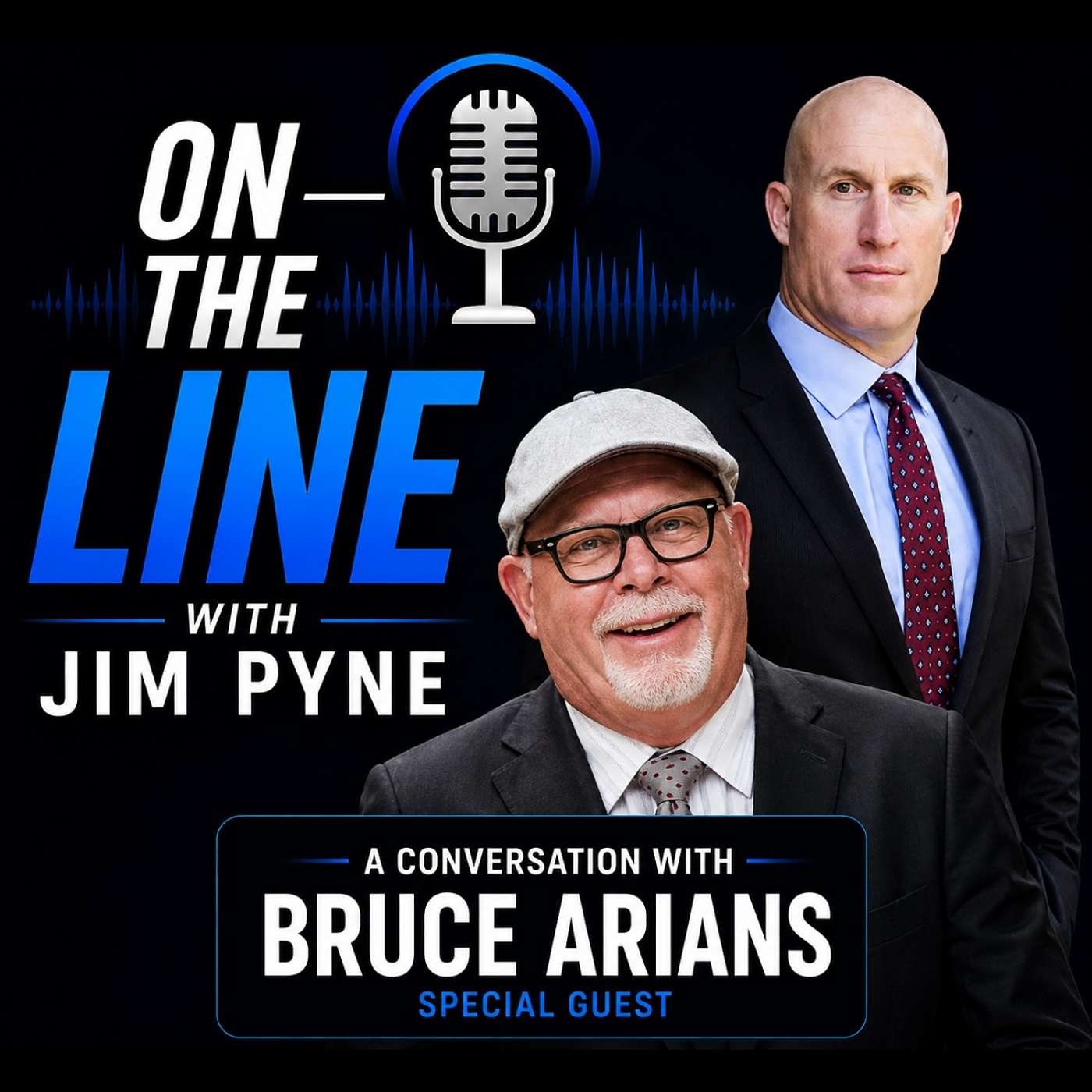
On The Line with Jim Pyne· Staffel 1· Folge 8
Bruce Arians: Leadership, Tom Brady & Building a Super Bowl Champion
Dienstag, 1. September 2026 · 36 min
Kapitelklicken springt direkt hin
Shownotes
isode Description
Super Bowl-winning head coach Bruce Arians joins Jim Pyne on On the Line for a candid conversation about leadership, winning, and building a championship culture.
Arians shares lessons from more than four decades in football, including his journey through the NFL, his coaching philosophy, and what he learned working with some of the game's greatest players and coaches.
He also takes Jim inside the Tampa Bay Buccaneers' Super Bowl run and talks about Tom Brady's competitiveness, preparation, leadership, and relentless drive to win—including the side of Brady that Arians saw every day behind the scenes.
Bruce and Jim also discuss relationships, accountability, handling adversity, and why great leaders have to be willing to coach people hard while still earning their trust.
It's a conversation about much more than football—it's about leadership, culture, relationships, and what it takes to win at the highest level.
🎙️ On the Line with Jim Pyne — conversations with championship coaches, executives, athletes and leaders about the experiences and lessons that shaped their success.
Support the show (buzzsprout.com/2632213/support)
Connect with Jim Pyne
Thanks for listening to On the Line with Jim Pyne.
If you enjoyed this episode, please follow the show, leave a rating and review, and share it with a friend. Your support helps us bring you more conversations with the leaders, innovators, and game changers shaping sports, business, and entertainment.
Follow Jim on LinkedIn and social media for updates on future episodes, behind-the-scenes content, and exclusive clips.
New episodes released often!
Transkriptvom Podcast bereitgestellt · Zeitmarken springen hin
Welcome to On the Line with Jim Pine. I'm Jim Pine. This episode is brought to you by PLS Aviation. Private Aviation perfectly executed. Now let's get on the line. So today, On the Line with Jim Pine, we have a legendary coach in person. He's a three-time Super Bowl winner, and a recent inductee to Buccaneers Ring of Honor.
They're a veteran of almost 50 years of coaching and just a great guy. But most importantly, he's a Virginia Tech Hokie too. So welcome to the show, Coach Arians.
How you doing, Jimmy? How you doing, brother?
Go hokeies. I even got a I don't know if you can see it over there. I got my uh on the side, I got my Virginia Tech helmet, and I put the bucks with us. So it's always always out front. But coach, you you've coached a lot of Hall of Famers, won Super Bowls, changed a lot of lives. What are you most proud of today?
Yeah, I think the relationships, you know, that that we've made over the years. And especially those years at Temple. You know, I was I was 30 years old, head coach, thought I knew everything, didn't know shit. But those guys are so close. And even today, I think over 45 of them are friends with my wife on Facebook.
And how successful those guys are and how close they are. That that group of guys very, very special. I mean, we had great times in the pros coaching great players. But man, those days at Temple and those kids are really special.
Yeah, sure. No, I remember Temple's great, great, tough program. Philadelphia played at the old vet, right? I remember when I was at Tech, we played Phil Temple several times and always a tough team, you know, tough kids, tough guys. And you know, I know you were there for a while, Coach, and you won a couple, a couple winning seasons, and had great great guys came from there too.
Paul, what was it, Paul Palmer, the running back?
Paul Palmer, yeah. John Reese, yeah. Yeah.
Yeah, he had a lot of great players. So great times. I mean, the toughness, and you're you've always been a guy I looked at as a tough guy. And uh that that was a good match there for Temple. But uh, I guess if people remember one thing about you, coach, what what do you hope it is?
That I was honest and fair with my players. You know, everybody says a players coach. I I don't I think a players coach is a guy that shoots them straight. You know, because them players can sure they can look right through the bullshit. And uh, you know, they they see it and they know you're phony, it's over.
And you know, for me it was if it wasn't right, we're gonna fix it. That's not criticism, that's coaching. And it might come out real ugly sometimes, but it's coaching, man. I love you, your football sucks, but you're a hell of a guy.
I I heard I recently I saw something you did where you they talked about uh you know when you were in Tampa, you you kind of you knew it was your last stop, and you kind of coached differently, and and the guys kind of bought into it, the team did, that they felt that too. There was a difference there.
What explain that to me, coach?
Yeah, I I had always called plays everywhere I was. And uh when when I set I retired in Arizona and and uh did the CBS broadcasting for a year, it's like now this isn't my king, I can't say what I want to say, you know. And uh and my son was like, hey, and my son Jake, he's my agent, and uh he's like, hey, you really gotta look into this Tampa thing, man.
You know, we had James in in our football camp in the 10th grade and and knew all of the legend of J. Boo. And uh it was a good young football team. And then all of a sudden, 18 of my coaches were available. And the main one was Byron Lefwich, because I didn't want to call plays anymore. I I just wanted to be the head coach, and I had trained him and and he got let go in Arizona, so it was like, all right, the handwriting's on the well, this is this is a sign, you know.
And uh we did it and had a blast, man. When you talk about a great three years with maybe the best ownership group in the National Football League, I think, personally, they're just fantastic people to work for.
They are, yeah. I I had the fortune I I played for the Glazers, I coached for the Glazers, and I was also uh on the front office with them. And so I have th three different times and great people, great, just you know, they like to be behind the scenes and out front and good people, and uh they like to win, they like to compete, and they they run it run it very well.
So I I agree with you there. Coach, you have the no risk it, no biscuit became one of your trademarks, right? Was that is that just that's football? Is that something you do in your your everyday life too? Is that your strategy?
That's life, man. I hit a lot of balls in the water, brother. I still do. I can't get there anymore, but I'm gonna still try. No, you know, when I was uh, I think I was uh 15 or 16, uh coach put to poem if by Roger Kipling in our playbook. And it talks about not being afraid to throw your hat in the ring.
Don't stand on the side. Even if you fail, failing is more important than standing on the side and watching. And that that poem just stuck with me. And then later, another coach put a poem The Man in the Glass in our in our and so at Temple, I had that poem written on a big big wall with a mirror next to it.
The guys looked at it every day. We took at going in and out of the locker room every game, that mirror was there. It's like, don't bullshit this guy. All right, you can't bullshit this guy in the mirror, man. So it's like those two things they kind of led to no risk at no biscuit, but the poem stuck with me for a long, long time.
I love it. Yeah, the The Man in the Glass read that one many times. That's a great one. The most important guy is the guy staring back at you, right? So I agree, Coach. That's deep. Oh, it is. Bear Bryant. You know, you coached with him. I mean, he's passed and a legend, right? I mean, growing up myself, you know, Bear Bryant with the hat, the whole deal, roll tied.
What was he so special? What made him special, coach?
Unbelievable manager of personnel. I mean, he was a master of personnel. People didn't realize even at the Liberty Bowl, the last game, we played 66 players in every game. He substituted all 66. No assistant coach. If you try to send a guy in, your ass was gonna get chewed out, brother. Because he handled personnel and you know, he had that knack of I was young and cocky, thought I knew a lot.
He just loved ripping my ass. And uh then uh, you know, if he walked in and he knew his secretary was down, he could just say two words and lift her right up. He just he just had a a knack of knowing people inside and out and and how to how to raise their ability to to do everything better.
Sure, sure. What that that that's great. No, he's a he's the legend. I I remember some a funny thing. I fortunate enough I was over your house. You were coaching with the Bucks. I had my two little guys who were a little bit bigger now. Two, I said, Coach, I got young quarterback here. Coach, what do you what do you tell a young quarterback?
And I loved your advice that you said, throw it to the open guy. I use that all the time to my son when he's getting ready for a game. Hey, listen, what did Coach Aaron say? Throw it to the open guy. Keep it simple, man. Just throw don't overthink this stuff, right?
That's right. Hey, you know where it's supposed to go and find him and hit him.
That's right. That's right. Coach, how do you build confidence in people before they've proven themselves?
I think it's a it's a daily step-by-step process. I don't think all of a sudden you just have confidence. You know, I have a when I make the first putt, I got pretty good confidence the rest of the day. I miss the first one, I'm shitty on the second one until I make one. You know, it's like it comes and goes.
But uh true inside confidence is is a belief in yourself. And uh it goes back to looking at man in the glass, you know, and uh you know, I I trust that that guy is doing everything he can to win. And uh, you know, when we started to program in Arizona and Tampa, we we printed three words on the wall trust, loyalty, and respect.
You know, trust is that guy you can't trust anybody unless you trust the guy in the glass. And it starts right there. Then you can trust a teammate, and he can trust you. And loyalty is loyalty to the cause. The cause is winning a ring, man. All your decisions, everything that we do every single day is about winning that ring.
And respect is respect is yes, respect your teammates, officials, everybody. But it's respect the process of coming to work every day. My dad worked in a factory seven days a week, and he'd always say, hey, this man's paying me. I'm giving him everything I got. And uh that's just what was inbred in into all of us as kids.
That's great. Uh that's great. That's great advice. To see your dad work like that. I saw my dad work too. That's that stuff in today's world of everyone's so virtual and on phones and stuff. But to see see people work, that's it, that's powerful and impactful. I guess what's the biggest mistake leaders make when building culture?
Trying to be somebody else. You know, I I look at guys who leave certain organizations to become head coaches and they fail. Because, first of all, they were never in another situation. They only know one situation, and they don't know all the answers to that test that that head coach went through to get to where he is.
You know, they just know, hey, these owners like, I'm gonna hire this system. That this system ain't the guy is the system. Somebody's gotta teach it, you know. And uh I think so many of them now try to be something they're not. And the players look right through it. They see right there if you don't know your shit, man, they're gonna find out in like one week.
That second or third meeting, they this guy don't know what he's talking about, especially if they've been coached by somebody really good.
That's right. That's right. The players know, you know, it's it they can see. I I remember getting coached by guys too that especially guys, yeah, again, my position overline. Like I had some coaches I think of that never played the position, never more, they're more quarterback guys, and he's telling, oh yeah, I blocked that guy, kick his ass, do this.
I'm like, okay, coach, how how it just doesn't work that way. Tell me how how you want me to do it, right? Versus just kick his ass, right?
Yeah, yeah. That's I think too many of these guys today grew up on computers. They never taught anybody how to block on a sled, how to tackle on a sled, you know, and the the the the techniques of the game we're losing, you know. The fundamentals are so bad. Tackling is a lost art. And uh well, mainly because even in high school you can't practice it anymore.
My son just started coaching out in Chandler, Arizona. They got one hell of a football team, they got five, five stars on that team. And uh it's like that, we never practice the little things. I said, and then you got a hell of a new head coach, and he's got him out there practicing, blocking, tackling, even the great players.
You gotta have fundamentals, man. It's in business too. If you don't have good fundamentals, you're gonna fail.
Right. No, no question. That's everything. And to your point, in today, today's world, uh, you know, they're not they're not teaching that like they like they did in the past. And it's the guys that just call them plays, really. I think there's a lot of young coaches that call plays, but the fundamentals are everything.
Coach, you're you're the quarterback whisperer. Whether you what you wrote a book about it and stuff, what do what do the greatest quarterbacks you've coached all have in common?
I call it grit. They hate losing, man. I mean, they hate losing. I don't care what they're doing. If it's tidley wings, shooting pools, shooting baskets, playing pig, whatever, they hate losing. And uh they have ability to will themselves on other people to make them win. And you've been in the you've been in the huddle with a guy that you know didn't know shit.
We got no chance. Then you've been in a huddle with a guy like, fuck yeah, man, whatever he says, we're doing. You know, even if it's wrong, he's he's right every time. And uh so it's like I think they have that that unique ability to just will themselves on people.
How did you how did you coach Peyton Manning differently than Ben Rothelsberger, Andrew Luck, Carson Palmer, or Tom Brady? How'd you coach those guys differently?
Each guy is so unique and different in how they learn and how what what what frees them up on Sunday? And Peyton and Tom were very similar. They had to have every rock unturned before Sunday. You know, they went through the corner, the safety of this guy. Three years ago, he got beat on this. You know, others, Ben, hey, I know the offense inside now, just let me play.
You know, hey, we're not afraid of who this corner is over here. You know, we got guys that are gonna throw it to the right. I don't care who he is. That's where the read goes. And uh and then use that natural God-given ability. Then nobody could get him on the ground. Andrew Luck was unique, he's the most unique bird I've ever had.
And that what he did as a rookie to win seven games in the last two minutes with six other rookies on offense. You know, we had three rookie receivers, two rookie tight ends, a rookie running back, a uh tackle, and a quarterback. And we win all these games at the end of the game, which is unheard of.
And now that was one thing, too, that I found out when Chuck got sick. If you give professional football players something else to play for other than money and each other, a lot of things can happen. And and that was probably the least talented football team I've ever been a part of to win 11 games.
But they were playing for Chuck. And every day, you know, till Chuck got back on the field. And uh it was something that times got tough. Hey, he's fighting a hell of a tougher battle than you are right now. Let's go, you know, and uh so it was uh it was it was a very unique season.
Sure, sure. That's a great point. Guys giving stuff because pro sports, which again, let's talk college sports, right? College is pro sports now, too. Like these guys, I see guys in high school, my son's playing high school, and he's getting people chasing the stars and this and that, trying to get NIL deals versus playing for passion, playing for a reason, playing for people, right?
Guys that inspire your coaches, what it may be, the team. You're kind of losing that today with today's today's business setup, right?
You think back the guys you graduated from tech, they're still probably your best friends. Now you switch four teams. They don't have that anymore. You know, I mean, you're lucky if you get if you switch the fourth team and you win something, you might have that to fall back on. But you don't really have that bond of going through the real hard times.
You know, when when when I went to college, freshmen weren't eligible. You were just you were meat, man. You were just practice meat. Boy, if you could survive that that first year, you might make it. Because we had like 60 guys on a scholarship, and the next year there were 70. It was just, hey, the survival of the fittest.
And today's world, man, they would all quit and went home.
Yeah, no, it's different. It definitely is. I mean, you think too, and as my son's going through recruiting, too. The really nobody's getting an education, too, to this thing. Everyone's moving to different schools. I don't know how they're getting degrees. I went up to one of the schools near here, and they they they said 95% of the classes are online, so no one's going to class.
So they they have these uh tutors, hundreds they this school said they had 150 tutors. I said 150 tutors, you got maybe 100 players. So we stand side by side, and they you know, no one's just giving them a degree, they're not going to class, they're pro-athletes. So that that's a another whole thing.
But back to Tampa Bay and Tom Brady. What convinced you Tom Brady could win a championship in Tampa Bay?
Well, yeah, everybody knew the pedigree. And we went back and looked at the last two years, and he was throwing balls that he'd thrown for the last ten years, and we never saw a drop-off in his arm at all. And uh so it's a matter of first of all, there's no way in hell he's leaving New England, you know, with all that success and everything.
And then all of a sudden, boom, he is leaving New England and he and he's interested. We had everything he was looking for. He wanted to be on the East Coast, he, you know, we had a great trio of receivers, a good offensive line, and a really good football team and uh and no taxes. So a lot of things fit for Tommy, you know.
And he wanted to stay close where he'd get up and see Jack play. And so he was recruiting me as much as I was recruiting him at the end. And uh it was really a marriage made in heaven. He was the missing piece. Not his ability, his confidence. When he walked in, all of a sudden that guy's a hey, we can win.
Well, we could have won anyway, but we could really win now because we got Tommy. And it was a struggle because of COVID. No spring practice, no, no spring, no, no preseason games, having to tackle ourselves, that scared the shit out of me, having the scrimmages like college, you know.
Right.
But it took a while, you know, we're seven and five and we're hanging. And and and finally it all clicked.
And that was one of the questions. What at what point during the season were you like, man, we can we can go win all this? When when did you know? When did you think?
Yeah, after you know, after the Atlanta game, we're down 17-0, and we gotta win the game to stay alive. And we're down 17-zip but half playing like dog shit. And you know, JPP goes off at halftime, and I went off a little bit, not too bad, but so hey, we're throwing this damn thing down the field every play.
All right, we gotta we gotta score, we gotta score fast. And we had, I think we scored 31 in the second half, and defense got a couple turnovers, and boom, all of a sudden the snowball started rolling, and we started being a more aggressive offense and defense, really a whole football team. And and it just led us right through the playoffs.
Yeah, it was a great run. It was uh it was amazing here living in Tampa and watching that, you know, the COVID year you mentioned. I I had my three children, it was the greatest. I told them, I said, we we guys, you don't even understand what's going on. We drove out of our house, 15 minutes to the stadium.
I said, You go into your hometown stadium, your hometown team's in the Super Bowl, and they won the Super Bowl. I was like, I don't have to take you to another game ever. This is like the greatest thing ever. And it was great because the COVID was it, I had the whole road to myself. They only had the limited seats in the thing.
We're in the front row. It was a great time, but a great game, an amazing time. You killed the Chiefs. Um, you know, that was just everything was rolling well. I was so happy for you, too. I know all you've been through and is a great, great, great. What did what did that season in that game mean to you, coach?
Yeah, that that I mean, it's it's only number two on the win list, but it uh it's very, very special. Number one was Temple. Pitt beat us 45 to nothing my first year. And then they had Bill Frelick and all those all-Americans, and they came in to Philly. I think we're like 30-point underdogs, and we upset him, beat him for the first time in 45 years on the last second field goal, and the Beach Boys were in concert right after the game.
So that's number one. That's the first one. Yeah, the Super Bowl's number two, and like you said, it was so, so special. Walking out there, and I'm looking for my sister, and like no, that's cardboard, that's oh, there's a hand moving. That must be them. You know, it was such a weird setup for the stadium.
And but yeah, the guys, I gotta give our guys so much credit, man. You know, because if you didn't beat the virus, you weren't gonna beat anybody else. And our guys sacrificed so much that year for each other. That's why I knew we had to help a football team, because we weren't losing anybody to the virus.
Sure, sure. No, it was a great, great, great, great game, great season, the whole deal. What what are things about Tom no one knows that you saw? Like don't that you saw out of Tom?
I think they're seeing now how fierce a competitor he really is. And you know, that's the way he is in practice. You know, it's one thing to be that win a game, but like I can't remember the first or second two-minute drill we lost on offense, and he wanted to keep going. I said, no. Maybe tomorrow. Man, he kicked, he threw his helmet two fields over, he threw a fit, and we ain't fucking losing no more.
This is bullshit. Defense like, this guy's for real, man. It's just practice. But yeah, that intensity never leaves.
Yeah, no, yeah, special guy, right? I mean, it is he he's got obviously the world thinks he won seven Super Bowls, was in like ten. I mean, what probably the greatest of all time. Or is he one of the greatest? What how do you rank him up there, Tom? He's one of the greatest.
It's hard for for me to say football players the greatest, because it's it's the best team sport there is. You're not great without ten other guys, you know, and and 11 on the other side of the ball and special teams. But I think Tommy was a great player, maybe one of the greatest players on one of the greatest teams.
Uh Peyton was the same thing when their defense finally got cranking, you know. And uh But you know, hard to say Dan Marino is not the best passer that's ever lived, you know, or Joe Namath, or Johnny Ineidas. I mean, this is who's the greatest. Tommy's got the most rings, so he's the goat.
Yeah, it's most production, I guess, with the with the rings for sure. Coach, adversity, right? Business, we we all deal with adversity in life. You know, you've had the heart stuff, the cancer. You know, adversity's we all face adversity. We're gonna have adversity coming up. What are some of the things you do uh with yourself and how do you face adversity?
How do you overcome it?
Yeah, I I think another one of those things a long time ago, tough times don't last, tough people do. You know, and uh it's like watching my mom and my dad they were sick, but they never missed work. You know, and uh somehow they paid the bills, somehow we had what we needed to have to be able to play sports and and and go to school and do everything we needed.
And it's like watching my dad walk that picket line and you know, where what we eating this week, you know, and those are those are real time. Adversity in sports, I think kids today are they're handing all these participation trophies and all this stuff, and hey, losing, no, don't worry about losing.
Hell yeah, worry about losing. You gotta learn how to lose. All right, if you learn how to lose real good, you'll be a loser. You better learn how to win. And uh, you know, and that that to me gets you better for ready for life. Learning how to win. But when you lose, why did I lose? And then let's fix it.
You know, for me it was always find an answer why. You know, and uh I started out you know, early in my life with I got kicked out of high school my senior year, right day after football season, my senior year. Everybody stopped recruiting me except one guy, and that was John Devlin at Virginia Tech.
And uh my best pay it forward moment ever was Coach Devlin was down at Houston, they got let go right during the oil bust, bankrupt, lost everything. I got to hire him as my assistant head coach at Temple and and and get him back rolling, and uh because he gave me every opportunity I ever had in my life with that scholarship.
And uh so that having him to lean on for three years at at Temple as a as my assistant head coach was really, really special.
That's great. That's a great story. That's his was his son Mike Devil Center too. He played, yeah.
That's Mike, that's his son, yeah.
Yeah, played at Iowa. Yeah, and I remember Mike's Mike's a good guy. He's coaching now, too, I believe, too.
Yep, he's offensive flag. I think Mike. I wasn't Houston for a long time. Mike made Baltimore now.
Right, right. So as a former player, you know, guys, you play, you coach for a while. You know, the transitioning from playing to what's next, right? Guys struggle with that. What's some advice you would give anybody transitioning, whether it be a CEO moving to another company or a player moving on, a coach moving on?
What what are some of the things? How did you trans? You've transitioned a lot of different roles and how to reinvent yourself per se. What's some advice you got there, Coach?
I I think it's always plan ahead. You know, uh I coach Bryant gave one of the best speeches to the high school clinic back in 1981. Like, hey, you got a job. Is it your favorite job? Well, you do the best damn thing job you can do and keep looking for a better one. All right. And then when you find the the one you're looking for, book your ass off to keep it.
And uh, but you're always always looking for that dream job, and but you can't get it unless you're working your ass off for the one you got and and you're earning respect of everybody around you. And uh I I learned real early, you know, my first full-time job, Danny Ford left tech and went to Clemson.
I got hired as running back coach for $10,000 in a car. And uh man, I thought I had everything. So I bought a little house, had a baby, and got fired. I say, all right, here we go. Here we're in coaching now. Moved to Mississippi, bought another little house, had another baby, got fired again. It's just a matter of I learned what networking meant.
I always thought the other team was the enemy. You know, well, I'm at tech, we're never gonna leave tech. So I I wouldn't speak to the other coaches and stuff. And then I'm out on the road recruiting for the first couple of times and met a couple veteran old coaches who'd been around and uh taught me a lot about networking and and and getting to know everybody in the league and because you're gonna need them one time.
And uh then lo and behold, it wasn't a year later, I'm calling, you know. And uh so it was like my son and I would always go to the senior bowl, and we'd make that lap with a job or without a job. And he'd he's always saying, What the heck? When you got a job, they all talk to you. Well, they all start running when you don't have a job.
I say, Yeah, but we're gonna make this lap every year, whether we got one or not.
That's right, that's right. Humbling, humility, right? That's that's true. It's great. Network with people, stay in touch with people. You care about you met, and it's just you know, you never know, right? That down the road you cross paths cross again multiple times, and that's that's life. That's great advice.
Virginia Tech, coach, a special place. You mentioned a few times. I I had fortune, I came from Massachusetts, you were from New Jersey, so we weren't from there, but went down. I I enjoyed it, but it was the people, right? I coached Beamer, all these guys, Steve Marshall, great coaches, Bud Foster and stuff that coached me.
What does Virginia Tech mean to you, coach?
Everything. I you know, I don't, I guess I don't have a high school to go back to, but I'll always be a hokey. I mean, that's that and the the friendships. I think we had 25 couples at the lake last summer. And uh, you know, all the guys from 74 to 75, 76, and that those are the guys that are still our best friends.
I don't have to see them. I might not see a guy for six months, but as soon as you see him, it's your best friend again. You know, and and you know there's a there's a bond that can't be broken. You know, we we had a kind of rough patch there. We went through, well, I went there for Coach Claiborne, and then Coach Clayburn got fired, and Charlie Coffey came in.
It was a rough road for guys from the north. He wanted guys from the south. And then Coach Sharp came in. I was the only guy out of 56 freshmen to make it to that fifth year. And and and that that was the best decision ever made. Because I was trying to get a junior high job and graduate. I didn't get the job, so I went back as as a quarterback, and Jimmy got me into coaching, and uh, and and and he was the next guy that really I owe everything to.
Great. And I you know, I saw the story. I Ronde was on the show before I played at Ronde. I coached Ronde. I was around Ronde a bunch, just a great guy. He he coached my daughter in lacrosse with his daughter here in Tampa, which is great. Obviously, amazing what he's done, Hall of Fame. You know, you were roommates with his dad.
I mean, people tell you you know, he Ronde talked about he was raised by his mother and all stuff like this. Well, I guess his dad was what kind of football player was his dad? I've never heard much about his Ronde's.
Really good, good hell of a running back. Yeah, he blew his knee out, blew his knee out, had had one of the first new kinds of surgery, but he he was so strong. He got back, went to Dallas for training camp, didn't quite make it, and then came back. We started coaching together. And uh, you know, he was one of the first African-American coaches out on the road uh in in the East at that time.
And uh, you know, when we got let go, he went into insurance. I stayed in coach and he went into insurance and hated it. And uh one thing led to another, and he just had a rough, rough time, and you know, and then he departed but from the family. And then, but yeah, babysitting the kids. I mean, we we bought those houses right next to each other.
We thought we had it made, man, back then.
Yeah, yeah, no, he's good. Ronda's done well, he's a great guy. So I'd love to see he's got a great great dad too. He's a great dad with his kids, and he's he's done a great job. So what's something people don't know about you, Coach? Bruce Arians.
Oh God. Uh any much, pretty much anymore. They know everything. Every every time I say something, it's printed somewhere. But oh, I don't know. I I just, you know. Had a great mom and dad, brothers and sisters. I have five brothers and sisters. My wife has five brothers and sisters, so we have a big family.
And we just had our 55th wedding anniversary a couple weeks ago, and about 60 members of the family were all here at the lake. And family means everything to me. And uh, you know, you you can you can lose family, you can never lose your family, man. You can't. You know, people talk about faith, family, and football.
For me, family is always first. Faith is faith is an individual thing, and you know that that's something that's just yours. And then football obviously paved the way for a great life for us and our family.
Sure, sure. What what role has your wife playing in your success, Coach?
Everything. I mean, I knew I was flunking out as a freshman. I think my grade point average is like a one-three. And I've been hitchhiking up 81 back to Pennsylvania like three times to see her. And she loves telling her story. You know, we used to have the phones on the wall, put a quarter in, and it was like 50 cents, like call or collect.
I said, Look, I can't do this anymore. So what? We break it up. I said, No, we're gonna have to get married. So, okay. I said, Well, you pick it up, I'll be home in a couple weeks. Set it all up. I'm saving this other quarter. That's the only one I got. So that was my proposal. She loves telling that story.
And but yeah, it's uh we got married, and always when I was on the dean's list all the time. You know, it's like I bartending up at Carlisle's every every Wednesday, Thursday, Friday, and dollar an hour and all you could eat and drink. That was a pretty good gig.
Yes, sir. Yes, sir. I guess looking back, what advice would 73-year-old Bruce Ayrens give 30-year-old Bruce Aryans?
You don't know everything, but think you do. Don't let them tell you you don't. And uh, you know, uh I was very, very fortunate in in in getting that Alabama job. A good, very good friend Perry Willis had gotten sick, and uh, and that job opened after spring practice. And Coach Sharp called Coach Bryant, and you know, he was one of Coach Bryant's favorites, and he was business coordinator for 10 years in Alabama.
And and I went over there after spring practice, and it opened so many doors. You know, and we we had just had a great year at Mississippi State. Nine and two, Emory Ballard, who was a genius. You know, I watched Emory who invented the wishbone, and then he invented the wing bone, and it was just he did it on graph paper, it was amazing.
And uh just a hell of a coach and and a great man. And then I got to work for Coach Bryant, and that led to be, you know, being able to be a head coach at 30, youngest head coach in the country, and then not again until I was 60. So it was it was a little different in the NFL.
Sure, sure. Who's the toughest player you ever coached, Coach?
It goes along with the best player. That's Paul Palmer. Yeah, led the nation in Russia for two years at 170 pounds, carried it 40 times a game. But I think the toughest player was this little fullback, Shelley Poole, in front of him. Paul got all the glory, Shelly got all the knocks on the head because we we were running a lot of ISOs, but we we had a little bit of a unique high formation offense uh with the trap option and some other things that we did back then.
And but Paul uh Paul's in the College Hall of Fame, and I'm hoping John Reinster gets in soon, too, who was a great player at Tech. You you might have been in that battle when when when Tech meeted at the vet 12-9, and Bruce Smith got that safety.
Okay.
That was a hell of a game, man. Because we had pitched one out to Paul Palmer, and he looked like he's going for a touchdown and tripped over third base at the vet. Third base was thick up about that high. It's like, shit, not now.
That's right. That was like playing on cement, but that, yeah, right. The baseball field thing was there, the pitching thing, all that stuff. That was a that was a tough deal to navigate that field for sure. What's the funniest locker room story, Coach? You got any good funny locker room story?
Yeah, I mean, for me, it's Peyton Manning, that shit they used to do, those quarterbacks, that you tell a practical, they got out of hand. The practical joke, some guys used to pull on each other. And I always go back, and I thought it was Peyton, but Kelly Holcomb later told me it was him. Steve Walsh was one of those guys who was who bitch will brush his teeth like five, six times, you know, in in between practices and shit.
So they went and bought another toothbrush, looks like his, took a dump, threw it in there, and took a Polaroid of it, and he's brushing his teeth. And they threw the picture down, he started puking. I said, This the shit is out of hand now. This is totally out of hand. This gotta stop. Then you know the powder over the toilet and all this shit every single day.
One of them would come in there soaking wet, or taco powder all over them, say, all right, enough's enough. But man, Peyton, Peyton and his practical jokes, uh, it was something special.
That's fun. You gotta keep it fun, right? Those are the long days of football. You gotta keep it fun as the players. What's your favorite cigar, Coach?
Uh, it's gotta be Arturo Fuentes, you know, forbidden. They send me a box for the Super Bowl and I got hooked. I'm giving them away, my brother goes, hey, don't give those away, give them other ones away. These are expensive, man.
Love it. What's your favorite golf course?
Oh gosh, the one I live on, Great Waters. Uh, is in my top I love Old Memorial and uh probably I've gotten very, very lucky to play some of the top ones, but uh that's great. So many great ones. Pebble Beach is not it. I love spyglass. Cypress Point, obviously, those three holes on the back. Pine Valley.
Pine Valley is it's been a long time since I played it. Hopefully get back up there soon, and that thing's just spectacular.
Yeah. That's awesome. That's awesome. So, yeah, closing down here. I guess how do you f define success now, Coach?
Uh for me a healthy family. A healthy family that's doing well, not monetarily, just well. And love and health and all the things that go with it. And uh, you know, uh my um little grandson just said, Pops, man, are you rich? I said, You're damn right are rich. I got you, your brother, and your Palmer and Briarley.
I said, I can't get any richer than the four of you guys. And I think people lose too much sight of that today in this money hungry, let's let's go, let's go, let's go. And you get there like, oh, where are we going now? You left everything behind that matters. You know, don't be in such a hurry to get there and miss the journey.
Right. It's great advice. That's great advice. I guess at the end, what what's your what legacy do you what do you want to be remembered for, Coach? What's your legacy?
Coach them hard and hug them later. You know, that's the last words Coach Bryant told me before I left Alabama to go to Temple. And uh, all the guys, I think they'll all admit they got coached hard. And uh if they got coached too hard, I'd find them in the locker room, make sure they knew I cared about them, but their football sucked, not them.
That's right, that's right. I guess what coach, you've coached some of the greatest players in NFL history. When it's all said and done, what separates the truly great ones from everyone else?
Yeah, that that that inner drive. You know, what made Larry Fitzdrill stay after practice and catch a hundred balls? What made Larry Fitzdrill the first one out there to catch a hundred balls? You know? He has great hands. Well, same thing with Ben and Peyton and Tom and Andrew, you know. Why do they put all that extra time?
Because they want to win, you know, and I love I love Baker's Moxie. I I think I love what Baker brings to the Bucks, you know, a fire. Each guy's so individually different. And I think for a really good coach, you bring out the best of each one and and try to bridle that stuff that's not so good.
Right, right. Last question if you had to give one leadership lesson that every CEO, coach, parent should live by, what would it be?
Yeah, trust, loyalty, respect. You know, that leads to the main word, that's accountability. You know, it's all of being about accountable. Uh for football, there's accountability and availability. You know, if you're not accountable and you're not available, you're not that good to us. And uh you can be the greatest player in the world if you're in the training room while it's uh not doing us any good.
And you can be the greatest player in the world if you're not accountable, you're not doing us any good either. So uh to me, it's accountability of being trustworthy and coming to work every single day and give them everything you got.
That's right. Uh that's great advice, coach. Thank you very much. Appreciate it. You know, you're one of the best guys I know. And go hokies, of course. And uh we'll talk to you soon.
You got it, Jimmy. Thank you, brother.
Thank you.
Bye bye.
