

Kapitelklicken springt direkt hin
Shownotes
Description
Does the left really need to be more conservative? What is the difference between capital C and lowercase c conservatism? Is the Blue Labour movement the best tool against the MAGA agenda and right wing nationalism?
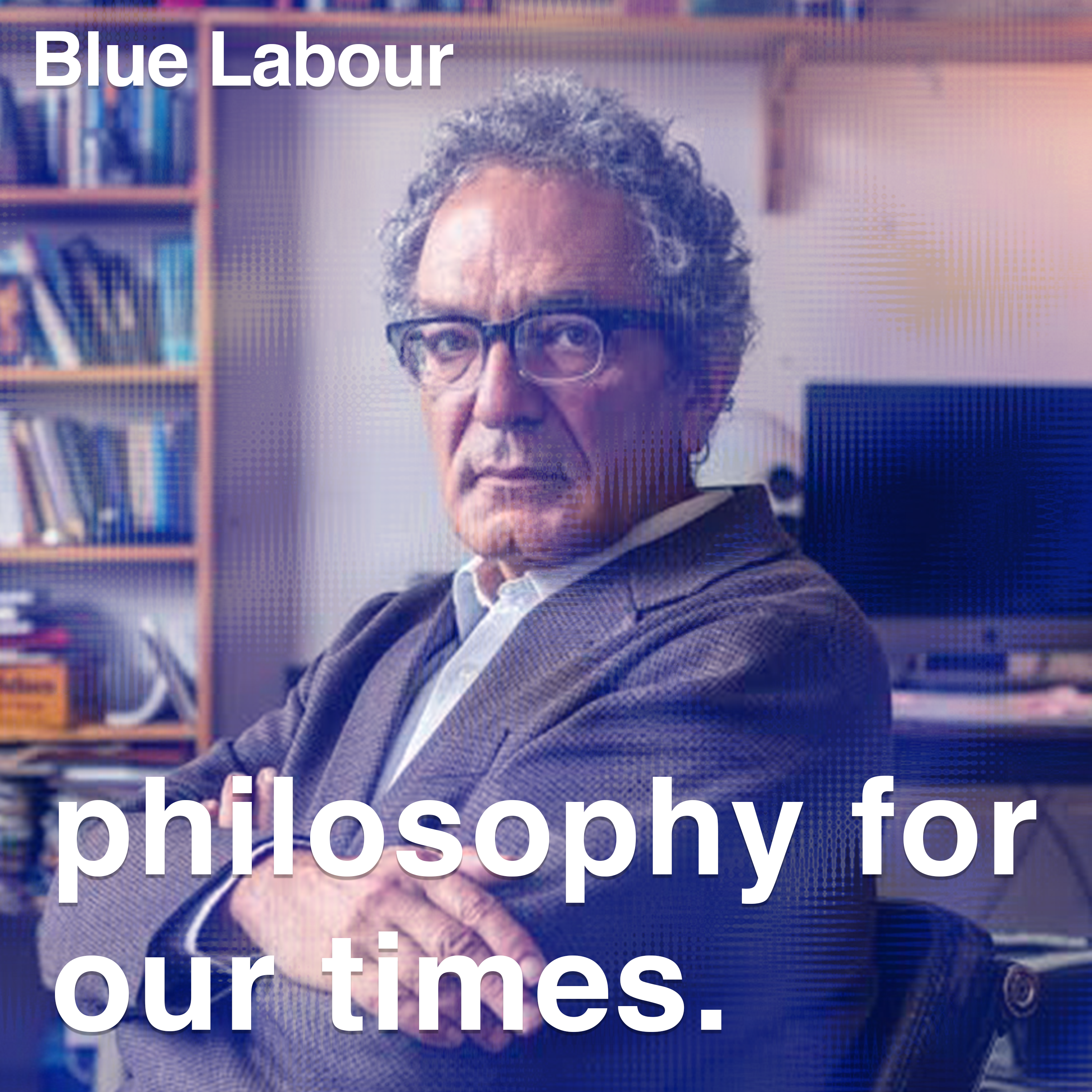
Maurice Glasman is the founder of the Blue Labour movement, a conservative strand of socialism that champions tradition, community, and civic association. In his view, we’ve come to the end of an era. From Thatcher and Reagan, through Blair and Clinton, we used to live in a period of open borders, globalisation and the rule of capital. Trump and MAGA show that the electorate is fed up with this. But what comes after MAGA? Glasman argues Blue Labour is the politics of the future.
Political theorist, Labour life peer, and a member of the House of Lords, Maurice Glasman founded the Blue Labour movement in 2009.
Don't hesitate to email us at podcast@iai.tv with your thoughts or questions on the episode!
To witness such talks live buy tickets for our upcoming festival: howthelightgetsin.org/festivals?utm_source=pod…
And visit our website for many more articles, videos, and podcasts like this one: iai.tv/?utm_source=podcast&utm_medium=show…
You can find everything we referenced here: linktr.ee/philosophyforourtimes
Transkriptvom Podcast bereitgestellt · Zeitmarken springen hin
Omari: of little to do with liberalism as possible. So that's why I dissent from the post-liberal. And it also means that you can get into an argument with people when I love liberty and I want to defend it. So I don't see liberty as the product of liberalism. I see it as a very complex development, Christianity, dissent, all manner of things. And not just John Walsh's theory of justice. That's not the primary text. Welcome back to Philosophy For Our Times. I'm Amari Edwards. Today we have an interview with Maurice Glassman. Glassman is the founder of the Blue Labour Movement, the conservative strand of socialism that champions tradition, community and civic association. And whilst not everyone on the team agrees with this view, he is certainly getting to the heart of many of the problems that can be found on the left. From Thatcher, to Reagan through Blair and Clinton. We've lived through an era of open borders, globalization, and the rule of capital. Trump and MAGA, Brexit in the UK, Maurice argues, shows that voters are fed up with it. So the question is, what comes next? Here is Maurice Glassman, interviewed by Charlie Barnett. Maurice Glassman, welcome to Have A Light Gets In. Love to be here. So as a blue labour MAGA supporter, in your view, what best explains the rightward shift that we've been seeing in both UK and West I'm not a MAGA supporter. I was invited to the inauguration and due to a left-wing history of guilt by association, I am guilty before the Central Committee of associating with MAGA, but I'm not. I mean, I see our politics as the politics that can defeat mega, but that's a really important thing. So what I see is the death of an era, it's a long era, era of what I call progressive globalization. the starting point, let's say, was the election of Margaret Thatcher in 79. So this is your life I'm talking about. And then Ronald Reagan in 1980, globalization, technology, capitalism, no borders, free movement. those, all those assumptions. And I think that the election of Donald Trump this time indicates the end of that era, tariffs, national industrial strategy, America first, all of that. So I see us as in the beginning of a new era, which is thus taking form. I don't think that a market based economic model can deliver the sovereignty or security that workers wish. So I actually view blue labour as the politics of the future, what will come after MAGA. And could you explain a little bit what the philosophy behind blue labour is and what the philosophical underpinnings are? philosophically, we're quite Aristotelian, so we believe that human beings have a natural tendency towards relationship, friendship, love. Sociability is a key aspect of human being, whereas the incentives of capitalism and progressive is career individualism. So we think our politics is suited to the era to come. Very important contribution of Catholic social thought, Pope Leo XIII, Verum Navarum, John Paul II, Laborum exe Chens, and Chintessimus Annus. So we also view human beings as capable of sin and virtue. and the structure of society is quite decisive in what is rewarded, what we call the incentives to virtue. We're in favour of that. And then a very important aspect is Machiavelli, the discourses while the Leprince, which is what are the conditions of a democratic polity and what is political leadership in that frame. And then Carl Palloni, The Great Transformation is a canonical text for us. So if you want a philosophical reading of Aristotle's politics, Machiavelli's discourses, Le Boron makes a chanson, Centesimus Honus from the encyclicals, Carl Palloni, The Great Transformation, and then it can expand into other areas. I think you get a strong contribution of socialist thought. that capitalism turns human beings into commodities, but a big critique of Fabian, very anti-communist in the sense that we think there's more to life than child mortality rates and literacy rates. Could you explain what you view as problematic about grounding, let's say, a moral philosophy and a politics centrally within the individual? We adore and are devoted to the individual development of individual personality. The paradox is that without a society there's homogeneity. It's either the Hobbesian all against all or what we have now. If everybody's sitting behind a computer at night ranting on the internet, that's not individuality, that's homogeneity. So we believe that political life real physical presence, conversation is transformative of the person and a realization. The second aspect of your question, which I guess is that we think it's insane to think that the individual is primary in this sense. You didn't choose to be born. You didn't choose who your parents were. You didn't choose what language you speak. You didn't choose what class you were born in. You you choose a huge amount and this The primacy of the individual chooser is just a fantasy. So you're going to have genuine liberty, you have to have strong social institutions that promote a culture of self-realization. you explain what you view post-liberalism to be, which many describe as a new movement essentially in opposition to the failures of, or what they see to be the failures of liberalism, and how that might link with any of your Sure. So I've been included a lot in post-liberalism. I have two reservations about the term. The first is the word post is a lazy term. So you just put it in there, post-modernism, post-liberalism. I don't know. That's one aspect. So it obscures the differences. And the second rule is that I've never been a liberal. You know, that's not personal for I love liberty. So this leads me into this. So I love the common law, the ancient constitution, the fact that in England we had really established liberty in our country. And liberalism is a threat to liberty because liberalism as an ideology that sees the individual outside of all relationships has a tendency to view people who disagree with it as criminals. You know, so I've developed this thing with the lanyard class unless you agree with a whole load of ridiculous propositions such as men are women. And if you disagree with that, you could lose your job. This is what liberalism became, an authoritarian, unreflective state ideology of domination and control. So I prefer to have little to do with liberalism as possible. So that's why I dissent from the post-liberal. And it also means that you could get into an argument with people when I love liberty and I want to defend it. So I don't see liberty as the product of liberalism. I see it as a very complex development, Christianity, dissent, all manner of things. And not just John Walls is a theory of justice. That's not the primary text. When people like Richard Tice and some members of reform say the political labels of left and right are getting a little bit tired, is that an assessment you agree with or do you think now more Well I go deeper than that. the left, I see the conflict in contemporary politics is between sovereignists and globalisers, people who want an effective state, and those who think that the market and technology should, and free movement, so between people who believe in bounded borders and people who don't. And that's not a left-right issue. That goes both ways. That's the first part of the answer. The second part of the answer is I really think the French Revolution was a disaster, like a real disaster. I think France has been whole since. I think it led to terror. I also know about the Russian Revolution or the Chinese Revolution. You know, these are very, very bad historical events. And it was the French Revolution after that that they had the left and the right. That was the beginning of that. And so I actually reject that whole thing. But that was a long time before Richard Tice came along and suggested that that was the case. people like John Gray yesterday argue that, quote, populism is a word liberals use to describe the social upheaval caused by their own policies, is that an assessment that you broadly agree with? I completely underwrite that. That's very good. The way the populism is used is that anybody who criticises capitalism is a populist. If you object to the capitalist movement, it's suddenly populism. So I consider it an ideological term to delegitimate democratic resistance to the status quo. And really what they mean is democracy. and they don't like democracy, but they call it populism. So usually when people say it's a threat to democracy, what they mean is it's a threat to the rule of lawyers. That's a really big part of the story. Could you expand on what you mean by the rule of lawyers? I believe you wrote a Times article quite recently on the very It's a really important thing. as the progressive left lost faith in any economic socialism, it became increasingly besotted with human rights. And that meant that, and this embodied itself absolutely in the EU, the EU muster, then Lisbon, then the ECHR. Essentially, it was an attempt to make politics illegal. You couldn't have an industrial strategy. You couldn't nationalize. You couldn't do anything. You couldn't control your borders. This is another huge aspect. So I really obviously uphold the rule of law. But the rule of lawyers is when political decisions are made in court, not by democratic decision. And I think that's the key analysis of what's gone on in the last, yeah, 30 years. Could you explain, you mentioned there with the concept of universal human rights. Do you have the problem with universal human rights as they've been politically wielded? Or do you think there's a more inherent problem with the idea of objective rights and morality? I was always very in favour of human rights and I've realised that what I was in favour of was liberty. In the ancient constitution there's four. Freedom of association, freedom of speech or expression, freedom of religion and freedom of conscience. Those are all social relationships. I'm happy with that. But what's happened with human rights is that they've tried to extrapolate a universal principle. And then the way it's worked is that they use cases in order to extend it and extend it. So I'll give you an example. There was an Albanian drug dealer who was illegally in England, but we could not deport him because his son said that the quality of chicken nuggets in Albania was inferior and that would affect their family life and the judge upheld it. This is just one example of the legalistic expansion of a fundamental decency into a political fiction. so that's why it's very difficult with the liberalism, people think you're anti-liberty and I absolutely love protected liberty. but human rights has become a racket run by lawyers in order to diminish and degrade politics. Mentioned earlier about what you think the real political opposition is between people today, slightly broader or maybe a slightly deeper question is what do you think more generally is the purpose of political oppositions in society and people having those tensions with each other? Okay, so there's always a clash of values and there's a clash of class interests going on. This is true of any society. you have to, it's absolutely vital that you have the representation of the interests of people who lost. I mean, this is the key feature of our civilization is we don't persecute and kill defeated parties. You know, not until now anyway, you know, that you, that this is a continuing conversation and any election is just an episode in a continuing. conversation and it will be the case that those who are last will be first, that those who lose and lose a lot can win. And we're going to see that with reform now. know, it's nut cases, basket cases, nutters. Well, you know, so there must be a contestation always. Is there a coherent philosophy behind reform? No. This is the point. At the moment it's an insurgency. They're moving into something around sovereignty for sure. But they haven't yet. I mean, I think, nitrofibers are saline bath, right. There's natural tendencies, Singapore, free markets. Now they're saying they're going to nationalise water, nationalise rail. I don't believe it. don't think Richard Tice is a much better example of where they are. And so at the moment they're a tribune of working class disaffection. but they're not yet at the stage of an ideological position. Some people, John Power and others, said that... Who? Sorry. Someone called John Power, he's a writer for The Spectator, and he's made the argument that essentially that reform have three quite coherent policies on things that people care about. The first is crime, the second is immigration, and the third is... energy or net zero related to the cost of living crisis. And that is coherent enough that essentially, if they maintain that, and they don't have any massive political blunders in the way that Labour have, they'll probably win the next election. Do you broadly agree with that? Yeah, I broadly agree with that. I think that's right. mean, when it comes to securing the borders, immigration, I'm completely with that, for sure. I don't think they have an analysis of contemporary capitalism and what the state needs to do in order to position us to be part of it. And that will come out in time, but as regards, you can ask if Labour has a coherent political ideology. I would say it doesn't. It would agree about, rhetorically at least, the immigration side, state reform as well. So yeah, I think that's enough to carry reform, but it's not enough for it to be a transformative government and build a hegemony position. Are there examples in history, do you think, where a party has turned from a sort party of the disaffection of working class people into something that is ideologically sound and something that can maintain itself for several years and several elections down the line? Labour. I mean, if you look at our vote in 1918, it was marginal. By 1945, we had a majority of 180. You know, and that was for nationalisation of steel, nationalisation of water, welfare state, national trust, all of it was a transformative government. So, yeah, there were periods and the weeks, the Liberals fell into obscurity. Yeah, this is a period of volatility and big change and this happened before. So we might have explained this, but what triggered the change into Blairism do you think? What triggered was Thatcherism. Thatcher won in 1979 to take a wrecking ball to the post-war settlement. Mixed economy, partly nationalised, partly private. People forget welfare. She was supposed to reform the welfare state. So she came to say that era of state dominion within the economy and trade union power was over, capital was going to organise the material needs with a state back up and accounted destitution, that sort of thing. She was the, and that Conservative government. won the argument. That's what I about hegemony. They won that argument. So, Labour then retreated from all its economic theory. No more nationalization, privatization. In fact, Tony Blair continued with privatization, globalization, multilateral treaties to secure free trade, the EU, all of this. So, essentially, it was the lack of faith in Labour's political economy that led to the subordination to Sacha. said earlier, just a sentence to sum it up. Well, Margaret Sacha mercilessly initiated Tony Blair immaculately consummated. That that was a period 79 until roughly now has been that agenda. The market is the best solution. Privatization is the way ahead. Transferable skills, borderless world, global capital. But it's not like that now. Things have drastically changed. So I'm just arguing that Labour should rediscover its political economy tradition. I wanted to ask you about the notion of political progress on a separate topic. So some like Steven Pinker and Hans Rosling have essentially argued that history is moving in a sort of direction towards something that's more progressive. Those like John Gray have criticized them for saying that that's that's created a political complacency and we're now seeing a backlash against it. wanted to know where you stand on the... I'm completely a tragic age. Progress is a shimmer. So I'd say the least true thing you will ever hear, and this is just life advice, is things can only get better. It's just not like that. Life is not like that. You've got to deal with real heartbreak setbacks. Things don't work. You've got to... deal with reality and not pretend it's another way and stop thinking that the arc of history is bending ever towards progress. We've got the most vicious surveillance state in China, you know, and that's held up as a model of development. Are you really telling me that Iran is a better place today than under the Shah? I don't think so. I mean, it's a nasty Islamist authoritarian state that it seems that the people... can't really find a way of getting out of it. You've got an explosion of pornography on the net. You've got suicide rates on teenagers exploding. Why are we thinking that things are moving towards? So yeah, I consider that to be a very, at best mistaken, at worst bad faith ideology. And to deal with the the whole human condition is to be able to find love in the tragic. That's where the future lies. And would you go further as to say that the belief in political progress, let's say in the way that some have put forward like Steven Pinker, is almost a replacement for a belief in some kind of religious entity? Yeah, well, this is another aspect of where we are. So I Catholic social thought is one thing, but obviously the Bible, the Christian tradition is a hugely rich tradition. Thomas Aquinas is a very important political thinker for me. And so what you have now is like a cult of progress without any notion of sin. It's really weird. So all the people I consider progressives are liberals. They think they're great people of nothing, you know, who are on the side of the good. They do not understand your John Gray quote. They are responsible for this situation, but they are as pure as the driven snow. And could you explain a little bit further what you meant by being a... What was the phrase you used? Living with the tragic. Yeah. What do you mean by that? I mean is both politically and personally, There are terrible things that happen in a life. Death of loved ones, illnesses, huge disappointments in relation to what you thought your life would be, very difficult situations in relation to living loved ones, both family, friends, colleagues. So there isn't any such thing as a world without grief. And we have to live with that and be wise in relation So anti-utopianism is part of this. That we can live a better life, but this idea of a life without death, a life without illness, this is the fantasy of the transhumanists. I can have all my body parts replaced, I can live for 400 years, I can live for 500 years. I think these people are both wicked and insane. My final question is, what do you like most about how the light gets in? Well, I can only go on being here day is that I found in both my sessions, I'm used to being shouted at and I'm used to the Labour Party and I found a genuine affection and reception and people were willing, I mean walking here, people coming up talking. It's a beautiful thing to be able to meet new people, talk about things that matter to both of us. Yeah, very good. Horace Glasswood, thank you very much. Well, thank you for inviting me. That was Maurice Glassman, courtesy of the Institute of Art and Ideas. You've been listening to Philosophy for Our Times. If you enjoyed today's episode, please subscribe to the podcast so you never miss an episode. I'm Emari Edwards and we'll see you next week.
