

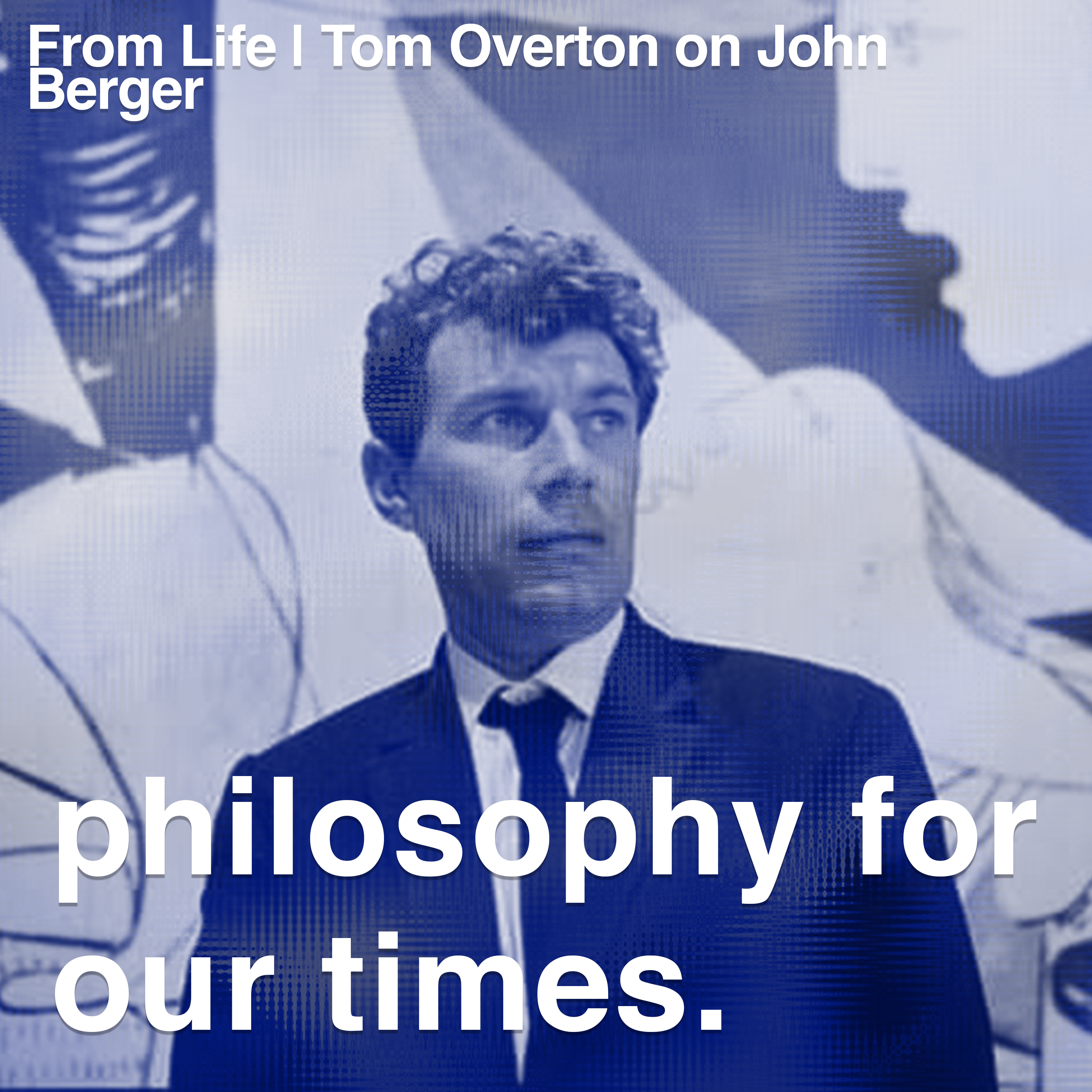
From Life | Tom Overton on John Berger
Dienstag, 27. Oktober 2026 · 1 h 01
Kapitelklicken springt direkt hin
Shownotes
Tom Overton is perhaps the worlds eminent researcher of John Berger. Alongside close to a decade of friendship, Overton has worked with Berger's personal archives for 15 years, giving him a unique insight into the mind of one of the 20th Century's most important cultural figures.
Don't hesitate to email us at podcast@iai.tv with your thoughts or questions on the episode!
To witness such talks live buy tickets for our upcoming festival: howthelightgetsin.org/festivals?utm_source=pod…
And visit our website for many more articles, videos, and podcasts like this one: iai.tv/?utm_source=podcast&utm_medium=show…
You can find everything we referenced here: linktr.ee/philosophyforourtimes
Transkriptvom Podcast bereitgestellt · Zeitmarken springen hin
Omari: That's what I mean, maybe that's the reason I didn't want to write an academic book because I think there's also I think there's something very lifeless in sort of discom in completely discounting the value of seduction. Like there's kind of like what you you know, w when we are moved by a piece of art or a or a book or a a song or a a poem or or a play, there is an element of that's what's going on and you know, if you take an entirely rational view of what's going on then you you won't be moved by it at all. But at the same time there needs to be a kind of Take broad historical scope, but it needs to be balanced with a sense of history too. Hello and welcome to Philosophy for Our Times, bringing you the world's leading thinkers on today's biggest ideas. It's Charles here, and today we have for you our interview with Tom Overton, writer and biographer of John Berger, conducted by Amari Edwards. Enjoy! Welcome to Philosophy for Our Times, the podcast by the Institute of Art and Ideas. I'm your host, Amari Edwards. Today's episode will be an interview with Tom Overton. Tom is a brilliant biographer, archivist, scholar who has delved into the life of John Berger in his new book, John Berger from Life. Tom had the unique privilege, and I think we'll get into How both the biography and his work with the archive got going. we'll dive into that into the interview. but what sets this biography apart is that it's a blend of this meticulous archival research with an intimate familiarity with John Berger. So welcome, Tom. It's a pleasure to have you for Philosophy for Our Times. Thanks for having me. Nice to meet you here. Well, in to kick us off. I mean, I think as I was saying, we should really start with you know, the beginnings of this book. I'm sure you you're very much used to telling this story now, but you've spent the last 15 years, possibly coming up sixteen years now, with the Berger archives. Could you tell us how how did you get into John Berger? How did you begin the story that led to this biography? Well I started reading John Burger. I was sort of aware of him as the the presenter and author of ways of seeing the which I think is a lot of people's root into him, the T V series, the movies seventy two T V series on the the sort of how art is changed by television. and I was kind of aware of these various different things that he did. But I'd actually read quite a lot of his nineteen fifties art criticism. And I was really interested in this very sort of unique voice. even when the the articles were unsigned in the sort of nineteen fifties, that I sort of was really struck by. And then around the time I was reading all that stuff, he donated his archive for British Library. this is 2009 when he donated it, and I thought I would really like to read more. I'd really like to get my you know, kind of get into that archive and read it. So I went on the British Library website and rather than any sort of catalogue for getting to be able to kind of call it up to the reading rooms, what I found was a job application to go there and catalogue it myself and sort of work write write about and sort of work on it. And so I I took a punt on that and through some sort of mad bit of luck, ended up getting it and started work there. And one of the first things I did As I was going through these boxes of papers which had been sort of brought to the British Library by my my then boss, JB Andrews at the British Library, from the Alps. I started going through them all and I started set sort of scanning things in or and sending them to John and his his wife Beverly, and he would sc He didn't use email but he did use an iPhone and he w he started off and he wrote letters, so he wrote he wrote back to me explaining what some of these things were and sort of a bit of a back and forth kind of conversation started there and that's how it started and that's how the and we worked on a couple of books of his art writing after that and it sort of went from there 'cause I yeah. Yeah. And and the biography. I mean, obviously I think with access both to the man and the archive, the the temptation must have been quite great as soon as you started thinking about it. I mean, I w I was talking to William Davies, who who did say, you know, the last time he spoke to you, which he he said might be nine years ago, that you were you you'd already started on on this mammoth task. So I I did wonder in terms of John's own suspicion about, you know, these great men, why you thought biography was was the right way of writing about this rather than you know, perhaps a more academic text? Yeah, that's it's a good question. I suppose I mean actually I did at one point I did at one point think it would be quite fun to write To write a novel about him because the his first novel, a painter of our time is about a writ about a writer going into the archive of an archivist. He sorry, of a an artist. That's a bit of a that's an interest. I slipped that one. the and the into he finds the diaries of an artist, and who is one of his friends and pieces to get pieces together his life by going through them. but I suppose I got to the point through these conversations, Well, there's kind of two I mean it's an interesting one. I I I know you're a philosopher and maybe maybe you'll have more of an insight into people's conceptualising people's motivations than I will. the but the I should say my cause I was doing it, I started off. It was I mean it kind of drifted a long way from there. It started off as a PhD and I wrote about I wrote kind of about this question in in that John described himself as a storyteller. And he did that kind of as a way of it was his response to the question that people often ask him about whether or not he would write an autobiography. and he he sort of the store the his con self-description as a storyteller is a kind of political way of sidestepping that by saying that he's not interested in his own story. he's interested in how his story connects with the people around him. and But at the same time, it will sort of as he connects to the experiences of the lived experiences of people he has met, then in the connection, those moments of his own life will come out. And I think it's most there in a book like here is where we meet, or it's probably a better example is his Into the Labors trilogy, where there is a a John narrator character as there is in lots of a genre narrator character as they're in l in lots of his books. And so i his own personal experience is kind of displaced in a sort of which in w a way has connections to his his love of James Joyce in these sort of shadow selves. And I suppose that this whole qu I think it was initially because I was interested in how his relationship to biography as a form and how that question you're asking and then realised that he himself wrote at least three books, which I think are really interesting sort of form-changing versions of biography. That's kind of the center of of the the book that I've written, is a a sort of, I think is this the 1960s when he wrote these three books, which aren't always considered as biographies, but I think it makes sense to do so. A Fortunate Man, which is his study of his GP, John Eskel, a the Picasso book, the success and failure of Picasso and Ernst Nice his book on Ernst Neist Vesny, as a Russian artist in the EU as well. And I think he was thinking through those problems there. And I think he was very engaged with them. He loved James James Elman's Joyce biography as well. So he was very engaged with the idea of biography as This really fascinating way of measuring the distance between humans, I think, and the how how exchangeable experiences. And I but I think at the same time, his way into that question was drawing, because he he trained first as a draw as a as an artist, and his he spent a lot of time trying to draw people's portraits and thinking philosophically about. And sort of emotionally about what it is. I mean, kind of sort of like the interaction we're currently having, and like we're looking at each other across the screen and trying to sort of yeah, we'd never met before and we'd want to get a sense of each other and how yeah, kind of how varied and ex and sort of exciting and interesting the exchanges can be. It's what I was trying to get at in the title From Life, because draw from life and it's different to technique photographs, which maybe would be more like an academic text. Sorry. No. No, no, I think I think I think that's a really interesting insight and and actually answers one of my questions, which was, you know, the the drawing from life I element. But I think one of the things that I found most interesting, because again, I know I perhaps you don't want to have to repeat it a for a second time, but you have previously discussed, and I think it's quite apparent in the book, that you know, your your gloss on the man. your understanding of John changes both through access to the archives and being able to contrast that with his own story, but then also meeting, discussing with the people who knew him, the people around him. And even even the the the discussion of him as a storyteller is something that you know, you you don't take straightforwardly. I think it's you know, in in the introduction you're you're quite clear in That you know, this is a self-conception and perhaps one that might might need a second look. I I thought it was very interesting that you were you were given the insight both through the man and the relationships, but then also the archive to look at John and see the image of him that is distinct from his self portrait. So did you think there was, you know Was there some particular value in having this you know, slightly outsider perspective, which I think influences the way that you also write the book, but also then having some intimacy with the subject? Yeah, it's I think there's it's a constantly kind of oscillating I don't know, oscillating is the quite word, is quite the right word, but there's there is this constant tension between proximity and distance. And one of the ways I started thinking about it was discovering sort quite late in quite late in in in the the process that he himself thought that he had two differently he had one eye that was short sighted and one eye that was long sighted and but that sort of became a sort of like a motif for me in the in the sort of like they're taking a you know the the a broader picture and then a very, very intensely closed picture because that was he he and he did work on these two different timescales and the two different sort of planes. But Yeah, it's interesting because I think there is something to be ga there's a lot. It's one of the lessons of his writing, I think, is how much can be gained from a sort of a really intense, close focus. But you know, it he you then have to take a step back and put things into a context or it loses all meaning. and I suppose some of that was it's almost like, yeah, I maybe depth perception is the way of trying to con continue that kind of metaphor about the about the two differently focused eyes. but yeah, I I the storyteller thing i is I mean I should say that I think it that doesn't mean that he's what I'm saying there is not that he that some of that his fiction is is without merit. I think I think he's here is where he meets and the the peasant trilogy on some of his you know, the the great texts in sort of in any any language really, but the And there's an enormous skill to them, but I don't think the skill resides in narrative necessarily. I think it's in those sort of moments of focus and sort of relation. but yeah, I I I had to and he was the there's a kind of s there's a kind of seduction inherent in everything that John does, and he thinks this through in the in the novel G and also in the book about Picasso, and it's obviously a big theme in in his life in all sorts of ways. But there's there's the and he you know, he was an enormously compelling person to talk to. And there's it's balancing the the being sort of drawn in like that and also taking a step back and putting it in context and realizing how many people were drawn in like that. But there is something I don't think also that's what I mean, maybe that's the reason I didn't want to write an academic book, because I think there's also I think there's something very lifeless in sort of discount in completely discounting the value of seduction. Like there's kind of like what you know, w when we are moved by a piece of art or a or a book or a a song or a a poem or or a play, like there's there is an element of that's what's going on. And you know, if you take an entirely rational view of what's going on, then you you won't be moved by it at all. And but at the same time, there needs to be a kind of if you're doing something like a biography that has to Take broad historical scope, but it needs be balanced with a a sense of history too. No, definitely. I th I think I think this is a a good place, as you say, it it really does need that scope. And I think starting perhaps not with his earliest moments, I will I will say to our listeners and viewers that they should go and obviously pick up a copy, which is available now. but you start off in childhood, but I I wanna skip a step. we'll we'll we'll perhaps bring in the formative elements of his time at the boarding school in his relationship with his parents. But Berger began as a painter and an art student in the nineteen forties London, obviously in with the shadow of war of the Second World War, and spent his early career as a critic in this post war Britain. what do you think was formative about this period and and what in it did he later go on to reject? I think the most formative thing about that period, I mean, you know, there are so many things, but if you're talking about someone's sort of teens and twenties book, a real sort of strong line was and if we think about how different it is to how someone, yeah, getting to that point in their life would experience trying to start life as an artist or painter now, like the it was just immediately after the Second World War and there was a sense, in the country and more broadly of s kind of state funding for the arts. and there being that sort of you know, despite living in an entirely sort of shattered continental world that had was massively indebted in all sorts of ways, that there were you know, there was a a newly founded arts council alongside you know an NHS and a but also a kind of nuclear weapons research campaign. but the The sense that John ha started life well, he reached he became he was an art student, and then he was called up to military service and then he was did his short period of military service and then became an art student again and that was funded with a an ex-serviceman's grant. So he had a you it wasn't an enormous amount money, but he could start out like that. And then when he started making money separate to that, it was on the BBC with the sort of predecessor of the BBC World Service. and so that was also another state funded thing and he was it this was the time of the the festival of Britain and so the sense of what art being produced on behalf of in a kind of democratic way on behalf of the people and the i the idea that the patron of the future was was the state or was the the people who had voted the who had voted for that government was I think struck him particularly powerfully because he'd around this time he met a a Hungarian Jewish emigré called Frederick Antoll, who in some ways becomes the subject of his first book, his first novel, sorry, who ha who wrote about the Renaissance and about how patronage worked in, say, Renaissance Florence, and early one, yeah, sort of early modern Florence and how their artists had been considered kind of craftspeople to work to a commission and their sort of individual hand was in how they served that commission that he John sort of would have first seen in these paintings in when they came one by one as part of the in the n to the National Gallery, as part of the picture of the month thing during the war, alongside works made by the war art to the war artists' advisory committee. So suddenly the sense that like people were making work to commission again rather than as an arts for art in the sense of arts for art's sake or yeah. their personal kind of wins. So I think that was probably the the most formative thing. And then the sense that art could have a a purpose social role became the subject of his criticism in the in the 50s. Yeah, no, definitely. And I I immediately realized my mistake in not bringing in one, I think, important element of his his younger years, which is obviously his engagement with both Marxist thought as well as a slightly more complicated relationship as as he develops. because as as a young man, he is is in, you know, I think you describe him going to do his exams with a hammer and sickle pinned to his lapel, which listeners of this podcast will imagine is something that I myself was doing as as a young person who is slightly more controversial. in in the the twentieth century than I imagine it was in in the current current day at the very least with the the div the time being so very different. but I I did want to bring in that sort of element because as you say he very much is inspired by a art for social good you know, I think the rejection and perhaps unease with arts for a patron. and, you know, I think we can then move on to this question of as as his thought is developing, you know, it's stressing further and further. And then I presume through his relationship with Anya Berger is developing into a more coherent philosophical view of the way that the world is, how things have been ordered. But could you lay out his very English Marxism as as as at the very least, you know, I was reading it and I was like, this is a story that I've heard from man so many public school boys, both in terms of biography and even today. Hmm. Well, his his early I think all the way through all the way through his his Marxism was un orthodox and it had his earliest sort of political formation had also had strains of anarchism. and I suppose you have to remember this was the the nineteen forties and the people he would be looking to as as elders had been through the experience of the Spanish Civil War and it was the direction and were sort of reconstituting their politics in the light of that, you know, for some of them it was a extreme you know, they'd Become extremely disillusioned with you know, the famous example is George Orwell, with with you know kind of stu especially stylism, but but often sort of Marxism in general. And it should be said that John was to the end of his life an admirer of Orwell's writing, if not his politics. but the two other figures that he politically latched onto more were Herbert Reed, who was an anarchist, and a poet and also had a sort of parallel experience to John's fathers in the s in the First World War. And the I suppose that the w i it's a few of them, but one of them was Palm Dutt, who was the the editor of Labour Monthly, which is the co communist party of Great Britain's magazine. And he John sort of picked it you mentioned the hammer and sickle pin badge. I think he bought that from a shop a bookshop in a a bookshop in Oxford, and alongside buying a cop copy of Labour Monthly. And yeah, this was Palm Dutz was an avowed, you know, he was a an absolutely kind of un an apologetic Stalinist. Like people throw that label around as a as an insult. Even sort of later on he talks about yeah sort of Stalin's crimes as being, I think I think the phrase is spots on the sun. and so he has this and they're quite you know, they're quite distinct positions, Herbert Reads and Palm Dudes. and John sort of and I I think some of it is j his being a teenage contrarian, a kind of preteen contrarian, sort of wanting deliberately wanting to annoy the people at his school. and but some of it is a growing sense of what the world around him is like and that these are ways of trying to sort of come to terms with and do something about his injustice. because his although he was at that school, he had got there through his his parents weren't from that world. They w they wanted him to become a gentleman, but he I mean his on his mother his mother was sort of working class from w a working class Londoner I mean h her her I mean John's grand great grandfather had been sort of had a sort of decent job but then there'd been a sort of f breakdown in the family home and so that they'd been that experienced poverty and she and she'd been she'd actually helped one of the the first Labour g Labour governments to power and sort of worked for one of the first female MPs. but then sort of put this all behind her to set up this very middle class home. And his father was the sort of had the emigre Jewish side of the equation in it in his in his background. but some of it was a kind of rebellion against them, but also a moving towards previous versions of them. so there's an interesting sort of combination going on there. And he he he pins John himself pins down a sort of political awakening to joining the army when he was called up. I having spoken to I'd found someone he was in the army with and I I I feel like he's he's remembering other other people's memories there in an interesting way. 'Cause I don't think I don't get the sense that he actually would have mixed in class terms that much in the way that he was called up. but yeah, that was his formation and then it it it sort of stays remarkably consistent up until nineteen fifty six when he I mean, I don't know if you want to move on to that. No, I I I I think w first I I just I think that's a really interesting point about his remembering others' remembrances as part of his storytelling. And I think we'll connect to as we move on to his later engagement with wider philosophy, obviously the work of Walter Benjamin. But I think it's really interesting to say that you know, and I don't necessarily think this is a a as an attack, I I I still think his work is is very powerful. But it's interesting that as a storyteller, you know, a storyteller's story isn't necessarily their own. And perhaps even even if he wasn't the one living you know chumming up with the the the roughest working class boys, that that that story is still something that's worth telling. But A an aside that I wanted to say on on on the path to getting getting towards his wider engagement with philosophy. So skipping ahead slightly, because you know, we've got this slightly romantic I think he he himself calls himself a a romantic Marxist, and then has this movement as as his works developing, as his criticisms developing, and presumably his relationship. with Anya Berger develops. Could you perhaps tell us a bit about how they met, how that led to the development of ways of seeing and the engagement with Walter Benjamin, which I think is, you know, a really important point for our more phil philosophical listeners, that have been keen to hear. Yeah, I mean Anya Berger, it should be said sort of right at the beginning, was a far more I would say, far more rigorous thinker in all sorts of ways. and really, you know, John's development, I mean from the whole from when they met in the in the nineteen fifties onwards is just sort of inconceivable without n and all of the stuff that made him gave him that sort of level of fame. and so they they meet in the when he's already made his name as a critic in the in in the nineteen fifties and they're both with other people at that point. Anya is with a a painter called Peter de Francia, who also becomes a friend of John's and is a really interesting figure in his own right. There are so many of these figures. and Anya has a background which John sort of identifies with in some in some senses, because she also is is from the sort of Eastern European Jewish diaspora w and she actually But she I mean, her father is a white Russian who loses a lot of his land in the well in the revolution and becomes a works on the railways, gets a job in the railways, which is sort of an of a cousin status to being in the you know the clergy or the army or something at that point, 'cause the railways are this enormous thing which connects Russia and this becomes this symbol in John's work later on. and also physically how they traveled across these vast expanses. And on Anya's mother's side is is Austr sort of Austrian Jews. and in fact there's a an amazing family story about when Anya is growing up in this context of l knowing you know, there being sort of all of his language spoken at sp language was spoken in the house, she starts stammering and it's sometimes described as interpreter syndrome when there's there's lot she almost doesn't know which language to to latch onto and starts speaking. And the family writes back to Vienna saying there'sn't this doctor upstairs who knows something like that. And of course the doctor turns out to be Freud. She lives just upstairs. but she is immersed in kind of those cultures and but she lit you know, she escapes the Nazis by you know, she talks about going to going down I think I think she's there at the Anslu Anschluss speech. or at least she's there at sort of I I forget now which you know, sort of nineteen sort of early nineteen thirties Nazi rallies and she's there out of curiosity. She obviously isn't there because she had any sort of agreement with it. and then she manages just to escape and gets to London just before the war starts. Well, I I think in nineteen thirty three, I can't I can't quite remember. but she goes to St Paul's school, and g and Oxford, but you know, so very very young, but didn't doesn't finish a degree because she starts work working for Reuters, I think, and gets a job and that's kind of translation work becomes a sort of stock and drag for the rest of her life, and takes this to some amazing places. But she these twin skills of she's has an amazing kind of analytical brain, but also a an incredible facility for languages. I think always forget the figure, it's something like you know, it the height of her abilities, she's speaking sort of more than six languages. Yeah, it's a kind of completely sort of you know kind of fluent stand yeah to to the level at which you can engage with philosophy at and she so she it's her who is I mean Walter Benjamin has a a bit more of a a profile particularly through Brecht because John knows about Brecht for I think first and that's partly through the seeing them the Berliner ensemble. and members meeting them through his sort of he sets at this thing in London called the the Geneva Club, which is actually Geneva is confusing because he later lives in Geneva, but it's about the Geneva Accords, which is about the sort of the pre-American history of Vietnam. So it's a kind of anti it's a kind of anti-colonial discussion group. and yeah it's Anya who All you know, from the sixties to the seventies is the one who is because she's working on alongside her sort of kind of day job at the UN in Geneva, she's translating Lukash and Benjamin and all these 'cause John reads and speaks French, but not not German. Which is strange 'cause I often think he sounds quite Germanic on recordings. But it's yeah, it's Anya who's putting it in front of him. And Annu who is also kind of I suppose kind of passing it for him because he his I mean, I'd be interested in your perspective on this, but the set the sense in which he is a philosopher, he's not in it's it it it's more on the sort of the it it often frustrates people, certainly from analytical philosophy tradition, the way that he constitutes things, but his yeah, he's drawn far more to expressing it in the kind of the more mystical, kind of poetic style of someone like Benjamin. yeah, and he's the kind of the Kabbalistic dimensions of that also kind of have a there's a kind of atavistic aspect of that because he knows his own heritage. No, definitely I I think in just just to plug my own opinion, which obviously is is far, far less educated on on John, but I think it's really interesting that one I think The art criticism and the poetic language and this looking towards stories, looking towards history is far more in line with a traditional view of continental philosophy more broadly, which often you know, the divide could be seen as a divide over logic and science versus you know, a study of history and ideas. Obviously, you know, both sides would argue against this. but as broad strokes, I think that's really interesting. And I I will say, coming as trained as an analytic philosopher, coming to John very much is like coming to someone like like Benjamin, like Heidegger, in that categories are more fluid, and his way of engaging I'm I mean, I think that the I I I want to go on to talk about his relationship with Descartes and Spinoza because at the very least in interviews he he says this is a touchstone throughout his life. I don't know as as the archivist whether or not that was true, whether it was it was likely that he was reading Descartes and Spinoza. but that it's very interesting, you know, this development against a sort of strict mechanical term Turn, rather, which I think someone like, you know, with Anya putting Walter Benjamin in front of him, I think, you know, that that to me is like the the debts could not be un undersold. That, you know, that that sort of language is really powerful and really important for developing both his thought and the way that he goes on to discuss, I think, you know, in terms at least of politics. you can you can already see that, you know, this engagement both with anarchists and Stalinists, you'll you'll be able to get some of the social benefit. But the the philosophy that ways of seeing goes on to develop, and perhaps we can talk about in in more detail now, you know, is really thanks to Anya, which is why, you know, very happy to bring her up because it's it's really Yeah. So it in in terms of, you know, turning more straightforwardly to I think obviously the novel's G, the Book of Prize winning novel, should be somewhere that anyone who's not familiar with John goes to as as an excellent read. but ways of seeing as this experimental, engaging, philosophical, challenging artistic project that is is part of as you were saying, the you know, the World Service BBC development a reaction to Ken Clark, not the MP, which, you know, Is really interesting. Could could you tell us, you know, how that sort of developed in Yeah. Just as a sort of a nice piece of trivia saying Ken Clark North VMP. funnily enough, Ken Ken Clark's son, Alan Clark, who wrote a book about the First World War is actually in the the footnotes of G. So there's a there is a both Kenneth Clark symmetry, but ways of seeing I mean it there's so many sort of potential angles there. I mean, ways of seeing comes out of a sort of i i that very complicated relationship between Kenneth Clark as in the na the National Gallery, Kenneth Clark of Lord Clark of Culture, Clark, because he is a really formative figure in a different sort of way for for John, in that he sets the sort of artistic culture Because he's a he's a bit obviously a bit older and is quite established by the time John's coming up as an art student. He sets the artistic culture into which John becomes a an adult who is looking at art. And you know, to the extent that when he's when John is trying to make his way as a painter, he's it's Clark he's writing to saying, Com will you come and see my exhibition? I could do with your you know, your sort of you giving my career a boost. and in fact, John's debut on TV happens actually before he's his first novelist. So it's interesting his first novel is published, so it's interesting to think about and then is a broadcaster before a a writer. and he has these simultaneous sort of debuts on BBC and commercial TV, and Clark's very involved in commercial TV, and so Clark is asking John, the younger generation, to tell him about Picasso. and So John has a very long broadcast career by the time ways of seeing happens. And in fact there's some sense Clark thinks that John would be a bet would have been a better presenter for Civilization, which is this this sort of very grand series, history of I mean it's not really framed as such, but it is a history of Western art. civilization the personal view, like Kenneth Clark's kind of blockbuster TV show, which is sort of commissioned as much as anything to show what c the new colour television can do. And civilization is often framed as be sorry, ways of seeing is often framed as being this counter blast to it. And the book, they do actually talk directly about it. It's interesting talking to Mike Dibb, the producer, who doesn't really remember it as being like that. The th that they were trying to make their own arguments that maybe were in a certain sort of relation to Casclark, but it wasn't the main sort of thing that they were doing. Like from Mike Dibb's perspective, it started in that they'd wanted to do he'd wanted to do a T V program about Brecht, and about sort of the translation of Brecht that John and Annu had worked on together. And that has which actually is being poems on the theatre, from the Nessingkaft dialogues is actually as a sort of plug is being republished this year. and yeah is worth looking out for. the but there's a line in that that always sticks in my head which is give us give us the world of men as it is, made by men and changeable. And I think every line in that is is really applicable to ways of seeing not just the very fact that it's men, this sort of universal philosophical men and anya Which is funny because Anya did actually she would say sort of you know, kind of men in that sense, but obviously one of the things that Ways of Seeing is remembered for is in mainstreaming what was then called women women's lib and sort of we now understand as feminism. and it's Anya you know, kind of also wrote the sort of you know, kind of gave John a sense of the how the the four episodes might work together. as well as sort of inserting the Walter Benouin, 'cause Walter Benouin, the text that they are riffing on is the often translated as the work of art and the age of mechanical reproduction and Benuin is talking about how art is changed by its ability to be photographed photographically reproduced and John is updating it for an area in which it can be televisionally reproduced and it now has this life on the internet as something you know, it's on YouTube. no doubt on the same channel in which people are watching this and people it has become this people are doing two ways of seeing in the era of the of the internet, what people were doing, what John was doing to Walter Benieman. Yeah. Well, I I I th I think that's for a perhaps not even a bit of speculation, because at the very least part of what was going on, this this reproduction. was happening whilst John was alive. Was was he aware of his his YouTube fame? Because I I think my first encounter with Ways of Seeing was receiving the essay and then going and looking on YouTube for for the episodes. Yeah. So w w w did was that ever a a discussion that you had or or something that you you know that he was aware of? I sp I didn't talk too specifically about YouTube, but like towards the end of his life, he absolutely loved his iPhone and he had he hi his his brain had started working in the same sort of way as as it seems like everyone with the smartphones does now in the even despite, you know, all of the the first hand experience he had as of a lot of painters that I can remember sitting with him in his house in in Paris and we were talking about the painter. And he got his phone out and Googled the Googled the painter and sort of we were looking we were going through his his phones and was being looking at reproductions there. So he he became part of that of of that world. I d specifically YouTube, I I couldn't say. fair enough. But he was o but he was aware I'm sorry, you know thoroughly aware that the that it had this continued life and that it had and one of the things that I think continued to give his work energy all the way through was the fact that he was always fascinated to learn from people younger than himself in this very kind of unpatronizing way. In the way that he'd been taught by I mean I mentioned earlier on Frederick Antal, and there are also all sorts of these. I mean he was John or Herbert Reed in fact, all sorts of these figures He's got elders in his life that he tried to mimic in the sense of having this very open, kind of unhierarchical relationship with the with the younger people he came into his life that he could learn nudge from them as and a lot of his collaborations came out of that. No. I I want to because I know we're running out of time and I don't want to keep you here too much longer, but I did want to before we finish perhaps pointedly move later in life obviously I I would highly recommend everyone go and read the book and see, you know, the breadth of his work. It's it's really a a magnificent biography that really gets into all of the different periods. But one of the things that I wanted to ask about is you know later in life he he goes on to write Bento's sketchbook. he he goes and I think does a BBC interview where he says he's turning away from Descartes towards Spinoza. and I just wondered as as a broader philosophical question to you and and just thinking about how his thoughts, his ideas were being changed, you know, whether whether the being drawn to Spinoza was also connected with Spinoza's being cast out, so Spinoz was cast out of him his Amsterdam Jewish community in a in a similar way much earlier in his life but John chose a sort of exile from from London and England. so you know how how did John you know perhaps not explicitly connect but how did John deal with this notion of exile and and connecting to his Jewish roots? Exile I mean he said he described exile as being his great theme, in in an interview and it is and it's partly because it I mean it he he said it was the the great theme of the twentieth century. and yeah, it's fairly I would say that's fairly incon incontroversible, really. I mean his The Seventh Man is his probably most direct book about the migrant experience. it's about sort of the migrant labour on which Europe European living standards rely. and yeah, I I would say it's obviously only one it's only something that's become more the case in the twenty first century. and I think there's a I mean he also he that sort of c comes into a s a different sort of focus in This notion of exile when he meets Edward Said, who has a slightly different understanding of it, but sort of nuances John's maybe. And especially and as they talk a lot about the Palestinian experience. but the Spinoza the Spinoza thing is interesting because it it's it's very, you know, it i it's very sort of explicitly the focus of Bento's sketchbook. And I know in one of your earlier questions you were you were wondering out loud, as I do myself about how, you know, he talks about this be it it being this interest all the way through his life, like how how true would that be? and, you know, whether that's coloured by memory. I if it is true, then it's probably it would be because you know peop people often say that Spinoza was Marx's favourite philosopher, so might have engaged in that sense. And I know that he he would have he is visibly engaging with I mean whether this is a a fair understanding of the the differences between both philosophers I I'd have to defer to you on but the in when he's writ when he's after actually after a a a seventh man when he's writing about peasant culture he's thinking about the relation human animal relations, he starts thinking more about Descartes and why look at animals, an essay which is Anthologized in about looking, which is another of the books that's republished this year, for John Centenary. is he's he's saying that there's this there's this sort of decisive break in human history when humans separate themselves from animals. and he sort of blames Descartes. fair blame. Day D Descartes did not have many good things to say about animals, unfortunately. Yeah. Yeah, and he and he he ta so he takes at certainly a point where John sort of gravitates even more towards Spinoza and th and then there's you know there's the purely philosophical reasons why you might do that, but also he he certainly does he can read around Spinoza's I mean it's it's kind of looping back to your first questions really sp Spinoza's biography and the the stu the life story that you you talk about there. I think some of it is always I mean the the center, imaginatively for John, is always is always seeing, you know, I'm not the first to say that and I won't be the last. But the I think one of the reasons he connects so much to Spinoza is is from a moment in Amsterdam where John has spent so much time looking at the painting of that era and that he can really sort of like he can visually imagine the world in which Spinoza is living. And it those Dutch painters were so important to him. But it also sort of more historically, more sort of politically and philosophically, it's the moment, that kind of Dutch moment is such a key moment in the the formation of the the capitalism which came to dominate the world he grew up in. Like he's fascinated in it on it from that perspective. And he it's interesting he links it back to drawing finally, the his bento sketchbook because it's about this connection between hand and eye and sort of soul and body that so fascinated him. Yeah. And just to pick up on on one of the things obviously as both his romantic Marxism, his his connection with Anya and and the consideration of colonial elements that is in the I think the third episode of Ways of Seeing, that you know, there's so much throughout his life. But what was how did John think about solidarity? you know, especially at this moment where There are so many crises. I think, you know, there was a a very unfortunate statistics that this might actually be a period where Stephen Pinker is wrong and more wars are going on than was in was happening in the twentieth century. so, you know, especially when you're thinking about the the Palestinian struggle, the the the I'm gonna I'm gonna immediately get the name wrong. The z Zapatistas. Zapatistas. Zapat Zapatista, as well as, you know, bring bringing in obviously I imagine he read Orientalism or at the very least had it explained to him in in conversation. you know, so this this question of the solidarity, this question of of empathy and giving attention to these struggles, obviously also with migrant workers, etc. so how how what was do you think is is this a a an arc along with exile that perhaps we can find through John's life? Absolutely. I mean I think the the i I I came to think of the moment that he donated his archive and set this whole process I'm talking about the in the the bar and the biography in chain and it was very important to him that it was a donation rather than a sale of it to a you've c a large, say, perhaps American institution and there was a a a kind of argument about solidarity contained in that. And it's it's a very similar moment to the probably the other famous moment in his life where he decides to share and it's often it's sometimes misdescribed as a donation. It's very consciously framed as a sharing of his nineteen seventy two Booker Prize for G. with partly with s a seventh man, which will be this project about migrant workers, and partly with the the Black Panthers, the London chapter of the Black Panthers. And it's it's it's framed as a sharing, because it's it it's a design I mean and I would encourage people to look up the speech the on on win accepting the Booker Prize, in which he sort of goes through his through his thinking for it and it's about He talks about things like the identifying that his his aims and those as the London Chatter of the Black Panthers are the same and that to straightforwardly accept would be to finance his next projects as he sees it from the enslaved labor of the the people who founded the wealth of Wilkins McConnell and he sees a parallel between that and what's going on with migrant labour in in the seventies. And it's interest and a seventh man is very specifically he's kind of written in this very b poetic. It's it's quite specifically based on the experience of German gastarbeiter sorry, Turkish gastarbeiter in Germany. But it almost immediately is picked up by the British left as being descriptive of the experience of Asian workers in Britain. That that's an experience that John said deliberately didn't write about 'cause he he wasn't living in Britain then and he didn't know about it. But Farook Dondi, one of the the writers who accepts the the money in a in a in a pub up the road from where John's just won the Booker Prize, writes about it relates it to his own experience and there's a a amazing essay on it in ra racing class, which again I'd encourage people to look up. But that I mean it's the same there's a similar gesture. I mean it's even the word gesture is A tricky one 'cause you say a a gesture that can sound th there's a degree of insincerity about it. decision perhaps, when he decided he shares the proceeds of his novel about AIDS to the wedding with AIDS charities in the in the country of publication. And again, it it's this thinking about the relationship between his work and artistic production and the sort of the structures that make it possible, which is kind of a product of that. that 50s moment of patronage that I talked about right the beginning. And kind of also a sense of because the the other dimension there was I mean Francis Stone of Sawdurn has died recently, the author of Who Paid the Piper, which is this fantastic book about how the CIA were funding artistic production in the in the 1950s, to develop this idea that that only in the West is our art free to be kind of art start art for art's sake and and you know it's speech free and John is always sort questioning that sense of free kind of like art for art's sake and and and free speech and kind of like how it connects to who is paying for things and how they are. how and that argument which is at the heart of the the Booker Prize speech I would say. I I did want to ask one final question and then I'll let you free because I've I've you know I've I've I've kept you but it's been really great and I've I've really enjoyed listening to you talk ten as I I I I would say. but you know, I a final question. And you know, as I said, you've you've you spent a lot of time with this material, you've spent a lot of time working on the book, and also with John. you do paint a picture of him that isn't you know, this isn't a hero worship kind of biography. You you take him warts and all. but I wanted to ask. What was the thing that most surprised you about him? Not necessarily negative, and of the negative stuff, people can go and read the book. but what most surprised you and what would a reader, what would you want a reader unfamiliar with John's work to take away from the book? I feel like there may be there may be slightly different questions, what might surprise me and what I would want a reader to take away from the book. because I suppose what what I want well but and maybe th th they yeah, they ultimately will be connected things. what I want a reader to c to take away from the book i is a sense of h the breadth and the energy of his achievement. and the sort of the sheer range of subjects and the the sheer sort of power that she wrote about them and the everything we can learn from them. And I suppose the thesis of the book i is partly that that one of the ways he that the way he did that really was and we haven't really talked so much about that, was the reminding of us reminding us of our connection to the dead and how art is a way of making those connections sort of obvious and and keeping those histories alive and reminding us that that is something at the core of politics. what surprised me most about him was connected to that breadth, I suppose. The the the one of the things was how many how many letters he wrote a day. Like how many the I mean, I I think I say this in the book, how amazed I am that he had time to do anything else other than write letters, because th if you look at the sort of I mean, the the the archive which came to British Library, like a a a a lot of that is letters to him and most of them seem to be ticked as replied to. But I knew that was edited in some sense. not in a you know, that it was curated, shall we say. Like they didn't the John and Beverly didn't send absolutely everything there, but then after Anya died, after her funeral we went j John's daughter Katra and I went to the basement of the flat that they'd lived in in the nineteen sixties and basically found they'd when they'd moved within the flat building, Anya had just put all of their papers in the what was supposed to be the the bob the the fallout shelter that all the Swiss buildings were supposed to have from the sixties from the sixties onwards and it was it was like it was sort of kind of but I think I've described it as Pompeii like. It was absolutely frozen in time. There was no editing that go on. It was exactly as it had come off the shelves. and Anya just thought it should be either couldn't bring himself to throw it away or thought it should be kept, but just kept it there. And so that was a a true impression, so far as you can get one, as as what of their day to day together. And the amount of correspondence is just astonishing. And you know, from you know, a lot of famous people that we would have heard of, but also sort of people who weren't famous and that were just sort of in John's life and that he valued and spoke to and had this sort of you know, these really intense correspondences with. I suppose I mean, maybe that is maybe that is what all of our lives are like, that once once you kind of open them up the intensity and the sort of range of people's connections with them. But I I'm not I'm not sure. I think there was something kind of particularly There is a particular scope there. And yeah, I f I every time I go back in, I still find it astonishing. And I think you can see that in the the scope of his work. Yeah. Well, thank you, Tom. the book is John Berger from Life. it's available in all good bookshops now. Thank you so much, Tom, for joining us. It's been a pleasure. it's I have have to really say it's an achievement. and at the very least, from speaking to other people. you you've been hard at it for for a number of years. So it it's it's really amazing to see it come together and in in a such an enjoyable read as well. Thanks, Amari. Thanks for the kind words and a pleasure to talk to you. Thank you for listening to Philosophy for Our Times. And if you'd like to hear more, please like and subscribe. Do take a look at our upcoming festival in May 2027 in Heyon Y, where you can watch talks like these live and meet the speakers. If you're busy, you can always head over to our website, iAI.tv, for thousands more recorded debates, talks, and interviews from the world's leading thinkers. Goodbye, and thank you so much for listening.
