

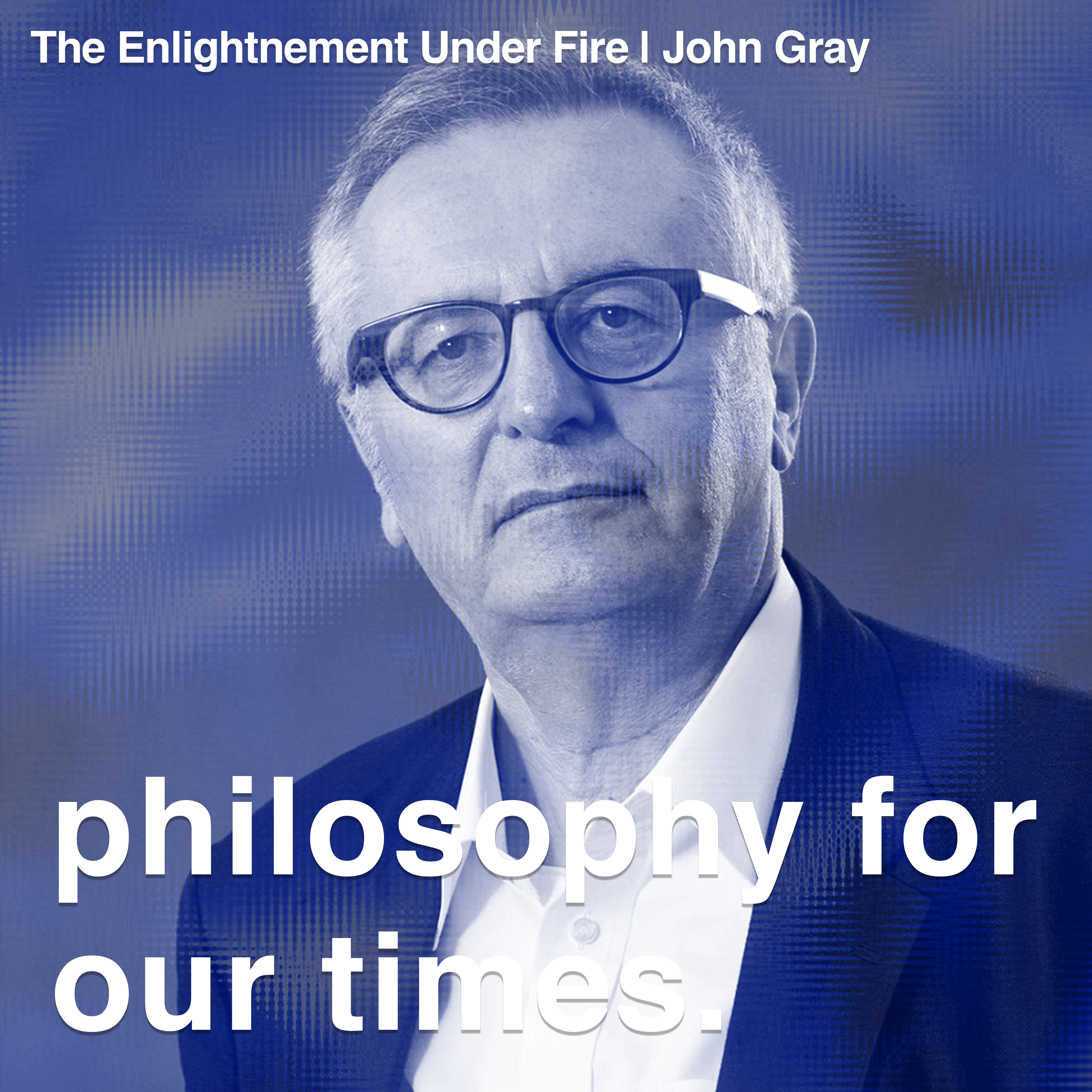
The Enlightenment Under Fire | John Gray
Dienstag, 3. November 2026 · 33 min
Kapitelklicken springt direkt hin
Shownotes
Is the Enlightenment a force for good today?
One of Britain’s most provocative thinkers, John Gray is a political philosopher known for dismantling liberalism and exposing the illusions of human progress. Former Professor of European Thought at the London School of Economics, Gray has challenged orthodoxy across the political spectrum with a body of work that ranges from critiques of Enlightenment rationalism to meditations on the limits of secular humanism.
He is the bestselling author of Straw Dogs, The Silence of Animals, and Seven Types of Atheism as well as a frequent contributor to The Guardian, New Statesman, and The Times Literary Supplement. Gray’s sharp insights and contrarian stance continue to shape contemporary debates on ethics, politics, and the future of humanity.
"One of the most important thinkers alive." — The Times
Don't hesitate to email us at podcast@iai.tv with your thoughts or questions on the episode!
To witness such talks live buy tickets for our upcoming festival: howthelightgetsin.org/festivals?utm_source=pod…
And visit our website for many more articles, videos, and podcasts like this one: iai.tv/?utm_source=podcast&utm_medium=show…
Transkriptvom Podcast bereitgestellt · Zeitmarken springen hin
26 11 03 John Gray Studio.CXP mixdown: I read a lot about medieval Tibet and right up to the invasion in by the Chinese in 1950. Stylized debates questioning the very foundations of Buddhism and therefore of Tibet society were a central ritual in the monastic life. it's very beautiful. Can you compare that? I mean compare that with what now goes on at Western universities. Sclerotic dogmatism being imposed on young minds, basically. Hello and welcome to Philosophy for Our Times. Bringing you the world's leading thinkers on today's biggest ideas. It's Charles here, and today we have for you our interview with John Grey. We tend to think philosophy should persuade us towards better, truer worldviews, but in this conversation with Hilary Lawson, John Gray argues that the real purpose of philosophy is disruption, not conversion. Lawson shares Grey's scepticism about our ability to access reality directly, but questions how he can therefore justify his own claims. On politics, Grey argues that liberalism has become dogmatic, refusing to acknowledge the political backlash caused by its own policies. However, Lawson points out that the collapse of liberalism would profoundly threaten political stability, something which Grey is eager to preserve. One of Britain's most provocative thinkers, John Grey is a political philosopher famous for dismantling liberalism and exposing the illusions of human progress. Former professor of European thought at the London School of Economics. Gray has challenged orthodoxy across the political spectrum with a body of work that ranges from criticisms of Enlightenment rationalism to meditations on the limits of secular humanism. Enjoy. John Grey, you're renowned for your critiques of the Enlightenment and progress and of course liberal humanism and and objectivity. And as a philosopher I share some of your criticisms of of of objectivity. And as the founder of I, many of the things that we are seeking to do is to explore what a world looks like when we don't have the ability to somehow reach through to reality in a straightforward way. So it is a great pleasure to welcome you here to How the Light Gets In. It's a great pleasure to be here because I followed what you've done both in your own work and now here at the the institution you founded. Yes. And I think it's vitally needed partly because not very much of it, or in fact hardly any of it, is being done in academic light. Yes. So thank you for that. So I I I'd I'd really like to explore the philosophical underpinnings of your view, obviously given our outlook. And you put forward a a very powerful and to to many convincing account of human society, human the human condition. But you are also critical of aspects of objectivity. And do you see there is a tension there? How do you support your own view? there is obviously a tension because I do at times refer to historical facts. I criticize people who neglect or pass over or somehow neglect historical facts. and there are certain, I think, continuing features of what it is to be human, that can be, I wouldn't say established, but can be discerned dimly through the evidences of h of history and common experience. In other words, I'm not one who takes the view that human nature is a misleading. Term that everything we think about ourselves as being basic is somehow a construction that can can be or worse yet should be deconstructed. I don't think that. But I think in this respect, I mean I'm there is the tension you mentioned, but it's also in many other philosophers that I respect. For example, one of the philosophers I most I've gotten most from, whom I started reading in the 1960s in English, is Schopenhauer. And Schopenhauer was a a radically skeptical Kantian. He thought that as Wittgenstein, very influenced by him in this respect, especially in his first part of his philosophical work, thought that there's much that's ineffable, but not that there's nothing there. He wasn't one of those who thinks that there's nothing to be silent about. There is a lot to be silent about and it it is there. So what I do resist, I must say, is the outright relativization of human nature on the part of recent thinkers like Richard Rorty. And I tell you why I do resist it. I resist it because it it it leads in practice always to a kind of presentism. It leads to the to a kind of reification and objectification of the ways of thinking we have now. And it can't go further than that. And that connects with another fundamental feature of my way of If I still do philosophy of doing it, which is that it cannot be done unhistorically. either I believe was a big influence on me in Oxford. He thought correctly that you can't do philosophy interestingly or usefully or productively if you don't do the history of ideas. R. G. Collingwood, earlier philosopher, a kind of critical Hegelian, I would say, almost, thought the same. So my I I resist the out and out. relativisation as it where there's nothing to be silent about. So you are obviously you know critical of some of the strategies of the Enlightenment. yeah. For example the use of reason and so forth. do you therefore not want to call on those strategies in defending your own view just to continue that sort of thought? Well, I mean I've been criticized for an ex for an aphoristic way of writing that I've adopted. which has been identified by many people as signifying a certain paradoxical, they would say, in telling for a an avowed skeptic dogmatism. I just sort of say things. Mm. But that's really as much an aesthetic o choice for me as an intellectual one. But there is an intellectual aspect which I'll come to in a moment, which is that when I s published Straw Dogs, which I think it was in two thousand and one or two, anyway, about twenty years ago. it was in part from a wish to write about philosophical questions in a different way, more like that maybe of Nietzsche or Lichtenberg or any of these other aphorists. And that is connected with something deep you've which is I strongly resist the Socratic met least as it's portrayed now, the Socratic idea of philosophy as a ca as the use of dialectic to affect persuasion. I'm not interested in persuading anyone from or to any particular positions. I'm interested in stimulating a process of thought. And that involves shaking up their way of thinking in some ways. It involves pointing out how culture and time bound it is, and that's connected with this constructivist momenting modern thing. You do come over as you're trying to convince people though. It's it's very convincing. Indeed, Straw Dog was a remarkable remarkable book. My my then I was introduced right about that time by to J. G. Ballard and we ki became friends t until he died and he said to me, every sentence packs a punch which is one of the best c compliments I've ever had. so that's true. And it might be paradoxical, but most my very lack of interest in con convincing anyone of any anything maybe enabled me to state my own thoughts in a way that if not convincing, I'm not sure that they convince anyone of a worldview behind it, but they certainly shake up a w the world view they've got. And I do have that that goal. But that's all. What moves human behavior is need and desire more than belief. And I share that view with I suppose with Freud, who in turn derived it partly from his clinical experience no doubt, but also from Schopenhauer. Because what Schopenhauer says his reason, or as I'm now told my belief, is like a kind of a servant. It's a domestic servant. It does what it's told to do. And finding out that how that works and illuminating, I think, is is extremely interesting and and does enable whoever does it moderately successfully to have a clearer view of the human world and of themselves. And that's worth it by itself. So it might not affect any other change in the world at all. But but you do in all of those things have a notion there of there being a clearer view. that that there is a an endpoint. And yet not necessarily. Right. You think so? I d I don't know it sounded, in the way the vocabulary it sounded as you elegant. And also these points of in these the process of inquiry is initiated in lots of different quite different circumstances. So even if there's a pragmatic asymptote, a pragmatic endpoint. It only tells you about that local part of the universe. I see. Or even the human universe. So would you in terms of that local account, do you d do you think that our theories and language are referring to reality? Do y do you know do you have that traditional philosophical realist version of language? No, because as I mentioned earlier, I mean I'm I'm what if i i to to use very old fashioned terms, I'm a pretty radical nominalist, that's to say, I think words are and concepts even and frameworks of ideas and so on are I wouldn't say tools in the narrowly pragmatic instrumental sense. Yes. Because they they grow of their own volition. Yes. They're invented and elaborated. They're like spiders webs. they have an underlying set of functions, if you like, in sustaining the sp the spider and providing a home for the spider, but they're not adopted Consciously I'm gonna have this set of concepts. It's how they happens. They're inherited and modified and then events happen and so on. Which can destroy them or at least greatly disrupt disrupt them. So but I do identify myself with an alchemist, hobbist philosophy of language. but I'm not a philosopher of language in any I haven't been in any extended way. so I haven't written as much as you have done on it, for example. Yes. Of course I I put forward a metaphorical view that language is a metaphor for the openness of the world, which I think has some points of affinity with the one philosopher who has influenced me a lot and who is known to the current philosophical world only for one line in Wittgenstein's Tractatus, in which he says, I think this brackets, but not in Mountness sense. That's Fritz Mountner, who is an enormously popular. widely read philosopher in Habsburg and post-Habsburg Vienna. And he was a radical non-nualist. He's he, I think, invented some of the metaphors about language that Wittgenstein himself uses. And he emphasized as strongly as Wittgenstein did in his early work, how provisional how partial, how instrumental language is. But I see the deep reason why I resist the view that concepts, the post-Kantian view or the Warfian view or that concepts constitute reality is that I think it's much it's anthropocentric. It's a type of human solipsism. very resistant to the reification of any human point of view as constituting reality. That's why. It it's a sort of solipsism. so I'm a n a radical nominal, use words but don't w what would you say? Countess of wise men or the the money of fools or whatever in Hobbes. I'm very resistant to that. So you you read philosophy as an undergraduate, postgraduate. In Oxford, yeah. Yeah. But but w w one of the things you you'll be aware of is that t The mainstream of philosophy in the English speaking world takes a very different approach to its relationship to reality, as it were, than than you do. And why do you think that is? And is it sustainable? It's hard to sustain it in a world in which so much is irreal, to use Nelson Goodman's term. Not unreal necessarily or delusional or illusory, but technology has made it harder to t to to take those traditional views. But although philosophers claim in philosophers of science particular to claim to be deeply cognizant of and influenced by science, it's I think in practice i they aren't that influenced by it. I the actual scientists, Heisek Heisenberg, for example. was very influenced by Vedanta. Yeah. by the non realist traditions of Vedanta. So the actual scientists don't see me. Why it why it is, I suppose a hangover from in in the British case of Lockean empiricism, also the fear of anything that sounds mystagogical or the lack of any strong phenomenological tradition of the kind that Husserl and others developed in in Europe and Heidegger of course in a different way. it's it's part of the national culture. It's more surprising in a way. Well in America it's associated, I guess, with inconsistently perhaps with a certain kind of temperamental pragmatism. we want it to be able to do things that are worth doing. And that even is an animating force in anti-realist philosophers such as Richard Rorty. I mean problem about Richard Rorty is I him by a charming man to lightful man. He'd never met an intelligent non-liberal. He'd never met one. So he didn't think there were any. I think oddly enough that Rorty takes over from the Enlightenment of which he's otherwise quite interestingly critical. This view that no one that basically to deviate from liberal values is just error. error. You just w and if you're if you're enlightened by reasoning, you'll give it up. that didn't that hardly ever happens. I try and express my w w myself in ways that are forceful enough to disrupt or defamiliarize the point of view of most of those who read my books. But no one reads my books, I think, unless they're already somewhat skeptical to the idea that their way of life or their way of thinking may be flawed. But you see, what does flawed mean if if there isn't something for it to be flawed about? So, I mean, one way of understanding what was is going on for Roughty and for Dorada, and I I I'm also critical of both of them, yeah. i is that they're trying to to prov provide a be be consistent about having an not having an overall story as it were. And of course the criticism is that well this allows ev anything to go or or it becomes a a narrow story of its own. A narrow story of its own. But but just to come back from your own position, the question is what is the alternative? Because you have many of the same motivations in terms of your assessment of the history. Yeah, the alternative is what Montagnet called essays, trials. Humanity is a word or a term or a concept like any other. which is useful in certain contexts and not very useful in other contexts. but that partly means what attracts, because having a a sort of semi stable or semi fixed idea of what it is to be human is on the one hand necessary, but if you become too sclerotic about it, it means that you can only describe others other human beings who might turn out to be the majority of the species in different ways, as non human. I'm interested in this respect, by the way, there are some Very interesting stuff written by the Aztecs. they're so different from us. I think it's in in so many different ways. When the when the conquistadors first arrived, they were amazed at the cleanliness and order and aesthetic gr aesthetic grace of the city. So the Aztec cities. but of course they also practised cannibalism and slavery and public torture. So Those are just cultural, radical f cultural variations, point point at radical cultural variations in our response. If you come from a Western tradition, that that's that they've somehow not fully realized themselves. And we're at we're at the high point looking down on everyone else. Empirical. as it used to be called. Just in terms of understanding your your approach, as it were, in terms actually maybe approach isn't the right word, maybe the method almost. Your your motivation. Yeah. So so that one way o of seeing your writing is that you are a radical critic critic of the Enlightenment and therefore, in a way, of the establishment. Yes. And traditionally Of course, put you on the left in the way that we think of the left. And yet your your instincts in terms of political theory are with Burke and Hobbes, who are traditionally on the conservative right. I'm not gonna get too hooked on those. Yeah. So how do you square those very different projects? The left projects in Europe and in Britain have pretty well all been Enlightenment projects, have they not? Yeah. So Why I didn't turn to the left. I I was an old Labour voter for many years, and I only but that was a v in a sense it conservatism on my part, because it was an established tradition by that time, somewhat corrupt in the northeast where from where I where I hail, but in a humanly acceptable way from kind of corruption. But my deep seated objection was to the the very idea of a rational plan of society. I think there's a direct link historically as well as logically between people who think that society as a whole should be planned in according to a certain pattern and dictatorship, because it simply comes up against the diversity not only within society, but within every human individual. Every human individual has conflicting and contending impulses and needs and im thoughts and images and so on. Squeezing that into a kind of overall plan. is inherently terrorist. So that's the reason. Now of course that can happen on the right as well. Yeah. Are are there, as it were, two sides of your p personality, as it were. W w one is wanting to shake things up and and challenge the mainstream, challenge the enlightenment, all of those sorts of things, lots of exciting and powerful criticisms of that. And there's another side of it that is is in favor of stability and order and so forth. And they feel as like th th they're two different personalities. Do you ever feel that tension in yourself? And and would you accept that description? to a degree. there is a I forget who who who said this. I think y I remember now, it was a a Russian fiddyist Jewish writer, Leo Shestov, who said, Anarchy inside order outside. Now, I think it's a lovely idea, but it's not practical because there isn't order outside. And the order outside that he wrote of vanished in Russia completely and was replaced by a new more constructivistic order, which had its own built in irrationalities and and and and insanities. But if if it's true a a society which can permit a high degree of sceptical, playful, ironical intellectual life, while maintaining certain traditions, which of course are not blind, they're only as blind as a batter's blind. is I think in ideas society. I tell you w I mean of course obviously I can't verify with that, but I read a lot about medieval Tibet and right up to the invasion in by the Chinese in nineteen fifty. stylized debates questioning the very foundations of Buddhism and therefore of Tibet society were a central ritual in the monastic life. it's very beautiful. Can you compare that? compare that with what now goes on at Western universities. Sclerotic dogmatism being imposed on young minds, basically. So when you describe the liberal humanist enlightenment view as a sclerotic dogmatism. Now, certainly. Which which say in many ways I I would agree with. there's also a way in which it could be seen as stable and and and in favor of some order in the way that elsewhere politically you're in favor of. So I guess well because why because I t I mean p how this works out in politics is I remember I remember hearing an interview with David Cameron, no great thinker, but he responded so he said, that's just populism. Now that what that struck me is that he doesn't understand the basic fact, if you like. I can use that term of fact, or the basic function of populism is a liberal term for the political for a political backlash against the social disruption produced by liberal policies. By imposing liberal policies on to say that's what it is. So if you don't understand that, you just see this inexplicable outbreak of destructive madness. And then if it takes on you say, well that's demagoguery. Demagogery's done that. So if you could only remove the demagogues or if so you have no explanation of the world around you. Why is it why is it I've been arguing like this for about ten or fifteen years now and all along people have seen been saying this is an anomaly. It was an anomaly Brexit was an anomaly. Trump Mark I was an anomaly. we'll a national rally government in France be an another anomaly? or all these movements all over they all reflect certain shade, at least in Bittensteinian common resemblance, family resemblances, very common pathologies, which a certain kind of splerotic liberalism or sclerotic hyperliberalism has brought about. So the trouble with representing it, which many liberals do this, if we give up with it, if we give this up, we'll just have utter chaos. They don't understand their old role in creating the they have no culpability, no sense of responsibility for the chaos that they've actually initiated around around them. what are let me put it on to what are culture wars? Because we don't have any more culture wars. People on the left say this all the time. You know what any other culture wars. But what are culture wars? Well, if you change the way people are supposed to speak, the way they the way they pl perform in sports, what their children can be taught at school. if you change all these things and some of them resist, that's a culture war. Well, all it means is that this is a very uncomfortable way for many people to live. It it's disrupting it's it's disrupting the spire the spires where that's my answer to that, which is that it's the sclerotic dogmatism of hyperbolic But isn't there the hyperbolic or liberal mind which produced the chaos. But is isn't there the the the the the counter that if you if we accept your your your criticism o of liberal humanism and say, well this is a challenge to that and you're shaking it up, isn't there a risk that then that generates a situation which doesn't produce the stability and order in culture that you'd like to see? I don't think stability and order I mean I'm in culture certainly not of a monolithic or monistic kind is either possible or desirable anymore. So I differ from many people on the right on that respect. Right. It's just not po a not possible, not viable. It would involve mass conversion and deconversion or re migration, horrible things that would only produce lots of hatred and suffering and despair. So the I don't think that's possible anymore. We've got to learn more to live among fragments, which is what what in fact we do. We are living among fragments, actually just be own up as to w as to what what that that means. It also, of course, greatly simplifies our view of the past. If we think that there was a a period of in European history, Western history which was after all the West. How old of a idea is it? I mean, maybe it's a Cold War construction, but if you wanted to take it back to the much further, it would be a a theological distinction between Eastern and Western Christendom. take it back to 10 1030 or whatever the great schism happened. So whatever the well the West was or or is, it was born in conflict. It was born in these internal contradictions over how to interpret a certain received missionary enterprise if you like so I don't share that aspect on that view that's why I like Hobbes because Hobbes He he was a monist in certain sense, certainly his view of human beings is too simple. For example, he he thinks bare bare existence is what most people want more than anything else. Not true. he bring about an idea of truth. Many people will give up their lives for duels in the eighteenth century, to promote many people I would s even go so far as to say, make meaning in their lives by killing and being killed. so It's it's it's grossly oversimple. But in terms of the society that is governed, there's no aim in Hobbes to go beyond what's necessary for peace. civic peace. You don't try and unify everything. You don't try and get everyone to believe the same thing, or you don't try to restore a lost cultural unity, especially if it's impossible, which it would it is which it is throughout the West now. So just a final question in the time that we've got. This festival is called How the Light Gets In and I imagine that you might not like this title very much. It i it does it does it feel as if it's rather unnecessarily optimistic in its No, I interpret it in a different way, maybe. My own in the idiosocratic way, which is that I I think you have to look at the dark to see the light. In other words, if if if looking for the light means turning away from the dark, that's a bad move. Yes. because you maybe not be i interested in the dark, but the darkness is interested in you. Well, in fact we are very interested in that 'cause the the the the line that it comes from is a lettered Cohen song and the one before it is there's a crack in everything. Yes. That's why the like how the like gets Well I love the fact that there are cracks in everything. Yeah. that's if there's anything salvific in the world, that's it. Yeah. Because it means there won't be an AI god. Yeah. there won't be any of these horrible i immutable utopias. They all break down. There's always rust. Trust is rust is the saviour of us all. And what goes with rust is c cracks and fractures and sort of they're built into the nature of things. And so I no, I I I think but we've gotta look at the gotta be ready. But not to look only at the dark on the other hand is a mistake. Yenisha was right about that. If you keep looking only at the dark looks back at you and that's not very good either. The abyss looks back at you. And so you could be so you have to be able to do as a few thinkers, I think. Not so much Schopenhauer, I think. I think he's he's too mon he's too metaphysically pessimistic for me. He's ruled by a single mood. Big mistake. Whereas Many people would think of you as being metaphysically pessimistic. Well that's because I'm in a culture saturated by optimism. Yeah. Or have been. and I mean for example, when I talk now about when you if you talk about decline, civilization decline, there are many people who say, well, it hasn't happened, we don't but even those who accept that it has taken as a pedagogic term, they can't accept that there might actually be irreversible decline. And I think there that's why I like particularly I like Greek Greek tragic drama and Shakespeare. Shakespeare is not an optimistic writer. I mean he writes beautiful light plays and ex no underlying You're certainly not driven by an ideolatry. No, and there's certainly no underlying metaphysics of optimism or of Christianity, actually. It's amazing how free of Christianity all of these. I'm not I admire Christianity in many ways. I'm very impressed by Augustinian moral psychological realism and I also like the I I think the the b biblical inheritance, especially the Old Testament actually, is is a very profound part of our culture. But what it has done, especially as it's been secularized in the Enlightenment, because Enlightenment is, there were thinkers that Enlightenment propagandists like to identify as as Enlightenment thing is in the ancient world in the Greeks. But if you read Lucretius, he's completely indifferent to the suffering. He speaks right at the start of his famous poem of watching with a mixture of indifference and pleasure. A boat sinking with all the people in it. No one who'd been brought up in Christianity could could have said that. So it's it's this kind of enlightenment as we know it is a neo-Christian project or or or s or set of projects. I think it's better either to go the whole hog and become Christian again than go on with all this all this nonsense. Well, John Gray, it's been absolute delight talking to you and and once again we're delighted to have you at the festival. Thank you for listening to Philosophy for Our Times. And if you'd like to hear more, please like and subscribe, and you can take a look at our upcoming festival in May 2027 in Heion Y, where you can watch talks like these live and meet the speakers. If you're busy, you can always head over to our website, iAI.tv, for thousands more recorded debates, talks, and interviews from the world's leading thinkers. Goodbye, and thank you so much for listening.
