

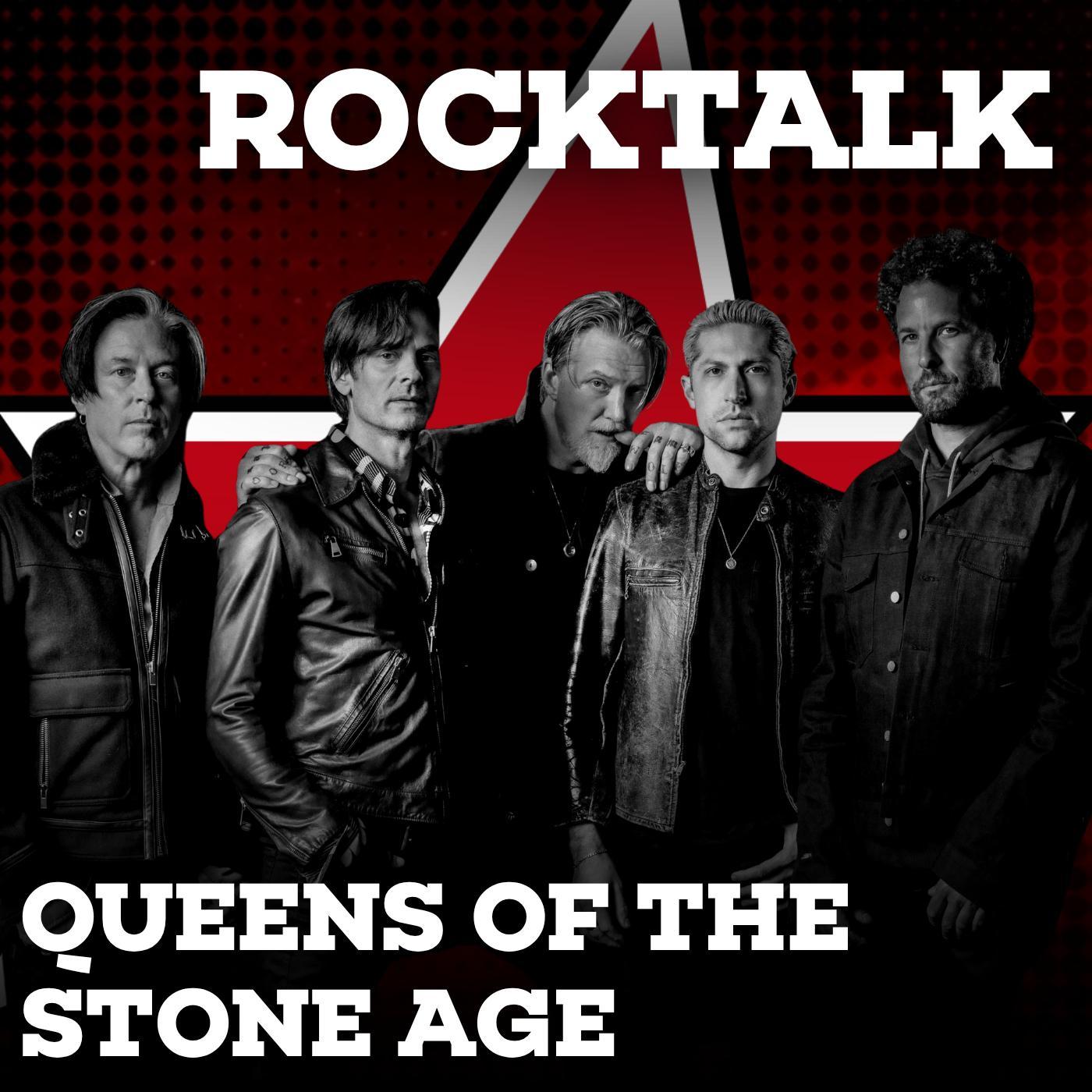
STAR FM Rocktalk· Folge 17
Queens Of The Stone Age: Gitarren-Therapie
Mittwoch, 14. Oktober 2026 · 27 min
Kapitelklicken springt direkt hin
Shownotes
Kurz vor dem Auftritt von Queens of the Stone Age im Berliner Olympiastadion trifft Simon Josh Homme im Waldorf Astoria. Bei ihrem Gespräch über das damals noch geheime Album PERFECTH geht es um zerbrochene Keramik, Black Metal und die Frage, warum ein Song nicht perfekt klingen muss, um etwas auszulösen. Josh spricht offen über Liebe und Verletzlichkeit - und darüber, wie all das seinen Blick auf Musik verändert hat.
Transkriptvom Podcast bereitgestellt · Zeitmarken springen hin
Hi, hier ist Simon und willkommen beim Star-FM-Rock-Talk. Bei uns im Sender haben wir ständig Besuch von den größten Rockstars und wir setzen sie selbstverständlich sofort vors Mikrofon. Und da geht es dann wirklich um alles. Die besten Stories, die ganz neuen Alben und natürlich auch der ganz alte Kram.
Aber im Sommer, da war es ausnahmsweise mal andersrum. Da habe ich nämlich einen Künstler besucht in einem Hotelzimmer im Waldorf Astoria. Und zwar kurz vor einem Auftritt im Berliner Olympiastadion. Ich habe mich mit Josh Homm getroffen, dem Sänger und Gitarristen von Queens of the Stone Age. Die Band spielte an dem Tag als Support für System of a Down und das neue Album Perfekt war damals noch strengstens geil.
Ich habe mich also mit Josh, der wirklich eine ziemlich einnehmende Präsenz hat, an einen kleinen Tisch im Hotel gekuschelt und er hat mir erklärt, wie zerbrochene Keramik und der Spaß daran, in ein Horn zu blasen, dieses Album geformt haben. Aber er hat auch von Black Metal und von seiner im Alter entdeckten Verletzlichkeit geredet.
Ein Rocktalk mit Ecken und Kanten, genau wie seine neue Platte. Und in diesem Sinne, viel Spaß beim Rocktalk mit Queens of the Stone Age. Let's talk about Perfect. And that's already the first question, because, you know, when you just... Well, it's actually called Perfect. And that was my question, because as a German-speaking person, we always have our difficulties with, like, pronouncing names.
And the TH especially did it. Oh. So this one was, like, a tricky one. We know the word Perfect, but we don't know with an H at the end. Yeah. Yeah. Yeah, making up words is fun. Bill Shakespeare did it. Why can't I? You know? So let's talk a little bit about the album. Maybe you could start off by telling me a little bit, you know, what, in your opinion, defines it as an L. Okay.
Just, yeah, well, I think it's, I think there's this Japanese concept, not a concept, it's a practice. It's called Kintsugi. Have you ever heard of this before? I think, actually, I have heard about it because of the PR text I received. Is that what's in there? So it was in it. So I did some research and yes, but please.
No, but I like Kintsugi because I like that practice of taking something which is broken, And through your efforts and through your care and attention, you somehow render it as something more than it could have been without this breakage. It's the art of repairing pottery that's been broken, putting it back together using gold leaf and gold solder. For like the cracks, you put it in the cracks.
Right, you put it in the cracks and sort of represent it. Und ich denke, es ist eine gute Praxis. Es ist eine gute Philosophie, wie viel von den Jepern, die die Jepern sind. Und ich glaube, ich denke, ich denke, die Rekord in diese Art, um, taking deine größten und vulnerable Moments und sort of allowing sie zu sein, dass sie mehr, you know...
Something mehr beautiful, in a sense? Ja, und ich könnte nicht haben geschrieben, eine Rekord, das war über Love, wenn ich in meine 20s bin. I just wasn't equipped to do that, you know. But I'm 53 now and those are the sorts of things that are important to me and, I don't care that I'm afraid of things anymore.
It doesn't, that feels like the direction I should be going. If I feel insecure about something or if I feel scared of something, that's where I should be going. I shouldn't be just jerking off to what I think I know, you know. But coming back to that metaphor of the Japanese technique, you know, when they're thought about it, you know, you take something that is broken and you butt, Wenn du das benutzt, die shape bleibt, nicht? Ja, oftmals.
Du kannst auch etwas aus dem Sachen ausziehen. Aber ich denke, was so brilliant about the Japanese ist, dass. Der Priorität ist, das ist etwas, das immer, das ist wichtig für mich. Der Respect ist ein Gift, du dir selbst. Und zu respecte others. Und frankly, wenn ich nicht jemanden oder jemanden oder jemanden, Es ist so impossible für mich zu engagieren.
Und ich auch liebe die Japaner... Und ich denke, das ist auch, das ist, wenn du... Haben Sie schon immer nach Japan? Natürlich nicht. Aber auch wenn du da bist, du hast die Trashman auf der Trash-Truck. Sie sind die Trash-Truck, der mit einem Selbst-Respekt, das ist wirklich obvious zu sehen. Right it's it's it's it's bizarre to my sensibilities because, if you're the trash man you're like fuck this job i can't stand right but but they're doing it with this sort of self-respect that's really noticeable, and and i think so on the subject of just repairing pottery as a philosophical practice repairing something broken and making it stronger and and sort of more beautiful because of the Das, ist eine cool philosophie,
dass ich natürlich nicht hätte, dass ich nicht mit mir selbst hätte. In welchen Sinne diese philosophie auch in musikalien, wenn du das Album schreibst? Ich denke, bei der Probleme mit den Schwierigkeiten, die du in dieser Leben erlebstst, und nicht auszuliehen. Es ist eine Song, der Insignificant Other, und es ist einfach als Beispiel.
If you're with somebody who's your significant other and you spend a lot of time together and if you have something to share with someone, you share it with them first because that's part of being in this relationship, and even to the point where you're like, oh, I'd die for this person. And then in another day later, it's completely over.
And those ends are such disparately different. That's so far apart, those points. And it's something people have to deal with all the time. Das ist so ein strange reality. Because on the music side, you make music that... You play music? A little bit. It doesn't take a rocket surgeon to know that when you're playing the music side, you just play something you think sounds cool.
That's such a simple origin. And you need to lay a thought over the top of that. And what shall that thought be? At this point in my life, I'm not really Interested in singing about cars Or dolls or, You know, food or politics, I don't give a fuck who you want to vote for. That's not what I don't want that in my music personally.
I value the escapism of music. I want it to take me away. And if it's going to talk about things which are real, I want them to sort of be the confusion and complicated emotions that everyone has to deal with. You know, that's more interesting to me. That's where I'm at, you know. Well, it sounds also like a little bit of cathartic for you, you know. Sure. Especially with that philosophy coming in, that you use those feelings, emotions, memories, work on them.
You have an outlet for them in some ways. Certainly. I don't see a therapist, I see my guitar. I do believe that if you make records honestly and authentically, and you pursue the things in your life which are difficult and sort of scary to deal with, dass die process of making a record you can unload baggage you can become a better person you can gain some understanding and that has this really valuable thing, for my life and I also think if I really love something and make something that I really care about then, I can attract someone that could really love this thing and it could be their favorite thing it could be the thing they use when times are dark or when times are joyous, because I want to be there with you then I don't give a shit when you're doing
your laundry I'm not necessary then, I want to soundtrack the high highs and the low lows and that's just kind of where I'm at and how does this get represented sonically really this album, if you put it next to the David record, actually he's got more akin Wir haben in Sonnach-Kley with our debut record.
Und Philosophically. The debut record is meant to be raw and singular in nature. The sound is supposed to be like one sonic thought. And the song is sort of like wear that, right? But it's supposed to sound singular, different. Ideally, you put it on and within three seconds you know it's us and it doesn't sound like someone else. That's important, right?
And here I think the philosophy where it needs to sound not like other people, and also it needs to proper sound for this emotion. There's a song called Mono on there and it's so raw. It's about total heartbreak, but that it should sound shitty almost because that's what that feeling is like. And it's done in mono. It's mixed in mono.
And that way when strings and things come in, they come in stereo and it's so wide. And when you are heartbroken, you're so one-track mind that it is mono. And you are broken, so it should sound destroyed because you want to try to get as sonically close to that feeling as humanly possible. Because that's the scavenger hunt you're on.
If I'm making a song about the heartbreak, how close can I get? So it actually sounds that way. You're not hiding behind layers of production and stuff. The opposite. You're showing every scar and there's fuck-ups all over it, but I think those are important because that's what makes it more human. You can correct and fix all your music if you want to, but oftentimes that leeches out the humanity and it sounds really fucking safe and really perfect.
And perfection is something you strive for, but it's not something you should actually expect. It's not something any of us could actually do. So when you correct your music, you're taking it to a, A place with a lack of humanity. Because the goal isn't for your music to be on the click and for there to be no mistakes.
Not for me, it's not. And I think even some of the black metal and stuff like that, what's cool is that they're playing so well that it's an exhibition of technique. If you fixed it, it's cheating. It wouldn't sound the same. You don't get the emotion. Black metal is a perfect example for that because it only exists in its rawn.
Und du kannst es in den letzten 90s, wo big labels get involved, und man hat mehr entwickelt, production-wise. Es hat sich das Echt zu. Right. The danger. Because they're trying to repackage it und sell it to you. Und wenn jemand gets involved in selling it to you, is der main goal, they cheapen this thing. They cheapen it, because they're like, Act out, you can get a second record for free, right?
And those sales tactics hurt, because they invade the emotion They try to get between you and the emotion you're feeling. The reason black metal is fucking awesome is because it's a scene that largely, shuns all that and is impervious to the salesmanship. It's like, you know, deep anger and deep emotions and reads to me like love songs that does because it requires such passion and dedication.
And after all, is that not love? Is it not love to be so dedicated and passionate about something that you forego all other things to pursue this thing? So to my ears and my sensibility, black metal reads like love. You know, it is love. And I think that's bitchin'. Is it something that, like, this kind of, like, niche music affects, like, what you do as well, like, you know, when it comes song-wise to the new Queens album?
Oh, I just want to, whenever we put out a record, because people have expectations. We always receive some sort of like, oh, fuck, because the whole point is to understand your expectations and crush them and not do that. You know what I mean? And I'm not going to copy myself. What do I need to go back for? This is, you know, you live one life.
We're in this moment and that moment it keeps moving. I'm going to stay in that moment. I'm not going backwards and I'm not going to rush ahead either but I do think, one of the primary building blocks of my job is to crush expectations, that's just surprise that's just that's what's cool about this is saying it's not what you expect, so go ahead and expect something because that way we can begin the crushing of that right because when your expectations are crushed then you reserve the right to be surprised by life and that's what's cool for me, The surprise and the shock.
Once you've let your expectations go, now what happens? Now that that's done and dusted, what are we going to do? So, I enjoy that part of it, you know. Do you just like intentionally, I mean, with this one, they were surprised the song by, you know, I mean, after the catacombs and stuff, we heard you guys like from other strings and stuff like that, you know, but this one was like, there was like a lot of that integrated as well and female vocals as well and stuff like that.
So, don't they like intentional choices to be unpredictable in a way? I think you hope that the grand total of it has unpredictability as an element of that. I don't want to just do things for unpredictability because that takes your eye off of what's important. I think you just allow, I think unpredictability will naturally come.
If you pursue a song and say, you tell me what you are and I promise to do as I'm told and serve songs as they are. So that means if you're like, I hear a female vocal here, that you don't pussy out and say, I don't want to do that, I'm afraid to do that, or we can't do that, that you shirk your own expectations and that if something needs horns on it, you know, I've used horns for years and und mask them as guitars because they're so guttural and well you fucking blow into it so I think you just allow, the sounds that you hear in your head to be actualized and that's your job and that if you really do that for each song each song gets its own individual, time and energy that you put into it then it will naturally be.
Es wird natürliche die expectation verändern. Und es tut es selbst. Kann man vielleicht mit einem Beispiel mit einem Rockmusik du starte mit der Lurie, du starte mit der Riff. Du hast eine Skeletin und dann ist es, du hast die vier Instrumente und das ist. Aber das kommt in different points, du hast, das könnte ein bisschen mit dem Strings There's a song called Where the Goth Girls At.
And that opening riff is so stupid and bonehead. And when you have five people that all want to play something interesting, at times you're all playing counter melodies and you're like, what's the actual cornerstone melody? So it goes boom, boom. Boom, boom, boom, boom, boom. And it became really clear we all need to just play the same thing.
No one do nothing different. Just all get behind this thing because it's so dumb and boneheaded this move, right? And it's plodding along. Now, by the time we get to the chorus, traditionally old school queens would, using keyboards and wah pedals and maybe octaves would go to this chorus, would go. Like we would make this as ugly and big as possible.
Und wir würden es mit Guitars und Keys machen. Aber dann war es so, oh, was eine interessante Juxtaposition. Wenn es eigentlich keine Guitars gibt, was es nur Horns und Strings gibt? Was wenn ein Orchestra kommt in? After etwas so stupid wie dieses Verses, das Stupidee der Part ist, was die Chorus ist nur Orchestra, und weil es so...
Weil das Juxtaposition sonnisch ist so... Really? The chorus is orchestra? There's one guitar playing a line, a counter melody over it, but it just felt so grand, you know? And it's so small and in unison in the verse, and then the chorus is so big and the landscape, it's almost like you turn on all the lights in a vast room sonically, right?
And that baton pass of this stupidity and singularness to passing the baton to an orchestra, that's where the heaviness is coming from. Those things feel exciting because you're starting by saying, wow, we wouldn't normally do that. And I think the joy comes from in saying, what's another way to do this that isn't just a habit?
Like, how do I break my own habits? Because I want to keep moving forward here. And I love recording so much. It's so much fun. And it's so much fun to have, to pursue an idea like, ooh, what if orchestras, it plays the chorus? What happens? And just to allow yourself, look, we're using words that we used when we were children.
I look at the guys in my band and I'm like, do you want to play with me? And that's the things I would have said when I was five. And that sense of play is what keeps you from being a bitter old cunt. You know what I mean? Und ich denke, Sie wollen das Gefühl, wenn du das Gefühl hast, wenn du das Gefühl hast, das ist das ich. Ich würde gerne ein Teil von etwas, das ist, in der Examination von etwas dark, ist es etwas Joyeus da.
Und so, das wäre ein Sonic Examen von diesem Rekord. Obviamente, ich glaube, wenn du es mehr und mehr integriert, und playing around mit es, wirklich, haben Spaß mit den Sons. Let me pause one thing. In the past, if you'd have said, or if I'd have said, yeah, let's have fun examining this thing, I would have been like, fun, what the fuck are you talking about?
What, this is like a pizza restaurant? But I don't think that anymore because I think of how in this modern day and age, sometimes just having fun, like a basic, simple, just that sort of gets devalued, or like everything has to mean something and all this stuff. It's like, no, no, no, no. Um i see the value in escapism, of what do you want to do and it's like i don't give a shit i just want to have fun i that you know there's a real value in that and where i would have been like fun get the fuck out of here with that before you know what i mean yeah, i mean creating is fun you know that's where it comes from it started as like, a thing to express yourself and what else is expressing yourself than like having
fun of yourself in a way i agree now but i also you know Für die Center part of my career, it was like, no, it's war. I want to push buttons and fuck with shit. It's war. It felt like an attack. Like, let's go. They'll never see us coming. We'll leap out of the darkness. But now it doesn't feel like war anymore. Es fühlt sich, wie man die interior des Lebens in diesem Leben und zu beenden, die Gefühle sind, die Gefühle sind, und was du in der Welt sehen, und was wichtig ist.
Und für mich, das ist Familie und Freunde, und deine Passions, und Liebe und Dinge, und ich möchte das auch verstehen. Wie fühlt es sich als 20 Jahre alt? Listening to this album you just recorded. If you would take this record and give it to yourself when you were playing in Caius. Well, in Caius, I only listened to punk rock music and I didn't want to be influenced, so I stopped listening to music.
I was like, I'm only going to listen to what I already know. I won't add anything to that. And when I was, we had a sound man, his name was Hutch, and he was like, man, you got to check out this music, you got to check out this music, you got to check. And I was like, I don't want to. And then I finally conceded and started listening to all this stuff that he was turning me on to.
And when I kind of broke out of that spell of not listening to music for a couple of years, I was like, I think I need to leave Kaisen, let it be preserved. It's time, instead of changing and all this stuff, let's leave this as it is. Let's try to preserve it. It's such a cool thing. And we'll leave it untouched and it'll just be like this for all of history.
It won't change that much, you know, and then I'll just start something else maybe or maybe I'll just quit, you know, so that's what I did, you know, I mean, well, I left I didn't expect that it needed to end. I just said I I'm done with it. I have to go. But, you know, more coming from like a musical set.
Do you think you would have liked what you do now as like a young man, angry man? Ich weiß nicht, wahrscheinlich nicht. Aber vielleicht. Ja, ich denke, ich würde, weil ich habe, ich habe gehört, zu diesem Jackson Brown record, Run on Empty, und The Doors, und Kenny Rogers, und, du wirst du was, und Charlie Daniels Band.
Ich habe gehört, zu einem sehr eclectic blend. Ich denke, das ist wie Kai's kam zu sein, ist es ein sehr eclectic idea. Es ist das, es geht nicht so, wie andere Dinge. Und das ist, because it was made up of strange chemistry. So I think I would have actually liked this because I didn't, you know, when it was time to play music at that time in my life, I was like, it has to be heavy and it has to sound like nothing else.
That's it, you know? That's why I tuned to C because I was like, I don't, that didn't exist. There was no detuning, you know? And I was like, this is how I can be an exhibition of myself of individuality. But what isn't out there? Let's start with that. I'll do what isn't out there. So I was like, all right, I'll tune my guitar down. That's how this starts.
And that would be the first thing that makes me sound different. And largely that worked. It still works. Well, now there's seven-string guitars and all this shit. None of that didn't exist. And I'm not saying I created that, but I did that solely because it was not being done. Because I wanted to try to have something that was different Das war es mir, aber ich habe das von Funk-Rock-Musik. Ich habe das von Black Flag.
Greg Ginn, die Gitarre Player von Black Flag, hat die gleiche Gitarre gemacht. Er hat seine Amp Heads gemacht und er hat sich komplett anders. Und ich war so, ich will das auch. Ich will nicht sein wie Greg Ginn, ich will sein wie mich. Und so, ja, da ist das. Ich denke, wir sind jetzt ein bisschen aus dem Zeit. Es wäre absolut toll, wenn wir, weil wir ein bisschen weiteres machen können, darüber nachher in der Zeit sprechen, um die Konzert zu sprechen. Wie, was du für dich?
Du bist ein Olympiakstadion, einer der größten Spannungen in Europa. Und es hat ein bisschen vieles attached zu sein. Wie fühlst du das? Ich denke, System of Down ist ein unglaublich und verrückter Band. In a weird way, I think we have a lot in common because we don't sound like them and they don't sound like us.
But that's what we have in common is a strange, quirky individuality. So I really like the... And their audience is great because they like strange, individual quirkiness. And so the audience has been really great. And so I've really enjoyed that. I think even the size for them is confusing. Talking to them, they seem to be much like, wow, what the hell is going on here?
Because it's so fucking big. It is huge. Yeah, and. That I don't love as much because it's just, I mean, it's cool. It's just so massive. It's so massive that it's bizarre almost. Ich habe nie gespielt, wo eine Band eine Einzündung hat, dass großartig ist. Ich habe nie erlebt, dass in meinem Leben. Es ist einfach einfach trippig, man.
You know what I mean? Yeah, I would shit in my pants probably. I'll shit in your pants then too. I would love that as well. Well, no, I think it's, I mean, it's not, it's not like daunting or, you know, it's just so strange. You know, I think it's a, it's just very rare error. You know, it's not, it's not commonplace to, it doesn't matter that we're on the bill.
They would have sold 80,000 tickets. Ich denke, es ist ein Testamento zu ihrer Kreativität und ihrer Individualität. Ich denke, ich habe einfach einen großen Respekt für diese Band. Das System of Down.
