

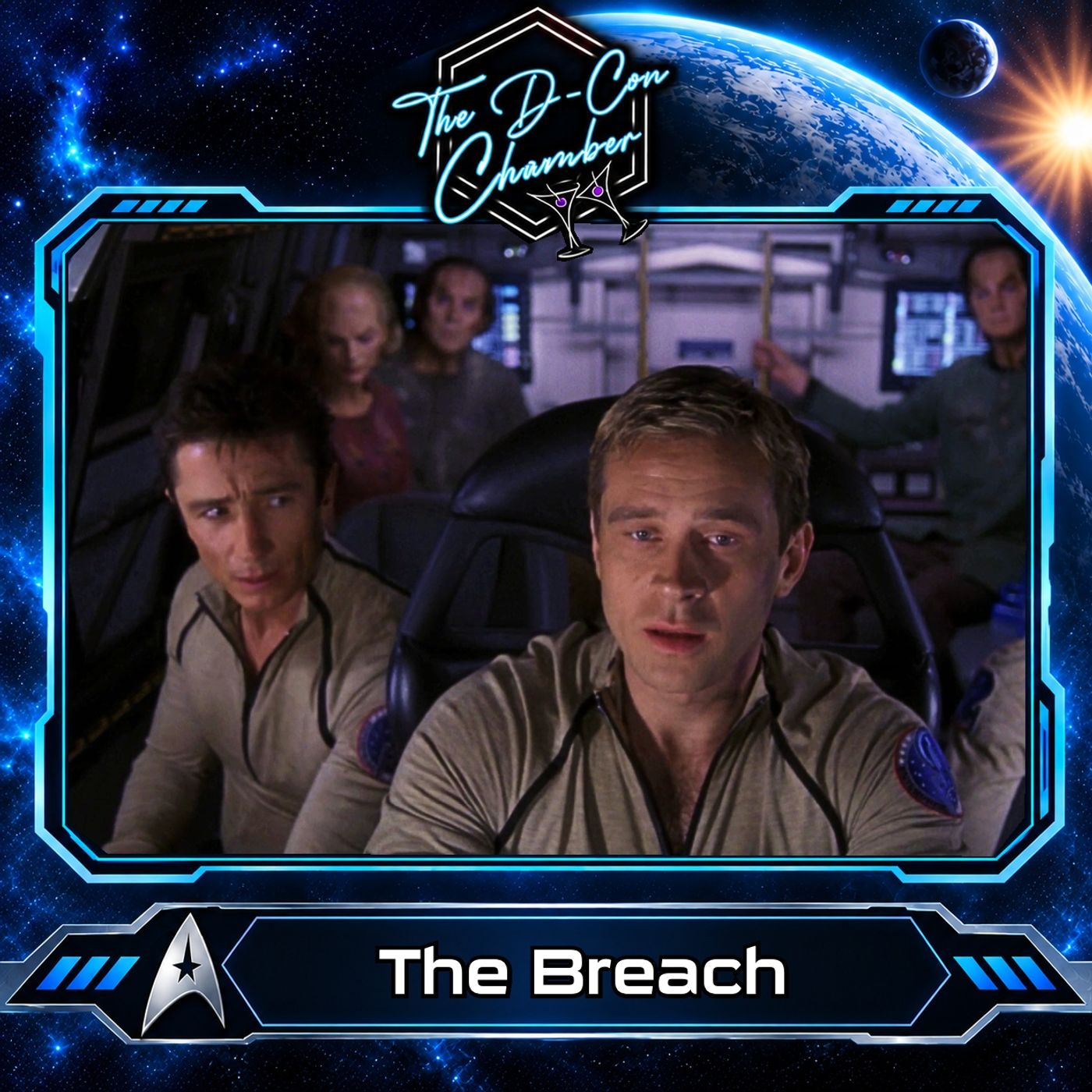
The D-Con Chamber· Staffel 5
Enterprise "The Breach" watch party with ROBERT DUNCAN McNEILL | S02 E21
Sonntag, 1. November 2026 · 1 h 12
Kapitelklicken springt direkt hin
Shownotes
Dominic Keating and Connor Trinneer -- with special guest, Robert Duncan McNeill -- watch Star Trek: Enterprise's "The Breach".
There are two breaches to be explored in this episode: one planetary, one familial. In our A plot, intrepid spelunkers Trip, Malcolm, and Travis go to save an (ungrateful tbh) Denobulan science team from a planet with unstable politics, to say nothing of the geology. The Denobulan history is explored even further on the ship when Phlox is tasked with saving the life of an Andoran, with whom their species has a terrible and bloody history.
Each week in The D-Con Chamber, we boldly revisit Star Trek: Enterprise through behind-the-scenes stories, watch-along commentaries, and conversations with the people whose lives were forever changed by the franchise. Whether they are breaking down classic episodes or welcoming special guests from across the Trek universe and beyond, hosts Dominic Keating and Connor Trinneer mix laughs, insider perspective, and Trek appreciation in every episode.
📸 Instagram: @thedconchamber
🌐 Website: thedconchamber.com
🛍️ Shop: thedconchamber.com/shop
🌳 Linktree: linktr.ee/thedconchamber
Want more? Find us on Patreon for exclusive clips + fun bonus content! patreon.com/thedconchamber
Become a supporter of this podcast: spreaker.com/podcast/the-d-con-chamber--618142….
Transkriptvom Podcast bereitgestellt · Zeitmarken springen hin
The show has begun with Connor and Dom. It's the Decon Chamber.
Ladies and gentlemen, boys and girls, Trekkies and Trekkers, welcome back to another Watch Party episode of the Decon Chamber. I am your co-host, Connor Trenere, along with my best friend and co-defendant, Dominic Keating. Today we are going to talk about The Breach, which is season two, episode 21. It is written by Chris Black and John Chabon and a story by Daniel McCarthy, who I don't remember. And it was directed by our guest, Robert Duncan McNeil.
Hey, Robbie. Hey. Hey, guys.
Good to see you, man. Great to see you. I forgot Chris Black wrote this. I love Chris Black.
Yeah, he's a lovely guy, isn't he? And he's a talented writer.
Super talented.
Did you see him in Vegas?
Yes. Did you see him? I didn't go to Vegas this year, and I haven't seen Chris in ages. But I remember, as far as your writing staff went, he was somebody that I really liked a lot. I thought he was smart. He was.
I don't know.
Yeah, I forgot he wrote this.
That's weird. Yeah, he's a very talented guy and he's very, just a pleasant man too.
Yeah.
He's lovely to know and yeah. He keeps wanting us to go out for a drink, Colin, by the way, so we should take him up on that.
Yeah, you should.
Before we get started, we were talking about this briefly before we started shooting. What are the unique challenges and are there always unique challenges in an episode that you walk into and what's the process of solving those?
Yeah, this one was interesting because of all the rock climbing. I mean, I'll probably answer your question in scattered thoughts. But one thought that comes to mind is I think I had recently seen Tom Cruise's Mission Impossible at the time we were filming this. And he was doing all the rock climbing. Do you remember that? He was climbing.
And the shots of, you know, these helicopter shots of zooming in and then getting up close to Tom Cruise on that rock wall, I thought were really dynamic. So I went into Rick Berman's office and I said, hey, Rick, I want to do this thing. And I knew better than to just shoot something and not run it by Rick.
For sure. I had learned that lesson. So I ran it by him. I said, hey, I want to do this thing where like imagine a Steadicam and we run through or move through the caves and then zoom into a close-up of the first line of each scene. So we were telling this story that they're just getting deeper and deeper and the camera flies through. And I said, like Mission Impossible, you know, with Tom Cruise, it's that flying into these tight shots. And Rick sat back, he goes, hmm, whose point of view is that? I was like, I don't know, it's the audience's point of view. He goes, no, they'll think it's an alien. They'll think it's like an alien chasing them. And it seems confusing to me. And I was like, oh, OK.
So that was extraordinary to hear.
I mean, I was disappointed.
Extraordinary, aren't they?
Yes, they really are.
They're a different breed.
Yes.
I was very disappointed because I thought it was a way to make. And your show was so modern. Like unlike Voyager, which was really modeled after next gen and like visually and just stylistically, I felt like Enterprise was from the opening credits of the theme song to just the style of the show felt the most naturalistic of any of the Treks in that era.
Yeah, I'll concur that.
Yeah, it did. It felt naturalistic. It felt modern. And so I was trying to, get Rick to sign off on maybe some more modern visual styles, but he didn't want to do that. So we were, you know, we shot it pretty traditionally, but as you guys recall, like coming into a, um, any episode, they've been writing it and talking about it for weeks or months probably. And you get the script on day one and you got, you know, seven days to prep this episode. So you're, I was trying to absorb this, visually this whole story very quickly and make a plan and they told me that they had set aside one corner of the stage for a rock wall and that we would use your existing cave which was pretty small your your little a
small thing they.
Built there we'll get into it they that passageway i remember they built uh where we crawl through yeah and uh and then you you had the luxury of just putting it on i think a dolly and just following us along didn't you yeah Yeah.
For that tight, the claustrophobic climbing, they did build, they adapted something that already existed. They did adapt something and do that cutout. Cause I was like, how are we going to shoot in this tight space? I said, what if we take out the, you know, a fourth wall so that we can kind of track along with them and, um, cover some of that. Cause otherwise we're just in this tube, uh, like a Jeffrey's tube or something that would be impossible.
So Before we get started on some of the, you know, the teaser and the chapters, I tell you, I noted that you got to direct really early on on Voyager. It was episode 18. How did you swing that, dude?
It was season two.
Oh, was it? I thought it was season one.
It was season two. But I literally on day one of our pilot episode, Rick Berman came to set, which he rarely did. But he came down to set that first day for our first day of wrap on the pilot. And as we were walking off the set, I said, hey, Rick, you know, I just want you to know I've been shadowing on some other shows. I shadowed on a series I did two years earlier that got canceled, never got a shot. I've shadowed some director friends on other shows.
I really want to direct. And he goes, oh, yeah, everybody wants to direct. Uh-huh. And I was like, no, I really want to direct. And he said, well, let's just get the pilot. It's day one. Like, let's just get the pilot, get the series. We'll see, maybe in a few years, you know, if things are going well.
And I said, no, I want to direct this season. I want to direct season one. I literally said that on day one.
That's quite ballsy. To Rick Berman.
Yeah, I didn't know Rick, you know.
You didn't know not to be frightened of him.
Yes, exactly.
I was naive.
But I said on day one, I said, I want to direct this year. And he laughed. He thought that was hilarious. I just took it really seriously. I actually got a career coach that first season. I hired, she was like a therapist almost, who specialized in people making career transitions.
All right.
That was quite.
Popular at that time in Los Angeles, wasn't it? It was, yeah. There were ladies in Malibu that you could ring up.
Yes, exactly.
Yeah, yeah.
I got this career coach. I was like, what do I need to do? And she gave me some great advice on just how to, you know, massage the situation and work it in a positive way.
And manifest it.
And manifest it and all that stuff. And so I shadowed a lot that first season. And then season two, Jonathan Frakes had to fall out very last minute. And I got a call on a Saturday from Rick saying, hey, you've been working hard. shadowing and observing and we were up yeah you ready yeah and so I started that next.
Week that must have been quite nerve-wracking.
Um it was very nerve-wracking.
Time or anything like that did you didn't do or did you have any prep.
Time I did Jonathan had not started his prep officially so uh when when Rick called on a Saturday he said you start prep next week Yeah, so I started prep that next week and just freaked out.
It was a Kes story, wasn't it? Yeah.
It was Kes getting kind of shocked by this energy field that we didn't understand. And Janeway had to go in this sort of spiritual vision quest to try to understand this energy field because it was a planet that had these spiritual beliefs that couldn't be explained scientifically. So we couldn't. We couldn't fix Kes scientifically. She had to go through this vision quest. And so I loved that first episode. It was mostly Kate, actually, mostly Kate Mulgrew on this vision quest and trying to let go of her science mind and open up to a spiritual experience.
How does she feel about, you know, the young Turk directing her in this?
She was so supportive, so supportive.
And Marvin, was he helpful?
Marvin was very helpful. Yeah. Marvin was always very helpful to everyone that showed interest in directing or in the technical side of things. He was very good at sharing what he knew and his thoughts.
He's very generous like that, isn't he?
Very generous, yeah. Yeah.
So the teaser for The Breach. I like the title too. I think it's great because in both stories there were breachers as it were. There's breaches of nationalities and of trust. And then in our rock climbing stuff, we're breaching down into the caverns of Zentaurus. But I like the opening with the Tribble. We introduced the Tribbles to the folklore.
Yes, that's right. That's right in the timeline you would be introducing them.
We've never seen them before. And Phlox alludes to, as Spock refers to it, the proclivative proclivities. It's not quite that. Multiplicative proclivities.
Of the tribbles.
Surely you must have realized what would happen if you removed the tribbles from their predator-filled environment into an environment where their natural multiplicative proclivities would have no restraining factors. Well, of course. What did you say? Which in English means they shag a lot.
Right.
That's all they do, eat and shag.
The nearest thing I can figure out is that they're born pregnant.
Which seems to be quite a time saver. I never knew that the way that they controlled that population was that these lizards that just put them in the cage.
The only thing that keeps their population in check is the abundance of reptiles on their home world. But it's a nice opening, a nice opening. And Hoshi's, Linda's reaction to him just casually chucking it in the cage after you see this rather nice furry thing is just priceless. It's a lovely little opener.
Yeah, Linda was very lighthearted in that scene in a way that often she could be so serious. I found her character often was very focused and serious. And there was something I liked about Linda's performance in that scene.
Yeah, she had the nuance to just throw some stuff away, you know. She's a good actress, I have to say.
Very good actress.
Usually scared.
And that's usually, I think, more of her level of energy. And it was nice to have that lightheartedness, definitely.
I think Phlox's reaction is a little. I mean, I guess it's a teaser. He amped it up a bit. So anyway, I think it's come from the Denobulan government that there are three scientists stuck on this planet. that is now, you know, assailed again by a militant faction. Apparently it's like somewhere in the Congo or something. And all off-worlders have been ordered out. And there are these three Denobulan scientists stuck somewhere deep in a cavern looking at speleotherms with the hope that that's going to help their seismic activity, I think, on Denobula, if I'm not mistaken.
Uh-huh.
Yeah. No, I think that's the fact. How much involvement did you have with the casting of everyone? Because I love the, what's his name?
Henry Stram, who- Henry was wonderful. He was wonderful. I remember as a director on Trek, you were always very involved in casting. In fact, one of the things I learned from shadowing Jonathan Frakes, they used to have this thing called the player's guide. Do you remember that? Yes. You'd put your headshot, you'd pay like 80 bucks a year, you'd get your face in it. It was a book that would go around to all the casting offices or whoever wanted it, and you could look up people. And I remember shadowing Frakes, and he would spend his entire first day looking through the player's guide.
Really?
And kind of going, it's all about casting. Like I want to think of ideas and names and people I know. And so casting is, yeah, was really important.
Do you sit on, do they bring you the final three as it were, or how does that work?
Well, back then everyone came into the room.
They did, yeah.
You didn't.
So it would be one day and they'd have seven people for that part and you'd pick one.
Yes.
Yeah. And everyone who, all the decision makers would be on the sofas.
Yeah, it would usually be, for Enterprise, it would have been the director, the casting director, I think Ron Surma was doing it. Ron, right. Mary Howard would be in the room, and usually a writer, producer.
Would Rick be there, or would he leave that alone?
I think Rick was in once or twice in all the episodes I ever directed, for big roles. Usually they'd be videotaping the audition. Right. So yeah, everyone would sit around, make your notes. And then we would, we would all have a conversation about who we liked and we'd pick our, usually our top two. And then we would send that to Rick for approval and then the studio. And then they'd have the tapes of, of that audition.
Would you get the final say or it's up to them after that?
No, it's really up to Rick and Brannon, you know, uh, on enterprise, it would have been their call from production to make a decision. But then the studio has to sign off on it. But Henry Stram is a phenomenal stage actor. And I was aware of him as a theater actor. I think he went to Juilliard. In fact, I know he did. Because I think we talked about that when we were filming. Because I had gone to Juilliard for a year and a half.
Oh, you got that in, did you?
Yes.
I did.
I saw that coming from around the corner.
Right. But we knew a lot of the same people.
You're like those Rada bitches.
Yeah, exactly.
Who are those Rada?
Well, I dropped out, so I don't get to claim it.
You get kudos for that.
I get a half a point for that. No, he's a phenomenal actor. And I don't know if John Billingsley knew him from theater, that they had known each other in the theater world.
Yeah, it was a lovely pairing, wasn't it? Oh, great.
Yeah, it was fantastic.
We're in act one. I guess it's, we have the meeting, don't we, where we're told that these scientists are trapped down there and Captain sets us to our charge.
The Denobulan Science Academy lost contact with them three weeks ago.
We've been asked to pick them up. Apparently Travis, I don't know where he's done his rock climbing before. He's a, you know, a spaceman.
He's got experience there, right?
Yeah, apparently. He's our captain on this one. But you know what the thing is, is that we did at least one day, maybe two. Oh, I think a couple. Lock climbing with Vince Dedrick.
With Vince Dedrick.
There you go.
Look for that foot positioning.
Make a pass. Come on. Piece of piss, as my English mate says.
No, Robbie, just Robbie.
I hope, okay, just Robbie, good. We'll never be out here again. Look at him, he's looking all tasty. He's smart.
Yeah, yeah, I see.
You know what?
You know what I'll do? I'll have Ben Betts make three copies. Oh, jeez.
Yeah, sure.
It was a very, I mean, we'd never done this before. It was, I think we all, we stepped up pretty well, the lads.
Oh, you guys look great.
And it was no mean feat. I mean, that set they built was, must've been 50 feet, maybe 60.
Yeah, they built it in the corner of the stage and they put dirt on the floor and rocks we could move around in the foreground. I did feel when they built that rock wall, that there were so many scenes that were supposed to be on the move. You know, you're supposed to be going from one place to another, to another, to another.
And I was like, where am I going to do that?
How are we going to make this look different? It's tall, but it wasn't that wide. It was very tall and built into the corner. And Marvin and I talked about it. And the way we tried to make it look different was to use those big rocks on the ground and shoot different angles with different rocks in the foreground and shoot.
So it looked like different terrain.
Yeah.
So we tried not to shoot it wide ever unless we had to and make it, to make it look very different from different camera angles.
I think that the lighting also. Lighting was great. Real dynamic role in those scenes.
Yeah.
It's darkness and, you know, you're only focused on what we're focusing on.
Yeah.
With the beams of light.
We did a lot of flashlight acting in our show.
Yes, you did.
We were already quite seasoned by then.
The one thing I remember acting when I was acting on Voyager that was so good that Marvin Rush was so helpful at training all of us for. And there's one other director I want to give credit to, Alan Craker, who would stage scenes with movement, with actors moving around each other. and having business and things to do so that the shots could not just be static.
Just be fluid.
Yeah, that you would hand off, you know, one line to the next and then someone would enter that frame. And so shots could continue and fold in, you know, one line folded into the next. Alan Craker and Marvin Rush are who I credit for that style, for me learning that style. And you guys did it a lot in this episode.
We did, yeah. I noticed that was actually, you know, we'll come to that scene, but that scene in the mess hall that could have been so static. You actually, you did exactly that. You come around Phlox to the back of, to Paul. Yes, we switched sides. You've got his coverage there. Then you come to just a closeup of her. And I thought, oh yeah, I see how that works now. Yeah. Clever stuff. Because otherwise that scene could have been quite sort of just purged, really. Banging on.
So we get ready. We're tooling up. There's a nice little joke in there with the poop bags.
Yeah, we take out everything we bring in.
Reminds me of Succession. They don't pre-poop them, Greg. Yeah, I have a bunch of them from back home.
Greg, that's disgusting.
Not really.
It's not like they pre-poop them or something.
It's not like... They're just bags, really.
But we're also told that we have three days.
Three days, the ticking clock.
If we don't find them in a day and a half, we've got a skedaddle.
Yeah, things are heating up on the planet. And so there's been some sort of accident down there too. And there's a lot of casualties coming up that we're going to rescue and try and attend to. And there's been a radiation leak. So there's flocks running around like a blue-arse fly attending to all these casualties. And then in walks one of the casualties, and he is an Antaran, or Ontaran, as the Americans would say. We didn't know this, but the Denobulans and the Antarans have had, you know, there's bad blood for over 300 years. The Denobulans sound like they were pretty dreadful, really.
Horrible.
Some sort of Nazi regime.
That's what it sounds like.
It did sound like that, didn't it? I think Phlox is the first one to notice that he's an Antaran and his face just freezes. You know, we wonder what the hell's going on. So then we're back to us. And I love that. I love the CGI stuff, our shuttle pod. Looks like we're in Utah, where you live now. It does.
I had to look at that again. I was like, did we shoot anything for that? And when I looked at it really carefully... It looks like CG people.
Yeah, they're little CG glasses.
I think your show, we never did that on Voyager. They had not really perfected or integrated digital people. But I know on your show, we did it a couple of times when I directed.
Right.
Yeah, I think we did it a fair amount.
Yeah.
And it wasn't cheap. And those days it was super expensive. I think a lot of our budget went on the CGI stuff. to make the show look modern, even though it had a retro feel. But I tell you what, the mirroring of that CGI shot and then our entering into the cave was really well done, mate.
It looked good.
It looked good. It didn't glitch at all.
No.
It actually looked like we were coming from that exterior, and I thought that was cleverly done.
I do remember those lanterns being a bit of a hassle.
Yeah, they kept banging on shit.
Yeah, up on the little extenders behind your head.
Yeah, it was like we were one of those pizza deliveroo boxes running around LA now.
I do like that line. You know, there is some humor in this episode.
And, you know, the last cave I was in had handrails and a snack bar.
Yes, that's a lovely, that's great stuff.
And a gift shop.
And then we're back to the A story and we're back in sickbay.
I stabilized him for now, but he's going to need intracellular regeneration.
The Antaran needs intracellular regeneration. I need that too, I have to say.
Sounds good.
I'm just in line for that. And I don't care what the Denobulans have done. But the Antaran comes around and takes one look at Phlox, and he would rather die than have this man, this Denobulan, touch him with a barge bolt.
I'd rather die than be treated by him. It does begin this existential crisis that both of them have.
That both these races just loathe each other.
Yeah, and I loved how... You directed that, Robbie. It was, you know, it could have been full of volume, number one, you know, and it wasn't.
It was, you know, it's that quiet pain that you're dealing with that's obviously for them multi-generational.
I have a sidebar because, you know, I do a podcast as well. You do. Deep Space Nine, right? We're talking about Deep Space Nine. We got Terry Farrell. We got Armin Shimmerman. We have our guests on. But what's been... Everyone kind of agrees is that when we were acting on Star Trek back in the day, we weren't given much direction. The directors didn't, you know, talk to us much.
I wanted to come to that with you. Yes. Yeah, no, you're right.
They didn't, right? Do you remember? Did I give acting thought?
Not really.
No, I mean, no.
I mean, and I wondered, I mean, did you ever feel like you needed to or wanted to or?
I don't I don't recall, but I do know when we talk about it on on the other podcast that I'm always thinking nowadays I give a lot of direction. I give a lot of acting notes, like especially.
On the show. You just finished up with Alan Tudyk.
Yes, Resident Alien.
Were you directing actors a lot?
All the time.
I met one of your young guys, Levi. What a gentleman that young man is.
Such a great guy. But we talk about the characters, the scene, the circumstances, the emotional turns and arcs in a scene. I talk to actors all the time. It's what I love about being a part of that process and you know, asking questions. I don't go in and say, well, you got to cry here. That's not what I mean.
But investigating the scene and kind of trying to find the right tone and make sure we're, you know, I don't remember directors doing that to us on Star Trek. And I wondered if I did it early on when I was, you know, directing early on.
I don't remember a lot of it. I do know it's, there's, you know, two camps.
Whenever I've been a guest star on a show, I get a fair amount of direction and the regulars.
Good job, Bill.
Yeah, they leave the regulars alone. Guest directors are afraid of the regulars, yeah.
Oftentimes, yeah. I mean, I remember the sort of direction that I remember getting was from someone like Jim Conway, and it would be, you know, if you were doing a walk and talk scene, it's like, can you get to here on that line rather than that line? But that was... pretty much it it was you know i needed it that mark there on that line yeah i always find that quite daunting it's like bloody hell mate you know okay i'm gonna.
Step this out i remember i remember being directed in a couple of really emotional episodes that var.
Seemed to have you know he.
Had those episodes i think the next one we're doing is co-genitor which is one of.
Them yeah and i do remember you know having some.
Real discussions about tone and objective and, and, and things like that.
And that doesn't.
Surprise me that it was another actor, you know, getting into that with you rather than what you would call a jobbing TV director.
Yep.
And a different sort of, and I spent a little of our two, you know, it's in many respects in the, in the Trek world family, as it were. So felt comfortable.
Yeah. Yeah.
I bet he going, going in there. And I think as actors, we, we, we, we, we, we welcome it. I mean, I do. You don't always have to take the advice.
Yes, exactly.
So Rafe Richardson was famous for going, oh, that's a jolly good idea. I hadn't thought about it. And if you didn't think of it earlier, you'd go back and do it exactly the same.
I was about to say, I would do that all the time. I'd go, oh, I see what you mean. Yeah, that's great. And then they'd walk away and I'd say to my fellow actor, I'm not doing that. No way.
So, yes, the Antaran comes around, would rather die than have this Denobulan doctor touch him. Act three, act two, sorry. We learn it's a 300 year old war between the Denobulans and the Antarans. A lot of bad blood. And this is the captain and the flock scene. Our two species have a complicated history.
It's been 300 years since they stopped fighting.
Since they stopped fighting. But there were 20 million casualties, as we'll learn, on the Antaran side. Clearly, the Denobulans were, you know.
Evil?
Fascistic evil society.
Did your doctor tell you that their battle tactics resulted in 20 million Antaran casualties? They sounded horrible.
I mean, like they were doing medical experiments on these people and... I like the fact that Phlox, you know, when he starts ordering him, I like this a lot about Scott's performance in our show, is that he's, you know, he's quite combative. Did you ever, did he just come up with that and you went, yeah, that's what I'm looking for?
I remember there was some discussion with Scott about this scene, and I don't recall, but I think it was one where he was He had some strong feelings or something, as I recall.
I won't let that man die in my sickbay if it can be prevented.
And I think we ended up kind of staging it very simply. I think maybe it originally... There's.
A long shot you use when they go outside of the sickbay that I found interesting. And you actually shot it from along the corridor and let it sit there in a long lens. And I thought that was good. Do you make all those choices, Robbie? Or are you discussing that with Marvin and.
There's always, you know, one thing I learned from Marvin, he said to me when I was shadowing and on Voyager, he said, you know, if there's one piece of advice I can give you, if you're directing, when you direct again, you know, he said once a day, at least once a day. day, give the DP a shot because the DP wants to be in the game.
So if the DP comes up.
To you and says, Hey, what about this shot? And it's not in your plan, but it won't mess anything up. And you think it's an okay shot. He said, just give it to him. because it keeps you, you know, the DP invested.
Yes, absolutely. And that was great advice. We always knew when there was a director that wasn't listening to Marvin at all.
Yeah, you could tell.
The pince-nez would go on, the paper would come out. And it would take Billy Pete's fucking hours to light the shot.
Well, I did that on your show once with Marvin where I wanted a shot. He didn't agree with it, I guess. Mm-hmm. And it was another episode I did with you guys. And I kind of pushed for it, pushed back with Marvin pretty hard. And he threw out the anchor and it was very slow. And I mean, I, that was my opinion. I mean, and the shot was very simple. It was just, I wanted to start outside of the mess hall and be tracking along the uh, through, you know, as if the camera was out in space from right.
Gotcha. Right.
Cause everybody was supposed to be looking out the windows at some thing. And I was like, well, I don't want to be inside raking. I want to see their faces. I want to line them up. So we come from one line to the other, to the other, and we sort of track along and then someone moves. And, and I think Marvin just philosophically didn't like the idea of the camera being out in.
Space, floating out in space. Funny. I mean, I would have thought that was.
A great shot.
We had a director on the show, you know, because I guess I'm getting the tonal elements of Star Trek in general and our show specifically, that we had to reshoot almost a whole day because the dailies had gotten back to Rick and he didn't like what was going on.
Do you remember what episode it was?
I don't, but I do remember the director, Dave Barrett. Oh, I know.
I remember Dave Barrett. Yeah, yeah, right.
He was new, you know, to the franchise.
He was that young guy. His dad, his grandfather was Mammoth.
Yes.
Dave's run. I went up there and met him.
Yeah.
I got quite friendly with Dave Barrett for a little bit, and I went up to Mammoth because I'd just started snowboarding. And, God, why am I blanking on Dave's run's surname?
Yeah, what is his grandfather's name?
They sold out eventually, but they made a fortune. But he worked for the DWP, and he was a guy that went up and measured how deep the snowpack was. And he was up on Mammoth Mountain in 1950-fucking-something, and he was a skier. And he went, this is a gold mine. And the rest is history. Dave, it'll come.
Sarah's going to find this out.
Stan Barrett was his father. I'm looking it up right now. Stan Barrett, his father, was a stuntman.
Was a stuntman.
Was Burt Reynolds and Paul Newman's stuntman.
That's right. That's right.
McCoy.
McCoy. Dave McCoy.
Dave McCoy.
McCoy's run. McCoy Station. I put mammoth. Yeah, we're boring the tits off the Star Trek fans now.
No, but Dave Barrett. Dave, I was very friendly with Dave as well. He became the producing director on Blue Bloods, and he brought me up to direct a bunch of Blue Bloods episodes.
Right.
And I went to the U.S. Open tennis tournament with Dave Barrett. He's a great guy.
His brother drove NASCAR for a bit.
Yeah. Yeah, they're all very action-packed stunt family. Yeah. But Dave shoots like a stuntman, very modern and very energetic. And it probably was not what Rick Berman was used to. Right. And I can imagine Dave having to reshoot some stuff.
So I think we get into the rock climbing. We've discussed quite a bit of this. But yeah, the rappelling stuff looked great. And I think you're absolutely correct, Connor. The lighting, Billy Pete's did a fantastic job. It looks otherworldly. I mean, that monochrome look is really lovely.
It also helps early on when we begin to descend that it's bottomless.
Yeah, it truly sells. I mean, you don't doubt that it's a long way down. One little bit of a trivia that my wife Sarah noted, the boxes that we find the speleotherms in that the Denobulan scientists are so keen on, collecting are collected in the Spacemaker plastic pencil boxes that every kid in the 90s had in America.
Were they really?
That's a fact. I think it's brilliant. Including my wife. Funny.
Hey, everyone.
Conor Trenere here.
Hey guys, Dominic Keating here. We want to thank you all for tuning in to our Star Trek podcast, The Decon Chamber.
We've officially opened our merch shop and we wanted to show you some of the t-shirts you can get there right now.
There are many designs, including these two wonderful ones. I went to Ryza and all I got was tied.
Up in a basement with him.
And let me tell you, this is just the beginning. We've got so much more to come.
If you want to check them out, head to thedeconchamber.com slash shop.
And if you are a Patreon member, you get a discount on all of our merchandise.
It's a great way to support the show and rep the Decon Chamber at the same time.
No, no, no.
We find a box that's a clue to tell us that we're on the right track.
We're on the right track.
We find the denobulans.
I don't understand. Why did the denobulans... collect these important samples and then shove them in a little cubby hole and leave them.
We need to find something to make sure we're on the right track, mate.
They couldn't pack them, I guess.
And apparently they're scampering up and down that wall all day long.
All day long, yeah.
So, yes, that's the captain scene next, isn't it? After we've seen us repel.
Yeah.
Did a really good job, by the way. We look great. I mean, our show was quite action-packed with the lads. We did a lot of stuff.
You did.
Unlike a lot of the other legacy shows that were, you know.
No, I think you guys, they wrote a lot more action. Like I said, I think your show was very modern. It was going for bigger action and more naturalistic performances and doing new things. It definitely felt. distinct from DS9, Voyager, and Next Gen, all were kind of in a particular mold. You guys broke that mold for sure.
Yeah.
You guys also, though, what was the Captain, your black and white 1950s?
Oh, Captain Proton, yes.
Oh, right, right, right.
That was a wild diversion from anything I think we'd ever seen.
Yeah, it was. It was silly. It was one of my favorite things we did, and we only did it, I think, two episodes is all.
Oh, really?
Two, maybe three, but it's not many. It was really just featured in one episode, but the other episode, or maybe two others, it had a very small part, but it was featured in one episode.
How did people respond to it? Did they like it?
Honestly, I don't know. Back in the day, I didn't track. I wasn't paying attention. Some of our actors were on these chat boards and CompuServe chat boards or whatever you had back in the 90s. It was not nearly as sophisticated as it is now. Garrett and Tim Russ, they were tracking the audience's response a bit. I think people liked it. I know the actors loved it. We got to play dress up. We got to sort of make fun of ourselves and vintage sci-fi. We had a blast.
It was great.
So there's no reconciliation between Phlox and the Antaran. And the captain gets quite volatile, which I liked, and lays out the law and Phlox pushes back. The captain reminds him he's on a human ship and the Hippocratic Oath is all that counts. I think that was amusing. You're a doctor.
He's your patient.
Find a way to help him. We're back in the caves. I mean, some of this stuff, me. Let's talk about the big action-packed fall. Because I remember you put us on trays, like large metal trays. that had some sort of, you know, ring in it that you just yanked us down.
We set up about 50 foot of track on the floor when we offset the camera so that it could look down at the stage floor. And then we put dirt all on the stage floor for your close-ups. Yeah. We dragged you across the stage floor. I had been a fan when I was younger of Romancing the Stone. Do you remember?
Oh, yeah.
When they slide down the, the waterfall and they're sliding forever. And then they splash into each other. And I wanted a romancing the stone kind of tracking shot. And that's the only way we could think to do it.
Well, do you know that cheat you? Yeah. Vince Dedrick did that stunt in romance.
Yes.
I forgot. He, we talked about that.
Well remembered. Yeah. Yeah, he did. That was one of his big early stunts that set him apart. God bless. How about that? And you remember that. Isn't that amazing? I'm always amazed by people's inspiration for the shot. We steal everything, basically, don't we? Either as actors or directors.
It's all been done before. It's all been done before.
But it's a great shot. Do you remember how much stunt doubles doubled for us in the dangling scene? I think we did a lot of this stuff. I seem to remember.
I think you did a lot of it. You certainly were hanging on the ropes quite a bit.
Yeah.
A lot of dialogue and things like that.
Definitely at the end of that slide, when I think it must be Trip falls off, that stunt guy.
Caught his hip and his butt.
He did, didn't he?
He launches.
Yeah.
I just, you know, you see the kind of work those dudes do and you're like, ah, how do you even walk?
Marcy, my guy, was tough as nails.
I was watching that with Rebecca, my wife. And when you hit that, there was like a bump at the bottom and the stunt doubles sort of hit it. And she has been talking about it for a few days now, making jokes about the family jewels and things like that.
It's a great sequence. And again, you just don't doubt for a second. It's just so well shot, mate. that we're really in this predicament. And Anthony really sells it up top. And I love the insert shots that the directors use, you know, with the hands, the piton pulling out of the, you know, it all happens. It's so well edited. It just, you know, carries it along, you know, beat by beat. It's good stuff.
That was a very important sequence. And it was the biggest sort of, you know, there's no big space battle here. Mostly you guys are climbing through tunnels or caves or things like that. That was the one opportunity to really Where they blow up. Big action sequence. And I don't know if you remember, as tall as that wall was, the slide part that they built for this sliding over the edge, it was only about 25, 30. 20 feet, wasn't it? Maybe. It wasn't very long. And so to get you guys sort of sliding, like romancing the stone and to build up the sequence, We shot a lot of sizes. You know, we did shoot wide shots. We shot a lot of tight pieces of that action to make it just go on for a lot longer. Because
if you did it in real time, it'd last about four or five seconds, maybe. They'd be over the edge.
I don't know if you saw it rained in my....
It was great.
Just a little bit.
This sequence, this little rock sliding sequence is on my demo reel. Is it?
Oh, nice.
Yeah, it's still on the.
It's got me now, work.
I don't know if it's gotten me any either.
How do you plan for that?
Like if you know you've only got, this is going to in reality be four or five seconds, we need to stretch it out.
Well, how does your shot.
Selection come into play and knowing that you have to make it longer?
Piece it all together?
Yeah.
I would storyboard. I'd shot list first, try to think of, all the pieces and then storyboard with Dan Curry would often be the one drawing the frames. We'd storyboard out these sequences. And then you sort of identify, well, we could probably stay in that close-up of him sliding for two seconds and then the other close-up for two seconds.
And you start doing some math and kind of going, all right, now we can take this slide and it's going to be a 20-second action sequence rather than a three-second slide. You can make it seem a lot longer, so.
The next really important scene is back in the sickbay, and I really like this scene. This is the meat and potatoes, isn't it? The confessional. And I tell you what I loved about it, Robbie, is that you shot your man, Henry Stram, playing Hudduck, through the gauze sickbay curtain. Do you remember? Was that your choice to do that?
I remember the curtains were there, and I think on the day... I looked at it and I was like, that's interesting because there's this wall between them. There's this emotional wall. They're on completely different worlds in terms of.
And it's like a confessional.
Or like a confessional. It just felt like an image that fit the story, the situation, the relationship.
It really added a lot to that scene.
I always like visually, and I don't mean to pretend I'm some... fancy artist esoteric kind of person but i just i always like visually especially in drama or genre stuff that there's layers of there's some obstruction you know it's something dirty in the foreground there's you know there's a microphone there's a there's things you know that you feel the three-dimensional quality and i used to have i still do actually i've got this um book I saw years ago called The Interpretation of Dreams. It's a book with pictures mostly, and it talks about different emotional experiences and the symbols in your dreams, like a bird, what that means, or a flower, a healthy flower, or a dying flower, or a clock, or what do those mean?
What are the symbols of dreams? And I used to, when I was prepping episodes, I would go through that book first I'd identify like, oh, this character is dealing with death and mortality. And then I'd go through the dream book, these images, and I'd ask props to get some of those things, like get me a clock, get me a flower that's dying. I would stack it up in the frame, you know, or come through the clock as I discovered the character. So even if it wasn't scripted, even if it's not noticed by most people, maybe subconsciously, they're kind of getting this universal symbol of mortality or time passing or whatever it is. And it's adding to it.
So I love layers that are stacked and I love that you call, you know, caught the curtain being whatever kind of abstract. Yeah.
It worked very well. I just thought it was, as you say, some barrier between them.
Yeah.
There's so much information here that's, that's doshed out about the Denobulans and Intarans and this, this never ending war. And, uh, the prejudice that's passed on from generation to generation, it still resonates. I mean, Connor and I have noted about this. We've been watching our show now for about a year and a half and doing these watch party. Somewhat sadly, so many of these, you know, philosophical debates that our show brought up are still so resonant today. And, you know, 25 years on, you know, politically, socially, we're still floundering around And I think this part of the episode really highlights that.
Yeah, definitely.
I also thought it was interesting with Phlox in that, you know, he always comes across as somewhat the Enterprise sage. Anytime there's anything wrong, Dr. Phlox has sort of like the rationale behind, well, think about this.
The wry smile, yeah.
He pops off and he can't manage it.
You're the reason we haven't been able to put the past behind us. You have kept this hatred alive. No.
I thought that that was the real.
an interesting character that we hadn't seen before.
Yeah, agreed. You know, it brings up a lot of old feelings and it turns out, you know, he was, you know, almost poisoned by his grandmother, you know, mindfully about these Antarens and somehow he managed to, you know, wriggle out of that, the generational grip. And we find out later on that, you know, he brought up his five children and, to think completely oppositely. I was determined not to raise them as I was raised. Except for his, is it his youngest, Metis, I think it is, isn't it?
I think it is. Who, you know, has sort of joined the manosphere, if you will, and still harbors these resentments. But I am proud to say that my children would consider my grandmother's attitude archaic, all of them but one. But it's a really, that's a really, it's a really good scene. And then it sort of, it's carried on into the Messel scene with Jolene as to Paul. And that's a lovely scene too. And as we've noted, you know, what could have been quite static is it's actually a very poetic scene. And Phlox sort of, you know, again confesses that I was brought up in a very different way and different thinking, but I've changed track. I think it's a really nice sort of denouement on that, you know,
discussion of what that A story is.
One thing I'll say about Trek is, and I've read that, you know, Roddenberry- was very inspired by the Twilight Zone, Rod Serling's Twilight Zone, to kind of create these little.
Vignettes.
Vignettes, these stories that were... Analogy is not the right word, but I can't think of the word I'm looking for.
They just shone a light in a sort of otherworldliness. They shone a light on the reality of the world you're living in.
Yeah, they sort of resonated on the story level in this Twilight Zone story, but also on a present day level. Also sometimes on a personal level. And I find that that's true with Star Trek lessons like this about Phlox, the Denobulans and the Antarens stories about each other that last for hundreds of years that they just can't let go of, even though they're not living it anymore. And I was thinking as I watched this, it resonates on a kind of public level that we can say, oh yeah, that happens socially and politically with us in the present day.
We have stories about other countries or other cultures that we have biases, right? But also on a personal level, you know, I've experienced in my life, in my family, we have family stories that people say, oh, dad was like this or granddad was like this. And I never saw that. There's a part of me that like, I think this lesson is true, not just in a social political way, but in a personal way. Like we all hold on to stories and big levels and small levels that maybe those stories need to be let go of.
And we need to. Agreed. I was born and raised the Catholic somewhere around 12, 13, 14. My father died when I was 13. My mom took to the church like a magnet and I went the other way. Look, I don't, I'm not, dissing anyone for having faith. It's a beautiful thing. But I just, you know, it was a big step for me to let go of my Catholicism, my Irish Catholicism. That somehow was a sort of story about who I was. And it really took some, you know, some time before I could let that story go.
Yeah, it's really interesting.
I forget the name of the show, but it's a PBS show where he talks about his.
Guests genealogy and their past and their, and their history. What is that called?
It was an English show originally, wasn't it? And they, they go back into your whole.
Family and all that.
And anyway, they had, they had Barry Diller on Barry Diller had believed this really fantastical, like crazy story about his mother.
And through the whole, the episode.
And they, they talk about this, what actually happened. Cause they have, you know, they have, dates that have ledgers they have you.
Could go to ancestry.com has been a huge you know but the thing that barry diller said was like this changes my entire narrative of my whole life.
That's what i'm saying that's the lesson i got from this is like let.
Go so we're back to the lads and we've discussed this uh pretty much already with that we have the crawling through the tunnel scene which is really well done a lot of action we we detect three biosigns that are denobulant And all of a sudden we're getting to act four and we arrive at their sort of cavernous scientific collecting area.
Which was the exact spot at the bottom of the rock wall.
It was, wasn't it?
We just put a bunch of light on it. We lit it up finally.
It looked great. Jimmy Meese, who was the production designer, did a lovely job setting that set. And God bless him, I have in the corner over there two massive crystals. I went over to him and I said, Jimmy, what's going to happen to all those rocks, mate? And he said, what do you mean? I said, two of those look really nice in my new house, pal.
Oh, how funny.
And he said, bring your truck out. I put a blanket over them and they've adorned my corner. over there for 25, 30, 26 years now. God bless. Wow.
This episode?
Yes, this was the episode.
Yeah.
So we've, you know, we informed the Denobulan scientists that we've been instructed to, you know, because there's trouble at Mill on top.
Yeah.
And they couldn't give a shit.
We're sorry you came all this way, but we're not leaving. So wonderfully annoying.
They are so wonderfully annoying, aren't they? And I love that when Malcolm walks forward, like, yep, The mobs here, do as you're told. Finally, they relinquish their attitude and we're on the move. And then we're back in sickbay. There's more stuff between Phlox the Antaran. And we've discussed this, actually. Yeah, Phlox confesses about, you know, Denobulan's attitudes all this time and through generations. And he mentions his son, Messus. It's another...
you know, a nice button on their relationship. And the fact that he hasn't spoken to this son of his in 10 years, that's a good scene. I just, that was my note for that. Then we're on the move again, getting the denobulans out. And that's when we're shamed as we stop putting our thing on the road to inch ourselves up foot by foot. It's hilarious.
I had wanted to see the climbing, like do a digital version of that. And we just, I don't think we could afford it, but I wanted.
One bit there that you actually had to contend with, but you've got a massive rock fall moment. You know, how many times would you get to shoot that? I wouldn't even remember once. Get it right one time.
Yeah. We put a lot of rock stuff in front of the lens. So most of the rocks in the shot.
That's the cheat, is it? Right.
Yeah. You put it right up in front of the lens. So again, foreground, you know, it's all this stuff falling in the foreground. You don't notice. that it's not falling everywhere else and keeps you guys safe as well.
Then we're back on the bridge and the Xantorans are bringing their deadline forward and getting on our captain's ass. And all of a sudden they're threatening, you know, World War III with us. And I love the fact that Captain Archer does not back down.
The question is, do you want to be at war with us?
Do you want us to? And he starts charging our weapons. It's like, you know, bring it on, kids. Stick to our original agreement and you won't find yourself fighting on two fronts. We're back in sickbay and the full reconciliation has happened and your man Huduk has taken the treatment and he's going to survive.
I have children as well. I've decided to accept your treatment.
And that's all lovely. And then the lads are in the shuttle pod and we're coming home and we get a little bit of, you know, arse-firing chase from the Xantoran, you know, military. But other than that, it's nothing but a sort of passing glance. And then we have that last scene with Phlox in sick bay is, you know, it's a really lovely scene. So sweet. And the fact that you shot it in silhouette was lovely.
Oh, thank you.
Tell us about, you know, because it's a lovely button on the whole episode.
Yeah, I mean, I don't recall, you know, choosing those shots necessarily or why I chose them, I guess.
And you shot him again quite from the side in a long shot. There were one or two close-ups only at the end. But otherwise, it was him confessing and trying to mend the breach between him and his son, Metis. It was very moving.
Yeah, it's a universal kind of moment, isn't it?
It is.
A lot of people have either been on one or the other side of.
Well, a really good episode, Robbie.
You too. Great work. You guys worked your butts off there.
We did. It was because we had a day, at least a day and a half, I think, learning how to rappel. Vince had a wooden, you know, like sort of wall in his backyard.
Oh, of course he did. Yeah. Oh, Vince was great.
He also took us out to, you know, out the 118.
Yes.
But then we went and did some real rocks.
Yeah. Wow. It was fun.
Yeah, it was. I mean, that's one of the wonderful things about being an actor. You learn You learn new skills often and you learn new worlds and new parts of history that you never, you know, would have looked into. You know, you're constantly examining human nature and that's always an interesting thing.
I still have my climbing shoes.
Do you? Do you really?
Yeah. You took those?
Yeah.
How about that? What do you do with them?
I put them in a bag.
I walk around them.
Yeah.
Great.
I scaled the side of the house.
You ended up directing, I think, 10 episodes of our show.
I don't think it was that many, but maybe. Maybe.
Definitely. Maybe I'm mixing you up with Roxanne.
Roxanne did a lot more than me.
Maybe it was her that did 10, and you did maybe half a dozen or so.
Yeah. I enjoyed doing your show.
Do you feel like you really cut your teeth to be able to go on and do Chuck and all the other stuff?
Yeah. I still think about the lessons I learned in Star Trek. even though visual effects has evolved far beyond what we could ever do back then, the ideas, the fundamental ideas of how to, how to approach a visual effects solution are still the same ideas. In fact, I was talking to Roxanne about it not long ago. She was on that show foundation. I think it's Apple TV, but big, huge budgets. I mean, you know, like, in the scale of Game of Thrones or Dune or something, the size of that show. And she said, you know what was great? One thing they loved about me on that show, she said, is all that Star Trek visual effects lessons that we learned. I was able to save them money. I was able to say, well, if you
did it like this and, you know.
Don't have to use that split.
Screen or you, you know, you lock the camera off, but you can shoot this way. And all those lessons, you know, I still use and clearly Roxanne still uses them as well.
This is an appointed question. Have you essentially retired as a producer, showrunner, director, or are you still.
Thinking to be active? I'm 60. I'll be 62 in November. I need a few more years of my health care and all that. So I have been directing. I directed this show, Stuart Fails to Save the Universe, the HBO show that's that's on right now. Jonathan Frakes actually ended up directing on that as well. So he and I were the Star Trek representatives in that universe. But Stuart Fails to Save the Universe, which is a Big Bang Theory spinoff on HBO. It's a single cam comedy, sci-fi comedy.
It's very funny. And then I directed a couple episodes of Baywatch, the reboot that's coming out.
Those couldn't be more different.
I'm grateful and fortunate that I've been able to do comedies and action shows and procedurals and sci-fi. I don't know how I ended up with this very weird, eclectic resume but um i enjoy it i enjoy comedies a lot i probably if i had to say my favorite thing to do is comedies but i like shooting action stuff too and and you know the business has changed a lot since we were making star trek the the landscape of television has shrunk oddly shrunk i.
Know i mean for the amount of content that you see out there it's it's you can't quite weigh it up No, it's very strange. And there just aren't the opportunities for actors. I don't know what that's, I don't know.
And even if you have an opportunity, your survival is, you don't have it. You're not getting paid enough.
It's brutal.
We used to make, what, 22, 24, 26?
26, we did. So we make 26 episodes. So even if your episodic rate is not exorbitant, You're making 26 paychecks every year. Yeah. And it's running for year after year. Now, I just read today, actually, that in Los Angeles, in the last two years, they have lost 46,000 TV and film jobs.
Yeah.
Wow. Compared to the previous two years. Yeah. 46,000 jobs.
Virtually nothing shoots here anymore.
No.
There's two, three shows. I mean, literally. And they're big ones.
Yeah.
The Pit.
But I mean, literally everything else goes to every other state. And frankly, I mean, look at Marvel went to London.
Yeah.
It's cheaper for them to shoot in London. In London.
Yeah.
Where taking a piss costs you five quid. Yeah.
My heart goes out to the crew, you know, because we lose our jobs all the time.
We get new jobs. We can travel anywhere. anywhere around the world, but these people were raising their families in.
Burbank and the rug got pulled out from under them and there's no work. No.
And this merger that's just gone down is not going to help. And we'll see. I'm glad, honestly, I mean, not that this is the ending doom and gloomy, but we're very lucky, the three of us, that we had our time when we did.
Yes.
Very lucky.
And I'm curious to see how entertainment and storytelling evolves, because I think, you know, I remember in the nineties when we were making Voyager, I would fly up to Sundance film festival every year because I got so inspired by these independent filmmakers that were making movies, finding the money to make a movie with, with, you know, no resources, no distribution, nothing. And then going to Sundance and, this work was so exciting and the independent film world has kind of disappeared. It's.
Yeah, it was. I mean, the problem was, you know, three to $ 6 million movies, unless you've got a good opening weekend, you lost your money.
But I think there's an opportunity now for people in television that used to work in television to make new shows without the studios or streamers.
Agreed.
There's a way to do it through YouTube or other.
Yes, absolutely. And you don't need to spend three to six million dollars to do it. You can spend look at that obsession that just as they made it for 750 grand.
Yeah.
And it's made gazillions.
Yeah.
And I saw it on a plane the other day. You know what? It's it's not my cup of tea, but I can see it appeals to a demographic and a certain age group. Yeah, that's exactly what they wanted to see with new faces. That's another thing that someone said to me. recently at a cafe I was at when I was shooting something in West Virginia. She was a young girl and she was talking about this film.
She said, God, it's just so refreshing to see just not the same old actress faces in every movie you go to.
Yeah.
It was like, yeah.
I also think like, you know, Ben McKenzie, who was on The O.C. and he did, I think, Gotham for years. He just made a documentary that he financed all himself about crypto. The downside, you know, kind of explains an expose of crypto, the crypto industry. But Ben made this movie. He's been taking it around the country to theaters and showing it and speaking about the film because he's passionate about the material and about his movie. And I think it's doing very, very well. I think you can now get it on Amazon or, you know, on Prime or something.
But I would say whether it's scripted work or make your independent documentary or feature film or short, And then show it where you want to show it. Like, I think there's opportunities for all of us. We're going to have to look outside of that old business that was so good.
Yeah, that model's gone.
That model is gone.
That model's gone.
Shoot it on your iPhone.
Shoot it on your iPhone and get passionate about something. Go make it.
Yeah, I always remember, just as a last parting, when I asked you about directing, because, you know, it was in our crosshairs to do it on our show, but the relationship's all... fell apart and that all went away but i remember you saying to me go away and make a short three minute film don't do a 20 minute film make a three minute film yeah make a story and use that to cut your teeth you said because i remember you you went away and made quite an extensive first piece didn't.
You i made a almost 30 minute for sure.
Yeah and you said it was a bit of a mistake it was.
A mistake way too long and then i made a 10 minute short film but even that I don't think it needed to be 10, three, five minutes.
Cut your teeth on three to five minutes.
Yeah, work on some small baby steps and try some different genres or styles.
Well, didn't you, having done those shorts, or at least one of them, kind of galvanize Rick to allow you to direct?
No, I did it after I directed my first episode. I made my first short film. I had shot something just as an experiment that I never showed anyone. Ethan Phillips told a joke one day and I'm like, oh my God, that would make a great short film. So I took his joke and I shot it on a weekend. I scripted it out and I got some friends and we, but it was a short five minute short that I never showed anyone. Cause it was, there was a lot of things I hated about it, but But it was a great experiment. It was a great lesson for me.
And I took some classes at AFI and did a lot of that stuff. But yeah, I think the time is ripe for the Sundance mentality of the 90s to come around into TV and other kind of content like you're making your podcast. You know, it's that people have to make their own thing. Yeah. Distributing.
I think, you know, there's enough, you know, what you call non-union independent filmmaking going on that it's quite good and they make these films for 200 300 grand and people there's an audience for them there really is yeah i was reading an article about you and uh maybe you want to comment on this because i i hear you're running for city council yeah in wattash county as a democrat.
Yes yeah so my neighbors my neighbors uh pat and rudy they're they're both 82 years old they still go skiing twice a week He goes mountain biking. He goes, he's very active, 82 years old. And Rudy and I had a date to go cycling one morning and a couple of weeks ago. And I pull up with my bike on the car, on the bike rack to pick him up and his bike to go biking at like seven in the morning. And he goes, ah, before we go, you gotta come in. There's a situation, Pat needs to talk to you. I'm like, okay, okay, Rudy. I go in their kitchen.
You didn't know what was going on. I know.
I was like, what is happening? And they're both very active in the Democratic Party locally and the old school Democrats from the East Coast, these guys. I love them. They're awesome. And they said the guy that was running for Wasatch.
Patrick Saucier or something, isn't it?
Yeah.
Oh, my God. Look at you.
Yes.
He has to drop out. He just got a job in New Hampshire. He's leaving. He's got to drop out of the race because he can't do it. And there's about 48 hours for us to put another name on the ballot or there will be no Democrat on the ballot. Would you be willing? And I said, well, is there a chance that I could win this?
Have I got to film it?
They said, no, no, no. The county I live in is 80% Republican registration.
So it's a very conservative area.
They haven't had a Democrat win a seat in 20 years or 30 years or something. So I just said, sure, if it's just a name on the ballot, put my name on the ballot. I'm happy to do it. I think everyone should know they've got choices.
That's all.
I think it's important that every race, wherever we are, there should be choices. If you don't like how things are going, Try the other choice, even if it's not the party you're familiar with voting for. And that goes for everybody. But vote, vote, vote, vote. And so, yeah, I got sort of recruited on my bicycling day. I got recruited to put my name on. And now they've they want me to actually can't.
Are you gonna canvas and you're gonna do are you do you have you been politically minded in your you know adult life i have been you have i would have said you would have been yeah.
Yeah i have been uh i i've i've been yeah involved in um supporting other candidates and canvassing for people. I've been to, when I lived in Georgia for a few years, I went to the state party convention there just to watch.
You go to all the places Democrats want to be.
Yes, exactly.
And I went to the state party convention this year here in Utah. I'm a local, I am my precinct co-vice chairman is what my role is. So I took on a very small role in my precinct of this district to try to get people just to vote, to be aware and pay attention. Good for you.
You're going to win.
I doubt it, and I really hope not, actually.
It would open up a box, wouldn't it? I don't know what we'd call it, but yeah.
I don't know what I would do if it shocked it. It would shock everyone, first of all.
Well, it's been a pleasure, pal.
Thank you. Great seeing you both.
This is the longest one we've done in a long, long time. Oh, wow.
Sorry.
No, it's good.
No, it's good.
Sometimes we're looking at 43 minutes going, well, what do we talk about now?
I'm a talker.
I'm a talker. I'll just keep talking.
All right.
All right.
All the best to you, pal. Thanks very much.
You too. Both of you.
See you soon.
Bye.
Bye.
Thank you.
