

The Projection Booth· Staffel 1· Folge 799
Special Report: Kylgor in the Grisly Abyss (2026)
Mittwoch, 28. Oktober 2026 · 21 min
Kapitelklicken springt direkt hin
Shownotes
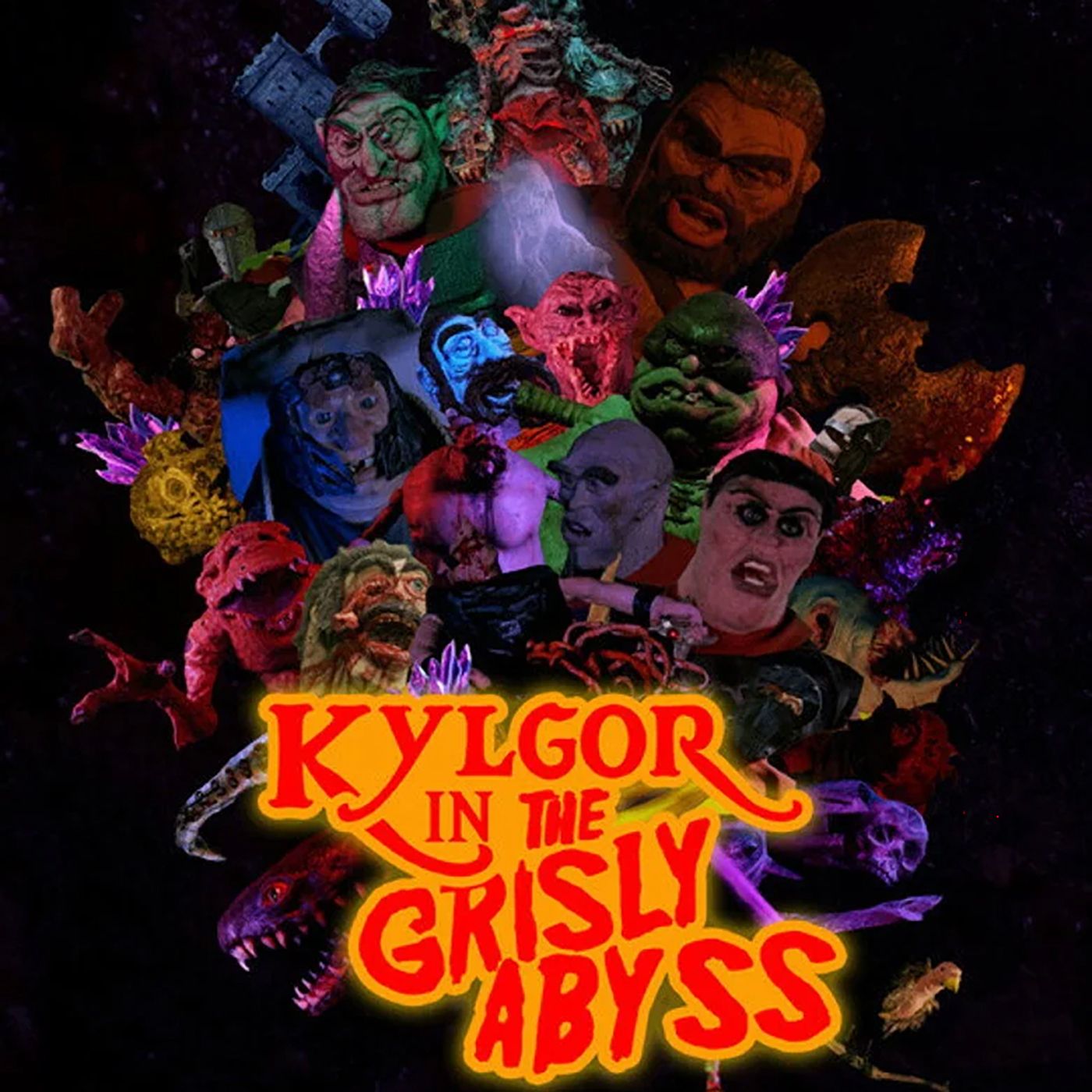
Barbarians lose their heads, monsters lose their guts, and not one actor ever set foot on the set: Kylgor in the Grisly Abyss (2026) is a blood-soaked sword-and-sorcery quest performed entirely by puppets, built in a family garage in Belleville, Ontario. Director Mason Newton DeRushie's feature debut had its world premiere at Fantastic Fest before heading to Australia's Monster Fest. Mason and his father, production designer Jason Derushie, join Mike to tell how a family raised on special makeup effects set out to bring back the '80s barbarian movie. They explain why a pandemic and a crowdfunding campaign pointed them toward puppets, how a list of ten creatures they wanted to see wrote the story, and how couch foam, chicken wire, old bedsheets and about $6,000 in spray foam became the caves. The puppet cast runs past 60 characters, from tiny insects to huge beasts, and the voice cast, led by Timothy Paul McCarthy and Ry Barrett of In a Violent Nature (2024), never saw one of them: the puppets were shot first and the voices recorded in two days afterward. Their touchstones run from Meet the Feebles (1989) to The Dark Crystal (1982). And the surviving puppets? Wet mattress foam is hard to dry, so they live in an airtight container, where nobody has to smell them.
Follow the film on Instagram (instagram.com/kylgorpuppetmovie) and North Blood Films on Facebook (facebook.com/northbloodfilms).
Become a supporter of this podcast: spreaker.com/podcast/the-projection-booth--551….
Become a supporter of The Projection Booth at patreon.com/projectionbooth
The Projection Booth is part of the Weirding Way Media podcast network. Explore more of our shows at weirdingwaymedia.com.
Transkriptvom Podcast bereitgestellt · Zeitmarken springen hin
Hold your ears, folks.
It's showtime.
People pay good money to see this movie.
When they go out to a theater, they want cold sodas, hot popcorn, and no monsters in the projection booth.
Everyone pretend podcasting isn't boring.
Turn it off. Turn it off. Turn it off.
You may survive in here, but you will never leave.
Good luck, Kilgore the Conqueror.
Hey folks, welcome to the Projection Booth. I'm your host, Mike White. Today I'm talking with Mason Newton DeRusci and his dad all about Kilgore in the Grizzly Abyss, a barbarian fantasy told entirely with puppets that they built themselves, more than 60 of them, over two pandemic-era years in their garage. Kilgore and the Grizzly Abyss made its world premiere at Fantastic Fest. Visit northbloodfilms.com for more information and to find out where the movie is playing near you.
Had a great time talking with Mason and Jason all about their film, and I hope you have a great time listening. Enjoy. Well, before we even start with talking about the movie, I want to know a little bit more about you guys. How do you even know each other? I guess, so you've known him almost all of his life, then?
Yeah, pretty much, yeah.
Okay, all right, all right, great. And how did you get pulled into this whole movie business?
My brother and I got into independent films as special effects makeup artists probably around 2006, 2007.
And not too far into our journey doing that, I was. Mason was probably maybe around 10. Yeah, 10 or 11.
And he just, I mean, he's always kind of had a similar interest to me, drawing and comics and, you know, superhero movies, horror movies, stuff like that. So he just seemed to gravitate towards, you know, the stuff that I was doing. And then him and a buddy started making short films and it just kind of snowballed from there.
And what got you interested in making movies? Is it just growing up with your dad and seeing all this?
Yeah, just growing up with him and him showing me all the crazy horror movie franchises and whatnot.
Yeah, just a general interest in it because of him.
So are you guys like old school, like Tom Savini style makeup effects? Like, just like, let's get the glue and the gore and all this kind of stuff and just like all the practical stuff, which I love so much.
Yeah, like I said, I.
When my brother and I got into it, we, like you said, we cater to mostly independent stuff. So, like you said, a lot of times I'll joke around that, you know, I make cheap dollar store shit look good. Yeah, whatever way we can pull it off and it looks good, we'll do.
Mason, how did you make that break into directing as well?
Well, when I was a kid and he was doing effects stuff and I was kind of helping out, initially I wanted to be an effects artist, but then you kind of quickly realize that you don't get to create the stories and actually have a real hand in creating the stories, so I wanted to do that. It was a quick transition into that once I realized that was the only way.
And where did the.
Idea for Kilgore come from?
Well, we were trying to figure out something that we could crowdfund And also this was when COVID was starting, so it kind of had to be something where we couldn't have a bunch of actors and stuff out. And we always really liked puppet movies and talked about doing puppet stuff, so it just seemed like a good fit to do that. And yeah, we just decided to do a barbarian story because we thought that'd be a good way to kind of throw in some adult themes and stuff, but still.
Have it be the puppet fun.
We felt that genre doesn't get the appreciation today that it That it did in the 80s, so let's bring that back.
Well, what are some of your favorite puppet movies? I mean, of course, there's The Muppets, but I'm thinking more things like Let My Puppets Come or some of those things.
Yeah, I like that one. My favorite is Meet the Feebles. I say when I watched that, it was almost like a religious experience for me.
When it's a very.
Go ahead. Sorry.
No, I just, I as a kid, I mean, I said, I grew up... everything you watched on TV as a kid was, you know, puppets, polka dot door, you know, Mr.
Rogers, Mr.
Dress up a friendly stranger. The, all those shows were all puppet based. So, and the Muppet show, I was a crazy poor when I was a kid. And then I said, when, when I was in my early teens, the dark crystal come out.
So, Oh, there you go.
Yeah. And it just ruined your childhood.
Yeah. Well, not really, but yeah, you could say that.
Oh yeah.
It's, I loved that movie as a kid as well. So I think we're probably right around the same age with all the stuff you're talking.
Yeah.
Yeah. Even the old Kuklafer and an Ollie show and all that. And Mr.
Rod.
Well, Mr. Rogers had his puppets, but then Captain Kangaroo had his puppets as well. So, yeah, so many puppets on TV. You're not kidding. Can't say I remember the friendly stranger, though. That sounds like a very ominous title. Yeah.
I'm a giant giant. I got that.
Yeah. Yes. It's such a smart idea to use that pandemic time to make a movie and especially to make one where you don't need the actors to be there. So tell me a little bit more about how you come up with the story for this and then also the manufacturing of the puppets. That must have taken quite a bit.
Well, for story, it actually kind of we just kind of batted around ideas of like what creatures we wanted to see.
And what creatures we really kind of wanted scenes in there.
So they, I mean, in a way it kind of wrote itself because it was, we just had like a list of 10 creatures and just weaving those scenes.
Into each other of how, you know, get from one to the other.
And yeah, just setting it in a cave was kind of a bit of a necessity too, because we could build it in the garage and everything was in our garage.
That's amazing. And then you tell me about the manufacturing of the puppets.
Yeah, it was a big job, but we knew we had to go big or go home with something like this, so we wanted to throw as many barbarians and as many creatures from tiny little insects to huge, gigantic beasts in it, as much as we could fit into it, just so it was just a standout in the puppet world, I guess.
I'm hearing a lot of in your guys's voices where are you at we're actually in belville ontario okay all right yeah yeah very nice sorry i just was very curious because i'm i'm right across the river over here in detroit so i i yeah i'm attuned to listening to that so that's fantastic that's amazing that you're doing this all in your garage that's really super smart and just What are you even using to manufacture stuff? Is this all, like, foam rubber and just painting it? Or, like, how does the actual physicality of the cave come together?
The caves were a lot of random stuff. Just looking around to see what we had. We didn't really want to spend a ton of money, so it was a lot of.
We went out initially and.
Bought a load of wood and built, like, our initial frame, and then it was just a lot of random pieces of couch foam and chicken wire and old bed sheets and just anything we could get our hands on the people we had some people friends donate some old stuff that they had lying around tarps and then yeah and then about probably about six thousand dollars in spray foam.
A lot of spray foam what.
Was the most expensive part of making this movie.
I'd say the sets. Yeah, the sets.
Yeah, we probably put all together probably, it was probably a good anywhere between $ 60, 000 in foam and spray paint to change the colors and the looks of the caves from set to set. So, yeah.
And how many versions of the puppets did you have to make, or was it just one?
Yeah, I think we had two Kilgores. The Stunt Kilgore and An everyday yeast Kilgore. We had two Kilgores, two Stronods.
We had a couple versions of a few of them, but most of the puppets, it was just one copy of them. If they really were going to take a little bit of abuse, we had a backup.
Right.
Well, yeah, there's a lot of squishy stuff in this. and I was just curious if they would get ruined if there was liquid coming out to them, because it's kind of a gory film in a great way. Yeah, it was messy, for sure. A lot of cleaning them up and Febreze-ing them off. Are they machine washable, or do you have to dry clean them? Well, as I said, their bodies were all like just like mattress foam, like a thin mattress foam that you'd buy, like a topper.
That's what their bodies were all made out of, is like a pattern. So once they got wet, they really are hard to dry out. They just don't dry out very easily. So the ones that we have.
Left are stored away in an airtight container so we can't smell them anymore.
Makes a lot of sense. Do you break them out and bring them to festivals with you? We plan on it.
Yeah, we plan to. Yeah.
That's fantastic. Is this your premiere coming up at Fantastic Fest?
Yeah.
Yeah. World premiere.
Oh, that's fantastic. Have you had a chance to see this with an audience yet?
No, that'll be the first time. Wow. Okay.
I was wondering if you had like test screenings with friends or something to get a little feedback.
We haven't seen it, but him and I sat and watched it together and that's Sends screener copies out to some people, but nothing like no groups of people sitting around.
Oh, that's fantastic. I'm so excited for you guys. You actually get to go to Fantastic Fest? Yeah.
Yeah, we're going to be there the full week.
That's wonderful. To see this with an audience for the first time, and I'm so glad that you guys, like this filmmaking family, it's such a nice thing.
Thank you.
Kind of getting back into the nuts and bolts of everything, like, tell me about your... voices and where you find these people and are they anywhere near the set or is this all done in post.
Yeah so all of our actors none of them actually saw any puppets or any sets or anything none of them were ever on set but they were all we chose all these people because they're actors from toronto people that we hadn't known and worked with on other things So we had them kind of figured out ahead of time and they were all just on hold for four and a half years waiting for the call. And when we finally gave them the call, it was to go up to the Lancaster Arts Centre to record their dialogue with Mike Treblecock is our sound guy.
Shout out to Mike Treblecock. And we just pounded all that stuff out in two days. All the audio.
That's amazing. So you did the puppetry first and then the audio afterwards?
Yeah, which I know that's not done that way, but we were trying to get into a recording studio beforehand, and it just seemed impossible at the time. We just couldn't get anywhere. So eventually we had to just go into filming and hope for the best, and I think it went really well.
Did you have to do any reshoots to make things match the movements better at all, or was it just pretty lucky as far as how the... the characters and the voices matched up.
While Mike, our sound guy, had to do a little tinkering to make it work in some spots where it didn't work quite as well, but for the most part, it all just worked the way it is.
In the film. And there wasn't too... Sorry, go ahead.
I was just going to say there wasn't any reshoots or anything like that, so it wasn't too bad.
Worked out pretty good.
Are you able to work on other projects while this one is going on, or is this just all this, all encompassing for four years.
It was this for four years, yeah.
On our end, because outside of getting some people to come and help on set on the days, it was just us, you know, just to put the sets together and everything.
What was the most challenging part of putting all this together? Probably it'd be a different answer from both of us. I'll let you.
Probably just the amount for me of puppets and creatures to create.
I think we had, when we did a rough count.
I think it was like, there was over 60 characters in the movie, anywhere from little bugs to the actual barbarians. So it was, and that's not counting the, the, the, the miniature, the miniatures of the, that we all did for the stop motion stuff. We had a bunch of stop motion creatures. I ended up doing the animation for some animated.
Sequences in the movie.
So just, just the amount I had on my plate back then seemed Herculean.
Yeah yeah how about you mason for me it was probably just like scheduling or getting actual shot lists together because we didn't really have too much like testing time so trying to plan shots around what the puppets will do but not knowing what they can do exactly it was pretty difficult for the most part i just had to wing it and then when we got on set hope it worked and Again, that was another area where it ended up just working 90% of the time.
There wasn't too much, like, retooling we had to do.
But, yeah, I was just trying to come up with a shot list when, you know, you don't want to go overboard and have things that the puppet just cannot do at all.
And then you're sitting there just, you know, so. Yeah, that base, I was looking at it a little bit. We basically had to shoot, like, set for set as well. We had the one garage space.
So, it, you know, we didn't have two or three other set sitting off in the wing that we could move in. It was basically, okay, we're done with that set, turn it out into the next one, done with that set, turn it into the next one.
So I wouldn't have wanted.
To try and schedule how we did it and trying to, you know, getting the hands in that we had to help, uh, working around other people's schedules, working around, you know, people getting sick, working around, like, cause every time someone got sick, we had to shut down for.
The amount of days that was allotted.
And, um, our, cinematographer, him and his girlfriend worked on the film. So if one of them got sick, we had to wait them out and hope that the other one didn't get sick. And if the other one got sick, it just doubled their time of shutting down. So I didn't have anything to do with the scheduling and planning and shot list and all that.
That was all Mason. And yeah, that would have been a nightmare.
Oh, man. Yeah, that sounds pretty nightmarish, especially shooting this during COVID times and having to worry about all that.
Yeah. Yeah.
It's a little bit annoying having to shut down for good chunks because you just kind of, you know, you're not going to get back at it for a while. So you're sitting around every day and waiting.
Well, tell me a little bit about your post-process. What did you actually edit this in and tell me about the music for it?
So I edited it in Premiere Pro just because that's like the standard, I guess.
It probably took like two years of editing on and off. Just because I was relearning. I hadn't edited anything since our short films before. So it was like four and a half years and everything changes and updates. So I was basically relearning all that and then learning all the things I had never done. I hadn't done any tracking and masking and all the VFX stuff, all that. I hadn't ever done any of it and ended up doing probably 80% of it myself.
Wow.
But then for music, that was just, handing it off to telling Mike Treblecock what we want and him just doing it. It just seemed like any time I'd tell him something, he'd just a day later, boom, here it is.
He was a wizard in that way.
So Mike was a lifesaver. Yeah, music-wise and just audio-wise in general, he was just a wizard. I don't know how he got everything done that he did.
It's fantastic. Where's the best place for people to keep up with the movie and where it's going to be showing at?
Would be our Instagram page is at KilgorePuppetMovie. And then also my Instagram is at NorthbloodFilms or NorthbloodFilms on Facebook. Or you can follow him at JGoreArt on Instagram. And between all those avenues, you'll find all the info you need. Fantastic.
Do you already have your next projects in mind?
Well, right now we're shooting.
It's like a documentary, kind of like American movie style thing of some local filmmakers. But we're already kind of into that on our own. We're talking about doing a found footage style thing, possibly. But they're in the early stages, so nothing too heavy right now.
Just finishing the festival rollout for Kilgore. Yeah, I know it's a lot. Yeah, it's definitely an eye-opener.
And all these new projects are all going to be 100% puppet-based.
No, so the documentary is just... Okay. Yeah.
So the found footage one's just like in the woods, a couple people really, probably even tighter and smaller than Kilgore in a way.
We would love to do a Kilgore sequel if it ended up going that way, but we would definitely want to do it a little different the second time around. We'd like to chop a few years off the time it took.
Yeah. I imagine you learned a lot of lessons during this one. Yeah, we did, for sure. So if anybody out there is listening that wants to make a puppet movie, they know to come to you guys for a consultation.
Yeah. We could give them some insight, yeah. Yeah, for sure.
Well, guys, best of luck. Break a leg when it comes to your premiere. I really enjoyed Kilgore. I had a lot of fun, and it was just so nice to see something so different. So, really, congratulations on that.
Yeah, thanks, Hugh. Appreciate that.
I appreciate your time today, fellas. This was really nice talking with you. If you ever get down to Detroit, look me up. so so so.
Thank you. Bye.
Bye.
