

Local Voices for Sustainability
How do you build a city everyone can access?
Mittwoch, 27. Mai 2026 · 24 min
Kapitelklicken springt direkt hin
Shownotes
What does the concept of “Mobility As A Right” (MAAR) (iclei-europe.org/publications-tools/?c=search&…) look like in practice? In this episode, we head to Mannheim, Germany, to explore how the city is rethinking transport through the UPPER project (upperprojecteu.eu). Mobility Coordinator and Policy Advisor to the Mayor Tim Neugebauer from the City of Mannheim leads us through the city’s multimodal transport system, which serves both its industrial needs and its aim to make mobility more accessible, affordable and inclusive – all while balancing local and global climate goals.
Transkriptvom Podcast bereitgestellt · Zeitmarken springen hin
Hello and welcome to local voices for sustainability. I'm your host Laura Schubert. In each episode of this podcast, we explore the sustainability challenges and solutions emerging in E Clay member cities across Europe. Today we're heading to Mannheim, Germany, where conversations about buses, bikes and public transport are really becoming conversations about fairness, access and everyday life in the As cities across Europe work to reduce emissions and improve quality of life, mobility has become about much more than simply getting from one place to another.
Increasingly, cities are asking a deeper question. How can transport systems ensure that everyone has fair access to jobs, education, healthcare, and daily life? This idea is often described as mobility as a right, the principle that accessible, affordable, and sustainable mobility should be available to everyone regardless of income, age, ability, or where they live.
So today, our central question is, what does it take for a city to make mobility truly inclusive? To explore this, I'm joined by Tim Noigebowa, Policy Advisor to the Mayor and Mobility Coordinator for the City of Mannheim. In his role, Tim works on strategic mobility policy, shared mobility services, rail and harbor infrastructure, and alternative fuels such as hydrogen and E mobility, while also helping steer the city's public transport system and local tariff association.
Tim, welcome to the show. Thank you for having me. Hi. So let's start broadly. Mobility as a right is a phrase that many people may not hear every day, but it speaks to something that affects all of us. When we talk about mobility as a right in a city like Mannheim, what does that concept mean in practice and why is it particularly relevant right now?
I mean Mannheim is a medium sized city for Europe with about 320,000 inhabitants, but it's part of a metropolitan region of 2.3 million inhabitants and closely connected to two neighboring cities which also have more than 100, thirty, 150,000 inhabitants such as look like Saffen, Heidelberg and so on. So mobility goes for us beyond city borders and this also means in contrast to outer metropolitan areas, commuters do not just commute from outside in one city, but the the commuting goes into all directions at the same time. Interesting.
Also crossing federal state borders, in our case crossing rivers. Mannheim was built really as a very car friendly city with them of car infrastructure for commuters getting quickly into the city and this causes in some parts a very concrete dominated area. Very car dominated area huh? And even still today.
Even still today. And on the other hand, of course, we need this infrastructure as we are kind of an industrial powerhouse. Here. We have Daimler buses making public transport buses. Here we have BSF, one of the bigger biggest or still in the biggest chemical plant in the world. We rely on logistics. We need us to keep the economy running while also making it possible or ensuring that there is more livability in the city. Yeah.
And we need to make sure kind of a socio spatial equity. Yeah, we have those more industrial areas and the city center, which is more urban and have to make sure that those very different areas with different needs, different social structures are met in their needs, right, but also seen in their context. Yeah, because of course, in the city center it's easy to commute by bike.
If you're living somewhere in the outskirts and have to cross a big harbour area, maybe other modes of transports are better than bike. You have to balance all that. So I think that it would be helpful for our listeners to be able to visualize the city a bit in terms of topography. What is Mannheim like? You've mentioned a river, the harbour. Can you paint a picture for our listeners? So my name is in in western Germany, somewhere between Frankfurt and Stuttgart in the Rhine valley. So it is quite flat, but it's very much shaped by the two big rivers, the river Rhine, which is one of the most important rivers and also county access for for transport and logistics. And the river Neca, which also
flows through Mannheim, a smaller river going to Sutcat. It's a quite a flat city, which is good for cycling, good for walking. On the other hand, it's a city which is shaped by a climate and summer, which can be for Germany pretty hot, one of the hottest cities in Germany, including heavy rains as well, quite humid climate.
On the other hand, the city is mainly shaped by being at the River Rhine, being industrial, being at the most important 10T corridors for flows of goods. So it's very much shaped by railways, by autobahn highways and by traffic, which is not part of the topography, but it's defining it. Yeah, Especially yeah. Interesting.
Of course, making mobility more equitable is not always straightforward. Cities are often trying to balance competing priorities like reducing car dependency, while also ensuring people can still move around efficiently and affordably. What are some of the biggest challenges Mannheim faces in creating a transport system that is both sustainable and inclusive?
Yeah. I mean, I already mentioned that we are still kind of very industrial city where we need trucks and lorries and a lot of industry. So we need to in some parts big streets. We have a lot of space competition. We have a lot of blue collar workers. This is a big challenge. So there's a lot of space competition going on in the city center with the historical dominance also of private car usage, with the space which we need for bike lanes, for pedestrian zones, for green areas and so on. Then of course, as always in mobility, changing habits is one of the biggest challenges you can have because it's not a decision you make every morning to take your car, It's just a habit.
Raising an awareness that people could use other modes of transport is difficult. One other thing is, of course, money, right? Cities all over Europe, but especially in Germany, are in the enormous financial crisis, economy going down at the moment. Social expenditures are rising. We see that politics on national or European level tend to rather focus on short and fast efforts than ensuring that we have a sustainable funded infrastructure. Yeah, we see this also with street infrastructure. We have a lot of big bridges reversing the rivers. They are important for cars, but they are also connecting us directly to the neighbor cities with our PT system. And we have had now one of those
bridges closed because of damages. And this caused an enormous decrease in the usage of public transit because this really made our tram network worse. And the same goes on with building barrier free stations. We already have 90% of public transport trips in Mannheim start and end at the barrier free station, which is very good. But of course we have some talentless left and this can be very expensive.
But it's absolutely necessary to have an inclusive trip and make sure that not only young and sporty people can use public transport, but also people with handicaps or parents with a trolley. Huh. OK. So then it sounds like your key challenges really are local industrial needs, shifting public behavior and health, money and the cost of things, and sort of the existing infrastructural limitations that are in place. So one initiative helping Mannheim explore these questions is the Upper Project, which focuses on encouraging more sustainable urban mobility behaviors. Can you tell us about the specific work Mannheim is doing through the UPPER Project and how those measures help advance mobility as a right rather than
mobility simply as a service, for example? Yeah, Mannheim has been part of the upper project for now, roughly the last four years. And with APA, we are trying to not change the whole public transport system, but to look at what kind of small measures and things we can change to make public transport easier to use, to bring more people into public transport, to encourage people to change their mobility habits.
And we work kind of as a living lab in the project. Sorry to interrupt, Tim. For those who don't know what a living lab is, it's like a pilot city within a project. Yes, we are pilot city. So the project and the consortium, they make proposes and give us tools and we try to test those tools in our city. As a city, one big thing is that we focus on the last mile. People say, yeah, I just don't want to walk with my luggage 10 minutes in the rain from the tram stop to my home. So for example, we use in the suburb Maria Phipps, which is our on demand system, which is a service that you can just book by app.
Interesting for the normal costs of public transit, that brings you the last mile between the station to your house. So just a typical on demand bus and to make sure that the last mile is served. But what we saw in this, it's not only good for the last mile, it's heavily used by people with handicaps and it's also used for new connections.
There are needs also to have trips between different suburb areas, not crossing the city center. Therefore the on demand system also works works quite well, also giving us information for mobility needs that we didn't see like this before. Right, it's providing you with data. Absolutely. Another thing is how can we integrate micro mobility?
We all know about these scooters or which have been a big issue in political debate, in public and politics in the last years. At the beginning they thought that's new mobility, that's sustainable mobility. Then there was chaos in the streets in nearly every bigger European city. And we always thought that the truth is somewhere in between.
You just have to regulate them in a way that they are seen as part of public transport. They're still privately financed and owned, but we don't need them that much in the city centers, where the network of public transport is really dense and where also those conflicts about public space are big.
We need them in the outskirts, yeah, where distances are bigger. And that's where we could also see in our data, for example in the suburb areas, young people going to sports, going to the football club. So football clubs are most in remote areas where a bus just does not make sense for those few people going there.
And we saw, OK, people are using E scooters to go there. So we implemented a concept where we regulated the E scooters and made E scooter provide us also to provide us services in the suburb areas. Tim, I think it would be helpful if you could walk us through briefly all of the different mobility options that people have in Mannheim.
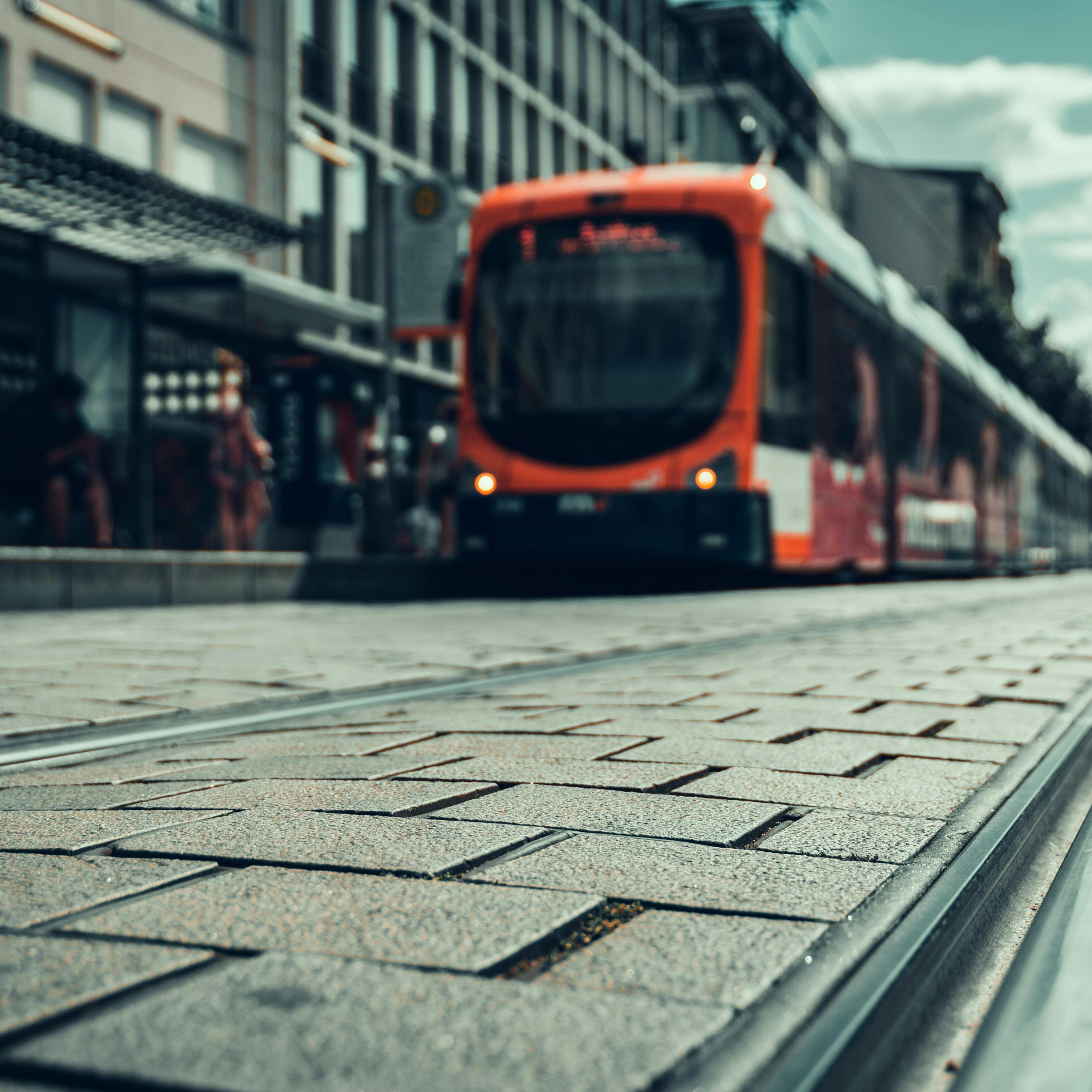
And Mannheim, besides the car, when we talk about screen mobility, the main backbone is our municipal public transport service, ENRI, which is also part of the upper project. It's a public transport company run by the three big cities here, Mannheim, Heidelberg, Olympics, Havan and it's running one of the biggest Meter Gorge tram networks in Europe as well as Meter Gorge. The gorge is how far the two rails are out of each other. 1M part, so it has a normal gorge.
Sorry, what kind of tram network? It's like type of tram system Andre is running well most of the biggest tram networks in in in Germany here, which is very extensive for also running trams between the three cities. Also the additional buses they have that serve in Mannheim but rather as a shuttle to the tram system because we want most people on trams. Then we have the typical German so-called S Ban, which is Deutsche Ban railway service rather for the regional area as well as regional trains, suburban trains. In the micro mobility area.
You have the publicly financed bike sharing system which is also regional. And we have the E scooters in the city which is free floating and private with free providers as well as well mainly one car sharing company providing car sharing to most city districts. Wow, you have everything? Yeah. It's the whole rainbow of mobility choices. And I guess in the end the need is to really connect them because most of this mobility options cannot function alone as a multimodal way, and also to make them visible as one. Yeah, it's also a question of of awareness. Transport systems, as fantastic and well-rounded as they can be, can only really succeed if people actually use them, and changing mobility habits can
sometimes take time. Have you started to see any shifts in how people move around Mannheim, particularly among groups who may previously have faced barriers to accessing transport? I mean, we have seen a lot of shifts. We have always expanded our tram networks to new districts and this always meant a lot of opposition in those areas. We don't want the work step, we don't be the tram. And in the end we saw that all those criticism has declined after a few months, having the new tram network introduced and that numbers of passengers were way bigger than expected before. OK, That's one of the biggest parts, saying OK, a good basic network is the absolute baseline of good sustainable mobility, as well as the good investment into
cycling infrastructure, making sure that people feel safe when riding a bicycle. The biggest competition we still have is the competition between cars and the solar green modes of transport. With regard to many distances and trips you have, it's still quicker to use the car, especially when you do not commute into a city center but into an industrial area somewhere outside.
It's still quicker to use the car compared to public transport, which is due to a completely overcrowded railway network and unreliable rail network especially. And when we're talking about our suburban trains, yeah, the city and the region are still quite a car friendly one. Right. So in terms of those living in areas that hadn't previously been serviced by public transport who now have access, are there other groups that had faced barriers in the past and are now able to access Mannheim's transport options in a richer way?
I mean of course barrier free transport is a huge issue. We always have been in city with a high level of barrier free stations. We had already low floor trams in the 90s, However we see with every new stop 3 we of course increase barrier freeness. And on the other side we already saw that complex terrace systems are often a barium for people.
They are. The Deutschland ticket scheme, of course, is an enormous advantage. And just a note for our listeners, if you don't know what a Deutschland ticket is, this is a monthly ticket you can buy that allows you to access all local public transport in cities across Germany, as well as regional trains through throughout the country. I think it's something like €60 now. So it really opens up possibilities for everyone. Absolutely.
Please continue, Tim. Digital inclusion although is a change. Better real time information simplified and apps like my VRN which we have now, there is still a lot of work to do there because the devil is in the detail there, but they make it more easy for people to navigate. Also for non residents to navigate through the city and through public transport.
Also regarding different mobility options. It's also how to make public space more barrier free, integrating those guiding systems for blind people. This is also kind of lowering barriers to make, in this case, walking and cycling, more attractive. And mobility doesn't exist in isolation. It connects closely with climate policy, public health, urban planning and quality of life more broadly.
How does Mannheim's work on inclusive mobility tie into the city's wider sustainability and climate goals? Mannheim is one of the mission cities for the EU Commission mission for 100 climate neutral cities by 20-30. And we know in Germany that the mobility sector is the sector making the worst progress with regards to climate neutrality.
Germany is a very car based country, so it's a big issue. So that's especially for a city which is so full of commuters and people in clamation marks. We can't influence just on our own as the city. Mobility is one of the most important things that we need to change to drastically reduce CO2 emissions. Another thing is of course the idea that we need more quality of life.
If we have less cars and for example more trams or tracks of the tram system. In most of the cities, wherever we can are green tracks. So tracks with grass. This means a completely different style compared to the street is also good for heat reduction. We are one of the hottest cities in Germany.
So heat reduction, we have a heat reduction plan. It's reducing noise as well. Mannheim always has been very much also connected to the sustainable development goals of the United Nations. So also they play a big part for improving quality of life, reducing social inequalities and so on and so forth. On the topic of climate goals, I'm wondering if we can just go a step deeper here.
Could you tell us at all about any mobility related climate goals Mannheim has established? Like are you trying to be emission free by a certain year for example? I know a lot of cities have that goal. We try to be emission free by 20-30, so that's just also means, for example, that our public transport fleet needs to be emission free. With a tram network, that's quite easy. We already buy green electricity for that. We also invest enormously into clean buses. We already have more than 50% of our buses being E buses or hydrogen buses, meaning in the end it's range extender buses. So E buses with the hydrogen extender and making electricity for longer distances.
This also has been an advantage of now with rising gas prices in Germany to make public transport less depending on gas prices. So for my final question before we move into the second segment of the show, I'd like to look ahead. Many European cities are now trying to build transport systems that are not only low carbon, but also fairer and more accessible. Mannheim is a part of a growing movement experimenting with what that can look like in practice.
So if we look a few years into the future, what would success look like for Mannheim in terms of truly accessible and inclusive mobility? And what still needs to change in order to get there? The vision would be a transport system where nobody's left behind, where people feel safe included. Of course, we need the new culture. Germany's always been the country of car culture, so we need kind of a behavioral shift here, normalizing a car light lifestyle or a lifestyle where you share mobility options such as car sharing instead of owning them. Especially from the perspective of the city, it's super important to have a financial sustainability, especially in Germany, the money we have as
cities stems from mainly the economy, and this is highly flexible to economical situation. And that's not good for public transport. For public transport, the study investment into the system and I think we need new models to find in public transport as it is to be able to invest in the future. Yes, for sure, especially for anyone living in Germany. We all know that story.
Absolutely, yeah. OK. So this brings us to the second segment of our show, which we call hot takes. We're going to turn up the speed a little bit with these next questions. I'm looking for a brief instinctual response Ready. OK, if you could instantly change one mobility habit in Mannheim, what would it be? That's cause.
Easy answer What's the first thing you notice about a city's transport system when you visit somewhere new? Cleanliness, affordability. And yeah, that's just easy to Orient to to be orientated, easy to find, easy to use. Here's a controversial one, at least for some. Should public transport be free? No, the cheapest option should always be walking. It needs to be affordable, especially with regards to the social structure and social needs. But it can never or should never be free. Which tells you more about a city, the early bird commute or late night public transport?
I mean this probably depends a lot on the city. In Berlin I would say late night, but in most cities it's the early bird. Yeah, I guess when everyone is moving around in a hurry, which matters more for getting people out of cars? Better alternatives or stricter rules? I guess you need the alternatives first to have the rules down.
So alternatives are always on top level to not make people feel, yeah, just pushed into into an option. And finally, finish this sentence. A truly inclusive transport system is one that. One that is reliable, accessible, easy to use, and affordable. And that's it. We've reached the end of our show.
Tim, thank you so much for joining us. Thank you so much for having me. I think you've really highlighted for us that mobility is about far more than infrastructure or transport networks. It's fundamentally about access, participation, quality of life, and I like to think that you've helped make mobility as a right feel both tangible and relevant for our listeners.
So thank you it. Was a pleasure. And to our listeners, if you'd like to learn more about Mannheim's work through the Upper Project, or about the wider idea of inclusive and sustainable urban mobility, check out our show notes. That's all for now. Thanks for joining us and until next time.
