

Local Voices for Sustainability
How Grenoble is using street design to reshape everyday life
Donnerstag, 7. Mai 2026 · 26 min
Kapitelklicken springt direkt hin
Shownotes
What if the journey to school could make cities healthier, safer and more social? In this episode, we head to Grenoble to explore how rethinking streets around schools can transform everyday urban life. Edwin Hatton, Project Manager for Grenoble City Council, and Lysa Sérot, intern with the city’s Public Space Planning team, take us inside the 'Breath of School' (iclei-europe.org/news/?City_of_Grenoble_wins_2…) project — winner of ICLEI Europe's Local Sustainability Award (award.iclei-europe.org) in 2025. Together, they reveal how child-friendly urban planning can strengthen climate resilience, improve quality of life and inspire cities far beyond Grenoble.
Transkriptvom Podcast bereitgestellt · Zeitmarken springen hin
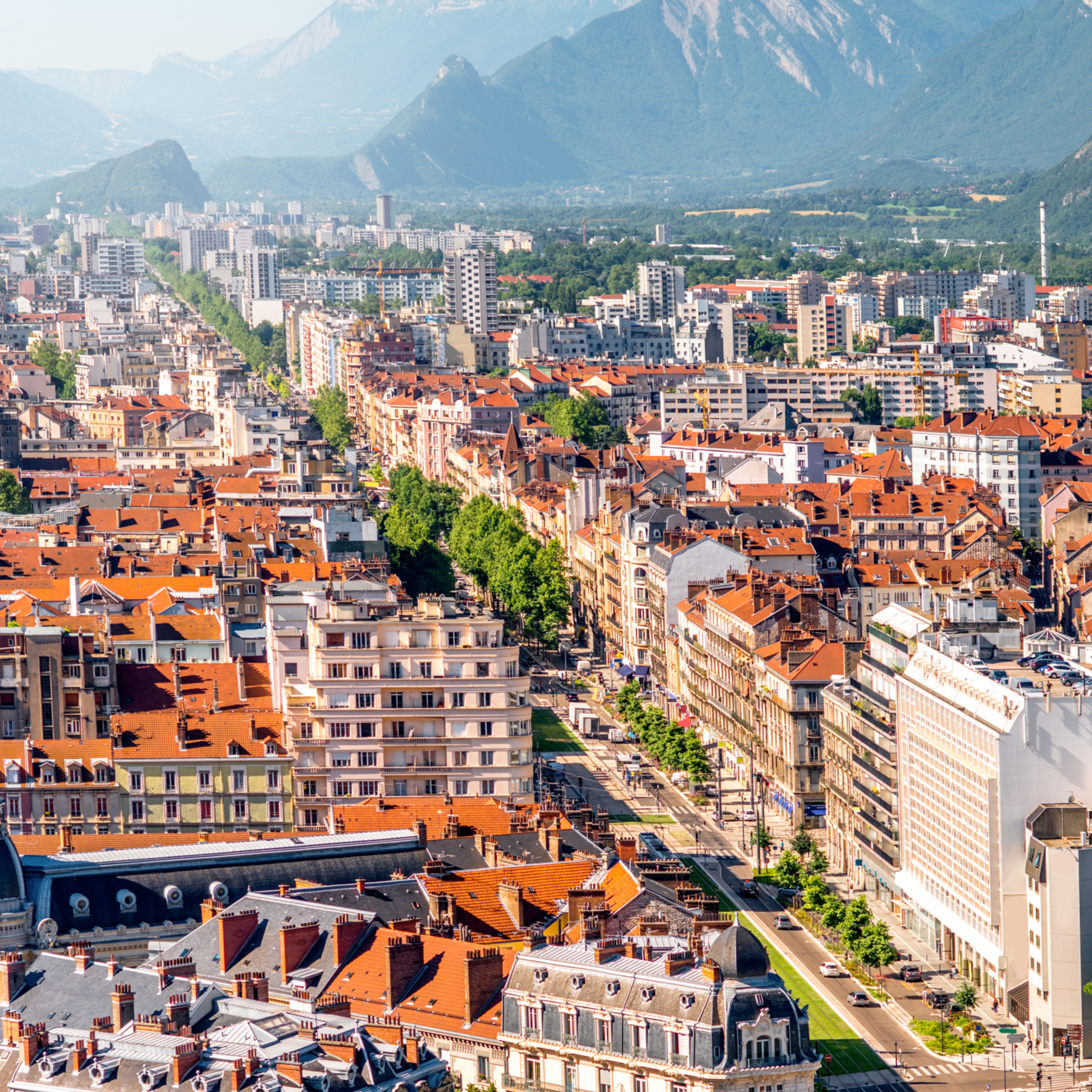
Hello and welcome to Local Voices for Sustainability, the Ikley Europe podcast. I'm your host, Lucy Mears. In each episode of this podcast, we explore the sustainability challenges and solutions emerging in Ikley member cities across Europe. Today we head to Grenoble, France, an urban area of around 450,000 residents nestled between 3 Alpine massives at the meeting point of two rivers.
Grenoble is a place where geography and science have shaped the city's identity. Known as the capital of the French Alps and a pioneer of urban innovation, it's a city where constraints have consistently produced new ways of thinking. Picture a typical weekday morning in many European cities. Streets outside, schools filled with cars, parents in a rush, and children navigating traffic, noise and pollution at the very moment they begin their day.
This scene was once familiar in Grenoble too, but in recent years the city has begun to sculpt an alternative picture, one that feeds directly into today's central question. Can changing the design of everyday streets change people's behaviour, attitudes and relationship with their city? Joining us today are two guests from the City of Grenoble.
Edwin Aton is a project Manager working on public space within neighborhood Renewal programs, bringing a broadview of how Grenoble approaches streets, mobility and urban well-being at the municipal level. We're also joined by Lisa Sehore, who works within Grenoble's Public Space Planning team and is closely involved in planning and prioritizing the transformation of streets around schools.
Edwin, Lisa, welcome to the show. Thank you very much. Thank you. So, Edwin, I'm going to start by asking you to set the scene a little bit. I understand that Grenoble has been working for many years to make the city healthier and more people centred. What was the broader vision behind rethinking how streets and public spaces should function in the city? Well, as you say, Grenoble is surrounded by mountains and it's also a city where it can be very hot in summer. So there are several challenges that the city face. There's this climate change issue, which is maybe stronger here than elsewhere, and also issues that are coming to all cities in France and in the world. In Grenoble, in 2014, the city
was the first big city governed by Greenmeyer. So big changes began. So yeah, the the the green majority that was elected in 2014 increased the efforts to make the city more green, to change the mobility habits, to encourage walking and cycling, to reduce the space for cars. And because of its geographical configuration, air pollution issue is stronger here than. Elsewhere, that was going to be my next question, which was what?
What is the kind of unique setup of Grenoble that makes it particularly susceptible to climate change? Actually, it's the Alps region. Surveys show that the the climate change is faster here than elsewhere. I I couldn't exactly explain you why, but seems that it's it's going faster. And you mentioned air pollution was one of those factors. I.
Mean that's long time issue, you know, air pollution and heat. So yeah, there was a will, political will to act on that by changing the public spaces and the mobility habits, you know, so that means. And you mentioned that there was a Green mayor elected in, did you say 2014? Yep. Exactly. And have there been green mayors since, or have there been changes in leadership? No, no, no, there wasn't any change in the majority. So that Mayor Eric Pierre did 2 mandates. So he stayed during 12 years.
And now at the last elections, which were one month ago, it's another Green mayor, a woman who was elected Laurence Rufant. So there's a continuity in the in the policies. Really nice because it provides a a good opportunity for kind of a continuation of the same missions. If we shift then Can you paint a picture of what everyday mobility looked like in Grenoble before these changes began?
So you did mention, for example, high population of cars, for example. So how did residents, and especially parents and schoolchildren, navigate the city, and what kind of challenges did they face before all of these changes were put in place? OK, nowadays there's about 25% of people who go to work by bike in Grenoble, which is huge. In France, the average is between 3 and 4%. As for schools, we did a survey in 2024 in seven schools that were affected by these St.
changes. About 15% of the parents used their car to drop their children to school on a regular basis. So it's less than the use of cars to commute because usually it's easier to actually go on foot to the school. But usually people live close by. Yeah. So actually, 2/3 of the journeys to school in Grenoble and close suburbs are made on foot.
And it's interesting to note that 75% of people who take their children to school are actually women. Yeah. So that's the global picture. You know, before these changes, these projects began. Usually school streets are open to car traffic, but they have reduced speed limits, They have signs, they have speed bumps, you know, to make it a little safer.
But it's not always enough and to change people habits. So that's why these projects were designed. And did you find, before we move on then to solutions, did you find that, you know, those things that you've mentioned, they're fairly typical for most cities, signs that say, you know, children walking and speed bumps and zebra crossings.
Did you find that there were particular areas of the city near schools where those mechanisms were simply ineffective? Yeah, actually it depends a lot on the the profile of the street. If it's a wide street, then cars tend to drive fast. So yeah, there are big differences in habits between the between the schools. So we had to do a diagnostic of the of the streets to target the most urgent streets to to change. Interesting.
OK, Well then that brings me nicely on to my next point because of course what you're describing is the city's vision coming to life. And this is in the project that we're now going to discuss, which is called Breath of Schools project in English, plus it's on fault in French. And this project has been redesigning the streets surrounding Grenoble Schools since 2022.
Lisa, I know Edwin's already mentioned some of the potential benefits to such projects, but it will be interesting to hear from you what the project really sought to achieve from the beginning and what the practical results have been so far. So whether those things were achieved and whether there were extra benefits that you hadn't foreseen.
Yes, so, so the goal is to make the school streets safer for children and yes parents. And so the main transformation is that the streets are being car free. So only neighbors, emergency services and maintenance are allowed in the streets. And the circulation and parkings of Sykes are being facilitated by the installation of cycle racks. So the safety is one of the main goal and and other one so is mobility of course to to allow children to come to school by by foot or by cycle.
And another subject subject is the visualizations of the streets. So a part of the concrete is just tried to add the trees to plant grass, flowers to make it greener and also permeable to water infiltration. And how many School Streets to date then, have been transformed? So yes, between 2021 and today, 2026, thirteen streets have been completely transformed, six are currently in a transitional phase and will be completely transformed in the next three years.
So that makes like approximately 40% of the school sites to have been transformed and the ultimate goal is that 100% of the schools are being of the school streets to be transformed. So you mentioned 13 streets. Does that imply 13 schools? Or in some of those projects were multiple streets around schools transformed?
Yeah, we talk about streets in front of one schools or 13 schools have received the benefits. OK, really interesting. And of course, the thing about transforming streets, especially when you reduce car traffic and remove parking, this, I imagine, can sometimes be controversial, depending on who you're asking. So, Lisa, how did the city work with residents, parents and schools to shape these changes and really garner support for the project?
Yeah. So as I said, there is like 2 phases in the transformation. First phases is a transitional phase. So it is a big safety evolution. And during this period we have two consultation workshops done. So there is workshops with parents, with local residents, we bring plans and scenarios to discuss to how the streets should be looking like, what are the needs.
And then after the final transformation, there are some times of appropriation of the space. So there is community planning projects. So we did like planting workshop with children in a school so that they can. Nice. Appropriate so they appropriate the space. Do you, when you say they appropriate the space, do you mean they they just get to use the space so?
The goal is that they make their the place their own by playing in it and having the habit to be in it. There is also some calls for cultural projects in these streets and festive times that are being organized by the school or the local associations so that everybody owns the place. So between that time where you first proposed plans to the school community and that finishing point where you have this potential celebratory event, what what time period is that?
How long does that take? It is about two years to three or four, depending on the on the context and the the the local difficulties or. So that means then that you've got multiple projects going on at the same time, presumably on the different schools. OK, thank you. Back to you, Edwin. Parents and children clearly benefit directly from safer green school streets, this much is very clear. But have there been any unexpected positive impacts in the wider neighborhoods surrounding the schools where these changes were implemented?
Yeah, globally, the parents are very satisfied about the changes and the residents are more critical. They are satisfied less, you know, usually they, I think it looks good. It's more beautiful, it's more pleasant. But they also face difficulties in parking and that's a big issue, as you said. So yeah, people are not always happy also because they say the street itself is safer, but the entrances of the streets are becoming more dangerous, you know, so the traffic issues are actually shifted to the entrances to the the extremities. So do you mean that the the entrances of the school streets become busier with with pedestrians engaging with each other or with cars?
Because that's the limit. No, with with cars. Because, yeah, exactly like parents who keep on using their car, they have to actually park to stop at the entrance of the street to, you know, let their kid go out and possibly to go with them until the entrance of the school. So that creates traffic jam. It doesn't solve everything.
You know, it makes a big difference in the use of the street. Like, people are encouraged to stay longer. Yeah. It's more pleasant, for example, to chat with another parent when you know that your child can play with other children. Really interesting to see how such positive actions can sometimes shift issues in a way that isn't always predictable.
But it sounds like there's a really nice community at the beginning of these entrances. So that's that's a really positive thing. I can maybe talk about my experience because I live close to a street that has been transformed and it's really a beautiful St. Every time I have the opportunity, I actually make a small deviation, especially when I'm with my kids, because in that street the grass area has been created for rainwater to infiltrate and above that area small bridges.
Wood bridges have been constructed for children to go, and also wood logs have been put for them, you know, to walk. So yeah, all kinds of urban furniture also, which are designed not only to sit but also for children to climb on it. So they've made a fairly functional climate solution into a playground for children.
Exactly. And that's the, yeah, the purpose of the project. How lovely. OK, so what's really nice about Breath of Schools is that it was the winner of iclay Europe's 2025 Local Sustainability Award, which was the inaugural edition of the award. Liza, why do you think that the project won? I will say that one of the things that is most striking is that this program has a really strong identity.
It's there is a uniqueness to the streets because a specific design have been developed and so we recognize those places, those streets. So there is specific furniture to sit, to play just like Edwin talked about. But it's really specific to this program. So that's one of the main reasons I think it is pretty aesthetic. It is adaptive, it is inclusive for all children. They can play in whatever way they want. So one of the main thing is that these streets are, they are not seen as traffic corridors anymore. They are really made to be used by foot. There is some marking on the ground, white markings that is very unique and specific to the streets. There is round shapes, painted games on the ground. And so it gives children and
parents a new public space area to be in, to play, to chat to, to be. Interesting. And I think when I think about the award, the one of the reasons I think that the project stands out is its potential for replicability and scalability. And that's something that I'm going to come to. And now so for my final question for this part of the show, it's regarding the future.
You've already mentioned that all schools you're hoping will be transformed eventually. Edwin. My question to you is, is the project's model easily transferable to other French cities and beyond? I think so actually. Grenoble didn't invent the concepts. So many other French cities are currently transforming the streets, Paris, Lyon, Lille.
So yeah, the the challenges are more or less the same everywhere. It's just that the mobility habits differ from one city to another, meaning that the use of car, for example, can be higher in some cities. But basically it's the same issues and the same answers which need to be implemented. So yeah, Grenoble is actually a model, but is also taking experience from other cities.
We do a lot of benchmarking and trips to other cities to see how they make it. So we are part of networks to experience exchange. OK, thank you very much. That's it for this part of the episode. So we're going to shift gears a little bit now into our lightning round. And this is something we call hot takes. These are short questions, fast answers, and no overthinking. Are you ready?
Yes. Lisa Which feature of the redesigned schools do kids love the most, and which surprises adults? I would say it's a playful furniture like wood logs. They love being on wood logs, jump, run and play with each other. I think it's really works. And what surprises adults? Maybe how long they can be in this streets and play it together. Lisa, can you share in a brief list some common specific characteristics that all these redesigned school streets have in common?
Yes. So they are car free, they are visualized, they are greener. We have playful furniture, we have fountain, we have bench and all sorts of furniture to sit in. And I think that's. It OK Edwin, what was the trickiest technical challenge the city faced when pedestrianizing these streets, and how did you solve it? Well, in it's actually quite tough to reduce the car. I mean, some car drivers are really have a believe that they have a natural right to drive everywhere. So people don't always respect the decisions, you know, so actually we had many places to put barriers, you know, and, and sometimes these barriers are broken or, you know, people try to sneak into the street.
So yeah, the the the biggest difficulties we have are for people to respect the car free characteristic. OK, this is one for either or both of you. Have you ever witnessed a moment that perfectly captured the impact of these streets on daily life? Well, I, I can, yeah, say that I've been to some of the streets at the opening or closing of the school.
And you can really see when of course the weather is good, that there are more people in the street and people stay longer. So it's, it's very nice because it makes the city more lively, you know, and it's exactly what the City Council tries to make everywhere is to really encourage a sense of ownership and to reclaim the streets, you know, because streets are not only car corridors, it's, it should be places for people to, to gather, for kids to play. At the same time, the City Council is running a policy of transforming schoolyards, which are important places because actually children spend a lot more time in schoolyards than in school streets.
And the goals are more or less the same to make them more green, to make them more playful because, you know, schoolyards are usually concrete spaces where children and especially boys monopolize the space with the ball games. So we noticed that transforming them also changed the their ways of playing by creating a lot of small places where they can either chat or play. And yeah, also for ecological reasons, you know, rainwater, etcetera.
We often say that the school streets are the extension of the school yards. Oh, I like that as an analogy. That's really nice. So why is it called Breath of Schools? Well, in French the name of the project is Plus Ausafun plus with an S in. Brackets. Yeah, I did notice that and wondered why. Because it's a pun, actually.
Because A+ is a square, but plus also means space, so it can be understood as the children's square also. Let's make space for children. And plus someone is also a phrase to say in a show. Please welcome. I understand. I see. That's so interesting. I like that a lot. Final question, if you could give one tip from this experience to another city trying something similar, what would it be? Yep.
It's important to make diagnostic, you know, to really have very good knowledge of all the streets, all the difficulties and also the priority. Because, for example, it's very hard to make a street greener when you have a lot of underground networks, you know? What do you? Mean. So if you really like, you know, sewage and that kind of thing, you know, you cannot plant trees if you have like underground.
Pipes, yeah. So if you really want a visible change, maybe not start with very ambitious goals. Maybe choose one St. in every sector of the city and and focus on that. And then give up your own method to be used in other other streets. So first phase the diagnostic is is a very important condition for the the success. Thank you.
Well, that's a wrap. Edwin and Lisa, we've reached the end of our show. Thank you very much for joining us and for sharing how Grenoble is reshaping streets and mindsets by rethinking everyday public space. Well, thank you very much for inviting us. Thank you. Listeners, if you take away just one idea from today's conversation, it's this.
Designing everyday streets differently can change how people move, meet, and experience their city. If you'd like to learn more about the Breath of Schools project and the Local Sustainability Award, you'll find links and resources in the show notes. That's all for now. See you next time on Local Voices for Sustainability.
