

Kapitelklicken springt direkt hin
Shownotes
In Episode 19 of The No Cover Charge Podcast, Tyler Larson and Jared James Nichols sit down with Ben Travers, a monster guitarist, thoughtful musician, and Grammy-nominated songwriter — for a deep, honest conversation about guitar, creativity, technique, and the mental side of being a musician.
This episode goes far beyond chops. Ben opens up about insecurity, social anxiety, discipline, effective practice, alternate picking, theory vs feel, songwriting, touring realities, and what it really takes to keep growing as a guitarist in today’s world. Expect jaw-dropping playing, real talk, and practical insights you can apply to your own guitar journey.
Whether you’re into shredding, blues, songwriting, or just love thoughtful guitar conversations, this episode delivers.
Check out all things Ben Travers (bentraversmusic.co.uk)
Subscribe on Apple Podcasts (podcasts.apple.com/us/podcast/no-cover-charge-…)
The No Cover Charge Podcast on Spotify (open.spotify.com/show/1etwgleKExKzncMWSeSqe6?s…)
Instagram (instagram.com/nocoverchargepodcast)
TikTok (tiktok.com/@nocoverchargepod)
Facebook (facebook.com/profile.php?id=61579811813164)
The No Cover Charge Podcast with Tyler Larson & Jared James Nichols is your all-access backstage pass to the world of guitar—and there's never a cover at the proverbial door. Hosted by two of the most passionate guitarists you'll find, Tyler and Jared deliver a mix of electrifying interviews with legendary guitarists, laugh-out-loud tales from the road, deep dives into guitar culture, and no-holds-barred gear talk.Whether you're a lifelong shredder or just love music, you'll find something unexpected in every episode—a hidden gem, a new perspective, an epic jam, or a story that'll stick with you. It’s always a good time, and best of all? No cover charge. Plug in and hang out.
Transkriptvom Podcast bereitgestellt · Zeitmarken springen hin
Making my way downtown, walking fast. Remember that song? If only we could share the meme that that was tied to the reason you're singing that song. It's stuck in your. Head don't look at my Instagram algorithm. It's really just quite a sight to behold. Every swipe is full of new and interesting. Guitar.
Stuff, right? Yeah, it's all guitar related. Especially on this show. If a human were a guitar, it could be bent. If a Cyborg came from Terminator Part 6. Here we go, here we go. Like to making people into monsters and like these things that aren't real. Yeah, this is true because of their doing that. No, I don't think we can.
I think it's just our natural tendency to describe these guests that we have on the show as otherworldly beings. Because Ben certainly fits that criteria in many ways, but he's also one of the most human and personable and well spoken guys that I've ever met. It's a real treat because I always see his stuff on like Instagram and he is like machine like with his precision but also he covers so many genres.
He swings in high speeds, which is kind of the hardest thing to do as far as the technical side. But again, can't overemphasize. The first thing I found on Instagram was him playing and it was the room noise. It was like aggressively assaulting his his tone in the room, which we're about to feel.
Let's see what happens man. I can't wait. I think everyone's going to enjoy this. Yes, without further ado, Ben travels. And you're just like, listen to the fuel in the. Fire. Listen, that's when you know you got a real crazy tone happening when all of a sudden you stop playing and your rig's just like it sounds like an engine about the blood. Also makes me realize I need to adjust the camera for the way Ben's moving in his chair.
Oh, I'm sorry, Ben. Is like a damn caged animal. And I'm really honestly, I'm again, I'm just trying to. No, this is. This is. He's into this, this House of celebrity that I'm in right now. The House of Celebrity. The most nerve wracking thing in the. World. Come on man. You had sat here. My God, I'm like Tommy Emmanuel, Joe Bonamassa, YouTube, Oh my God. Everything.
Steve Moore, it was an A job about everything. Everyone. I'm just like, what the hell am I doing here? So first thing is, thank you so much for entertaining dude. You're here because A, you RIP B, you RIP three ABC. You're a really sweet, nice dude. I've fooled you and. You feel like people that are watching are going to see you and go, who is this if they don't know already?
And they're going to be like, I need to know everything about this guy. Well, again, thank you so much just for having me. It's a it's a huge honor. You know, I'm not going to keep gushing about it, but I'm a mega fanboy. I can't believe I've infiltrated this place and managed to actually be between these two guys. Well, they don't realize it's what's going to happen is they're not leaving here now.
Gagging and bagging the pair of them, taking them home with me. That's pretty much it. This is the last episode they were never seen it. Never be seen again. How? Did it get uploaded? No, no. But it is, it's it's it's, it's great for me because as you guys know now, I had a huge absence from music. So I was, I was, you know, back in the day, a, a, you know, professional musician.
And then had, that's something we can talk about, the highs and lows of a musician and the the truth behind the door, behind the curtain, if you will. Rick and I talk about this all the time. Rick Gray, the IT may seem on the surface that we've got this perfect life, but behind the curtain, you look and you go, oh, my God, this guy's, he's a car crash. He's playing.
He's. Yeah, whatever you like. You've achieved this. You've achieved that. But in reality, there's a lot of stuff behind the door, I guess. I guess they call it mental health these days. I don't know. It's, I don't want to get too deep into it. It's just the reality of the, of the work that goes into this. So we, you know, we look at, I look at either of you and I'm like, look, it just looks easy.
And it's like, it's not your life, your life's work. Oh, yeah. And, and not only that, the, the, the passion to keep it going and to stay consistent when you don't want to in the morning. And then people are like, oh, it's all right for you. All you do is play Utah. Like we were just talking because I was just in the UK and in Europe.
Yeah, did 38 shows and meet and greets and guitar stores and all this stuff. About halfway through, you start to go, wow, I'm really tired, but I'm going to keep it going. And then you get sick and you're like, I'm sick and I'm tired, but I'm going to keep it going. And then you start to go, I love playing guitar, but I don't, my energy is so low.
And then you're trying to just continue to pour out. You know what I'm saying? And I think a lot of people when they show up to the show, they go, OK, I'm going to see this and you do it for the people. And you, you, you really are there to play to the best of your ability. But it is a toll mentally, physically.
Yeah. It's like an athlete, night after night, every day. It's like you have to bring your A game, whatever it takes. I think see if you got a degree, I think one of the hardest things is the, the social aspect that goes along with it because the it's interesting, like you say, the the athletic side of it and the discipline for your instrument and for your craft song, right and all that type of stuff. Yeah, that's one thing.
But then so a lot of really, really like highly developed musicians are quite you know, they don't they're not outward going, projecting, confident guys a lot of the time and girls and they don't like that whole social side of things. Like the thing with me, like if you only knew the truth behind it, like sitting here and having lights on and like the you know, and daylight and stuff. I don't like it.
It freaks me out. And the worst thing is go into because you'll think it now, you know, you know, outgoing guy, confident and all that. Like no mask. It's a mask. I have to put this portray portrayal on to to, to get myself in those situations to keep me moving forward. If I did what I've truly wanted to do, I'd be in a dark, cold room and I'd never come out and.
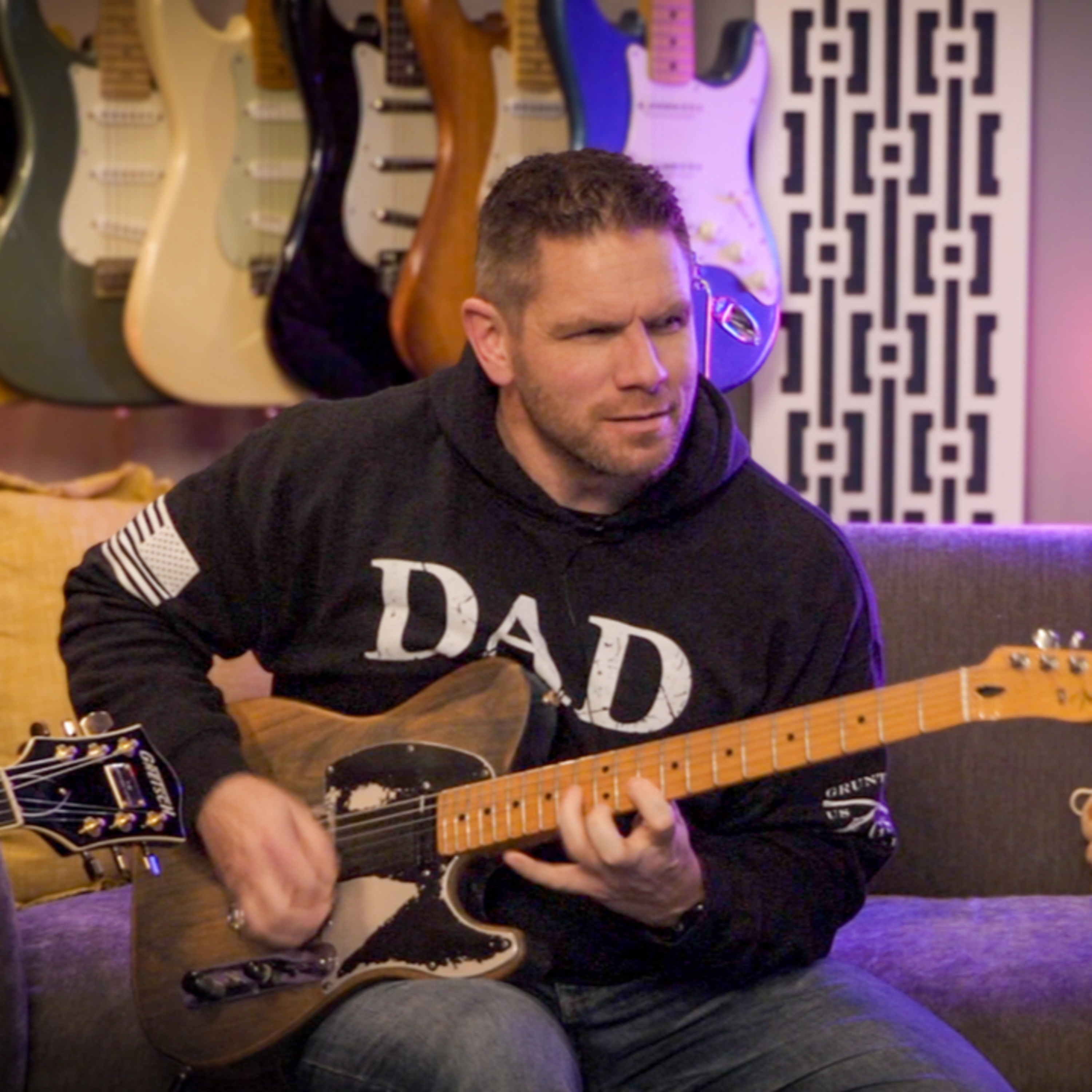
That's where you film your Instagram. Video I dressed up for this. I wore a different hoodie. Yeah, actually you you put the drop D. Put the drop deal well it is dad as well I'll talk about Oh no sorry I bugged up the mic you're good I've I'll talk about that as well because I have to I have to show you something a message for my children later but. I think a lot goes along though with a lot of people that are probably watching this, that aspect it, I don't want to say it holds a lot of people back from certain things, but just getting in front of people and playing or being outside of your comfort zone with a guitar.
I mean, I met people that would say, man, you know, I've never played on stage, I've never played standing up. You know, there's certain things. It's like there's all these little things that add up to getting out of your comfort zone that are really, really challenging. And I don't want to say that your story probably a lot of people.
I felt that way forever, man. And it's like you just have to find ways to get out of your own skin about it and just like you're doing right now. Yeah, the thing with me is it's the, I should say, the social aspect of it. Your close friends and comrades of, of a musical nature is great. That that's why guys, you know, they get used to anyway, you know, it's different world now, but you can't, we can't be the old guy.
Not that we are. You guys are younger than I am, but I mean, I can't be the old guy and be like, oh, you should be in a band. You should do this. You should get out from a because I'm like, clearly you don't have to. Now. It's a different world all together and we can't get lost. It's like the people, like I'm like the old guy who never wants to drive an electric. I'm like, oh man, I'm going to stay in my challenger forever. But it's like, no, no, you, the world moves forward. You might as well embrace it or you'll get lost. Like the digital and the, you know, the amps and reel and all. I'm like, I love all of it.
The thing I struggled with was the I was good with this close knit group of friends. I was good on the stage playing to the people. It's the being at the bar afterwards and the then interacting that I used to really suffer with. I've got a lot better with now, but it's something that it is I, I always try and put that across to every other musician is it's not just you.
Most of us who pursue this kind of thing have a lot of that. I don't know if it's all right for everyone else, it's me. I'm all for. It's like, no, we're all and Rick Graham talking, we talk about this so much. He's like, no, he's exactly the same. But those two, Rick and I holding ourselves to account to do a project. You very kindly letting him me in your studio with the, you know, we did the gypsy jazz thing and you know, we got into that.
In reality, I, I wouldn't have, if you hadn't have hold me to account, say, come on, man, we're doing it playing this way. And I was like, and then the more I do it, the more I'm like, hi, I do belong doing this kind of thing and I do love it and I want to push forward and reach my full musical potential.
I just had this dip where I had to walk away from it because it was horrible. But it was more just like I said, the, the social thing, but I am getting better and, and every, every step is a step forward. Is it slightly lateral? Thing saying out loud all of this step in the right direction because a lot of this, I find it's incredibly easy to just bury way down deep and saying it out loud, especially on a place we're supposed to be doing social media. I think we're sort of like melting minds right now because this is how it feels.
I think whether you're doing a podcast and you're involved in this world like we are, or if you're just on your phone and looking at social media in general, I think this is more or less the underlying mental condition of all of society. And we're all learning how to be authentic with ourselves and actually feel some sort of sense of reality rather than getting sucked into what we aren't actually best at or comfortable with. But there is something to be said for adapting, adapting to something that feels like it's worth sharing as opposed to just, you know, just putting out another meme. I feel like I love putting out memes. There's room for that as well.
I feel like as guitar players, though, it's like, I don't know, I've always felt this thing where it was like, like I'm not good enough or I need, you know? I'm feeling that right now. Me too. But there's this situation where I think like we start to tell ourselves that enough, no matter what the condition, you always feel that way.
But music and like art, like I've said this before, it's like it's not a competition. It's literally the expression. And I always think to myself, I'm like, whenever I've got in a jam with like certain people, like yourself or like Steve Vai or any of these people, and I go, this guy is unbelievable.
I just say to myself, I'm just going to be me. That's the best way to be there's. A difference between listening and then trying to keep up or something like that, and that's what you're describing, is I'm going to be myself and that's actually when the best music comes out, which is to forget about it.
And I totally agree with especially musically be myself. Yes, when it comes to socially, I can't be myself because because you are, you know, you're a glorious person. Look at this, you target, you're the you're just so good with people. I've seen it Me, I'm I can't be in myself because I'm a horrible bastard.
He's a nasty man. He's a nasty boy. I have this face. My friends talk about it. The rest in, you know, the actual, like, you know, the whole rest in bitch phase. That's like rest in bastard phase. I literally just walk around like that. I don't even realise I'm doing it. I might not gravity. Mug just people. Out go down like that.
No, me. It's just gravity, man, I swear. Yeah. Yes, gravity making me pull on my eyes. I'm like, no, I'm one of the happiest men you'll know. I'm just grumpy, that's all it is. But to bring it back with, you know, you were saying I'm, you know, you know, not good enough and all that. And it's like the insecurity aspect of not feeling good enough or whatever.
I spoke about this so many times. It's a superpower if you can harness it. Because I've spent the majority of my life just feeling like, you know, like I'm scared of it. I'm scared of, But then something happened when I was younger, I was like, do it anyway, you know, go for it anyway and push through it, punch through the target. Like I say, you know, keep going and the, and it's OK to stumble and fail on the way up, so long as you get up and you keep going forward.
It's the, and again, the, the, the letting the fear or something stop you doing it. Like today, like honestly, you know, being sat in between you got. And again, like we've spoke about the, the stuff, the, the collaborations I've had in the past, the people I've played with in the past, all this, the, the technical level or whatever.
I'm like, no, I still feel it because I'm forever a student. I'm never the guy who thinks, oh, I know that I've developed this better or whatever. There's so much I can learn from both of you, you know, that kind of thing. And that's the secret weapon as opposed to the, the territoriality of guitarists where they're like, oh, no, no, no, no, you know, and they and they don't want to go anywhere near anything else. Whereas I'm like, no, I am the ultimate fanboy. I want to learn and I want to hold everyone up as well. The one thing I've got to make sure I don't do is end up looking at you like the there's a clip of, I think it's Gal Gadot, the actress, where she looks at the guy like, yeah, I've.
Done it. You like Ben looks at Jared. Yeah, I've. Caught myself a few times, you know where? You're too sweet. What's 1 of the latest things that you've learned? Then you seem to know it all. Hey know it all. Dude, but seriously, what is something that you've learned in your guitar exploits recently? Ironically, that's cool.
I can talk about that before I do that. I can. I can say I know enough. And again, it's a superpower. I know enough to know I know fuck all in the grand scheme of things. I know enough to know I don't know everything, dude. That's the best place to be. Yeah, seriously. Place to know. It's over there.
I'm just going to keep going that way. I have no doubt that I'll keep walking on the path, but I'll never get there. Yes, yeah, I'll never. And again, I'll never be, I'll never be where I want to be. The the whole point of the second you feel secure and happy or whatever the the progression ceases.
My Uncle ALDI, ALDI date. Hello, Uncle ALDI. Do you know what I mean? He's a he's a Liverpudlian, you know, like the beat. Oh, yeah, yeah, yeah, yeah. So he talks like that, but he sort of got me started on guitar and showed me. And again, you love it. He, he only really knew, you know, like the basic chords and like a little. Rock'n'roll.
And he played with his fingers and stuff like that. But even like that, you know, that kind of thing. He just did all those little phrases with his hand. That's literally it. He knows basic 5 chords, a little bit of rhythm and stuff like that. And he's the happiest guy playing his working men clubs, getting up, singing, a bit of status quo.
Everyone's like, yeah. And then I got to a point I was like, I know loads of chords and I'm depressed. I don't understand how is he so happy? And I can do all of this stuff and like, but then you realize it was he never really thought I want to be the best guitarist in the world. His drive was, I just want to play music. I don't want to make people happy. He was more about the entertainment aspect and enjoying it as a by product.
A lot of us, not as in you guys, but a lot of us especially, you know, some of the some of the more technical people will admit you get sucked into that technical world of like, can it be done? I want to be there. Why climb the mountain? You know why? But I'm like, because it's there. It's like they're developing the alternate picking all the sweeping and stuff like that. You can't get caught up in the doing it. Whether you why you're doing it, whether you should do it, you know, what's the point?
But then when people say that, what is the point? I'm like, what's the Jazz 3? That's the point right there. Yeah, that's the point right there. That's what it's all about though. But it was it was we talk about Paul Gilbert, that sound, just hearing that, his early aggressive machine gun sound stuff and those real aggressive, like fuck you.
That was just that sound. Oh yeah, he there was. I remember watching all those. You have some over there. The terrifying guitar trip and. Intense. Terrified. Intense. Rock 2 Yes, terrifying guitar guitar. Elix or it's no terrifying. Guitar. Yeah, that's it. And then he had some that he really pushed in Japan. I can't.
I'd never really got to. You couldn't read the titles? No. I would watch them and they would have those overlay backgrounds like green screen, maybe like someone cooking or you know what? I mean, and the cheerleaders. Coin some pink background and someone with this pinkulator. Yeah, yeah. But you're sitting there and he is just absolutely technically unbelievable. Yeah.
I used to just watch him and just marvel at it and just. And I even knew in my head I was like, my coordination was so bad with a pick. I was like, I'm never going to play that. But it was just to watch him was just inspiring. It's. Inspiring. Now I understand what happened with with Paul because early on, again, like we spoke about very lucky he got to he played on one of my tracks of phenomena and he played. I asked him to be, you know what? I what you know, I was like, can you do that? And he was like, yeah, yeah, yeah, sure. And he did.
And. He can you do Paul 88. Yeah, yeah. No, no, that's it. No, but it was, it was on acoustic and he is, he's shredding it all over because the but the track called for it. It was a track, a song called Hypertension, and it was all about that aggressive. We played it on the last video all the way through. It's just constant sixteenths.
It's about tension and about the feeling of being chased. I just love an ear, a certain ear at 1992 Paul Gilbert when he was in Mr. Big and he played the live in San Francisco and that solo. I'm just like, that was just unbelievable. The problem is a lot of people expect that. But then even when he was in race direct and he was in Mr. Big, he was a songwriter and he was writing songs and he was writing music and he's a Beatle maniac and he's a well, you know, the that era, but he just kind of people lock into that and they want that.
Just how do you remember like a long time ago, you get like Harrison Ford was Han Solo, right? And everyone was just like Star Wars, Star Wars, Star Wars. And he was like, oh man, I was like, I did that ages and it was one movie. I'm like, you know, I've done this, I've done this, and it's one of those things that.
Typecast. Yeah, it can hurt. Paul Gilbert got typecast as a He had to use the speed drill or else nobody. Wants a little bit and it's not great sometimes for him and his own because he wants to. Because he's an incredible singer also, and like the music that I know he likes to write in, that songwriting world is a lot different than the stuff that we watch on those videotapes. So getting pulled into that, you know, if I had to pick one to have to repeat every night that people want to see, I probably want to do the singing and playing as opposed to like, Oh my God.
Keeping that level of technique which. Is probably unfair to say because it's just in his blood anyway he'll he'll do it but. I toured last year, yeah, last year with the Mr. Big Farewell tour. I did like 55 shows across Europe and all that with, with Mr. Big with Billy and, and Paul and to watch Paul at soundcheck and to watch him backstage. He always had his guitar on.
He was always practicing. He's not sitting there playing shred licks. He would walk in my backstage every day. I could tell like a whole podcast about Paul's stories. He would walk in the backstage every day and he'd be like, is Jared here? And I'd be sitting there like, you know, burnt from the road and I'd be like, hey, eating a ham sandwich.
I'd be like, what's up Paul? He's like, do you want to share licks? Like I'll show you a lick. You show me a lick and I'm like, sure. So he's sitting there and I was like, what lick do you have? And he plays me something. And it was like a bebop lick or he'd be like, oh, this is Oscar Peterson, this piano line.
And he would play it and it was so far away genre wise from what you're expecting from him that you would go, this is what you're into. And they'd be like, check out this chord melody. This is Joan Baez or, you know, they use this SUS chord. And I'm sitting there and I'm going, I'm with Paul Gilbert and he's showing me stuff like this.
And and then he's like, you show me something. And I was like. I got a ham sandwich from my hands. Man, I was like. I can make you a great ham sandwich. No, I remember the one thing I showed him. I was like, well, Paul, I always do these like bends, like micro vens or whatever. And I showed him like, I was like, it was something like a bend slide.
And he's like, wait, do that again. And then he's I'm sure. And I was like, I can't believe I'm sitting here right now showing Paul Gilbert, you know what I mean? It was just, but yet again, a total student. He's. Always reaching for the next thing. That's the thing I always want to try and keep hold of is the I've inadvert like because I threw myself back into the instrument for like this last year.
And as you'll have seen, it's a lot of what I'm doing is, is quite over the top technical shred stuff and all that. But I, I don't care. The fact that people are interested in that because to be honest, I did that because I know it's, it gets attention. It's a flashy thing. It's a bright light, like when something new catches a bit of attention. I didn't want to open up trying because again, I'm starting from scratch, you know, with no one knowing anything. I don't want to assume people care about my heart and soul and my, you know, true feelings on the instrument. I'm like, I love playing Paul Gilbert stuff. I love playing, you know, Zack Wiles stuff. And and just my love of it is also with things that people have enjoyed getting into and
the rawness of being live in the room and suck in sometimes, you know, and not being perfect. And then on the journey, the more because I I'm so grateful that the people like the followers and the people who were here giving me a career again, I'm like, if you want to hear that 100%, I'll do 100%.
I will never do the thing where I'll be jaded because I did get there, you know, playing love, especially the Django Reinhardt stuff. And I'd be playing it in front of these jazz audiences. And I had this guy come up and said, oh, this is that was so good that it was like, I was listening to Django. And for a minute I was like, oh, thank you. So wow, you really get what I'm doing. He's like, oh, yeah, Django Reinhardt. He was the best, wasn't he?
And I'm like, absolutely. And then he goes, yeah, we saw him in Cheltenham Town Hall last week. You know, he's great. I'm looking at him like, yeah, he died in 1956, man. I'm like, oh, this guy doesn't know anything. Oh God. Not to change. Django Reinhardt, right? Not to change the subject, somebody told me about a meeting that they had. It was at like Capitol Records, and a employee walked in and it was for like a Jimi Hendrix box set. And they were like, yeah, Excuse me, Does anyone know when Mr. Hendrix will be here?
Well, he's always, he's always here. He's here with. He lives with. Absolutely. He is here. He's right there. Yeah. What's what's a Hendrix messed up? Hendrix jam since he's here. Messed up Hendrix. Yeah, oh dude, do some weird shit. Now, can I say that's the beauty? This is why guitarists, especially rock guitarists, when they get together, it's hard. It's different in jazz.
You can play standards and they're interesting because you can move around and you can just say let's play, never be another you. Let's play major in this, let's play newer, let's play that well, let's play. And there's a format the same in bluegrass where you've got like the melody or the head and then you can all solo over changes.
But every rock guitarist gets home, gets together and all because they're like, let's do a Blues jam. And it's like, that's the one thing rock guitarist don't really ever do Well, practice. And it's like, oh man, I suck. I suck at everything, but I know all these licks and phrases, but I can't do any of it like that. But that's the beauty there.
Like you said, playing something Hendrixy wise where you've got those standard sort of phrases and licks, but then you throw in AB flat and all of a sudden you're like, oh, you can throw that and then F as well. And you can add in that jazzy edge. That's what makes it interesting rather than just pentatonic all the time, which is for sure, which is also why everyone who plays little wing, they can't get over it on us. That's hey, Joe, isn't it?
That's a little wing, Yeah. Yeah. The fact that they've got an F in there, it's in a major key as well. You know, it's, it's a very different thing that gorgeous. Someone also told me and this was like back in the street days with little wing that progression. They're like, yeah, man, play E minor over the whole thing right.
But when it gets to the. Play E minor over the whole thing and you'll sound incredible, but there's you learn later on that there's so much more to explore that's actually right there. It's sort of the standard for non jazz as far as that goes. Little Wing is the guitar player's standard. It is and you can get away with E minor all over it. Pentatonix, you can get away with it and then the only thing you you really need to think about is thrown in an F at one point.
That's literally it. Yeah, that's literally. It's just that one part where it's the F rather than an F#. But again, it's just a it's not, it's not over the top jazz. So what you're doing here, man, is, is when, when did you start to get in? So there's one thing about we talk about the technicality of playing guitar, but then there's a whole other aspect that you've studied, obviously.
And it's classical education of understanding music rather than in guitar. We learn it early on as boxes and shapes and stuff. Yes, which is fine. That's part of the process. If you were to do it properly, you know, old school where you're forced to do this, trained in it, you'd learn your notes that well, first of all, you learn what notes are. You'd learn understanding the, you know, N harmonic equivalence and the fact that what's, you know, tones and semitones. Then you learn about the chromatics and then you learn scales and major scales minus and the modes of the major scale and then the different types of the pentatonic type scales and stuff and all that type of stuff. But it's mathematical side of
things, isn't it? But there is element there is in the theory of it. When you understand how music works, and can I say it, intervals. That's what it's all about. Why does something make you go? What gives you that sound? It's the intervals. It's the distance between the notes and the relationship between the notes. But it's actually the secret weapon to composition composers. So I was given the tasking, you know, of, of writing a song for moving.
The director was very much just for the artist, you know, for Sade. And the the the director was like, it needs to be this, this, this, and it needs to. And Sade was like, I want that, that, that I want this kind of sound. I want it to be contemporary Chicago, feel that needs to be minor, but it can't be too sad, needs to feel uplifting in there and all that.
I'm thinking all these things, but I'm thinking, oh, I already know what key I kind of want to be in for a vocal range of and I want to have that that. And I used like the fall down because the song is about a woman who's lost everything and she's, you know, she feels like she's falling and not right there. It's an inversion.
It's basically a list of cadences and stuff. So some people think if you know all the theory then you'll lose your musicality. And I'm like, no, no, no, no. I've always felt like that was such a cheap thing to say. It's. Well, it's also a lot of people do stuff. You wanna shut up? People do it with technique though.
Like we spoke about the fact that I'll sit, I've sat and worked on all elements of technique because I love it and I enjoy it. But people want to say, Oh no man, you've got no feel, man. And I'm like, feel that. For me, like I worship the altar of all that Blues stuff. And I remember being a kid and like hearing like these guys, like Otis Rush and Buddy Guy and the way that they would play and there was a lot of stuff that they played that was really, really rough. Yeah.
And you go OK, like play me AD chord. Don't mind if we do. Oh. If you know the technicality behind that, you don't lose the feel. Do you know what I'm trying to say? Like, no, no, no, no. And people would say that, oh, I'm not a school musician. I play by feel and I go, What does that even mean?
Yeah, man. I can hear it now. I didn't even look at you play it and I played it. Yeah, yeah, exactly. It's it's. But we all played it differently right there. Yeah, but you hear, you hear the interval right there. You, I know right now root D and then we've got the major third, but it's not a major third, but it's not it's the.
Jared 3rd It's not, it's not it's yeah, it's like almost. Yeah, where you're hitting it on the guitar. It's very, very different, but the I should say the the whole names and labels, that's all the theory is. It's a form of communication. So you know, now you said D and I'm like, I know what you mean. It's no, it's no different.
It's it's like the whole thing music. Originally there was no, you know, the recording wasn't a thing. You had to write it down or you forget it, or if you wanted other people to play together, it had to be written down. It's not, that's not what music is. It's not necessarily just dots on a page. It is here and it is feel and it's, you know, all that type of stuff.
It's just the the method behind it all allows you to, once you know what you're doing, you can be more creative if you don't get lost in it. But then you can't go the other way when you end up just being a monster technician and you don't know any theory or write any songs. But the other thing is, I need to say that to everyone as well.
That's OK too, if that's what you want to do. It's all OK. Yeah, that's the best part. Instead of the word feel, the word should be inspired. Yeah, because you guys ever pick up a guitar and you literally go, I don't really feel it right now. And then some days you pick, pick up the guitar and you sit and you're just like, yeah, man. And you go, the other day you did it. You did the same exact thing.
But up here you're just like, it's not really connecting. So I think that being inspired when you play brings a whole fresh perspective to everything. Gear, the music you're playing. It's all about being inspired. And keeping playing every day, you just keep your hands on the instrument. And the other thing I say is so long as you're pushing for something, I like to do this whole balancing.
As long as you can have a percentage, I guess it can say it can change between the person. But like a lot of the percentage is enjoying what you're doing and working on something for the fun of it. Not because it's necessarily pushing you, but then you have some space to work on something you're not good at and turn it into something you are good at kind of thing.
That's, that's the balance is everything. And I've gone, I've been trying not to get too locked into the technicality and trying to get the the fun back into writing, which is what the what my main job was. Would you believe as a as a writer, like as my biggest success has been as a writer, not as a not as a technician, you. Write with Sade.
Yes. And that music video that you have songwriting credit on is nominated for a Grammy. So you're a Grammy nominated songwriter, Mr. Ben Travers. I should have, I should have Wait a minute, welcomed him to the show. Grammy. Grammy nominated super shredder? No, he feels everything. No dude, that's an amazing testament though to everything you're talking about is the fact that you are a songwriter now.
You're Grammy nominated for that alongside of loving the instrument Loving. Their everything about the geos necessarily in Chadez. There's no. Do you know what the weird thing is? There's no guitar. There's no guitar in it. There's no guitar. Yeah, there isn't. I play piano. On it the ultimate testament.
Ben literally goes, you know what? No guitar. It's not happening. No, I think we no, but that's the beauty of it. We always started with like the projects I've done with it, We've started just just an acoustic and her voice. And that's the thing. And it goes back to this whole, you know, like the, the whole AI debacle, you know, and it's like everyone's panicking about it. And I'm like, yeah, I understand that. But people panic.
Like we've just spoke about written music when they came up with recording, you know, oh, they've got this thing called the gramophone. We're going to put it on vinyl. All the live musicians freak the hell out. I think we're all out of a job. They're just going to record it and no one's ever going to come to a concert again.
It's like it's it does that. Life goes like that. You just, again, you adapt with it all. It's the, the, the whole thing. You've got to remember with all of it. You just pull the power cable. I was like, oh, you're fucked now. What you're going to do now? Yeah, easy acoustic. Come and play me a song. It's like, what are you going to do? Yeah, the phone stopped working.
It's like, Oh yeah, screwed now. It'll always go back to that olden times. A guy with an acoustic. Basically, we're entertainers on. We were the gestures for the king. Get the loot out and play the song. These are our little megaphones right here, projecting out into the astral plane. It is a really kind of beautiful thing to say though, is the fact that if everything goes away and it's back down to the basics of you and a guitar.
Yeah, pretty much, pretty much. Or the thing with the instruments like that where you can it's they're accompanying and the lead capable, you know, it'd be difficult with a saxophone. Play me a song. It's like you can play the melody, you know, you can get some harmonics in there. But with a guitar you can accompany, you can have a melody lead line, you can play multiple parts, same with piano and you can sing.
And that's why the majority of great performers still like the most of majority of working musicians, the true, you know, sent a mass of musicians play an instrument and they sing bars, clubs, entertainment, because that's what it's there for, right? Or and then there's the real higher up echelons. You were working the scalpel effect. You were working on all this technicality and stuff and all the equipment, all the gear and all the whatever. It all boils down to the guitar and the everyone singing around because it's, again, it's a form of communication and it's a form of keeping morale high in the tribe. That's that's what we're doing, really. We're just, we're just more elevated and stuff and inspiring, like you say, Yeah.
What about your guitar playing upkeep do you find is the most beneficial to not just being like, Oh my God, I can't do this droning exercise, but also is going to keep you fresh. Is there some sort of musical device? Like I usually play Satriani songs or things like that where it's like enough of a good time that I'm practicing, but it's but also really if I want to sound good, I'm going to play it right. So I make compositions out of exercises and things like that. Do you do you work on your guitar playing that way? Or I don't necessarily make a composition out of an exercise. I don't do that.
I understand there's the great method behind that, the like the Petrucci job. Petrucci, you did like the attitude out of exactly working on great and that works. It's brilliant. I've never necessarily done that. I will generally, but I'll do the same as you. I have no problem. And we've spoke about this, you know, in the future I'm going to get all my, you know, heroes signature guitars and I'm going to totally try and be, you'll have seen on, you know, on my channel where I'm trying to, you know, I'm playing like a Satriani song or whatever. And I'm literally, you know, and eventually I'll be like, I'm going to dress up with you.
I'm doing the fucking trying to be Jared for a bit. I'm going to send up some of my clothes for Christmas. Yeah, I also. They weren't too short. Coming back to the music and the guitar again, my main focus was always to do like a, an online learning hub of all my knowledge, not just the technique.
It started out technical and especially focusing on all their picking because I developed it, you know, to a reasonably high level. I don't see this instrument as a course with a start and a finish because I have no, you know what I mean? I still feel like I'm absolutely just starting my journey, but what it is is I'm documenting everything from technique, you know, improvisation, songwriting especially. I'm going to do all that and the theory aspect, but then all the different styles, the rock side of things, you know, there's slightly jazzing, the gypsy side, the finger style, acoustic, all that.
I just call it effective practice where I enjoy it. I'll do like AI use a boxing timer, you know, because I've been a boxer for most of my adult life anyway. And I just drill something. If I'm working on a specific thing that's giving me trouble because I want to learn it or had to learn it as a session player, a live player, you're going to be filling in for, you know, whoever you know, you're playing that sad songs and this is the song and you're like, Oh my God, I can't play. I didn't want to be the guy.
I can't do that. I've got to I've got to play it a different way. I might know I need to be able to execute whatever it is they give me. So I will drill a certain thing and say effective practice for like 3 minutes and people think that's not very long. I'm like, it is long. If you're pushing yourself and you're actually drilling it and then you have three round, you will know earlier you will too as well because you're the physical type. Let's not pretend you're not and all this like, Oh no man, I know all about your background.
I got him. Nope, the. Biggest thing that always used to wind me up is the you'd see people again. We did the Paul Gilbert thing or the I've got to do a shred tone, any kind of fast picking thing. 3 Nope. A string, it doesn't matter. Anything like that. Just relax man. Just relax. No Jared, get under the bar, it's £300 in there. Just relax.
Yeah, you're like, I can't relax. I will die. Yeah. My boxing trainer early on used to say to me, I was there like, I'm trying to move around like that. And he's like, he'd go relax. He'd hit my leg, relax. And I'm like, OK, OK, relax. He's like, no, you're tense, relax. And I'm like, if I relax anymore, I will fall. I will die.
But to him, he's trying to explain it. He's like, just stay loose, stay relaxed. But then I had to explain like, you've done this for 20 years. You're conditioned, you've pushed past that, and this is a relaxing speed. Yeah, yeah, yeah. So again, when it's talking about speed, it's not because music isn't about speed, but it is the aspect of speed, the discipline of speed and technical accuracy.
And everyone wants it because it's a form of musical tension. It's that solo. And you get up to there and you'd give it a well, and then you hit the bend and you're like, fuck. Of course it's the absolute apex. And it's part of that, you know, it's part of a musical expression. And the shred thing, it's the sound of the pic.
The bite of the pic said to Rob the other night, It's ACDC fucking said it. So you know, that we've rolled tonight to the guitar. The bite, that fucking, that staccato, that Paul Gilbert, it does something to me. The development of the technique to give you that sound, it can't just be done. You know like you see the adverts give me 3 days, I'll change your picking forever.
It's like no, you may change the concept. The development takes years and just because again it's a hard fact. This is what takes me back to that thing. We first you were asking me about what something I've noticed recently and it's the whole I I remember developing that three note thing. I just wanted to be Paul Gilbert and I was trying to play Paul Gilbert and I was and I was getting there it was like, Oh yeah, great. There we go.
I can do, I can pick fast. And then someone played again. Just go in that wow going and I'm like, I can't do it. I can't do it. I don't understand. I thought I could pick first, but it's like it's a tune. It's a different grouping. It's a smaller grouping and you have to focus on that kind of thing.
Because I've done this online method and I'm breaking down the picking the legato everything to the most basic form. I noticed this. There's a development of the core foundational technique, but then there's the nuances, the micro movements and changes. And this is something that I noticed they call it, you know, like the.
Oh. Yeah, Troy Grady. Troy Grady with the Pixlanty. Pixlanty, yes, and I've never heard of it. I'm like, whoa, I don't know what that is, but I've done it my whole like, like my musical career, my development, and it's only now noticing and getting the cameras. And then because I was breaking down the technique and I'm like, Oh yeah, I actually in order to go inside and outside the the technique, the movement is the same, the compound core movement, but those slight changes where you can get trapped and caught.
And that's where I focused it again. It's happening regardless. What Troy did was define it. Yeah. And he like showed This is why this person plays this way. But it isn't something that you necessarily have to study pixlanting to be able to play fast, Right? Yes, Yeah. Is that true? So it's just something you can hone in and maybe develop quicker if you had that kind of source. It's like a technique in the technique. Yes, it's the reason you'll get caught somewhere and you'll have what I had.
Where you think I've solved it? I can do it. And then something else comes along and you're like, I can't do it. What the hell? And it's so, so frustrating when you don't know why. And it's literally down to that. Especially what's really frustrating is there's only a down and an up stroke and you think, how hard can it be? Why can't I play?
Actions. Can I be messing? Up, but that's why a stupid thing like that just going and you think, oh that's nice and comfortable, easy and that's me relax there. But then if I was to start with an up stroke. That's exactly different. Is that the secret to Ben Travers sound? Because I just heard something a little different there.
Oh yeah. What? Oh man. Oh, you. Did that on. Maybe you do that on purpose sometimes, even though you know it's harder. Oh, I do. I do. Yeah, I do. I incorporate because. It honestly sounded like I could hear the Ben Travers tone. Yeah, listen to the difference. If I just do again, just like a phrase where I'm going up and down like that, like a major thing, a major seventh thing, between there.
It's very, very difficult. So if again, if I just did that, this is freaky, but it's, you notice it with my hand, this fucking phrase. But what I did, I didn't know the the sweep. So he does the sweep, but I didn't know that, so I did this weird inverted thing where in there those and it gives you a different sound.
But the other thing and I oh, and again, I'm a huge fan of Andy Wood as well. He's been sat right here. Oh yeah. But he was another guy who incorporated the group of five where you've got this. But that group of five, I would practice all those into integral movements, all different variations, because I didn't want to do that thing where you play it one place and you can do it, but then you play it somewhere else and there's a slightly different variation. Then you just can't do it.
And then you just go and you don't understand why. But then when you break down why and you focus on the actual point, and I call them like they're little neurological markers, you know, you just focus on that one particular thing. And again, you get, you get a lot of horrible, a lot of hate for those classical exercises.
They they incorporate all those insurance and outs and inside stuff like that, but you just you can get the. Exception in there. Yeah, dude, I mean, this all is obviously blowing my mind, but like, do you use the same kind of things for your gypsy jazz? Oh, no, no, no. So different, totally different. So that was where my head was going. I was like.
I have a video for you. Yeah, I know what you do. I got the camera out just like I. Did, but it's almost as if you have two different guitar, you have different brains. Can I, can I show them quickly? Can I just show them? Have you got an acoustic? Like anything you don't, it doesn't matter if not I can.
The people in the in the middle will tell you all these rules. You know, like the middle management. Yes, the guys at the top are like, say, oh. No, man, I don't know what I'm doing. I'm just. Yeah, yeah, I'm just playing. Yeah, they just play because they go off of tone and stuff. It's just perfectly in tune. Do you reckon?
Do we need to put a mic on that thing? Oh, it's only just for me to show you like, wouldn't it? This pick? The difference here is if, again, if I was to pick like that, it gets cool. You have to come away from the guitar and come over the top. Oh wow, so it's. And you do the rest stroke here where I'm pushing through. I'm slightly desensitized to this because he already did this to me, but Jared's getting it first hand. Well, OK, Well, dude, dude, I've literally been this close to Tommy Emmanuel.
You know what I'm trying to say? Like all these players, I'm sitting like this. Honestly, I love that you're in that spot because watching you just like. Dude, look how close I am right now. Dude, this is ridiculous because I'm going. To do a little super cut of you leaning into the guitar players watching their fingers. Well dude, what you're playing as well is so inviting that literally me is just a fan of all. I just want to get closer to the sound. And it's all about the 6th kind of thing. But that right there they will generally only when you change string you do on a down.
So you get this horrible like downward ascending When did you start playing gypsy jazz stuff? I would have been about 20 and I started, I studied it very, very in depth, but I didn't like a lot of the happy jazz, bouncy music. I was really into the. Dark. That's the dark. Stuff the minor swing and the Lizzie and Noir and the real again, it's because of those fast changes and the technique involved. Those savage chromatics they get in Django would it would be play with a big aggressive pick and get that sound in there. Savage stuff.
What about this? I didn't get to see this guitar when you were here last time because he didn't have it with you. My baby. Is it? How long have you had that guitar? Not that long because I gave all my guitars away. So it was I had to buy it. I bought it like four or five years ago, I think 03 years ago.
Did you strip it? No, no, it came like this. Oh, wow. Yeah, Apart from that, this was black. I've worn, I've worn a shark fin in it. Wow. Yeah. But it's what do you diagnose your technique as with that shark fin? Yeah, yeah. Indentation. Yeah, I don't know. Yeah, man, eating. He's a man eater. Man Eater.
Yeah. No, not at all. My God. Flawed. That's what I class it as. Rusty. I've got so many projects. Rick and I still. We're doing an album project and pushing out for it. Yeah, well, we're going to. We have to. We've done a podcast, I should say, Rick. Graham that is when Yeah, we I feel like we should maybe bring him into this conversation. We just wanted we had to do the first. This is the first four people on on the pod. Yep.
So this counts too. Right. It's a four pod. Absolutely. A4 pod we're. Giving you a virtual hug been. Doing in the middle there being sandwiched between YouTube. What do you call it? The Wiener in the bun. You are definitely the Wiener in the bun today. Just wanted to give you a shout out. We're talking about the podcasts and it's great.
I got the Charvel here so I've been constantly reminded of you and miss you and and looking forward to seeing you one of these days. Absolutely. Definitely. It's great to see you, man, and it's nice to meet you. It's Jared. Right, that's right, dude. Yeah, Great to meet you, man. It's. A pleasure to meet you man.
Hopefully we'll get to meet in 3D in real life at some point. I would love that, take it. Easy. Love you guys. Later, brother man, have a good night. Bye, Rick. They also Rick bye bye. That guy's the best. We are, we are brothers in arms and we're we hold each other up a little bit because we're both being very, oh God, I don't want to do it. And then he's like, stop, get a grip coming. I'm like, oh, yeah, OK, well, let's do it. And then he goes, he goes, I'm like, stop in, come on, get it, you know.
And he's like, yeah, OK. OK, that's a great relationship we. Constantly do that at the minute to the point that we've just like we've said, we've said we're doing this, we're doing this, but then I'm going moving forward, keep pushing my side of things. He's pushing his side of things and it's great to see him back out there because he's been, like I said, we've both had like a lot of issues. There's a lot of guitar duos, I feel like over the years that push ourselves, push themselves and keep each other accountable, yeah.
You know it's a train. Sometimes it's like a nice formula. It's also to have someone that you can talk to about the things that it's you can talk to anyone. Yeah, I'm trying to do this. I'm trying to do this. I'll go. Oh, OK. But until you have someone that's literally in the field, yeah, that like that goes, I know that exact pain. Yes.
That's when you start to really bond over certain things that other people won't understand. They don't get it. And it's also that you're putting yourself in those situations that again, because I told him and I'm going to do the Nam thing and he's like, oh God, that's my nightmare. And I'm like, it's my nightmare too, man.
But again, the goodness that will come out of it. Oh yes, it is totally worth it. And again, the irony because it's, it's a social event. I'm going to, it's to be around the people again. And they've all been so kind and being gracious, welcoming me in there and stuff. And so many guys like, who are just really positive about it all. And it is quite the American aspect that I love as well, because I do love this place.
I want to live here. And it's just the because of the positivity of, yeah, dude, it can be done. Let's do it. I find a lot of my British musical friends, they find a reason not to do it sometimes just because a lot of us are bitter, You know, we have a very. Yeah, dude mentality on this podcast. I think though, in order to do anything musically, you have to be a little crazy and you also have to take risks that most logical people would probably say. I don't think that's going to work. And you have to go.
You have to believe in your mind, you're like, I'm going to do it. I don't care what's in front of me. I'm just going to do it. I'm going to go straight through. Yeah, exactly that. Not the we can't go around, we can't go. And it's like, you go through it and then just pick up the pieces afterwards and then just be like, and it's better to beg forgiveness than ask permission.
Close this bad boy out with a jammer. Thank you so much. Everybody get there. On DAD. I'm making sure this guitar is in tune. Oh. No, no, wait. Can I do one thing? Tosh? Sorry, I need to do this. Oh, please. What? Do you have here? Now, you see, this is Tango, OK? This is my little girl, right? My little girl and I, we have one of these each. They're like, they're the hearts come together in like a magnet thing.
So when it when I'm away, I take this, well, we swap them, but I take one away. So I've already got it with me. So she's with me and all that type of stuff. And then when we're back, they reunite and put together. But I have to say hello. Ellie, this is for you. Sorry, this is Tango. And then she's got Bobo at the minute. Cool.
She's only nine. Yeah, it's only a little. Girl, there's some Bobo. They'll magnetize back together. They'll magnetize back together. But she'll love the fact that I've said hi in the old video because I because I haven't done that. And then hi to Max as well, and to Louie and Jacob. But they're boys, they don't, you know. But my little girl, she knows now. So Tango is famous now.
Tango was on the no cover charge. Podcast, the no cover charge podcast. So now we've got it. Obviously, let's go to drop Dina because I'm going to try and. Should we let them hang out while we're jamming? Yeah, Tango back there. Yeah, there you go. But it's just so I can be a bit more alpha now.
