

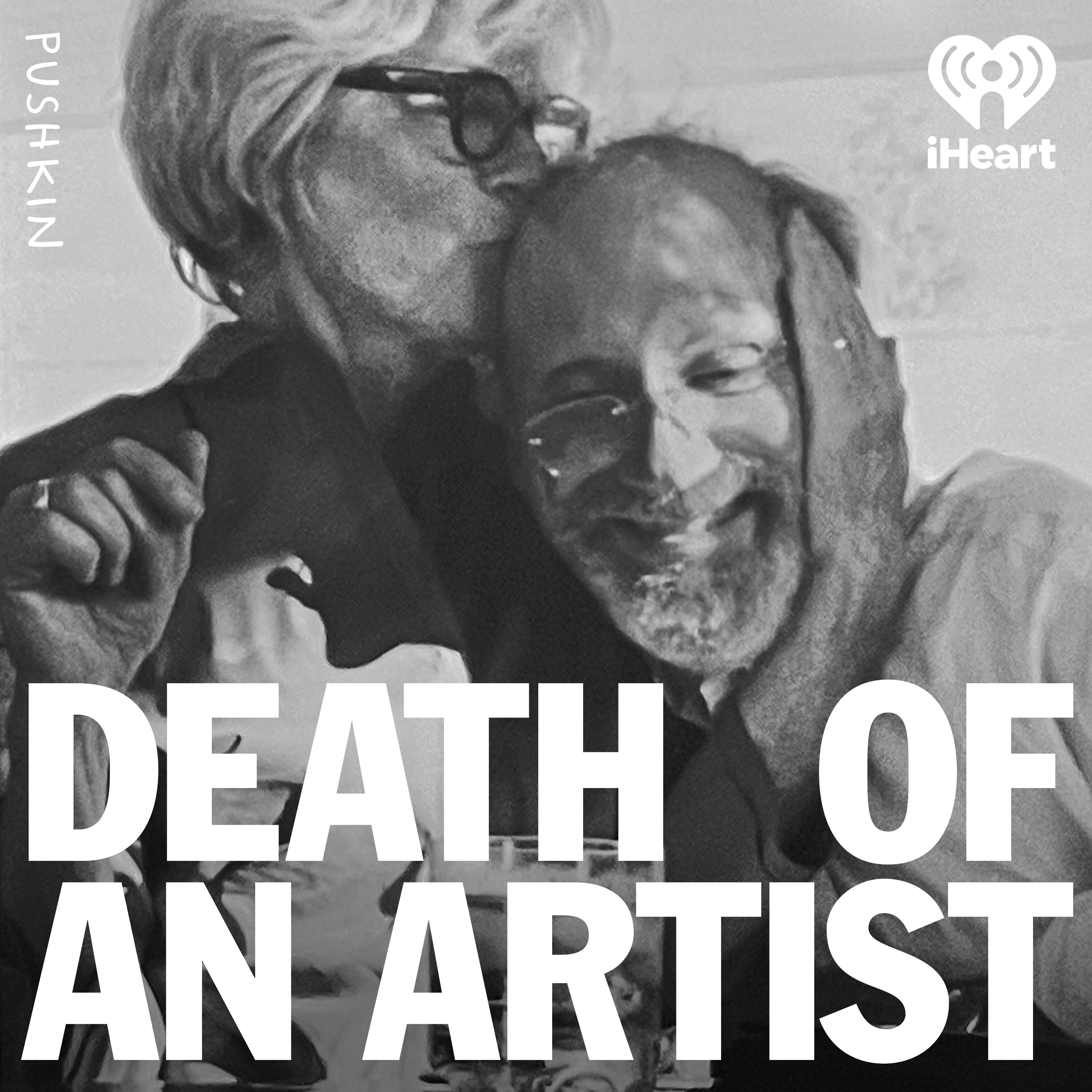
Death of an Artist· Staffel 3· Folge 3
Episode 3: The Train Has Left the Station
Dienstag, 1. September 2026 · 44 min
Kapitelklicken springt direkt hin
Shownotes
“I have never regretted my decision, only the amount of unhappiness it caused you. Still, unforgivingness is the product of those who feel it.”
When Petra and Michael died, they left everyone in their lives behind. But it wasn’t the first time: When Petra first fell in love with Michael, she left her son Tillmann to be with him. In an interview with Alice and Leon, Tillmann reckons with his mother's choices and the marks they left on his own life.
Get early, ad-free access to the entire season of Death of an Artist by subscribing to Pushkin+ on the Apple Podcasts show page (podcasts.apple.com/us/podcast/death-of-an-arti…) or at pushkin.fm/plus (pushkin.fm/join-pushkin).
See omnystudio.com/listener for privacy information.
Transkriptvom Podcast bereitgestellt · Zeitmarken springen hin
Pushkin.
Leon Nafok here. Before we get into this episode, I wanted to let you know that you can hear the full season of Death of an Artist ad-free right now by signing up for Pushkin +. You'll also get bonus episodes, full audiobooks, and true crime binges from your favorite Pushkin hosts and authors. Sign up and save on the Death of an Artist show page on Apple Podcasts or at pushkin.fm/.plus.
Use the code ARTIST25 for 25% off an annual subscription. Let's get into the show. Previously on Death of an Artist.
Petra and her then-husband David were living down at the Oregon coast. She met Michael and it was truly love at first sight.
When I saw the two of them together, the image that came to mind was two checkers.
It's like a very extreme example of what any marriage is, which is necessarily.
By choosing one another, you're forming.
A unit that is by definition dependent upon excluding people.
Oh wow, look at the dedication.
To tell. Her son.
Episode 3. The train has left the station.
My mother had a collection of children's books. Like, there were my children's books, and then there were her children's books, too.
Oh, interesting.
And usually my favorite ones were the ones that she had, other than a couple.
And they were ones that she appreciated for their... Artistic.
Yes. As a child, her favorite author, illustrator was Tomi Unger. And I mean, some of his books, they're almost like written to scare children. And I don't know that my mom ever really liked children. I always liked her pictures and stuff. I didn't realize the gravity of it. until her first show nearly sold out. That's when I think she knew that she could really do something with her career.
So growing up, she was an artist in your mind?
Yes. Yeah. I mean, she started doing pictures in my bedroom.
Do you remember them?
I do. One vividly. It's actually a really painful memory because it's, she painted and she, it was, I think she actually did it with colored pencils. And it was a monster. I would stare at a monster before I went to, you know, as the lights were dimming and I was going to sleep. And then she had done some other pictures. And she ended up selling them, taking them out of my room and selling them. I begged her not to do it. And then I begged her, just at least let me keep the monster. And she said, no, we needed the money and sold them.
I assumed when you said monster, it meant that it was a painful memory because you were scared of the monster.
No.
No, you loved the monster.
I loved the monster. I'm really proud of my mom's career. I just, it's not, you know, my mother, Petra Mathers, the artist, is not who my mother is to me.
Petra was probably my mother's closest friend. Their friendship was of unique and mystical quality. My name is Corey Schreiber, and I met Petra Mathers when I was about 13 or 14, as she was living in Gerhardt, Oregon. Around January of 1980, Petra was staying with the Michaels, I think, who lived in Portland at the time. I'm not sure you've heard their name. She was still married to David.
David was her second husband. Yet, I believe she had fallen in love with Michael. So it was arranged that, Corey, can you drive Petra down to Gerhardt to get some of her things in the van? And I said, yes.
Of course.
How clued in were you about the stakes of what was happening?
I mean, I felt more like the getaway driver because I'm too young to really comprehend it. My mother's not sharing information with me. I understood the hierarchy of of adults versus adolescents, you know, or teenagers, whatever I was. I picked her up in the morning, probably a reasonable hour, around nine. And so you're down at Gerhardt by 11, and Petra says to me, come back in three or four hours. And then I hang out on the beach for the requested amount of time. And then I just remember pulling up and whatever she was taking back to Portland, was neatly arranged in front of the house. And I don't even recall if I got out of the car to assist with putting those things into the truck. But I don't have any words maybe beyond hello to David
or to Till because obviously there's this deep, deep sense of sadness there. And Till is about five years younger than me. And he's standing outside saying goodbye to his mom.
Did you talk to him at all?
No, no, no, I was the driver. There was not a word spoken on the way back to Portland. Imagine, it's a 95-mile drive, it's dark, and it's cold, and it's raining. I mean, she was just staring out the window, and there was this deep quietness. It just would have been hard to penetrate. And I just quietly drive her back to the house and the stuff stays in the car and close the door and say goodbye and I walk home. It's just, to me, it's this visual of the saddest scene of the mom kind of saying, I don't know at that point for sure whether she knows when she'll see Till again or she won't. But I can't imagine what he was feeling at that time.
So many people that we've talked to have referred to you as Till, but was that your childhood nickname?
Yes.
My mother wanted to name me Till, but apparently it wasn't amongst the approved list of government names that were allowed in Germany at the time of my birth. So I became Tillman. I prefer Tillman.
Okay.
But I mean, you can see, I mean, Michael's letter to me is addressed to Till. Is Till.
What's your instinct here? Like how to start this? Do we start at the end? Do we start at the beginning?
That's up to you.
I think we start at the beginning.
Yeah. Okay. When I was about three and a half going on four, my biological father, Eberhard Richter, and my mother moved to Portland, Oregon. They broke up when I was five. They each started cheating on each other. Eberhard moved to Amsterdam from my understanding. And then eventually my mother married David Spence. basically for a green card. My relationship with my mom was really wonderful with David because in my mind it was very clear that it was my mom and I. We were the most important things in each other's lives. When I came home from school, there would always be a snack for me. I mean, I had her attention. She was a dead companion that I enjoyed spending time with. She wasn't just my mom,
she was my friend. I became aware that my mother was cheating on David. I was aware of several relationships that she was in. My mother had an incredible charisma to her. Men were drawn to my mom. David's friends were, I mean, it was very visibly obvious that, you know, they're sitting there gawking at her.
Was that something you were aware of as a child and proud of?
Yes, absolutely. Yeah, yeah. I mean, I was the kid. I was the kid in school that had the hottest mom, you know.
Yeah, I guess that is exactly what I was asking.
So it sounds like the meeting with Michael happened maybe while she was meeting lots of people.
Yeah, I mean, from the way my mother says it, I mean, she met Michael and that was it. It was love at first sight. So my life after my mom left became... very, very different. David and I were basically two bachelors living in the same house. David just crawled into a bottle and never came out. He'd sit in a corner. He would listen to Willie Nelson's Stardust over and over and over again and would drink all night.
I would isolate myself in the den watching television. Either that or I'd be out with my friends. If I was out with my friends, I could be gone for three or four days at a time. not check in with him come back home and he's like okay you're alive I mean from about 13 on so my mom leaves for Michael is with Michael is all about Michael and David has checked out I didn't have interested parents I didn't My parents were completely disinterested in my life.
And then Michael and my mom ended up in Singapore when I was 14 years old and wanted me to come out. I had to earn part of my airfare. So I saved money up for that so I could go see my mom. And the minute I landed in Singapore, they announced to me that they were married. I felt I was losing my mom. I was trying to be on my best behavior and not be angry for fear of losing her completely. At that time, my mom was so enamored with Michael that I was just like this third wheel. I mean, honestly, I just felt every time I was alone with my mom, she was selling me on Michael. She was selling me on, like, oh, he's such a great guy. I mean, it's just like, can you stop?
Why did they go to Singapore?
Michael's brother Bill was out there. Bill had made a fortune in marine construction, and he became a treasure hunter. Michael and Bill were kind of adventure buddies when they were kids. So he sailed out into the South China Sea, and they found this wreck and pulled up a bunch of tin bars and Spanish galleons. Or Spanish doubloons or whatever the heck you call them.
Was it as cool as that sounds?
No, because I was miserable. Once they got back from Singapore and moved to New York, my mom asked me if I wanted to come live with them. And I said no. I had moved around so much as a kid. I had all my friends. And at that time, I still didn't like Michael. I didn't want to move across the country.
As a teenager where you didn't want to. Yeah, it's not my life all over again. And when you say you didn't like him at the time, did you not like him in a generic way?
I didn't like him because he's the person who ruined my life.
My mother, Luanne Schreiber, was a prolific letter writer, and she sometimes made carbon copies. This is a letter that my mother writes to one of her boyfriends. Petra arrived back to Oregon and will be leaving soon to go treasure hunting in Singapore. Michael's brother has a large ship, and they will work and live on it. Eventually, a book of photographs will develop from the adventure. and that Michael will take the photographs and it will become a book.
I am going to dinner with Petra tonight and I am beginning to think I will always be saying goodbye to her.
End of paragraph.
I think my mother in a way vicariously lived through Petra. She thought at that time with the whirlwind of being in love with Michael and going off and traveling that that was going to be her life. I mean then it took Roughly 10 years after that sentence was finished, Petra moved back. So there was some truth to that.
So this letter is actually written to me. Petra comes to visit, so my mother goes to the airport to pick her up. Petra was glamorous when I eventually found her in the luggage area of Northwest Airlines. She seemed delighted to be back in Portland, although apprehensive about her book signing at Powell's Books. It went smoothly, and the piles of her books dwindled as the two-hour period progressed.
We leisurely ate breakfast and left for Sylvie's.
Island around 11. We walked a mile and.
Then the sun brilliantly emerged as we sat on a weathered gray log. I could practically watch Petra's skin turn browner as she leaned back against the log in her white t-shirt and black cotton pants. The conversation rambled about movies, favorite stars that we have mutually adored. Your future tills potential.
This one says, Petra writes glowing letters from London and their excursions by foot in the city. She leaves for Seville this weekend and then jumps to Singapore. She worries so much happiness is going to extract an eventual pain on her. This is typical Germanic thinking, my mother writes. Always a price to pay.
Once she got together with Michael, it was very clear that Michael was number one for her. I mean, it's hard to describe because I don't rate love. You know, like, I mean, I love my wife and I love my son. And I don't love one more than the other. I love my wife as my wife and I love my son as my son. But it was very clear that Michael was number one for her. To me, that wasn't how my mom felt. My mom was, I mean, enraptured with Michael.
Do you think Michael changed her?
Yes, 100%. Do you blame Michael for that? I don't know that I can blame him for it. My mother would have never had the career that she had without Michael. Michael's father opened a lot of doors for my mom. And she embraced it. I mean, they were both starving artists. They lived for free in this 52-room mansion for five years, not having to pay for anything other than their food.
All this wonderful opportunity was laid out for them, and they took advantage of it, and good for them.
One thing I wonder, I mean, I can't tell if this is something you think about endlessly all the time or not, It doesn't really register with you. But it really struck us that she only started writing children's books after she left her child.
Yes. I never really kind of caught the irony of that until you said it.
My first marriage was going through a very difficult time. And my mother was so judgmental in a way. And so I didn't tell my mother about it because I didn't want the lion to come out of the den and destroy everything. So I went down to Astoria and spent the night at Petra and Michael's house because I felt that there's something I wanted to talk about. And so Petra became like, she's the surrogate mother, right? So we're sitting in the back by the fireplace. I think Michael's gone to bed or something. And I'm telling her about this pain in my life. And there's also this part of her that's kind of just like, well, Corey, you know, that's the way it is. Don't sit there and wallow in these, you know, emotional issues that do exist,
but they don't need to sit there forever. And that was good for me, you know, to say, yeah, yeah, this shit happens. So get used to it. When I remarried, Michael said, are you two going to have children together? And I wasn't sure at the time that Joy and I would have Greta, our daughter, who's now 16. And he said to me, you know, I don't want to say that he said it's better, but what he was alluding to was like, but then you can't just focus on each other. And I think what he was doing was declaring that, you know, Pedro and I decided to just focus on each other and the chemistry and all the vital things that would make for that type of relationship.
And I think that that statement, you know, came from a very deep place where he and Pedro made that commitment that they would always be connected and about each other in this way that you see in the photographs. I was always shocked that some people were so angry when they departed. You know, he said to me, like, you know, as they got disappointed, his friends came and went and were dying and ending up in homes and so on and dementia was creeping into friends and you know I said to Michael like so what's the story I mean like what do we do he goes well most people just kick the can down the road kick it down and kick it down and then they don't want to talk about it so I think what he what he was saying was like we know what happens
it's a question of how you want.
It to happen.
Now he didn't have any bloodline children so his perspective was a little bit different too you know or you know his stepson but that's that's totally different I think.
Michael adopted me shortly after Ava Hart passed away. from cancer.
But weren't you already 30 by then?
Well, yes, I was well into my 30s. So 32, 33 years old.
I didn't even know adoption could happen to a non-minor.
Yeah.
No, yeah, it can. Yeah. So Michael wanted to formalize that relationship. At that time, our relationship was good. And I was excited that he wanted to, you know, see himself as my father. I mean, I didn't start calling him dad or anything like that. But I mean, I would introduce him. Like if I was to introduce... I would say, hi, Alice, this is my father, Michael. Michael and I were never really close until I was an adult and, you know, had my own relationship and was no longer like needing my mother's love because I had Brenda, my wife. And the high point of my relationship with Michael was when they were living in Portland and we were living in Portland. And we would get together for dinner almost on a weekly basis and just have a
lot of laughs and things were good. And then little things from my mom to my wife started to kind of interfere with the relationship. And then after Jake was born, things got better. got bad between us really quickly because my mother had a lot of opinions of how I should raise my son. Okay. So here, the disinterest parent who left me behind telling me how I should be raising my son, who just is an infant at the time.
And so that created a wedge and that wedge just kind of kept getting bigger and bigger over the years. It's, It's this little molehill that just turned into this mountain for very little reason. It's like we all were throwing rocks on top of it until it just became this thing that no one could climb over. The foundation was set long ago. And there's no way the house was not going to come crumbling down because the foundation was so weak from the start.
Do you think that foundation being weak is the result of your mom sort of not having what it takes to be a mom?
Yes.
Is that the original sin here?
The original sin is the way that my mom left, the lack of regrets that my mom had throughout my childhood to me, for me at least. Michael and I would get together maybe twice a year and try to sit down and try to talk through this. And he started it off the same way every time. And he was like, what do you want from me? And it's just like, okay, well, the only thing I want from you is your love. And he's like, well, you have that.
And it's like, yeah, but, and I didn't realize it at the time, is that what I wanted from both of my parents, which I got from neither of them, was I wanted their unconditional love.
Right.
Their love was always conditional. It always required things to be on their terms. Several years ago, my parents sent me a letter letting me know that they were cutting me out of their will and that I wouldn't be receiving anything from them.
When was this?
This was probably, I guess, about a year and a half ago.
A year and a half before they died?
Yeah.
Yeah.
It sounds like at least from your point of view, you never gave up on her or them.
I did in the end. In the end, I gave up. Then I was.
Done.
Hey, Tess. You have a good day? You want some more water?
Oh, wait.
Make sure she doesn't get into traffic.
Yep.
Hi, Tess.
I do have a snack for you. This is Sonia.
Hi, Tess.
Can you say hi?
Tess, what did you do at school?
Anything to report?
Tess, you're on mic.
No, I'm not on mic. Is this off the record, Tess?
No.
Oh, great.
Tess, will you tell us one thing you did at school today? Do you play with toys?
No. No.
Do you go outside? No. No. It's funny, we've been having such a hard time with Tess. in recent months I guess she's been so uh ready to fight about everything like she wants something she screams when you give it to her but then it's like over whether it's candy that she's finished and she wants more or swinging you take her to the playground and she's swinging but then she doesn't want to get off when you tell her she has to she starts screaming she's just like everything's a fight uh But then, like, you're away from her all day and still just can't wait to see her again.
Yep.
But then within 10 minutes, you wish you could send her back.
Corey said this thing about how Michael talked to him before he had a kid and was like, are you guys going to have a kid because it will change your relationship? It won't just be the two of you anymore. Right.
Was he kind of counseling Corey not.
To have a child?
He was.
Kind of what it sounded like, yeah.
I mean, now that you spent so many years together not having a.
Kid and now... Do you have a kid?
No, it's better now.
Yeah, it's way better now. It's so much more fun.
Sort of.
But then if you think of any individual thing as enhanced.
By having tests there, like, no. It's way worse. Like, traveling, worse. Eating dinner, worse. Watching movies, worse.
Sleeping, worse.
And yet somehow all together it's better, I guess. Yeah, I mean, she doesn't on its face improve anything.
And yet... You have a shared purpose.
Your common interest is mutual obsession.
Do you want to get out and push the button?
Oh, you want to go up the stairs?
No, I don't.
Think so. Okay.
You're calm.
Okay.
Big step.
Big step.
Welcome home.
Would you like a string cheese?
Do you want to eat and read a book?
Yeah? Great.
Let's do it. I want this one. You want Kisses from Rosa, the really sad one? Do you want to read the introduction?
Okay.
Dear reader, When I was Rosa's age, the worst thing that could happen was for my mother to go away. Yet, that is exactly what she did, often and for months on end. She had tuberculosis, which took a long time to heal. The word mommy has to go away always took the bottom out from under me. The first days after she was gone, I seesawed between tears and giggles.
I was sick from missing her, but also excited by this different life without her. In time, I got used to it, but I often imagined her watching me or waiting for me, and that was very comforting. When you love someone and they go away, it leaves a hole in you. Even if you know that they'll be coming back, it hurts.
Just the same.
This story is for all of you.
Patriot Mathers.
I forgot about this. I haven't read this one in a long time.
Because when I read that, it took my breath away. And I was like, oh, this must be a secret apology.
You don't read it that way?
No, I don't. No, I think this is my mother telling her story.
You view her as having been in denial about what she did to you?
Oh, yeah, 100%.
Yeah.
Yeah, in her mind, it didn't happen. In her mind, she was a good mother. In her mind, Michael was a good father. And a good father. figure to me. To your question of did I see this coming, not at the time, but little statements like there's not much time left, I would get in an email. The last email that she sent was, It would be nice to see your face again.
When was that sent?
That was sent probably... It was right around Christmas before. So shortly before.
Did you respond?
No, I didn't. The first time that I started getting these, you know, there's not much time left stuff, I would respond, I mean, are you okay? Are you sick? And she's like, oh no, we're fine. And it's like... And well, then what do you mean? Oh, we're just getting old. Michael didn't want to get old. He didn't want to be weak, you know, a weak old man. I mean, Michael's a very physical person. I mean, he went to Harvard on a hockey scholarship. He was an avid rower, hyper-athletic, hyper-competitive.
I think his pride wouldn't allow him to have someone to, you know, have to care for him. I was able to contact their doctors after they passed, and the doctor basically said, we were absolutely shocked by this. There's no reason for it.
My mother, Luanne, passed away in 2021. In Oregon, it was legal, still is legal. I think you can do aqua cremation. It's a dissolution process and it takes like seven or eight hours to dissolute the body into ash. But when they dissolute the body, the liquid remains. So some people take it and pour it into the apple tree or the whatever. And I don't know, but I wanted to get it in the ocean. So I stayed in a beach house away from Pedro and Michael the night before. They gracefully got kind of dressed up. Michael brought his camera, so he has a picture of me doing this, which I'm grateful for. And we didn't have this unified thing. I kind of wandered off in the distance and went out in the waves a little ways,
and so I was separate from them. They stayed together, did whatever they did, said whatever they said, and it was a beautiful moment. When I saw them for the last time, Petra, she didn't let go of me. Usually when I would leave their house after, you know, an hour or two hours of just chatting, Michael would usually stand at the door and he would wave to me.
And then Paige would usually walk me out to the car. And she wouldn't say anything specific. She's just going to be quiet and say something like, well, do you think you'll come again or will you visit or whatever? And, you know, there wasn't really that conversation this time. And then she went to give me a hug. And then I noticed that usually with a hug, you don't, you know, you have a quick hug and then you let go. Well, she kind of held on to me a little bit longer.
I get a letter the first week of February from Michael that says, Dear Corey, the train has left the station. Next stop, Wonderland. Thank you for all your support over the years. If there's something you'd like of patron minds in the house, please feel free to contact Patty Flynn.
Love, How did.
You find out that they had died?
Letters.
You learned from the letter?
Yeah.
I went to the mailbox and saw this letter. I recognized Michael's handwriting and was like, okay, what's it going.
To be now?
I got one from each of them.
In one envelope though?
Yep.
Okay.
Which one did you read first?
Michael's actually. So it's typewritten. Dear Till, by the time you get this, your mother and I will be dead. Ever since we were together, we always knew that we would go together. We've been married for 44 years and it has been a very good run. We're getting older and frailer. Neither one of us would live without the other, and we did not want to be a burden or an expense to those left behind. This was a decision made with consideration and forethought. It is, however, unfortunate that we had such a conflict with you and Brenda, but hey, that's life. You seem to be doing fine. We wish you the best for the rest of your life. Petra will be sending something as well. For the record, our conflict with you had nothing to do with our decision. Best, Michael.
Holy cow.
Yeah.
So, yeah, I love the best part too.
And then was the other letter in the same envelope?
Yes.
Did you just immediately?
Yeah, I knew that this one was going to be from my mom. I couldn't tell by the handwriting. So this one is dated January 27th, 2024. Dear Till, Over the years, and especially since Luanne's death, my friendship with her son, Corey, grew and in time with Michael as well. He remembers you fondly and is the kind of human being best suited to bring the last gesture of my love.
I have never regretted my decision, only the amount of unhappiness it caused you. Still, unforgivingness is the product of those who feel it. At the uncountable times I think of you, I remember all the years when the going was good. Love, Mommy.
What was your immediate reaction upon receiving this?
Shock.
Yeah.
I mean, I must have looked as white as a ghost, as Brenda was like, what's wrong? And I said, I think my parents are dead. And so I let her read the letter. She immediately hopped on the phone to the Astoria Police Department, and they confirmed that they had removed two bodies out of the house on the 6th.
And how many days had passed since then when you called?
So that was a Tuesday, and I got the letter on Friday.
And no one had called you?
No.
How's that possible?
I don't know.
Did you reread the letters?
Yes, several times.
And what did you think?
Um... It was sad that those were the last thoughts that were given to me.
The line about unforgivingness is a product of... Those who hold it. That feels like just kind of getting the last word.
Yeah, it is. Yeah, seeing now my whole body language has changed too.
You're crossing your arms.
Yes, exactly. Exactly. The things that my mom wanted to express to me were in the package that Corey sent to me.
Petra asked me, slowly but surely, I might not say over like six to eight months, Corey, would you be willing to do something for me, for Till? And I just said, yeah, whatever you need, you just let me know. And it's not anything I saw. She just said, basically, I have a briefcase for him of some things from him growing up. And she said, at some point in time, could you deliver this to him?
What did it look like?
It was a beautiful old, probably her briefcase from the old days in New York when she was delivering illustrations to Harper and Rowe or whatever. whoever her publisher was at the time. I mean, I think it was where she kept her, her work, you know, uh, my sense was, I don't think it was Michael's. I think it was her, her briefcase.
Do you mind telling us about seeing Till and giving it to him?
Yeah, we met in March of, uh, 24. He brought his lovely son, Jacob. And, uh, I was at work, unfortunately, which was okay, but we just sat at a round table together, kind of in a public area, so it wasn't totally private. And, you know, just reminisced a little bit and speculated and had a very pleasant conversation. I mean, I don't think I had seen him in a couple decades.
I did not have the material in my hand when I came downstairs in my workplace to meet him. We sat at the table, we talked, and then he said, well, we have to be getting on. So I said, okay, let's go out to the, the car and I'll get it for you from my car. I never knew what was in the package. I mean, that's like handing somebody an explosive device or something. It's like, when is it going to go off? And then at that point, you know, there was kind of a somberness And they kind of came around and handed the two of them the briefcase, and they went on their way.
No, it wasn't a mom. It was just pictures and a journal that she wrote, kind of of her vision of our history. Kind of a chronological history of our lives. A lot of it was dedicated to trying to, once again, tell me that Michael was a good father and a good man.
Did you learn anything from it?
No, not really. It's all stuff that I knew. I mean, there's stuff in there that I disagree with.
I was going to say, was it self-justifying?
Yes, it was self-justifying. I was very disappointed. I was really hoping for something monumental. I was really hoping for a reason why, and it wasn't there. I believe that this was Michael's plan all along. And my mother decided to go along with it rather than be alone.
Do you think of him as having killed her?
Yes, I do.
I hold Michael responsible for my mother's death. I'm angry. I'm furious at Michael because I was still hoping for a chance to, you know, still have a relationship with my mom. I mean, even if it came down to, you know, caring for her in her world. In her older age, I mean, I would have been happy to do those things. As much pain and anger that I have towards her, I mean, she's still my mom. She's the only real parent that I've ever had in my life.
And that's gone now. And now there's no chance of getting her back, and Michael took that away.
And, yeah.
If he was in front of me now, I'd probably kill him all over again.
Next time on Death of an Artist.
Has the thought crossed.
Your mind that if you and Mike had ended up together and been married, that it would have been you being asked to die?
That's the thing.
I mean, I've thought of that and thought, well, you know, the way our timing was.
Death of an Artist, Season 3, is reported and produced by me.
Alice Gregory.
And me, Leon Nafok.
Our supervising producer and editor is Diane Hodson. Our producer is Sonia Gerwitt. Our showrunner is Alexandra Gerriton. Our executive producer is Jacob Smith. Original music and sound design by Evan Biola. Our fact checker is Annika Robbins. Additional production support by Julian Collet. And our show art was designed by Sean Carney.
This episode featured interviews with Tilman Richter and Corey Schreiber. Special thanks to Sarah Vytak and Thaddeus Moore at Sprout City Studios in Eugene, Oregon. Death of an Artist is a production of Pushkin Industries. To find more Pushkin podcasts, listen on the iHeartRadio app, Apple Podcasts, or wherever you listen to podcasts.
