

Kapitelklicken springt direkt hin
Shownotes
“It brought up all the things I've never done. All the risks I haven't taken. It was always about trying to be free, you know?”
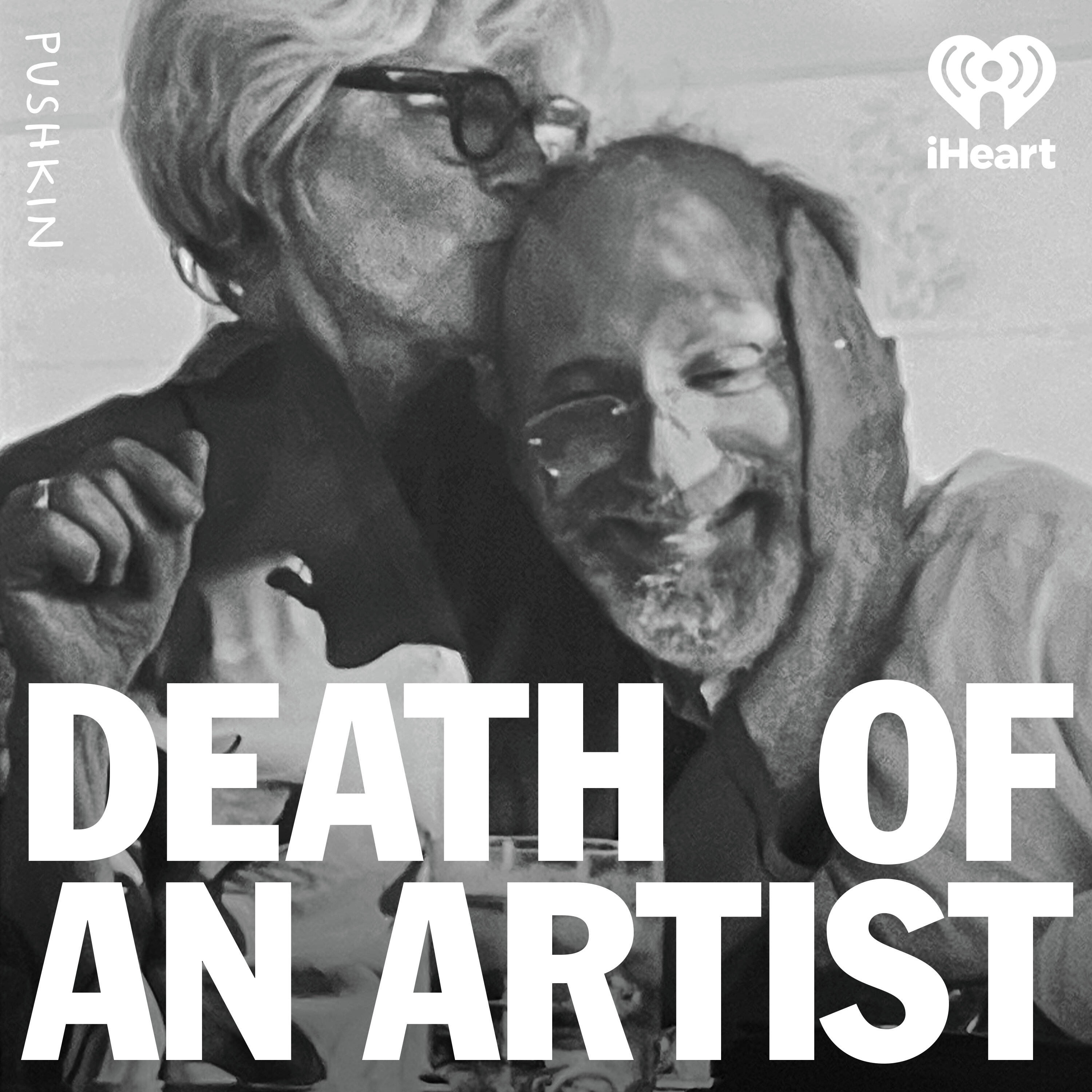
According to Michael Mathers’s first true love, he was always a romantic. Was the death orchestrated with Petra the ending of a love story he’d been trying to craft all along?
Get early, ad-free access to the entire season of Death of an Artist by subscribing to Pushkin+ on the Apple Podcasts show page (podcasts.apple.com/us/podcast/death-of-an-arti…) or at pushkin.fm/plus (pushkin.fm/join-pushkin).
See omnystudio.com/listener for privacy information.
Transkriptvom Podcast bereitgestellt · Zeitmarken springen hin
Pushkin. Leon Nafok here.
Before we get into this episode, I wanted to let you know that you can hear the full season of Death of an Artist ad-free right now by signing up for Pushkin +. You'll also get bonus episodes, full audiobooks, and true crime binges from your favorite Pushkin hosts and authors. Sign up and save on the Death of an Artist show page on Apple Podcasts or at pushkin.fm/.plus. Use the code ARTIST25 for 25% off an annual subscription. Let's get into the show.
Previously on Death of an Artist.
Do you think of him as having killed her?
Yes, I do. I hold Michael responsible for my mother's death.
I believe that this.
Was Michael's plan all along.
And my mother.
Decided to go along with it rather than be alone.
Alice, can I show you something?
Can I talk to you for a second about Mike at Middlesex School?
Please, yeah.
Mike was very much a straight arrow at Middlesex. He was good. The faculty loved him. The students loved him. He was a great athlete, soccer and hockey. And his tie was knotted. And his shoes were good. He was also the president of our class, junior and senior year. Then, Alice, our yearbook came out in the summer of 1964. And we had informal meetings. Pictures taken along with a formal picture.
I'm going to show you Mike here.
Okay, that's the formal picture.
That's the formal picture. Okay, yeah.
So his tie is knotted neatly. His hair is combed.
Hair is perfect.
Perfectly shaved.
Right.
Tranquil looking.
Yeah.
Okay.
And here's the informal picture.
Oh, yeah.
He looks like an inmate there. Oh, my gosh. Okay.
Can you see it?
Yeah.
Rumpled shirt. Standing kind of aggressively outside.
Rumpled shirt. He's got a cigarette, got the cigarette hanging out of his mouth. He's got the Jack Kerouac books on the road and Dharma bombs. Can you see that?
I can see that. So what happened?
I got the picture and I said, what the hell is this? What Mike Mathers are we looking at? Is she making fun of the village scene, the Greenwich Village scene? But no, that's Mike. nonconformity, individual assertion. I'm going to do things my way. That's Mike. I'm Locker McCarthy. I knew Mike Mathers at Middlesex School from 1960 to 1964.
And I regarded him as one of my very closest friends. We spoke, I would say, once a month. for the last 10 years until he died in 2024 in February. He would call me or I would call him. We sometimes argued. We'd have arguments, and Mike would always end the arguments. It was good humor, but he would end the arguments with a sigh of exasperation. He'd go, Locker, like that.
Locker.
And that was sort of ended.
You had a phone call with him the day before the suicide. Is that correct?
Yes.
It was an inconsequential phone call, Alice. It was just my checking in with him as I always did. I mean, what can I tell you? There was no depression or anxiety. He seemed like Mike. But yeah, if there's anybody who was going to do this, pull this kind of stunt forgive my phrase sorry Mike but it would be Mike Mathers.
I mean it's been fun as you get older you get up more times to pee at night so every time I get up I think of another thing that we did together and um So I was trying to think of symbolic ones. Like on my 21st birthday, we went skydiving. First time for both of us. And he wound up in a fucking tree. Excuse me.
You can swear.
It's okay. Yeah, please.
My name is Don Hooper from Brookfield, Vermont. Now retired public policy maker. And I went to college. with Mike Mathers. I met Mike as a freshman at Harvard, and I had no, he lived in the next entryway, and I had three roommates, and there was a thin door between my little suite and his suite, and he played his Johnny Cash kind of loud, and Glenn Yarborough, and so on, and he was one of the few people freshman year who had some really had something quite different about him.
He had an Indian motorcycle, which is a big old 30s or 40s machine. It would be the equivalent of a Harley today. And so he already had, there was a branding, an imagery around him that was kind of exotic. And we all revered him. I mean, we had a great love of his roustabout exuberance. Freshman year, we both had a hankering to go sail the seven seas and, you know, jump off of a tramp steamer or something like that. But it's very hard to break into. It's really hard to.
It's hard to break into sailing the seven seas.
It is.
There are barriers to entry.
Did you sail together?
We did in the summer of 1967. We sailed on the Great Lakes together. We Took ore down from Duluth down to the Ford plant in Detroit. Two and a half day trip each way. And we did that all summer long.
What do you think Mike liked about that?
Well, we were always doing screwball things. Flying kites off the fantail. Kind of entertaining other crew members. And the people that we worked with were all ordinary working class people. people from the Midwest. It was just a new view of the world, something that was expanding his universe from Oyster Bay and corporate father, very powerful mom. We read Huck Finn together all summer long. And then at the end of the summer, we decided we'd make a raft and play Huck Finn on the Mississippi. He just did stuff because it was It was something interesting. He rented an apartment over a casket factory in Charlestown, and that became quite a destination for all the cool kids. You know, we'd go there for dates and shack up, and it
was really a fun place to be.
He was good with girls?
Oh, yeah. That was always my impression. I think that he left many more broken hearts than the other way around. Have you talked with Birdie Emerson?
Hello.
Hi, Birdie.
Hi.
Is that Alice?
It is. Hi.
I'm here with my husband, Leon, too.
Hi, Birdie.
Nice to talk to you both. I've taken the opportunity while I was waiting for you for this call to come to be reading an article. about how the billionaires are buying up and blocking out the best parts of Montana, which is where I spend a lot of time. I read something like this and I think, oh man, if Mike and I had gotten together, we would have been doing this kind of thing.
What kind of thing?
Oh, he was just a brilliant photographer. And I was a writer more than a photographer, but did both. Anyway... There you go. It never happened.
Could you take us back to the beginning a bit? Was it love at first sight?
Oh.
Was it love at first sight? Well, it was connection at first sight. I don't know if you call that love, but it was just like, you know, zap. I don't think I've thought of it in terms of being in love with Mike Mathers. I thought of it in terms of escaping with Mike Mathers, you know? It was all an adventure. It was all an adventure. We were young and naive and just doing all kinds of things.
You guys were 16 years old at this point?
Let's see. Yeah, 16. Jeez. Oh, I can't believe we were that young. Now that I'm almost 80, I just can't believe we were that young. When I look back at the time we'd spent together, I think, wow, that was 10 years. And for the first five, it was just, you know, we were still in high school and college.
And it was pretty much all wonderful. And then it was for the last five that things fell apart. Anyway.
Anyway.
I grew up in a very, very strict Puritan household. I didn't do drugs. The first time I did any marijuana, it was probably in, oh, I don't know, probably 1967, probably when we were juniors in college or so. And so finally Mike got me to smoke a joint or something, and I was in their college room, and I just went catatonic. I went and curled up in the corner.
And Mike grabbed me, and he carried me all the way down to the banks of the river and kind of dropped me and yelled,' Marry me!' And he knew that that would snap me out of my catatonic state. That wasn't the first time he wanted to marry me, and that was kind of a joke. But we did talk about that over the years, and I was just never ready to commit.
Bertie, why did Mike live in a coffin factory?
Well, this place was pretty cool. I mean, it was right over the railroad yard. And it was in the total industrial part of town, which is what Mike would always gravitate towards. And the fact that it was a coffin factory was a big plus for him.
Should it be interpreted as an indication that he had a long-standing fascination with death?
Well, yeah. I mean, I think he did. I mean, that and the fact that he drove a hearse for a while.
He drove a hearse for a while?
Yeah.
Yeah. You didn't know about the hearse?
I thought it was an ambulance for some reason.
Yeah, someone said ambulance.
There was an ambulance too, but there was also a hearse. That's amazing. I wasn't a big part of all that, but I did remember riding around in it once. I wasn't quite so fascinated with the death as he was.
What was his fascination?
Death is the ultimate experience. It's the ultimate. That's going to the max. That's the end. That's it. And that's what he was all about, was taking things to the max.
It was always an adventure to be with him. It wasn't necessarily safe. But he had a view of the world that absolutely bubbled over with a zest for learning new things, whether it was riding the rails or following a circus or Basque sheep farmers. So I really believe probably that he wasn't afraid of death, but not being alive probably scared the heck out of him. when I learned of his death, I said, ah, what an appropriate exit.
That was, I really, I greatly approve. Partly because I was the sponsor in the Vermont legislature of a bill in 1990 or 91, the Kevorkian era, that was death with dignity. And I just imagined death that he and Patriot made a deal that said, you know, if one of us dies, the other one's going to be a mess.
So we should go together. And I mean, that was the kind of moral authority that I think that they cooked up together. It was just a pact that made sense to them.
Bertie, did you always kind of think that you would end up together?
Oh, yeah. Yeah. Back then, yes. We had one of our chats about a year before he died.
And we started.
Arguing, you know, in a good way. We started arguing about how many times we'd broken each other's hearts. I've always felt that probably everyone thought that I was the one that guilted Mike in the end and went off and got married. And it's always felt too sad that, no, that's not the way it happened, people. He guilted me.
You know, not that it matters, but yeah, I was just never ready to commit. And when I finally did commit, everything fell apart. He gave me an ultimatum. He said, look, it's either Hugh, my other significant other at the time, or me. He said, it's now or never. And so I said, okay, it's now. And I went out and said goodbye to Hugh, the other guy. And then I went to the coffin factory. And sat there for about two hours. And then Mike came in with a woman.
And Mike said they had been out to dinner. And she had persuaded him that committing to me would be just more of this cycle he'd been on. And so he decided he was going to follow her advice.
And.
It was a real bummer. It was really awful. And when I got home that day, there was a note from Hugh saying he had decided he was going to try to talk me out of Mike. And lo and behold, you know, he saved me from my agony. And then a month later, he married me. Anyway, Mike burned all the photos of me, all his photos and negatives of me.
He told me he burned them all after I got married. And I thought, well, okay.
Bertie, has the thought crossed your mind that if you and Mike had ended up together and been married, that it would have been you being asked to.
Die that's the thing if it were i mean i've thought of that and thought well you know the way our timing was that never would have happened we never would have been able to agree on when to do it uh i mean and i really mean that.
Actually My name is William Wellington Walbach Jr.
Triple W.
Triple W, exactly. But my friends call me B, and it's a childhood nickname that I've had since, I don't know, preschool. And to me, it's to be or not to be, and I choose to be.
That is literally the question in this story, I suppose.
Michael was somebody who I really looked up to. I had a loving relationship that just Started out at Harvard and continued right up until they killed themselves. The shock of the letter was just the first sentence, which is, by the time you read this, Petra and I will be dead. It said, Petra and I had a great run, but we've decided to end it. I'll see you in the next stop. As if we were taking a passenger train from life to life. There were enough details in it so that I knew it was written to me.
But it was very possibly a form letter that he had sent out. I'm not sure he even said thank you or anything like that. Not that he needed to. But the fact that it was just a door was shutting on a relationship that I really cared about. And all I got was this piece of paper in the mail. I just felt cheated. I first met Petra Mathers in Oyster Bay, Long Island, at Mike's parents' house. It was this huge house. It was like Charles Adams' house, sort of.
It was very big and sprawling.
What did you observe about Petra, their relationship? I'm just so curious what that dynamic looked like to you.
Well, you know, Mike was larger than life and she was petite and, you know, very friendly and nice. And she had a son by a previous marriage, I believe, of Till. Petra was really comfortable in that house. I think Till seemed less comfortable. But anyway, Mike was married but then got divorced before Petra died. But I think he loved Petra right from the beginning.
I was so excited, so excited to hear that he got married, to get this beautiful card from him.
What was the card?
It's a picture of him and Petra in front of the wedding registry in Singapore, I think it is. And he just got his arm around her and they're both really smiling and looking beautiful. And it's like a lot of his Christmas cards, you know, and really nice black and white print. And on the back, he just wrote, I finally hit Pager, you know, and that was always this.
He was always looking to hit Pager, right? And he was always setting up romantic situations. They didn't always pan out, but he would set them up. And finally to think that it had happened was really good.
I went to our 53rd reunion at Harvard, and one of the activities that all of us attendees were invited to was to have a presentation to your classmates. And Michael's was all about The Christmas postcards that he and his wife, Patriot, had been sending out for years.
The Christmas cards?
The Christmas cards, yeah. They would send out a postcard for Christmas every year with a photograph that Mike had taken of the two of them. Each year was different. There was a little saying, you know, on the back.
And this was in the context of a reunion event where other people were sharing gifts. Professional accomplishments, other kinds of achievements.
Absolutely, yeah. He presented, I don't know, save 10 of them and flashed them up on the screen and gave the background of each one.
When I look at the Christmas cards, I get the impression that this is a unit. They are in harmony with each other in these photos. I just pulled one up that says it's Petra and Michael standing on a dock. She's playing a cello. He's playing an accordion. And their dog is in the audience for it. The caption is, let the music play in 2004. The next one is Petra in a ball gown sitting at a white, what's it called now?
Like a white linen tablecloth.
They've made a picnic table up to look as though it's a fancy dinner table.
And Michael's like playing the butler or whatever, and it says, may the world be your oyster in 05.
They just look really locked together.
Well, yeah, they were locked and locked together.
So the takeaway of this presentation was kind of like, this is my life's work, this marriage.
Yeah, exactly. It was a documentation of their love story. This is the thing I'm proudest of. And that persisted. above and beyond anything else in their lives together. After they killed themselves, I had been given one really nice photograph, color photograph of just the two of them. When you first look at it, it's just a photograph of Mike and Petra smiling at you. They're indoors, and they're behind this gauzy curtain. But I... Being a photographer and a videographer myself, I blew it up. And I could see all kinds of details. Mike's jaw was clenched. Petra's was actually frowning, it appeared like. And her jaw was clenched.
I mean, you could see the muscles in their face, both of them. And Mike had his left arm around her. He was holding her in place. And he was holding a camera with his other hand. The symbol of the Gauzy photograph was, you know, hey, we're gone now, but we're happy. But a closer look didn't appear to be happy at all. And so that, you know, that photograph really threw me off. And I started to think that Mike forced Petra to do this. And I just was blown away by this sort of a revelation. But I have no idea whether it was a true revelation. revelation at all. I don't even know the date on the photograph.
It could have been for a Christmas card, for all I knew, and she didn't like the setup for it or something like that. The details I read from the story on paper about the death scene and how she had died first and Mike had carried her and put her in bed beside him before he actually killed himself, it seemed like I don't know, somehow gentler and she was aboard with the whole thing. She was a willing participant by the time that it all took place. But it seemed like he was forcing her to take this photograph.
You know, I don't know.
Thank you.
This whole interview has been Perfect.
Yeah.
Thank you so much. Thank you.
You're most welcome. It helped me a lot, too.
Thank you.
Locker, you mentioned that he had spoken to you about their intentions.
Yeah.
I had just gotten out of the hospital. This was 2020. And I had some surgery. And when I got home, I was feeling very frail. And I asked him how his health was. You know, I'm feeling frail. How are you? And he said, I'm all right right now, but if things get bad, Petra and I are going to take care of things. And we have the equipment. And I said, what are you talking about? And he said, well, we have a friend who gave us some nitrogen tanks. So that's how we're going to do it. Wow. He had the plan and the means six years ago.
And.
I said, so you're really serious? He said, yeah, we're not going to do the decrepit thing. Not going to go that way. Petra and he were like that. They were a conjoined couple, if there ever was one. And they were determined to go out together. It was never going to be anything where one person was going to leave the other. It was we do all these things together.
We travel together. We watch movies together. We'll kill ourselves together.
Does it strike you as romantic?
Sure.
Isn't it? Don't you think? That there's a romantic element to it? Mike loved romantic movies. He loved rom-coms. Did he? Yeah. Rom-coms that have sad endings.
I was absolutely astounded at what an impact their death has had on me. It brought up all the things I've never done. All the, you know, the risks I haven't taken. It was always about trying to be free, you know, like a bird on a wire, right? And Mike was just, that was what he was to me. I think that's what we were to each other, you know.
But our timing was off. It always was. Here comes the train. Every day I think of him when the train comes by. I live right next to the railroad tracks. And especially there's one conductor who really has a need. whistles, but he plays us the whole tune as he goes by. Makes me think of Mike. One of the horrible things about suicide is that that's what you remember about the person.
You know, and I went, damn, that's not what I wanted to remember about Mike.
What would you want to remember instead?
Oh, let's see.
Well, There was one night when I was leaving to drive across the country for something. I don't remember. And he, I guess, snuck out to Concord in the middle of the night, and he threw flower petals all from my front entryway to my folks' house, filled with flowers, and all the way out to my car. The song at the time that we'd been playing a lot was Leaves.
your flowers at my door, I leave them for the one that's left behind. You know that song? Leave your... I'm not going to sing it for you. You can look it up. Leave your flowers at my door. I leave them for the one who's left behind. And anyway, that was magic. He knew how to make magic just by being a regional the problem with Mike is that I remember so many instances exactly as they happened you know and it's ah it's exhausting um you know they they never added up to a life together but it was for a lot of really bright bright times in my life you know and they are they're just moments in, in, uh, through a whole lifetime of, uh, being married and bringing up kids and working, uh, that they're just, they're like
glimmers of, of, uh, living life at the fullest. And that, you know, I did have a good life. I did have a good life. I just, Never forgot or quit loving Mike.
Dear Locker, by the time you get this letter, both Petra and I will be dead. You know, that stopped me right there. That was when I started wandering around my apartment, not believing it. I wanted you to hear it from me. This was not a rash decision. I recall having mentioned it to you early on. As I said, it was years before. It was carefully thought out and planned for years. We had been married for 44 years, and it has been a great ride. Neither one of us could live without the other. It may not seem obvious to others, but we are becoming more frail mentally and physically and did not want to be a burden or expense for those left behind.
Ah.
I have really enjoyed our conversations immensely these past few years. I wish you the very best, Mike. That still hits me. I don't remember much about that day except calling people, calling people who didn't know Mike. I just wanted some shoulders to cry on. I think that, you know, the Kubler-Ross stages of grief, I think I went through them very rapidly and But I still don't accept it. I really don't. He's just not there.
Do you find that letter satisfying as a form of goodbye?
I can't think of anything more final and in some ways gratifying. He talked about how much he liked our conversations. So there's that, which gives me some comfort.
And it sounds like the letter you received from them was... earnest and had a correct amount of gravitas, despite being quite short. But not everyone I've talked to received letters that were written in that spirit. And a few people I've spoken to were kind of flabbergasted by how almost lighthearted the way they were written was. was, if that makes sense. And I wonder if you have any thoughts about that, if almost like what they did at the end echoed this sense of humor or like almost aesthetic.
Do you know what I'm getting at, really?
I do. I do. I get it. You know, you're asking, that's pretty deep, Alice. You're talking about whether or not in some strange, crazy way, what he and Petra did was a bit of a joke. I hadn't thought about that until this moment, now that you mentioned it. Yeah, it was Mike and Petra doing the unexpected out of left field thing. Yeah, Alice did it. I got to say it had a bit of dark humor about it, didn't it? I guess it's Mike getting to the point.
I'm dead. I'm no longer alive. You're not going to hear anything more from me except thanks. It was nice to know you. Thank you very much. We had a good time talking to each other over and out.
Does what they did make you think differently about your own life?
Ah, yes, of course. Something like that happens.
Yeah. Yes.
What am I living for? I didn't want to waste any more of my time that I had left, have left. I didn't want to do that. I want to be conscious, more conscious of living in every regard than I had been before this. And here's an answer to a question you haven't asked. Have I thought about what I'm going to do if that looks like the future, the near future?
Assisted living, blah, blah, blah. Yeah, I'm not going to hang around, Alice. I'm not going to be in a state of decrepitude. I'm not going to do that. I have the means, pills. But that's, I'm fine. I'm good. Don't worry.
Do you think you would be so sure of this had they not done what they did? Were you sure in this way before you found out about their death?
The impetus to think about the end of life, my end of life, was that letter.
Yes.
Yes.
Alice, I don't have any family. I think that has a lot to do with what I'm thinking. I think you have to consider your loved ones and your family. And if that means suffering, well, life is suffering. You know, you've got to accept that. I think family is everything, and I don't have one. So it's easy for me to say, bye-bye.
Next time on Death of an Artist.
Did you know about Poe?
Petra's parents died?
Was it kind or was it cowardice? You know, I don't think it was cowardice. Except they were afraid of what the future was.
Death of an Artist Season 3 is reported and produced by me, Leon Nafok.
And me, Alice Gregory.
Our supervising producer and editor is Diane Hodson. Our producer is Sonia Gurwit. Our showrunner is Alexandra Gerriton. Our executive producer is Jacob Smith. Original music and sound design by Evan Viola. Our fact checker is Annika Robbins. Additional production support by Julian Collet. And our show art was designed by Sean Carney.
This episode featured interviews with Locker McCarthy, Bertie Emerson, Don Hooper, and William B.
Walbach.
Special thanks to Catherine Cook and Tucker Dalton at CDM Sound Studios in New York City, and to Tony Gottes and Warren Babson at Bangasong Studios in Gloucester, Massachusetts.
Death of an Artist is a production of Pushkin Industries. To find more Pushkin podcasts, listen on the iHeartRadio app, Apple Podcasts, or wherever you listen to podcasts.
