

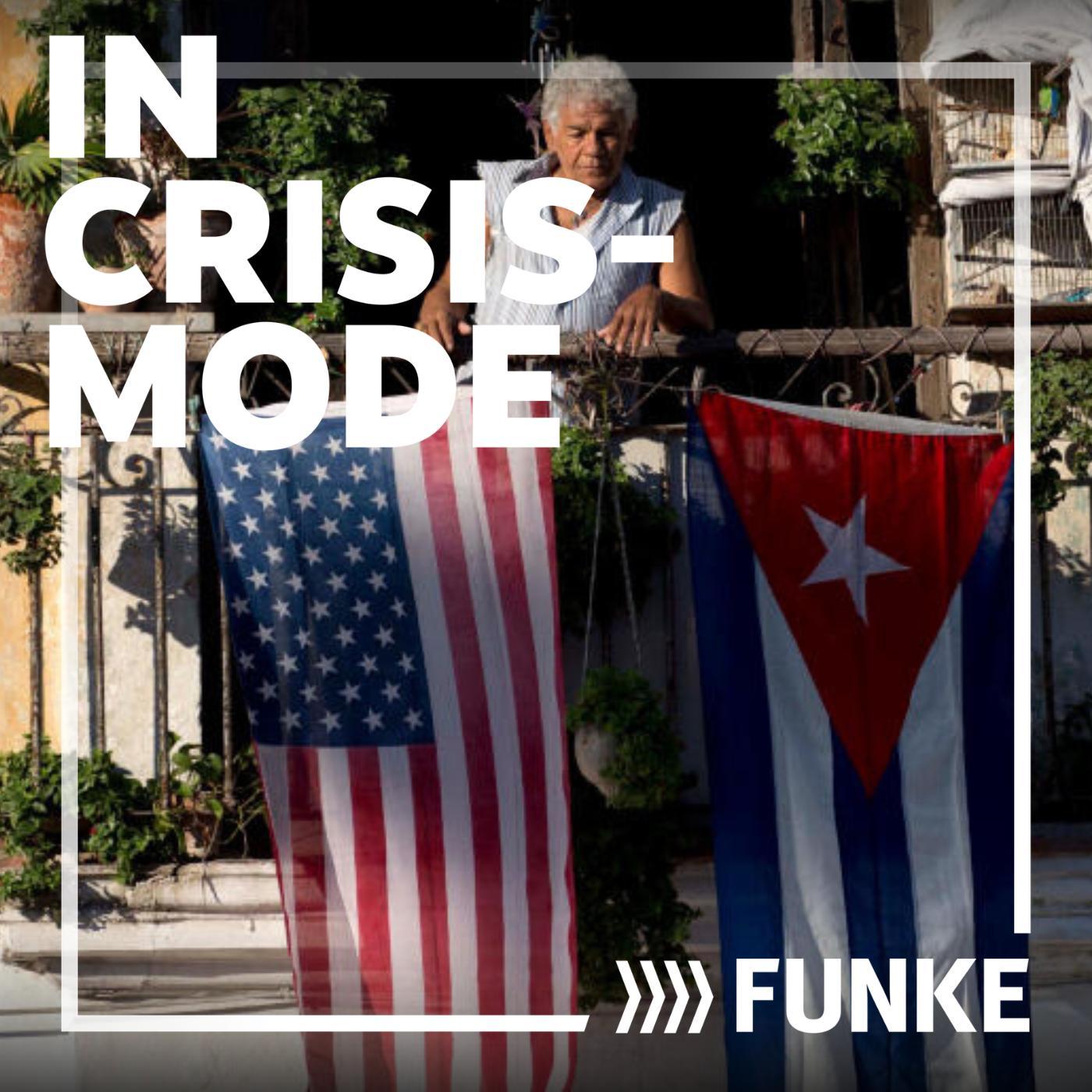
Im Krisenmodus· Folge 143
Cuba's Crisis: Oil Shortages, Political Deals – and Washington's Agenda
Mittwoch, 1. April 2026 · 25 min
Kapitelklicken springt direkt hin
Shownotes
This episode was made with the help of AI.
For weeks, Cuba has been facing a severe oil shortage. Diesel is scarce, power grids are faltering, and hospitals are being forced to scale back services. What is driving this crisis – and what role do the United States play?
In this episode of “Im Krisenmodus” (“In Crisis Mode”), FUNKE war correspondent Jan Jessen speaks with Dr. Claudia Zilla (German Institute for International and Security Affairs) about the connections to Venezuela. Prof. Dr. Bert Hoffmann (GIGA / Freie Universität Berlin), who was in Cuba in February, shares first-hand insights into the situation on the ground. Together, they explore where developments may be heading – and what will be decisive in the weeks ahead.
Guests
Dr. Claudia Zilla – Senior Fellow, Research Division Americas
German Institute for International and Security Affairs (SWP), Berlin
Prof. Dr. Bert Hoffmann – Lead Research Fellow & Editor “GIGA Focus Latin America,”
GIGA – German Institute of Global and Area Studies, Hamburg;
Honorary Professor, Freie Universität Berlin
Host
Jan Jessen – Head of Politics at NRZ and War and Crisis Reporter for the FUNKE Mediengruppe
🧭 Chapter Overview
1 – Oil Cut Off, Pressure Rising: Why Cuba Is Back in Focus
Jan Jessen sets the scene: Venezuela is opening economically without political reform, while US oil policies are increasing pressure on Cuba. What does this mean for people on the island – and could diplomacy replace confrontation?
2 – Venezuela as the Key: “Economic Change Without Political Transition”
Dr. Claudia Zilla explains how Caracas is liberalizing parts of its economy, especially in energy and mining, without fundamentally changing its political system.
3 – Liberalization Does Not Equal Democratization
Zilla highlights that reduced repression does not automatically lead to free elections or meaningful political participation.
4 – Cuba ≠ Venezuela: Geography, Power Structures, and Symbolism
A comparison of the two systems: Cuba’s island geography, limited resources, tightly knit power structures linked to the military – and its unique symbolic legacy.
5 – Why Cuba Matters to Washington
Zilla outlines US interests beyond oil: the military-controlled conglomerate GAESA, tourism and the global image of Havana, unresolved property claims, and the political influence of Cuban exiles in Florida.
6 – Scenarios Without Military Intervention
Rather than “boots on the ground,” Zilla considers negotiations with Cuba’s ruling elite as the more likely path, possibly involving leadership changes but maintaining continuity within the system.
7 – Everyday Life Under Pressure
Prof. Hoffmann describes the reality in Cuba: fuel shortages disrupt transport, water systems fail, and hospitals struggle – affecting nearly every aspect of daily life.
8 – “Why Cuba?” – A US Perspective
Hoffmann explains the geopolitical and symbolic importance of Cuba: its proximity to the US, domestic political pressure, and economic interests in tourism and real estate.
9 – Escalation Scenarios: Conflict or Negotiation?
Why a US invasion is unlikely, what risks it would entail, and how internal political shifts in Havana could unfold.
10 – The Tanker Question: A निर्णing Factor
Will fuel shipments reach Cuba? Hoffmann emphasizes that US decisions regarding oil tankers could determine whether the country gains temporary relief or faces a worsening humanitarian crisis.
11 – Conclusion: Pressure, Daily Reality, Open Questions
A concise summary: causes (oil supply and US leverage), strategies (pressure and negotiation), consequences (life under scarcity), and the broader political significance of Cuba. Key uncertainties remain – including fuel deliveries, potential concessions from Havana, and pressure from exile communities.
Foreign Office
Current travel and security advice for Venezuela
🔗 auswaertiges-amt.de
📬 Contact & Feedback
Questions, comments, or suggestions? Get in touch:
✉️ krisenmodus@funkemedien.de
🟢 Subscribe Now
“Im Krisenmodus” – available on all major podcast platforms:
Spotify (open.spotify.com/show/0IQW1w25NYSrz60aAPzwvB?s…) | Apple Podcasts (podcasts.apple.com/de/podcast/im-krisenmodus/i…) | Deezer (deezer.com/de/show/3737197) | YouTube (youtube.com/@Krisenmodus-Podcast_FUNKE)
📅 New Episodes
Every two weeks, always on Wednesdays
“Im Krisenmodus” is a podcast by the FUNKE Mediengruppe
Transkriptvom Podcast bereitgestellt · Zeitmarken springen hin
Die Übersetzung von Jans Stimme vom Deutschen ins Englische wurde mit einer KI erstellt. In January, the United States launched an offensive against Venezuela, abducting its president. Now, the US is engaged in a war with Iran, a conflict that appears to be entering its de-escalation phase. And already, Washington has a new target, Cuba.
Cuba, the island nation off the coast of the United States, has been under socialist rule for nearly seven decades. And Cuba now faces an enormous problem. It is running out of oil. This is no coincidence, as the US has significantly ratcheted up pressure. There has always been an economic blockade against Cuba, but this has now been expanded.
No more oil is entering the country. In short, Cuba is under immense economic, political, and strategic pressure. The question is, is Cuba being forced towards a US-friendly government similar to Venezuela without military intervention? What's currently unfolding might seem somewhat complex at first glance, but at its core, it is quite clear.
And that's what we will examine in detail today. In Crisis Mode, the podcast from Conflict Zones with Jan Jessen. I am Jan Jessen, Political Editor-in-Chief at NRZ and a Crisis and War Reporter for the Funke Median Gruppe. To truly understand what is happening in Cuba right now, it is indeed worthwhile to first look at Venezuela, because there, as you all know, something decisive happened in January.
We have covered this several times in this podcast. We will put the follow-up episodes in the show notes for you. You'll remember, President Maduro, whom the US accused of being a drug trafficker and a threat to US security, he was abducted at the time as part of a US military operation against Venezuela.
This was not a major war. It was a brief military action involving airstrikes and, as mentioned, the abduction of Maduro. Und jetzt, eine Regierung in Venezuela ist, die aus dem alten Regime ist, aber ist noch mehr US-freundlich als Maduro. This government is now opening up the economy, but politically, the system essentially remains the same.
However, this also shifts the balance of power in the region. Our first interviewee is Dr. Claudia Siller from the German Institute for International and Security Affairs in Berlin. She says, without Venezuela and the events that transpired there, Cuba is currently difficult to understand. Was wir zurzeit in Venezuela beobachten ist eine ökonomische Transformation ohne politische Transition.
What we are currently observing in Venezuela is an economic transformation without political transition. This means that a systemic policy change is taking place. A great deal is being reformed within the economy. Politically, there are reforms, but they do not fundamentally alter the nature of governance.
Und viele wichtige Maßnahmen für die Reform der Energie, als auch Mining, sind sehr schnell und sind verabschiedet. All das ist in der spiritue der Ökonomie, die garantiert für foreign capitalen und, wie wir sagen, in close cooperation mit der Regierung der USA. Denn beide Parteien, die Trump-Administration und die Regierung von Delcy-Rodriguez consistently report very, very good cooperation.
Yes, so a lot is changing. The economy is opening up under pressure from the US, which now smells good business, especially, of course, for its oil companies. One must not forget, Venezuela has the largest oil reserves in the world, significantly more than, for example, Saudi Arabia or other Gulf states.
And in that respect, it is naturally a very interesting country for the American oil industry. And now, through the intention to open up this country, to reform the energy sector, to reform mining, These are all things that will benefit potential US investors. However, and this is also very important, Caracas is opening up economically, but without a democratic transition.
When the US attacked Venezuela, I also spoke with people in the opposition who naturally hoped that the regime's stranglehold would now loosen. That is, the multitude of intelligence agencies and all the pressure that weighed on the people. That this would now be over, but that definitely doesn't interest the US.
Das interessiert nicht die Trump-Administration. Für die USA, business ist wichtig. Und sie sind jetzt. Aber das hat auch sehr direktes Wissen für Cuba. Venezuela, ein lange-Standig ally von Cuba, also state-socialist, war der wichtigste, die wichtigste Öl-Supplier für Cuba. Das ist nicht mehr der Fall.
Die Channel hat sich aufgelöst. Und Washington ist wahrscheinlich auch insurem dass alternative deliveries, e.g. Von Russia und anderen Ländern, Das Ergebnis ist, dass die Energie in den letzten Jahren noch nicht erzielt ist, dass die Energie in den letzten Jahren nicht erzielt werden. Aber es muss auch sagen, dass in Venezuela, wenn es die Regime noch immer noch existiert, also für Maduro, zumindest in Dr. Ziller's Meinung, etwas verändert hat.
Also es ist spürbar. Es ist palpable dass die Regime nicht mehr repräsentiert werden. Aber das ist nicht dass keine Konditionen für freiwillige Ereignisse ist. Nichts ist auf dem Fronten oder dass die Opposition die Beziehung beitragen zu diskutieren. None of das ist passiert. So, therefore, eine bestimmte Liberalisierung ist, die nicht demokratisiert und nicht mehr co-determination die aber nicht demokratisieren und nicht mehr Mitbestimmung der Bürgerinnen und Bürger bedeutet.
Now of course one can compare Venezuela and Cuba, both state socialist countries, countries where their own populations have been subjected to repression, where there was either a neutralized or virtually neutralized opposition in Venezuela, or none at all, as in Cuba. But there are clear differences. This already starts with raw material deposits.
Der offensichtliche Unterschied ist, dass Kuba nicht die Ölvollkommen von Venezuela hat und dass das ein Inselstaat ist, das halb so groß ist, was die Bevölkerung angeht. The obvious difference is that Cuba does not have the oil reserves of Venezuela and that it is an island nation, half the size in terms of population, and not continentally integrated into South America.
So I would say, on the one hand, Cuba's situation is much more precarious, much more isolated, cut off from the world. The leadership seems more cohesive, so the cohesion is greater and characterized by family ties. This means there is more cohesion among those who are in charge there, and they are also part of the military.
At the same time, Cuba has a symbolic power that Venezuela does not possess. So, there was no revolution in Venezuela like in Cuba. And for all the heroism emphasized in Venezuelan propaganda, Cuba can offer more in this area, symbolically, historically, ideologically. Cuba has a Che Guevara, and Venezuela does not. unterstrichen wird.
Kuba kann in diesem Reich mehr anbieten, symbolisch, historisch, ideologisch. Kuba hat ein Che Guevara und nicht Venezuela. The question now naturally arises, if there is no oil there, and we noted earlier that oil was certainly one of Donald Trump's most important motivations for acting in Venezuela to gain access to the oil wells, why then is Trump so interested in Cuba?
Und da ist, ich glaube, auf der einen Seite die Symbolik-Level, eine Socialist-Revolution auf der Türsteppe der US. Das war immer ein Thorn in den USA, die Mutterland der Kapitalismus, und auf der anderen Seite die Diaspora-Diaspora-Cubans, die in Florida, an sich in Florida an ein sehr viel Votier-Potenzial haben.
Vorher US Senator Marco Rubio hat die Eltern in Cuba-Cuban, so, sehr Symbolik. But there are also other reasons, says Dr. Ziller, Es hat keine besonderen Rohstoffe vorkommen, aber es könnte eine sehr interessante Riviera sein. Aber es könnte eine sehr interessante Caribbean Riviera sein. So, at the moment, the Castro family, oder die Militär, holding Geisa, this economic bloc, owns many luxury hotels, and that in cooperation with Spanish capital.
Und jetzt, die Tourismus in Cuba hat sich verletzt, weil die Flugzeuge haben, weil die Situation so precarisch ist, weil es nicht klar wird, was in den nächsten Tagen passiert. Aber aus Tourismus perspective, die Island hat großartig, die hat schon sehr viel genutzt, und du hast eine andere Unterschiede.
So wir haben eine größere Venezuelan-Diaspora, aber in den USA, die Rolle der Cuban-Exilienste ist mehr als die Venezuelans da. Eine größere venezolanische Diaspora, aber in den USA. Ist die Rolle der Exil-Cubaner bedeutender als die der Venezuelaner dort. So, a lot is coming together in Cuba, politically and economically.
It is a symbolically charged island. There are Cuban exiles who exert pressure. There is the economic side, tourism, which Dr. Zilla just mentioned. And all of this is now hitting an island suffering from a massive energy shortage. The Americans are tightening the stranglehold more and more. And the question, of course, is, is military escalation to be expected, or will it be a deal?
Just a few days ago, Cuba's deputy foreign minister said that they were prepared for a military intervention Ja. Das Militärpotenzial Iran ist in Kuba nicht vorhanden und gleichzeitig, als er gesagt hat, wir bereiten uns vor, Yes, Iran's military potential is not present in Cuba. And at the same time, when he said, we are preparing, it must be said, that belongs to national propaganda and also to the sovereignty of a country, both.
At the same time, he said he rather rules out a U.S. invasion. So, along the lines of, yes, we cannot but prepare, but we assume it won't happen. And above all, it is hoped that it won't happen. And that is why talks are taking place. So, meanwhile, both the Cuban and the U.S. sides have confirmed that there are talks.
And I don't believe that the U.S. is interested in boots on the ground, meaning ground troops. They will avoid that, and if the U.S. Considers Venezuela a success, which is the case, then they will try to do the same. And possibly, an abduction might not even be necessary, because President Miguel Diaz-Canel is not a powerful man.
Unlike Maduro, I would say, he represents the country's ideology even less than Maduro. So, Maduro, as Chávez's successor, perhaps embodies Chavismo a bit more than Miguel Diaz-Canel embodies Cuban socialism. I think so. Als Miguel Díaz-Canel den kubanischen Sozialismus, glaube ich schon. Und deswegen könnte Miguel Díaz-Canel schnell weg sein und dann wird mit dem harten Kern kooperiert, nämlich um die Castros herum. So, Dr.
Zillah clearly assumes no tanks, no ground troops and no airstrikes either. Instead, a strengthening of the economic stranglehold, a minimal willingness for boots on auf der Grund, meaning ground troops. I personally don't assume that either. Ground troops, that is always a huge potential danger for the commander-in-chief of the US, in this case Donald Trump, because.
Boots on the ground means soldiers who are massively endangered and if fighting takes place on the ground, the air superiority that the US definitely has over Cuba is somewhat neutralized and one has seen in the wars in Afghanistan or Iraq, that one can quickly get bogged down if ground troops are deployed.
That can work if commando units are sent to extract people, as happened to Maduro, the president or former president of Venezuela. But the Americans apparently do not intend to exfiltrate, abduct and bring leading figures of the regime in Cuba to the US to put them on trial there. At least, there has been no announcement to date that any of these individuals would be designated as terrorists or drug traffickers, Was all of this specifically means for the people in Cuba is described by Professor Bert Hoffmann.
He is a Cuba expert, works at the Giger Institute in Hamburg and has just recently been on the island himself. Ja, die Situation ist tatsächlich dramatisch. Das kann man kaum überzeichnen. Kuba kriegt seit inzwischen zweieinhalb Monaten kein Öl ins Land. Yes, the situation is indeed dramatic. It can hardly be overstated. Cuba hat nicht bekommen oil für 2.5 Monate jetzt und Cuba ist 100% dependent auf die Importe für Diesel und Gasoline.
Das bedeutet, dass alle Trucks auf Diesel fahren, das jetzt komplett auszultert. Alles ist jetzt zuerst. Und ohne Trucks, Food wird nicht mehr von den countryside zu der Stadt, Pregnant Frauen wird nicht mehr von der klinik, Oxygen wird nicht mehr von den hospitals, Wasserpumps für die Wasserfläche nicht mehr funktioniert.
So es hat all indeed become sehr, sehr dramatisch für die Bevölkerung. Und das ist, so zu sagen, die Cynical Game. Die große politische Frage der Liberation von Cuba, Regime Change, ist die Forderung auf den Seiten der Menschen. Das ist das, was du wieder und wieder hören von den Menschen. Das ist nicht der Präsidenten, es speziell mich, als ein Ordinary Person.
Es ist eine große Bitterkeit, das du immer überall hörst, und die Situation wird worse, und es wird so wenig Prozesse, dass es wird besser. Und es gibt zu wenig Aussicht, dass sie besser wird. So, what Professor Hoffmann outlines is a country, an island, on the verge of a humanitarian catastrophe. And that is of course also a game, one must say, that the Americans are playing there on the backs of ordinary people.
The regime forces will probably not suffer from it. This may exert internal political pressure on the government in Cuba to finally agree to negotiations. On the other hand, as Hoffmann says, what is happening right now is cynical. And Hoffmann, like Dr. Silla, believes that in addition to tourism aspects, symbolic politics plays a very large role.
You're absolutely right. What distinguishes Cuba is this symbol, Fidel's revolution in the face of the US. Das war ein Humiliation, und da ist ein Unsettledes Score. Aber beyond das, da sind auch die Wirtschaften Interessen in Cuba, keine Öl. Aber die Kubanen Exiles, die Kubans, die nach der Revolution, leben in den USA, und sind auch ein politischer Faktor in den USA.
Da sind viele alten Property-Claims, auf Unternehmen, auf die Zucker-Cane-Fields, auf Real Estate in Havana. Das ist ein sehr definierter Interesse, und die US-Grovernheit hat es ihren eigenen zu verkaufen, für diese jetzt US-Citizienste. Es gibt natürlich viel, viel, viel Material in das. Ein zweites Interesse ist, ist es Tourismus. Wenn Spanische Unternehmen jetzt die Hotels zu machen, dann die Amerikaner denken, wir können das auch.
Dann wird die Unternehmen gewonnen. Die Real Estate-Market in Havana wird sicherlich machen viele Menschen rich. So, es gibt Interesse. Nevertheless, Cuba is always politically bigger than economically. And if the US now, quasi-under Trump, says, we want a new edition of this Monroe Doctrine, meaning that all of North and South America should essentially be a US-friendly hemisphere, then this symbol, so to speak, must fall.
And there must be a government in Havana that supports this foreign policy line, as the new government in Venezuela is now doing. Zumindest diese außenpolitische Linie mitfährt, wie es die neue Regierung in Venezuela jetzt tut. Nevertheless, the question must be asked and I wanted to discuss this with Professor Hoffman as well, how great the potential for military escalation is in such a crisis.
But there too he is very clear. Also ich nehme nicht an, dass wir in Absehbarzeiten der Militäraktion der USA und Kuba haben werden. Das scheint mir nicht, dass. So I don't assume that we will see U.S. military actions in Cuba in the foreseeable future. That doesn't seem to be the primary scenario to me. At the same time, if Trump is one thing, he is not entirely predictable.
But we also don't have a situation like in Venezuela, where they would, so to speak, have to militarily remove the state president zu bringen die Regierung in line. Die Kuban-Leaderschaft ist sehr cohesiv, und wenn ein Deal agrees dass eine neue Person an der Topf ist, dann die Party-Leaderschaft in Cuba und die Militär-Leaderschaft kann das alleine.
Dann die Präsident resigns, für health-reasons oder was. So ich nicht sehe das. Of course, Cuba hat keine Militär-Capacity zu preventen oder withstanden eine US-Attack. Aber sie haben die Capacity zu inflicten auf die Amerikaner. Und above all, die Aftermath ist die komplett open question. Afterwards, there would then be a US military government. The US needs someone to administer the country for them.
And that is completely unclear if we really have a military strike. The last point on that, there is the US military base in Guantanamo on Cuban territory. And that is potentially if the US really launches a military strike, also a hostage in the hands of the Cubans. So, the Cubans can bombard the military base in Guantanamo, the defense capacity extends that far.
And there would then be some dead, and I don't think anyone in the US wants that. So I don't see that as the primary interest of either the US or Cuba. Nevertheless, we currently have so many US military strikes that Cuba is, of course, preparing for it. And also, of course, saying, we will not give up without a fight.
Trotzdem haben wir so viele Mitherschläge der USA gerade, dass natürlich Kuba sich darauf vorbereitet und da natürlich auch dicke Backen macht und sagt, ey, wir werden nicht kampflos aufgeben. Das ist guter Neues für heute. Beide Experten consideren die Militärinternet eher unbezüglich. Auf der anderen Seite, die ökonomische Pressure ist eine Katastrophe für die Menschen in Kuba.
Es gab bereits mehrere eilandwider Kraftwerke, weil die Elektrizitätskrankung auch auf Diesel beteiligt. Und die Frage ist, wie lange kann Kuba das ohne Köln verlassen? Das ist was die USA herbeiführen, ganz klar, natürlich. Also wenn sie keinen Diesel haben, Das ist was die USA ist, ganz klar, natürlich.
Wenn man nicht diesel hat, dann kann man nicht von den Porten zu den Schenken für die Distributionen kommen. So viele Dinge brauchen diesel oder Gasoline, und jetzt ist die Zeit, die Supply ist fast über zero. Nur sehr kleine Quanten kommen via private Imports, nicht via Tankers, sondern in normalen Container Ships, in Container die eigentliche für Freight-Transport sind.
Das ist nicht das wirklich das Land bleibt. A lot of improvisation is happening. The country still manages, so to speak, to maintain a basic level of normality in some areas. Most pregnant women still get to the hospital somehow. But you see the fuel gauge. With every trip made, there's less in it. And that's a very, very threatening situation.
Aber Sie sehen den Tank, der geht runter, mit jeder Fahrt, die gemacht wird, ist weniger am Tank. Und das ist schon eine sehr, sehr bedrohliche Situation. Ich persönlich denke, dass Trump sicherlich will, um sich in den letzten Tagen abzunehmen. Er hat das sehr klar in den letzten Tagen gemacht. Even während der aufgehörigen Iran-Ware, er sprach von ihm als eine große Ehre zu nehmen.
Lamentlich, es ist eine große Ehre für ihn, zu tun viele Dinge publikamente, including zu töten Menschen in Iran. Er hat auch gesagt, dass er, als er sich in den Iran-Ware bezeichnet hat, das ist auch eine große Ehre für Donald Trump. Und ich habe das Gefühl, dass er ein leichter Exit wird, if he stumbles out of the Iran war into which he stumbled.
A war that was conducted incredibly clumsily, that was completely aimless, that ultimately did not or will not lead to, one must say, at the time of recording this episode, the Iran war is still ongoing, but I assume it will be over in a few days. But the government, the regime, the Mullah regime will remain in power.
There is nothing to suggest that it will collapse quickly now. Essentially, what happened there is a defeat for the Americans and also for Israel. And the Mullahs will be able to celebrate themselves as victors. Of course, Trump will do that too. But in the end, he knows that he lost this war in the eyes of the world public.
And all the more important then, might it be as a signal to the domestic US audience Before the midterms, which are coming up soon, at the end of the year, that the signal goes out to his own electorate. At least in our backyard, we are number one. Make America great again, make America so great that we also dominate the entire, so to speak, American hemisphere, both the North and the South.
And in that respect, I could imagine that he will not let himself be dissuaded from taking Cuba. In whatever way, I don't believe that there will be a military action. I don't believe that they will send troops there, but they will definitely force the government to give up, simply out of concern for the population and possibly then also initiate democratic reforms.
So not just economic reforms that enable Americans to do business or American investors to do business on the island, which allow American tourists to have a nice vacation there. And possibly Trump's real estate business will also benefit. He wants to turn everything into a Riviera, Gaza, but possibly also Cuba.
And one has to see whether that can actually be implemented. Ich glaube, Trump wird viel zu machen. Und von diesem Anspruch muss man natürlich auch sagen, dass es die Ende, oder dann wäre es die Ende, der leftist-State-Socialismus in Südamerika, even wenn es noch leftist-State-Socialismus gibt, in Südamerika.
Aber es würde die Ende der State-Socialismus, als Cuba exemplified es, als Venezuela auch exemplified es für ein paar Jahre. Das kann auch nicht schlecht sein, aber die Methoden, die Trump und seine Regierung sind für heute sind nicht nur für ein Cynical, but it is a catastrophe for the people who are now really facing huge problems.
I am curious to see how this develops in the coming weeks. I may also have the opportunity to travel to Cuba myself. If so, we would of course produce an episode for our podcast In Crisis Mode from there as well. That was In Crisis Mode. The episode was produced by Alexander Baumeister, who is also a journalist for a radio station of the Funke Mediengrupper.
All episodes can also be found on Spotify, Apple Podcasts, Deezer and YouTube. Feel free to send us an email with questions and suggestions at christenmodus at funkemedian.de Follow us and recommend us. That helps make our work more visible.
