

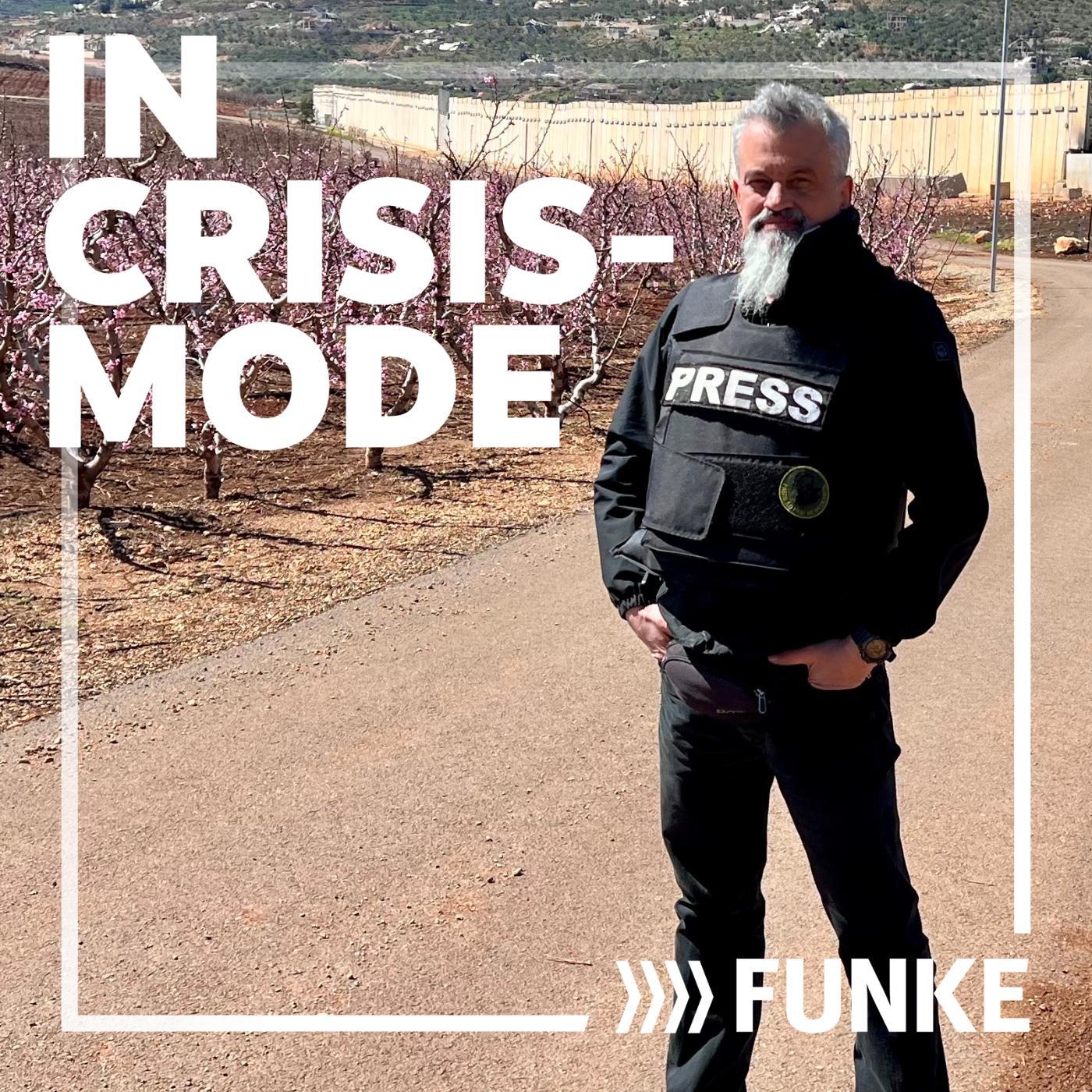
Im Krisenmodus· Folge 141
Rockets from Lebanon: Daily Life in Northern Israel in the Shadow of the Iran War
Mittwoch, 18. März 2026 · 36 min
Kapitelklicken springt direkt hin
Shownotes
Disclaimer: This episode was made with AI.
___
In this episode of “In Crisis Mode”, FUNKE reporter Jan Jessen is on the ground in Israel. He speaks with residents who barely sleep at night, with a social worker caring for elderly and sick people, with restaurant owner Daniel Dorfman from Metulla, who now only opens his establishment for take-away, and with security expert Sarit Zehavi from the Alma Center.
The episode shows what the Iran conflict feels like at Israel’s northern border—and why the crisis has long since extended far beyond Gaza.
Guest Voices / Participants:
• Shira Bar, resident of Metulla
• Daniel Dorfman, restaurant owner from Metulla
• A social worker from Metulla and an assistant delivering food to elderly and sick people
• Abid, community manager in the Arab village of Aramshe
• Sarit Zehavi, analyst and head of the Alma Research & Education Center
🧭 Chapter Overview
1 – Under Fire in Northern Israel
Jan Jessen provides context: war between the USA/Israel and Iran, Hezbollah attacks from Lebanon, almost daily rocket alerts in the north—and what this means for people living along the border.
2 – Metulla: Shira and Sleepless Nights
A walk through the nearly empty border village of Metulla. Shira describes nights with sirens and explosions, friends who have fled—and why she chooses to stay despite the fear.
3 – “Zero Seconds’ Warning” – Daniel Dorfman Amid Rocket Fire
Restaurant owner Daniel recounts the “worst night” since the start of the war: zero seconds’ warning, debates over evacuation—and why he consciously stays to defend his home.
4 – Elderly in the Bunker – The Social Worker from Metulla
A social worker and her assistant care for elderly and sick residents. They describe what happens to those who can’t reach shelters in time—and why many found long evacuations more difficult than the bombardment itself.
5 – Aramshe and Tel Aviv: Arab Village and Underground Hospital
Community manager Abid from Aramshe talks about his connection to the land, inadequate shelters, and fear of invasion. The episode also visits Ichilov Hospital in Tel Aviv—daily life in a state of emergency.
6 – “50 Attacks a Day” – Analysis by Sarit Zehavi and Jan’s Summary
Security expert Sarit Zehavi explains Hezbollah’s strategy, the short warning times, and the role of the Lebanese army. Jan concludes why this war goes far beyond Gaza and could destabilize the entire region.
____
📬 Contact & Feedback
Questions, criticism, suggestions? Write to us:
✉️ krisenmodus@funkemedien.de
🟢 Subscribe Now
“In Crisis Mode” – wherever you get your podcasts:
Spotify (open.spotify.com/show/0IQW1w25NYSrz60aAPzwvB?s…) | Apple Podcasts (podcasts.apple.com/de/podcast/im-krisenmodus/i…) | Deezer (deezer.com/de/show/3737197) | YouTube (youtube.com/@Krisenmodus-Podcast_FUNKE)
📅 New Episodes
Every two weeks, on Wednesdays.
In Crisis Mode is a podcast by the FUNKE Media Group.
Transkriptvom Podcast bereitgestellt · Zeitmarken springen hin
Die Übersetzung von Jans Stimme vom Deutschen ins Englische wurde mit einer KI erstellt. For about a week and a half now, the conflict between Israel and Iran has been escalating noticeably. The United States has intervened militarily, while the Iranian regime is striking back. At the same time, the war is spreading beyond the immediate area.
Attacks are hitting several countries across the Gulf region. Hezbollah has also entered the fighting from Lebanon. As a close ally of Tehran, Es ist financed und militärisch unterstützt von Iran. Für Menschen in northern Israel, das bedeutet, dass es sich unter constant stress ist. In Pläsen wie Metulla, auf der Bordern, sirens manchmal sound throughout the night.
Rockets, drones, impacts, oft in rapid succession. In der Arab-Towne von Arab al-Aramsheh, there ist manchmal nicht genug Zeit für eine Warnung. Many Menschen können nicht mehr sleep. Some have fled, while others stay, out of defiance, a sense of duty, or simply because they cannot bear to leave everything behind once again.
Hanging over everything is the same question. How far can this conflict escalate? What is unfolding along the northern border is no longer just a local confrontation. It is part of the broader power struggle between Israel and Iran, with Hezbollah acting as an extension of Tehran. And for the people on the ground, it means one thing above all, living in a state of emergency with no clear end in sight.
In Crisis Mode, the podcast from Conflict Zones with Jan Jessen. Ich bin Jan Jessen, war und crisis reporter für Funker Media Group. Ich bin seit Jahren von Konfliktzonen in Ukraine, Syria und Irak. Jetzt bin ich in Norden Israel, in Matula und in die Arab-Village von Arab Al-Aramsha, auf der Bordeur mit Lebanon.
Da habe ich mit Menschen, die mir erklären, was die Situation ist. Seit dem Angriff von den USA und Israel auf Iran the war has expanded significantly. Countries now affected include Bahrain, Qatar, Kuwait, Saudi Arabia, the United Arab Emirates, as well as Iraq and Jordan. Hezbollah is attacking northern Israel from Lebanese territory.
Israel in turn is striking back, launching massive air raids on Lebanon and sending ground troops into the country, into southern Lebanon. Dozens of people are dying every day. Und während es umhörter Diskussion über Missile Defense System, Drones und Militärsstrategien, Menschen hier in Norden Israel versuchen, eine normaler Lebenszeit zu halten, zwischen Sirens, Schlechern und der Frage, Should wir wieder weg oder bleiben?
In this episode, you'll hear voices. We walk through Metula with a resident. We speak with a restaurant owner there who barely gets any sleep at night, with a social worker who takes care of elderly and sick people, and with a security expert at the border who explains why this war is different from the previous one.
I've now been in Israel for several days. I'm based, so to speak, in Tel Aviv, this beautiful city on the Mediterranean. A few days ago, I traveled to Metula in the far north of Israel, and that's where I went first. Metula is a small village right on the border with Lebanon. The border fence, where I was, is only a few meters away.
After October 7th, 2023, when Hezbollah intervened in the war alongside Hamas, Metula became a restricted military zone. The village was completely evacuated. There were no civilians left, only soldiers. After a ceasefire in November 2024, people began to return. When I drove to Metula, I was a bit surprised that it was actually possible to get there without any difficulty.
There was hardly any military presence in the area. Above Metula itself, there was an Israeli military base, but even the soldiers there seemed completely relaxed, which was somewhat surprising. Normally, the Israeli armed forces are very restrictive when it comes to journalists, but in this case they were entirely relaxed and did not interfere with our work at all.
I then walked around Matula for a while. The village was eerily quiet. It was around 9 or 9.30 in the morning. Everything was completely still. You had the impression that Matula was deserted. There were only a few cars driving around, very few people, and that's where I met Shira. I spoke with her about what has been happening in Matula since Hezbollah re-entered the war. The situation is not so good.
We don't sleep. Wir müssen uns in der Morgen schlafen, weil wir alle Nacht haben. Viele Menschen leben in dieser Umgebung, weil sie hier nicht sind. Es ist so schrecklich. Es ist nicht die einfachste Leben, die wir wollen. Und alle unsere Freunde, nicht hier, gehen zu Elat, weil sie hier wollen. Aber wir lieben das Ort, also müssen wir hier bleiben. Es ist so schwer, ich will nicht lieben.
Very quiet now. Schirra dann showed me videos on her phone, footage from the night before, and it was pretty intense to watch. You could see rockets flying, explosions lighting up the sky. There was a constant barrage of noise, artillery fire, blasts, gunshots. It was obvious that it had been a very, very difficult night for the people in Matula.
And that's exactly what everyone we spoke to there told us. But interestingly, life somehow goes on in Matula, even Schirra Shirah, who showed me those videos, would laugh from time to time. You get the sense that people in northern Israel are used to war, that they feel a certain fear, a certain respect for it, but that it has also become part of their everyday lives.
And despite everything, they try to maintain that sense of normalcy. The same is true for Arab Al-Aramshe. It's a small village, also located right on the border, a bit further to the west. Arab Al-Aramshe is a Bedouin Arab community. Die Menschen dort wissen genau was, was es bedeutet. Der letzte Konflikt mit Hezbollah ist nicht so lange, und jetzt ist es wieder zu beginnen. again.
The situation here is very complex. We just come out of war and reconstruction and it's happening again. There are many concerns because this time Iran is also to the war, not just the Hezbollah. Und natürlich, die Menschen haben das Gefühl, dass die Krieg nicht wirklich endet. Es nur wieder in Waves kommt.
Just als Reconstruction ist mehr oder weniger complete, das nächste Runde beginnt. Das ist wahr für Arab Al-Aramshe, genauso wie für Metula. Es auch applies zu anderen Staaten in der Region, wie Kiryat Shmona. I was there the last time the war with Hezbollah was raging. Back then, these towns were heavily damaged.
There were numerous strikes in the villages. Those damages have since been repaired. On the other side of the border, however, things look very different. When you look across from Arab al-Aramsheh or Mithula, you see completely destroyed Shia Arab villages in southern Lebanon. More than 150 villages have been devastated because Hezbollah operated from these areas, launching rockets, mortars and grenade attacks and sending infiltration units across the border.
As a result, these Shia villages in the border region have been almost entirely reduced to rubble. Nothing but ruins remain. On the Israeli side, the situation looks completely different. The damage has largely been repaired. In fact, both Arab Al-Ramshe and Metula appear almost like small, idyllic villages.
They are set in a beautiful landscape. These could easily be tourist hotspots, rolling hills surrounding the villages, some forested, lots of greenery. And on the horizon, you can see mountain ranges that were still snow-capped. It's truly a stunning setting, peaceful and picturesque. But the problem, of course, is the war, which has now started again.
Hezbollah decided to re-enter the conflict shortly after Israel and the United States attacked Iran, once again on Iran's side, which supports and finances the group. Das hat leden zu massiven Israeli-Retaliation, dozens von Airstrikes und die Bekämpfung von ground troops in southern Lebanon. Auf der Lebanese Seite, mehr als 400 Menschen haben bereits getötet, und da ist eine massive Waffe des Displacements, mit Menschen fließt von der Süd nach dem Nord, nach Beirut und beyond.
Das ist eine extremamente dramatische Situation für die Leute in Lebanon. Ich hatte eigentlich geplanten, zu gehen da auch. Aber jetzt ist die Airport in Beirut geöffnet. So it's simply not possible to get there right now. In Metula, I met Daniel Dorfmann, a 42-year-old man who had just stepped out of his restaurant.
He used to live in central Israel, near Tel Aviv. For the past 16 years, he has been living right on the border with Lebanon, running a small restaurant. And he told me that the previous night had been the worst since the shelling began. Die letzte Nacht war, glaube ich, die schlimmste Nacht, in Bezug auf die Bombe von Lebanon.
Oder von Iran, oder beide, ich weiß nicht. Aber die Nacht, von etwa 8 Uhr in der Nacht, gab es Alarm nicht zu stoppen, und Bombe und Schütze. Es fühlt sich wie, um ein Feuer zu arbeiten. All the time people are running to shelters and safe places. It's not quiet from the beginning. The situation is that a lot of people left the town because they don't feel safe.
Wenn wir auf der Grenze sind und es gibt directe Missiles, die Hezbollah schießt, und wir haben 0. So, even if you are in the middle of the street and you hear an alarm, you don't have time to find a shelter and the bomb can fall on you. So Daniel describes exactly what Shira also showed in the videos, nights when the sirens wail nonstop, when it feels as if you're going to work under fire.
A major problem in Matula, and also in Arab Al-Aramsheh, is that there is barely any warning time. In Tel Aviv, where I am, when the sirens go off, you usually have 2, 3, 4, maybe 5 minutes to reach a shelter. You even get a kind of advance warning on your phone, a loud alarm that says the air raid alert could start soon, so prepare yourself. Then the air raid siren goes off, and you still have a little time to get to the shelter and be safe.
In Metula and Arab Al-Aramsheh, it's not like that. There, the sirens sound, and the explosions often follow immediately. Sometimes, the residents told us, you even hear the impact of a strike before you hear the sound of the launch itself. Many people have left Metula for this reason, but some, like Daniel, stay, out of stubbornness, out of attachment, or simply because you can't flee every time Hezbollah fires.
It's also important to note that back in October 2023, the Israeli government had asked people in the border region to evacuate. The government even arranged for people to stay in hotels in places like Tel Aviv, funding it themselves. This time they are not doing that. Instead, they are saying that, despite the ongoing shelling, people in the north are relatively safe, especially since Israeli ground troops have now entered southern Lebanon und die Zonen des Zonen zu verabschieden.
Es war eine gute Entscheidung, die Menschen aus der Grenze zu evacuieren. Aber es war ein Fehler. Es war ein Fehler. Wenn wir bleiben, ich denke, die Metula nicht verletzt werden, wie es war. 90% der Häusern wurden in einer Weise oder in einer Weise verletzt, weil sie wussten, dass die Leute die Häusern verlassen und nur die Armee bleiben.
Also, wenn wir letzte Mal bleiben, dann wäre die Situation weniger schwer. Und wir bleiben jetzt, bis es keine andere Option gibt. Und jetzt ist die Armee mehr bereit für die Situation. Und wir lernen die Lehre von der letzte Mal, glaube ich. Also, es ist gut, dass wir hier bleiben. Daniel also points out that the evacuation at the time was obviously a double-edged sword.
On one hand, it provided protection for the people. The problem back then was that Hezbollah infiltration units had crossed the border. There was fear that what had happened previously in the Kibbutzim near the Gaza Strip could happen again, Er sagt, dass Hezbollah-Fighters in Israel und verletzt werden, aber er sagt, dass die Evacuation die villages sehr verletzt war, nicht komplett verletzt, aber zumindest 90% der buildings war, weil keine Zivilisten waren, nur die Armee, macht die villages ein military-target.
Das ist warum viele jetzt wollen so lange, weil sie fühlen die Armee ist besser vorbereitet this time als es war. In fact, das Krieg hat nie wirklich stopt, along this northern front, or in Lebanon. There was a ceasefire in November 2024 which stipulated that Hezbollah should withdraw behind the Litani River, The Litani flows about 30 km behind the border, roughly parallel to it.
The agreement also stated that the Lebanese army would enter southern Lebanon, disarm Hezbollah, and destroy its infrastructure. Hezbollah, much like Hamas in Gaza, relies on tunnels for protection from airstrikes and to launch attacks from underground. The plan was for these tunnels to be destroyed by the Lebanese army, but that did not happen. I was in southern Lebanon in December and spoke with Christian residents of some villages there.
They told me that Hezbollah was still present, which is why Israel has been conducting frequent strikes on Lebanon over the past year and a half, averaging about two airstrikes per day. The ceasefire, in other words, was extremely fragile. While we were standing in front of Daniel's restaurant, we could hear gunfire again. These were outgoing rounds, shells fired into Lebanon by the Israeli army.
I also asked Daniel what kind of weapons Hezbollah is using here in the north and what worries him the most. They have anti-tank missiles, it's called Nuntet in Erebor. So you cannot, there's no warning against it. They shoot and it's like, there's no system that can warn you against it. So, this is really dangerous.
Last time a farmer, you know, have been killed here when he was working. Die anderen Weapons haben sie, die Missiles und... Katiuszas oder so etwas. Es ist nicht Katiusza, es ist viel mehr advanced. Katiusza ist in den 80ern oder 90ern. Jetzt haben sie viel mehr advanced Weapons. Sie bekommen sie von Iran, natürlich.
Hezbollah und Iran sind die gleiche. Ja. Kein Unterschied. So they supplied them with more advanced weapons and it can do really bad damage. Also the cluster missiles. But I think we are more prepared and by now no one was hit or killed. Diese sind relativ einfachen Rohrkets, die kind die Hamas und andere Palästinien-Gruppen immer noch benutzen.
Hezbollah, aber jetzt hat es deutlich mehr advanced Weaponry, capable von striken deeper into Israel. Just die Woche bevor wir uns auf Montag gesehen haben, wir gesehen haben, in central Israel. Ein Projektil, auf Hezbollah, nach Tel Aviv, landet, oder war interceptet, in Ramla, ein paar Kilometer von Tel Aviv. Debris fell, and several people were injured.
This wouldn't have been possible with the older Katyusha rockets, which have a very limited range. The bigger problem, Daniel says, is the anti-tank rockets Hezbollah is using. These have a relatively short range, but it's long enough to reach villages, and there's no warning, because they can't be detected by radar.
Naturally, that worries people when such projectiles come in. At the same time, Daniel emphasizes that they are better prepared now, and fortunately, no one has been killed. At the time of this podcast recording, there were no reports of civilian deaths at the border. On the day we were in Metula, two Israeli soldiers were killed in southern Lebanon.
They were sappers working with a large recovery vehicle, repeatedly attacked, and they died. But as of this recording, no civilian fatalities. Like Daniel, all the people who remain in Metula or Arab Al-Aramshi share a similar mindset. There's this mix of fear and resilience that you can feel throughout northern Israel and really across the country.
Finally, I asked Daniel why he chose to move to Matula 16 years ago, a tiny patch of land right on the border, the first place to be hit whenever rockets come from Lebanon. This is my home now. Yes, he says, this is his home. And that's exactly why he doesn't leave, despite the war. Others have said the same. After my conversation with Daniel in Matula, I met a social worker who was out with an acquaintance, delivering ready-made meals to a client.
They primarily take care of the elderly and sick residents in the village. She too emphasised the difficulty of the situation and of course I acknowledge that it's especially challenging right now in Matula. The situation, like you see, is not good. We think we don't have a missile, like I told you, a direct missile.
We don't know if the missile... They have everything. We must take them, like you said, like I said. Go over the litani. Maybe more. That's all. Because they can shoot us without alarm. You know, they just hear the bomb and it's very dangerous to walk like this. In Matula, there are actually shelters on almost every street corner.
Every few meters, in fact. These are small bunkers with steel doors. You go in, walk down a few steps, and you're immediately inside a protected space. Naturally, I asked the social worker what all this shelling means for those who cannot get to a shelter quickly, such as the elderly or people with disabilities, and then she said... They stay in the room, in the safe room, or in the shelter, if they have.
And if not, do we have a problem with them? Yes, maybe. I also asked the two of them, similar to Daniel, back then the government provided accommodation in safe areas. Are you being offered something like that this time as well? No. Nein, und wir wollen nicht. Warum? Keiner will mit Metula. Du willst mit Metula? Nein.
Die Leute, wir leben nicht. Sie haben, wenn wir aus Metula sind, für eineinhalb Jahre. Die Leute haben Angst, die Menschen sterben, die Menschen getrennt. Sie wollen nicht mit Metula, keiner will mit Metula. Wir leben hier, wenn sie wollen, sie gehen. Das war eigentlich das Fall. Back then, here at the hotel in Tel Aviv, where I am now, I met people from Kiryatshmona, from Metula, and from other villages in the north.
They told me how difficult it was to be away from home for so long. Some were upset that they had left, others were frustrated with the government because Metula had been declared a military zone. There were cases of depression, illness, and isolation, and some people even died far from home. Many say today that they would rather live under fire in Matula than be uprooted again for a year and a half.
But the war doesn't only affect the border villages in the north. Rockets are also falling in the greater Tel Aviv area. A few days ago I visited Ichilov Hospital in Tel Aviv. Within five hours of the alert going off last Saturday, all seriously ill patients were moved underground. Parking garages were converted into emergency hospital spaces, a kind of massive bunker, housing all departments, including intensive care.
Patients who could walk or were relatively stable were sent home and are now being monitored via telemedicine. It was incredible to see just how prepared this country is for war. When the sirens sound above ground, people in the second, third and fourth basement levels definitely can't hear them. It's intense to see hundreds of beds lined up closely together.
There's almost no privacy, yet the atmosphere was surprisingly good. A head nurse in orthopaedics, Fasimi Hari, told me the situation isn't ideal, but morale is high and both patients and staff feel safe. I also spoke with a patient, almost 70, originally from Berlin, sitting in a wheelchair beside her bed with a bandaged leg.
She said they feel safe down here and that you have to be patient and somehow cope with the situation. Meanwhile, while Air Raid alarms were going off above ground, nurses dressed with little elf wings were handing out Purim pastries to the patients. It was very touching. Purim is a Jewish holiday, somewhat similar to the German carnival.
You really get the impression that they are maintaining daily life under extraordinary circumstances, two floors underground. Of course, the war doesn't only affect Jewish communities or predominantly Jewish cities like Tel Aviv. Es auch beeinflusst die Arabischen Gemeinschaften. Ein paar Kilometern von Metula in Arab Al-Aramsha, ich habe Abid, die Gemeinschaftsministerin.
Er hat mich gesagt, dass sie auch wollen in ihrer Stadt bleiben, obwohl der konflikten Konflikt ist. Hier haben wir noch nicht geblieben, und sie wollen nicht leben. Sie sind sehr verbunden mit der Lande. Aber hier, natürlich, They are asking for more protection and permanent solution, not another war every two years.
Arab Al-Aramsheh is part of a larger Jewish municipality, so it's a village within this Israeli Jewish municipal structure and is actually quite well protected. The village has nine bunkers for just 1,700 to 1,800 residents. That's significantly more than in any of the other Arab communities in Israel, Vielen Dank.
Arab al-Ramsheh ist direkt auf die Grenze mit Lebanon. Wir waren auf einer Helle, wo man sich nach der massive Grenze des Bordern, mehrere Meter hoch, jetzt mit Metall-Fenzen, um die Anfängerung von der anderen Seite zu verhindern. Beyond das, man sieht die verletzten Lebanese villages, reduziert zu nichts, aber grayer Ruhm.
Abid hat mir gesagt, dass, obwohl sie viel protection haben, in seiner Meinung, es ist noch nicht genug. Wir haben in den letzten Jahren gegründet, But they are not up to standard. Today there are daily weapons and we need a lot stronger protection. And in Arab al-Aramsheh, just like in Metula, a major problem is that the warning time is extremely short.
Abid confirmed this to me as well. The truth is because we are very close to the border, sometimes there isn't much time. Es ist eine Minute von Sekunden. Manchmal gibt es keine Alarms, wegen der Proximität der Börder. Despite all die protective measures, die bunkers in Arab al-Ramshe, und die sehr detailed video-surveillance, ich sogar in einen kleinen Monitoring-Bunkers, wo einige Soldaten auf der anderen Seite auf der Seite sehen, ob jemanden ist.
Abid sagte, dass die Leute in Arab al-Ramshe Sie haben Angst, dass Sie in den letzten Tagen einfluss von Hezbollah-Fightern zu brechen die Borde, aber die Armee hat sie verhindert. Ich habe auch mit Sarit Zahavi in den Norden gesprochen. Sie ist eine Israeli Analyst, formerly mit Militär-Intelligence, und jetzt die Alma-Research-Center, die hat die Situation auf der Norden bordeiligert.
Of course, sie analysiert die Situation aus einer bestimmten Israeli-Perspektive, but her assessments are quite precise when it comes to the facts. Wir sind unter einem konstant Führer, von ungefähr 50 Achtkriegen jeden Tag. Ein Teil der Achtkriegen sind Dronen und zwei Teilen sind Rockets, wie Sie gerade sehen.
Die meisten Achtkriegen, aber nicht alle, All of them are to the areas of what we call the borderline, which is up to, I don't know, seven kilometers from the border. But this is the second attack today, which is outside of the borderline. So there are attacks outside. Yesterday evening, there were a few barrages to Haifa.
Okay, so the majority are to the borderline, but not all of them. Wir glauben, dass Hezbollah's goal, die Taktik goal, ist zu wiederum eine Evacuation der Israelis. Und um die Erschung zu erreichern, die wir in der vorherigen Krieg hatten hatten. Dass die Gemeinschaften waren für eine lange Zeit, für ein Jahr und ein halb.
Almost 50 attacks per day, a third of them carried out by Drones, two-thirds by Rockets. Most of these attacks are aimed at the so-called Borderline Region, about 7 km deep into Israeli Territory. But Zehavi says there are also repeated attacks outside this Zone. I mentioned earlier that Tel Aviv, or the greater Tel Aviv area, was attacked yesterday by Hezbollah.
Zevi is convinced that Hezbollah has a tactical goal with what it's doing. From my impression, Hezbollah is not trying to bring the Israeli army to its knees. That would be impossible after years of war. They are definitely too weak for that now. The rocket fire is also not as intense or challenging as it was after October 7th, 2023.
Aber Hezbollah könnte den aimer erzeugen von einem anderen Evacuation des Villages in den Norden. Von Israel's perspective, das würde bereits fühlen wie ein Admission von Defeat, ein Sign of Fear. Israel ist hart zu versuchen, dass das. Zehavi notes, dass Israel ist, partly durch die Deployment von Ground Troops zu establishen Buffer Zones, aber sie auch erzeugt, dass die Natur der Threat verändert hat.
Wir sind unter constantem Feuer von Drones und Rockets. Aber die Gefahr der Direkt-Shootung von Antitank-Missiles oder eine große Invasion. Die letzten Mal in der Süden Lebanon war ich direkt auf der anderen Seite der Israelite, in einer christianischen Stadt. Ich habe mit den Leuten darüber gesprochen, wie sie sich in dieser Situation fühlen.
Sie sagten, dass Hezbollah in der Stadt wiederholfen und in der Stadt launchen Rockets in Israel. Die Stadt haben das verhindert, sagen, dass sie nicht in die Konflikten wollen. Ich habe auch ein UNIFIL-Kamp, die UN-Interim-Force in Lebanon, gestorben diese Zeit von Soldaten aus Ghana. Ich fragte, was die mission von UNIFIL ist, und ich fragte auch die Rolle der Lebanese Armee.
Der Aufgabe war es, um Hezbollah zu disarmeln, nach dem Litani-River und zu kontrollieren. Der Antwort war sehr klar. Nein, IDF nicht fail, es nicht endet die Arbeit. The one who failed is the Lebanese government. What they are doing, they are cheating. It's as simple as that. They are cheating, they are collaborating with Hezbollah, and they had a fantastic PR to tell the whole world that they disarmed Hezbollah south of the Litani, which is proven to be a lie Sie sagt, die IDF hat nicht failed.
I had also asked her whether what's happening now is an indication that the Israeli Defense Forces, IDF, have failed. She said, no, no, no, they haven't failed. They just haven't finished the job. And it's the Lebanese government that has failed. Sie hat auch gesagt, dass sie sehr wenigstens von dem UNIFIL, die UN-Observation Mission, ist.
Sie hat gesagt, dass die Ammunition Hezbollah ist currently in den Häusern und in den Häusern. Die Lebanese army hat nicht in den residentialen Gebäuden. Und wenn sie haben, ist oft in coordination mit Hezbollah. Außerdem, falsche Reports über was sie supposedly gefunden haben. Das hat sich ein constantes Kritik von Israel gemacht. What the Lebanese government is doing is simply not enough.
The Lebanese government is essentially afraid of Hezbollah's power, which remains a capable military force in Lebanon. To avoid angering Hezbollah and provoking what could turn into civil war-like clashes, the Lebanese government has done nothing to curb Hezbollah's capabilities. In Arab al-Ramshe, I also spoke with Abid, the community manager.
I had been struck by the rubble I saw on the other side of the border, the completely destroyed villages, and asked him whether Hezbollah fighters are still there. He said, yes, of course, and assumes there are still Hezbollah fighters in tunnels that the IDF has not yet discovered. For the people in Mithula and Arab al-Aramsheh, politics plays a relatively small role.
The question of who is responsible for what is secondary. They experience the consequences directly, sirens, strikes, und die Uncertaine von ob die nächste Nacht will be calm. Travelling in den Norden, you realise how abstract many debates in Europe sound about strategic buffer zones, drone warfare, decapitation strikes.
Für Shirah, this simply means she no longer sleeps well. Für Daniel, it means he only opens his restaurant for takeaway because the sirens could go off at any moment. For Abid in Arab al-Aramshay, it means there may be just a second, or no warning at all, before danger strikes. Für alle da, es bedeutet eine Konflikt, die lange die Gaza-Konflikt hat, wo es all begann ist.
A conflict now threatening to engulf the entire region, in Lebanon, Jordan, Bahrain, Kuwait, Qatar, Saudi Arabia, the United Arab Emirates and beyond, and a war that could destabilize the entire region. How long it will continue, whether Hezbollah will stop firing, whether a new agreement might be reached or whether Iran will intervene directly, no one can predict this reliably at the moment.
The Lebanese government has made it very clear that it wants Hezbollah disarmed, leaving it only as a political party rather than an armed force alongside the regular Lebanese military. This had already been demanded last summer but was not enforced. Now, at least domestically, Hezbollah's renewed attacks seem to have pushed the situation almost to the breaking point.
I also spoke with friends in Lebanon, not only Christians, but also Shia residents, who said they strongly disagree with the fighting Hezbollah is conducting, which is putting the entire country in danger. And certainly, every day is a risk for Israeli civilians along this border. The same is true for civilians in Lebanon, and for all people affected by this multi-front war.
It is, of course, to be hoped for everyone in the region that this war ends quickly, und dass das Peace ist endlich restored. Das war In Crisis Mode. Der Podcast wurde von Alexander Baumeister, who ist auch ein Journalist mit der Funker Media Groups Radio Network. Wenn du unser Podcast genutzt hast, dann bitte like, follow und recommend uns.
Du kannst auch schreiben zu uns auf krisenmodus at funkamedian.de. Take care of yourselves. Until next time, ciao ciao. Shalom. Salaam alaikum. See you.
