

Kapitelklicken springt direkt hin
Shownotes
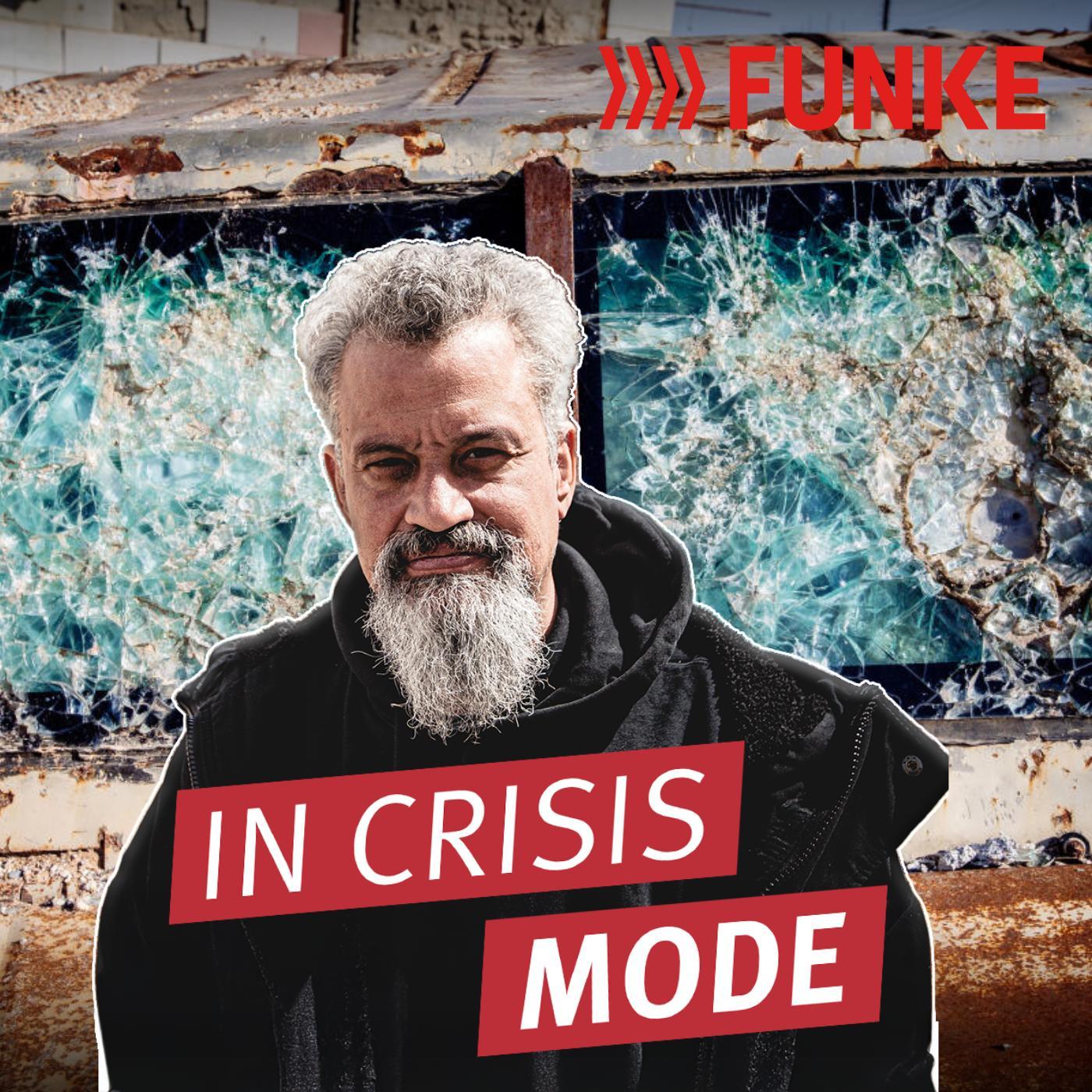
Kobane—once a symbol of defiance against the Islamic State—is once again under threat. In this episode of In Crisis Mode, journalist Jan Jessen (nrz.de/autoren/jan-jessen) travels to northern Syria and speaks with those now trapped in a familiar nightmare: refugees who cannot return, civilians caught between the fronts, and Kurdish fighters trying to hold the line. Their message: the world must not look away.
Note: This episode features an AI-assisted English voiceover of Jan Jessen.
With:
Talal Sadun – calls for protection from a world he feels has forgotten the Kurds
Dschalal Musta – warns of the impact of daily airstrikes
Yussuf – fled Manbij, and knows he cannot return
Jan Jessen – with insights from the ground and a call to the international community
🧭 Chapter Overview
1 | Kobane under pressure
Why the region faces new threats—and why it matters beyond Syria.
2 | “No one protects us” – Voices from Kobane
Talal Sadun and Dschalal Musta speak out against abandonment and airstrikes.
3 | “We can’t go back” – Displacement and despair
Yussuf and others explain why home is no longer safe.
4 | Global silence, rising danger
What Turkey wants, how the SDF responds—and where the world stands.
5 | What now?
Jan Jessen reflects on Kobane’s future—and the cost of ignoring the crisis.
More episodes to explore
Myanmar in Ruins (nrz.de/podcast/article408672264/myanmar-in-rui…) – Earthquake amid war and political collapse
📩 Contact & Feedback
Have questions, ideas, or thoughts? Reach us at:
📧 krisenmodus@funkemedien.de
🟢 Follow & Subscribe
Spotify (open.spotify.com/show/0IQW1w25NYSrz60aAPzwvB) | Apple Podcasts (podcasts.apple.com/de/podcast/im-krisenmodus/i…) | Deezer (deezer.com/de/show/3737197) | YouTube (youtube.com/@Krisenmodus-Podcast_FUNKE/videos)
Just search for In Crisis Mode and click “Follow” to stay updated.
📅 New episodes
Every other Wednesday
Thanks to Thomas Bertram (radiooberhausen.de/moderator/thomas-bertram-26…) and Fabian Hölscher (radioemscherlippe.de/moderator/fabian-hoelsche…) for their voices.
In Crisis Mode is a podcast by the FUNKE Media Group.
Transkriptvom Podcast bereitgestellt · Zeitmarken springen hin
Kobani, a city in northern Syria, which has become a symbol of resistance for many. Kobani is a city that nearly collapsed in 2014, but then the so-called Islamic State suffered its first major defeat there. Now Kobani is threatened again. But this time, the danger does not come from the Islamic State, but from Turkey and its Islamist allies.
The Turkish army is conducting airstrikes in the region, attacks, civilians are dying, the so-called Syrian National Army is attacking on the ground. One who experiences this daily is Talal Sadun, who grew up in Kobani. We protected Europe, and now it's Europe's turn to help us. Countries like Canada, Germany, the US and France must protect us.
In Crisis Mode, the podcast from Conflict Zones with Jan Jessen. Welcome to In Crisis Mode. My name is Jan Jessen. I am a war and crisis reporter for the Funke Media Group. For this episode, I have been traveling in Syria. Specifically in the north of the country, more precisely in Kobani, and I am talking to the people here about an escalation in the country, which began even before the fall of Assad in December and is still continuing now, and I meet survivors who have already risked their lives for this city once and may have to do so again.
Wir fragen uns, will Kobani hold out, oder ist ein neues Disaster looming? Vielleicht muss es sich erklären, dass Kobani, als ich in den Beginn sagte, ist ein Stadt, das sich ein Symbol des Registens gegen den so-calleden Islamic State, die IS, wie viele andere. Diese Terrorist-Organisation hat in den Kontrollen von large parts von Irak und Syrien in 2014 und 2015, a region der Größe der Great Britain, und hat es als Terror-Caliphate dort gemacht.
Sie hat mit den ZDF gemacht, hat mit den ZDF gemacht, hat mit den Yazidis gemacht, und hat mit den ZDF gemacht, und hat mit den ZDF gemacht, und eine der Fiercest-Opponnenten in den Kampf gegen den so-called Islamic State war die Kurds in den nord der Land, in den nord der Syrien. They fiercely defended themselves against AIS and became one of the closest partners of the West, the anti-AIS coalition.
They significantly contributed to the defeat of the Terror Caliphate in the year 2019. And Kobani was such a focal point. Kobani, that is a city directly on the Turkish border, and the Islamic State tried to capture this city in 2014. 15. That was around the turn of the year. 2014. 15. The IS tried to capture it, and indeed they managed to conquer large parts of the city.
I remember back then I was on the phone with one of the Kurdish commanders who was still in the city, and she told me that they were only in one neighborhood somehow, and defending, but somehow seeing no chance to continue defending the city, that the superiority of IS is gigantic. And they are basically just there to take as many of these IS people with them to death.
She also told me back then, which I found extreme, that they kept the last bullet for themselves, especially the women, because the women, terrible things would have happened to them if they had fallen alive into the hands of ISIS. Perhaps a side note, the ISIS fighters hate fighting against women, even today, because they believe that if they are killed by a woman, they will not go to paradise.
So in that respect, that was quite an intense conversation, I must say, back then when I spoke with this woman. But then a little miracle happened. For one thing, suddenly Kurdish women and men from other countries like Turkey, Iraq, but also from even Iran, joined this resistance and have together defended Kobani with the Syrian Kurds. And that was crucial.
The Americans intervened, or rather the American-led anti-IS coalition. They then carried out airstrikes on IS, which at that time was still armed with tanks, heavy artillery, and other things they had previously captured during the conquest of Mosul in Iraq. And, yes, the Americans ensured through their airstrikes that Kobani could be held.
Not only that, but that the Islamic State suffered its first heavy defeat there. That means the aura of invincibility of the Islamic State ended with Kobani. Well, and now the following is happening from Kobani. It goes directly to the Turkish border. When you are in Kobani, you can see on the other side huge Turkish flags that have been planted there somewhat menacingly as a warning and Turkey has always opposed the development of self-administration structures beyond its border Kurdish dominated self-administration structures because Turkey believes that those who now have a say in northern Syria are connected with the banned workers party PKK in fact they are ideologically close but there are no organizational connections to
At least none that I am aware of. And, nevertheless, Turkey has been trying for years to dismantle these self-administration structures. Turkey has conducted several major military operations in 2016. 2018, and 2019 in the region and has occupied parts of northern Syria with the help of Islamist militias.
These are basically, yes, they can be described as mercenaries. And this is the Syrian National Army, the so-called. And they fight on the side of Turkey. And these areas, which were occupied by Turkey in 2018 and 2019, are located west and east of Kobani. And when in November, the so-called Hayat Hari al-Sham people, and also a larger militia that had a dominion in northwestern Syria, in Idlib, when they advanced and conducted their so-called blitzkrieg against the Assad regime, In parallel to this advance.
This Syrian National Army also advanced, but not on the areas controlled by the regime, rather on the self-administration structures. And these battles are still ongoing, which is something relatively underreported. But currently there is fighting at the Euphrates, and the attempt by the Syrian National Army, together with and supported by Turkish airstrikes, is simply to cross the Euphrates to encircle Kobani.
So from the, to advance from the western occupied areas of Syria to the areas occupied east of Kobani. That means if that succeeds, Kobani would be encircled, cut off from supplies and that is precisely the current plan. The opponents on the other side are the so-called Syrian Democratic Forces, the SDF.
These are the Kurdish dominated groups that are now trying to defend themselves against this onslaught somehow. Jalal Muster, who lives in Kobani. I met him in a still completely destroyed neighborhood of Kobani, which is also right on the Turkish border. Kobani has, in recent years, that is after IS was driven out, Kobani has actually been largely rebuilt.
You can still see scars of this fierce battle of the fight for Kobani 2014-15 everywhere, but large parts of the city are rebuilt. Kobani is not a really beautiful city, to be honest. ist eine sehr kreis-Greyte. Exhaust fumes waffeln durch den air. So, das ist, dass es, da sind nur zwei-storre buildings, es ist nicht so schön, aber, wie gesagt, es wurde wieder gegründet.
Only this one neighbourhood, where I met Jalal Muster, has not been rebuilt. They have deliberately left it like that to, well, simply remind people of what happened there 10 years ago. And there you can see the incredible violence of the confrontation. Back then, in the fight against ISIS, many buildings are completely destroyed.
And at the same time, also old war material, for example, these so-called Mad Max vehicles of the IS. Those were vehicles that the IS had prepared with armor plates so that they were protected against bazookas and machine gun fire and with which they then sent off suicide bombers. They had converted these vehicles into rolling bombs, drove into the Kurdish positions.
And you can still see all of that there. And Jalmal Muster is an older gentleman who has made it his mission to conduct tours in this neighborhood and also to tell what happened back then, but also to show what happened in Kobani at that time. Und er hat mir gesagt, dass für Wochen er hat, wie er daily erlebt hat, wie er auf seine neighbors in der Nähe gesehen hat.
Die Leute, er sagt, sind hier desperate, weil sie sagen, die Welt ist nicht zu sehen. Planes sind immer über uns und mowing uns down. Wir haben 7 bis 8 deaths per day. Diese bombings do nicht die Militär, aber die civilians. Die bombings sind indiscriminiert. Er ist indiscriminiert und nicht interessiert, ob sie Kinder oder nicht. Er ist und zählt sie.
Ich habe keine Ahnung, keine Ahnung, keine Ahnung. Das war etwas, was auch gehört in Gespräch mit SDF, auch mit vielen anderen Leuten in den Norden gesprochen. Auf der einen Seite, sie sagten, es ist irgendwie beeindruckend, dass niemand wirklich interessiert. Jeder schaut zu Damascus. Was ist diese Transitional Regierung da?
Aber niemand schaut zu Kobani, niemand schaut zu Norden Syrien und schreibt, was passiert da, oder sogar kritisch zu Türkei. This is something that really irritates people to a high degree, especially since, as I said, these fights at the Euphrates are apparently quite intense. So I also spoke with an SDF commander, or rather a spokesperson, press officer of the SDF, who said there are entire areas, for example, at the Tishrin Dam, which is a dam plant where basically Turkish drones are constantly attacking, Turkish fighter jets attack, where the SDF fighters have to hide in tunnel systems because so much bomb material is being dropped on them.
Und das, als ich erwähnt, passiert da immer, immer an der Zeit, der ich auf dem Podcast. Even wenn das etwas weniger in den letzten paar Tagen in den letzten Tagen verstanden ist, es muss auch gesagt sein. Aber diese Fights continue mit der Beklarung der Beklarung durch den Euphrates. Und dann, als ich erwähnt, auf die Bereiche der Türkei hat, east von Kobani.
Und, ja, was könnte passieren in Kobani? Yusef experienced that and I met Yusef very close to Kobani in an industrial area, I would say it was like a conglomerate of many workshops and shop premises, these are like container type stories, where as I said, car repair shops or whatever were actually located they are all empty now and refugees are in there there were dozens of families and these families come from Manwich Manwich, that is a city which a few months was captured by those SNA people.
It is located south of Kobani, southwest, to be exact. And Manbij was once a city that was also ruled, controlled by the Islamic State. It was once considered the London of the Middle East, because in Manbij for some time, largely, English was spoken because so many foreign ice fighters landed there.
That was the first hub through which they were then distributed, further to Raqqa or to Mosul or to other cities. Manbij was recaptured in 2016-2017 by the Syrian Democratic Forces They paid an incredible toll in blood there So there were a lot of deaths during the capture of Manbij And well, this city was then, just a few weeks ago taken by our NATO partner or the troops supporting them that is this Syrian National Army And the people we met there, near Kobani in this industrial area, they were already quite desperate, I must say, So he said, a return for him to Manbij was not possible, it was far too dangerous.
We have no plans to return. The people who fled are forced to stay here because they have nowhere else to go. No one can return to that cities, neither to Manbij nor to Afrin. As long as these forces are there, no one can go back because there is no security. Yousef, he told me that during the defense of Manbij or the battles for Manbij, over 700 fighters of the Syrian Democratic Forces were killed and 30 civilians were killed.
And one must not, yes, forget. So these, I already mentioned at the beginning, this Syrian national army, they are basically mercenaries. And they proceed accordingly aggressively. They were also in Afrin in 2018, well, throughout the entire outer northwest. They have established a more or less terror regime in Syria.
There are very, very many reports of looting, kidnappings, rapes, executions, murders, and all this, and similar things are said to have happened also in Manbij. That is what Yousef said, and that's what the others I met in the industrial area said, that they have heard and seen videos of such atrocities.
And now many fear that Kobani could become the next Manbij. Yousef has therefore made an appeal to Germany and to the European Union. Die erste Sache wir wollen von der German Regierung und der EU ist für die Türkei-State attack auf Rojava zu stoppen, auf Syrien in generell und Rojava in particular. Die zweite Sache ist, dass sie diese Leute helfen. Deutschland ist ein großer Land und hat viele Leute gelesen.
Aber die wichtigste Sache für uns ist, dass sie die Türkei-State attack auf uns stoppen. Ja, die attacks haben natürlich verändert, in der Rojava-Region. This is nothing new. Rojava is the name for these Kurdish-dominated areas in northern Syria. As mentioned, these are mainly populated by Kurds, but also Christians and others.
Various Arab tribes, they are all now united under this umbrella of the Syrian Democratic Forces. And as I said, in 2016, 2018, 2019, there were already attacks by Turkey. And also, in the past years, there have been, at least occasionally, airstrikes and smaller attacks. Aber jetzt, die current attacks sind wirklich die Menschen zu despair.
So bevor Manbij war, zum Beispiel, da war auch ein kurdisch Kursk, die in den Norden der Aleppo war. Und es war, seit 2018, still controlled by die Syrien Demokratik forces. Und in dieser kleinen Kursk, viele Menschen, über 100,000. 3,000 refugees, die von Afrin in 2018, waren dort unter precarious conditions, Aber es ist in eine Sicherheit.
At least no bombs fell da. Das verändert sich in November. Das ist die Syrien National Army und die intensified Turkish airstrikes. So first die Enclave fell. Dann Manbij fell. Und als ich sagte, jetzt die current fighting in den Euphrates region. Und natürlich die Menschen sind afraid. Die Kinder suffer, wie immer, die meisten in such conflicts.
Und natürlich, sie sind auch sehr afraid der Bombs fallen da. I met Talal Sadun, who was mentioned at the beginning of this episode at the Arin Mirkan roundabout. In Kobani, this roundabout is named after a young woman, Arin Mirkan, who was involved in the defense battles in Kobani. And Arin Mirkan became famous because she was a commander of such a small platoon, about 12 female fighters whom she commanded.
Und wenn sie in eine Hopeless Situation waren, sie dann ordered sie ihre Begräder zu retten. Sie covered die Begräder und dann, wenn sie clear, ihre Begräder waren und safe, sie zählte Handgrenades. Wenn die IS-Berberinnen geteilt wurde, sie zählte Handgrenades so als nicht zu fallen, ihre Hände zu fallen, und sie hat 10 IS-Berberinnen.
Whether das ist wahr, ich weiß nicht, aber das ist was das been reported. Took another 10 IS fighters with her to death, and she sacrificed herself to stop the IS terrorists. Khalil Sadun, an older guy with a huge mustache, had a red scarf, a red and white scarf wrapped around his head, wore Kurdish clothing, and was sitting there relatively relaxed on a plastic chair.
But then, when I started talking to him, er schnell wurde ergeriert und sehr klar wurde, warum er glaubt, dass Europa jetzt endlich ist. Wir saved Europa. Wir losten 12,000 fallen und 24,000 wounded. Wir protected Europa und verletzten die armdekunsten. Heute Erdogan ist trainiert 1,000 of fighters in California, Belgium, Afghanistan und Pakistan.
Er war in Libya, Azerbaijan und Karabakh. Er ist basically saying, I will take control of all countries, I have terrorist fighters and I will send them to different countries. Yes, the people here know they can only defend themselves at present. I was in Kobani too and that touched me very much. To see a so-called martyr cemetery.
So martyr is always a slightly strange term for us but it is a common word. Not just for people from the Islamist context who fall aber für alle, die in den Kriegen sterben. Und in Kobani ist eine große Martyr-Cemetery. Also Talal just said that they have had at least 12,000 fallen in the north. And alone in Kobani at the cemetery, there are thousands, and it is quite bitter to see.
They have these graves, and on the tombstones are always the pictures of those who fell. And among them are very young people, who may be 15, 16, 17 years old. That is, of course, bitter to see. Und diese sind alle Menschen, die in den Krieg gegen den Krieg gegen den Krieg, die auch in Europa threatened.
So Sie sicherlich remember die attacks in Paris, oder die Rampage in Berlin. Oder die letzte Jahr in Solingen. Diese sind alle Dinge, die in den Krieg, oder sogar orchestrated, by IS. Das heißt, die Kurdish Männer und Frauen, die da und jetzt hier in dieser Cemetery in Kobani, also defended Europa's security.
Und sie haben immer wieder gesagt, das. By the way, this also applies to the Iraqi Kurds on the part of European and German politics. And they were repeatedly told that one is proud of them, that one greatly appreciates what they do, that they are sacrificing their young people in the fight against the Islamic State.
And in the end, one must say, we abandon the Kurds. And that is simply bitter to see. And on this cemetery, there are, and this touched me deeply, now also new burial fields. And these new grave fields, there as we were just there, a young woman was lying over one of these graves and was really distraught, screaming, crying, sobbing and her friend was trying to comfort her.
We didn't speak with her because it was clear that the woman was not in a position to tell us what had happened to her. But it was quite obvious that she there just lost a dear person. And, well, yes, it makes you a bit, how should I say, angry. So this silence of the Europeans, the Western world, Germany, about what is happening there. Aber es gibt noch eine Hoffnung für internationalen Unterstützung.
Talal, Youssef und Jalal essentially say the same thing. My plea to the German government is to help us in some way and stop these attacks. Warplanes are constantly flying over us, bombing us. What have we done to deserve such attacks on civilians? We are running from one corner to another, trying to escape the asteroids. Ja, so it's not about saying send troops to protect us, defend us.
We don't need that. We can do it ourselves. What needs to be stopped are the Turkish airstrikes, because that's something our people can't do anything about. I have said that the Syrian Democratic Forces are currently in the tunnel system. They come out now and then. Und übrigens, sie sind jetzt so-called FPV-dronen, diese First-Person-View-dronen, die in large numbers in Ukraine sind.
So sie haben gelernt ein bisschen von dem Ukrainischen in ihrem Kampf gegen die Russische Armee. Aber als ich gesagt habe, gegen die Air-attacks, gegen die Drone-attacks, sie können nicht defenden. Das ist deshalb dieser Urgent-Pliee. Ensure das Türkei endlich stopt Bomben uns. Es gibt auch noch eine No-Fly-Zone.
Similar zu den in Norden Irak in 1991. Which helped the Kurds defend themselves against Saddam Hussein. And you might also be asking yourselves, why the Turks are not directly attacking Kobani? So it has happened occasionally that airstrikes were conducted there. But there is no direct ground offensive on the city now, and this might be related to the presence of the Americans in the region.
I did say the Syrian Democratic Forces were and are the closest partner in Syria when it comes to the fight against ISIS. There are also images of American special forces on the ground, who sometimes have the patches of the Syrian Democratic Forces on their jackets, but this is a very, very, very small group that the Americans have deployed there.
They are now mainly concerned with securing the Syrian oil fields, which are in the far east of the country. However, they occasionally also patrol in the Kobani region. And that is possibly one of the reasons why no direct attacks are being launched on Kobani, because just that the Turks possibly, yes, have the fear that they could then anger the Americans, along with their somewhat erratic president.
In this regard, as mentioned, there are currently no direct attacks on the city itself. But indeed, in the region, as mentioned, with the aim of closing a siege around Kobani and eventually starving the city, would ultimately have the same effect. Kobani would, in the worst case, fall. Yes, so I think Germany should become significantly more active there.
I mean, Turkey is not a terrorist organization like ISIS. It's still a NATO partner, so someone who also relies on the other allies. Turkey is a close trading partner of Germany and... I would expect from my government, from our government, we would wish that it makes it very clear that what is happening there cannot be in the interest of the German government.
As mentioned, the Syrian Democratic Forces have sacrificed many, many people. The Kurds have sacrificed many people in the fight against ISIS to make Europe a bit safer as well. And I think we not only owe them gratitude, but also support. People simply need protection. And I also think that even if we put aside loyalty.
Gratitude, and so on, I also believe it's very, very wise to protect the Kurds and the self-administrative structures in a new Syria, also out of self-interest. Because, as I said, they are fighting against ISIS. ISIS is still active in the region. That means there are still 10,000 terrorist fighters who are at large.
The Kurds also guard very, very many captured IS people and relatives of IS fighters. If all that collapses, we will certainly have a huge problem in Europe and in Germany. That was it for this episode in Crisis Mode. The podcast was produced by Alexander Baumeister. He is also a journalist at the Radio and Media Group.
And you can find our podcast everywhere where there are podcasts. You can, of course, subscribe to us there as well. That would be very helpful and would make us happy. Feel free to follow us and write to us at krisinmodusafunkimedian.de if you have questions, suggestions or other things. And you can also write to me personally on Facebook.
Yes, feel free to recommend us as well if this podcast has helped you and if you believe that it could also help other people, we'd be happy about that too. I'm saying goodbye for today. Thank you. Take care. See you soon. Bye-bye. In Crisis Mode, the podcast from Conflict Zones with Jan Jessen.
