

Im Krisenmodus· Folge 136
Siege, Escape, Betrayal: Voices from a Collapsing Northeast Syria
Mittwoch, 18. Februar 2026 · 31 min
Kapitelklicken springt direkt hin
Shownotes
This episode was made with AI.
_______
A school in Qamishli serves as an emergency shelter. An elderly man says, “We Kurds have no friends.” A woman from Afrin has been living in temporary rooms for years, and an official of the self-administration warns, “ISIS is back and stronger than ever.”
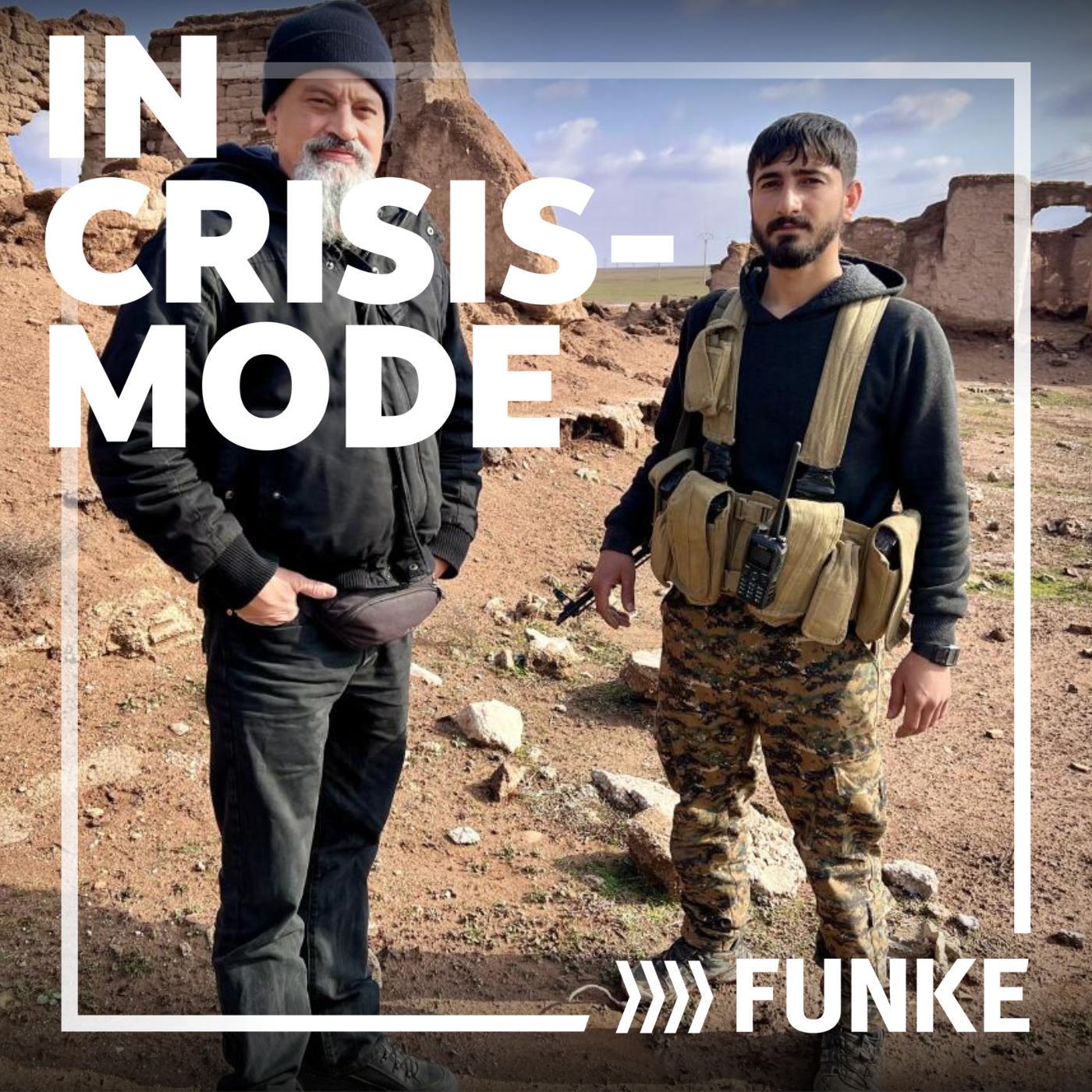
FUNKE correspondent Jan Jessen (nrz.de/politik/article410904986/aufstand-gegen…) traveled through northeastern Syria and, for our podcast “In Crisis Mode,” spoke with people experiencing firsthand the siege of Kobane, the deal with Damascus, and the resurgence of jihadist groups.
What does this mean for the Kurds, for minorities and for Europe’s security?
Guests / Voices in this Episode:
• Ilhan Omar Sido – 55, refugee from Afrin / Raqqa
• Moham Hassan – 76, displaced multiple times
• Hamo – SDF fighter on the front lines
• Khaled Ibrahim – representative of the Kurdish self-administration
• Social worker from the EMMA organization (Yazidi women)
• Additional refugees from Qamishli and the surrounding area
🧭 Chapter Overview
1 – War on the Doorstep: What’s Collapsing in Northeast Syria
Besieged cities, fleeing families, and a deal that ends the self-administration.
2 – “We Kurds Have No Friends”
Ilhan from Afrin and Moham from Kobane speak about years of displacement—and their fear for the future.
3 – Frontline Near Raqqa
SDF fighter Hamo describes drone attacks, tribal militias, and the breakdown of alliances with Arab groups.
4 – “ISIS Is Back—Stronger Than Before”
Khaled Ibrahim analyzes the situation: released IS fighters, weak control, and a crumbling security structure.
5 – The Fear of Minorities
Yazidi social workers report on abducted women, a power vacuum, and the fear of renewed violence.
6 – Betrayal, Power Plays, Open Questions
What the collapse means for the region, the Kurds—and for Europe. Jan’s conclusion.
📬 Contact & Feedback
Questions, comments, suggestions? Write to us at:
✉️ krisenmodus@funkemedien.de
🟢 Subscribe Now
“In Crisis Mode” – available wherever you get your podcasts:
Spotify (open.spotify.com/show/0IQW1w25NYSrz60aAPzwvB?s…) | Apple Podcasts (podcasts.apple.com/de/podcast/im-krisenmodus/i…) | Deezer (deezer.com/de/show/3737197) | YouTube (youtube.com/@Krisenmodus-Podcast_FUNKE)
📅 New Episodes
Every two weeks, always on Wednesdays.
In Crisis Mode is a podcast by the FUNKE Media Group.
Transkriptvom Podcast bereitgestellt · Zeitmarken springen hin
Die Übersetzung von Jans Stimme vom Deutschen ins Englische wurde mit einer KI erstellt. In northern Syria, a new tragedy has unfolded over the past days and weeks. Ongoing fighting has forced tens of thousands to flee. The Kurdish-led self-administration has collapsed. Damascus, the central government, has taken control of northern Syria, leaving countless people there fearful for the future.
What is life like when fleeing is no longer an emergency, but an everyday reality? Und vielleicht die größte Frage, warum sind so viele Kurds jetzt sagen, wir haben keine Freunde left? Germany turns a blind eye, wir Kurds haben keine Freunde. In Crisis Mode, the podcast from Conflict Zones with Jan Jessen.
Hello, I'm Jan Jessen, a war and crisis reporter for the Funker Media Group. I recently travelled to northeastern Syria, a region that has undergone dramatic changes over the past weeks. The SDF, the Kurdish-led forces that had been in control for years, reached a deal with the Syrian transitional government.
On paper, this was meant to end the fighting that had erupted in recent weeks. In reality, it marks the end of self-administration, what some describe as the end of a dream of a self-governed, autonomous Kurdish region. I wanted to understand what all this means for the people living there, and I spoke to many, many people on the ground.
I spent most of my time in Qamishli, one of the largest Kurdish cities in northern Syria. We've covered this region several times in this podcast, and I've added those episodes to the show notes. I travelled there at a time when fierce fighting was ongoing, when it was unclear whether massacres or bloody confrontations would erupt, a full-scale war between Damascus' central government and the Kurdish-led SDF forces.
In the days before my arrival, the transitional government's forces had already made significant advances, taking cities like Dayasur, Raqqa and Tabqa, cities largely inhabited by Arabs. By the time I arrived, government forces were at the edge of the Kurdish heartlands, – cities like Kamishli, Al-Hasakah and others.
At the same time Kobani, a city of immense symbolic importance to the Kurds, was under siege. And when this podcast was recorded, Kobani remained under siege. Kobani is significant because it was there in 2014-2015 that the city mounted massive resistance against ISIS, where thousands of Kurds died and where ISIS suffered its first major defeat.
Essentially, Kobani marked the beginning of the end for the so-called Terror Caliphate. Es war auch in Kobani, dass eine alliance zwischen dem SDF und dem US-Led-Anti-ISIS-Koalition war, ein partnership held für viele Jahre. Recently, however, die US-Witdrew, breaking die alliance, die in turn allowed Damascus zu advance into Kurdish Territories und reclaimen areas previously unter SDF-Kontrol.
In Karmischli, die Effekte von all das war stark. Thousands von displaced Menschen, fleeing die fighting, had taken shelter in schools, mosques, and government buildings. The humanitarian situation was extremely tense. The local self-administration in Kamishli was overwhelmed. International aid was limited, but Kurdish organisations stepped in to help.
On one side, Syrian Kurdish organisations like Haver Sor and the Kurdish Red Crescent, and on the other, an Iraqi Kurdish group called Balazani Charity, which sent over 100 people from Iraq to assist Kurdish refugees in Syria. In one of these schools I spoke with several displaced people. Among them was Ilhan Omar Sido.
She is 55 years old, and along with her brother and a few personal belongings she could carry, was staying in a classroom in Kamishli, one of the many schools now housing refugees. These buildings were in poor condition, and it was quite cold at the time, with snow having fallen in the days prior. Sie hat mir gesagt, dass das nicht die erste Zeit sie hat, sie hat so viele Male zu verabschiedet, und hat jetzt eben noch einmal left Raqqa.
Raqqa lies further south, und ist predominantly Arab. ISIS war damals die de facto capital von Syrien, von 2013 bis 2017, liberiert von der SDF in 2017, und jetzt ihre Kurdish residences sind wieder wieder durch die Regierung. Ilhan also explained that life in Raqqa had never been easy for Kurds. Mein Name ist Elham Amar Sido.
Ich bin mein Vater, mein Vater, mein Vater. The Arabs from Raqqa attacked us. After we left, our home, or rather our property, was stolen. The Arabs from Raqqa did this to all the Kurds. Wenn ich nicht in den Kasten habe, dann bin ich nicht in den Kasten. Ich habe die Kasten, die ich nicht in den Kasten habe. Wenn ich nicht in den Kasten habe, dann bin ich in den Zint.
Das war Das war's, was ich kurz herausgefunden, von nearly allen ich gesprochen habe, auf der ground. Ilhan originally kam von Afrin in Nordwestern Syria. Afrin war ein Kurdisch-controlled Enclave bis 2018 für mich. Als die Türkische Armee, unterstützt und unterstützt durch die Türkei-Fundte Islamist Militias, hat Afrin gegründet.
When the Turkish forces occupied Afrin, many people fled, including Ilhan. The Turks bombarded us heavily, sometimes using aircraft. Because of this, we fled Afrin and went to a place called Al-Shaba. Al-Shaba, the next Kurdish enclave east of Afrin, didn't last long either. People managed to live there for several years, though under extremely precarious conditions, camps, unfinished buildings, and basic shelters, but at least it offered some measure of safety.
That changed dramatically at the end of 2024, Das war die sogenannte Naya Tariq al-Shaba, eine militant Islamist-Gruppe led by Ahmad al-Chara, der damals, mit seinem Nomme de Gehr Jolani, und jetzt ist der Transitioner Präsident, wurde schnell in die Welt gegründet. Their forces, known as Hayat Tahrir al-Sham, HTS, moved first toward Aleppo and then into Hamaa and Homs, before making a push toward Damascus.
At the same time, the Turkish-backed Syrian National Army advanced alongside them. In this context, they took over Al-Chabar, where displaced people like Ilhan had found temporary safety. Ilhan and many others had to flee once again, moving from Afrin to Raqqa and now, once more, to Qarmishli and the Kurdish heartlands to find safety from Islamist militias.
Ilhan also shared with me a grim story about a security officer in Raqqa who was shot, leaving behind a child who remains missing. What happened in Raqqa is still contested. There are videos and images showing Arab residents celebrating the disappearance and displacement of Kurds, while the Kurds themselves report harassment, mistreatment and looting, even before the city was fully taken over by the transitional government.
The full truth will likely only emerge over time. Ilhan is deeply afraid for the future, not just the immediate threat, but longer-term insecurity. She worries about ISIS, which although territorially defeated by the Kurdish forces, still has fighters active in the region. She is also fearful of the militias that remain in Raqqa, mit der Transitionell Regierung.
In der gleichen Schule in Kamishli, ich besuche ein altes Mann, Mohamed Hassan, 76, die aus dem Kobani wurde, dann Afrin, dann Aleppo und später Raqqa. In northern Aleppo, Kurdish neighbourhoods were attacked by transitional government forces in early January, resulting in fierce battles, numerous deaths, and apparent war crimes.
This marked the beginning of the government's push into Kurdish territories and the end of self-administration, which Mohamed Hassan witnessed firsthand. He told me about disturbing incidents, some of which appear in videos, such as injured fighters being shot, prisoners mistreated or abused, und brutal treatment of deceased fighters.
One particularly shocking video, circulated in Arab circles, showed a man holding the braid of a Kurdish female fighter, a symbol of Kurdish female identity, which caused outrage. Later, it was said to be a hoax, but the incident fuelled fear and anger among displaced Kurds. Above all, the people I spoke to in Qarmishli and other cities felt abandoned by the West and former allies, die sehr partners die mit den Jahren verletzten.
Das Gefühl von Betracht ist, was viele Kurds sagen, wir haben keine Freunde left. Der Welt sieht alles und macht nichts. Trump, Erdogan, die Arabischen Länder, sie sind alle gegen uns. Er hat uns die mit dem einen anderen Er hat uns Er hat uns gesagt, dass sie nicht realen access zu News für Tage. Natürlich, es gibt keine TV-S in den Refugee shelters und die phone he hat nicht funktioniert.
Das only adds an uncertainty when you can only get sporadic updates. Es ist an incredibly difficult situation for these people und to that sense of helplessness is added the constant cycle of displacement. Ilhan summed it up quite perfectly. Wir leben für Jahre nur in temporary rooms. Afrin, Shaba, Raqqa, jetzt diese Runde. Ich weiß nicht, wo wir morgen gehen.
Was struck mich während dieser trip war die relationship zwischen Arabs und Kurds und wie es sehr nahe es wurde durch die Situation der letzten Wochen. Der Verhältnis zwischen den Gemeinden ist sehr stark. Es gibt viele Videos, die sich in den Verhältnissen von der Transitional-Gövernement befinden, die Arabischen, abzulernen und abzulernen Kurds.
In vielen Videos, man hört Allahu Akbar, als ein Krieg von Islamist-Fightern, die nur die Angst und die Angst haben. In Raqqa, nach der Stadt wurde von der Transitional-Gövernement, waren sogar Brief Images von ISIS-Flag. Das macht es sehr schwierig für Kurds to trust the transitional government, which already has a very poor reputation among minorities in Syria.
We've discussed before how groups like the Druze in the south, the Christians or the Alawites in the west are unsure of their place in the new Syria and live with ongoing fears. Ilhan also told me that many local residents had long harbored sympathies for ISIS. They kept their weapons and now have openly taken them up again.
Doors were defaced and there's fear no matter who is in control. Another man from Afrin, who had also come from Raqqa, shared similar observations. The man went on to describe what it was like when they fled that enclave. He said that at this point they don't have any concrete plans anymore, just bags they keep packed.
If you've had to flee three or four times over ten years, leaving everything behind each time, it becomes almost impossible to build a sense of future. Everyone I met seemed utterly exhausted. Worn out and understandably hopeless. I also spent time on the outskirts, at a moment when it wasn't clear what would happen next.
Transitional government forces were on the brink of the Kurdish heartlands. Fighting was ongoing around Al-Hasaka, skirmishes near Kamishli, and in Kobani, further west, the situation was even more intense. Kobani's humanitarian situation is still critical at the time of this recording. Very few aid supplies are getting through, people report shortages of food, kerosene for heating and generators, and almost no medicine.
I wanted to understand the military situation firsthand. In Kamishli itself, once night fell, fires were visible at every intersection and roundabout. Citizens had armed themselves, many with old Kalashnikovs or other rifles, to defend the city. They feared sleeper cells of ISIS could be activated at any moment, and they were determined to protect Kamishli from approaching government forces.
I also managed to speak with some SDF fighters. A few kilometres outside Kamishli, I met a young fighter named Hamo, positioned with others among the low ruins of mud houses that had once been sprawling fields. In the distance were villages now reportedly occupied by transitional government forces. Hamo described the composition of these forces as quite mixed.
Core forces of Hayat al-Jam, the president's militia, integrated SNA militias aligned with Turkey, und, according zu SDF-reports, though propaganda cannot be ruled out, even former ISIS fighters now incorporated into these forces. A crucial point he made was the involvement of Arab tribal militias who had previously fought under the SDF banner but had now switched sides, siding with the transitional government.
They turned against the Kurds they had worked alongside for years. This defection is a major reason for the deep mistrust Kurds now feel toward Arabs. Amo told me that the day I met him had been relatively calm. Later, that defensive position he occupied held, at least in the Kamishli area. Still, he emphasized the strategic importance of that position, highlighting how tense and fragile the situation remained.
This point is important because it's close to the front. In front of us are villages full of enemies, militias, tribal fighters, people posing as an army. One of the key challenges for the Kurds is that they have no air force. The SDF never had helicopters, fighter jets or anything comparable. They also lacked long-range drones like the Turkish Bayraktar drones and they didn't have heavy artillery or tanks.
That's part of why the transitional government was able to push them out so effectively from Arab-majority areas like Raqqa, Tabqa, Manbij or Dayasur. Not just because some Arabs switched sides, but because the government forces have heavy equipment and receive Turkish air support, including large drones armed with missiles capable of destroying positions on the ground.
I asked the young SDF fighter how they managed to cope with these drones, artillery strikes and air attacks and more importantly, how they stay motivated in the face of such overwhelming firepower. Still, they can't hold ground here. As long as we have even a drop of blood, we won't give up our land.
Und der Wazwere. Ein weiteres Problem in der Region, außerhalb der Transitionell Regierung und ihren Allied-Militien, ist die Frage von ISIS. Der Angst, dass ISIS-Mitglied sein könnte, ist immer noch nicht. Es gibt Indikation von Menschen mit tiefem Wissen der Situation, von denen der Irak-Intelligence-Chief, der vorhin ein Interview mit dem Washington Post, dass die Zahl von ISIS-Mitgliedern, oder die unter dem Black-Banner, auf den letzten Jahr geliefert wurde.
At the beginning of the year, around the time Assad was overthrown, there were said to be about 2,000 ISIS fighters active in Syria. Now, according to those estimates, the number has grown to around 10,000. Among them are reportedly many new recruits from Arab tribes that once lived in areas controlled by the Kurds.
That clearly points to cities like Raqqa, the former de facto capital of ISIS. The threat is something many people in the region take very seriously, Interestingly, the young SDF fighter I spoke to seemed relatively calm about it. There's no challenge. We will win. But others I spoke to on the ground take a much more critical view.
In Karmishli, I later met Khaled Ibrahim, one of the most senior representatives of the Kurdish self-administration. He sits on the Foreign Relations Board, effectively serving as the administration's foreign policy spokesperson, and is also responsible for counter-terrorism affairs. Er begann mit einem öffnen Perspektiven. Und einer muss sagen, Kurdischen Offizierungen tenden zu definieren Entwicklungen auf eine viel größere Ebene.
Für sie ist das nicht nur ein Konflikt regional. Sie sehen es als Teil einer größeren Geopolitischen Herausforderung. Khaled Ibrahim hat diesen Punkt sehr klar in unserer Gespräche. Wir stellen uns ein Problem. Was passiert hier ist nicht nur ein Konflikt zwischen den SDF und Damascus. Es ist ein Krieg in der vielen Ländern haben ihre Hande.
Jetzt. Zu be fair, da ist eine Wahrheit in das Assessant. Türkei hat immer noch versucht, das Ziel des Kurdischen Selbstadministration in Norden Syrien. From Ankara's perspective, this autonomous region was essentially a protostate of the PKK, the Kurdistan Workers' Party, which is designated as a terrorist organisation in Turkey, Germany and several other European countries.
For Turkey, the leaders of the self-administration were never simply local Kurdish actors. They were seen as extensions of the PKK. That is why Ankara has worked for years to weaken and ultimately destroy the project. The military operation in Afrin in 2018, followed by another cross-border incursion into northern Syria in 2019, widely criticised as violations of international law, were clear manifestations of that strategy.
Turkey's objective has always been to prevent the emergence of an autonomous, let alone independent, Kurdish region along its southern border, anything resembling the model of Iraqi Kurdistan, where Kurds enjoy far-reaching autonomy. From Ankara's standpoint, that scenario had to be stopped at all costs.
So when Kurdish representatives argue that Turkey has played a decisive role in reinforcing the transitional government's determination to establish a centralized Syrian state without meaningful autonomy for Druze, Alawites or Kurds, they are not entirely wrong. Khaled Ibrahim put it this way. Turkey has been working on a strategy to weaken us Kurds.
Their goal is the destruction of the Kurds through racism and internal wars, all planned in dark rooms. Whether all of this was coordinated behind closed doors is impossible to prove. And when Kurdish officials frame it that way, one has to be cautious. The language can sometimes drift toward the realm of conspiracy.
But it is undeniably true that Turkey is pursuing its own strategic interests. It sees itself as a major regional power, alongside Israel, and is keen to expand its influence. Turkey has heavily supported the so-called Syrian National Army, which effectively acted as its proxy force on the ground. It now backs the transitional government as well, with the expectation that this will further strengthen its regional leverage.
When I spoke again with Khaled Ibrahim, who beyond his foreign policy role is also responsible for counterterrorism within the self-administration, we turned to the issue of ISIS. The topic is especially sensitive because, until recently, the Kurds controlled several prisons holding thousands of ISIS fighters, as well as camps detaining tens of thousands of ISIS family members, many of whom are still considered highly radicalized.
We've discussed these prisons and camps before in this podcast and will link those episodes in the show notes. Now, however, some of these facilities are no longer under Kurdish control. Since the self-administration collapsed and the transitional government advanced, prisons in places like Raqqa and the massive Al-Hol camp, which houses tens of thousands of ISIS affiliates, have come under the authority of Damascus.
And according to Ibrahim, that shift carries serious risks. Many ISIS fighters were released, reorganized, and have rejoined the Syrian army. Wir sind in Syrien. Wir sind in Syrien. Wir sind in Syrien. Many ISIS fighters have been released, reorganized, and in some cases rejoined the Syrian army. The Americans, who abandoned the Kurds despite years of cooperation, where the SDF had acted as their ground force to defeat ISIS, have essentially said, your job is done.
We now support the central government and Al-Shara instead. Die Idee war ein bisschen mehr Leverage durch Damascus als weiter über die Kurden. Doch auch die Amerikaner sind nicht einfach. Don't forget, Al-Shahra war, bis heute noch ein Wanderer, mit einem 10-million-dollar Bounty auf dem Kopf, issued von der US-Grovernheit.
Er hat nur die Legitimation letztes Jahr nachdem der Macht in Damascus. Previously, er war mit Al-Qaida, der ISIS-Rival, so trust ist natürlich limited. One clear sign of that is that the US has transferred several thousand imprisoned ISIS fighters to Iraq, where they are to be held in other facilities.
At the time I spoke with Khaled Ibrahim, about 500 had been moved. Now the number exceeds 2,000, with plans to relocate a total of 7,000 international ISIS members. Among them are reportedly some Germans. Estimates suggest around three dozen who joined ISIS and have been in prison since 2019. For me, this is a strong indication that, despite Washington's public expressions of support, there is no real trust in the transitional government.
Khaled Ibrahim, of course, has a very clear view of what is happening on the ground. Ich habe nicht viel geholfen. Ich habe nicht viel geholfen. Ich habe nicht viel geholfen. Die Stadt ist sehr gefährlich und der Daesh wird wiederkommen. ISIS ist zurück, und viel stärker als vorher. Die Region ist in extremem Gefahr.
So ist Europa. Das war der Fall. Das ist die Wahrheit, die Menschen, die in den Jahrzehnten, die in den Jahrzehnten, die in den Jahrzehnten sind. Die Menschen, die besonders Angst und Angst sind in der aktuellen Situation, sind die Yazidis. Sie werden die Yazidis, die ein religiöser Ingenie in der Region, die in den Regionen verletzten wurden, die brutalisiert wurde von ISIS.
Die fanatische ISIS-Ideologie, die Yazidis als jäzidis-Worshippers, verletzten ihre Extermination. When ISIS advanced in 2014, thousands were killed in Iraq's Sinjar region, and thousands of women were enslaved and sold as sex slaves, over 2,000 of whom remain missing to this day. In Amrudi, another town in northeastern Syria, I visited an organisation called EMMA.
This group works with these abducted women, providing psychosocial support for those who have suffered sexualised violence and unimaginable trauma. Aber Emma also works to free women who are still in captivity nearly a decade later, almost 12 years in some cases. Explaining the process in detail is complicated, but last year alone, they managed to free 10 women.
Remarkably, these women were not rescued from camps like Al-Hol or Al-Raj. Instead, they were freed from Idlib, the province controlled in recent years by Hayat Tahrir Al-Sham, the very group now led by the transitional president. This detail suggests there are overlaps between ISIS and HTS networks.
Among the 10 women rescued, Some had even been married to high-ranking HTS officials. I also met a social worker who shared with me how the Yazidis are feeling right now, fearful, anxious and deeply uncertain about the future. To be honest, all the people here are under pressure and they are afraid about what will happen to the minority.
Maybe this small group just will live here. Es gibt sogar 3 oder 4 Millionen in Rojava. Und alle sind Angst, nicht die Städte von Syrien, denn es gibt keine Städte. Wenn wir uns selbst und alle Menschen wollen, sind ISIS, denn der Städte der Städte ist jetzt ein großer Mitglied. You know of Jabhat al-Nasra, and his history is full of movement from one group to another, and all of them are jihadi.
And the people who help him to be now in the state as a government, they don't represent the Syrian people. Those who feel the most fear and unrest right now are the Yazidis. Und es ist nicht nur in Syrien, in den Sinjar region in dem Nürburgring Norden Irak, und in den Camps across Iraqi Kurdistan, wo 10,000 Menschen aus dem Jahr seit 2014 noch leben.
Es ist ein Pervasive-Sensierer, dass etwas terrible könnte passieren wieder wenn ISIS sogar sogar ein Frächter von ihrer Vorbereitung. Ich persönlich glaube nicht ISIS könnte ever wiederholen eine Caliphate wie es dann war. Aber die Angst sind real und verstehen. Untertitelung des ZDF. Iraqi Kurdistan, previously controlled by Syrian Kurds, are now under Damascus' authority.
The oil and gas fields, the self-administration's main source of revenue, have also come under central government control. In concrete terms, this marks the end of Kurdish self-administration. Whether the agreement will hold is still unclear. Kobani, the most symbolically significant city, remains under siege, and the humanitarian situation continues to deteriorate.
Whether peace will prevail in other cities, or if clashes will resume between transitional government forces and Kurdish fighters, is still open. One critical question is that of prisoners. Many people were taken captive during recent fighting. In Karmishli, I met a family of 11 crammed into a small room.
The grandmother showed me a photo on her phone of her grandson, Masood. Er war nur 16, als er in den SDF war, und wurde in den letzten Krieg gegründet. Es ist schockiert, natürlich. Kinder und Kinder haben in alle Syrien militias. Die SDF, die Syrien National Army, HTS, Druze militias, you name it. Masood, wie viele andere, hat sich gegründet. Und niemand weiß wo er ist.
His Mutter showed mir ein Video sie bekommen durch Indirekt Channels, wo er auf der Rückseite mit anderen Präsenz, being beaten and insulted as a Kurdish pig by transitional government troops. It's deeply distressing. The long history of violence, massacres in southern Syria against Druze and Alawites, clashes on the western coast last year and now fighting in the north has left deep scars.
The Arab-Sunni majority may be satisfied that the transitional government has asserted central authority, but minorities see things very differently. They have long advocated for a federal system similar to Germany's. Autonomous regions for Alawites, Druze, Christians and Kurds in the north. The fragile trust between the Kurds and the west, particularly the US, has been severely damaged.
Kurdish fighters made enormous sacrifices in the fight against ISIS. Thousands died. They took on missions in Raqqa, Manbij and Diyasur, majority Arab areas, under US direction. And now, when it mattered most, the Americans abandoned them. That betrayal is etched deeply into the collective memory and will take a long time to heal This was today's episode of In Crisis Mode The podcast was produced by Alexander Baumeister If you enjoyed this episode, please like and follow us It helps and makes our work more visible You can also write to me with suggestions for future episodes at christenmodus at funkcomedian.de Take care of yourselves, Ein Podcast von Funke.
