

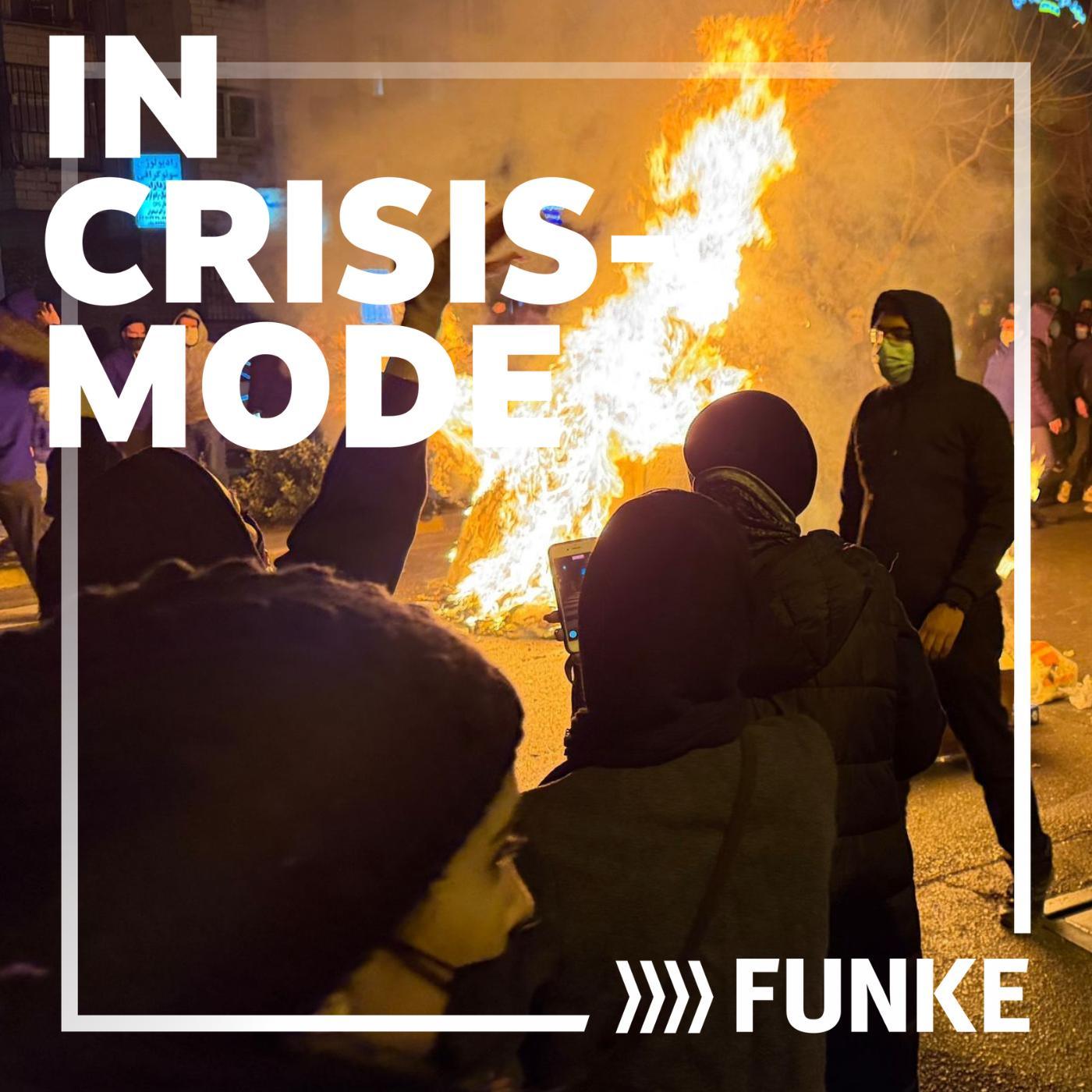
Im Krisenmodus· Folge 132
Iran Uprising 2026: Protests, Threats from Trump, and Escalation Risks
Mittwoch, 21. Januar 2026 · 27 min
Kapitelklicken springt direkt hin
Shownotes
This episode was made with artificial intelligence.
Mass demonstrations in Tehran, gunfire in Kermanshah, burning barricades in Isfahan: for two weeks now, Iran has been in turmoil. Security forces are cracking down brutally on protesters, and the internet has been largely shut down. Reliable information is hard to obtain—while at the same time concerns about international escalation are growing.
In this episode of Im Krisenmodus, FUNKE crisis reporter Jan Jessen speaks with two Iran experts about the dynamics of the protests, conflicting casualty figures, the stability of the power apparatus—and the question of whether the regime is approaching a tipping point or once again proving resilient.
Opposition spokesperson Shahin Gobadi describes the situation as a revolution already underway and speaks of a new balance of power between society and the regime. Iran expert Walter Posch offers a more cautious assessment, warning against overinterpretation—and explaining why even harsh repression can become a long-term risk for the system.
The discussion also looks at the role of the United States, threats by Donald Trump, possible military options—and why many regional actors prefer stability over an uncontrolled collapse of the regime.
Guests
Shahin Gobadi
Spokesperson, National Council of Resistance of Iran (NCRI)
Opposition alliance founded in 1981 in Paris
Walter Posch
Iran specialist, Landesverteidigungsakademie Österreich (LVAk)
Institut für Friedenssicherung und Konfliktmanagement (IFK)
____
🧭 Chapter Overview
1 – Protests in Iran: What we know—and what we don’t
Internet blackout, fragmented sources, violence in the streets
2 – “Has a revolution begun?”
The opposition’s view: spread of protests, new slogans, the role of Gen Z
3 – Is the regime still holding?
Walter Posch on resilience, the security apparatus, and Pyrrhic victories
4 – Staging and counter-narratives
Pro-regime rallies, propaganda, and mobilization of the Basij and IRGC
5 – Trump, threats, and risks of escalation
Military options, symbolic strikes—and the dangerous “what comes next”
6 – Regional perspective
Why Saudi Arabia and neighboring states prefer stability to collapse
7 – What comes next?
Scenarios between stalemate, transition, and escalation—and what matters now
____
🤝 More Information
German Federal Foreign Office
Current travel and security advice for Iran
Website: auswaertiges-amt.de
📬 Contact & Feedback
Questions, criticism, suggestions? Write to us:
✉️ krisenmodus@funkemedien.de
🟢 Subscribe Now
Im Krisenmodus—available wherever podcasts are found:
Spotify (open.spotify.com/show/0IQW1w25NYSrz60aAPzwvB?s…) | Apple Podcasts (podcasts.apple.com/de/podcast/im-krisenmodus/i…) | Deezer (deezer.com/de/show/3737197) | YouTube (youtube.com/@Krisenmodus-Podcast_FUNKE)
📅 New Episodes
Every two weeks, on Wednesdays.
Im Krisenmodus is a podcast by FUNKE Media Group.
Transkriptvom Podcast bereitgestellt · Zeitmarken springen hin
For two weeks now, Iran has been in turmoil, once again. And from Washington, there are threats. US President Donald Trump says he is reviewing military options. What does this mean for the people in Iran? And what does it mean for the region? A new balance of power between the people and the regime.
A new attitude of the people towards the regime. The fact, as I said, they are not fearful anymore. Fear has shifted camp, I would say. It's now the regime, which some people call it a zombie, basically living on its last straws. So in that sense, yes, we are seeing the last phase of the regime, definitely.
Is this the tipping point? Or will the regime once again push back, as it did in 2019, in 2022, in 2023? And would an intervention by the United States help? oder würde es riskieren, die Situation zu schützen, vielleicht all die Richtung der Civil War? Das ist das, was dieses Episode ist. In crisis mode.
The podcast from Conflict Zones with Jan Jessen. Welcome to In Crisis Mode. My name is Jan Jessen. I'm political editor and a crisis reporter for the Funke Media Group. For around two weeks now, people in Iran have been taking to the streets. What began as protests by bizarre merchants against rising prices and taxes, and above all against the collapse of the national currency, the Rayaal, has turned into a nationwide uprising.
In some places it has become militant. The internet has been throttled and in many areas completely shut down. That makes it extremely difficult for outside observers to verify what is happening. All indications suggest the regime is responding with force. Videos showing burning mosques play into the hands of those in power.
They speak of terrorism and foreign interference. Donald Trump, meanwhile, has hinted that the United States could intervene if violence continues. We'll start by hearing from the opposition and then turn to an expert assessment. Our first guest is Shaheen Gobadi. He is a spokesperson for the National Council of Resistance of Iran, an opposition alliance with a large network inside the country.
The council is controversial, but its insights are still important. In a nutshell, I can tell you a revolution has begun in Iran. That's how I would describe what's going on in Iran. Monday night was the 16th day, Und zwar eine sehr, sehr, sehr, sehr, sehr, sehr, sehr, sehr, sehr, sehr, sehr, sehr, sehr, sehr, sehr, sehr, sehr, sehr, sehr, sehr, sehr, sehr, sehr, sehr, sehr, sehr.
Sehr, sehr, sehr, sehr, sehr, sehr, sehr, sehr, sehr, sehr, sehr, sehr, sehr, sehr, sehr, sehr, sehr, sehr, sehr, sehr, sehr, sehr, sehr, sehr, sehr, sehr, sehr, sehr, sehr, sehr, sehr, sehr, sehr, sehr, sehr, sehr, sehr, sehr, sehr, sehr, sehr, sehr, sehr, sehr, sehr, sehr, sehr, sehr, sehr, sehr, sehr, sehr, sehr, sehr, sehr, sehr, sehr, sehr, sehr, sehr, sehr, sehr, sehr, sehr, sehr, sehr, sehr, sehr, sehr, sehr, sehr, sehr, sehr, sehr, sehr, sehr, sehr, sehr, sehr, sehr, sehr, sehr, sehr, sehr, Die Protests continue nationwide.
Revolution is, of course, a big word. And it is also the word people like Gobadi have been using and hoping for, for many, many years. The Mullah regime has been in power since 1979, when the Shah was overthrown. Ever since, the opposition has dreamed of its collapse. So it is understandable that someone like Gobadi uses this term.
But we want to place that view next to a more sober analysis. That assessment comes from Walter Posch of Austria. He works at the Austrian Armed Forces National Defense Academy and is an expert on Iran's security apparatus. Ich glaube nicht, dass diese Proteste jetzt schlimmer oder härter oder umfangreicher sind als 2022.
Ich glaube nicht, dass diese Proteste jetzt schlimmer oder härter oder umfangreicher sind als 2022. Oder bigger than in 2022. Back then, they were already huge, really widespread. Und of course, the biggest crisis was in 2009. Und der Regime survived that, too. You mentioned the numbers. Und as in all these conflicts, numbers get twisted all the time.
Everyone counts differently. Some out of desperation and anger, others out of political calculation, both on the government side and on the opposition side. And the dependence on the internet for images, that's also meant that we're basically blind now. Unlike before, when war correspondents could actually talk to people on the ground, take real personal risks, that's not really possible anymore.
From what it looks like, or maybe it's already happening, the tide is turning, and the regime is acting very confidently, with a lot of self-assurance. There's nothing to suggest that these protests won't just fizzle out like all the others. But that doesn't mean it's a single victory or a clear, clean win for the regime.
Das heißt aber nicht, dass es ein einziger Sieg oder ein klarer Tag für das Regime wäre. Merz was on a state visit to India, his first official trip to Asia, when he was asked about the protests in Iran. He said the brutal crackdown, with several hundred deaths and likely far more than 2,000 fatalities, some estimates even speak of 3,000, was an indication that the Mullah regime was close to collapse.
Merz suggested the regime might have only days, perhaps weeks left. Walter Posch, the Iran expert from Austria, is clearly far more reserved. He assumes the regime remains relatively stable. To underline that contrast, let's turn back to the opposition, particularly on the scale and brutality of the crackdown. Let's talk about the numbers.
As I mentioned, everything inside Iran is extremely blurry, especially since the internet was shut down last Thursday. Since then, very little has reached the outside world. There are a handful of videos circulating, apparently transmitted via Starlink Connections, but verifying all of this is difficult, so the figures being cited must be treated with caution.
According to the information provided by the Network of the People's Mujahideen Organization of Iran, which is the biggest member of our coalition on the ground, until January 11. At least 3,000 protesters have been killed by the regime. 3,000 Protesters. This information comes from 195 cities throughout the country that have been involved.
In den Protesten kommt es aus den Hospitals, es kommt aus den Local Coroner's Office, es kommt aus den Relatives der Victims. So, nach einer extensive Forschung durch die Netzwerk der Mujahideen von Mujahideen, haben wir noch mehr als 3,000 Protesten, die, als auch noch, haben, definitiv, definitiv, noch nie getötet.
Aber, despite dieser heavy, heavy crackdown, which, zu einem extent, ist es sogar even difficult zu imagine, die Protesten haben immer noch weitergegangen und wir haben noch immer noch getötet von Iran. All of this is understandable. I've said it before, the opposition, people like Shahin Gobadi, want the regime to fall. They believe the moment has come.
But in fairness, we've heard this before. We heard it in 2022 and 2023, during the protests following the death of Gina Massa Amini. You'll remember, a young Kurdish woman died after being arrested for allegedly wearing her headscarf incorrectly. That sparked nationwide protests that lasted for weeks and months.
And back then, many observers also said, this is it. The Mullah regime is finished. But as we know today, that didn't happen. The regime survived. The same caution applies to claims of escalation. In recent days, only limited information has come out of the country. Regime-affiliated Telegram channels reported that protests had significantly declined.
State television showed images of large pro-regime rallies. So the reality on the ground remains unclear. The opposition says the system is on the brink of collapse. That's expected. The expert urges caution, especially with numbers, and points to the regime's resilience. Aber Walter Posch auch sagt etwas anderes.
Every so-called victory comes at a price. Und wir sollten nicht vergessen, was ein paar Monate vorhin passiert. In Juni gab es eine 12-Dage-Ware mit Israel. Israelien und US-Auerhörten haben schwerer Streichs auf Iran's nukleierprogramm. Auch die Zeit, die so-called Axis der Ressistenz, Hezbollah in Lebanon, Hamas in Gaza, hat sich große Blöden gemacht.
Alle diese Gruppen wurden armiert und unterstützt von Tehran. Das verhörte das Regime. Und wie Posh sagt es, dass jeder Verkaufswege weitererogt ihre Grunde. Das ist viel mehr davon, dass bei jedem dieser Proteste dann niedergeschlagen wurde, dass die 27.000 Euro-Türmer-Sieg ist. Every one of these protests that gets crushed, sure, it's a victory, but it's a Pyrrhic victory.
And at some point, you just can't afford Pyrrhic victories anymore. Not only has the regime's legitimacy already taken serious damage, starting really with 2009, the manipulated election that was all about getting Ahmadinejad into power, oder der ideologische Verkäufe in 2022 während der Frauen-Life-Freedom-Protests.
Du kannst es überall sehen. Die Fragen der Legitimität sind bereits weg. Man sieht es überall, das sind Legitimitätssachen schon dahin. Die Leute wollen auch nicht mehr, agieren auch so, dass sie sagen, wir glauben nicht mehr an die Reformkräfte, wir glauben nicht mehr an die Reformierbarkeit des Regimes. Menschen glauben nicht mehr in Reform, sie glauben nicht mehr, dass das System verändert werden kann.
Wenn die Zahl von 3,000 Menschen überhaupt nicht richtig ist, ist es eine Verkämpfung. Und es kann nicht komplett nicht pläuflich sein. Auf dem Tag dieses Mal, Tuesday, der Regime selbst acknowledged mehr als 2,000 deaths. Verified footage von einem Forensik-Institut zeigt die Räume von Körpern, mit der Gefahr der Beziehung, die sie zu identifizieren.
Es gibt auch die Räume von massen und fast-träten Trennungen, folgt von Exeküssen. Officially, the authorities speak of rioters and terrorists. At the same time, state television broadcasts images of pro-regime demonstrations. Gobardi calls them staged. Let me be very clear. These are all, as we say, state-managed.
These are all, you know, state-organized protests. And despite all the regime's propaganda, I think these are desperate acts to boost the morale of the regime's forces, which are totally, totally dispirited. Because from all indications, they realize that the end of the regime is in sight. Obviously, the regime will go out of its way in propaganda, trying to prop up, as I said, the morale of its forces. But they saw that how protests spread throughout the country.
They saw first how several generations have been involved in these protests. They realized that they had to resort to a massive, massive crackdown. And one has to keep in mind, When you kill that number of people in the streets, despite all of that, the regime's own forces realize how massive the protests are.
So you're talking about the regime, which is basically, in my opinion, is unborrowed time. And these are quite evident. So the idea that the regime has popular support is gone a long time ago. The regime, which resorts to this kind of a massive, massive crackdown, realizes that this is a one-way street. Und diese sind signen der Regime, die einfach nur für die Erwachsenen sind, um die Erwachsenen zu leben.
Das Klaim braucht auch ein Kontext. Iran ist eine Diktatur, aber es ist nicht ein Regime, das nur auf einen Person ist, obwohl alles letztendlich auf Supreme Leader, Ayatollah Ali Khamenei ist. The system stands on much broader pillars. There are the Islamic Revolutionary Guard Corps, a military force separate from the regular army, loyal only to Khamenei.
Some call them an elite force. In reality, they have become a state within the state. Then there are the Basij militias, closely aligned with the regime. There are several intelligence services. And there is a security apparatus that has hardened over decades. This is important to understand. Es ist ähnlich wie in den letzten Wochen, wie in Venezuela.
Ich empfehle dich zu unserer letzten Episode über das Land, wo US-Förserer vorgelegt wurden airstrikes und die lange Zeit verletzt, Nicolas Maduro. Dann haben wir auch mit einem Experten über die Resilienz des Venezuelan Regime gesprochen. The pattern is familiar. There are many people with a vested interest in the system's survival.
In Iran, hundreds of thousands, if not millions, work in the public sector. Others are afraid. Many are angry. But large parts of society still depend on the regime. That means removing one or two figures, whether Maduro in Venezuela or Khamenei in Iran, changes very little on its own. What is new, or at least particularly striking this time, is how these protests began. They started with the economy.
At the end of December, the Iranian riyal collapsed. It is now almost worthless. 10 million riyals are worth roughly 8 euros and 60 cents. That's practically nothing. And this is where it gets interesting. The first people to take to the streets were bazaar merchants in Tehran. Traditionally, they are seen as conservative. Sie sind oftmals als Pillars des Systemes.
Dass sie die ersten zu protesten war, ist sehr ungewöhnlich. Erstens war es um die Kosten und die Ökonomische Hardschaft. Aber sehr schnell, die Proteste wurde politisch. Chants wie »Death to the Dictator« echoed durch die Straße. Und das merkt ein rapides Veränderungen, schneller als in 2022 oder 2023.
Gobardi also draws eine klar distinction zwischen dem wir jetzt sehen und den Protesten der letzten Jahre. In terms of how quickly it spread throughout the country, it spread for a matter of a few days to 195 cities and towns throughout the country. It began by a strike of the Bazaris, which are the backbone of the Iranian economy.
But in a matter of a few hours, it spread first throughout Tehran, then other cities, and then it came nationwide in all 31 provinces. So that was one very clear, distinctive criteria for this uprising. The second one is the slogans of the people. It's very true that it started on economic grievances, but very quickly it became down with dictator, down with Khamenei.
This year is the year of the blood and Khamenei will be overthrown and down with oppressor being the Shah or the supreme leader. So it clearly shows that people have a very clear vision about rejecting the regimen in reality and rejecting any form of dictatorship in any shape or form, either the previous one or the current one.
Also, this time you had the composition of the protesters. You had merchants who are traditionally, as I said, middle class in Iran, who are becoming destituted because of this regime's policies. You had urban poor. You had intelligentsia in terms of academics and university people. So the composition is also very telling Das ist eigentlich alles die urbanen area compositionen.
Und das wichtigste ist, die courage von Generation Z, Gen Z. Das, statt einfach nur, wenn sie verletzt, die Regime verletzt, sie kämpelt. Sie kämpelt. Ich sah in Tehran billboards, die big letters geschrieben haben. Wir werden nicht in den Krieg sein, wir werden zurückkehren. Das ist die Opposition's Perspektive. Es ist wichtig. Aber es ist nur eine Seite.
Die Frage jetzt ist, was passiert von der anderen Seite? In der Iranien, eventen sind aufgeräumt. Von der anderen Seite, die Rhetorik ist auch heiß. Donald Trump hat gesagt, dass er will actionen. Doch mit ihm ist es immer nicht klar, was das bedeutet. Es ist keine Werte, dass der Regime auf die Protesten ist.
Die Autorität ist offenbar. Let me admit to cracking down on what they call rioters and terrorists. Trump has repeatedly suggested that the United States might use military force. I do not believe that a large scale US attack on Iranian military or administrative targets is imminent. Not tomorrow, not right now. There simply aren't enough resources in the region for a full scale operation.
What is always possible however are symbolic strikes or targeted killings of regime figures. The US has sufficient air power in the region for that. But both options would be extremely risky. Inside Iran, repression would likely intensify. Outside, retaliation would be almost certain. Iran has made it clear that if it is attacked, it will strike back.
Possibly against Israel. Possibly against US bases in the region. That could trigger a dangerous chain reaction. And there is another crucial question. What comes after? If the regime were to collapse, whether from internal pressure or external strikes, is there a plan for what follows? History in the region gives us plenty of warnings. Iraq, Libya, Syria, Afghanistan, Iran's neighbor.
In all of these cases, regime change, driven or accelerated from the outside, plunged countries into chaos. In Afghanistan, 20 years after the Taliban were overthrown, they are back in power. Das ist warum die Frage der US-Involvement ist so sensitiv. Iran-Expert Walter Posch put it this way, wenn asked über Donald Trump.
Trump is a whole different case. It's really interesting because what he's done so far, well, back in June, with that bombing and the Iranian counterattack, there were zero casualties. He makes threats, sure. But he also emphasizes, you can talk to us, you can talk to me. I don't see any troop buildup, nothing strategic on the ground.
And, of course, the Americans can bomb any point in the world at any time. But that doesn't really achieve anything if the next day Mr. Kameny appears on TV and gives a stirring speech after the bombing. And those are the things Trump is thinking about. Another important question is how Iran's neighbors are reacting, especially the Arab states.
Saudi Arabia, for example, is often described as Iran's arch-rival. The rivalry between Sunni-majority Saudi Arabia and Shiite Iran has shaped the region for decades. Yet according to Posh, even the Saudis are not interested in a collapse of the Iranian state. The states that could really hurt Iran the most would be the Arab countries, Saudi Arabia, for example.
Saudi Arabia has indicated that they're not interested in destabilizing Iran. They'd rather have a self-focused but stable Iran, one whose influence in the region has been curbed, than see a regime collapse. The key thing is stability and reliable points of contact, and that when you call from Riyadh, someone actually picks up the phone.
Und mit dem man sich einigen kann, ist ihnen lieber so ein Regimesturz. Es ist ihnen sogar egal, ob da der Schaar kommt, ob da eine Demokratie kommt oder wieder ein Moller. Wichtig ist für diese Staaten Stabilität und dass man weiß, wenn man Anrufe Probleme hat. Man will wissen, wer ist der Geheimdienstchef, man will wissen, wer ist der Generalstaatschef.
Und dass die das Telefon abheben, wenn man von Riad aus Anrufe anruft. They do not want their country to become another Syria. They do not want state collapse. They do not want 14 years of war. Iran is a highly diverse country, ethnically and religiously. There are Kurds in the west, Balush communities in the east, supporters of the National Council of Resistance, and others who still march with the flag of the former Shah.
Some hope that Reza Pahlavi, the son of the Shah overthrown in 1979, might play a role in the future. There is no unified vision for what Iran should become. Kurds often advocate for a federal system. Among the Baluch, there are separatist tendencies. These competing ideas carry the risk of internal conflict, even civil war.
And Walter Posch does not rule that out. Still, at the center of all this are people. That is why I wanted to hear something more personal from Shahin Gobadi. I asked him where he would go first if the regime were to fall. Gobardi has lived in exile in London for many years. I will go to the place that the victims of this uprising and victims of the 1988 massacre are buried.
Because this is their revolution. This is what they fought for. When people talk about this guy coming to power, that guy coming to power, it's saddening for me because... This whole thing belongs to the people who lost their lives for it. It's a story of a nation so heroically standing up for its dignity.
For things that is their right, a good life, a good future, equality, freedom. So I think the very first place I will go is to, if I be alive by that day, who knows, to go and tell them and make a commitment that I will do anything possible to make sure that their aspirations and their goals are safeguarded.
They wanted freedom, they wanted democracy, they wanted an egalitarian society. They wanted a good future for every Iranian, and this is a commitment that we as a movement have made to them and me as a person. So that's my intention. That explains why many people continue to demonstrate despite the danger. Many people are just fed up, really, with the regime.
The regime is rigid. It's incapable of reform. It's obvious. The economic situation is terrible. And of course, that leads to even more discontent. And the question is, what can these people actually achieve now? So, like I said, in 2022, 2023, a lot of observers thought, okay, now it's over for the regime.
But it held on. It managed to consolidate its power. Wir sehen uns wieder einmal, dass es die Flüge der Informationen in den Land kontrolliert, die Kontrolle über die Bilder, sozusagen. Und es senden diese Leute aus den Straßen. Es complain über die foreign-interferenz, über die foreign orchestrationen, die protestieren gegen den Regime.
Und wir sehen, wie die Protesten hart sind, diese Zeit. Die große Frage ist, was passiert next? In der kurzen Zeit, das System obviously hält. Sicherheits- und Netzwerke-Dependenten arbeiten. Every protest that is crushed, though, as the Iran expert Posh told us, is a leader's victory, but a victory on an ever thinner foundation.
The regime's legitimacy is definitely eroding. The problem now is that with threats from the outside, for example, Americans saying they might intervene militarily, maybe with Israeli support, that actually reinforces the regime's narrative that the protests are foreign-directed. So I think that's a very, very dangerous game the Americans are playing once again.
In my view, there's almost no opposition group that explicitly calls for foreign intervention. The only one who occasionally suggests it is Reza Pahlavi, the son of the former Shah. But otherwise, everyone we talk to, whether Kurds, Baluchis or Shia Persians, basically says, if there's going to be a revolution, it should come from the people themselves.
That's how you avoid total collapse und versuchen, Iran zu einem demokratischen Zukunft zu führen. Wie gesagt, die große Frage ist, wer würde das eigentlich tun? Was ist es für die Zukunft? Ich sehe nicht eine, und weder die anderen Observers. Das ist natürlich ein großes Problem. Ich hoffe, aber, dass es, wie es möglich ist, die Mullah-Regime zu verändern, mit einem smoothen, mostly peacefulen Transition zu Demokratie.
Für jetzt, was wirklich wichtig ist, dass die Internet-Scheinheit in den USA verabschiedet wird, obwohl die Internet-Geschränke, die Menschen zu riskieren, und die soziale Gesellschaft zu stärken, in den Iran und in Exile, ist, dass die Internet-Scheinheit in den USA Ich denke, es ist wichtig zu bleiben und nicht in die Illusion, wie Friedrich Merz sieht, dass Regime kann in ein paar Tage beitragen werden.
Das ist der große Dauer, wie wir bereits in Syrien sehen. Niemand will das. Es ist ein Dilemma. Jeder will die Iranien, die ihre Leben für Demokratie haben, für die Überfläche der Mullah-Regime. Aber die Frage ist, was kann man von der anderen Seite tun? In my view. Staying informed, keeping pressure through sanctions, and avoiding military strikes is key.
Military action would be counterproductive and would lead to uncontrolled collapse. And no one wants that. This was In Crisis Mode. This podcast is produced by Alexander Baumeister, a journalist from the Funke Median Gruppe. If you enjoyed this episode, subscribe, share it, and email us at chrisenmodus at funkemedian.de.
Take care of yourselves, see you next time.
