

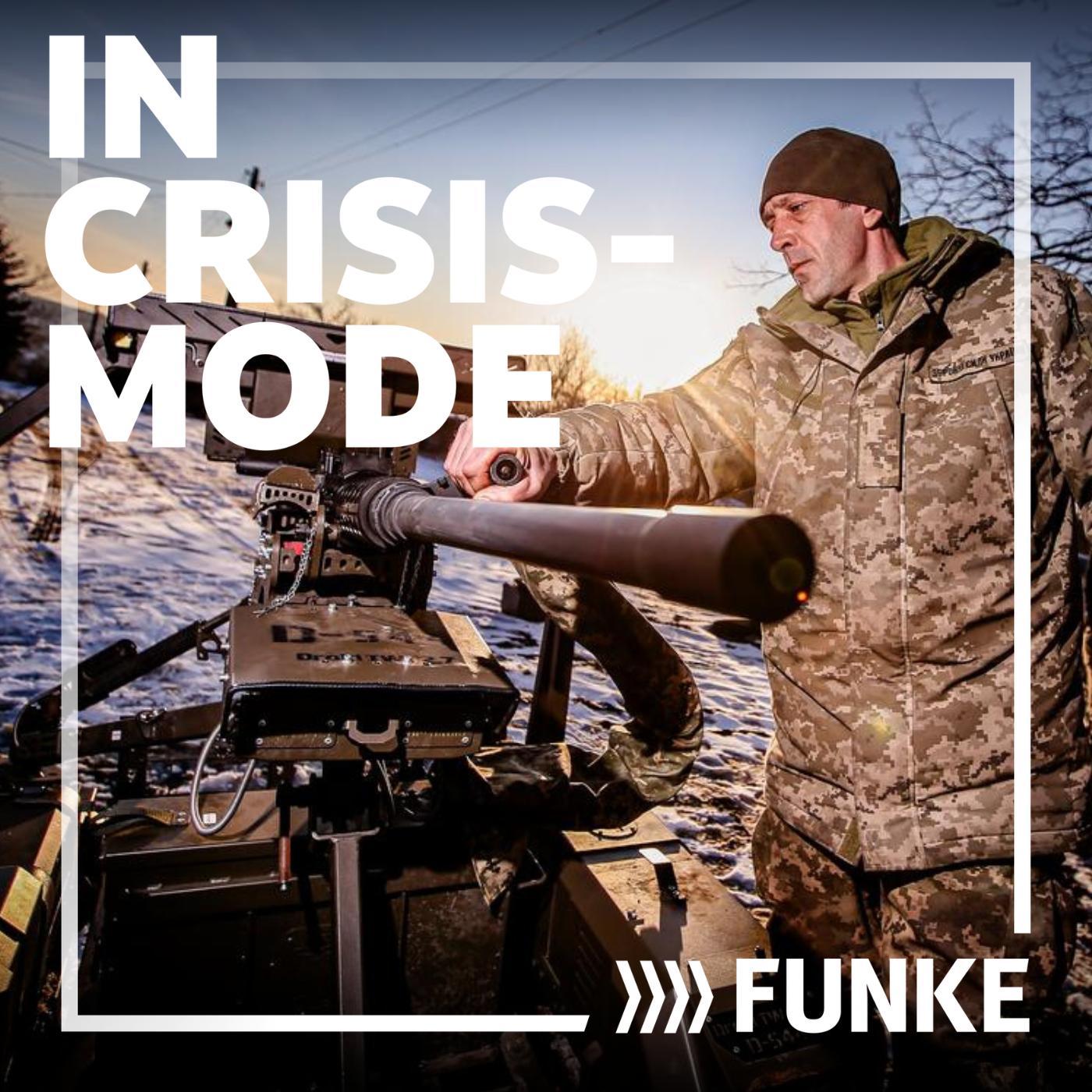
Im Krisenmodus· Folge 148
Terminator Myths in Drone Warfare: Ground Robots and AI in Ukraine
Mittwoch, 29. April 2026 · 33 min
Kapitelklicken springt direkt hin
Shownotes
This episode was made with AI.
The front in Ukraine has turned into a "death zone," relentlessly patrolled by drones. While kamikaze drones haunt the front lines, long-range systems strike deep into the Russian heartland. On the ground, robots ferry ammunition to the trenches and extract the wounded from the line of fire. Military expert Gustav Gressel explains why modern offensive and defensive maneuvers are essentially "suicide missions" without drone support, how Ukraine is pioneering new tactics with land and air robotics, and why humanoid combat robots remain little more than a military gimmick. A Ukrainian officer recounts how his unit used a ground drone to evacuate a critically injured soldier 16 kilometers through a frozen death zone at -15 degrees.
Jan Jessen, war correspondent for the FUNKE Media Group and host of the podcast Im Krisenmodus (In Crisis Mode), analyzes the impact of this drone war on soldiers and outlines the urgent lessons for Germany and Europe.
Guests:
• Dr. Gustav Gressel, Military Expert, National Defence Academy Vienna
• Officer, Land Drone Unit, 101st Brigade of the Ukrainian Army
Host:
• Jan Jessen, Head of Politics at NRZ and War Correspondent for FUNKE Media Group
🧭 Chapter Overview
1 | The Death Zone and Ground Robotics at the Front
Jan describes the drone-dominated "death zone" and his visit to the 101st Brigade to see the Droid TW 12.7. Gustav Gressel discusses how ground drones are becoming mass-produced tools for logistics, medical evacuation, and combat.
2 | "Lifesaving Equipment": Medical Evacuation by Ground Drone
A Ukrainian officer details a 16 km evacuation at $-15^\circ\text{C}$. Jan discusses the "tourniquet problem" (high amputation rates) and how ground drones save lives without putting more soldiers at risk.
3 | The War Machine: Drones, Resupply, and Foxhole Life
Jan explores how drones dictate daily life: sustaining soldiers isolated in foxholes for months, the 20 kg payload limit of aerial drones versus the 200 kg capacity of ground robots, and the use of "net tunnels" to counter Russian FPV drones.
4 | Robotic Assaults and the Limits of AI
Gressel explains Ukraine’s testing of robotic assaults and the role of drones across the seven phases of an attack—noting that infantry is still required to hold ground. Discussion includes AI "mission-driven" drones, the "Helsing" issues, and why signal interference makes swarming difficult.
5 | The Terminator Myth vs. Real Combat Robots
Jan introduces the Phantom MK1 and the "Terminator" trope. Gressel debunks the sci-fi myth: humanoid robots are militarily impractical. He argues that flat, specialized machines are far more effective than "robots with glowing eyes."
6 | Hybrid Armies and the Warfare of 2026
Gressel concludes that while drones are a permanent fixture of the digital revolution, they coexist with traditional artillery and infantry in "mixed armies." Jan’s final takeaway: war is increasingly digital yet remains brutally analog. Machines both kill and save, and the lessons from Ukraine will soon reshape global defense.
📬 Contact & Feedback
Questions, criticism, or suggestions? Write to us:
✉️ krisenmodus@funkemedien.de
🟢 Subscribe Now "Im Krisenmodus" – available wherever you get your podcasts:
Spotify (open.spotify.com/show/0IQW1w25NYSrz60aAPzwvB?s…) | Apple Podcasts (podcasts.apple.com/de/podcast/im-krisenmodus/i…) | Deezer (deezer.com/de/show/3737197) | YouTube (youtube.com/@Krisenmodus-Podcast_FUNKE)
📅 New Episodes Every two weeks, always on Wednesdays. "Im Krisenmodus" is a podcast by the FUNKE Media Group.
Transkriptvom Podcast bereitgestellt · Zeitmarken springen hin
Die Übersetzung von Jans Stimme vom Deutschen ins Englische wurde mit einer KI erstellt. Der Luft ist voll von Dronen, über die Trenchen, über die Gravel-Röden, über alle Dirt-Track-Leading-Fronten. In Ukraine, Soldaten sprechen jetzt von einer Zollung, die 20 Kilometer tief ist, einige sogar 40. Jeder, der sich da bewegt, weiß, dass ein Bewegung sein könnte.
Und in der Mitte dieser Zollung, neue Maschinen sind, Dronen, Tracked-Vehikel, mit Ammunition, Wasser und Essen. Some of them are armed and some are used to evacuate wounded soldiers from the kill zone who would otherwise have no chance of survival. In this episode of Crisis Mode, we want to take a closer look at how profoundly these drones have changed the war in Ukraine.
What does it actually mean when ground robots suddenly become mass-produced? How close are we to those images, AI-driven drones, combat robots, a Terminator on the battlefield? Und was das alles für uns in Europa bedeutet? Without drone support, organisieren einen Attacken oder eine Defense ist essentiell eine Suicide-Mission.
In Crisis Mode, the podcast from KOM. Ich bin Jan Jessen, war und crisis reporter für die Funker Media Group. In diesem Episode, wir kommen auf eine Konversation viele von euch haben bereits gehört. Putin's Drones over Europe – How Big is the Threat? war der Titel von dem Episode und wir werden es wieder in den Show Notes verabschieden.
Back then, wir haben mit Militär-Expert Gustav Gressel über Drones, über Airports, Power Plants und Barracks, über Reconnaissance Flights und Russland's politische Tests. Today, we're taking it a step further, moving closer to the front line in Ukraine. As we've discussed several times on this podcast, the war in Ukraine has changed dramatically in recent years. It has now been raging for four years, and the technology has transformed completely.
At the beginning, when I first traveled there, after the start of the Russian invasion, there were a few reconnaissance drones in the air directing artillery. Now, drones have become one of the most important weapons, if not the most important. As I mentioned earlier, drones now dominate the airspace directly over the front.
Long-range drones attack Ukrainian cities every night. And on the other side, the Ukrainians use long-range drones every night to strike Russia's energy infrastructure, oil and gas production, in an effort to weaken the Russian war machine. There are surface drones, underwater drones. Und wenn ich da in den Kramatorsk-Ukraine war, in den USA.
Bin ich mit Soldaten von der 101st Brigade in einer wooded Nähe der Stadt. Kramatorsk ist eine der zwei zwei major Stadt in den Donetsk-Region, still held by Ukrainian forces. Die 101st ist eigentlich ein Guard Brigade von Generalstaff, aber es ist jetzt auch auf der Front Line. Dort haben sie mir einen Droid-Robot gezeigt, der Droid TW 12.7.
Der 12.7 betrifft den Kalliber des Weaponen auf dieser Fahrrad-Vehikl. A heavy Browning machine gun, as I said, caliber 12.7. They use it as a combat robot. But the platform carrying that Browning is also used for many other purposes. Transporting ammunition to the front as well as water and food. And sometimes evacuating the wounded.
That's the machine I saw there, the one they showed me. It's used for firing. But how new is this? And at what scale are we now talking about these kinds of systems? That's what I asked Gustav Gräsel. He is a military expert at the National Defense Academy of the Austrian Armed Forces in Vienna. And you may already know him from our podcast. We've done several episodes with him. We'll also link everything we've done with him in the show notes.
Ja, wir sehen sie natürlich hauptsächlich in Ukraine. Also andere Fahrzeuge benutzen auch robotische Kettenfahrzeuge, aber in viel geringerem Ausmaß. Yes, we naturally see them mainly in Ukraine. Other armed forces also use robotic tracked vehicles, but on a much smaller scale. The first application was actually in mine-clearing operations, either to remove mines or for more specialized mining tasks.
For example, sending tracked robots equipped with cameras into buildings suspected of being mined. They would first take images, map the interior spaces, and only then decide how to clear the structure. In combat or logistical roles, however, these tracked robots have now become mass-produced in Ukraine. Last year alone, Ukraine produced around 12,000 ground robots.
This year, the goal is 50,000. In terms of quantity, this far exceeds what has previously been deployed by other countries such as the United States or Israel. Also das ist sozusagen von der Quantität hervorweit größer als das, was bisher von anderen Staaten, USA, Israel, eingesetzt wurde. 15,000 ground robots last year alone. The target is 50,000.
That's an industrial scale that we in Europe are still far from reaching. And these robots aren't operating on some testing ground. They're deployed in the middle of a war in which drones, as I said, have become one of the most important categories of weapons. Every month... Tens of thousands of drones are produced.
FPV drones, these kamikaze drones operating at the front, reconnaissance drones, bomber drones, long-range drones, as well as surface and underwater drones. They're built in Ukraine itself and also supplied from abroad. The UK, for example, recently announced it plans to deliver 120,000 drones to Ukraine. As I said, these have now become one of the key weapons.
What that actually means in practice is something I witnessed near the front line around Kramatorsk, where the front is still about 10 to 15 kilometers away. You can already see how dangerous the situation has become when driving into Kramatorsk or into the neighboring city of Slovyansk. Für Kilometern, du fährst durch, was essentially net tunnels, protective coverings stretched over the roads to shield civilian vehicles still moving through the area, as well as military vehicles from Russian drone attacks.
It's a makeshift solution, and driving through it feels quite oppressive. You're effectively inside a kind of tunnel made of fishing nets. Und manchmal kann man sehen, wo die Drones sind, da sind, da sind, da sind, da sind, da sind, da sind, da sind, da sind, da sind, da sind, da sind, da sind, da sind.
All of this shows just how dramatically things have changed due to drone warfare. Wir waren near Kramatorsk in a small wooded area meeting with soldiers. At some point a large transport vehicle arrived and then this drone rattled out. At first glance, it actually looked quite cute, not particularly large, more like those small mini excavators you often see on construction sites, maybe two or three meters long, very compact in appearance.
And that's exactly how this drone came across. But then you notice the machine gun mounted on it and suddenly it didn't look cute anymore. That made it feel distinctly more threatening. This drone is essentially a platform, a set of tracks with a base unit. Differente Modulungen können auf ihn beantragen werden. Nicht alle diese Dronen sind mit Maschine-Gunst.
Ich fragte die Oficierenden, ob sie diese Dronen wirklich brauchen, oder ob sie eher technologische Gimmick sind. Sie sind sehr wichtig. Es sind die Wohnungen notwendig. Die in irgendwelchen Sphären benutzen sind. Ja, diese Drones sind absolut wichtig für uns. In essence, sie sind eine Lebens-Saving-Equipment.
Wir benutzen sie für die Wounded Soldaten, für diejenigen, die Hilfe brauchen. Wir verkaufen sie für die Anwendung, für die Medizin, für die Medizin und für die Anwendung mit ihnen. Wir benutzen sie auch für die Mäne, und sie können auch für die Feuer-Support nutzen. Das bedeutet, dass sie wirkliche Systeme sind.
Und für uns an der Front, sie sind sehr wichtig. Wir machen alles, wir machen, wir machen, wir machen eine Feuerwehr, unsere Positionen. Es sind sehr viele Funktionale Produkte, die in vielen Sätzen benutzen sind. Ja, Lebensmittel, Evacuieren die Wounded, Transporte Ammunition und Supplies, Lägen Mines, Providere Feuer-Support, all of this kann be done mit diesen Tracked Vehikeln. As I said, they're built on a modular system.
Not every drone can do everything, but once you have the platform, it can be reconfigured quickly. Most of that conversion work is actually done by the units themselves. And of course, I asked the officer about a particular mission that had stayed with him, whether there was an operation he especially remembered.
He didn't want to turn it into some grand heroic story. For him, this is simply everyday reality. Aber er hat er noch nicht gesagt, dass er eine Evacuation ist. Wir haben noch nicht in den Extraordinary Missions. Es ist eine gewisse Arbeit. Es ist eine Evacuation von verletten. Es sind eine Lebensmittelbarkeit.
Wir senden eine Provision, wir senden eine BK. Es ist eine soziale Arbeit. Ich würde nicht sagen, dass wir immer noch immer noch gewohnt haben, die meisten von uns ist routine. Aber eine Evacuation in meinem Kopf ist. Ein Infanterie-unit bringt einen sehr schweren Soldaten zu einem Positionen und ihn auf der Grunde auf der Grunde.
Es war sehr schwierig, weil Russische F.P. V. Drones waren überall, und Russische Reconnaissance war die ganze Zeit. Wir dann laden den Mann auf den Drone und ihn 16 km aus der Grunde. Wir haben die Evaküation, wir haben sie in den Dronen, die wir aufwärmung haben. Das war sehr schwer. Die Leute haben sie mit dem Dronen gebracht.
Wir haben ihn mit dem Dronen gebracht und wir haben. Das war die Evaküation in der Region 16 Kilometer. Das war sehr schwierig. Wir haben die Leute, dann haben wir ihn mit dem Drone geholfen, ihn mit dem Drone und monitorieren ihn. Das war ein Evacuation über 16 Kilometern. Wenn wir über Ukraine sprechen, ist wichtig zu verstehen, dass die Drone Evacuierung der Wounded haben, das immer schwer geworden ist, ein Thema wir schon seitens in diesem Podcast haben.
Drone activity in der Front hat es viel schwer gemacht. It's not just that soldiers now face enormous risks simply getting to their positions because there are so many drones in the air. Many are killed on the way in or on the way back. It also creates extreme challenges for evacuating the wounded. Normally, injured soldiers need to be moved out of frontline positions as quickly as possible so they can be treated at stabilisation points and then transferred to hospitals.
This is especially critical for soldiers who apply tourniquets, those self-applied devices every soldier carries to stop severe bleeding, for example, from shrapnel wounds or arterial injuries. These tourniquets are life-saving because they stop bleeding, but they also need to be removed relatively quickly.
Otherwise, the limb, an arm or a leg can die due to the restricted blood flow. Unfortunately, this has become a major problem. Many soldiers are now undergoing amputations, because the tourniquets remain in place for too long. This condition is often referred to as tourniquet syndrome, and it's something I'm seeing more and more frequently in Ukraine.
That's why these ground robots are not just gadgets, they are often life-saving tools for soldiers. If you can send in a machine to retrieve a wounded soldier, you don't have to risk two or three others who would otherwise have to carry their injured comrade out under fire. And there's another aspect. Drones, not just ground drones, but aerial ones as well, have become essential lifelines for soldiers at the front.
Some remain in their positions for one, two, three, sometimes even four or five months. They can't shower, they can't carry enough supplies, and they often sit in small dugouts, nur ein paar Meter m² in der Größe, die für Wochen an einem Zeitraum geholfen werden müssen. Sie müssen mit Essen, Medizin und Ammunition beherrschen. Increasingly, Drones sind dafür benutzt.
Large aerial Drones können mehrere Kilogramm bis zu rund 20 Kilogramm. Dropping supplies where needed, but ground drones can carry much more, up to 200 kilograms of supplies to the front. And as mentioned, they are also used to evacuate the wounded from this 20 to 30 kilometer deep kill zone where kamikaze drones attack anything that moves.
According to Gressel, Russian forces may now be suffering more dead than wounded simply because many injured soldiers can no longer be evacuated from the battlefield. The distances are too great and the route to collection points is too dangerous. Some of the Ukrainian drones now even have mechanical arms that can lift wounded soldiers onto the platform.
But in most cases, it's still their comrades who place the injured soldier onto the drone, press the start button and then send the tracked vehicle off on its own through the kill zone. Infantry soldiers loading a severely wounded comrade onto a ground drone Russian FPV drones overhead Russian reconnaissance everywhere 16 km, as the officer described in minus 15 degrees Celsius 4 hours on a tracked vehicle right through the kill zone.
Without these drones, the officer said, the wounded would simply freeze to death. That's one side of the story. Ground robots as improvised ambulances in a world where the routes to the front have become deadly, where evacuation itself has turned into a massive problem. But on the other hand, these systems are only part of a much larger picture.
Gressel says Ukraine is only just beginning to learn how to integrate ground and aerial drones mit Infantry und Armored Units into Coordinated Operations. The increased production numbers mean that last year many individual systems were tested. And this year Ukraine is essentially trying to experiment with how to deploy robots in combination with regular infantry and mechanized forces.
They are also testing how to coordinate multiple types of robots together and how to integrate them operationally. A lot of what is currently happening in terms of innovation and learning at the front ist tatsächlich tactical learning, figuring out what quantities of which systems are needed for which combat tasks, how the mix has to be structured and how synchronization between different systems must be achieved in order to be successful.
The drone I looked at there, the Droid TW 12.7, the one equipped with a Browning machine gun, reportedly achieved something quite remarkable. Not this exact machine, but one of the same type, is said to have held a position for about a month and a half. That means the system was deployed to the front line, moved into position, and then effectively secured that area.
And according to the soldiers, it managed to do this for around six weeks. During that time, it also reportedly engaged in several firefights with Russian soldiers and assault units attempting to break through to the front. At night, the machine would return, be reloaded, its batteries recharged, and then head back out to the same position the next morning.
And this cycle is said to have continued for about a month and a half, as the soldiers I spoke with told me. More recently, Ukrainian President Volodymyr Zelensky said that Für den ersten Mal, die russische Positionen wurden gesammelt, nur mit unvergänglichen Systemen benutzt. In anderen Worten, diese Maschinen waren nicht nur defensiviert, um eine Position zu halten, sie waren in eine offensivante Operation.
Und natürlich, das klingt quasi wie science-fiction, eine Krieg ohne Soldaten in direktem Kampf. Ich fragte Gustav Gressel, ob das tatsächlich realistisch ist oder ob es mehr möglich ist, Propaganda. Ja. Ukraine is experimenting with such offensive methods. In purely robotic attacks, however, the terrain still has to be held at some point.
Eventually, infantry has to move in. So there is usually a transition between robotic control and human control, and drawing clear boundaries between the two is difficult. What is interesting is that in these seven phases of a Ukrainian attack, only the last two phases are actually carried out by regular mechanized infantry, armored infantry units, known in Germany as Panzergrenadier, und physical troops.
In den ersten Phasen, conventional artillery still plays a limited role. Aber für die meisten Parten, drones dominate. Reconnaissance in attack drones, electronic warfare systems, electronic intelligence systems und similar technologies. Yes, that may be the big reality check when it comes to robotic attacks.
In the end, humans still have to go into the terrain. There always need to be soldiers who physically hold ground and who, wenn es um zu nehmen oder zu schützen territory geht, um zu erinnern, dass es eigentlich kontrolliert wird. Die reale Frage ist weniger über wann die Maschinen vollständig werden, sondern mehr über wie die Dronen die Battlesfeld vorbereiten und wie sie die Natur der Krieg verändern.
Wenn man mit Dronen-Operanten in der Ukraine spricht, und wir haben das für diesen Podcast schon seitens getan. You constantly hear the same idea. In the future, drones may only receive a mission objective and artificial intelligence will handle everything else. What does that mean? The theory is that drones would eventually be equipped with small onboard computers or controlled by them that are AI driven.
That could solve many of the current problems on the battlefield when it comes to drones. Right now, the biggest issue is that many drones are still radio-controlled. That makes them vulnerable to jamming and disruption through electronic warfare. This wouldn't be the case if the drone had its own small brain, so to speak.
In that scenario, there would be no need for pilots anymore. The drone would simply receive a mission and a tactical objective, then set off on the ground or in the air and carry out that mission autonomously. It's a chilling idea, of course, because in practical terms it would also mean that a drone could ultimately decide on its own what counts as a legitimate target, what is a high-value target, Und es könnte auch entscheiden, dass Menschen aus dem ETHIC-Perspektive zu töten.
Das ist extrem schwierig, obwohl man in der Krieg immer immer fragt, wie eine ETHIC-WARFARE in der ersten Stelle kann. Ich fragte Kessel, ob das nur ein Traum ist, oder ein Nachtmärk, oder ob wir diese Visions von ukrainischen Engenern und Soldaten sehen, werden sie eine Realität. Aber bis wir dahin kommen, dauert es noch eine Zeit. Also wir erinnern uns an die Medienberichterstattung über zum Beispiel die Helsing HX-2, die angeblich nicht funktioniert hätte.
Aber wir sind noch ein bisschen weg von dem. Wir können alle wissen, dass die Medien über die Systeme wie die Helsing-HX2 die Allergienste nicht funktioniert. Leider den Fall, dass ein paar Zahlen und die Erklärung des Verkaufs war, dass die Software der Analyse der Anwendung des Anwendungen war. Die Software, die Tarkotik des Anwendungen der Anwendungen zu finden und die Drones ohne eine direkte radio-link, besonders in Situationen von heavy jamming oder GPS-Disruption, funktioniert sehr gut auf Firing Ranges und Training Grounds.
Aber in realen Kampf, die andere Seite ist, und ist nicht ein klar, identifiziertes Ziel. Depending auf wie die Russen, wie sie sich verfolgen, wie sie sich verfolgen, wie sie sich verfolgen, wie sie sich verfolgen, wie sie sich verfolgen, wie sie sich verfolgen, wie sie sich verfolgen. Es gab da wirklich noch ein paar Ziele in den Medien. Das war nicht nur in den Medien, die Ukraine-Dronen-Dronen-Stand auf die gleichen Probleme.
Die Computationale und die Programme in der Real-Kombat wurden deutlich höher als die Ukraine-Dronen-Stand in testing or laboratory development. It took about a year to solve these software issues and refine the systems for real-world use. The second major challenge is bandwidth, especially with drone swarms, of which there are currently very few or none in actual deployment.
Large amounts of radio communication are required. And radio is the Achilles heel of drone warfare. It can be jammed or at least detected and used to trace the origin of a signal and locate where the opponent is launching from. This means both sides are trying. Und da ist natürlich die Koordination von Drohnen untereinander, die dann sozusagen ganze Zeit technisch einen Chatter haben, ein schwieriges Ding.
So, everyone is working on it and in my view, this kind of scenario is clearly a nightmare scenario. The idea that machines could one day independently decide to kill people is something I personally find deeply problematic. But the reality is more complicated than what you might imagine in a lab or in theory.
That was made very clear again recently. Over the past few weeks, I noticed reporting about humanoid robots that have now arrived in Ukraine. These are Phantom MK1 robots, produced by a company that is described as a kind of American-German joint venture. These machines really do look like something out of Terminator.
They are about 1.75 meters tall, black, and have an unsettling appearance. They are now in Ukraine and are being tested there for now. They are supposed to be used for supply missions, but in the future they may also be equipped to carry weapons. Und das ist dann, wenn es anfängt, wie etwas direkt aus einem Film von Science Fiction.
Black humanoid-robots mit glücklichen Augen, die sich nach der Frontline bewegen, um die Kampf für Menschen zu bewegen. Ich fragte Gressel, ob das wirklich der Zukunft der Warfare ist, oder ob es mehr ein Show ist. Also humanoide Roboter halte ich zum Großteil für Spielerei ganz einfach. Nicht, weil ich sage, es wird nie Landroboter geben, die Infanterie versuchen werden, Infanterie zu ersetzen. Das wird es natürlich geben.
Overall, I consider humanoid robots largely to be a gimmick. Not because I think there will never be ground robots attempting to replace infantry. Of course, there will be. But the question is, do they really need to look like humans? Like the biological form that evolved over hundreds of thousands of years as a kind of hairless ape? Wenn ich nur in der Battlefield-Effekt habe, dann würde ich sagen, dass ich nur ein Weapon-System habe, ich nicht eine Human-Shape habe.
Ein Flatt-Track-Vehicle mit der Batterie-Mounted-Low und ein Arm, vielleicht eine Roboter- oder Hydraulik-Arm, das kann ein Weapon haben, hat eine viel größere Target gemacht. Its Cross-Sectional-Area ist viel größer als das von einem Human-Being. Es kann auch möglicherweise überlegen, mit höheren Ground-Pressure und mehr Stabilität als ein Walking-Humanoid-Robot.
So, die Frage ist, wenn ich eine bestimmte Menge Batterie habe, wie viel ist eigentlich nur für Lokomotionen? Weil ich mich auf einen Weg zu machen, dass man zwei Legen kann. Will probably have their place, especially in civilian applications like care work or service roles. Because many environments, like cities or our homes, are designed for humans.
They are built for us to live in. Kitchens, bathrooms, everything is arranged for human use. In that context, a humanoid robot makes sense. For example, helping elderly people clean their kitchen, where it cannot just stay 30 centimeters off the ground. But if the task is simply to bring a machine gun into a firing position, then a low-profile robot that effectively sticks to the ground is actually a very good solution.
So, I think humanoid robots are one possible development path. But in the military domain, we will likely see highly specialized machines for specific applications rather than human-shaped robots taking over the battlefield. Aber wenn ich aber eigentlich nur ein Maschinengebär in die Stellung bringen soll, dann ist ein Roboter, der eigentlich 30 cm über den Boden klebt, eigentlich eine ganz gute Sache. Aber da ist da unten wo hingehört.
Also da denke ich, ist das natürlich eine Entwicklungsvariante, aber da werden sich spezialisierte Maschinen für die jeweilige Anwendung auftun. Er sagt sehr clearly, dass er das nicht realistisch ist, dass wir es in den Terminator-Filmen sehen, um die Roboter-Filmen zu kämpfen. In anderen Worten, er nimmt uns aus der Terminator-Illusion.
Natürlich, Ground Roboter werden immer weiterentwickeln, und sie werden bestimmte Tasche verwendet werden, aber sie müssen nicht wie Humans. In fact, aus einem Militär-Perspektiv, es macht viel mehr Sinn für sie zu sein, Small, flat, and difficult to hit, rather than humanoid robot soldiers from science fiction.
When you talk to drone pilots, engineers, and military personnel, you quickly get the impression that the future belongs entirely to drones. It can start to seem as if artillery, tanks, and fighter jets might be relics of the past, and that we are witnessing a technological revolution similar to the First World War, when tanks suddenly appeared on the battlefield.
Und als die Kavail, mit dem Horsen, plötzlich aus der Kriegsgeschehen, obwohl es noch existierte in der ersten Weltwahrer und in der ersten Weltwahrer, man könnte denken, dass die Technologie komplett verletzt werden, diese alten Systeme. Aber Gressel nicht glaubt das. Mechanisierte Kräfte werden zwar eingesetzt und sie haben noch ihren Kampfwert, aber sie können natürlich nur in den Räumen agieren, die sozusagen die neuen Kräfte, also Drohnen, Elektronische Kampfhörungen und schaffen.
Mechanisierte Kräfte sind jetzt noch benutzt, und sie haben noch einen Kampfwert, aber sie können nur in den Spaces, die für sie die neue Systeme erzeugen werden, wie sie nur in den Spaces, die für sie für sie sind. Drones, Elektronik-Warfare und related capabilities. Without Dronesupport, organisieren ein Attack oder sogar eine Defense ist eine Suicide-Mission, und dieses Entwicklung wird nicht beendet. Es ist nicht so, als ob die Drones einfach nicht mehr so verändern.
Die Technologie ist zu mitten für das. In der Weise, Drones, wie wir sie heute sehen, sind auch ein Produkt der Digital Revolution. Wir können das in unsere Smartphones sehen. Wie die Computing-Pohre im Großen. Wie die Miniaturizeiungssysteme und Kamera Qualität haben verhaut. Heute gibt es die Smartphones, die Sieben Kameras produzieren, die Bilder zu digitalen SLR Cameras aus der 2000en. Das zeigt, wie viel alles aufgerufen und in die Performance verbessert.
Und diese Miniaturization- – die Verzweckungskosten und Batterie- – ist genau das das was für die Möglichkeit, diese Technologie zu vermitteln. Das gleiche ist an den Drones. This is not going away, and it's not going backward. At the moment, the side that is winning is the one that combines conventional firepower with drones and uses drones in a way that opens up opportunities for conventional forces to engage and eliminate the enemy.
The question of when and whether drones will completely replace other weapons systems is, in my view, one that will unfold gradually over a long period of time, much more slowly than many people imagine. Konventionelle Feuerkraft mit eben diesen Drohnen verbindet und die Drohnen so nutzt, dass sie den konventionellen Streitkräften auch Ansatzmöglichkeiten kriegen, den Feind zu killen.
Wahnsinnig. und wo Drohnen vollständig andere Waffensysteme ersetzen. Ich glaube, dass das selber wird ein gradueller und langsamerer Prozess werden, als wir uns das vorstellen haben. Ja, das ist sicherlich ein wichtiges Konterargument zu all den technologischen Projekten. Wie Gressel sagt, Drones nicht verändern die konventionelle Weapons zu verändern.
Aber ohne Drones, Tanks und Artillerie operativen sind heute extrem vultuertig. Drones sind ein Produkt der digitalen Revolution. Und sie werden nicht mehr mehr verändern, als die Maschinen oder Artillerie nach der ersten Weltkrieg. So, instead of a single robot army, what we will likely see in the near future are mixed formations.
Artillery, infantry fighting vehicles, infantry and drones working together. Drones open up space for these units, conduct reconnaissance, strike targets deep in enemy territory, carry out evacuation missions, deliver supplies, and are used for a wide range of tasks as a complement to traditional weapon systems that have defined warfare up to the Ukraine war.
When I think back on this episode, two images stand out. One is the officer describing how they once placed a wounded soldier onto a ground drone in minus 15 degrees Celsius, sending it 16 kilometers through the kill zone. Without that tracked vehicle, the man would simply have frozen to death. And beyond that, the ground robot ensured that his comrades did not have to risk their own lives to carry him out or be pulled away from their positions.
In that sense, it is an extremely useful addition to the military arsenal. The other image is Gressel's view. Humanoid robots are largely a gimmick. What makes sense militarily is something small, flat and hard to hit. Four years after the beginning of the war in Ukraine, we are seeing things at the front that were almost unimaginable in 2022.
When I first started reporting there, reconnaissance drones were used mainly to guide artillery and observe enemy movements. At that time, large mechanized formations with armored vehicles were still common. Das hat komplett verändert. Die Front hat sich stark stagniert. Es gibt kaum noch territoriale breakthroughs von eitheren Seite, weil die Infanterie gar nicht mehr kann.
Large mechanized assaults mit Infanterie-fighting und Tanks sind quasi non-existent, weil sie, besonders bei den Russen, enden in disaster. As drones dominate the airspace, ground robots are now being mass-produced. Drone units exist as their own branch within the Ukrainian armed forces. And there is extensive experimentation with artificial intelligence.
At the same time, artillery and infantry are still fighting over the same villages. And perhaps that is exactly the new reality of war. It is becoming more digital, but it remains brutally analog. Machines that save lives, machines that kill, and much of what is being tested here will not stay in Ukraine.
Gressel says that without drone support, an attack today is essentially a suicide mission. I would add, without understanding this, every political decision is made in the dark. Und das ist etwas, was Soldaten und Engenheber mit in der Ukraine in der Ukraine wiederum beantworten. Sie sagen, wir müssen diese Technologie weiterentwickeln, weil der Krieg, Russland, das auch macht, und zu schlafen ist nicht eine Option.
Aber gleichzeitig hoffen sie auch, dass wir die Technologie weiterentwickeln. Global politics will finally set some boundaries, that guardrails will be put in place and that at some point a stop button will be pressed globally before we enter a development that can no longer be controlled and where no one knows where it might ultimately lead.
This was Crisis Mode, a podcast by the Funker Media Group. This episode was produced by Alexander Baumeister, who is also a journalist at Funker's radio station. If you enjoyed this episode, follow us on Spotify, Apple Podcasts, or wherever you listen, and feel free to leave a rating. If you have ideas for future episodes or questions about this one, you can reach us at christenmodus at funcomedian.d.
Thanks for listening. Stay alert. Take care and see you next time. In crisis mode.
