

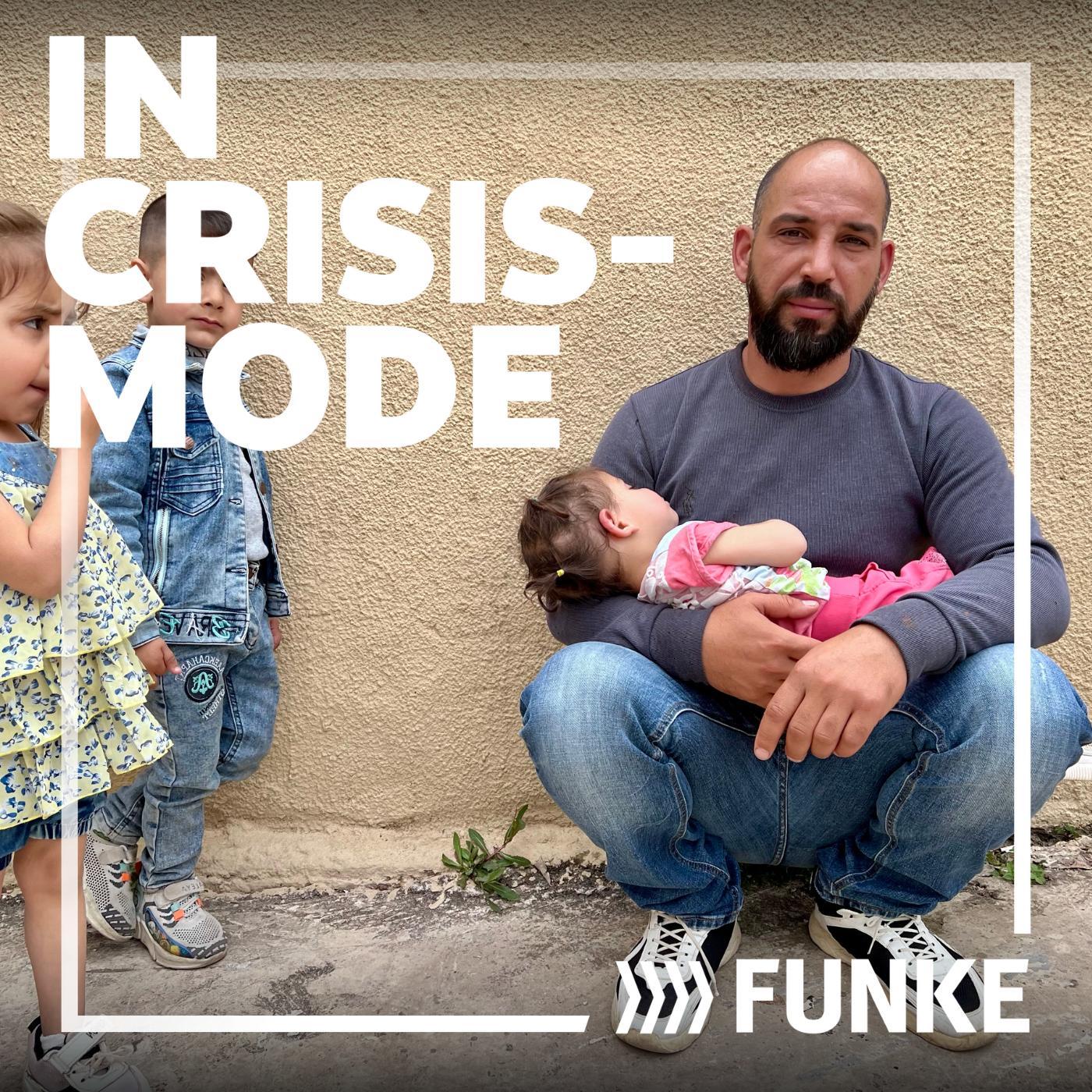
Im Krisenmodus· Folge 150
Lebanon at the Edge: War, Flight, and a Faltering Truce – Aid from NRW
Mittwoch, 13. Mai 2026 · 26 min
Kapitelklicken springt direkt hin
Shownotes
This episode was made with the help of AI.
The ceasefire in Lebanon hangs by a thread. Jan Jessen, war and crisis reporter for the FUNKE Media Group and host of the podcast “Im Krisenmodus” (In Crisis Mode), travels to Beirut alongside Claudia Peppmüller, spokesperson for Peace Village International, and Josef Neumann, Member of the State Parliament of North Rhine-Westphalia (NRW).
On the ground, the full scale of the crisis is visible: ongoing bombardments in the south, hundreds of thousands of internally displaced persons (IDPs), schools converted into emergency shelters, and a devastating lack of essential supplies. This episode explores the geopolitical dynamics involving Israel, Iran, and Hezbollah, while asking what is urgently needed on both a political and humanitarian level.
Guests:
• Claudia Peppmüller (Peace Village International, Oberhausen/Dinslaken)
• Josef Neumann (SPD, Member of the NRW State Parliament)
Host:
• Jan Jessen – Head of Politics at the NRZ and veteran crisis reporter for the FUNKE Media Group
🧭 Chapter Overview
1 | A Ceasefire on Paper Only
Jan explains the current reality: a crumbling truce, daily strikes in the border regions, and why so many continue to flee toward Beirut.
2 | Classrooms as Homes: Aid Distribution in Beirut
Claudia Peppmüller discusses food distribution at a state school housing 370 people—focusing on culturally appropriate food packages and the needs of children.
3 | Children in a State of Emergency
A look at the psychological toll: children oscillating between hyperactivity and withdrawal, living in cramped classrooms. Jan provides context on the urgent need for mental health support and structure.
4 | Access and Security
Targeted destruction in Beirut, restricted neighborhoods, and no access to the south—yet, paradoxically, why parts of Beirut currently feel safe.
5 | Daily Life Under Pressure: Schools, Prices, Medicine
Schools serving as shelters means education is on hold. We discuss inflation, the high cost of medical care, and the overlapping displacement of Lebanese IDPs, Syrians, and Palestinians.
6 | Aid Without Borders: NRW and Civil Society
Peace Village International, the State of NRW, and various churches provide interfaith, unbureaucratic support. How this aid directly reaches the people.
7 | Politics and the Truce: What Happens Next?
Securing the ceasefire, the necessity of diplomatic dialogue (Israel, Iran), and the complex challenge of disarming Hezbollah. Jan summarizes the political steps required n d Hisbollah – und fragt, was jetzt politisch und humanitär nötig ist.
📬 Contact & Feedback
Questions, criticism, or suggestions? Write to us:
✉️ krisenmodus@funkemedien.de
🟢 Subscribe Now "Im Krisenmodus" – available wherever you get your podcasts:
Spotify (open.spotify.com/show/0IQW1w25NYSrz60aAPzwvB?s…) | Apple Podcasts (podcasts.apple.com/de/podcast/im-krisenmodus/i…) | Deezer (deezer.com/de/show/3737197) | YouTube (youtube.com/@Krisenmodus-Podcast_FUNKE)
📅 New Episodes Every two weeks, always on Wednesdays. "Im Krisenmodus" is a podcast by the FUNKE Media Group.
Transkriptvom Podcast bereitgestellt · Zeitmarken springen hin
Die Übersetzung von Jans Stimme vom Deutschen ins Englische wurde mit einer KI erstellt. In der Schatten der Krieg gegen Iran, eine andere Krieg ist in Lebanon auch. Wieder wieder, muss man sagen. Und obwohl Donald Trump, der Präsident der USA, hat ein Krieg für Lebanon ein paar Tage vorgegeben, die kämpfe in den Süden des Landen weitergeht.
Die gesamte villages sind zu verabschieden. Hunderts und tausende Menschen sind fliehen. Und natürlich muss man die Frage, When children are sleeping in classrooms, when parents are fleeing for the 10th time, can one really still speak of a ceasefire? And what is happening to the people in the country?
In Crisis Mode, the podcast from Conflict Zones with Jan Jessen. Welcome to In Crisis Mode. I'm Jan Jessen, war and crisis reporter for the Funke Media Group. A few days ago, I was once again in Lebanon. I had already been there last December. Then again four weeks ago. And now once more. This time I was travelling with Friedensdorf International, a humanitarian aid organisation based in Oberhausen. You probably know them already.
We've featured them several times on the programme. And of course we'll include links in the show notes to everything we've experienced with them so far. As I said, the ceasefire that Trump announced a few days ago, which is also supposed to apply to Lebanon, does not really exist, at least not in the south of the country.
There are dozens of bombardments every day by the Israeli armed forces on one side. On the other side, there are daily attacks by Hezbollah, the Shiite militant group that is strong in southern Lebanon, against the Israeli forces that have moved in with ground troops. Israel in turn wants to establish a buffer zone in order to stop attacks on northern Israel.
So this country is still very, very far from any kind of ceasefire. And we were there in Lebanon to see how people are coping. Around 800,000 people have been displaced from the south of the country to Beirut, der Lebanese capital, und zu dem nord der Lande. Schulen haben sich in die emergency gesellschaftlich gegründet.
Prices sind in der ganzen Welt, partly wegen der Klosch der Strait des Hormuz. Das ist ein Land auf dem Brink. Das ist das wir da. Wir waren da auch da, weil der Städte Regierung von North Rhine-Westphalia hat gerade 100,000 Euro in finanziert. Die Geld wurde von Friedensdorf gegründet, so dass, mit local Partnern, sie konnte das Lande organisieren.
Travelling with us was Josef Neumann, a member of the State Parliament for the SPD and chairman of the Health Committee in the North Rhine-Westphalia Parliament. He joined us to assess the situation firsthand and to see where and how the aid from North Rhine-Westphalia is reaching people in Lebanon. Among other places, we visited one of these schools in Beirut that has now become an emergency shelter.
Overall, it's an extremely difficult situation because all public schools have been used as shelters since March 2nd. That means regular schooling is no longer possible in Lebanon. The date is important because the bombings by the United States and Israel against Iran began on March 28th. The following day, Hezbollah decided to enter the war as well.
Hezbollah is a Shiite organization financed, trained and equipped by Iran. Und eine große Rolle in ihrer Identität hat immer den Kampf gegen Israel und die Struktur der Israel-State. Over den Jahren, es hat viele Worte mit Israel-State kämpft. Und jetzt, wie ich sagte, es hat wieder einmal den Konflikt auf Iran-Side.
Die ganze Land hat sich als resultiert, und wir konnten das clearly fühlen, während unserer Besuchung. Wir besuchen eine dieser Schulen in Al-Mazrah, eine Stadt in den Norden Beirut, in der Hauptstadtstelle von Sunni-Muslims. Just als Hintergrundinformation, Lebanon ist ein multikonfessional, multireligious Land.
Roughlich ein-durchschnitt der Bevölkerung ist Christian, ein-durchschnitt von Sunni-Muslim und ein-durchschnitt von Shiite-Muslim. Das ist nicht genau so leicht. Als ich schon sagte, Al-Mazrah ist ein predominantly Sunni-Distritt, aber viele Shiite-Refügeer aus dem Süden haben auch hier. Wir besuchen die Schule.
Besuchen die Schule. It was an extremely striking and disturbing sight. There was a huge crater where an apartment building had once stood, with neighbouring houses damaged and facades torn away. And this happened just 200 metres from the school where the refugees are being housed. Israel says it targeted Hezbollah positions there, a Hezbollah command centre or something similar.
But even so, you can clearly feel in Beirut just how close the war has come to these refugee shelters. Inside the shelter were several dozen displaced people, The people running the facility oversee five different shelters, housing a total of 370 refugees. Conditions are, of course, far from ideal. Ten people are living together in a single classroom.
The man in charge of the shelter explained the challenges they are facing. He said that one of their biggest problems is access to proper food, and that hygiene issues are constantly arising as well. Just over two hours ago, we returned from a food. Vor gut zwei Stunden sind wir zurückgekommen von einer Lebensmittelverteilung.
Das Land NRW und wir erneut... Yes, we're in Beirut right now, back at the hotel. We're sitting outside and reflecting on the day. Just over two hours ago, we returned from a food distribution. The state of North Rhine-Westphalia, and we ourselves, with NRW contributing for the first time, made a donation to our partner organisation, Tima, so they could purchase food for refugees.
Und als ich gesagt habe, wir haben einfach nur ein Wir haben einfach nur ein In der Stadt, wo Shiite und Sunni Refugees sind Housed zusammen in eine Public-School, Currently, 370 People are living in That school Und natürlich, They need absolutely Everything, Wir felt that the Most important thing At first was Simply making sure People had enough To eat Children in particular Need proper nutrition Und wir waren Very happy to see How Tima also Took cultural aspects Into account When it came To the food For example They included foods In the packages die Menschen aus dem Süden kennenlernen und genügend zu essen.
The person you just heard was Claudia Peppmüller, spokesperson for Friedensdorf International, which has been providing humanitarian aid in Lebanon for quite some time now. The state of North Rhine-Westphalia, which Claudia just mentioned, provided funding there. That money is being used to organize humanitarian assistance in Lebanon.
In this specific case, food distribution. Some time ago, the state had already funded two so-called food trucks, refrigerated trucks used to distribute food supplies. Und jetzt haben sie ihre Unterstützung wieder erhöht, um noch 100,000 Euro zu helfen. Natürlich, und das muss man auch sagen, ist das nur ein Drop in den Osten.
In der Ende, mit 800,000 displaced Menschen, internal refugees, meaning Lebanese citizens, die von den Süden zu Beirut sind, ist relativ wenig. Und wenn man also consider dass rund 1,000,000 Syrien refugees sind in der Land selbst, die Situation wird sogar noch schwieriger. Es ist einfach ein Schotage von allem.
Food, shelter, medicine. Und oft sogar die Basis, wie towels oder andere Hygiene-Produkte, sind missing. Wenn wir da sind, Claudia Peppmüller selbst wurde eine kleine Sensation. Claudia hat blondes Haar und nicht eine Headscarf. Und natürlich war sie sofort bei allen Kindern in der Schilder. Es war auch mit den Kindern zu sprechen.
Sie kamen direkt, also waren neugierig. Es war also deeply moving to speak with the children. They came up to us immediately, curious about where we came from, asking questions about why we were there. Because it is still very, very rare for foreigners to come here and actually join the aid distribution inside the shelters.
What was especially striking was seeing how children process these experiences. Some of them have lived through bombardments. We heard that in the north as well. Some have seen dead bodies. What struck me about the children was that some of them seemed extremely hyperactive, almost overstimulated. A few had already entered a kind of survival mode where they had somehow adapted to this truly terrible situation.
They are living in incredibly cramped conditions, sometimes with ten family members sharing a small classroom. And with others, you had the feeling that you simply couldn't reach them at all, even when you spoke directly to them. Sie gar nicht, auch wenn man sie anspricht. Yes, as I said, this wasn't my first time in Lebanon. I had already been there in December and looked at the south of the country.
At that time, there were no active military clashes. Hezbollah also stayed out of the previous war with Iran, the so-called 12-day war in June of last year, which involved heavy bombardments on both sides, Israel and the United States against Iran, and Iran against Israel. Back then, Hezbollah had stayed out of that conflict, although it had previously fought alongside Hamas after the Hamas terrorist attack in October 2023.
As a result, there had already been significant destruction in the South. And when I was there last, in March, it was during what you could call the most intense phase of the conflict when there was still mutual fire between Iran and Israel and at the same time Israeli bombardments in Beirut. That was not the case this time. During our visit, nothing fell on Beirut in the days we were there.
Not even in Dahieh, the Shiite stronghold, a suburb of Beirut. Nothing happened there either. However, we were told that heavy fighting was taking place in the south of the country while we were there. Fortunately, we didn't witness any of it this time. And of course, that was also a relief for the people in Beirut, who were at least spared bombardments during those days.
And Claudia Pepmüller describes it like this. Also in Beirut, you can see, at certain points, that weeks ago individual buildings were heavily bombed. This neighbourhood here, we are not allowed to enter it. Of course, that would have been very interesting for us, if only to see whether aid could be provided there, but we are not allowed in because the district still runs the risk of being bombed again. It's the same in the south.
Access there is also blocked for us due to the intense fighting. People earlier reported that it had never been as bad as it was yesterday. So there must have been very heavy bombardments. Here in Beirut, I have to say, I don't feel threatened by the situation for a single moment. I do feel it is safe here.
We have experienced other situations where you thought, no, this is different. That would be my assessment of the situation. Also ich empfinde das schon als sicher. Sie beschreibt die Situation auf dem Boden als relativ calm. Und ich muss sagen, das war eigentlich auch unsere Erfahrung. In March, als wir da waren, wir noch sahen Israeli aircraft fliegen über Beirut, an extrem speed, breaking die Sound-barrier.
Es gab einen enormen Sonnig boom, der wirklich frightened Menschen. Es ist ziemlich stöchentlich, ich muss sagen, wenn Sie da sind. Aber nichts von dem das this time passiert. Die nur was wir da hörten, als wir da waren, war ein Drone, ein Surveillance-Drone, über die Stadt. You could hear it clearly. It has a sound like a motorcycle.
You hear it very distinctly. It is also a kind of show of force by the Israeli armed forces, to make it clear, listen up, we are here, and please don't cause any trouble in Beirut at least. As mentioned, there is heavy fighting in the south of the country. Hezbollah is attacking Israeli troops there, and Israel is carrying out very heavy bombardments in the south these days.
With Friedensdorf International, I have not only been to Lebanon, but also, for example, to Afghanistan, another very compelling country, and of course also a deeply tragic one when it comes to the situation on the ground. As I said earlier, we will also put the details of those experiences into the show notes.
Also traveling with us in Lebanon was Joseph Neumann, an SPD politician, a member of the state parliament and chairman of the Health Committee, who has a lot of experience with Lebanon, has visited the country frequently, und ist jemanden, der sich zu helfen, dass Lebanon nicht vergessen ist. Er war auch sehr beeindruckt, was er da war.
Denn, wie ich gesagt habe, Lebanon ist eigentlich ein Land auf dem Brink. Das ist auch connected zu dem Fakt, dass die Lebanese Regierung. At least die Christian und Sunni-Muslimen parts von es, no longer wollen Hezbollah. Sie sagen, dass Hezbollah repeatedly provokes Israeli attacks und jederzeit der Rest der Land ist in ein Konflikt, das ist nicht its own.
For that reason, the Lebanese government decided back in August last year that Hezbollah should be disarmed and turned into a purely political party. Hezbollah refuses to do so. And this was something that came through very clearly, almost between the lines, in all the conversations we had. A growing fear that Lebanon could once again slide into civil war, like the one the country experienced between 1975 and 1990.
Einige von euch daran erinnern. Es war eine extrem brutale Zivilwahr, mit massiver Destruction über das ganze Land, mit verschiedenen Partien und religiösen Gemeinden, die sich gegen andere kämpfen. Und die Begründung ist, dass etwas so etwas zurückkehren könnte. Ja, Libanon besteht seit Jahren die Herausforderung, sich in einer Krisensituation zu befinden.
Und aktuell kommt noch eine Kriegssituation dazu. Wir haben 100 Es gibt noch Tausende flüchtlinge aus Süd-Libanon. Die auf der Flucht sind, aufgrund der... ...Lebanon, für Jahre, die Herausforderungen sind in einer constanten Stade of Crisis. Und jetzt haben wir eine Situation in der Lage, eine Situation in der Süd-Libanon.
Wir haben Hunderts und Hunderts von Thausenden von Süd-Libanon, die vor allem die Militär bombardungen in der Süd-Libanon flüchtlinge, Sie sind oft in Beirut, oder anderen Bereichen, in der Süd-Libanon. Diese Menschen sind in der Lage, in der Süd-Libanon zu helfen. As we have seen, public schools are filled with many refugees who need to be cared for.
But this also means that schools cannot operate normally, and hundreds of thousands of students are unable to attend public education. This shows just how difficult the situation has become for people in the country. In addition, there is an extremely high inflation rate, along with very high living costs.
What people need is, at a minimum, a daily meal, a roof over their heads, and, where possible, employment. Although the latter is currently barely functioning for many people in Lebanon. And when you look at the children, at their faces, you realize that these children will only have a sustainable future in their lives if there is peace and if we enable them to survive in this country.
And survival means supporting them with food supplies, but also with medical care. Because healthcare in Lebanon is particularly expensive. And that is a very, very major challenge. Haben, wenn es Frieden gibt. Und wenn wir ihnen ein Überleben in diesem Land ermöglichen. Und Überleben heißt, sie zu unterstützen im Bereich der Lebensmittelversorgung, aber auch im Bereich der medizinischen Versorgung, denn medizinische Versorgung ist im Libanon besonders teuer.
Yes, Josef Neumann addressed this as well. The country is facing enormous challenges. As I mentioned earlier, there are not only these 800.000 internally displaced people von den anderen Ländern, die jetzt in die Stadt sind, in den Städten haben, oder sind auf den Straßen. Auf dem auch, da sind rund 1 Millionen von Syrien aus Syrien.
Wir haben auch einige in Rahbeh, eine Stadt in northern Lebanon. These waren Alawite Menschen, die in March von dem Jahr flog. At der Zeit, da war ein Massaker auf der Syrien-Koast. Islamist groups, attributed zu den Transitionen-Governement, carried out attacks against Alawite communities there, killing many people.
Tens of thousands then fled. They were added to the already large number of Syrian refugees who were already in the country, in Lebanon. These people are also living in extremely precarious conditions. They are essentially in the country illegally, as Lebanon does not have an asylum system like the one we have.
They have to somehow get by, are supported through aid organizations, but as mentioned, they are an additional burden on the country. Es ist auch wichtig zu verstehen, dass Lebanon eine Population von über 5 Millionen Menschen hat. So diese 5 Millionen Menschen sind nun effektivt für 800,000 internen Displaced Personen, 1 Millionen Syrien Refugee und auch über 200,000 Palästinien, die in der Lande leben als Refugee in der Stadt für Jahre.
Das ist eine sehr große Herausforderung. Ich finde es sehr richtig, dass Friedensdorf International ist hier, und dass die Stadt der Nrw-Westphalia in Nordrhein-Westphalia auch schon ein paar Zeit ist, in den meansen es hat. Was ist auch visible, however, ist die sehr starken commitment der verschiedenen Christen Kirchen in der Lande. Und das ist sicherlich die Menschen in einer interfaithen Weise.
Menschen sind nicht gefragt, was religion sie belong zu ist, in order zu bekommen. Und ich glaube, dass das ein wichtiges Seed in einem Land wie Lebanon ist, wo wir so eine große Rolle in einem Land wie den Libanon haben, und damit auch an unterschiedlichen sozialen, politischen und sozialen Strukturen. in diesem Lande haben.
What Josef just mentioned I also found quite remarkable. The local partner organisation of Friedensdorf is an organisation called Tima, which Claudia already briefly referred to earlier. Tima consists of Baptists, Evangelical Christians. One could view that critically or not. In any case, these people are very deeply rooted in their faith, and they are supporting Shiite refugees in the school we visited.
They are also supporting Alawite refugees in Raabé, completely independent of what religion, ethnicity or country of origin they belong to. And this is what Joseph already pointed out, perhaps also an opportunity for Lebanon, that there are people who look beyond these sectarian divides and build bridges simply by helping others in a selfless way.
It was also remarkable for me to see how that can work. The head or organizer of this facility, the school, this refugee shelter, also made it very clear that religious and political flags or symbols are not allowed in this school, simply because the aim is not to deepen the divides, but to close them, to fill them in, the divides that exist in this country.
This is what Lebanon is defined by, its multi-confessional, multi-religious character. In a way, that is something wonderful, something beautiful. When you travel through Lebanon, you see mosques, viele christian-churches und eine sehr lange Geschichte von verschiedenen Ethnicitäten, Religionen und Confessions leben.
However, in recenten Decades, dies auch ein Curse für Lebanon ist. Die Civil War ist noch sehr presentiert in den Memorien von vielen Menschen, und viele jetzt Angst, dass es wieder auszultert wird, weil Hezbollah ist nicht das die Regierung hat eigentlich entschieden, um zu disarmen und zu werden, eine politische Partei, in order to finally bring peace to this front and to end the wars with Israel.
And in the end, no one knows what the future will bring. Das Entscheidende ist, wir müssen alles dafür tun, dass es den Waffenstillstand hier gibt. The crucial point is that we must do everything we can to ensure that there is a ceasefire here. And that requires many diplomatic approaches. It is extremely important to enter into diplomatic dialogue on this issue with all countries that are involved in this war, that naturally includes Israel.
In addition, there is the conflict with Iran, which plays a central role. And then one has to look at the situation on the ground, wo es Hezbollah ist und die notwendige Disarmung von Hezbollah ist. Wer kann das eigentlich tun? Wer kann das eigentlich tun? Es gibt viele politische Probleme, die sich nicht mehr bewegen müssen. Und einfach standen und watchen wird nicht genug, dass wir eine politische Wörter geben müssen.
Und die Zuschauer wird nicht genug, um diesen Konflikt und diesen Krieg nur anzuladen zu beenden. Joseph already said it. The most important thing is to stabilize the ceasefire and to establish channels of communication. That is also difficult. Donald Trump, the US president, has in fact called on Netanyahu, the Israeli prime minister, and the Lebanese government, represented by President Joseph Ayoun, to hold talks in Washington.
As of the time this podcast was recorded, that has not yet happened. Ayoun is also viewed critically because there appear to be communication channels zwischen den Israelis und der Lebanese government. On the road from Beirut towards the airport, you pass through Dahyeh, the Shiite stronghold, where you see images everywhere of Khamenei, the Iranian religious leader who was killed at the beginning of the conflict, as well as other Shiite leaders such as Qasem Soleimani and others who have been killed in various conflicts over the years.
And now, on a bridge, you see an image of Aoun in traditional Israeli clothing, with an Israeli flag in the background. They are essentially branding the Lebanese president, their own president in fact, as an Israeli agent, which of course makes the situation somewhat dangerous. But in the end there is no alternative.
Of course you have to talk to Israel, and ideally Hezbollah would also have to talk to Israel, but due to its ideology, it simply cannot or is not allowed to. Israel will also likely never speak directly with Hezbollah. So it must now be the task of the Lebanese government to disarm Hezbollah and to convince Hezbollah that it no longer makes sense to seek this constant conflict with Israel, especially since they are repeatedly losing these wars.
In the end, entire villages in southern Lebanon lie in ruins and the people who have fled from the south may have difficulties returning if this conflict situation does not end. The entire country is standing on the edge of the abyss and may even be pushed into it. Das ist sehr wichtig, dass dies von der anderen Seite moderiert ist, und dass Deutschland in diesem Rolle auch.
Als eine der Welt größten, mit considerable influence zu können, es sollte nicht die Feld entweder zu den Amerikanern, wenn es um die Negotiations zu kommen. Aber eher Europa, und Deutschland in particular, sollte nicht nur die Humanität nicht nur die Hilfe, sondern auch die Politik politisch zu medieren, die Situation.
Das, ich glaube, ist sehr wichtig, weil wenn Deutschland in der Abyss fällt, Then for purely self-interested reasons alone, one can say, that must not happen. Many refugees have told us that they no longer see their future in Lebanon because of the constant conflicts they experience there. Instead, they see their future in Europe, in Canada, in the United States and elsewhere.
And if we do not want even more refugees coming to Europe and Germany and the situation here potentially becoming more tense, including a rise in far-right politics, then we have to help on the ground. That is the key point. And not only in humanitarian terms, but also politically, We should push for Hezbollah to be disarmed.
We should support the Lebanese government. We should also support those Shiite forces in Lebanon that are distancing themselves from Hezbollah. And we simply have to help. Of course, we must also influence Israel. Refugees from the south told us this as well. They begged us, repeatedly saying, please, please, please make sure that Israel stops bombing in the south.
An elderly man told us that he had fled 10 times in his life. He was someone who grew oranges. Er sagte, dass jetzt es die Weihnachten und die Orangen sind in der grove. Er sagte, dass sie die Kinder gemacht haben. Was haben sie getan? Sie haben nichts gemacht. Und sie sind sie, sie sind, verletzten, verletzten. Und das muss stoppen. Und ich denke, das ist das was Deutschland, die sich eigentlich tun.
Intervene mit den beiden Seiten der Konflikten und auch die Influenz auf die Lebanese Regierung so dass die Menschen eventually haben eine peacefulfüße und wiederholen Lebanon. Das war heute's episode of In Crisis Mode. This podcast was produced by Alexander Baumeister who is also a journalist working for the radio station of the Funkamedia Group If you like the podcast, please like and follow us It helps make our work more visible Feel free to write to me if you have suggestions for future episodes, christenmodus at funkamedian.de Take care of yourselves See you soon Bye.
