

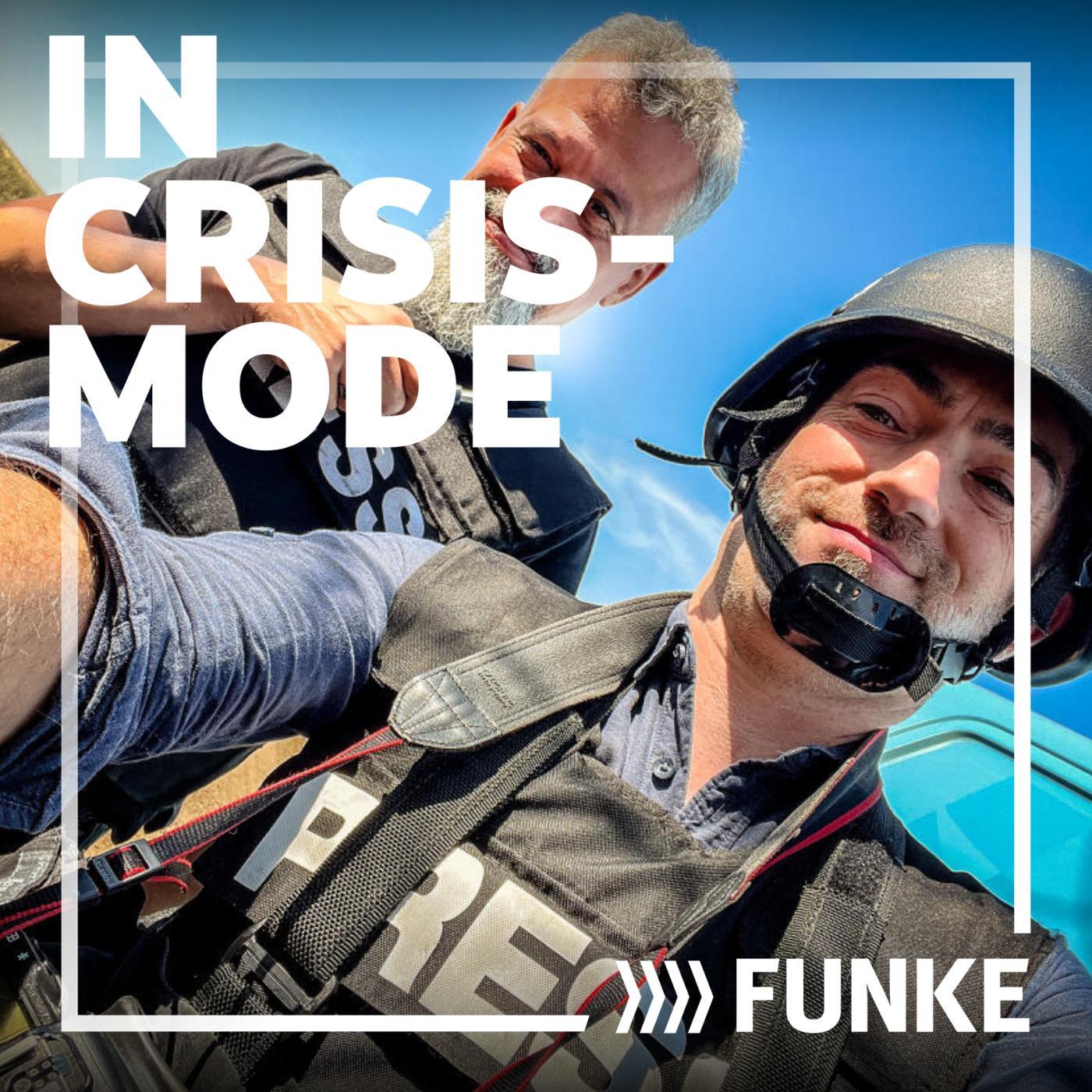
Im Krisenmodus· Folge 152
How free is the Press? Journalism in Times of Crisis
Mittwoch, 27. Mai 2026 · 29 min
Kapitelklicken springt direkt hin
Shownotes
In this episode of “Im Krisenmodus”, Jan Jessen (nrz.de/autoren/jan-jessen) head of politics at NRZ and war and crisis reporter for the FUNKE Media Group, speaks with photojournalists Reto Klar and André Hirtz about censorship in everyday reporting, questions of responsibility behind the camera shutter, and the quieter realities of conflict zones.
The episode is prompted by Jessen’s receipt of the 2026 Press Freedom Award and explores where boundaries are necessary—and where public access to information is being restricted.
Guests:
Reto Klar (funkefotovideo.de/team/reto-klar) (photographer, FUNKE)
André Hirtz (funkefotovideo.de/team/andre-hirtz) (photographer, FUNKE)
🧭 Episode Overview
1 | Teaser: Censorship in Everyday Reporting
Opening from Kherson, featuring covered PRESS patches and Reto Klar’s remark (“image destroyed”), framing press freedom as a constant point of friction in the field.
2 | What Does Press Freedom Mean?
A practical rather than legal perspective: Reto’s definition from deployment, André’s focus on plurality and professional stance, and Jan’s contextual framing.
3 | Germany: Soft Forms of Censorship
Reto on experiences in Berlin (being pushed back, restricted access), and Jessen on interactions with press offices, image control, and subtle limitations.
4 | Frontlines: Security vs. Restriction
André on accreditation systems, operational security (OPSEC), and location risks; Jessen on image review processes in Ukraine and guided IDF tours without independent access.
5 | What Do We Show—and What Do We Leave Out?
André on ethical responsibility at the moment of capture (“What do I choose not to show?”), the use of implication instead of shock, and Jessen on editorial standards in print and audio.
6 | Facts vs. Fakes
Jessen on examples from Tel Aviv: AI-generated images, deepfakes, and disinformation—and how verification and transparency are essential for maintaining trust.
7 | Why We Go Out & the Quiet Moments
Reto on motivation and purpose; André on an emotional encounter in a Ukrainian senior care facility; a brief reflection on Afghanistan; concluding thoughts from Jessen.
📬 Contact & Feedback
Questions, criticism, or suggestions? Get in touch:
✉️ krisenmodus@funkemedien.de
🟢 Subscribe Now
Im Krisenmodus – available on all major podcast platforms:
Spotify (open.spotify.com/show/0IQW1w25NYSrz60aAPzwvB?s…) | Apple Podcasts (podcasts.apple.com/de/podcast/im-krisenmodus/i…) | Deezer (deezer.com/de/show/3737197) | YouTube (youtube.com/@Krisenmodus-Podcast_FUNKE)
📅 New Episodes
Every two weeks, Wednesdays.
In Crisis Mode is a podcast by FUNKE Media Group.
Transkriptvom Podcast bereitgestellt · Zeitmarken springen hin
Die Übersetzung von Jans Stimme vom Deutschen ins Englische wurde mit einer KI erstellt. Die letzte Mal in Ukraine, in Februar, haben wir etwas sehr, sehr strange erlebt. Wir mussten unsere Presse-Label auf unsere Protektive Vests für den ersten Mal und der Grund für das war, dass wir in Kursen, eine Stadt in der Südkirche, und wir wurden gesagt, bitte, sie aufzuhören, tape über die Presse-Markings mit Duct-Tape so dass Sie nicht sofort identifizierbar sind als Journalisten.
Der Grund war, dass Russische jetzt aktiv sind, Vielen Dank. Nicht nur in den Zonen, sondern auch in Deutschland selbst. Was ist eigentlich Press Freedom? Warum brauchen wir es? Und was sieht es in der ganzen Welt in Deutschland? Was sieht es in der Zonen? Und above all, wir wollen auch über die Verantwortung der Press.
Denn Press Freedom ist natürlich nicht ein ein-Way-Street. Es kommt mit einem großen Teil der Verantwortung. Und das ist genau das wir wollen heute sprechen. You often have situations where your image is being deliberately distorted, where there is simply a desire to prevent certain images from reaching the world, and that is, in a way, a form of censorship. Censorship. Du hast das ganz häufig, ne?
Du hast das ganz häufig, ne? Du hast das einfach sozusagen, dir dein Bild kaputt gemacht. You often find that your work is, in a way, deliberately disrupted. Your image gets broken, so to speak. And that in itself is a form of censorship. And you see that quite often in everyday political life. Security personnel, for example, stepping in front of you, physically moving you away, blocking access, so that in practice your ability to do your job is restricted.
Das war ein Beispiel von Deutschland von Ratho Klar, ein Fotografier mit der Funker Media Group, mit dem ich oft bin in Krieg und Krieg. Er hat auch gesagt, dass die Freiheit in Deutschland, ist, dass es in bestimmten Situationen ist, an einem bestimmten Fall. Und in fact, das ist mehr und mehr common überall. Wir sind in Probleme, wo die Freiheit ist nicht mehr unbezüglichen Freiheit.
Und zu sagen, es nie wirklich war. Das ist natürlich ein großer Herausforderer für uns als Journalisten. Und trotzdem versuchen wir zu informieren, fair und so close zu Menschen wie möglich. Das ist das Balancing Act, das wir zu machen müssen. Und wie das funktioniert, oder wie wir versuchen es zu machen, das ist genau das, was wir zu sprechen wollen.
In Crisis Mode. The Podcast from Conflict Zones with Jan Jessen. Welcome to In Crisis Mode. I'm Jan Jessen, war and crisis reporter for the Funker Media Group. Press freedom is definitely not a luxury. It is in fact the foundation of enlightened and democratic societies. Because press freedom is meant to ensure that people can form their opinions based on reliable, well-researched information.
And that's why it is absolutely not a luxury, but something fundamentally essential for open and informed societies. Press Freedom shapes every single day what we see and also what remains hidden. A few days ago I was in Berlin, where I was awarded the Press Freedom Prize 2026 by Germany's two major publishers' associations.
It was a great honour for me, and I saw it as recognition not only of my work, but also of the work of many colleagues who are constantly out in the field. Two of those colleagues are Reto Klar and André Hertz, both photographers with the Funke Media Group. You already heard Rito earlier. I often travel with both of them to war and crisis zones, whether in Israel, Syria, Ukraine, Afghanistan or elsewhere.
Today they're going to share their own perspectives. And I think this is a great opportunity for you to get to know them, the people who have accompanied me on many of the journeys I've talked about in this podcast. So I'm really glad they had the time and interest to be part of this. So, what does press freedom actually mean? Let's start with a practical definition from Rito's perspective as a photographer in the field.
Well, press freedom primarily means being able to say, write and photograph what you personally consider important. Because when I'm on the ground somewhere, I'm essentially the eye, the first filter of information. And doing that without fear and of course without censorship in the end. Und ohne Zensur natürlich am Ende des Tages, dass im Nachhinein jemand kommt und sagt, nee, darfst du nicht.
Press freedom is definitely not an abstract concept, but something that is lived in everyday practice. Access, independence, protection from intimidation and responsibility towards the people we report on. There was recently another edition of the Press Freedom Ranking by Reporters Without Borders. It's an organisation that works globally to defend press freedom and publishes an annual ranking showing how it is developing around the world.
This year, for the first time, more than half of all countries fell into the categories difficult or very serious. That is, of course, a sobering analysis. And it becomes even more striking when you see countries like Israel or the United States ranked so far down. Israel is at 116, the only democracy in the Middle East, and the US, often seen as the birthplace of modern democracy, is now at 64.
Germany has also slipped in the ranking, currently at 14. Das ist noch relativ stark, und ich denke, wir können hier in Deutschland nicht unbedingt hier in Deutschland, obwohl es sich immer mehr schwierig ist. E.g., Kollegen in eastern Deutschland arbeiten für die Thüringer Allgemeine jetzt attenden die Ärzte, die AfD oder andere right-wingen Gruppen mit Personal Security.
You can already feel that the climate is getting a bit harsher hier, aber overall, we are still in a comparatively good position. André adds another layer to this discussion, focusing on plurality and one's own Ja, pressfreiheit heißt für mich frei arbeiten zu können. Selber eine eigene Stellungnahme zu formen, eine eigene Stellungnahme zu bekommen, und zu ermöglichen, andere Perspektiven zu lassen.
Es bedeutet, dass es eine pluralität von Opinions gibt, in die Debatte und sogar Friction zu sein, und es bedeutet, sich auch zu retten und zu retten und zu respektieren. Für mich ist es sehr konkret. Sitting at a desk und judging or describing the world from a distance, das ist schwierig. Of course, du kannst das zu einem gewissen, von consulting experts und so weiter.
Aber für mich ist die wichtigste Part, zu gehen da, zu sein, zu sein und zu sprechen, direkt mit den Menschen und die Menschen, die die verletzten. In praktischem Sprache, wenn es um Krieg und Krise geht, es bedeutet, zu sprechen mit Menschen, die bei Krieg, Konflikten oder Verletzten sind. Und ich finde das absolut essentiell für unsere Arbeit, Das heißt.
Das auch an der Press Freedom Award Ceremonie, wo ich auf die Publisher zu geben, und zu geben uns die resources zu geben, so wir können die Situation erstellen, rather than relying auf secondary sources. Aber das also bedeutet, es bedeutet, es bedeutet, es bedeutet, es bedeutet, es bedeutet, es bedeutet, es bedeutet, es bedeutet, es bedeutet, es bedeutet, es bedeutet, es bedeutet, taking a stance without falling for propaganda.
However, and I've said this before, restrictions don't only begin when you have to tape over a press vest because you might otherwise be targeted by a Russian drone or when colleagues in difficult countries are imprisoned for their reporting. At the Press Freedom Award ceremony, the publisher Jimmy Lai was also honoured.
He is currently in prison in China, originally from Hong Kong, and was jailed by the Chinese regime for his work. Naja, das kommt halt glaube ich immer darauf an, wie man jetzt sozusagen oder wo die Presse, wo man meint, Bis die Pressefreiheit anfängt, das fängt ja teilweise schon, sag ich mal, auf Lokalterminen an, ne?
Well, I think it always depends on where you actually draw the line, where you say press freedom begins. And in some cases, it starts much earlier than people might think, even at local events. For example, I had this experience just last week in Berlin, when the Senator for Culture announced her resignation.
Her assistants came in and immediately pushed the press aside and moved us behind a wall, because they didn't want images circulating of the senator, so to speak, leaving the stage. So even there images are being managed, constructed in a way, that are not really free, I mean, it's a public institution, and there was no general photography ban.
So in my view, that's already where restrictions begin. And then, of course, you and I have often been in areas where press freedom exists in principle, but where the work of journalists is still restricted for various reasons. Security concerns around military sites, for example. So in many situations, press freedom is quite frequently limited in practice.
Die Arbeit von Journalisten einschränken, also Sicherheitsbedenken, militärische Anlagen und und und. Also ich meine, man bedient mit Presse sozusagen, oder sagen wir mal so. Pressefreiheit wird halt relativ häufig eingeschränkt. So, there are restrictions, especially in modern press offices within ministries, or in the same way at events involving actors or concerts.
Photographers in particular are facing more and more limitations. There's a growing desire to control the images that are being taken of ministers, politicians or public figures and celebrities, and that obviously doesn't make the job any easier for our colleagues working in photography. On the other hand, there are also rules that are there to protect lives.
Wir experience that at the front line as well, when we're out in forward areas. There, too, the military imposes restrictions, but they often have clear reasons behind them. So, the way press freedom, or photojournalistic work in general, is restricted varies a lot. In Germany, of course, there are hostilities and attacks from different groups, whether from the right or the left. People put their hands in front of cameras, shout at you, or try to obstruct you in other ways.
And as a photographer, you're especially visible. You stand out much more with a camera in your hand than someone who is just working for the press in another role. Abroad, there are of course different frameworks, for example, through accreditation systems or in military contexts. There are restrictions because we are granted access to areas that are security relevant or sensitive. In those situations, it's about protecting the safety of the people being portrayed, as well as our own safety.
For instance, images can reveal locations. So, those limitations are also there to prevent that kind of risk. I don't really see that as a restriction in a negative sense, but rather as a form of support, encouraging us to be more careful and sensitive in how we handle security and the protection of the people involved.
Dich zu gewährleisten. Ja, was André just described is of course always something that people debate about. Journalists also complain when militaries say, you can't just go to the front line on your own, you have to be accompanied by press officers, or you need special clearance and accreditation to go forward, and sometimes you even have to submit the images you've taken at the front.
And yes, that is a restriction on press freedom, but at the same time, in my view, it is understandable. As André just outlined, Wenn wir Fotos auf der Fronten nehmen und eine Räden oder eine Rädenlinie oder eine Rädenlinie sind, und die Bilder werden publiziert, die Oppositionen können, wo sie wurden und dann direkt firet.
In der schlimmsten Fall, das kann man zu Menschen getötet werden. Und das ist natürlich etwas, was man nicht zu beantwortet. So in diesem Sinne, ich denke, es ist okay zu haben solche Regeln. Sie müssen einfach nicht zu weit gehen. Wenn man in den Feld ist, gibt es sehr unterschiedliche Regulations- und Veränderungen.
Zum Beispiel, wenn man mit den IDF, die Israelien Defense Forces, die restrictions sind extrem strikt. Militär censorship ist sehr verpronounced. To this day, there is no independent access for journalists into Gaza. There have been guided tours by the Israeli military, but even there you cannot just freely take photographs or move around.
You are completely embedded in an IDF vehicle, you cannot leave it, you cannot speak to Palestinians, and you are taken to specific locations where you are shown things like, look, this is a hole in the ground, or this is a tunnel. You can take pictures there and then you are taken back. From a journalistic point of view, that has no real value.
We have been requesting independent access to the Gaza Strip for years, simply to be able to document what is happening or has happened there. So far, that has not been possible, and personally, I find that very difficult. On the other hand, with the Ukrainian army, there are also certain restrictions, as I mentioned earlier, such as having to submit images for review and having press officers present during conversations.
Aber ich habe nur einen Fall gesehen, wo etwas aktiv war, oder ich war gefragt, nicht zu publikieren. Das war ein ziemlich intensiver Situation. Ich habe ein company commander gesehen, der sicherlich ist von severe Post-Traumatik-Stress-Disorder. In der Gespräche, ich habe ihn gefragt, was, in seiner Meinung, was, in seiner Meinung, zu Ende der Krieg war.
Und er sagte, dass der Präsident, der Parlament, der sich verabschiedet, und eine Militär-Diktatur installierte. At that moment, it was clear to me that I could not publish that as it was, because I would be putting him in danger. Later, a press officer also asked me not to report it in that way, and especially not to quote him by name, because it would obviously get him into serious trouble, and I think that is completely fair.
In general, as I said, guidelines are fine when they are there to protect lives. In that case, I would not consider them censorship. It becomes problematic when PR interests start blocking access oder controlling images. Und wieder und wieder haben wir auch ways of pushing back against such restrictions wenn wir choose to, legally, für example.
Und das passiert von Zeit zu Zeit. Aber was wir sehen, nicht nur in Deutschland aber überall, ist das das ist increasing. Press offices sind mehr und mehr trying zu influence was ist, especially in visual reporting. Und dann die Frage immer kommt, was wir sehen und was wir nicht sehen? Of course, Sie können Fotograf almost everything But some things simply won't appear in newspapers.
Quite plainly, for example, we do not publish images of war dead because we do not want to violate the dignity of victims. And André brings it very precisely to the point as a photographer. Ich glaube, Fotografie ist sehr häufig eher die Frage, was zeige ich nicht, als das, was ich zeige. Also ich glaube, in der Fotografischen Perspektive ist eher die Frage, Ich denke, Fotografie ist sehr oft less about what you choose to show und more about what you choose not to show.
From a photographic perspective, the real question ist oft, when do I not press the shutter? That can be for aesthetic reasons or for content-related reasons. Through our images, we create public awareness. Wir triggeren wider debates. Images can also shift or influence political dynamics. And that means that with every press of the shutter button, you carry an enormous amount of responsibility in that very moment. And you have to be aware of that.
For me, the key question is really, when do I press the shutter? Because we are showing these images to an audience, you also have to ask yourself, what is actually bearable to show? A lot of photography works through suggestion. It opens up space for interpretation, visuell und conceptuell. Und ich finde immer die Bilder die größten Töne, wenn sie Dinge auf dich verbreiten.
In einem sehr blühen und ganz explizit. Für mich, die quieterer Töne ist viel mehr interessant als eine große, überwählende Blutbath. Die kleinen Töne zu treffen, Das finde ich sehr viel spannender als jetzt das große Blutbad. Was André sagt natürlich applies to print and audio in exactly the same way.
When I write, I also have to make sure I respect certain red lines that I don't cross, especially when speaking to people in war zones. You often meet people in the most extreme, vulnerable moments of their lives. Very often people want to talk because shared pain can sometimes feel easier to carry. But then you also have to ask yourself, when do you become a voyeur, when does it turn in to something like war pornography, if I can even put it that way.
And when are you actually telling people's stories in a dignified way? You simply can't push everything to its absolute limit. You have to make sure you respect those boundaries. And I think that is part of the responsibility of journalism, to always keep the dignity of the people we report on in mind and to do everything possible not to violate it.
Of course, that also includes checking facts and, as I said before, openly correcting mistakes when they happen. Das ist das Vertrauen, besonders in Zeiten von disinformation, das, ehrlich gesagt, wird mehr und mehr extrem werden. When I was in Tel Aviv during the height of the conflict with Iran, there were numerous posts on my Facebook account claiming that power had already failed in Tel Aviv, that a power plant had been hit by Iranian strikes, that there were widespread riots, and that shelters were only open to Jewish people.
There were claims of large-scale destruction in the city due to incoming strikes. These posts were often accompanied by images and videos, and it was all rubbish. It was AI-generated nonsense. And this kind of content is increasing massively, Whether it's AI-generated images and videos, deepfakes, or simply written misinformation.
These things get shared thousands of times because they match certain expectations or because people find them compelling. But very often it simply lies. And as journalists, we have to counter that by doing our job, by adhering to ethical standards, by checking facts, and by getting as close to the truth as possible.
Because fully owning the truth, I think, is impossible. Truth is often also subjective. Aber unsere Aufgabe ist es, dass wir so weit wie möglich sind, und das ist auch eine der Grund, warum man muss in die Führung gehen. Als ich gesagt habe, das ist ein Teil von mir, aber die Leute auch immer fragen, warum du in die Warzone gehst? Warum du dich durch das?
Und Rito beschreibt es als ein Moment, wo die Arbeit wird meaningful. Naja, ich mache jetzt meinen Job seit 40 Jahren ungefähr und habe wirklich so verschiedenste Phasen in meiner Arbeitswelt durchlebt. Also, ich habe diese Arbeit für 40 Jahre alt, und ich habe sehr viele verschiedene Phasen in mein Professionell.
Ich habe das Wahnsinn gemacht. Repertage, portrait photography, all of that. Ich habe wirklich all of it. Tremendously. Und dann, ein paar Jahre später, ich hatte die Chance, dass ich mich in war-reportiert habe. Und für den ersten Mal hatte ich das Gefühl, dass ich wirklich, wirklich etwas meaningful war war war war.
Meaningful in the sense that I felt I was doing something, I absolutely had to communicate to people, to readers. That gave me a huge amount as well. But this feeling of purpose, of understanding the importance of your role? That was a completely different level of journalism for me. I mean, a nice portrait of Karl Lagerfeld, or the Chancellor, or whoever.
It's all nice, it's enjoyable, it's satisfying. But this form of reporting, this kind of work, was something that, on a very personal level, gave me a deep sense of fulfillment. Probably more than any other assignment ever has. Hat mich auch gefreut. Aber ich sage mal, wirklich diese Form von Berichterstattung, ja, das ist halt etwas, sag ich mal, was mich persönlich zutiefst befriedigt hat, wahrscheinlich von der Aufgabe her so wie mich keine andere Aufgabe irgendwie befriedigt hat.
Ja, das ist genau der Punkt. Es ist wahr, dass du wirklich hier in der Arbeit machst. Und natürlich ist es nicht einfach. Wenn du in einer Kriegszone bist, ist es auch gefährlich. Auf der anderen Seite, du oft viel mehr arbeiten als du in einer Arbeit machst. Sometimes wir sind da für 18 Stunden ein Tag. Und trotzdem, es fühlt sich wirklich sinnvoll.
Denn was wir machen, ist es helfen die Menschen in Deutschland zu verstehen, was Krieg eigentlich bedeutet, was Katastrophe. actually mean. What changes because of what is happening in Ukraine, in Israel, in Lebanon, in Afghanistan or anywhere else, how it transforms people's everyday lives. And in that sense war and disasters are no longer something abstract or sterile that you just write about from a distance.
Instead you can tell the story through the experiences and destinies of individuals and give wars, conflicts and suffering a human face. And I think that is incredibly important. Because only in In that way, I believe, can we also counter lies and propaganda by focusing on the people affected by these crises and letting them speak for themselves.
Sometimes it's also the small quiet moments that stay with you, a sound from André that shows why empathy is such an essential part of our work. Ich glaube, auch da ist das nicht der große Peng, glaube ich, den man erwarten würde. Ich glaube, das sind die kleinen Neben-Szenen. Das sind eher in dieser Rauheit der Konflikte. I don't think it's the big bang, the kind of dramatic moment people might expect.
I think it's more the small side scenes. In the rawness of conflict, it's often the quiet, gentle moments that really catch you. For example, there was an assignment at a senior center in Ukraine that we visited. A lot of elderly people were staying there, people who had simply lost their homes and had sought safety there.
And there was one woman who was offering Yoga classes. Another one was simply talking about her rose garden. So there was this older woman who just spoke about it in such a simple way. And yes, that was incredibly moving. dass sie ihren Rosengarten, also da gab es eine ältere Dame, die einfach davon erzählt hat.
Ja, das ist unglaublich berührend. Also... Ja. Ich denke, es ist extrem wichtig, denn wenn du dich emotionalisch fühlst. Dann sollte du diese Arbeit stoppen. Und wenn du dich tief in dein Herz gehst, dann musst du auch stoppen. Wir versuchen immer diese Balance zu finden. Wir reflektieren es zusammen, als Kollegen, und ich denke, das ist wichtig.
Empathy ist definitiv nicht ein Kontradition zu Professionellism. In meinem Fall, es ist die Grundlage. Ich bin auch in Afghanistan mit Andrei. Er hat mich da twice mit mir. Ich bin da regelmäßig mit der Friedensdorf Initiative, auf die Situation auf der Gäuble, das extrem schwierig ist. Und in der Presse-Freedom ist, man kann es quasi vergessen.
Local Journalisten haben keine Real-Presse-Freedom. Es ist eher oder weniger staat-messaging Journalismus. Kritikation der Regierung da, die Taliban, ist nicht toleriert. Und yet, Kollegen immer noch arbeiten auf der Gäuble. Für uns als Reporters, es geht nicht so leicht. Es wird increasingly schwer zu erhalten, für Arbeit zu bekommen.
Und ja, Afghanistan ist ein extremes Fall. Aber es gibt natürlich auch andere Länder, wo journalistic Arbeit ist extrem schwierig, als auch. Eritrea, Sudan, North Korea und andere. Es bleibt wichtig, dass Afghanistan nicht immer über Politik ist. Es ist einfach über die Politik. Es ist ein Land, die sich über die Städte befinden, mit einem sehr frühen economicen Situation, und constant earthquakes, floods, droughts und all kinds of crises.
Wir haben tatsächlich gesprochen über das several times in the podcast bereits. Ich werde einige Videos für Sie in den Show Notes geben. Und für André, das Assignment in Afghanistan war auch eine sehr intense Erfahrung. Das ist sehr unterschiedlich, aber ich glaube, ein Land, was an jeglichen Extrem kratzt, ist wirklich Afghanistan aus meiner Sicht, die Abkopplung von der Welt, von Weltgeschehen.
Es ist sehr unterschiedlich, aber ich denke, dass eine Lande wirklich auf jeden Fall ist Afghanistan, zumindest von meinem Perspektive. Das Gefühl, dass die Menschen aus der Welt cut, von globalen Zeiten, die geografische Positionen, die Menschen in den Land, die politische Situation, die Gefühl, dass nichts wirklich funktioniert, ist alles sehr intensiv.
Being so isolated in a country that is both politically and geographically cut off from the rest of the world, is something very particular. You really do feel alone there. And it's not just a feeling of isolation. It's the sense that in a crisis, there is no external organization, no political institution, no authority that can actually come in and help you out.
You are essentially on your own, and you're also dealing with local forces on the ground, including things like ISIS sleeper cells and similar threats. ... den Kräften vor Ort mit IS-Schläferzellen, mit Co. Umzugehen, also da sind ja auch Konflikte, das sind ja keine symmetrischen Kriege, keine symmetrischen Konflikte, sondern das ist ja auch sehr unnössichtig und ja, das ist unglaublich besonders. So, these are not symmetrical conflicts.
These are asymmetric wars and situations that are often incredibly opaque, and that in itself is extremely unique. Press freedom, I think you can ultimately say, is fundamentally essential. Without press freedom, and without the freedom of the press to report on what it wants, to hold those in power accountable, but also to portray everyday life, there is no democratic formation of opinion.
Und das ist deshalb so wichtig, dass wir sicherlich, dass Pressefreiheit nicht unter weiteren Angriff, wie hier in Deutschland. As I mentioned earlier, there are now cases in Eastern Germany where colleagues, even at newspapers within the Funker Media Group, require personal security when attending right-wing events.
And honestly, that is just shocking, that something like that is happening in Germany. I hope that this remains an exception, and that things move in a more positive direction. And when it comes to work in other countries, yes, we have to go out there. We absolutely need to go into these zones of conflict, crisis and disaster.
To show people in Germany what is actually happening, what it means for the people on the ground. Because all of these conflicts are not abstract political debates played out on some stage somewhere. They directly affect people's lives in very concrete ways. And that simply has to be shown. That's why I think it is so important that our publishers continue to send us out, give us the freedom to do our jobs, and that there are still readers who are interested in this kind of reporting.
At the same time, it is equally important that we as journalists Keep reflecting on our own role Stay aware of the enormous responsibility we carry Especially towards the people we report on in crisis and war zones That we respect boundaries Protect human dignity And constantly hold ourselves accountable And when we make mistakes We correct them openly So that we maintain the trust of our readers and audiences And do our job properly This has been today's episode of our podcast In Crisis Mode This podcast was produced by Alexander Baumeister who is also a journalist working at the Funkamedia Group's radio station.
If you enjoyed this podcast, please like and follow us. It really helps make our work more visible. Feel free to get in touch as well. And a big thank you to Reto Klar and Andre Hertz for their insights. If you have suggestions for future episodes, you can reach us at christenmodus at funkamedian.de.
Take care of yourselves. See you soon. All the best. In Crisis Mode.
