

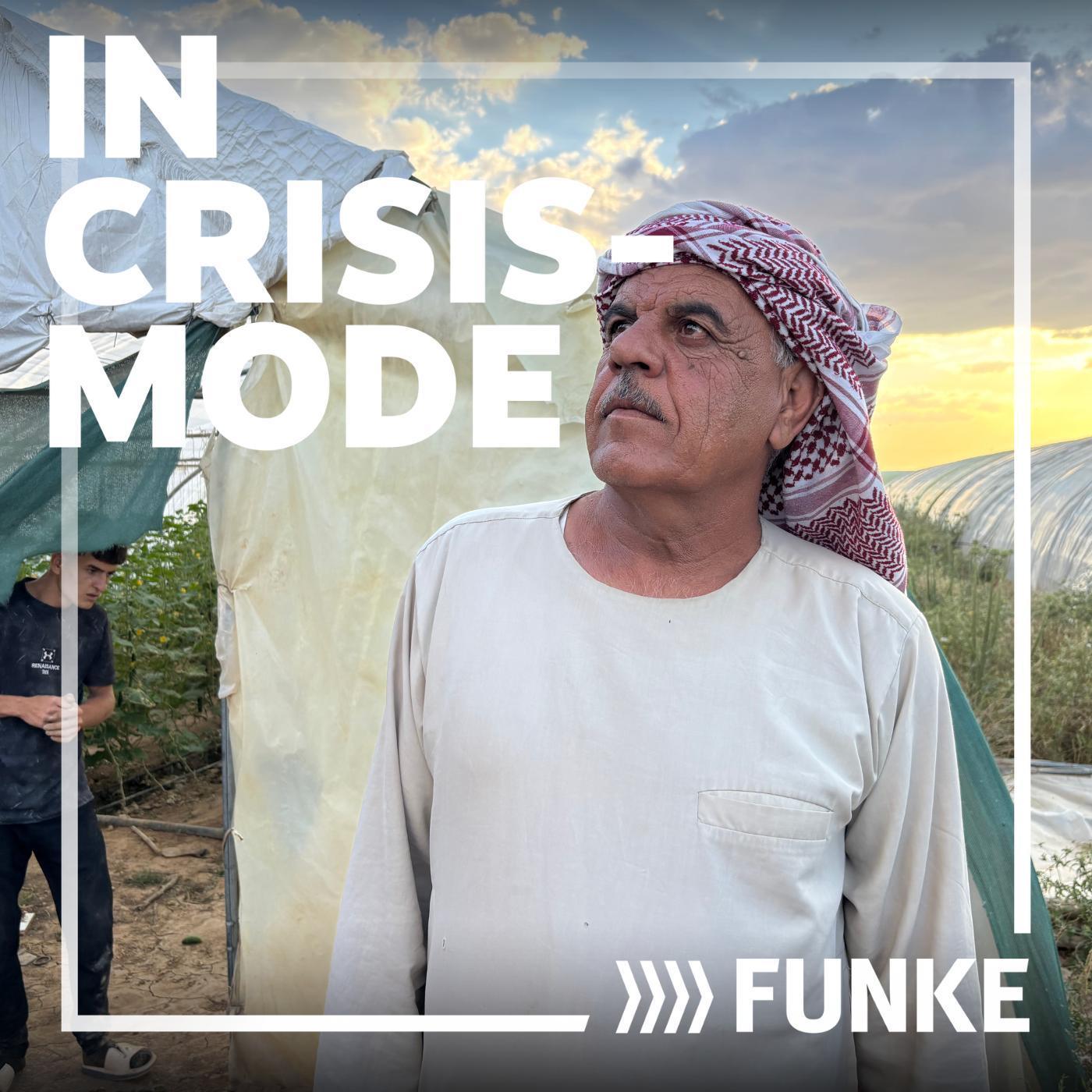
Im Krisenmodus· Folge 154
Years After ISIS, Many Yazidis Still Face Obstacles to Returning to Shingal
Mittwoch, 10. Juni 2026 · 25 min
Kapitelklicken springt direkt hin
Shownotes
This episode was made with the help of AI.
For this episode of In Crisis Mode, Jan Jessen (nrz.de/niederrhein/article412159496/diyen-hat-…), Head of Politics at NRZ and war and crisis correspondent for the FUNKE Media Group, travels to northwestern Iraq.
He speaks with Yazidi returnees in the Shingal region who are involved in a greenhouse project in Sinune, as well as with Irfan Ortac, Chairman of the Central Council of Yazidis in Germany. The episode explores why, despite the military defeat of ISIS, many Yazidis have still not returned to their homeland, even in the presence of aid projects, reconstruction efforts, and isolated signs of hope.
Guests:
• Irfan Ortac, Chairman of the Central Council of Yazidis in Germany
• Participants in the greenhouse project: Badal Khalaf Kasem, Sabah Qaro, and a Yazidi farmer from Sinune
Chapter Overview
1 | Shingal After ISIS: Why Many Yazidis Have Not Returned
Jan Jessen opens the episode with the central question: Why have so many Yazidis still not returned to Shingal in northwestern Iraq, despite the end of the ISIS attack?
2 | Shingal, Iraq: Checkpoints, Control, and Insecurity
Jan describes his journey through the region, marked by numerous checkpoints and restricted movement in an area still shaped by insecurity.
3 | Everyday Life in Sinune and Gunde Ahsan
Small shops, new houses, and a school full of children reflect a fragile sense of normality—alongside fear, mistrust, and the lasting trauma of the 2014 Yazidi genocide.
4 | Returning to Shingal: Education, Work, and Greenhouse Projects
Jan highlights how local initiatives in Sinune and Gunde Ahsan are enabling limited returns through education, agriculture, and employment opportunities.
5 | A Yazidi Farmer from Sinune: Destroyed Homes and Missing Support
A returnee explains why he cannot go back to his home village, describing destroyed property, lack of assistance, and ongoing hardship for his family.
6 | Irfan Ortac on Shingal: Militias, Absence of State Authority, Lack of Security
The Chairman of the Central Council of Yazidis in Germany outlines why many Yazidis are still unable to return safely, citing the presence of armed groups and weak state structures.
7 | What Yazidis in Shingal Need Today: Security, Reconstruction, and Perspective
Jan concludes that return requires more than hope: it depends on security, functioning governance, reconstruction, and sustainable future prospects.
📬 Contact & Feedback
Questions, criticism, or suggestions? Get in touch:
✉️ krisenmodus@funkemedien.de
🟢 Subscribe Now
Im Krisenmodus – available on all major podcast platforms:
Spotify (open.spotify.com/show/0IQW1w25NYSrz60aAPzwvB?s…) | Apple Podcasts (podcasts.apple.com/de/podcast/im-krisenmodus/i…) | Deezer (deezer.com/de/show/3737197) | YouTube (youtube.com/@Krisenmodus-Podcast_FUNKE)
📅 New Episodes
Every two weeks, Wednesdays.
In Crisis Mode is a podcast by FUNKE Media Group.
Transkriptvom Podcast bereitgestellt · Zeitmarken springen hin
Die Übersetzung von Jans Stimme vom Deutschen ins Englische wurde mit einer KI erstellt. The Iraqi government, they are doing nothing for us, especially the Yazidi community. You see that people are going abroad, for example to Europe, from all other countries. They give them their rights there. They give them the stay in Europe, for example.
We are as Yazidis in our country and we don't have our rights. Das ist was ein Mann in Sinjar. Es ist eine Region in Nordwestern Irak. Und dieser Mann hat dort zurückgebracht. Er ist in seinem Haus wiedergekommen. Und jetzt sagt er, wir haben keine Rechte hier. Wie kann das sein? Die Sinjar Region ist die Hohemland der Yazidis, eine religiöse Minorität in Irak die jetzt auch eine große Diaspora-Gemunitie in Deutschland.
Und in 2014, 12 Jahre jetzt, die sogenannte Islamic State swept durch die Region und überran es. Hundreds of thousands of Yazidis were driven from their homes. Thousands were killed, literally massacred, and thousands of women and girls were abducted. The German Bundestag has recognized the crimes committed against the Yazidis as genocide.
There is aid, there are projects in the region, and there are places where reconstruction is underway. And yet, many of those who suffered back then have still not truly returned. Why is that? In Crisis Mode, the podcast from Conflict Zones with Jan Jessen. Hallo, ich bin Jan Jessen, Waren Crisis Reporter für die Funker Media Group.
In diesem Episode von In Crisis Mode, ich bin zu den Sinjar-Region. Ich war da ein paar Tage, gesprochen mit returnees, mit Menschen versuchen, ihre Leben zu verbessern, und mit Irfan Ortak, der Präsidenten des Central Council der Yazidis in Deutschland. Ja, Sinjar ist eine sehr, sehr spezielle Region, es muss man sagen, in Nordwestern Irak.
Und zu even getren, du hast einen Irak-Visa, which is always somewhat complicated to obtain. In my case, I first had to travel via Egypt, then to Baghdad, and from there on to Erbil, the capital of the autonomous region of Kurdistan, before finally continuing to Sinjar. And yes, Sinjar is essentially a military-restricted area.
You also need special permits to move around there. The region is marked by countless checkpoints. At some point I said or wrote, in Sinjar there is a kind of war of flags. There are checkpoints every few hundred meters, military posts everywhere. The men stationed there, the soldiers, wear very different insignia on their uniforms.
That's because many different militias operate there, groups with different loyalties. When I was there, as always happens at some checkpoint, I stood out, and then intelligence services got involved. An intelligence officer, dressed in civilian clothes, questioned me closely, und ich habe mir einen deutschen Passport für einen langen Zeit gesehen, zu sehen, ob die Visa von Bagdad war real.
Er hat gefragt, was wir in Sinjar machen waren, und hat es sehr klar, dass die Bewegung dort ist jetzt sehr reguliert und sehr restriktiv. When I first visited Sinjar in 2015, shortly after the so-called Islamic State had been pushed out, you could still basically drive into all the towns and look around freely.
This time, he told me, you can go as far as Sinun or Borek, but definitely no further. And that's where it becomes clear, even though ISIS has long been gone and its so-called caliphate destroyed, nothing here in Sinjar is truly normal yet. Für die Yazidis, Sinjar ist viel mehr als nur eine Region, es ist ihre Hohenland.
Until 2014, es war die Hauptsettlemente der diese religiöse Minorenheit. Some Yazidis auch in Turkey oder Syria, aber viele leben in Irak, specifically in Sinjar. Und wie ich bereits gesagt habe, in 2014, ISIS war durch die Region. Für die Islamist-Extremisten von ISIS, Yazidis waren die Terror-Worshippers, Und sie wurden brutale persecutiert. Thousands wurden getötet.
Frauen und Kinder wurden abdukt. Zu diesem Tag, es gibt keine Träte von 3,000 Frauen. Noen weiß was zu ihnen. Sie wurden sold und abgedeckt als sex-slaves. Entferte villages wurden erased. Viele Familien noch nicht liveen, wo sie damals kamen. A large number of sie bleiben in die Flüchtlinge in der Autonomie Region von Kurdistan.
Es gibt reasons, warum die Menschen nicht zurückkommen. Die Presence von vielen verschiedenen Militias, die Lack von Sicherheit, aber auch die Absence von Jobs und die Fakt, dass Infrastruktur ist immer noch nicht verletzt. Wenn ich da diese Zeit war, das war mein 10 oder 15er Besuch zu Sinjar, ich auch sah, dass in ein paar Bereichen Menschen zu kommen, zum Beispiel zu Sinjun, eine kleine Stadt in Sinjar.
Life has started again there. You see men sitting in teahouses, small shops and food stalls lining the streets, sheep being transported on pickup trucks, trucks delivering stones and building materials. At first glance it looks somewhat ordinary again, but the memory of 2014 is everywhere, and so is the insecurity.
Not far from Sinun lies Gunde-Asan, a young settlement close to the mountain that gives the region its name, the Sinjar Mountain. Es ist eine langer mountaineinend, die durch die Mitte der Region, die in den Norden und Süd. Das mountainein wurde ein Platz von Isis kam. Die Leute hier weggekommen. Sie erinnern die dramatische Bilder von August 2014, die Menschen in den Mänten ohne supplies escaped. Die Leute da weggekommen, die Angst, die Hunger haben, bevor sie von der Luft geflogen.
Und das ist das Landein war eine Lifeline. Das ist warum ein Settlement wie Gunde-Asaan Es gibt heute viele Familien zu starten über den Mountain, weil sie Angst, was in 2014 passiert, und weil sie sich da weit entfernt, wenn es notwendig ist. Ich habe auch ein kleines Scholes dort gesucht, ein Projekt von der Karitas Refugee Aid Organisation in Essen. Ich bin transparente, ich persönlich involvete als Volontär mit Karitas Refugee Aid.
Wir haben diese Scholes vier Jahre vor, in Gunde-Asaan. In der Kourtyarde, Kinder stehen in schwarze und schwarze Schäuze. Es sah etwas wie ein Uniform von der Karte, aber es war nicht die Einführung. Alles in Sinjar ist improvised. Forty-five families live in this village. These families divide the work among themselves.
Each family takes turns managing the greenhouses. When four or five families are on duty and stay here, the others take care of their own affairs. That's how it works. Das ist genau der Punkt. Das Projekt ist nicht nur ein bisschen Geld, sondern es bringt eine Struktur in ein dailyes Leben, das, für viele Familien, hat lange nur nur von Uncertainty gegeben.
Der Mann, die du hörst, in den Beginn, kommt von Tal Azzer. Nach dem ISIS-Fahrer, wie viele andere, er fuhr zu den neigern Kurdistan. Es war wirklich dramatisch, dann. Als ich sagte, August 2014. Ich war da ein paar Tage später und sah es ersthand. Es war einfach schockiert. Hundreds of thousands of Menschen waren in den streets of Erbil, Duhok und andere Stadt in den Autonomous Kurdistan Region, in Mosques, in Schools.
Und was ich fand, was wie die localen Bevölkerung, die Kurds und Kurdish residents, provided für diese Menschen, because the state or the Kurdish regional government simply couldn't keep up. People even carried mattresses out of their homes so that others wouldn't have to sleep on the streets. On the one hand it was extremely dramatic, but on the other hand it was also impressive to see how a society organized itself and helped people in such a situation.
This man, the farmer you heard earlier, returned to Sinjar in 2016. That is unusual. Most people at the time stayed in the autonomous Kurdistan region because Sinjar was extremely, extremely unsafe, much more unsafe than it is today. But he did not return to his original village. In Tal Azzer, our houses were destroyed and they gave us nothing.
So how am I supposed to go back? Die Iraki government was supposed to give families 1,000,000 Iraqi dinars. Later, returning families were even supposed to receive 4,000,000 dinars. But I didn't receive anything. Yes, what he is referring to here, the 1,000,000 Iraqi dinars, is not a large amount. I would estimate that's roughly 800 to 900 euros. Families were once promised that they would receive this money.
It was paid out briefly a few months ago, but that support has since been discontinued again. So this is another key issue. If you arrive back with nothing and there are no jobs in Sinjar, then it is obviously very difficult to rebuild a life. At the same time, you also hear something different in the greenhouse project, namely that local employment can make a real difference for returnees. Ich bin heute Morgen.
Ich bin 2014 und ich bin 2016. My name is Sabah Karo. I come from Boric. Wir sind in 2014 und zurückgekehrt in 2016. Ich bin ein Farmer von profession. Das Jahr, ich bin die Möglichkeit, um in diesem Projekt zu arbeiten. Es ist besser hier als da. Wir sind viel besser hier. Wir freuen uns hier zusammen.
In addition, das Place ist close to the market. Ich bin ein Foto, wenn ich mich nicht so gerne bin. Ich bin ein Foto, wenn ich nicht so gerne bin. Das ist natürlich Teil der Wahrheit von Sinjar. Projekte wie die Greenhouse Initiative oder die Schule sind, am besten, die in den Osten. Sie können ein paar Familien unterstützen, aber das ist es. Es gibt auch andere Initiativen, zum Beispiel von der Barzani Charity Foundation, die wir mit dem Partner, ein Partner, die wir mit dort arbeiten.
Sie bauen Wohnungen für Familien zurück. Es ist fast unglaublich. Wohnungen in Sinjar kosten rund 14,000 Euro für eine Familie von 7. so relatively little. They do this work, but of course it only helps a limited number of people. And above all, such projects do not solve the major political problems.
But they do make return possible for some individuals. They cannot make up for everything that has been lost. First and foremost, people's own homes are gone. And they also cannot resolve the ongoing uncertainty. What happens next in Sinjar? How will the political conflicts there be settled? As I mentioned earlier, There are multiple militias competing for influence and control, as well as the Iraqi Federal Army and Federal Police operating there.
There are Shia militias, the Hasht al-Shaabi, which are more or less controlled by Iran. Within their ranks are now also Yazidis, who earn an income through them. There are militias linked to the PKK, the Kurdistan Workers' Party. There are also militias aligned with the Kurdish regional government in Erbil.
In other words, it is an extremely complex situation, und Insekretär ist etwas, was man immer hören kann, der Angst, dass ISIS ein Tag zurück könnte. Ein anderer Pfarrer meinte sehr klar, wo ich schlaue, wie ich ein Leben mache, wie meine Kinder gehen, ist es安全, kann ich bleiben, This farmer has a large family of 14 people and told me how difficult the years after returning have been.
It was difficult. My children worked in shops. Each of them earned 10,000 Iraqi dinars per day. 10,000 Iraqi dinars is practically nothing. 1,000 Iraqi dinars is roughly 80 euro cents. So we are talking about about 8 euros per day. That is, of course, not a meaningful income. Für eine Familie von 14, das ist nicht finanziell security. Es ist survival, nichts mehr.
Das ist warum ich die Projekte wie die Greenhouse Initiative so wichtig finde. Nicht weil sie all die Probleme lösen, sie natürlich nicht. Aber weil sie Menschen ein Grund zu bleiben. Ein kleiner Income, ein Task, ein bestimmtes Level von Stabilität. Und yet, obwohl sie jetzt haben diese Greenhouses, und obwohl sie nicht nur eine Dächtung, sondern auch ein Income, Sie kommen noch mit Probleme.
Die Prices für Cucumber und Tomatoes sind sehr volatil. Sie gehen auf und auf, auf wie viel ist imported aus der Nähe von Turkey oder Syrien. Außerdem gibt es auch, dass es die Zürfnisse anbieten, dass es gut ist. Aber es ist nur gut, aber es nur einfach lässt sie leben. Und das ist wichtig. In der Sinjar region oft macht es die difference zwischen dem und dem Staying.
Die Situation ist eine Sache. The other, perhaps even more important question is Do people here feel safe? I'm not sure. If there were international security, it would be different. But around us there are only Muslims and Arabs. It is difficult for us. That is a sentence that naturally makes you pause.
When someone says, Muslims and Arabs surround us, and that is difficult for us. In fact, it is true that the Sinjar region is not exclusively inhabited by Yazidis. Yazidis are the majority, but there are also many Muslim Arabs living in towns like Tal Afar, or in Sinjar City itself, the largest town in the region.
Und viele von diesen Menschen, und das ist ein Teil der Uncomfortable-Truth, waren die Verletzungen in 2014, die sofort in ISIS-Abergen waren, als die Gruppe swept durch die Erie. Als ein Ergebnis, da ist noch ein tiefes Verständnis heute. Das Verständnis kann nicht einfach vergessen. Wie könnte es sein, wenn die Leute gesehen haben, die Kinder zu töten, verloren haben, oder sah die Eltern abducken?
So das ist, of course, sehr schwierig. Und insofern, die Veränderung zwischen den Yazidis zu den Muslimen Arabischen bleibt sehr, sehr tief in diesem Zeitpunkt. Die Yazidis also experienced in 2014, wie alle sensen von Sicherheit plötzlich disappeared. Sie sahen Kurdische Security Forces, die sie verletzten, die sie verletzten, verletzten, nachdem ISIS kam.
Das führte sich in Sicherheit. Das Gefühl hat nicht einfach, was die Farmer, oder die Farmer in generell, erleben als die Realität, Irfan Ortak describes as political failure. Ortak is the chairman of the Central Council of the Yazidis in Germany. The council was founded in 2017 to represent the interests of the Yazidi community in Germany.
For Ortak, it is clear, the military defeat of ISIS does not mean the problem is solved, Die Lage in Shingar sieht zwar im Gegensatz vor einigen Jahren etwas entspannter aus, aber die politischen Perspektiven... Although the situation in Sinjar appears somewhat more relaxed compared to a few years ago, the political outlook is still concerning.
Namely, that more than 250,000 people are still living as internally displaced persons in Kurdistan, dass viele noch nicht zurückkehren und die Yezidi-Villages in Sinjar sind noch nicht mehr verletzend. Überall, die Irregular militias in Sinjar, insbesondere die mit den PKK und die mit dem Hasid al-Shaabi, die noch immer noch in den Städten arbeiten, die Menschen nicht mehr verletzten oder nicht mehr verletzten.
All diese Facts machen uns in der Central Council von Yazidis. Immer noch quasi Staat im Staat sind und die Menschen sich nicht frei bewegen können und sich frei entfalten können, all diese Tatsachen stimmen uns als Zentralrat der Jesiden in Deutschland sehr traurig ein. Yes, ORTAK clearly identifies the core problem.
The war may be over, but the order that should follow it has still not been established. For people who have never been there, this sounds relatively abstract, Aber auf der Grund die Frage ist sehr einfach. Wer ist eigentlich in charge hier? Wer kontrolliert die Straßen? Wer protects die Menschen? Und als es keine klarste Antwort auf diese Frage ist, zurück remains, für viele, einfach ein RISK.
Ich habe auch gesehen das in Pläne, wo es Leben visibly zurückgekehrt ist. In Sinunay, für example. Und in Gunde Asan, this small village where children receive their report cards und dreamt of future professions. These Pläne show that life is continuing, but also that it is continuing with reservations, because reconstruction is stalling.
Many people have started building again, especially those still living in refugee camps in the autonomous Kurdistan region, or those renting houses and apartments there, working as day labourers, saving money, and gradually rebuilding their homes in Sinjar, because their hearts are still there and they want to return.
But everything takes a very long time. This was also visible in Gunde-Asan. Some houses are already finished, but many are still just shells. And in the south of Sinjar, many villages are still destroyed, still in ruins. Infrastructure remains in poor condition, mainly because Baghdad, the central government now responsible for Sinjar, is doing relatively little there.
As mentioned, some families dare to return. There have also been many cases of people returning to Sinjar, only to go back again to the autonomous Kurdistan region. Und viele von denen du sprichst, eigentlich dreamt nach Europa zu gehen. Although ISIS has been defeated and no longer formally exists there, it is incomprehensible to us why Yazidis still cannot return to their homeland, why the Iraqi state and the Iraqi government are not doing everything possible to enable these people to return to their homeland, to have a long-term prospect of staying there and to rebuild their houses.
Dass die Häuser wieder aufgebaut werden. Ja, dieser Kritik von Autak ist direkt auf Bagdad und es ist nicht neu. Der Irak-Geräusch hat die Hilfe und die Reconstruktion gegründet. Aber aus der Perspektive der vielen Yazidis, das passiert sehr schnell. Too wenig arrives, oder nichts überhaupt. Und ich meine, Deutschland ist auch ein sehr wichtiges Fund für Reconstruktion.
In 2016 oder 2017, wir haben mit dem dann-German-Geräusch-Generer in Erdbeeren, Erbil. Sie sagte mir, an der Zeit, dass über 67 Millionen Euro bereits in Sinjar auf der Germanen Seite investiert. Und ich fragte, »Ich habe zu Sinjar several times und habe nicht gesehen, dass es nichts von Sinjar gibt.
Unless underground work hat sich getan, wie ein Subway-System, ein Kanal-System, oder so, ich wirklich nicht weiß, wo das Geld eigentlich ging. Es kam dann, dass Deutschland das Geld zu Bagdad hat. Und, wahrscheinlich, sehr wenig von Sinjar hat sich erreicht Sinjar.«. The farmer I met in the greenhouse says exactly the same thing.
His house is destroyed, money was promised, but nothing ever arrived. And at the same time, there is another side. There are people who are rebuilding. There is the school principal who told me he would like to open a preschool. There are children who dream of becoming doctors or engineers. There are families building houses, even if the money is often only enough for the shell or the very first steps.
And there is the greenhouse project where 45 families are working, All of this shows, people are not just waiting, they are trying to help themselves. But this self-help has its limits. It cannot replace major politics. That is, I think, the core problem. Security is not guaranteed. It cannot compensate for missing state structures.
What is needed is more than humanitarian aid. It requires political commitment. For this reason, Irfan Otak's focus is not only on Iraq. In this context, I would really like to remind the international community that it made a promise to the Yazidis, not only to defeat ISIS, but also to ensure that they can return to their homeland again.
This is an important point. Taking military action against ISIS was one thing. Enabling people to return safely afterwards is something entirely different. If you travel through Sinjar today, you can see that there is help. There are individual projects. There are schools, greenhouses, small initiatives.
Clinics have been built, hospitals as well. But many Yazidis are missing something else. A comprehensive plan that ties everything together. Security, reconstruction, employment, administration. And the certainty that return is not just a brief moment, but a real long-term prospect. This is exactly where the tension in the region lies. From the outside, you can look at certain developments and say, things are improving, life has returned to Sinyoun, children go to school, families work in agriculture, all of that is true.
But the people I speak to say something different. Yes, we are here, but we have not truly arrived yet. ORTAC becomes particularly clear when it comes to Germany. Als deutsche Yezidi muss ich wirklich meinen Tone in diesem Zusammenhang geben. Als ein German Yezidi, ich muss wirklich meine Tone in diesem Kontext geben.
Ich bin sehr froh in meinem eigenen Regierung, in meinem eigenen Staat, Deutschland. Apart von ein paar Showcase-Projekte, wir sehen nichts für Yezidis. Yes, this is the bizarre situation. Germany has formally recognized the genocide against the Yazidis as such. The German Bundestag passed a corresponding resolution and also stated that Germany bears a special responsibility to protect the Yazidis.
With this genocide resolution, many naturally hoped that more would follow than just a symbolic act. Ortak says very clearly that this has not happened. He misses a broader and more sustainable approach, A plan that truly helps people leave the camps, return to their homeland, and be able to stay there.
Whether one agrees with every point of this criticism or not, if you spend time in Sinjar, you understand where it comes from. I think of the farmer in the greenhouse, of his family of 14, of the children working for a few thousand dinars a day, of his statement that he has no rights in his own country, and I think of the school in Gunde-Asan, of the children with their report cards, their ambition, und der Headmaster, der weitergeht, obwohl alles was missing.
Und ich denke auch, wie absolut necessär es ist, dass Yazidis eine Zukunft haben in Sinjar. Wenn sie keine Prospekt haben, wenn sie nicht verletzt, wenn sie die Region verletzt, dann diese ancient Religion wird immer in ihrer Hohenland verletzt. At der very least, die Gemeinde wird fragmented, scattered across viele verschiedene, Länder. Es gibt jetzt Yazidis in viele Länder über Europa.
Deutschland hat die größte Diaspora, Aber es gibt auch Gemeinschaften in Australien, Kanada und den USA. Sie sind allgemein in der Welt verbreitet, das ist natürlich ein großer Herausforderung für diese religiöse Gemeinschaft. Und zurück zu Sinjar bedeutet auch, dass man dort leben kann, mit einem Roof über deinem Kopf, mit einem Income, mit Schulen für Kinder, mit der Freiheit der Bewegung, und mit der Hoffnung, dass alles nicht wiederum fliegt. Aber es ist genau diese Hoffnung, die ist missing.
Und das wurde sehr klar in den Gesprächen, die ich auf dem Boden hatte. Irfan Ortaq also describes the political side of the same problem. Too little protection, too little reconstruction, too little reliable state presence, too little consistency from the Iraqi and international side. Still, it would be wrong to end this story on a purely bleak note.
Because, as mentioned, there are also people who do not give up. Teachers who teach, families who build, children who learn, farmers who stay. And my impression after this trip was, Sinjar does not need more big words. Sinjar needs action, it needs support, and above all, it needs security, reliable and under clear state control, reconstruction and compensation that actually reach people, and jobs and economic prospects that go beyond isolated projects.
As long as this is missing, rebuilding Sinjar will remain extremely difficult. ISIS has been defeated militarily, but for the survivors, this story will only truly be over when they can live in safety again. Die Podcast wurde von Alexander Baumeister. Er ist auch ein Journalist und arbeitet für eine Radio-Station in der Funkamedien Gruppe.
Wenn du dieses Podcast gefallen hast, dann bitte like und follow uns. Es hilft, es hilft, unsere Arbeit mehr zu sehen. Und fühle dich zu schreiben, wenn du mir hast, für die nächsten Videos. Chris & Modus at funkamedien.de Take care of yourselves. Bye-bye. In. Christ's name.
