

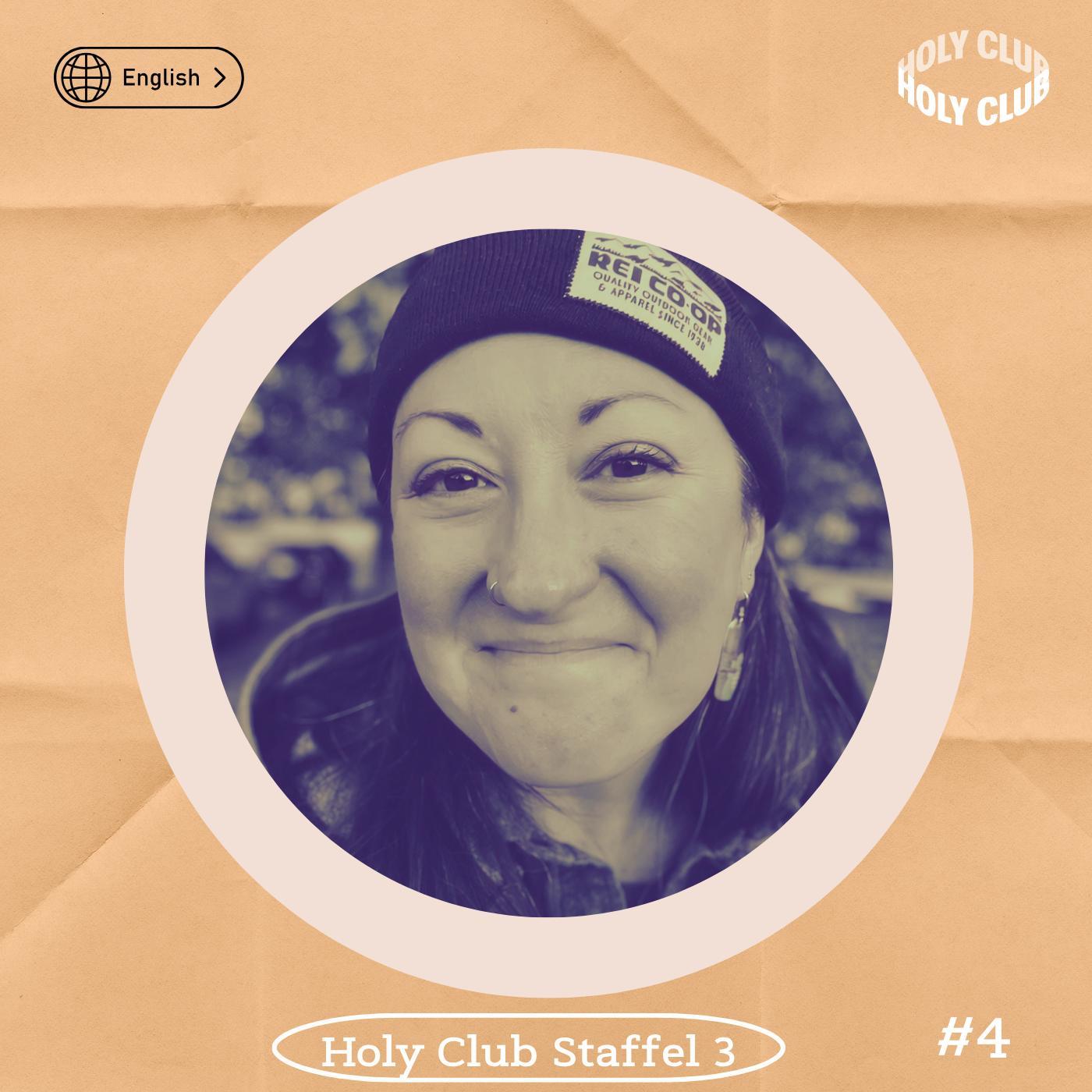
Hannah Terry - Church between Grace, Change and New Beginnings
Montag, 5. Oktober 2026 · 47 min
Kapitelklicken springt direkt hin
Shownotes
Damian heads to Houston, Texas – and brings along a guest who chose the United Methodist Church over the Free Methodists for a very theological reason. (Spoiler: it involved beer.) Hannah Terry is an ordained deacon, soon-to-be elder, and pastor of Grace UMC in Houston's Heights neighborhood.
In this episode:
From fundamentalism to grace: Hannah grew up a pastor's kid – first pew, mom directing the choir, dad preaching. It was at a Free Methodist college where she first felt grace work on her in a way she'd never experienced. The rest is Methodism.
Duke Divinity and a professor's ultimatum: Hannah didn't plan on seminary – until a professor threatened disappointment if she didn't apply to Princeton or Duke. She arrived terrified. She left transformed.
Personal and social holiness: The both/and that drew Hannah to Methodism. Why is social justice such a hard sell for so many churches? Hannah's honest answer: fear. And a very long history of it.
FAM Houston: For 13 years Hannah built a nonprofit bridging refugees, immigrants and local Houstonians through a community farm. She called it her baby. Letting go was real grief – and she talks about it with honesty and grace.
On transition: Don't turn away from grief. Look it in the eyes. Keep your rituals. Hannah's includes a siphon coffee every morning – which she acknowledges sounds a little snooty.
Coming to Germany in 2027: Damian and a cohort of 15 Texas pastors are doing a learning pilgrimage from Berlin to Munich. Methodists along the way – reach out!
The Holy Club drops every Monday on Spotify, Apple Podcasts and wherever you listen.
Instagram: @holyclubpodcast · Hosts: Moritz Mosebach, Sarah Staub, Damian Carruthers
Transkriptvom Podcast bereitgestellt · Zeitmarken springen hin
Welcome, welcome, welcome to another episode on Our Holy Club and with a New Methodist on Monday. I'm Damien, our host today, and with me is Hannah Terry. Hannah, how are you and where are you at right now? I'm doing well, Damien. I'm in Houston, Texas. Oh, wow. Okay, so now we have a real American in the house.
Because for most German-speaking people, when I think about America, I think about Texas. Like Americans think about Bavarians, right? Oktoberfest, we think of Texas. So do you have a cowboy hat and cowboy boots? You know, when I moved to Texas, because I'm not from here, but we can get to that. When I moved here, the first morning after I parked my U-Haul here, I went to go buy cowboy boots. And then I realized that that was silly.
That's hilarious. Okay, we'll talk about that a bit more. What are the differences in Texas and where you're originally from? But of course, you want to have our most important question for, or most beloved question for some of our listeners is, what is your favorite Methodist hymn? There are so many bangers, but my absolute favorite is Christ the Lord is Risen Today.
Oh, it's a Wesley song, yeah. Yeah. The pomp, the circumstance of resurrection, Easter Sunday, like how this hymn begs for you to belt it out. And the lyrics are just epic, joyful. It's just so good. That's right. In a German Methodist hymnal, it is 224, Christ der Herr ist auferstanden. It's the same melody, but of course German text. But yeah, it's a favorite one.
I love it. There's no Easter without that song, I feel like. That's right. That's right. Yeah. And even it's pretty familiar with other denominations too, right? It's a very well-known hymn. Cool. Did you grow up singing hymns? Was it a thing? Absolutely. Absolutely. I'm a pastor's kid, not Methodist, so I had a journey to the Methodist Church.
But yeah, I was on the first pew. My mom was the choir director, my dad was the pastor. And so the whole hymnal, it's not the United Methodist hymnal, but the whole hymnal that I grew up with, it still was read. It was, yeah, knew it all and could play it too. I started playing the piano pretty young.
Well, nice. That's always helpful if you work in ministry. Das ist richtig. Und so, bevor wir start a little bit about your journey, what is your current job? Are you a layperson? Are you a clergy? For our listeners, I think that's important to know. Yeah. I serve as a pastor. I'm ordained at the United Methodist Church. I am a deacon.
I was ordained in 2016. So, I serve as the pastor at Grace United Methodist Church in der Heitz-Neighborhood von Houston. How can you serve as a pastor when you're actually a deacon? Isn't that like, don't deacons have different jobs actually in ministry? Yeah, often do. I would say that deployment of clergy is something that is, there's different ways of doing that based on geography, I would say, and culture.
In my conference in Texas, there are not many of us deacons who are serving as pastors of a church. But I had been in a role for 13 years and began to hear a calling and took a while. It's kind of like Samuel, like, okay, you're saying my name. Yes, you're calling me. It took a while to get clear that that call was to serve a congregation as their pastor.
So, yeah, the bishop said, you know, kind of special dispensation and, you know, let's have you there. But I'm also now back in the discernment process, with the Board of Ordained Ministry. And I anticipate if this continues to be the path and folks around me in community, agree that they see those gifts for elder, that I'll be ordained for the second time.
Same church, same denomination, but be ordained again this coming May. So this is already sort of a deal. You will be ordained. Or is there still something, homework to do? Some papers? You know, the homework to do is just to do my job. To keep showing up and to be reflecting on like, all right, is this taken?
Is the Holy Spirit continuing to confirm with me that like, yeah, this is the place for me to be. This is where God wants me to be. I assume you did the course of study regarding policies in the Book of Discipline or? I really need to brush up. As a deacon, my passion is that connecting church and world.
What does it mean for the church to be sent, for us to be following Jesus out in the world and being fully alive? Um, and, um, so all that being said, um, I, I've known what's in the book of Discipline, but I'm not one of those people who sat down and in seminary was, you know, reading it cover to cover.
But now is, now I think is probably the time, like, I need to do some things. I'm like, oh, I need to, I need to Google. Where is that in the book of Discipline? I think also I use the book as visible like I use my theology books I learned in seminary where I can find answers to questions I have and so I use it when I have questions around the discipline, and then sometimes I feel like also, don't ask just do and then see if it gets problematic I hear you I hear you, I had to do this as a refresher because I came over here in this American system I had to do this course of study for policies and the book of discipline and it was like.
One of the most boring classes just reading that book of discipline writing an understanding paper of it and I'm like oh gosh, Pretty dry. Oh, yeah. Okay, let's go to the fun part. So now you're a deacon working as a pastor, soon to be ordained as an elder. But how did you become a Methodist? What is your journey to Methodism? Yeah.
So as I mentioned, PK, Pastor's Kid, I grew up really in fundamentalist Christian world. Oh, funny. Und so, ja, so continue to Zelle, my therapist, regularly. Und wenn ich wähle, wo ich zu gehen, ich glaube, es war ein paar Schulen, aber da war ein Spektrum. Da war Bible Schulen auf einem Ende des Spektrum.
Da waren all Christian Schulen. Und dann der sehr Ende des Spektrum war ein Free Methodist College, Roberts Westing University. Now, and I ended up choosing Roberts. And when I got there, so that was my introduction to Wesleyan theology and Methodism. So when you said you grew up fundamentalist, it was a non-denominational church?
Yeah, it was a mix. My dad served at a couple churches, non-denom for one of them and then Baptist. But really it was essentially Southern Baptist in the United States in the North, in terms of what the theology was. Was this the state you grew up in then? I grew up in New York. Oh, okay. Upstate New York, so the Finger Lakes. It's a really beautiful place, a couple hours from Canada.
Okay, good. Okay, so I'm back to this studying. Yeah, yeah. So I got to college and when I remember being there and beginning to feel grace work on me, I was a kid that I could recite passages of scripture. Like I knew word for word, you know, um. But when I was there, it was people living out grace. I was like, oh, I think these people really know what grace is about. And I think that I'm beginning to feel what grace is in a way that I've never felt and been impacted by before.
So I got curious, super curious about them, about the people in my life. So they were new friends, but then also upperclassmen that really took me under their wing, mentors, and then professors. Um and yeah I became Methodist because of how I felt being around Methodist oh so that sounds like an alderskate experience with Methodist sort of, yeah did you did you feel your heart strangely warmed or you know I'd say many times yeah awesome yeah for sure cool but yeah I think that um well to quote the sage Maya Angelou like, I'm not gonna remember what Ich weiß nicht, was sie gesagt hat, aber ich will immer wie ich mich fühle.
Das war ein Free Methodist-School, und ich habe mich über den Ende der Zeit, und eine von meinen Professoren, die auch mein Pastor war, er hat mich gesagt, Anna, du hast dich einfach zu pick, um, choose where you're going to become a member. Ich habe nicht become a member of a congregation yet. I was very involved in a number of congregations.
And so for me, my grace gauge was which denomination is more comfortable with beer? Not that I'm particularly into beer, but I was like, okay, the Free Methodist would be United Methodist. Which ones are more down with alcohol? And it turned out that the moderation and all that was more so United Methodist and that's my church. Yeah.
So, yeah. That's a way to go. Yeah. Yeah. It's funny. Is that why you're planning a trip to Germany? Experience some German people. Hey, you know, alignment in life is important. Yeah, apparently. So, how did you then, did you just show up one day, Sunday, at the United Methodist Church? Or were you already involved in the United Methodist?
You know, I got to know the United Methodist Church when I was in seminary. So I joined the United Methodist Church actually before I joined a congregation that one of my professors was the pastor of in Rochester, New York. But I didn't have a car. And so I attended the Free Methodist College that was, you know, just connected to the university.
Wait a minute. Rochester, New York. Yeah. Did you, when were you there? What year? It was 2005 to 2009. Because I can swear it is Rochester United Methodist Church. I was at that church. Let me see, I'm just. Was it called, um... No, it's not called St. Jones United Methodist Church, right? No. But I was at one in Rochester with a group from a German Methodist Choir in 2013.
Yeah, and they took us into New York City then for a trip. Oh, wow. Yeah, so I think it might be, because we visited a lot of churches there, maybe we went at that same church. Yeah. Okay, anyways. The connections. So you became a member there and then. Went to seminary? I did. And really the reason I went to seminary, I mean, there were professors who were speaking into my life, could see things, my gifts and graces that I was not, I couldn't see.
You know, I grew up in a tradition that women were not allowed to lead. So I was kind of, I was scratching my head. One of them wrote on one of my papers my professor gave back to me was, hey, we'll save you a seat in the communication department, was my speech professor, because I hadn't yet landed on my major.
He said, also, P.S., have you considered ordination? And I was like, orda what? Um so for me it took um these pastors and and these biblical scholars who saw something in me that it took a really long time for some healing to happen for me to um, hear how god was calling me so when i went so i i applied um to um a different seminary my my my options were okay I could be a New Testament scholar, professor, I could teach ethics, or I moved to New Zealand and I became a skydiving instructor.
Not that I've ever gone skydiving, but that was my third option. Where did that option come from? You know... Working something else out, apparently. But one of my professors, they were probably frustrated with me. And one of them took me to coffee and said, hey, if you don't apply to Princeton or Duke, we're going to be disappointed in you.
And that was really manipulative, but it was kind of like a grandpa moment or an uncle. And I was like, wait, what? I didn't see that possibility for me. So that's how I ended up at Duke Divinity School. Which was an excellent place for me in terms of the kind of deconstruction and reconstruction that happened for me there.
Just for our listeners, Duke Divinity School is in North Carolina. It's a very big Methodist seminary. And there is a German professor, Jörg Rieder, who has been on the podcast before, too. Oh, lovely. So, there's a connection in that way. And it is a pretty impressive seminary, yeah. I thought when I got there was like, because I hadn't even visited before I showed up to like, you know, for class.
And I was terrified. I was like, I'm not going to make it. Like when I got my first paperback, I was like, I'm going to flunk out. But the reason that I was there, I was not yet clear around path toward ordained ministry, call to be a pastor. But I was there because I deeply wanted to study more and learn.
Study God, like know God more deeply, and know myself more deeply, too, going on the education journey, and know then how then do I belong and serve in the world. So those were really the reasons I was there, and then really the voices of people, this community in my life that were part of my discernment process um, and it was like i got thrown into you know a totally different universe that for me but that was a good thing for me um so, nice so you enjoyed the time at duke and you became a basketball fan i assume yeah how can you not.
Cameron is incredible it's uh yeah for listeners um it is a it's a small it's the smallest college basketball stadium in the country and it is the most raucous and it's just incredible, and it's pretty well known the team a little bit like Gonzaga basketball here in Spokane is also pretty big, but there's a funny it just came to my mind story to connect again because when we did that choir tour in, 2013 we also went down to North Carolina and did a tour at Duke Divinity School, Then we stayed with a Methodist pastor there Who used to be a Pentecost guy or something And we did a concert there On an evening where there was, A Duke Divinity A Duke basketball game.
So, while that game was, the pastor in the back had his headphones in on one ear to listen to the game while we were there with the choir doing the concert. It was, I was like, this is insane. It is. It's a problem. Who was the pastor that you stayed with? Don't forget the name. It's like 13 years ago.
Well, that would have been when I was there. I was there, well, maybe not. I was there, no, I wasn't. It was 2009 to 2012. Oh, yeah. But probably the pastor was still, like, was in Durham at the time. Yeah, it could be, yeah. And one of my friends, Rafaela Swador, she's from Germany. She went for a semester to Duke Divinity School, too, from Germany.
But I must have been in, also after you left already, I think, yeah. Yeah, awesome. And so, that's the way to Methodism. And then, is there something, while you were studying at Duke and also Methodism, did there something stuck out, jumped at you that was something, oh, I love this so much about Methodism.
This is just great. I mean, could talk all day long about grace and, you know, our sacramental theology and just how we understand how grace works. Aber ich denke, es war die und-Ness der Methoden. Und ich denke, es wirklich definiertes following Jesus. Aber Gott, Gott liebt. John Wesley's idea of personal holiness, social holiness, dass das inextricabel sind.
Me growing mehr, reflecting die Liebe von Gott. Ich kann nicht mehr be disconnected from me loving the world, loving people, loving creation, und being a part of, that I'm working toward the thriving of all that. Ja, the both and. So, as someone who grew up in a fundamentalistic background. I feel like when we talk about this personal holiness and social holiness, for us as Methodists it seems so logical like, that's how it should be like why would you not see that right for God loved the world, because God loved the world Jesus came not because he hated the world Jesus came right but why is it sometimes so often other denominations or non-denominational churches have this kind of we have to,
you know put up the walls and let the world be out there and we just try to be our holy little group inside of this. Why is this so... Why is there no emphasis on this social holiness and also of social justice, which is a big part of our social principles and all of that? Do you have an idea? I wish I could say, other than fear, you know?
And I mean, I really think that also that goes really deep and personal. Like, there's a fear around almost like, who am I? In a fully receiving. God's love for me, there's real, fear around homophobia, right? Like, if I was any question within myself of who I am other than, you know, straight heterosexual person, I can't look at that because what if?
And there's just a lot of fear. So, I don't know. The only thing I can point to is fear and othering. Und, wie das ist dieses, wirklich, deep, deeply rooted sin für generations und generations und generations. Und es einfach takes a lot of work, to undo und soften, the soil to soften enough so that can be rooted out und repent.
And to have a change of perspective like worldview shift that's deeply personal I'm not sure, I was wondering when you mentioned about growing up in a system that doesn't allow women to lead or preach that's probably something even though you know at one point from your head that's okay, that's probably still hard to just get rid of those thoughts right because you internalize it probably when you grew up, sure and I think just a personal experience can show how difficult it is for a group or society to get rid of those prejudices or those original ideologies and stuff, we might say it's going on to perfection, but it's lifelong, that kind of being transformed it's lifelong.
Ja, ja. Ich war, an Sunday, ich war auf die Geschichte der so-called Prodigal Son. In Deutschland we call it the Lost Son because it's the Lost Coin, the Lost Sheep and then the Lost Son story. And the question then is actually who is the Lost Son? Is it the younger or the older brother? And what I thought was what I landed when I was thinking about this text and stuff is, again, back to Grace, there is this kind of older brother cannot, deal with the grace of the father he's just like not comprehending it even though he lived all the time with his father worked for him as he says as a slave, and then doesn't understand why the other brother which he calls your son not his brother he says to his father your son,
the father says well your brother, but he cannot comprehend the grace part in that that's how I felt and that's when the Pharisees come into play who ask about, you know, who are you welcoming? And then Jesus tells those stories. And this is sort of such a picture for me, for us as Christians oftentimes that we sort of live for decades in this grace and then we are so harsh and so ungracious, right?
It's so fascinating how that, you can believe it, as you said, you can quote all the scripture passages and still, sit there and don't get it. Yeah. I mean, really this really being free, like freed by God, because, I mean, again, to go back to what I learned at Duke, Kervatus, you know, being that image that Augustine gives us of like that we in our sin that we're curved over, like we're just like looking at our belly buttons and like unable to, you know, um look look out and look up um i think that you know that thing you know that the lost brother which one's lost i love a parable right every scripture's parable but um, yeah whether that is you know pride greed, selfishness like that is this um,
journey of that continuing to be revealed and it's hard, it's gross, it doesn't feel good to do that kind of reflection look in the mirror, and so it's if a community is not like if a community is really comfortable around yeah we're just not going to look at this, it's an echo chamber, right? It's a silo in terms of the denominational you know yeah.
Ja. Also, just because you mentioned the other issues like greed and stuff, I'm always thinking, like, why do we have AA meetings where we don't have a non-nose greed people or something? Which is a big problem in our society. Or Power Hungry, which is also a problem inside our denomination. Sometimes I feel like, not naming any names, but like just an idea that it might be out there.
Um yeah interesting, yeah let's let's look a little bit about the we talked a bit about the joyful things about and grace and, but there's something sometimes something frustrating I assume being in this, denomination and working in it and trying to survive in it um is there something, you have difficulties or you would criticize or you say like well um this is something, I wish there would be a change in our Methodist tradition or the way we do church or structure-wise.
Yeah, I mean, I think that here in the United States, our denomination mirrors our government as a country. And that is uber frustrating, right? like the bureaucracy the inefficiencies, and yeah it really really can drive me up a wall um. So, I'm very curious to learn about the Methodist Church in other places beyond the U.S.
And how they're structured, because, you know, nothing that drew me to the Methodist Church truly was the structure. You know, I grew up non-denom, saw the good, the bad, the ugly, and the horrible around not having an accountability system, a connectional system that resource, like we belong to each other.
But then also you've got resources around like, hey, when stuff goes sideways, what do you do? So I think that's the gift of our system is that we've got a lot of thoughtful care around that and accountability systems and kind of like with government, what's the word I'm looking for? The checks and balances, right?
And that's really important. And. The bureaucracy is really annoying. That's a good point. I think Germans feel the same way, I would say. But I also learned since I'm here, what you just mentioned, the positive side of structure is that here is a bigger experience of that sometimes. Like Amcor, right?
Our Methodist Committee of Relief, who helps in disaster situations. I've been working with them a lot lately about the fires in Spokane and then flooding on the west side and stuff like that. This is like the moment where you're like oh that's so awesome to have this agency that come in tell you what to do and help and.
Be present and it's yeah our brothers and sisters in our tradition I like that it's pretty, pretty cool or as you said like when it comes to money questions we have to do audits we have someone who looks over our budget again we cannot as pastors we are not dictators we just do that the way we want to and then maybe even embattel some money.
Well, you see this in the megachurches that happens apparently often a lot because there's no transparency. And I think Germans don't experience that that much sometimes because it's more outsourced to the conference, especially the budget stuff. But bureaucracy is not annoying. If you want some change or you need something differently or they tell you you have to do it that way, and you're like, why? It doesn't make sense.
And I get that totally, yeah. Das kann man sehr frustrieren. Aber einfach zu unterstellen, was du gesagt hast, um, den Connectional System. Daher ist, mit der Apportionment, es ist ziemlich awesome, wie wir zusammenfassen haben, als ein Denomination, dass wir nicht mehr tun können. So, ich liebe die Image, too, von Generosity. Ich meine, wir können besser, too, um, das, was das aussieht.
Aber da ist ein viel, da wir können, wenn wir in der Lage sind, mit Generosity zu können. Yeah. So next year, July of 2027, there's a group of pastors, about 15 of us, who we've been in a learning cohort together. So it's a five-year learning cohort. It's called Advancing Pastoral Leadership. So it's pastors that were all in, here's some jargon, the South Central jurisdiction of the United Methodist Church in the U.S.
So, we are in Texas, Louisiana, Missouri. So, we gather together. Yeah, most of us are in Texas, but not all of us. And so, we've been gathering for retreats and learning. So, a week at a time. Every time we gather, it's a full week. And, you know, learning things that we can immediately apply back home at our church. For example? Ja.
Oh, so right now I'm new at Grace and about a year in. So we're going through a visioning process right now. So visioning and strategic planning was, I think, one of our first weeks of learning. How do you handle conflict? Yeah, hiring, firing with church staff. Like, how do you do that? Yeah, management of staff.
Um um yeah that kind of stuff that, usually you don't learn in seminary and that like you know it's on the job learning but, um often when it's on the job there's a lot of mistakes being made so how can we um you know build our tool the toolbox um so that we're doing least harm we can do and while we're still learning.
So we're in year four now and these are now friends. I mean, they're colleagues, but they're friends who have become family to me. So we just went on a learning pilgrimage to Washington, D.C. I think that was just last week. Yeah. And so, you know, in however many months that is, 10-ish, no, less, we'll be, Das war's closer to 11, nearly. Ja, 10 months. Ja.
Und so first, what we did with our planning, because we had five, essentially, pilgrimages to plan together. And that's part of the learning, too, is learning how in a small group do you plan a trip? Because a lot of things to navigate, right? And also pastors tend to be leaders, but if they expect someone else to lead, they can be very annoying teens.
Das ist mein Erfahrung. We all got it in us, right? So what we did first before picking the location was what is the learning objective? What do we want to know? What do we want to learn together? And then from there, it's like, well, where do we want to go learn that? Who do we want to be learning from?
So the learning objectives for this trip we're planning are we want to learn from churches that are in more of a post, I mean, the language is, you know, post-Christendom culture. Where church is. Many of us, we're still in the Bible belt down here in the U.S., but that's not everywhere in the U.S., where you are.
So there's a lot of learning to be done, and we really wanted to learn from people who've been doing this for a long time. So we thought about going to the U.K., but we said, let's push further into Europe. Um, and then, um, yeah, the real, yeah, yeah, yeah, excuse me, thank you. Um, so yeah, and then, um, we're also really, so learning from, um, from people, from churches that are experimenting with models of community building and faith community.
We want to also learn, how do you navigate the social-political climate and your story as Germans? So yeah, those are the things that we are really excited to make this journey and that you'll be our guide. It's going to be incredible. So, yeah, well, I'm going to do this together and see how that goes.
But I'm excited to show my country to fellow American clergy and visiting some projects I wanted to visit for a long time because I just knew the people who do it. I have heard about it a lot, saw about it a lot. And that special one, we're going to go to Rosenheim, who was on the podcast before, is the one I have not seen myself so far.
I just read about it and was part of the process that decided to do that at that time. Yeah, it will be an exciting thing. So next year we'll be on the east side of Germany, starting in Berlin, going down to Munich. And if some of the Methodists on the way there want to meet us, let us know. We'd love it. It would be a cool experience, yeah.
Awesome. Well, do you have any other projects at the moment that are special or, what you're working on in your ministry besides the cohort and all of that, which is probably a lot of time already? Um, you know, so I'm, I would say, um, maybe, maybe the answer is no, maybe I'm still getting my footing at this, um, this new church learning.
I, so what I did, the ministry context I was in and, um, before, um, being sent to Grace, um, 13 years, I was, I was on staff at a church as an associate pastor, started as a lay pastor. So really I was a layperson that the church hired to become the church's community pastor, that I would be building relationships out in the neighborhood.
And really that whole, and that's really what brought me to Texas, was this particular church. And so anyway, long story short, we... We built a non-profit organization called FAM Houston, which builds community with refugees, immigrants, and local Houstonians. There's a farm now that's a community-led farm where folks are growing food for their family, where these cross-cultural relationships are happening.
And that really was, that was my baby. It was an experiment in church planting. And when I was brought on with that church, the church planting office of the conference said, we really don't know how to, we don't know what the models of church planting with this community is. So have fun and let us know what you learn.
And so I thought it would be a series of house churches. Und es endet up being ein mentor that. Pointed out that I was not I was not seeing as big as maybe God was wanting me to see I was kind of stuck in like how do we make this a church like a model and really it was no there was bridge building happening between neighborhood and the congregation, and that that ended up really impacting the congregation changing it, that it's, you know, over the course of the time I was there, that the church really um, was singing a new song based on the relationships in the community.
So I would say the project I've been working on, first of all, has been a lot of grief with this transition. Because of letting go this baby, as you said. Yeah, yeah. And I knew that a couple of years prior to this transition, I had some pretty profound moments of realizing there will be a day that I am not the best fit.
I'm not the best fit leader anymore to lead this community and this ministry. So I began to grieve that and recognize like this day will be coming. And then it was kind of surprising the way God moved and led me. So I would say the last year of leaving FAM and being sent, so same city, which is wonderful.
And actually I've been living in this neighborhood I moved to this neighborhood in 2018 to be near friends who had become my community and so now I get to serve in this community, in my neighborhood which is wonderful, but yeah, I would say it took about a year for me to really. Transition so yeah, we're now getting a little bit out from that year so I'm curious what are the projects that God has next, Ich bin wirklich glad zu beher, ich bin wirklich trying to learn die Geschichte, die Leute und was Gott ist hier.
Und ich bin excited about what das might look like, aber vielleicht sind andere Dinge, too, die sind um die Bände, dass, wir sehen, was sie sind. How would you say, for those who are listening, who might be clergy, especially Methodist clergy, who have to be appointed once in a while to a new area, new job, what would you say from your experience?
What did you help you with that transition or with the grieving process? What was the grieving process like, you said? Was helped you with the transition, with the grieving? Was there an advice you can give all of us who go through those things? Yeah. I mean, to grieve means that you've loved, right?
So when we grieve, it's the sign that we have loved and we've been loved. So to, I would say, what really helped me was to not turn away from it. Um, to be. To really look that grief in the eyes and say, okay, I'm deeply sad today. I really miss, like it takes a long time to build relationship and trust.
Like that's just how it works, you know, for human beings. So, you know, I was missing that kind of depth and realizing, oh my gosh, it's going to take a long time to get to know these new people that God has given me to love. Um so and then other things that helped me um friendships community is so important and that community for a pastor being separate from um the, your your ministry context you've got to have people um, walks outside my dog um.
Um having the rituals that are part of my daily life Every morning I make a siphon coffee. Sounds snooty. It really probably is. I really love a good cup of coffee. And so having a number of rituals in my day that when days felt hard and I needed to show up and be pastor to people and to be interested in them and not be just, thinking about this other grief that I've got, like it's there.
Aber Those sorts of practices Are very important to me so I could be present, Where I am now And then also carving out the space and time You tend to My soul Yeah. Thank you. I just learned something for myself. I need to start my rituals because I sort of switch them up all the time and it's always sort of different. And I think that structure is very helpful for things.
Well, you can also have a ritual that is that because I understand, Damien, like I relate to you on that like I'm always needing things to be a little tweaked, a little different but even it's the intentionality, I think for me of like, you know, what's the big bucket ritual but like that you can play with that and, you know, change it up even you know, day to day but that, yeah, I have found the structure to be really helpful Totally, yeah, Awesome Hannah, we are in 45 minutes nearly, so is there anything you would like to add or something you had on your mind also to share with us.
I'm getting ready to preach this Sunday on, it's a lectionary passage that is kind of like, I forgot what the name is. It's like the alternative reading, but it's the Ten Commandments, Exodus 20. And what I've been thinking about is how our three simple rules really sum them up. Do all the good you can do.
Do no harm. Stay in love with God. I love that that's who we are as Methodists. Keep it simple Simple, also hard But deeply good Awesome And I would maybe add and Put a lot of grace in it as well, Lots of grace With ourselves, with others Yes. Thank you so much, Hannah I am looking forward to our trip And having more conversations About church and life And how can people reach you if they have questions or want to hear more about you what's the best way, well thanks for having me it's been a joy I'm on Instagram, I think that my handle is what's that I think it is Hannah.
As in Ruth Terry so I'm there I do have a private account but I do see messages that are sent to me. I will put in our show notes and make sure that's the right handle that people can connect to. Okay. Awesome. Hannah, then I hope you are two hours ahead of me. I hope you have a good upcoming evening. It's closer than I am to it.
And it was a pleasure to talk with you and everybody else. Thank you for listening and I hope you enjoyed it. And as I said, if you have any questions or feedback, reach out to Hannah or send us an email and we will forward it. And yeah, thank you for being with us today. Thank you for having me, Damian. It was a joy.
