

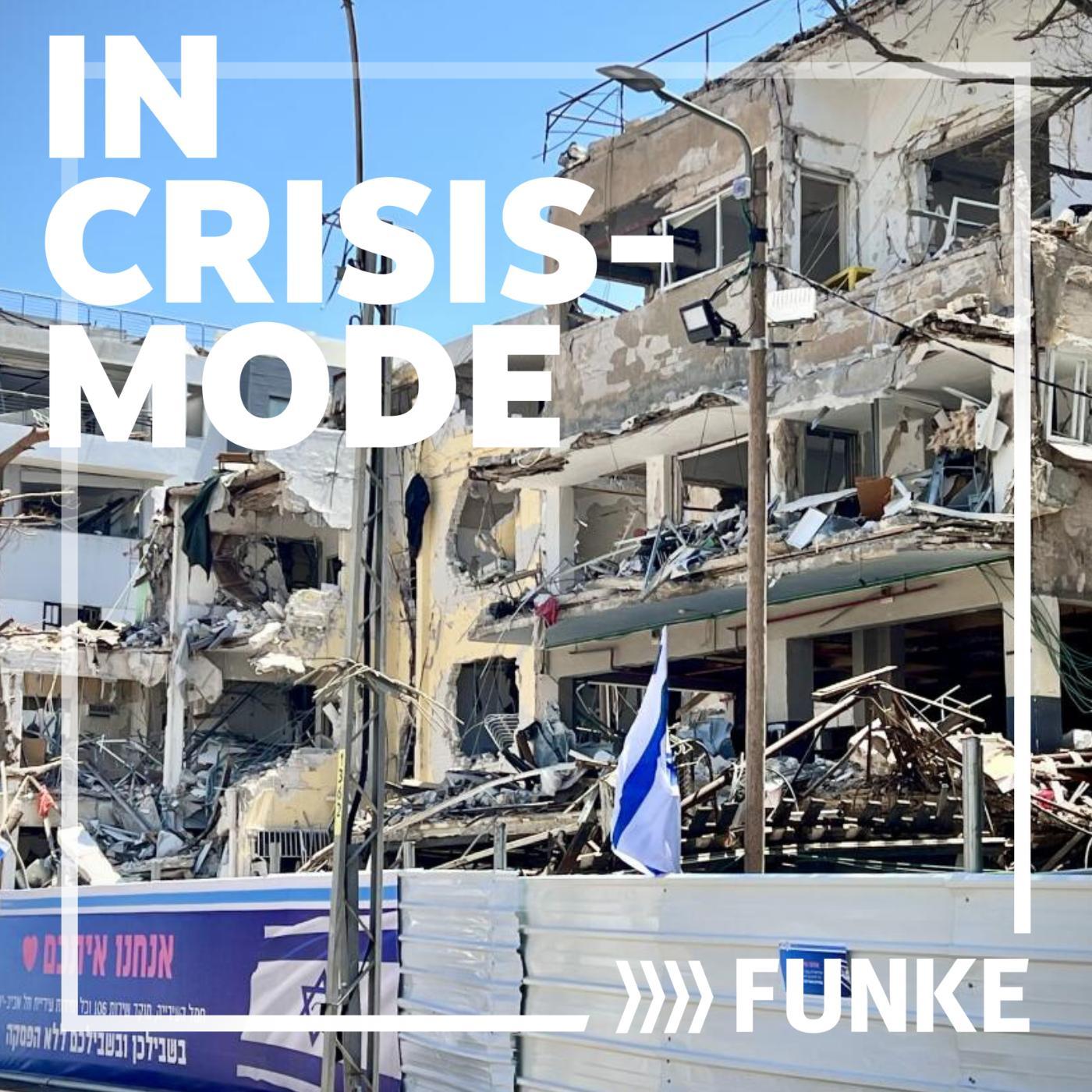
Im Krisenmodus· Folge 100
After the Attack: Cleaning Up in the Shadow of War
Mittwoch, 9. Juli 2025 · 26 min
Kapitelklicken springt direkt hin
Shownotes
Disclaimer: This episode was made with AI.
After the Short but Intense War Between Israel and Iran, a Ceasefire Holds – But Peace Looks Different
In this episode of "In Crisis Mode," FUNKE’s reporter Jan Jessen was on the ground:
In Be’er Sheva, where rockets hit just before the ceasefire.
In Tel Aviv, where homes were destroyed, people were evacuated, and trust was deeply shaken.
And in Jenin, where refugees struggle to survive – with no prospects and no aid.
Jan Jessen, politics editor at NRZ and reporter for the FUNKE Media Group, speaks with:
• Idor, a volunteer with the organization One Heart
• Danna, a social worker with the Tel Aviv municipality
• Sharon, an architect at the heritage conservation office
• Emelia & Motti, residents of Tel Aviv
• Anjad, a refugee from the Jenin refugee camp
Jessen reflects: What remains after this war? How fragile is the ceasefire? And why might this be merely the calm before the next storm?
🧭 Chapter Overview
1 | Rockets Before the Calm
A final rocket strikes a residential building in Be’er Sheva shortly before the ceasefire. Jan speaks with Idor, a volunteer with One Heart, who is helping with cleanup efforts – while mourning the losses.
2 | The Ruins of the White City
A rocket hits the center of Tel Aviv’s Bauhaus district. Sharon, from the heritage office, talks about the loss of history. Social worker Danna assists evacuees. Meanwhile, the city’s cafés are filling up again – caught between everyday life and trauma.
3 | Fear, Anger, Survival
Emelia survived the blast. Motti compares Tel Aviv to Berlin in 1945. An anonymous official shares fears of new attacks – and the belief that Israel must "finish the job."
4 | The Shadows of Jenin
In the West Bank, Anjad recounts how his car was shot at, his son was injured, and how his family now survives in a refugee apartment shared with twelve others. Hope? Nowhere in sight.
5 | Peace on Borrowed Time
Israel’s strike on Iran’s nuclear program – a preemptive attack with questionable outcomes. Jan analyzes: What was destroyed? Why is the situation still tense? And can this ceasefire last?
6 | Between Normality and the Next Alarm
Cafés in Tel Aviv, checkpoints in the West Bank, bombs in Gaza – Jan sums up: What’s left after twelve days of war? And what’s at stake if this fragile peace collapses again?
🎧 Listening Recommendations
• "If the Regime Falls, Civil War Like in Syria Could Break Out" – Masala
• Carlo Masala: "Israel’s Actions Violate International Law"
• There Is No Safe Place in Gaza
📬 Contact & Feedback
Questions, criticism, or suggestions? Get in touch:
✉️ krisenmodus@funkemedien.de
🟢 Subscribe Now
"In Crisis Mode" – available wherever you get your podcasts:
Spotify (open.spotify.com/show/0IQW1w25NYSrz60aAPzwvB?s…) | Apple Podcasts (podcasts.apple.com/de/podcast/im-krisenmodus/i…) | Deezer (deezer.com/de/show/3737197) | YouTube (youtube.com/@Krisenmodus-Podcast_FUNKE)
In Crisis Mode is a podcast by the FUNKE Media Group.
Transkriptvom Podcast bereitgestellt · Zeitmarken springen hin
Kurzer Hinweis vorweg. Diese Folge ist auf Englisch und wurde mit einer KI generiert. Für 12 Tage, Israel und Iran exchanged rocket fire. Für 12 Tage, war returned to the Middle East, another violent escalation in a region already marked by numerous smaller conflicts. A ceasefire is now in effect between the two countries.
But what remains? What impact have the past 12 days had on people in Israel? What have they gone through? And how do they reflect on the recent escalation? What hopes or fears shape their view of what lies ahead? These are the central themes, explored in this episode of In Crisis Mode, the podcast that brings voices from the world's crisis and conflict zones.
In Crisis Mode, the podcast from Conflict Zones with Jan Jessen. Hello, I'm Jan Jessen. I'm the head of politics at the NRZ and a war and crisis reporter for the Funk Media Group. Du kannst mir meine reports in den NRZ, WRZ, Berliner Morgenpost, Hamburger Abendblatt, und natürlich auf all unsere Online-Platforms.
Ich habe gerade von einem trip zu Israel und den West Bank. Ich habe da nach dem Krieg, welches, ich weiß, das kann ein bisschen cynical, aber von einem Reporter-Perspektiv, es war ein bisschen unfortunate. Vor dem, ich war in Afghanistan für zwei Wochen. By the way, wir werden auch über die trip in einer unserer Podcast-Empfälle, Anyway, I traveled to Israel following the American strikes on Iran's nuclear program.
I thought we were on the brink of a massive escalation. That things were really about to explode. That's why I went. But then, unexpectedly, a ceasefire was declared. So, I didn't witness any active combat while I was there. But I did speak with people who had just lived through it. People who were clearing the rubble and trying to return to something a resembling normal life.
In previous podcast episodes, we've also talked about the situation in Gaza, where the war continues with relentless brutality. Now for over 630 days. At the same time, Israeli military operations are ongoing in the West Bank, in southern Syria, and not least in Lebanon. So, while there may be a truce between Israel and Iran, many of these conflict hotspots continue to smolder.
We also spoke in a previous episode with Carlo Masala, a military expert and political scientist from the Bundeswehr University in Munich. He helped us put the Iran-Israel conflict into geopolitical context. You can still listen to that episode. We'll link it in the show notes so you can catch up. Now, as I said, things have moved on a bit.
The major conflict with Iran, the mutual bombardment with ballistic missiles, cruise missiles, and of course drones, has come to a temporary halt. You could really feel that in Israel. I entered the country on the very day the ceasefire was announced, because the airspace was still closed. I couldn't fly into Tel Aviv directly.
Into Ben Gurion Airport. So I had to enter via Jordan. It was a bit of an adventurous journey, but it worked out in the end. When I arrived, people were just starting to catch their breath again. On that first day, you could still feel the tension. People were wary, unsure whether the ceasefire would hold.
The streets of Tel Aviv, which is usually a buzzing, vibrant city on the Mediterranean, Israel's party, capital, and its secular heart were noticeably quieter. Traffic was lighter than usual. The beaches weren't nearly as full as they normally are. You could sense the skepticism. Millions of Israelis had spent the days of the war in bunkers and safe rooms, trying to stay protected from Iranian missile strikes.
I then traveled to Beersheba in southern Israel. Just minutes before the ceasefire officially took effect, a ballistic missile from Iran struck a residential building there. Four people were killed. Again, mere minutes before the truce began. Near the ruins of that building, I met Ido, a 23-year-old volunteer with 1HAR, a kind of civilian emergency aid organization, somewhat comparable to Germany's THW, though not as technically equipped.
These are people who respond after bombings or other disasters, helping clear debris and providing assistance. During the Iranian attacks, they went into destroyed homes to help people clean up and tried to offer emotional support. Ido told me in detail what exactly they do in those moments. Ja, wir kamen in die Apartment, die getroffen wurden.
Normalerweise nicht die Abitur, die getroffen wurden, sondern die Umgebung. At least 500 m pro Jahr, der parameter, da ist ein Damage. Also, wir knacken in die Apartment, asken, ob sie Hilfe brauchen, um die Gläser zu evakuieren, vielleicht die Tafeln, die Stabeln. und alles. Edor und andere sind helfen Menschen, die sich sehr verletzten, als er selbst beschrieben hat. Er ist das auf seine eigene Initiative.
Es ist nicht etwas, was er zu tun, sondern eher eine Art von der sozialen Gesellschaft. Und das spiritet ist sehr stark in Israel. Wenn etwas Schmerz passiert, Menschen stecken in und unterstützen sich. Er hat auch gesagt, er ist das auch, weil er etwas zurückgebracht hat. Die Ich wollte ein großer und schreckliches Hit, das letzte Hit.
Es ist heartbreakend, jedes Mal. Es ist besonders hier in meiner Hohem-Town. Es ist ein Schade, dass sie hier. War in der Schelter. Mom, a kid, and the kids' girlfriends all vanished, all disappeared. And I know them, actually. Her other daughter was in school with me and she left alone. Yesterday I'd been in her funeral.
Completely heartbreaking. It's terrible. It's a major crisis for the people affected. I also spoke with two women standing in front of the wreckage. For them, it was clearly a traumatic moment. Israel has never experienced anything quite like this. Ballistic missiles with warheads weighing several hundred kilograms crashing into the heart of its cities.
There have, of course, been repeated Katayusha rocket attacks from Gaza and occasionally ballistic missiles launched from Yemen, but the direct impact on civilian infrastructure in densely populated urban areas marks a new and bitter reality for many Israelis. Das Gefühl von shock war etwas, was ich wieder und wieder in meine Gespräche.
In Tel Aviv, ich mit Sharon, eine Architekt, die fluent Deutsch spricht. Sie hat mir gesagt, dass in der Vergangenheit, die Angst in der Vergangenheit war, nicht wirklich ein Teil der Welt. Aber jetzt, die Missile Strikes haben nur wie vulnerable sie wirklich sind. Die Fakt, dass diese Rockets landen in den Mitte der Stadt, in den Mitte der Stadt, macht die Vulnerability nicht möglich.
Eine Missile hit Tel Aviv's so-called White City, die cultural und architectural heart der Stadt. Es ist ein Bereich mit mehr als 4,000 Bauhaus-style buildings, designed by German-Jewish architects who emigrated bevor oder during the Nazi rise to power. Es ist oft referred to als Tel Aviv's German legacy.
Und das ist genau wo der Missal landet, auf Pinsker Street, zerstörtlich mehrere buildings und severely damaging dozens mehr. Sharon works für die Stadt Preservation Authority. Als wir durch die devastated Area sind, you could see the pain in her expression. Standing among the ruins, it was clear just how deeply affected she was.
I just have stomach pain right now. Especially because we take such incredible care of these houses. Even the two across the street were just renovated. With an extra floor, with an elevator, with shelter rooms. Das ist wirklich ein Verlust. Das Destruction kann nicht beuprägt. Es ist wirklich ein Verlust. Aber wenn es eine Art von originalen Substanz ist, dann verliert man ein Stück Geschichte.
Und hier ist das so. Es kann ein bisschen strange sein, wenn es ein Verlust ist, wenn die Gebäude verletzt werden. Aber für Sharon, es ist. Sie ist ein Architekt, arbeitet für die Stadt Preservation Authority. Und was verletzt wurde, ist Teil des Historicen Herzen. Für jemanden, der professionell life ist, die sie zu preserving und behalten, es ist ein besonders bitteres Blut.
Es ist wichtig, wie das Konflikt begann. Auf Friday, June 13, Israel launched eine military-operation mit dem declared aim des Ablen, Iran's nuclear program. Die strikes kamen als ein surprise, nicht nur weil die Negotiations auf Iran's nuclear ambitions waren still unter anderem. Another round of talks had actually been scheduled for the Monday following the attack.
Israel justified its actions by claiming Iran was only days away from developing a nuclear weapon, a weapon Israeli officials fear could be used against them. In their view, a nuclear-armed Iran would pose an existential threat, and they say that's why they launched a preemptive strike. That's a legally controversial move, as military analyst Carlo Masala confirmed in a previous episode of this podcast, which we've linked again in the show notes.
But from the Israeli perspective, it was a matter of national defense. After all, Iran has repeatedly questioned Israel's right to exist, calling the country a Zionist entity that should be eliminated from the region. And so on June 13th, Israel acted. The Iranian response was massive. More than 550 missiles and over 1,000 drones were launched toward Israel.
While the country has one of the most advanced air defense systems in the world, a multi-layered shield. It didn't stop everything. The system includes Iron Dome for short-range rockets, David Sling for mid-range threats, and Arrow 3 for long-range ballistic missiles, like those coming from Iran. But even this sophisticated network couldn't intercept every projectile.
Missiles struck not only Beersheba and Tel Aviv But also cities like Bat Yam and Haifa It was a level of vulnerability Israelis were not used to, Something Sharon mentioned again in our conversation In the same street where I met her I also spoke with Donna She works for the Tel Aviv municipality And was part of the emergency response team Supporting those affected by the strikes, We're in the center of Tel Aviv An Iranian missile hit this street and damaged many buildings Some were completely destroyed.
The municipality set up what we call a street office office. So residents can come to us directly. We help them deal with bureaucracy and we offer emotional support. Many are now living in hotels. Not everyone is strong. Some people need help. Some are afraid. But we try to stay optimistic. Okay, so we are in the center of Tel Aviv, where a missile hit one of the streets, an Iranian missile, and it affected many houses.
Some of them destroyed completely. Some of them are still under evaluation to see if the tenants can go back and live there. And some of them had a minor effect, like glasses that broke, doors that came out. But again, the tenants doesn't live there. And now we are dealing with them, we are helping them.
The municipality of Tel Aviv established some kind of street office where they can come to us, talk to us directly. We try to help them with all the problems, bureaucracy, emotional things. A lot of them are in hotels. So we also help them if they need to move from one hotel to another, if they have a social problem, any kind of problem. Wir versuchen zu helfen, in dem wir können.
Ich meine, nicht alle Menschen sind stark. Some Menschen brauchen Hilfe. Some Menschen haben Angst. Ich meine, ich verstehe das. Aber wir versuchen, zu beoptimisten. Wir versuchen, zu überkommen. Was Donna sagt, dass Menschen versuchen, dass sie sich optimistisch ist, ist etwas, was man wirklich fühlt in Israel.
Es ist ein sehr starker trait, besonders in Tel Aviv. Die Stadt ist als ein Hub von Resilienz, but also as Israel's secular heart, its party capital. There's always been something of a California vibe to it. People playing beach tennis or volleyball, lounging by the sea, enjoying life outdoors. And even now, despite the shock, you could sense a strong desire to return to normalcy. That includes trying to remain hopeful.
I also spoke with a woman who didn't want to give her name. She was standing across the street, outside another street office. This one run by the city's tax authority. What she told me echoed what I'd heard from many Israelis over the past few days, We have to find a way to deal with the threat from Iran, We feel for the people there They live under a terrible government But we have to protect ourselves I think Israel must finish with this problem, We're sorry for the people there They are poor people We're very sorry for them Wir verstehen, dass sie in einer schlechten Situation leben, mit einer schlechten Regierung leben.
Aber wir hoffen, dass sie einen guten Tag haben. What this woman essentially said was, we should have finished the job. And that, in her view, and in the view of many others I spoke with, is exactly what didn't happen. After long hesitation, the US did eventually join the Israeli operation against Iran.
American B-2 bombers carried out strikes on suspected nuclear sites in Fordow, Natanz, and Isfahan, where Iran is believed to be developing its atomic infrastructure. But the operation didn't go entirely as planned. In typical fashion, Trump later declared that everything had been destroyed, that the damage was massive and the nuclear program was over for good.
Yet reports increasingly suggest that Fordow, considered the heart of Iran's nuclear program, was not fully destroyed. In fact, it may have suffered only surface-level damage. There is now concern that Iran could resume its nuclear efforts within a few months, if it ever truly stopped. That too remains uncertain.
No one can say with absolute certainty that Iran is building a bomb. Everything points to it, but nothing is conclusive. And even if they had the bomb, no one can say for sure whether Iran would actually use it against Israel. Nuclear weapons are, after all, typically used as a strategic deterrent. Every nuclear-armed state so far, from Pakistan to India, China, France, the UK, the US, North Korea, and reportedly also Israel, has refrained from using them in war.
The only exception remains the US in World War II. That's the paradox of nuclear weapons. They're built to prevent wars, not to fight them. In Iran, there are even fatwas, religious rulings, forbidding the possession or use of such weapons. But how much weight those hold is unclear. Ultimately, we just don't know. What is clear, however, is that the US attack was not as successful as Trump and his Defense Secretary Haxton claimed.
In essence, not much has changed. Some facilities were hit. Israel did succeed in taking out many Iranian missile launchers. Along with nuclear scientists, senior officers in the Revolutionary Guards, and intelligence officials. But the regime in Tehran is still standing, and there are growing indications that its nuclear program could resume sooner rather than later.
That's what bothered this woman, and many others I spoke with. They told me, if we're going to strike, we should have seen it through. We should have finished it. Later in Tel Aviv, I met Emilia A young woman who stood stunned in front of the damaged buildings She told me she had lived in that neighborhood for three years, und es war dort der Nacht, die Missile struck. Ich war hier für drei Jahre in diesem Nachwuchs und bin hier in der Nacht, wenn alles passiert.
Und es ist ein bisschen schwer. Es ist sehr schwer und es war ein Apartment von zwei meiner Freundinnen, die überlebt, weil einer in Mamad in dieser Zeit und einer mit den Eltern in anderen Stadt. So it's also a bit a bit. Es ist schwierig zu erkennen, dass es mit meinen Freunden ist und es ist schwierig zu erkennen, dass es in meiner Nähe.
So ich bin nicht zu gehen hier viel. Luck, of course, plays a big part. Like what Emilia said, that by chance her friends simply weren't at home. The Israelis have another advantage compared to, say, the Iranians. They have a vast network of bomb shelters. It's mandatory for people to go into these shelters whenever there's an air raid alarm.
These shelters are relatively safe. They won't withstand a direct hit. If a ballistic missile lands squarely on a building with a shelter inside, the shelter won't offer much protection. But they're very effective against smaller rockets like the Katsushas, fired from Gaza, shielding people from shrapnel and flying debris.
If a rocket is shot down and fragments fall, shelters are a good defense against that too. And as I said, despite these massive attacks, and I don't want to sound cynical, only 28 deaths is comparatively low given the scale of the bombardment Israel faced. Now, as I mentioned, there's a ceasefire between Israel and Iran.
And whether it will hold, that's the big question. So far things look promising, you have to say, But whether it lasts, nobody really knows Even the people I spoke with on the ground Weren't quite sure how to read the situation. For example, I met an older man Morty Mantelkern was his name Who was nearly 80 years old He briefly shared with me how he felt And what he thought about everything that's happening Es ist unglaublich und ich habe keine Worte.
Sie sehen Tel Aviv als wenn es Berlin war in 1945. Es ist nicht easy. Das ist die Israelie perspective. Aber natürlich, und das muss nicht vergessen, ist auch die Palestinian perspective. Während der Iran-Israel-Konflikt raged, die war in Gaza in Gaza continuierte unabated. Und nicht nur Gaza, sondern auch in den West Bank.
Es ist nicht eine Formal-State-of-War da, aber die Situation bleibt sehr intensiv. Als Western-Journalisten, wir, unfortunately, nicht in Gaza zu entdecken, zumindest nicht in eine Weise, dass es independenten Informationen gibt. Die Israelis haben keinen Zugang für auf-deckend Informationen gegeben, so wir müssen auf die Accounts von Menschen in Gaza zu relyieren.
Wir haben hier ein Kind von Gaza aus dem Podcast ausgesprochen, who is critical of Hamas, but also condemns the Israeli attacks. He told me again recently that he is unsure whether the ceasefire between Iran and Israel will actually bring calm to Gaza. Trump, the American president, wants peace now. But whether it will happen, as he envisions it, remains a big question.
Meanwhile, in the West Bank, Israeli military operations are intensifying. There are increasing attacks by far-right Jewish settlers who are expanding their presence, building illegal settlements that violate international law, yet remain somewhat protected by the Israeli army. Shortly before this podcast was recorded, there was an incident where Jewish settlers attacked Israeli soldiers.
This has become a major issue in Israel because it is deeply unsettling for the public when Israelis attack other Israelis. However, the group that has suffered the most from these clashes in recent months is the Palestinian civilian population. Ich spreche mit einigen von ihnen zu den West Bank, vor allem zu Sebastia, eine kleine christianische Kirche neben Jenin.
Da, die Palestinian-Refugee aus der Jenin-Refugee haben geholfen. Das Camp ist nicht mehr eine Tent-City, sondern in eine kleine Stadt, neben Jenin. In January, people fled from that camp when the Israeli army moved in, suspecting terrorists from Hamas and Islamic Jihad. Fierce fighting broke out, and people fled.
One of them is Anjad, whom I spoke with. The attack, the Israeli army's assault on the refugee camp, was so brutal and intense. From the air and the ground, they attacked with helicopters and drones. I was sitting in the car with my son when 23 bullets hit the vehicle, and my son was struck by shrapnel in his head.
Now, these people live in Sebastia, a town with 3,000 residents. In addition, 1,300 refugees have arrived. A stressful situation. Everyone there complains that hardly any aid is reaching them. Anjat made this very clear. We only received four packages for six people. My wife and I have five children. That's never enough. We've been living here for four months. It's far too cramped.
I asked him if he was also angry at the armed militias in Janin, who may have sparked the offensive. But he saw things differently. I have the right to defend myself when you see an army attacking you. His anger was mainly directed at the neighboring Arab states, which he feels have abandoned them. Then I asked how they experienced the Iran-Israel war. He replied, we were glad to see rockets flying toward Israel. For the first time, they know what it feels like.
What can you say? For me, it showed just how deeply divided things have become. In the West Bank, Israel plans to build 22 new settlements, despite international protests. This is likely to trigger resistance and possibly more violence. The refugees from Jenin, like Anjad and his family, face an uncertain future.
Many are unemployed, and they cannot return, because part of the camp is scheduled for demolition. Meanwhile, in Israel, some normalcy is returning Cafes in Tel Aviv are busy again And the beaches are lively Donna, a social worker in Tel Aviv, told me. Wir wollen nur ein normaler Leben, in einem normalen Land. Aber Israel ist weit weg, und so ist die gesamte Region.
Whether in Gaza, Syrien, Lebanon oder die West Bank, tensions bleiben. Die Krieg in Gaza continues, Hezbollah bleibt, Hamas still holds hostages, und es gibt auch noch airstrikes, violence und fear. No one weiß, ob die Krieg zwischen Israel und Iran wird dauern. Will neue attacks passieren? Will Iran retaliate wieder? Ich weiß nicht, dass wir alle hoffen, für Israelis, Palestinians, Iranians, Syrians, Lebanese und Yemenis, dass sie endlich leben können, dass sie endlich leben können.
Das war In Crisis Mode. Das Episode war von Alexander Baumeister, also ein Journalist mit Funke Mediengruppe. Wenn du Spaß hast, schreibt es, schreibt es und schreibt es. Vielen Dank für die Feedback. Danke für die Zuschauer. Stay safe. Ein Podcast von Funke.
