

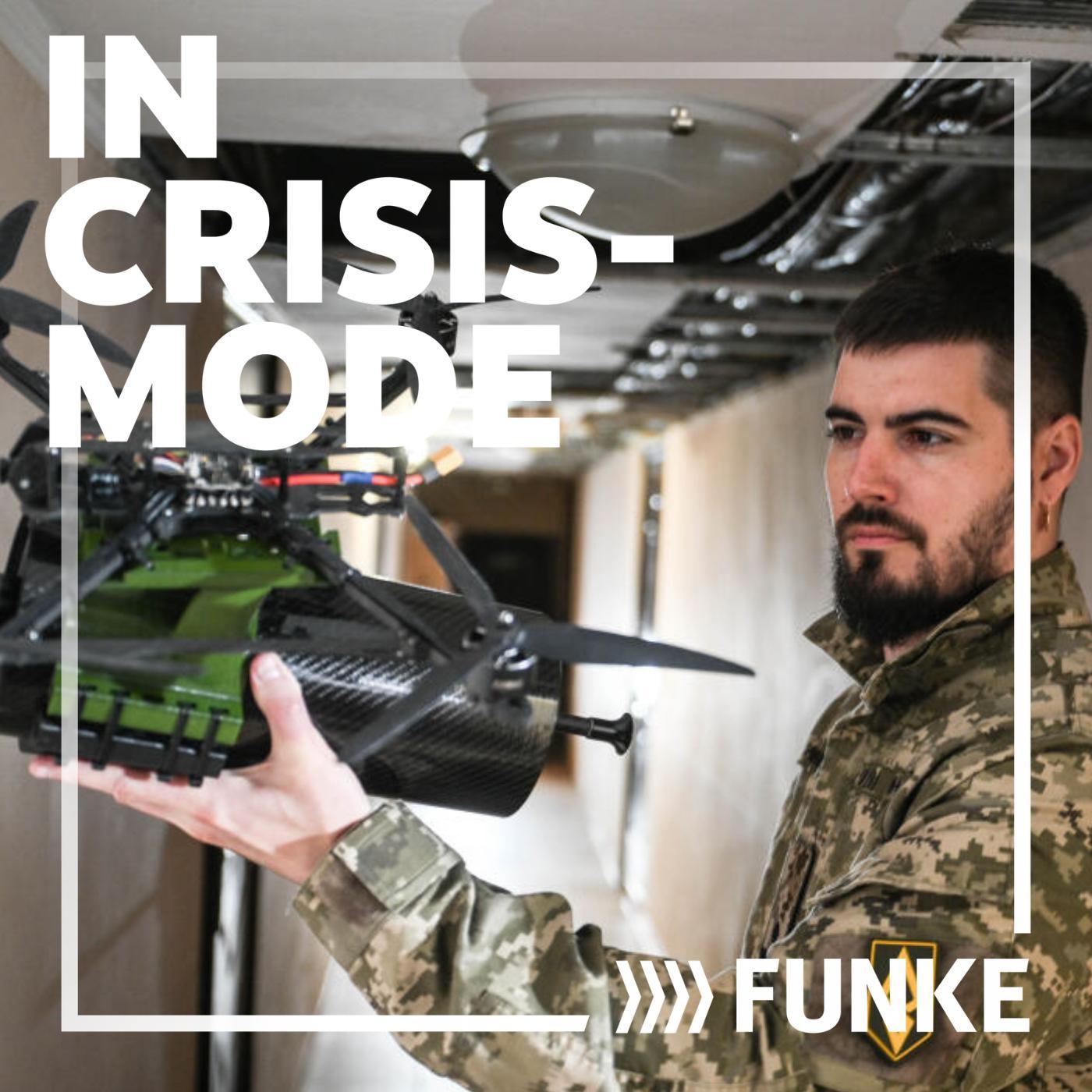
Im Krisenmodus· Folge 97
Drone Frontline – A New Era of Warfare in Ukraine
Mittwoch, 25. Juni 2025 · 25 min
Kapitelklicken springt direkt hin
Shownotes
Disclaimer: This episode was made with AI.
Ukrainian frontline technicians are developing new drones every day — often under pressure, without centralized guidance, and using improvised tools.
In this episode of "In Crisis Mode", FUNKE reporter Jan Jessen visits a secret workshop near the front line. He speaks with a commander about range, malfunctions, and autonomy — and shows how Drone Warfare 4.0 is transforming the battlefield.
How are drones adapted to 20-kilometer spools? What role does AI play? And who’s winning the race — Russia or Ukraine?
Featured in this episode:
• Yuri Fedorenko – Ukrainian officer and developer of fiber-optic FPV drones
• Mavic – Technician specializing in drone repair and modifications
🧭 Chapter Overview
1 | In the Engine Room of War
A secret workshop full of batteries, cables, laptops — and men who fine-tune drones 12 hours a day. Why nothing works at the front without modifications.
2 | Modifying over Mass Production
Why off-the-shelf drones often fail — and what it takes to make them fly 20 kilometers without interference.
3 | David vs. Goliath: Ukraine’s Drone War
Improvised basement labs versus Russian mass production: how Ukraine’s small teams are catching up — and what “20 kilometers” really means.
4 | Autonomy or Decoy? The AI War Begins
Artificial intelligence learns to aim: how Ukraine is working on letting machines decide which targets are real.
5 | FPV, Fear, and Precision
Cheap, deadly, and psychologically powerful: why FPV drones are radically changing the battlefield — and what happens when humans no longer make the final decision.
📬 Contact & Feedback
Questions, comments, suggestions? Write to us:
✉️ krisenmodus@funkemedien.de
🟢 Subscribe now
"In Crisis Mode" — available wherever you get your podcasts:
Spotify (open.spotify.com/show/0IQW1w25NYSrz60aAPzwvB?s…) | Apple Podcasts (podcasts.apple.com/de/podcast/im-krisenmodus/i…) | Deezer (deezer.com/de/show/3737197) | YouTube (youtube.com/@Krisenmodus-Podcast_FUNKE)
📅 New Episodes
Every two weeks, always on Wednesdays.
"In Crisis Mode" is a podcast by FUNKE Mediengruppe.
Transkriptvom Podcast bereitgestellt · Zeitmarken springen hin
Ein kurzer Hinweis vorweg. Diese Folge ist in Englisch. Im Krisenmodus wird nun häufiger zweisprachig erscheinen. WDR mediagroup GmbH im Auftrag des WDR, Tinkerers, and AI developers. One officer at the front told me, half-jokingly, it's like Terminator. A bit exaggerated, sure. But still, it's a chilling statement.
And it feels more like a documentary than science fiction. In this episode, I'm taking you into the world of Drone Warfare 4.0. In Crisis Mode, the podcast from Conflict Zones with Jan Jessen. Welcome to a new episode of In Crisis Mode. My name is Jan Jessen. I'm the Political Editor-in-Chief at NRZ and report on war and crises for the Funko Media Group.
You'll find my reporting in the NRZ, Waz, The Courier, Braunschweiger Zeitung, Berliner Morgenpost, and of course online and in the e-papers of the Funka Media Group. Today's topic is drones. We've covered this before in one of our podcast episodes. You'll find that linked in the show notes. But the pace of development has been incredibly fast.
As I said, no other war has been shaped by drones as much as this one. Over the past three years, the battlefield has changed dramatically. And we feel that too. As journalists, we can no longer get as close to the front lines as we used to. Simply because the air is now filled with drones. Whether FPV drones, first person view, whether pilot sees through the drone's camera, or bombing drones or reconnaissance drones, the sky is full.
And there's something entirely new we'll talk about shortly. There are now so-called fiber-optic drones in use. These are an evolution of drones that are already omnipresent on the battlefield, and this development is far from over. During my last visit to Ukraine, I was near the front, where exactly I can't say, but we visited a drone regiment.
They're called Achilles, and they show just how important drones have become. They started when Russia invaded Ukraine, with just 35 volunteers working with Mavics, Chinese drones originally used for reconnaissance. They were actually the first to arm them with explosives. The drones would fly over a target and drop a charge. That was three and a half years ago.
Now this 35-person group has grown into a regiment with 3,000 soldiers, around 1,000 of whom are drone pilots. That gives you a sense of how far drone warfare has come. Today, drones even form their own branch within Ukraine's military. Alongside the Navy, Army and Air Force. Achilles is part of the Army, but there are many such units by now.
When I was with Achilles, I visited a drone workshop hidden in the basement of a building to avoid detection. It wasn't exactly a high-tech lab, more like a space that had been set up just a few months earlier. Still, it was buzzing. Dozens of people working, mainly modifying drones. There we met a young soldier using the call sign Mavic, named after those early Chinese drones. He explained what they do.
Drones supplied by manufacturers don't always meet the technical requirements needed on the front line, meaning they must be modified. We change operating frequencies and add circuit boards and components that trigger an explosion when the drone hits its target. Die Standard-Modulen, die die Dronen in den ZDF-Modeln mit, oft nicht so gut performen, so wir nur die Qualität zu nutzen.
Die Herausforderung ist, dass es viele Unen und, accordingly, eine sehr lange Front-Line gibt. In der Sektor, wo wir arbeiten, bestimmte Frequenzen und Dronen konfigurations funktionieren. In einer anderen Sektor, alles kann sich komplett anders sein. Das ist warum manufakturern nicht genau das jeder Militär-Unit braucht für ihre bestimmte Aufgaben.
Das ist das, was manufaktur für alle militär-Unitär-Unitär ist. Das ist das, was manufaktur für alle militär-Unitär-Unitär-Unitär ist. Das ist das, was manufaktur für alle militär-Unitär-Unitär-Unitär ist. Basically, even though the drones are manufactured in Ukrainian factories, they still need to be modified for frontline use.
They receive the drones and start tweaking. We walked into a room filled with dozens, maybe hundreds of drone boxes. Shelves held batteries, hundreds of them being charged. The room was filled with buzzing sounds, screens everywhere, technicians at work. Their job? Tinkering, testing, modifying. Shifts are 12 hours long, 7 days a week. When I said, that's quite a workload, Mavic just shrugged.
We'll sleep after the war. Before any drone goes to the front, where they need to scout and strike effectively, it has to work perfectly. That's why they have these drone workshops, to make frontline-ready modifications. As Mavic explained, they adjust frequencies, ensure stable flight, and confirm everything works.
In the workshop I visited, one of several within the regiment, they were modifying FPV drones. These are kamikaze drones, fitted with explosives and flown into enemy positions. They're single-use and destroyed on impact. Mavic explained why testing is crucial. Das Problem ist, dass sehr vieles Geld, das wir erhalten, wir erhalten ihn hier, dann wir ihn auf den Poligon in den Stadtmöglichkeiten und alles funktioniert.
Much of the equipment we receive works during testing, but not in actual deployment. In der Stadt oder in der Stadt, alles läuft so gut. Aber in der Front ist es eine andere Geschichte. Der Radiospektrum ist so congested, dass viele Systeme einfach fail. Das ist warum wir alle Dronen in der Stadt testen.
Nachdem die Software aufgelöstetieren, das bedeutet, dass die Software aufgelöstetieren. Dann machen wir eine Testfahrt mit dem Wait unter realen Regeln. Nur wenn es aufgelöstetiert ist, dann senden wir es auf die Fronten. Traditionell Drones sind durch Radio-Signale. Der Pilot benutzt eine Remote-Kontrolle, und der Drone reagiert.
Aber das hat die Herausforderungen. Zum Beispiel, die Drones nicht über die Höhe, wenn der Pilot losst. Die Radio-Contact breit. Und sie können nicht gut in den Fortschritten werden. Das war ein relatives Ziel für Journalisten wie uns. Wir könnten durch die Wooden Bereiche ohne Drone attacken. Nicht so für Soldaten, die da immer alle Tage sind. Aber auch für sie, die Fortschritten haben. some protection.
Drones had difficulty operating there. You still risked artillery or mortar fire, but at least not drones hunting people. Another key point, these drones can be jammed. Electronic warfare has evolved too, and jammers, devices mounted on nearly every vehicle at the front, can disrupt radio-controlled drones, causing them to crash before hitting their target. Das ist wo die Fibre-Optik Drones kommen.
Diese Drones sind durch die Fibre-Optik Kabel. Die Russen waren zuerst die Fibre-Optik Kabel in den letzten Jahr 2024. Und jetzt die Ukrainien sind die Produktion auf der scale. Unter der Drones ist ein Container, wie ein Spuhl, holding die Fibre-Optik Kabel. Die Kabel tranzsignalte Kontrollen direkt, die die Drones sind in der Jammung, und able to fly over hills or into forests.
No line of sight needed. It's a major shift in how war is fought. Aber diese Dronen haben auch die Ausflüge. Je mehr Kabel sie tragen, je mehr sie bekommen, das beeinflusst die manöverhaltigkeit. Mavic sagte uns, dass sie jetzt Kabel auf 20 Kilometer lang benutzen. Wir haben jetzt 10 km auf 10 km gelegt, weil der Krieg begann sich weiter.
Wir haben jetzt 10 km auf 10 km gelegt. Wir haben jetzt 10 km auf 10 km gelegt. Aber die Russen haben sich sehr viel zurückgelegt. Jetzt nur die Infanterie bleibt. 10 km ist nicht genug. Wir haben jetzt 20 km gelegt. Es gibt auch 35 km reels. Aber die länger sie sind, die schwerer und mehr vulnerable die Drone wird.
Mehr Kraft bedeutet weniger Explosive Payload. Und in starken Winden, sie sind leichter aus dem Weg. Das ist warum 20 km ist ideal. Portabel, Efficient und Stable. Und das zweite, wenn sie sehr starkes, sehr starkes und solle, und so ist der dron sehr schwer, weil sie ihn ausweiten. Wir sind auf 20 km, weil es optimal ist.
Das Fiber-Kabel ist so schwer als ein Katz-Whisker, so Piloten müssen sehr vorsichtig sein. Keine Jerky-Move oder die Kabel könnte Snack. Sie sind schwerer zu kontrollieren und schneller, rund 45 km pro Stunde, anz. 70-80 km pro Stunde, für Traditionell FPV-Drones. Ein Skilled-Shooter könnte spot und sie schütten, besonders als die Kabel-Spool erhöht ihre Größe und Visibilität.
Und wegen der Änderung, sie können nicht großartig, Explosive-Pay-Loads. Ukraine's approach ist, als immer, sehr improvised. Sie haben eine Verfahrenindustrie aber sie sind noch weit hinter Russland in der Maschproduktion. Russland hat nur mehr Ressourcen. Aber Ukraine hat viele Start-ups und kleine Unternehmen arbeiten auf Drones.
Some now produce large numbers of them. So, we're talking about 100,000 drones being produced each month. And just to give an idea, take Ukraine, for example. In just one small workshop we visited, part of a single regiment, and there are many regiments, and even that one regiment has multiple workshops.
This one workshop alone modifies up to 4,000 drones per month. Of course, the more improvisation involved, the more difficult it becomes to coordinate. Das ist warum diese kleinen Workshops sind essentiell, um zu adaptieren und zu schützen, die Drones funktionieren, auf der Front. Wir haben auch mit Yuri Fedorenko, der founder von der Achilles Regiment.
By the way, es heißt Achilles, weil das sein ist, weil er der Kommandert der Regiment ist. Wir haben ihn in eine Basement, die in einem Kommandert wurde in eine Kommandert zu haben. Wir haben ihn mit ihm für lange Zeit über die Drone War und wie es erfolgt. Fedorenko ist in seinem 30s, also noch ziemlich jung.
Er ist eine der jüngeren Officersen in der Ukraine, mit einem völlig anderen Verständnis von Waren. Das ist eine große Veränderung. Das ist eine große Herausforderung. Ukrainian warfare. Wenn wir über eine 20 Kilometer Reel, ideal für die Anwesenheit der Anwesenheit, oder für die Anwesenheit der Piloten, wir sprechen zu einem Drone-Type mit 13-Inch Propellers, also mit einem großen Propeller über 33 cm in diameter, plus mit einem zusätzlichen Munitions.
Das Drone ist großartig, damit es relativ easy für ein Trainshooter zu treffen. Das ist warum der Loss-Rate von Anwesenheit von Anwesenheit ist deutlich höher mit diesen Drones als mit kleineren Modellen. However, diese Technologie funktioniert genau wo es ist, in der Front. Es gibt keine andere Systeme, weil es nicht 40 Kilometer gibt, und es gibt keine Precise-Remote-Control.
Right now, 20 Kilometer ist die Standard sie arbeiten. Sie spüren eine 20 Kilometer Kabel. Honestly, das ist ziemlich wild. Das ist eine sehr schwere Range. Russian forces can now reach many frontline cities with this. That's also a problem. We were often in Kherson, in the south, where the Russians are just across the river.
Also in cities like Kostyantinivka, Kramatorsk and Kharkiv. All of them lie within that 20km range. That means Russian pilots can now enter these cities, target civilian infrastructure, hunt down buses. They actually do that. And of course, that's a problem. These drones are being used to terrorize civilians.
Still, there's a clear division of roles on the front. Directly at the front line, you don't even need that long a range. This is a system with limited range and controllability. but indispensable for its specific purpose. For example, infantry units often use reels with a range of up to 7 km. That's sufficient for them. They only need access to the frontmost line.
Specialized units, on the other hand, are working to reach 20 km and beyond. We've mostly talked about attack drones, so-called FPV drones. One advantage of fiber-optic drones is their vastly improved image quality. If you watch attack videos online, drones going after tanks or other military targets, the footage is often very grainy.
The closer they get to the target, the worse the picture gets, and just before the hit, the video usually cuts out. That's not the case with fiber optic drones. They can slowly circle around a vehicle, identify the most vulnerable spot, and then strike with precision. That's a big change. These drones can observe better and strike more accurately.
Ukraine has now heavily reoriented its defense industry toward war and is able to produce a large number of drones domestically. That's especially interesting because, as you may have heard, Chancellor Merkel recently said that Germany wants to help Ukraine with weapons production. In practice, this means Germany will invest money in Ukraine so it can further expand its weapons manufacturing.
Because weapons, and especially drones, don't build themselves. You need foreign components, and you also need money to pay workers and engineers. That's exactly what Germany plans to support. I think it's a sensible step. It sidesteps endless debates over which weapons we should or shouldn't send, what crosses a red line, and so on.
Jetzt ist die Fokus auf die Produktion zu unterstützen. Ukraine's former Defense Minister sagte mir das auch letzte Mal. Sie haben einfach nur die FÜL, um die Maschine zu fahren. Marwek also described how differentiated their workshop system has become. Wir haben auch workshops, die in den Repair und Modernisierung der heavy-bomb-dronen.
Diese heavy-dronen machen die realen Arbeit. Sie bauen die enemy positions. Sie sind auch für die Logistik, für die Humanität, für die Anwendung, für die Anwendung und andere criticale Anwendungen zu unseren Anwendungen. Er ist auch F-PV-dronen, wie wir gesagt haben, aber auch reconnaissance-dronen, die von der Luft und monitort enemy movement sind, nun mit highly-precise Kameras.
According to Marvik, einige Drones sind auch für Logistik. Die Ukrainien benutzen agricultural-dronen, große, Powerful-machines mit sechs oder acht Rotor. Diese sind nun repurposed, zu carryen heavy-däubigen, including large Bombs dropped auf enemy Pläne. the front. The Russians fear them deeply and call them Babajaga, a mythological witch figure from Russian folklore.
These Babajagas either drop large explosives or deliver things like food, ammo or supplies to the front. This is crucial for troops cut off at the front. They used to use helicopters for this, but helicopters are far easier targets than these drones, even large ones. So drones are now preferred. Russia initially had an advantage in drone tech, especially with fiber-optic cable systems.
They were the first to use them in 2014. But Ukraine is catching up. The background is this. Our enemy was the first to deploy this technology. And that put them one step ahead of us. We're now catching up. And I believe that in the coming months we'll reach the same level the opponent is operating at today.
Was interessiert ist, wo sie diese Fiber-Optik-Cabler auszuleben sind. Ich fragte, ob Deutschland sie supply. Marvek sagte, nein, sie sind alle von China. Das ist interessant, denn China ist nahe zu Russland, aber hat keine Probleme mit dem Kabel zu verkaufen, die wichtig sind für die Kontrolle. China sieht eher business-focused, als ideologisch hier.
Kommander Yury Fedorenko sieht eine Chance für die Ukraine zu erreichen, zumindest in den Frontlineen. Unfortunately, we must acknowledge, because of China's geographic proximity to Russia, the enemy has access to many times more drones than the Ukrainian defense forces. However, I am confident that by the end of this summer, through government contracts and support from our partners, we can reach numerical parity on certain sections of the front.
That's the current state of things as we've been discussing. Now though, both sides are developing drones powered by artificial intelligence. We're talking about drone warfare 4.0 heading into Terminator territory. These drones have something like a brain. You assign them a task, kind of like a prompt in ChatGPT.
But instead of write an article, it's fly to grid square XY, analyze the situation, identify enemy targets, and attack. And then the drone makes the decision itself. That crosses moral and ethical lines we haven't seen before in this war. It's no longer a human deciding to kill. Es ist eine Maschine.
Fedorenko has been thinking deeply about this. For AI to be effective, it must be trained, just like a person must learn before mastering a task. A key challenge is this. When military equipment, like a tank or vehicle, is spotted, how should AI know if it's operational, damaged, or just a decoy? Teaching AI to make these distinctions is a major focus right now, and it's crucial.
Even for humans, this is hard to judge. For AI, it's a real challenge, but we're making progress, and I believe we're ahead of the enemy in this area. One specialized unit has been involved from day one. It upgrades existing drones, develops new ones, and defines what's urgently needed on the battlefield, like FPV bombers.
Wir formen die Beispilotungssysteme, die wir noch nicht hatten, aber sie sind notwendig. Zum Beispiel, wie FPV-bombere. Es ist sehr technisch, natürlich, aber man kann sich das, dass dieser junger Kommandant nicht ganz gut mit der Richtung es geht. Ich habe ihn direkt gefragt, was du von dem? Er hat gesagt, well, dass die Dronen uns eventually kontrollieren.
A. I. Will. Kontroll. Wir müssen diese Systeme entwickeln, denn die Enemy ist es auch. An einem Punkt sagte ich zu meinem Fotografer, Rito, dass es nicht so crazy, dass wir als Welt nicht mehr fragen, wo das alles ist. Nicht nur auf der Bällefeld, aber auch in der Situation, in der Situation. Es ist verrückt, wie wir die Entwicklung forwarden, ohne zu schaffen, oder zu verändern, was wir eigentlich wollen.
Honestly, what's happening in Ukraine right now scares me a bit, because at some point, this tech might take on a life of its own. What Fedorenko mentioned in the end was something from Twitter, a kind of hybrid story between the FPV kamikaze drones we already know and bomber drones that drop explosives.
These are still controlled by pilots, with cameras showing the drone's view on a screen, but the pilot doesn't see everything precisely in real time. FPV drones are flown with headsets, so the pilot basically is the drone, if you put it bluntly. This is now also being developed for bomber drones. Was kann ich sagen, auf einen Seite ist es fasciniert, was passiert technologisch.
Auf der anderen Seite ist es terrifying. Die Ukrainian soldiers, die wir gesprochen haben, Leute wie Fedorenko und Marvek, sind ein bisschen gefeiert, auch. Sie sind tech-nerds, die alles irgendwie cool finden. Aber am Ende der Tag, diese sind die Weapons, eventually controlled von AI. Ich habe wirklich goosebumps.
Es ist schuldig. I'm very curious to see when the first fully AI-controlled drones will appear on the battlefield. The impact drones already have was shown just two weeks ago, when Ukrainians launched a massive attack on Russia's strategic bomber fleet. You probably heard about it. Ukraine smuggled FPV drones into Russia by hiding them in trucks, drove them near airfields, opened the truck roofs at a set time, drones flew out, hit the airfields, and destroyed Russia's strategic bombers.
So, small FPV drones, costing just a few hundred euros, destroyed million dollar bombers, inflicting major damage on the Russian Air Force. A huge psychological blow, and a clear sign of how far drone warfare has come. Ukraine has even developed long-range drones that can fly thousands of kilometers.
Sie erreichen tief in die Russische Territory, in den Faktoren, in den Faktoren, in den Faktoren, und mehr, durch die Wirtschaft, und die Supply-Line. Drones have become a decisive weapon class on the battlefield. Soldiers say it clearly. Drones won't fully replace artillery, tanks or infantry, but their role is becoming more and more central.
Where all this is heading, I don't know. As I've said, it scares me. I hope we reach a point, globally, where we set some limits, say what we do and don't want. Sadly, that moment hasn't come yet. Ich hoffe, dass für so lange als das war weitergeht, Ukraine kann weitergehen, und die Deutschland und Europa unterstützen sie in so.
Das war Crisis Mode. Dieser Podcast ist von Alexander Baumeister, der auch ein Journalist von Funker Media Group. Ihr findet alle Crisis Mode episodes auf Spotify, Apple Podcasts und YouTube. Wir haben neue Videos every second Wednesday, plus Special Episodes jetzt und dann. One recent special featured Carlo Massala, the conflict researcher from the Bundeswehr University in Munich.
He spoke about strategic developments to expect in the coming months. We've linked that episode in the show notes. So hit subscribe in your podcast app. It's totally free. Thanks for listening. Take care and see you soon. Music.
