

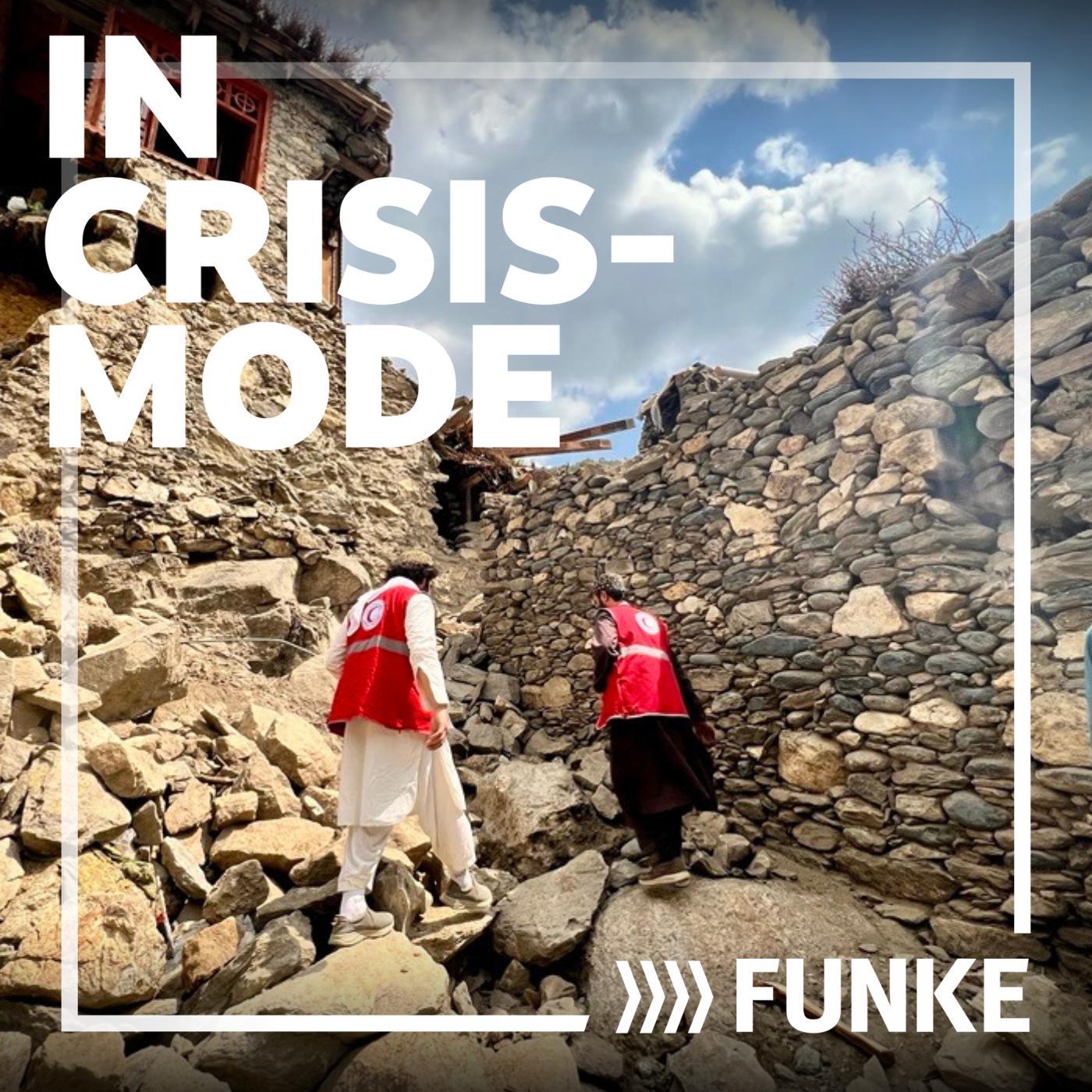
Im Krisenmodus· Folge 111
Earthquake in Afghanistan – Survival without help
Mittwoch, 17. September 2025 · 28 min
Kapitelklicken springt direkt hin
Shownotes
This episode was made with AI:
More than 2,200 people die in an earthquake in Afghanistan, tens of thousands lose their homes. FUNKE reporter Jan Jessen is on the ground when the disaster strikes – in a country already scarred by war, hunger, and climate change. He meets survivors who had to bury their loved ones, doctors who have hardly slept in days, and aid workers who, despite Taliban restrictions, try to comfort women.
In this episode of “In Crisis Mode”, he speaks about destroyed villages, desperate families, and a country once again left in chaos – while the world looks away.
🎙️ Guests in this episode
– Sayed Khan, survivor
– Murtaza Safi, farmer
– Village representative from Sumay
– Samita, midwife from Momand Dara (Nangarhar)
– Bibi Amena, psychotherapist from Pachir Agam
– Dr. Kefaitullah, doctor, part of a relief team
🧭 Episode Guide
1 | A country in chaos – Jan’s impressions on the ground
Jan Jessen travels to Afghanistan with Friedensdorf and witnesses the quake firsthand.
2 | “Everything destroyed, even the animals” – Sayed Khan
A survivor loses his wife and granddaughter – and faces the ruins of his life.
3 | “My brother died under the rubble” – Murtaza Safi
A farmer recounts how the quake shattered his family.
4 | No future without help – voices from the villages
A village spokesman, aid workers, and doctors speak about destroyed homes, trauma, and lack of medical care.
5 | Hope despite catastrophe – Jan’s conclusion
Why Afghanistan has no chance without international aid – and why its people still refuse to give up.
🎧 Listening recommendations
Flood disaster in Afghanistan
🤝 Ways to support
Friedensdorf International
Aid for children from war and crisis zones.
🔗 Website: friedensdorf.de
Donation account:
Stadtsparkasse Oberhausen
IBAN: DE59 3655 0000 0000 1024 00
BIC: WELADED1OBH
Afghan Red Crescent / International Committee of the Red Cross
The world’s largest humanitarian network, active in Afghanistan and worldwide.
🔗 Websites:
Home | ARCS (arcs.af) - Afghan Red Crescent Society (ARCS)
Afghanistan | INTERNATIONALES KOMITEE VOM ROTEN KREUZ (icrc.org/de/wo-wir-arbeiten/afghanistan)
🎧 Listening Recommendations
• German Armed Forces in Lithuania – NATO Brigade Positioned on the Frontline (so-fuehlt-sich-krieg-an.blogs.audiorella.com/1…)
• Rape as a weapon — Russia’s crimes against women (so-fuehlt-sich-krieg-an.blogs.audiorella.com/1…)
• Kherson Under Fire: Voices of Survival (so-fuehlt-sich-krieg-an.blogs.audiorella.com/9…)
📬 Contact & Feedback
Questions, feedback, suggestions? Write to us:
✉️ krisenmodus@funkemedien.de
🟢 Subscribe Now
In Crisis Mode – available wherever you get your podcasts:
Spotify (open.spotify.com/show/0IQW1w25NYSrz60aAPzwvB?s…) | Apple Podcasts (podcasts.apple.com/de/podcast/im-krisenmodus/i…) | Deezer (deezer.com/de/show/3737197) | YouTube (youtube.com/@Krisenmodus-Podcast_FUNKE)
📅 New Episodes
Every two weeks, always on Wednesdays.
In Crisis Mode is a podcast from the FUNKE Media Group.
Transkriptvom Podcast bereitgestellt · Zeitmarken springen hin
There are already more than 2,200 dead and the number is rising every day. Earthquake disaster in Afghanistan, you surely have heard about it. And this earthquake disaster hits a country that is already battered like hardly any other. Afghanistan is probably one of the countries on earth that suffers the most from man-made climate change.
And then unfortunately this country also lies in a region where tectonic plates constantly rub against each other and cause earthquakes. Ich war in Afghanistan, als dieser Erthquake kam, ich war da, um die Arbeit von Friedensdorf international zu unterstützen. Wir waren in der Erthquake Region, um zu sehen, was die Situation war.
Wir sprachen mit Survivoren und sahen, wie die gesamte Ville liegen in den Ruinen. Ich sprach auf dem Boden mit Menschen, die so viel verloren haben, mit Doktors, die nicht nur für Tage zu Hause haben und die Hilfe haben. Und eine Frage immer für mich ist, wie man eigentlich leben kann, wenn man plötzlich.
In crisis mode. Das ist der Podcast von Konfliktzonen mit Jan Jessen. Welcome to In Crisis Mode. I am Jan Jessen, Head of Politics and War and Crisis Reporter for the Funke Media Group in Germany. Normally, I report on wars and conflicts. This time, it was a natural disaster that hit a country already truly very afflicted.
Afghanistan, I always say when I report about the country, Das Land ist für mich ein Land, das ist quasi ein Land, das ist, quasi ist, das Land ist immer wieder durchschnittlich. Das Land war letztlich sehr viel, sehr viel Flügel, besonders in der Bahlang Region. Das Jahr vorhin, zwei Jahre vorhin, da war ein großer Erdkrank in Herat, in der west des Land. Now, es hat sich in der east des Land.
Und auf dem dann, natürlich, der Land hat sich wieder für vier Jahre über die radicalen Islamic Taliban, who impose their own rules. And the economic situation in Afghanistan is also truly a catastrophe. So it is a very, very difficult environment that we entered. When 14 days ago, 14 days before this recording, we went to Afghanistan together with Friedensdorf International.
And the actual task we had was to select children for treatment in Germany. Friedensdorf International has been working in Afghanistan since 1988. So for nearly 40 years, bringing injured, sick children to Germany for treatment. And that was what we wanted to do again this time. So this time it was about the child presentation.
That means parents bring their children to Kabul, the Afghan capital, present their children there who suffer from various ailments. And the staff of Friedensdorf then select those children, those who can be taken to Germany. It is a very, very bitter task. This time more than 2,000 children were presented to us by their parents.
We could take only 76 with us to Germany. 173 are being treated in Afghan hospitals. Aber natürlich, wenn man sich wählen muss, ist das eine sehr schrecklich und sehr schwierige Aufgabe für diejenigen, die es tun müssen. In der Beginn, während wir in Kabul waren, und bei dieser Kind-Presentation, wir haben auch noch nie slept für drei oder vier Tage, etwa eine Stunde sleept per Nacht.
Und dann, wir fiel auf Herat auf der Bordelein mit Iran. Oder wir fiel nicht in der Auto, aber wir fiel, weil Herat ist ziemlich weit von Kabul. Und in Herat, wir sahen die Situation auf der Bordelein. Das ist auch eine Katastrophe, auch eine Mann-Made-Katastrophe, da ist. Weil seit mid-June, Iran, der Mullah-Regime in Iran, hat ihn geportiert Afghanen und Migranten workers zurück in Afghanistan.
Das ist 1.5 Millionen Menschen seit mid-June, die seit Jahren in Iran leben, und jetzt sind geholfen, in ein Land, wo, wie gesagt, die экономische Situation ist bereits sehr, sehr schwierig. So, wieder eine Katastrophische Situation. Und auf der Grenze, wir haben mit vielen Menschen gesprochen, was sie zu ihnen passiert.
Sie waren alle komplett überrascht, ohne Perspektive, deported zurück in Afghanistan, in Busse mit ihren wenigen Besuchern, jetzt haben sie zu irgendwie figurenter, wie sie zu leben. Friedensdorf hat dort unterstützt, organisiert es, medizinisch, besonders für Kinder. Und dann in Herat, wir bekommen die News von dem Erdquake in der East, auf der genau opposite Seite der Land, auf der border mit Pakistan.
There the earth shook massively with a magnitude of 6.0. That is actually not extremely high, but the thing is that in Afghanistan, especially in rural areas, construction is very simple. These are houses, very simple stone houses built from roughly stacked stones. And this way of building means they are not at all resistant when earthquakes occur.
That was also the case here. So the earth shook and already that morning when it was said there had been an earthquake, there was talk of hundreds of dead and it was clear the numbers would rise massively. So we decided to go there to the earthquake region to see the situation on the ground. And secondly, we decided to organize medicines, so-called health kits, large packages of medicine for a total of 40,000 people.
Sie kamen zwei Tage später in der Umgebung, und wurden dann von mobilen Teams verabschiedet. Wie ich sagte, wir kamen erst nach Kabul zurück und dann kamen wir von Fahrzeug nach Kunar. Kunar ist eine Provinz in der east der Lande, die Provinz am meisten beeinflusst durch die Erdquakes. Und das war bereits eine sehr, sehr schwierige Reise, man muss sich sagen.
Man muss sich vorstellen, es ist eine mountaine Region, und in dieser Mountaine Region, da ist ein Valle. Und in dieser Valle, wir dringen deeper und deeper in die Mountains. Aber die Straßen in Afghanistan sind einfach ein totaler Dissaster, besonders in ruralen Bereichen. There you only have a narrow, dusty, dirt track, stony and rough, along which all the aid trucks moved, pickups with dozens of volunteers who wanted to provide help to pull people out of the rubble.
It was unbelievably chaotic. Sometimes for hours you couldn't move forward or backward because the traffic was jammed. A very, very difficult situation. And yes, when we were finally there, the talk was already of more than 1,500 dead. As mentioned, the numbers have since risen. At the time of this podcast recording, we are at about 2200.
It is still assumed that many dead remain under the rubble. And in some villages, simply every family has lost one, two, three, four, five relatives. We then went to a small village called Sumai. It was a small village. There were eight dead and 22 injured. And there I met, among others, Syed Khan. His house was destroyed.
We went into this village on foot because there was no access for cars. Wir mussten durch die Landschaft ein bisschen. Und dann er standen in dieser village, sein Haus auf einem Slope, komplett destroyed. Es war ein Wasteland von rubbel. Die stones rollen die ganze Helle. Und als ich gesagt habe, er standen.
Right next zu sein Haus war ein kleiner, self-made kemetery. Und da er hat er bereits buried seine Eltern, die in dieser Erdkrankung, seine Worte und seine 5-Jährigen-Ganddaughter. Und da er stand, in der Mitte der rubbel, uns was passiert. At night, we had just gone to sleep. It was around half past eleven, quarter to twelve.
Then the earthquake happened. It destroyed everything, also the animals. Some of them are still lying under the rubble. The people in Kunar, in this region where we were traveling, are very simple people. They mostly live from agriculture in this valley. Scenically, it looks beautiful there, one must say. lush green cornfields and rice fields down in the valley a river also runs through this valley and it really looks totally idyllic and that was such a stark contrast to what had happened there, Wie ich sagte, wir gingen durch die Stadt, sahen die Destruction, sahen wie alle Helperen gekommen sind, besonders aus der Afghanen Red Crescent.
Sie haben ihre Feldhospitale dort geholfen. Wir sahen die Destroite Houses. Und das war so eine starke Kontradition zu dem Idyll, wie die Landschaft eigentlich ist. Und dann habe ich auch mit Zahir Khan gesprochen, wie es für ihn jetzt weitergehen würde. Und er auch nicht wirklich wusste, weil er einfach nur ein Farmer ist, er natürlich Er hat nicht viel Geld, und er hat nicht mehr Geld, wie es weitergeht.
Die Regierung, wie wir auf der Weg zu Sumai hörten, wollte ein altes Amerikaner Kampen, eine Militär base in Hunan. Wir waren auch über, und dort konnte man verschiedene Städte sehen. Und es wurde gesagt, dass sie die Militär base gegründet haben, um die Leute dort zu Hause, die alles verloren haben.
Es ist gesagt, dass in dieser Erdkrankung, at least 8,000 Städte wurden komplett destroyed. The people, as I said, have nothing, no savings with which they could somehow rebuild their villages or their houses. So now one just has to see what will happen to these people. And as I said, the government is trying to reactivate this camp.
And I also spoke with Syed about it, but he said, this is my home. Here are my loved ones. Here my loved ones are now also buried. And actually, I don't want to leave here at all. But on the other hand, he also doesn't know how things will continue for him. Afghanistan, one must say, belongs to the countries most at risk from earthquakes in the world.
As mentioned, there are tectonic plates rubbing against each other, the Indian and Eurasian plates, also the Arabian plate. And so there are again and again massive earthquakes. As mentioned in 2023, the major earthquake in Herat with 1,500 dead. Last year, there were also smaller tremors. It is said that since 1990, more than 350 quakes with a strength of more than five have been registered in Afghanistan.
And especially the east of the country, where now this current earthquake took place, is one of the most affected regions. And every year, on average, more than 500 people die from tremors. Und für viele Familien, das bedeutet, dass sie ihre Hausen von Klai und Stone haben, wenn sie ein bisschen was, ein bisschen was, dass sie das tun können.
Und dann, in der worst-malen Fall, ein paar Jahre später, sie wieder sind unter der Brügel. Also in Sumay, der wir waren, es war gesagt, dass sechs Jahre ago, da gab es auch eine solche Erdkirche, nicht ganz als Catastrophic als dieser, aber sie waren bereits used zu. Und was ich fand, was auch die number of aftershocks. The earth kept shaking, kept jolting, and this went on for days.
In some cases, I think four days later, there were still aftershocks. That, of course, greatly unsettled people. And it was also difficult for the helpers who went into the disaster area because much of what was destroyed was then also damaged further by landslides or rockfalls. And because of these aftershocks, there was, of course, the danger that helpers might also be buried under the rubble or be endangered.
In Sumay, I also met Mutaz Asafi. Er ist 30 Jahre alt, also ein Farmer. Er hat die Quake erlebt, aber seine Brüder nicht. Mutazer hat mir die Geschichte erzählt, und es war sehr bewegend, weil er es einfach begann, weil er es einfach begann, zu kreieren. Er hat sich draußen auf einer wooden Kut in front der Brüder der Haus geblieben, und dann haben sie ein Provisional Pavilion mit tarpaulins über ihn gelegt.
Es war sehr, sehr heiß, muss man auch sagen. This region reminds you a bit of Southeast Asia in terms of the weather, very humid, very hot. And so they set up this provisional pavilion. It was very touching when I met this Murtaza because he sat there on this wooden bench or wooden cot, seemed very helpless, naturally sad.
And then there was a helper from the Afghan Red Crescent who recited and sang a morning prayer, an Islamic one. And the men had gathered there to give him comfort. Und Motazza dann told how he had experienced the night. When the first earthquake came, just before midnight, we all woke up. At that time I was already injured because I had just had surgery before.
I fell out of bed and tried to get up. My father came into my room to help me, but I told him, go and check on my brother. He went to check on him, but he was not there. Dann der Haus collapsed und mein Bruder war unter der Rubel. Es war sehr schwer, es war sehr schwer, es war sehr schwer. Es war sehr schwer, es war sehr schwer.
Sir, ich gebe Ihnen vier Projekte. Es ist ein bisschen schwierig. Die Helpers wurden dann able zu holen, den Bruder aus dem Brügel zu holen. Aber er hat später in der Krankenhäuser und der Problem war, dass Murtaza selbst, wie er gesagt hat, hat gerade aus dem Krankenhäuser weil sein Bruder war aufgeriert.
Und er braucht eigentlich rest. Er muss sich aus dem Krankenhäuser aus dem Krankenhäuser, und jetzt sitzt er da in front of sein Haus, in front of der Brügel. Und wie bei Syed Kahn, Er weiß nicht, wie es weitergehen wird. Und dann, der village-elder von diesem village hat mich auch wieder klar, was die Dimensionen dieses Katastrophe hatte, nur für seine Village.
Als ich gesagt habe, acht in diesem kleinen Village allein, 22 injured. Und dann, der village-elder hat sich erzählt, was er passiert. Almost 100 Houses haben komplett destroyed. Nobody helps uns. Wir sleep in der Sonne, in der Rain. You are the first ones who even ask how we are. We cannot rebuild this ourselves.
That is exactly such a problem in Afghanistan. They told us that they had received help only briefly, so there were helpers from the Afghan Red Crescent. The Afghan Red Crescent is, so to speak, the counterpart to the Red Cross that we have in Germany. And they came in for a short time, helped to recover the injured and the dead.
But then they moved on deeper into the mountains where the destruction was even worse and larger. And the people were somewhat helpless, not knowing how things would continue, whether anyone would help them at all. We were the first internationals who were there. You could also notice, for example, Claudia Peppmüller was the spokesperson of Friedensdorf International.
She has blonde hair and always has problems with her headscarf. She somehow never really manages to keep the headscarf properly on her head. In any case, you always see her blonde hair. For the people in that village, that was a sensation. I think it was the first time they had seen a foreign woman. And yes, as I said, we were the first who came there to check things out and also to offer help.
As I mentioned, we had organized medicines and then also offered that medicines would be brought into the village. But beyond that, we could not promise much more. And well, even if these houses were rebuilt, one has to assume that the next catastrophe will certainly come. Denn Afghanistan, wie ich sagte am Anfang, ist nicht nur durch die Erdbegründe, sondern auch durch die Konsequenzen der Klimawandel.
Beispielsweise, was wir letzte Jahr in Afghanistan erlebt haben, in der Provinz von Bachlan, flash floods, die entire villages weggezogen haben. Auf der anderen Seite, man sieht komplett ausgedrückt, formerly fertilte Felds, wo der Soil ist bereits gefeiert, weil in ein paar Bereichen, da sind Jahre lang drähts.
So in parts of Afghanistan, it sometimes hasn't rained for years. And when heavy rainfall then comes after it hasn't rained for years, the soil is so sealed that it cannot absorb the water anymore and flash flood events occur. And that was also something we experienced last year in Bahlan. Then in that province alone, hundreds of people drowned in these flash floods.
And yes, what shall I say? It is simply catastrophic. And in Afghanistan, one disaster just comes after the next. In addition, because of the difficult economic situation, millions of people do not have enough to eat. The UN says at least half the population is urgently dependent on aid. At the same time, however, the number of international NGOs, international aid organizations, has actually decreased since the Taliban takeover, the retaking of power by the Taliban four years ago.
Und wie ich sagte, eine Sache einfach zu erinnern, und das war jetzt auch das Fall in der Erdquake-Situation. Die Afghanen Red Crescent war dort aktiv. Larger Organisationen kamen, zumindest durch die lokale Partnerin. Die Welt Food Programme, zum Beispiel die große UN-Organisationen, UNHCR oder UNICEF, dann Weltungerhilfe und solche Organisationen, die aber auch mit Partnern auf dem Boden arbeiten, kamen.
Aber man hat einen Moment, dass es sehr lange dauert, bevor aid in die Umgebung kam. Das ist, natürlich, weil diese Umgebung sind sehr, sehr inaccessible, wie ich bereits erwähnt habe, mit den Straßen, die dort liegen. Es ist wirklich schwierig, dass die Umgebung in diese Umgebung richtig in diese Umgebung stehbar.
Wir dann in einer anderen Stadt besucht haben wir ein Feldhospital der Afghanen Red Crescent. Wie ich gesagt habe, die Organisation sehr stark representiert dort. Und da, in einer Tent, wir sahen zwei Frauen, die in Burkas sind. A Burka ist dieses voll-body-Covering, usually in blue. Die beiden auch so eine dark-blue Burka. Du kennst es aus den Bildern, diese typischen Bilder von Afghanistan, mit den narrow-machschschlussen in front der Augen.
Und du kannst auch von den beiden Frauen, dass sie nicht wirklich fühlen in diesen Burkas sind. Und es war also auch ungewöhnlich für sie. Aber irgendwie, eine der zwei Frauen war Bibi Amena, und sie war eine Psychotherapist. Sie hat uns gesagt, dass sie, natürlich, die Frauen da auf der Seite verantwortlich war, und dass die Frauen eine große Unterstützung brauchten, weil sie depressed waren.
Viele, wie ich gesagt, haben keine Eltern verloren. Viele wussten nicht, wie es weitergehen würde für sie. Und sie dann sagte, wie sie versucht, die Unterstützung zu geben. Wir sagen ihnen, das war Allah's will, nicht das von Menschen. Allah could have taken us all, but you are still alive and there is hope.
You are mothers. You can do this. So it is mainly encouragement. We then also asked whether they had medication against depression and they did not have anything like that on site. So psychotherapeutic support actually works, or at least at first works, through conversations. That is what these two women did. One was Bibi Amena, as I said, the psychotherapist you just heard.
And then there was her colleague Satima. She was a midwife and a doctor. She also told us how difficult it is to help in these regions as a woman. Yes, we wear the burqa because of the culture, because of the tradition, and because you men are here. When you are gone, we take it off. That is, of course, exactly the kind of thing that is always circulated when it comes to Afghanistan.
After we came back, I also saw a report in the New York Times, which by now very, very, very many German media are also referring to, according to which women supposedly were not helped. So women who were buried, women who were lying under the rubble because the Taliban had supposedly issued a kind of ban on touching. Ja, das existiert.
Die Taliban sind, nachher all, radical Islamisten, die gegen Frauen discriminieren, und die haben auch Probleme mit Frauen sprechen, mit Männern, mit Männern, und mit Männern, die tatsächlich beobachten sind. But in this specific case of catastrophe, at least that was what we saw on the ground. Doctors, both female and male, of course, provided help there.
I saw videos of doctors, of male doctors who carried out resuscitation attempts on women. They had pulled out of the rubble. And of course, male helpers also pulled women out of the rubble. The Afghan Red Crescent compiled statistics according to which their helpers alone, Mostly male helpers provided emergency medical care to 1,700 women and 1,500 men.
So this report, it may of course be that some lunatics and some super radical idiots in individual cases prevented women from being pulled out. I cannot rule that out. But overall, I think such a report, which unfortunately, as I said, has now been quoted everywhere, presents at least in part a distorted picture of the situation.
I simply saw how thousands of people voluntarily set out to help people out of this rubble. And that, regardless of the gender of the victims, and I always find it a bit difficult when only one picture of Afghanistan is circulated, I believe that this does not do justice to the people who work day and night to help the victims of this earthquake.
To be honest, I always find that a bit problematic. And I took away other impressions. The hospitals are full of injured women, children or adolescent girls and that is also an indication that they were not left under the rubble but that they were helped. And well, maybe just as a little aside, in this field hospital near this small village, I also spoke with a doctor.
He was a young man who, like his entire team, looked really tired, black-rimmed eyes, really tired, really exhausted. Und Sie können sich das bereits arbeiten day und night ohne Pause. Er hat auch kurz gesagt, wie sie die Situation verstanden hat und was sie hat getan. Wir haben hier seit dem ersten Erdquake. Wir sind hier seit dem ersten Erdquake.
Wir sind hier für die Erdquake- und Traumma-Care-Service zu den Menschen. Wir sind hier in der Nacht hier in der Kampen, und wir sind hier in der Nacht, und wir sind für unsere Menschen. Wir sind in den ersten zwei Tagen nur für Trauma-Karren, weil die Menschen in der Kampen gekommen sind. Die erste Frage war, dass sie sich in der Kampen.
Was he says, no clean water, A main problem that we were told again and again there. So we saw both with the doctor and midwife and psychotherapist as well as with the doctors in another 10 patients, little patients, children who had come because on the one hand they had diarrheal diseases and on the other hand were dehydrated.
One leads to the other so diarrheal disease leads to dehydration. Und warum diese Diarrheal-Disease? Weil die Kinder trank von der riven, weil es nicht mehr Wasser war, die Wasserpipen in den villages wurden auch verletzt durch den Erdquake oder die Erdquake und die späteren Aftershocks. Und so, die Menschen wurden verletzt zu trinken von der riven und das in turn leden zu diese Diarrheal-Diseases, die in turn leden zu Dehydration.
Und in diesem Respekt, es war gut, dass unsere Medizins dann arrived direkt aufsite, weil das, of course, verletzt die Menschen entsprechend Außerdem, bevor der Erdquake, bei least 84,000 Menschen sind gesagt, dass sie sich verletzt haben. Bei least 8,000 Houses wurden verletzt. Wie ich gerade gesagt habe, in ein paar villages, wo wir verletzt haben, hat jede Familie verloren.
Und die Intense Sache war, wie ich sagte, als wir in der Feldhospital waren, da war besonders ein Tent. Und dann habe ich mit einem Helfer von einem Afghanen Red Crescent gesprochen, komplett Freund, komplett nett. And suddenly he somehow looks at me very grimly I thought at first and pushes me aside and runs away and I think what did I do now so I thought I had somehow offended him or I don't know what because I simply had not noticed but then it turned out that apparently there had been another tremor which I strangely did not notice but everyone else around me and he did and then he looked at me with such an ashen face and said oh god I'm going to have a heart attack if this continues here Und natürlich ist das auch ein Problem.
Als ich bereits gesagt habe, für die Helpers auch ein enormes Psychologisch-Burden. Diese constanten Erthquakes, wenn man in den Mitteln der Mountains ist, wo man auf der Seite der Mountain Slope geht, auf der Seite ist ein Precipice, wenn man durch die Straße geht und dann die Erde shakes, und man nicht weiß, ob man die Rocken wieder kommen wird von der Mountain Slope.
Das ist natürlich sehr, sehr schwierig. Ja, und jetzt ist es noch Sommer Zeit. Ich sagte vorhin, die Süd-Asienklimat in der Region von Kunar und Langahar, die nahe Provinz, sehr warm, sehr humid und noch bearable, weil man außerhalb muss, aber Winter ist an der Tür. Und jetzt, was die Leute haben, die ersten Achte, die gut ging.
In den Medizin und Essen. Aber was muss jetzt passieren, in der Perspektive, ist, dass diese Hilfe für die affecteden Menschen weitergeht, dass sie eine Art Schäuze bekommen, zum Beispiel, dieses Camp, das former US-Military Camp in Kunar, das ist supposed zu werden, sodass die Menschen dort werden können, aber das wird sicherlich alles kosten.
Und wie ich gesagt habe, wir waren in Herat, auf der Grenze, far in der Westen der Lande, 1.5 Millionen Afghanen von Iran-Deporten. Und nachdem wir in der Erdquake-Area waren, wir waren auch für ein paar Stunden auf der Pakistani-Border. Und auf der Pakistani-Border, das passiert genau das gleiche als auf der Border zwischen Iran und Afghanistan.
So Pakistan auch Afghan-Refugee, die in part haben in Pakistan für Jahre alt, über 2.5 Millionen. So all zusammen, wir haben bereits 4 Millionen additional Leute, die in diese bereits tense economic Situation haben. Und natürlich, das komplett überwältigt die Taliban-Geräusche, besonders als ich auch schon gesagt habe, viele internationale NGOs haben geflüchtet.
So eine Sache builds auf die andere. Und als ich gesagt habe, jetzt die Erdquake-Viktiken sind auch noch added. Es ist einfach eine sehr, sehr schwierige Situation. Und ich weiß, dass Afghanistan, of course, nicht gut ist. Das kommt auch aus dem Reporten. Ich habe schon gesagt, dass die New York Times-Report, which is now quoted everywhere, that women allegedly were not helped during this earthquake situation.
Those are reports that, of course, darken the image of Afghanistan even further. But in the end, this turning away from Afghanistan leads to those being punished, whom one supposedly means to protect, namely women and children. They are always the first ones in all disaster areas worldwide, in all wars worldwide, who suffer the most from such conflicts, from such crises.
Und wenn die Welt von Afghanistan abhängt, weil man sagt, dass man in irgendein Weise nicht will, diesen Taliban-Regime zu unterstützen, dann werden Frauen und Kinder noch mehr zufrieden. Und das ist einfach so eine Dilemma-Situation, die man irgendwie klarer muss, ich denke. Und ich glaube, die Menschen verdienen Hilfe. Ich habe einfach gesehen, also jetzt auf unserer letzten Reise, wie die Menschen selbst versuchen, sich zu unterstützen und sich zu helfen.
Es gab, wie ich gesagt, Tausend von volunteers, die einfach in dieser Erdbewegung gehen, um zu unterstützen. Die Regierung versucht, in ihren Möglichkeiten, zu tun, damit die Menschen nicht sterben. Und ich glaube, Afghanistan definitiv deserves, dass wir weiterhin Hilfe in Perspektive geben. Und ich hoffe, dass das auch passiert.
Weil, wie gesagt, Afghanistan ist einfach ein unglaublich blattere Land, und die Menschen einfach nicht verdienen zu sein und abandone. Das war Im Krisenmodus. Dieser Podcast wurde von Alexander Baumeister produziert. Er ist auch ein Journalist an der Radio Station von Funke Media Group. Wenn Sie uns unseren Podcast gefallen, schreibt uns einen Like, einen Kommentar oder folgt uns.
Every zwei Wochen In Crisis Mode ist in Englisch und produziert mit der Hilfe von AI. Bye. See you soon. Take care. Ciao, ciao. All the best. In Crisis Mode, the podcast from Conflict Zones with Jan Jessen. Music.
