

Im Krisenmodus· Folge 110
Rehabilitation after the war – Living with bionic prosthetics
Mittwoch, 3. September 2025 · 21 min
Kapitelklicken springt direkt hin
Shownotes
How do you go on when war has destroyed your body?
In this episode of “In Crisis Mode”, FUNKE war and crisis reporter Jan Jessen meets severely injured Ukrainians – soldiers and civilians who lost limbs to rockets, drones, and explosions. They speak about surgeries, bionic prosthetics, high-tech rehabilitation – and the struggle to find a way back to life.
With the voices of Yaroslav, Oleksander, Glib, Ihor, Roman, and Vladym – men whose bodies are scarred, but who refuse to give up.
🧭 Episode Guide
1 | Wounded in War – first impressions at the Tytanovi Rehab Center
2 | “A Second Birthday” – Glib survives a drone attack
3 | Psychology and Hope – Ihor after severe burn injuries
4 | Living with Amputations – Roman and Vladym fighting their way back
5 | A Place Full of Energy – community and the future
🎧 Listening Recommendations
• German Armed Forces in Lithuania – NATO Brigade Positioned on the Frontline (so-fuehlt-sich-krieg-an.blogs.audiorella.com/1…)
• Rape as a weapon — Russia’s crimes against women (so-fuehlt-sich-krieg-an.blogs.audiorella.com/1…)
• Kherson Under Fire: Voices of Survival (so-fuehlt-sich-krieg-an.blogs.audiorella.com/9…)
📬 Contact & Feedback
Questions, feedback, suggestions? Write to us:
✉️ krisenmodus@funkemedien.de
🟢 Subscribe Now
In Crisis Mode – available wherever you get your podcasts:
Spotify (open.spotify.com/show/0IQW1w25NYSrz60aAPzwvB?s…) | Apple Podcasts (podcasts.apple.com/de/podcast/im-krisenmodus/i…) | Deezer (deezer.com/de/show/3737197) | YouTube (youtube.com/@Krisenmodus-Podcast_FUNKE)
📅 New Episodes
Every two weeks, always on Wednesdays.
In Crisis Mode is a podcast from the FUNKE Media Group.
Transkriptvom Podcast bereitgestellt · Zeitmarken springen hin
In der Krieg in Ukraine, hundreds of thousands of people have already been wounded. In der vierte Jahre der Krieg, kämpft in der Nord-East, der East und der Süd der Ukraine mit mercilessch severität. Every day, Soldaten sterben. Every day, Soldaten sind severely injured. Few sind bei enemy bullets. Most der Krieg sind der Fall von Explosionen, von Schälen, Rockets oder Drones.
Diese Schäden sind schrecklich. Other Soldaten sind in ihren Fahrzeugen während der Rockets-Strikes. Und wir wurden attackiert von Kamikaze-Drones, FPVs. I got injured, had my mates with me, but they all died and I survived somehow. In Crisis Mode, the podcast from Conflict Zones with Jan Jessen. I am Jan Jessen, Head of Politics at Funke Media Group and War and Crisis Reporter for the Funke Media Group. In this episode, I take you to people who return from the war severely injured and still search for a way forward.
A rehab center, the Titanovi Center in Kyiv. The Titanovi Center specializes in war invalids. All of them have suffered amputations. Here they not only receive prostheses, but also the opportunity to train with them. That means regaining their mobility, and they are given the chance to slowly return to another life. And I came to this center through our fixer.
Fixers are those people who organize appointments for us in Ukraine. They translate for us and open up possibilities for us to make stories that we, of course, had planned beforehand. So I always wanted to do a story with war invalids. I had already done a similar story about two years ago or so. In another rehab center, but this Tita Novi Center is also special because the prostheses that are made there, very special prostheses are bionic prostheses.
And that really interested me. And then Artem, our fixer, opened the doors for us into this center, contacted the people there, and then we went there and looked around and made stories with the people. Talked to soldiers, but also with the caregivers and the engineers working on site. Among them is Jaroslav.
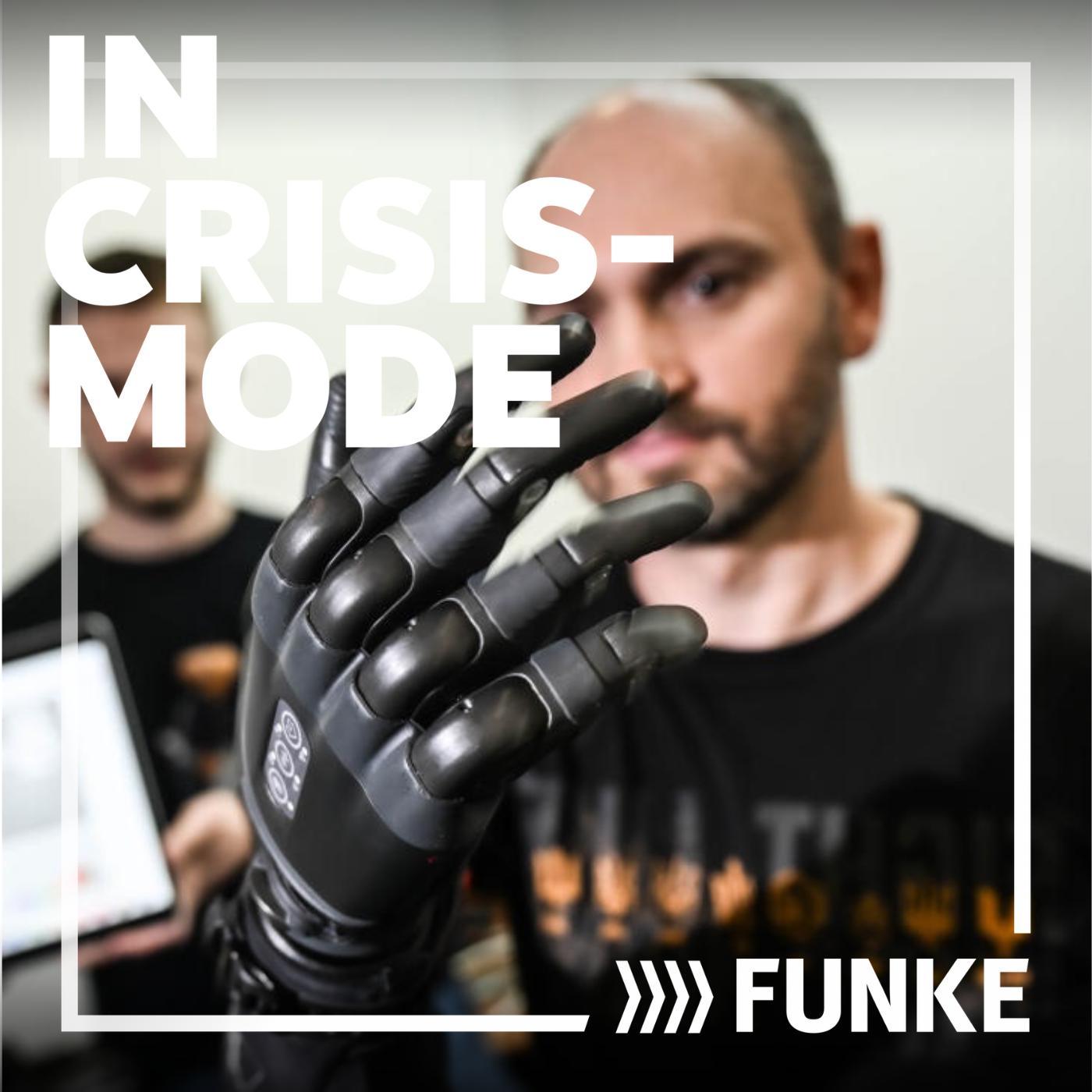
Jaroslav is an engineer in this rehab center. He explained to me how bionic high-tech prostheses work. These are prostheses that at first look super crazy. These are black prostheses, especially these arm prostheses. They are very flexible, so they somehow have 27, 28 functions. The fingers can be moved individually. With the help of AI muscle signals, patients learn to control their movements again.
So these prostheses are actually directly connected to the body sensations of the wounded. und die Prothesis, he explained, reacts zu nerve impulsen. Die Signals run from the brain through the nerves to the muscles. As soon as the muscles are activated, Sensors read these impulses and translate them into different commands for the Prothesis.
The Sensors can distinguish different types of signals and different signals mean different movements. This is based on artificial intelligence and machine learning. Michael Tiching. As I said, it really is high-tech, what is being offered there, what is being tested there. And certainly Ukraine will also, as in so many other areas, especially when it comes to weapons technology, also become a country from which the world can learn.
This will certainly become one of the centers worldwide where prosthetics technologies develop the most after this war. And certainly this will also be something because this extent of injuries, amputations, of course, we do not see here in Germany. But also here our prosthetics manufacturers learn, not for nothing, in this Titanovi Center, a large German prosthetics company is also active, which is basically conducting field studies there and observing.
And I think that through this war, as terrible as it is, prosthetics technology will get a new boost. And this will certainly also help people who have not been injured through military conflict and need prostheses. And I have to say, I was really deeply impressed. So Yaroslav first showed it in theory and afterwards came Alexander.
Alexander also works there as a bioengineer. Alexander was injured nine years ago. The war in Ukraine, you know that. It has actually been going on longer, not only since 2022, since the beginning of the Russian assault, but actually since 2014, when the Russian armed forces also occupied the Donetsk and Luhansk regions, where Russian separatists at that time attempted an uprising.
Back then, Crimea was also occupied by the Russians. und seitdem ein Krieg war. Besonders in der westen der Lande, nicht mit dem, was gerade passiert in Ukraine ist, aber es war ein Krieg. Und Alexander hat bereits verloren in dieser Krieg in 2015-2016 und jetzt ist er ein bioengineer, arbeitet dort auf der Seite.
Und er hat mir gezeigt, wie es funktioniert, und das war wirklich verrückt. So er hat die Prosthez und dann hat meine Hand. Und das war wirklich ein starkes Handshake, das er konnte mit seinem Gehirn kontrollieren. Und er hat mir auch gesagt, dass es nicht so easy zu handeln, diese Maschine zu handeln.
In the beginning, I had to work on training my muscles so that the prosthesis understands me. But over time, these functions become automatic. Today, I control the prosthesis with so-called phantom feelings. For example, when I think about moving my elbow down, the prosthesis automatically follows, because these feelings work exactly like tensing a real hand.
In the beginning, you have to concentrate hard when you're learning, and the prosthesis also has to get to know you first. But now it works. Wenn ich meine Elbowe nach unten mache, ich mache genau diese Bewegung in meinem Kopf und die Prosthesis reagiert, wie wenn ich meine Hande schreien. As I said, for me, I am a complete layman when it comes to things like this, but I really found it crazy that somehow it is possible with what you are just thinking.
Because our movements, the way we move are completely automated, as he just said as well. But you don't really think about how you move your hand, how you move your arm, and that this is possible with such an artificial arm. I found that really, really crazy. And this is certainly a technology that is still in its infancy.
But with the help of artificial intelligence, this will certainly become much, much more effective very quickly. und ich sagte zuerst, dass eine Hand nun hat 27 Funktionen. Das wird sicherlich werden mehr in der Zukunft. So, an einem Moment wird es dann automatisch automatisch. Die AI, so zu sprechen, learns zu readen Menschen's thoughts.
Und das, was ich sagen, ich fand es super interessant. Ein von den Soldaten ich da war Glib. Glib ist sehr, sehr jung, mit 20s, und Glib war also ein Soldat. Und survived ein Drone Attack, in welchem his Freunde died. You heard das in der Beginn, und er hat beide seine Hand und seine Lege. leg. Nevertheless, he told me that for him his life is basically beginning anew after this injury.
It was my second birthday as I say, but I lost both of my limbs due to tourniquet syndrome. After I was wounded, I actually didn't have any mental problems. Psychologically I understood that I will have some prosthetics and that's it, but when I adjusted classic prosthetics with Ilza. I understood that it doesn't work well for me because I have a very high amputation 12 and 5 cm of residual bone were left and it's not a lot and I have some complications like with walking because I need to put a lot of effort Ich habe einen Schritt, einen Schritt, einen Schritt, damit ich nicht fallgehe.
Und ich habe auch Probleme mit dem Sweat, und das ist warum meine Prostetik ist. Und ich war ziemlich depressed. So I walked like this around eight months and after I told no, I won't suffer the rest of my life and I will go for wasio-integration. And I dream about a bright future, you know. Wenn du durch den Center und du wirklich sehen, so viele sehr, sehr, sehr injured Leute, da sind Leute, die nicht mehr haben, wo die Hände haben, wo die Hände haben, direkt below die Hände haben.
Du sehen Leute, die nicht mehr haben. Du sehen Leute, wie Glib, die haben einen Arm und einen Legen verloren. Und in dieser Facilität, du hörst vieles Laugh. So die Leute ich da mette, der bei diesen Terribleen Injuries, at least most of die Leute, die ich sah, waren sehr, sehr full of life und hofft, dass Dinge weitergehen können. für sie.
Und das, wie ich gesagt habe, ich finde es auch total beeindruckt, weil es auch zeigt, ich glaube, was wichtig ist, das diese Leute sehen, dass sie nicht diejenigen, die sie nicht diejenigen, die sie verletzten, die sie nicht diejenigen, die sie verletzten, die in ihrer 20s oder in ihrer 30s plus haben, und wo man würde normalerweise denken, okay, ich habe verloren, verloren, verloren verloren.
Of course, ich also sehe, wenn ich dann auch schocken, wenn ich dann walken durch die streets, und das macht die Leute sehr depressed. Aber ich glaube, dass durch diese Gemeinschaft, sie erleben sich das, sie helfen sich aus diesen Depressionen und aus diesen Dörren. Ein Beispiel ist auch Ihor. Ihor ist jemand, der wirklich sieht schlecht aus.
Ihor ist, in Mikolaj, in der Beginn der Krieg, er war in der Militär academy, ein Officer und natürlich war er in den Combat Operations, von der sehr Beginn. Und in Mikolaj, er hat einen hit, wenn er in seiner Base war, und er wirklich sieht schlecht aus, so wirklich, wirklich bad aus. Der Gesicht ist verletzt, beide Hände sind weg, also verletzt.
Der Lung ist verletzt und auch seine Vögel-Cords wurden verletzt. Der Feuer hat er verletzt, so seine Gesichter sieht, als ob es hat er verletzt. Und jetzt arbeitet er als Psychologer in der Mitte. Ihor was, für mich, eigentlich such an example, a symbol of this Ukraine, this country that has now been experiencing war for three and a half years.
Many cities are destroyed, much is broken. Many, many soldiers have died. Tens of thousands, hundreds of thousands have been wounded. And still this country continues to fight. Still this country does not give up. And I thought Ihor was such an example of that. And after he was burned, he endured dozens of operations, lay motionless in bed for months.
And still, as I said, he does not give up. Of course, I see improvements. In the first three months, I just lay in bed. But it is a very complicated and tough process. Nevertheless, I feel progress. Yes, this voice you hear, this whispering, that is simply because his vocal cords are destroyed and his lung is destroyed.
He has such a tube in his throat and therefore, unfortunately, can only whisper. Aber das macht ihn nicht aus, dass er als Psychologer in dieser Facilität ist. Ja, und er hilft die anderen. Natürlich, ich auch frage mich, wie es wenn jemand sitzt in front of dich, die sieht wie Eihor, dass das nicht so etwas frightening oder disturbing für die Menschen sitzen in front of ihn.
Aber ganz klar, es hilft, und er hat auch eine gute Art von Menschen. Still, ich muss sagen, ich habe gesehen die Bilder von ihm von früher, wirklich ein junger, also sehr handsome Mann, und wenn du ihn jetzt sehen, Yes, then you really know how horrible and terrible war can be. The same also applies to Roman.
Roman was also injured relatively early in this war, in October 2022. He fired his anti-tank rocket at an armoured vehicle in which he was travelling with 12 other soldiers. All of those 12 soldiers died, he survived, but he was really terribly severely injured, so his entire right side of the body was affected, he lost his right leg, lost his right arm, Sein Kopf ist nur mit einem Titanium-Plaat, die sie in ihm geplant hat.
Sein Right Eye ist verletzt und Sein Right Ear ist auch. Er kann nicht hören. Er ist jetzt 46 Jahre alt. Er war da mit seiner Mutter. Er hat sich auf solche Geräte gearbeitet. Es ist wie in einem Gym, wo man einen Treadmillen hat, damit die Leute lernen, wieder zu gehen. Wo man auch andere equipment hat, für Muscle-Buildung. Und da hat er dann mit seiner Mutter trainiert, wie ich sagte, mit ihm.
Er war in Oktober 2022 die Anti-Tank rocket attack in which all his comrades died. Es war ein slow approach. Wir waren neben Kharkov in Richtung Lohask. Wir waren mit unserem Infanterie-Fighting Vehikel und in dieser Bereich, ein Anti-Tank Missile struck. Of den 13 Soldaten, ich war die einzige, die ich war.
Mit Roman, du hast ein bisschen das Gefühl, dass er ein paar ich da war, die nicht ganz so hopeful war, weil er auch gesagt hat, dass sie ihm ihm amputiert hat, dass er seine Legen incorrectly hat. Now they have to cut off another piece of it. And you had a bit of the impression that he was sitting in a hole.
But as I said, at least he had the support of his mother who was there. And the good hope was that her son would somehow get better again. Vladim, on the other hand, he is only 25 years old. And in July 2024, he was hit by an artillery shell near Kupyansk in the east of Ukraine. So he had a comparatively fresh injury, just about a year old.
And both his legs had to be amputated just below the hips. Und Wladim suffers von etwas called tourniquet syndrome. Tourniquets sind self-binding systems. Every soldier carries them. Wir auch als Journalisten, wenn wir zu den Fronten gehen. Diese sind self-binding systems, die Sie verhindern Sie von Ihnen zu sterben, wenn Sie sind.
Sehr oft ist das der Fall mit schrapnel-Injuries. Das ist, wenn ein projectiles explodieren, kleine pieces von metal fliehen, oder metal fragments, oder concrete parts fliehen, in jeder Fall schrapnel, which can cause large scale injuries that can among other things also damage the arteries and if you have arterial bleeding if no help comes you would bleed to death relatively quickly so you have these self binding systems these are things that you can bind around your arm or leg and then you pull them tight twist them further and then the blood flow is stopped that is of course a great thing for the first moment you don't bleed to death on the other hand because you cut off the blood flow the leg or the arm will eventually die if you do
not get help immediately or quickly So you can have the arms or legs tied off for a maximum of 2-3 hours without consequences. And very often in Ukraine right now, it is the case that soldiers lie in the trenches for a very, very long time after a wound because the medics simply cannot get them out. Because as soon as medics drive forward and try to evacuate people, Russian drones attack.
It doesn't matter at all whether you have an ambulance marked or whatever, they are attacked. And that means very often soldiers now lie 9 hours, 10 hours, Sometimes even days in the positions before they can be taken out. And if they then have these self-binding systems around the arm or the leg, then these limbs die.
Und das ist passiert zu mehr und mehr Soldaten, und das auch zu Wladim. Er ist jetzt in der Center, in der Intensive Physiotherapie, und, wie Glib, glaubt, dass mit modernen Prothesen, er kann wieder sein können. Ich kann nicht wearieren, weil ich eine sehr hohe Amputation habe. Ich erst habe ich den Bone oder es grow.
Physiotherapy hilft mir nicht zu mitdrehen, aber zu tun, und zu tun, und zu leben. Die Doctors sagen, dass es möglich ist, für Bone Extension, und sie sind optimistisch, dass ich später eine suitable Prothesis bekomme. Ich habe bereits gesagt, was mir in diesem Center der optimisten, die ich erlebte da, und auch dieses Gefühl, dass sie, in der wahrsten Sinne des Worten, wieder zurückgekommen werden, oder dass sie wieder nutzen können, oder dass sie wieder nutzen können.
Ich fand das sehr beeindruckend. So, dieses Vertrauen in die Möglichkeiten der Technologie, der Prostetik, und gleichzeitig auch dieses Optimismus, die Sie, das ist, wie ich gesagt, sehr remarkable. Perhaps it is also because this Titanovi Center in Kyiv clearly differs from hospitals I have been to in Ukraine or from other rehab facilities I have been to.
So most of the rehab facilities I have seen are simply, as you imagine, a hospital. It smells of disinfectant. It smells of floor wax. It is relatively plain and coolly furnished, ideally also somehow with white neon light, which makes the whole thing even worse. And in this Titanovi Center, it is completely different. When you walk in, you immediately have such a warm atmosphere There are many flowers and green plants, colourful pictures hanging on the walls, graffiti on the walls.
You hear music playing all the time from some loudspeakers. There are aquariums with fish in them. The whole place is furnished, very, very chill, nicely furnished. And then there are areas where you can play chess or where you can just talk and chat a bit. Then there are also many volunteers working there, young people who help the wounded do their exercises, and all of it in a very, very family-like atmosphere.
Und ich denke, dass das natürlich auch hilft die Soldaten zu machen, ihre Rehabilitationen in so einer Umgebung. Es ist auch so eine energetische Ort. So, man sieht von den Leuten, of course, was sie haben, was sie durchgeführt, was sie durchgeführt haben. Viele von ihnen, wie Roman, also Glib, also Ihor, haben bereits viele Operationen, still basically suffer von pain und natürlich von massive Bewegungsrechtschränkungen.
Nevertheless, für sie, es geht etwas über ein bisschen weiter, und ich fand das sehr moving, als ich da war. Es gibt keine Situation, wenn ich... Die Atmosphäre hier ist inspirierend. Es ist nicht wie in einem Krankenhaus. Diese Atmosphäre hier inspiriert dich zu wollen, zu bleiben. Aber es ist auch hier, die Atmosphäre, die Atmosphäre, die es nicht so, um weiter zu leben, um zu leben.
Aber natürlich ist es ein sehr beeindruckendes von Ihor, dass er fühlt sich inspiriert zu bleiben, besonders Ihor, der noch mehr conspricht, oder sogar worse, als die anderen Soldaten, einfach weil sein Gesicht ist weg. Und natürlich, wenn er aus in der ganzen Welt ist, Leute sehen ihn und er wird, natürlich, stand out.
Und trotzdem, er sagt er, er will, und ich dachte, das war toll. Er unterstützt auch andere Menschen, er arbeitet als Psychologer in diesem Center. And still, of course, this whole country will suffer from this war for years, decades, and will suffer after this war. By now in the cities, you also see very many wounded. At the very beginning, it was such that you somehow had the impression these people were more or less being hidden away in some facilities.
Possibly it was also about not weakening the morale of the population. But by now, people have become used to the sight of people who have undergone amputations. Very many of the wounded, of the disabled, also wear these prostheses quite openly. So, for example, they roll up their pant legs so that you can see the leg prosthesis.
And I believe this is now a site that, of course, we in Germany are no longer at all accustomed to, that existed with us in the First or Second World War, that you saw all these war invalids. But in Ukraine, that is by now everyday life. And as much as this Titanovi Center, of course, helps these people, and as great as it is that such initiatives exist, this Titanovi Center is also a private institution founded by a former officer to help the wounded and it lives from donations, this center.
And as great as all this is, but of course you simply see how shitty war is when you are together with these people, when you speak with them, no matter how optimistic they are, no matter how hopeful they are. There are people who have been wounded by a war that Russia brought over Ukraine. It is a war that still does not end despite all these peace negotiations that supposedly are now being conducted or despite all the peace negotiations that are currently being conducted.
This war continues, and certainly many, many young people will still suffer from this war, will be wounded in this war. Young people who definitely had other plans in their lives than to become soldiers. Most of them at least, of course, there were also professional soldiers among them, but the great majority certainly had other plans in their lives.
And very certainly they did not want to lose their legs or their arms in a fight that was forced upon them. And of course the question is also how will it continue with these young people that I met there, oder mit diesen Menschen, mit den Wohnden? Wie werden sie in die Zukunft integriert? Was für die Arbeit für sie? Will Barrier-Free opportunities werden in Ukraine gegründet?
All diese sind offen Fragen, die immer noch zu beantworten. Aber das Worte muss immer wieder enden, einfach nur zu preventen Menschen wie Ihor, wie Roman, wie Glib oder wie Vladim, von zu fangen, zu schweren Injuries zu gehen, und zu gehen durch solche Rehaben. That is why, as I said, I hope that somehow this will soon be over, that Russia will somehow be forced to stop and end this aggression, and that there will no longer be any wounded.
Of course, also on the Russian side, that also belongs to it, that also among the Russian soldiers, very, very, very many are wounded, including also very, very many young people who, just like the Ukrainians, probably imagined their lives in a completely different way. This was In Crisis Mode. This episode was produced by Alexander Baumeister, who is also a journalist at the radio station of the Funker Media Group.
Feel free to follow us so you don't miss our special episodes which we occasionally insert on current topics. Normally you can find us every other Wednesday. Please leave a review. It helps us a lot to make our work more visible. Also feel free to recommend us to your friends, acquaintances and relatives if you enjoy In Crisis Mode.
I look forward to having you with us again next time. Until the next episode, take care. Bye bye. Music.
