

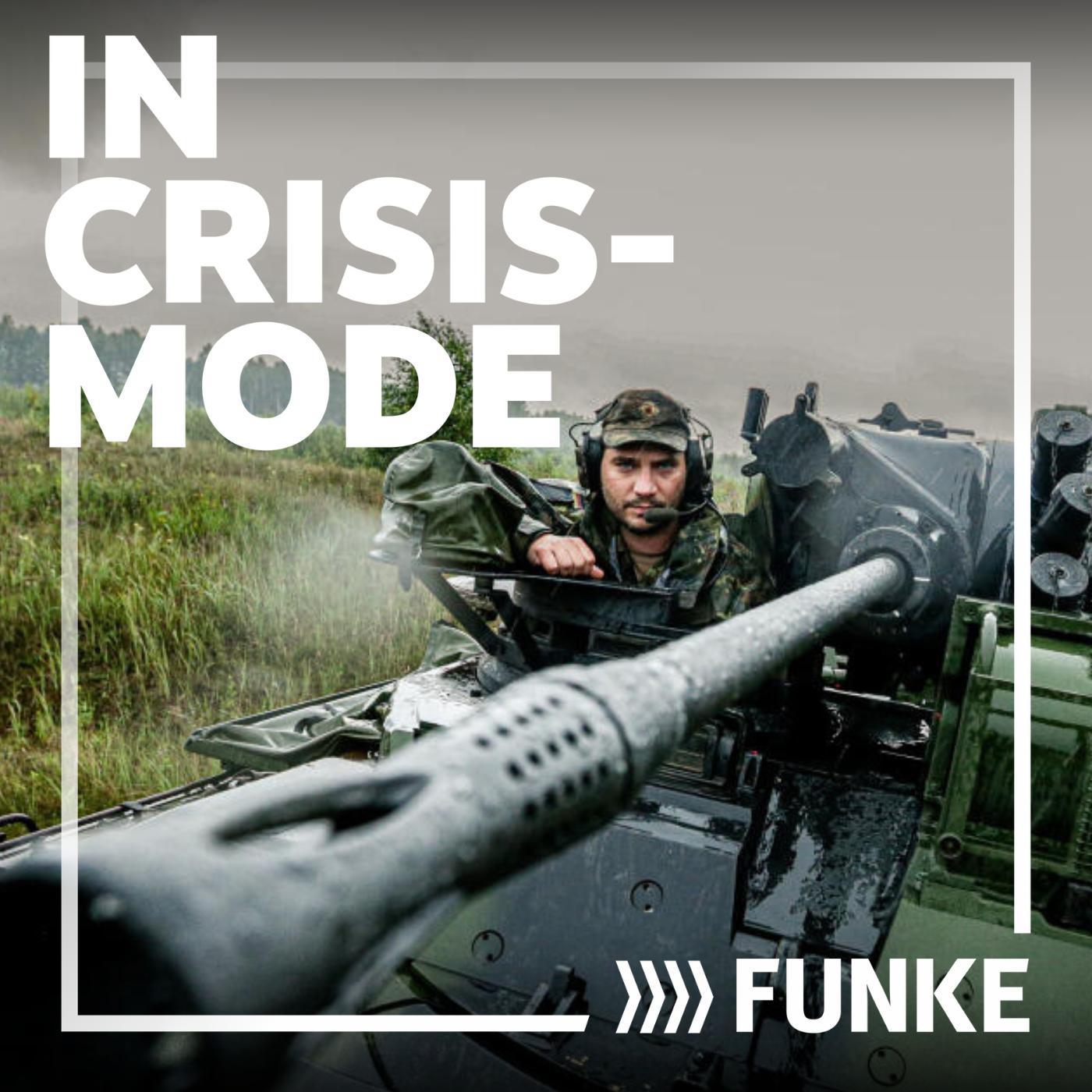
Im Krisenmodus· Folge 107
German Armed Forces in Lithuania – NATO Brigade Positioned on the Frontline
Mittwoch, 20. August 2025 · 23 min
Kapitelklicken springt direkt hin
Shownotes
Tanks, Patrols, Permanent Mission:
What is a German Marder infantry fighting vehicle doing in the Lithuanian forest? How is the Bundeswehr preparing for a possible war? In Lithuania, NATO’s deterrence force is gaining a new unit: Armored Brigade 45.
In this episode of In Crisis Mode, FUNKE’s war and crisis reporter Jan Jessen speaks with soldiers and Brigadier General Christoph Huber about daily life in the multinational battalion, the psychological strain, and family life. First-hand impressions and voices from between the training grounds and geopolitical reality.
And Jan asks: Are tanks still relevant in the age of drones – or are they a relic of past wars?
👤 Guests / Interviewees
• Christian, Master Sergeant, Tank Commander
• Dennis, Private First Class, Armored Infantryman and Driver
• General Christoph Huber, Commander, Bundeswehr Brigade Lithuania
• Marcel, Corporal, Driver
• Malte, Senior Corporal, Gunner
🧭 Chapter Overview
1 | Ten Seconds to the Outside – with Christian in the Marder
Jan rides along with Master Sergeant Christian. They discuss everyday life in the infantry fighting vehicle, the proximity to the Suwałki Gap – one of the most sensitive points on NATO’s eastern flank – and how to balance family life with deployment.
2 | Heavy Equipment, Heavy Responsibility – Dennis on His Tank
Dennis shares his enthusiasm for the “coolest job in the world,” talks about responsibility during missions, and explains what the Bundeswehr contributes to NATO’s mission in Lithuania.
3 | Ready for the Real Thing – General Huber and Marcel
General Huber explains why Armored Brigade 45 must not only train but also be ready for real combat – and what message it sends to Russia. Marcel talks about training within the multinational force.
4 | Training, Deterrence, and Jan’s Conclusion
Malte emphasizes the high quality of training and how they deal with fear. General Huber discusses deterrence as a core mission. Jan wraps up with the hope that the worst-case scenario never comes.
📬 Contact & Feedback
Questions, criticism, suggestions? Write to us:
✉️ krisenmodus@funkemedien.de
🟢 Subscribe Now
In Crisis Mode – available wherever you get your podcasts:
Spotify (open.spotify.com/show/0IQW1w25NYSrz60aAPzwvB?s…) | Apple Podcasts (podcasts.apple.com/de/podcast/im-krisenmodus/i…) | Deezer (deezer.com/de/show/3737197) | YouTube (youtube.com/@Krisenmodus-Podcast_FUNKE)
📅 New Episodes
Every two weeks, always on Wednesdays.
In Crisis Mode is a podcast by the FUNKE Media Group.
Transkriptvom Podcast bereitgestellt · Zeitmarken springen hin
Ten seconds. That's all the time there is. When things get serious, it has to happen fast. When the rear ramp of the Marder Infantry Fighting Vehicle drops, the six soldiers in the back have to be out, fully equipped in just ten seconds. Ten seconds to get outside. Ten seconds into a situation where shells are hitting, where the noise of battle is deafening, where the bloody reality of combat unfolds.
I'm in Lithuania, not far from the border with Belarus, in a region considered the most vulnerable in all of NATO territory. For nine years now, a NATO force has been stationed in Rukla, made up of soldiers from several countries. Germany leads the mission, but troops from the Netherlands, Norway and other NATO members are also part of it. Units rotate every six months.
But now, something is changing. The multinational battle group will become part of a new structure, Armored Brigade 45. Für den ersten Mal, Deutschland wird permanent ein Major-Military-Unit outside ihren eigenen Bordern. Es ist ein wichtiges Schritt, und sicherlich eine andere Signale, dass wir in der Mitte der was Germany calls a turning point in History, set in motion by Russia's full-scale Invasion of Ukraine in 2022.
Der Vision für Armored Brigade 45 ist eine stark-armende, state-of-the-art, highly-capable combat-formation. Two of its three battalions will be permanently in Lithuania, Panzergrenadier, Battalion 122 from Oberwirktag in Bavaria, and Panzer Battalion 203 from Augesdorf in North Rhine-Westphalia. The third element, the multinational battle group that has been in Rukla for nine years, will also be part of the brigade, though it will not be permanently stationed there.
The brigade is currently building up its strength. In the end, it is expected to comprise up to 5,000 soldiers, main battle tanks, infantry fighting vehicles, armoured recovery vehicles, ammunition depots, workshops, a wide array of drones, and more, all stationed in Lithuania. Es ist eine massive logisticale undertaking, und, als erwähnt, diese Brigade wird in der größten Bereich der NATO-Aliance, near die sogenannte Suwauki Gap.
Die Suwauki Gap ist ein 65-km-strip von Land zwischen Poland und Lithuania, regarded als NATO's most strategically vulnerable point. Wenn Russland war zu launchen, either von Belarus oder von Kuliningrad, und sieben Kontrolle, this corridor, the Baltic states would be militarily cut off. In other words, this is one of NATO's weakest points.
In the event of armed conflict with Russia, this is likely where Moscow would strike first. I travelled to Lithuania to meet the soldiers on the ground, to talk with them about how they view the war, how they see their mission, the state of morale, and what it feels like to serve so far from home. One of them is Christian, a soldier I met in Rukla inside a Marder infantry fighting vehicle. He is the commander of that Marder.
I always like to say, peace and security aren't something you can buy at a gas station. They require people who are willing to stand up for them. Music. In Crisis Mode, The podcast from Conflict Zones with Jan Jessen. Hello, I'm Jan Jessen, Head of Politics at Neue Ruhrzeitung and War and Crisis Reporter for the Funker Media Group.
You can read my reports in the Hamburger Abendblatt, the Berliner Morgenpost and other Funker newspapers. In this episode, I'm taking you to NATO's eastern flank, specifically to Lithuania. Here, a new brigade is being formed, die erste major Bundeswehr-unit nicht permanent in Deutschland, aber abseits.
Das ist unbezündet, etwas das nicht seit dem Forderung der Bundesrepublik Deutschland. Es ist ein sehr sensitives Missions. Auf einer Seite, Lithuania ist, in der NATO-kontext, arguably die größte Region der Suwauki-Gap, ein langer Land-corridor zwischen Poland und den Baltischen Ländern. It's flanked on one side by Belarus, Russia's closest ally, and on the other by Kaliningrad, the heavily militarized Russian exclave.
On the other side, it's not the first time Germans have been in Lithuania. Between 1941 and 1944, the Wehrmacht occupied the country, committing horrific crimes, killing, murdering many, particularly Jewish people. That historical weight is always present in such deployments, requiring a special sensitivity from the German soldiers stationed here.
I also spoke to people on the ground about that. In Rukla you see the Bundeswehr soldiers in the streets. They seem to be welcomed here. The night before we met them, we had dinner in a restaurant where several soldiers in uniform were also present, chatting with locals. The relationship between the military and the town seemed very good.
Ruckla itself is a small place, just a few thousand residents, so the presence of uniformed soldiers is noticeable. The next day we visited the barracks of the multinational battle group. The soldiers currently on rotation from Germany are from the Panzergrenadier Battalion 411 in Mecklenburg-Worpommern.
They've only been here for a few days and are still settling in. Whenever units rotate, as they call it, everything has to be set up from scratch. Sie sind in den nächsten Jahren wiederholen. Einmal von Christiaan war Christiaan, ein 40-jähriger Master Sergeant und Kommander von ein Marder Infantry-Fighting Vehikel.
Der Marder ist relativ klein und agile. Its purpose ist, dass sie sechs heavily-armen Soldaten mit Antitank-Weapons, Maschine-Guns, Assault Rifles, Grenade Launchers, in die Battle. Once aufsicht, sie entdecken unter den Cover von der Marder's Turret-Mounted Heavy Machine Gun, oder Auto-Cannon, die mit Suppressiv-Firren.
Christian war die einzige in den Crew, die in Rukla war, in 2022, als Russland launched its full-scale invasion of Ukraine. Wenn er sich zurückkehlt in 2027, die Panzer Brigade 45 wird vollständig erholt, und er wird nicht mehr fahren, die Model wird wiederholt. Instead, er würde die Puma S1, its modernen Replacement, als Teil der Brigade, die nur die newesten Hardware beitragen.
Leopard 2A8 main battle tanks, PZH-2000 self-propelled howitzers and a range of advanced systems including drones, ground-based surveillance and so-called loitering munitions or kamikaze drones. Panzer Brigade 45 is planned to be a high-tech, heavily armed formation and the Bundeswehr's mission in Lithuania is not just routine training.
The aim is deterrence, to build a force strong enough to prevent Russia should it ever consider such a move, from attacking NATO. The most likely scenario, experts say, would be an attempt to seize the Suwalki Gap, cutting off the Baltic states from Poland and the rest of NATO. This is why the unit is being equipped with the best and most powerful systems.
Christian, as I said, was here during the 2022 rotation, witnessing the outbreak of war in Ukraine. He reflects on it. Of course, the war in Ukraine hasn't passed us by. Every day we try to do our homework, drawing as many lessons as possible from the conflict." This new brigade is also a sign of the Bundeswehr's changing self-image.
It's not the first time German troops have been deployed abroad, Afghanistan for example, where they saw combat, including the infamous Good Friday battle in which three soldiers were killed. Those missions were traumatic but also offered learning experiences. Since Russia's invasion of Ukraine in February 2022, and with the changing relationship with the United States, the Bundeswehr is repositioning itself.
Massive sums are being invested to make it a modern, capable force. There's room to debate whether this money could be better spent, or whether Europe should first coordinate procurement systems and defence policies instead of each country spending billions on its own military. But that's a political discussion for another stage. Für die Bundeswehr, this shift means moving forward and many in the Baltic States and in Poland welcome Germany's new leadership role.
There is less fear of a rearm Germany and more appreciation that it is taking responsibility and showing it can act without and when necessary independently of the Americans. In that sense, Chancellor Scholz's statement at the start of the war that we are in a Zeitungwende, a turning point, applies just as much to the Bundeswehr.
Der Ziel ist, die Bundeswehr in der wahrsten Sinne zu machen, dass die Bundeswehr »kombat-ready« in der wahrsten Sinne. Ein Wort, das einige Menschen flinchen, aber es ist genau das, was passiert. Das ist nicht nur ein technisches, logistisches und finanzielles Herausforderungs. Es ist auch ein menschliches Herausforderungs.
Soldaten, die lange Stretze von Hause spenden, haben Familien hinterher. Und das nimmt einen Sinn. Natürlich habe ich Christian, der Marder-Kommander, gefragt, wie seine Familie damit handelt. Of course, my family always worries, but the good thing is, we can stay in touch every day. I can call home whenever I want, that's no problem. Still, I think it's the family who suffers the most.
My partner is at home, lying alone in our bed, going through daily life in our apartment without me. And of course, the rest of my relatives feel it too. It's hard for them, but I tell them every day, there's no need to worry. We're doing fine, we've got each other. Everything's okay. Passt alles. Für eine Teil der Panzer Brigade 45, die separation von Familie wird nicht so lange.
Wie ich vorhin schon erwähnt, der drei Battalien zu machen, zwei werden hier permanent werden, während der einen weiterentwickelt werden, jeden jeden sechs Monate. Die permanenten Soldaten und die Zivilisten werden hier für Jahre, vielleicht sogar für Jahre, um ihre ganze Karriere in Lithuania zu machen.
Das ist deshalb, nach dem Wilk, ein komplett neu Bundeswehrkomplex ist unter der Konstruktion. Barracks, Kindergartens, Schools, Housing. The Lithuanian government is funding the entire project because it wants Germany to have a strong presence here. Building infrastructure for more than 3,000 people is a massive undertaking, but it's being pushed forward with urgency.
Panzer Brigade 45 is also a prestige project, initiated largely by Defence Minister Pistorius and now backed across the political spectrum. Shortly before our visit, Finance Minister Kling Beil was here. When the brigade's creation was officially celebrated in Vilnius, President Steinmeier was present as well.
It's a high-profile project in both Germany and Lithuania, and work is moving ahead quickly. The soldiers I spoke with are pleased about it. Serving in Lithuania, in a place where something could actually happen, gives their work a sense of purpose. One of them is Dennis, the driver of Christian's Marder infantry fighting vehicle.
I have to say, I think it's the coolest job, driving heavy equipment. Ich denke, das ist jeder Mann's dream. Aber es ist auch ein großes Problem. Heavy equipment, ein großes Problem. Still, es ist ein großartiges Posting. Dennis clearly enjoys his job, aber driving ein Armored Vehikel ist nichts, aber safe in combat.
In einem anderen Video, die wir in den Show Notes haben, wir über Oleg gesprochen haben, ein junger Mann in Ukraine. Deutschland hat über 140 Marder IFVs zu Ukraine. Mehr als 40 haben bereits verletzt oder verletzt. Wenn ein Marder ist, die Crew suffers, auch. Oleg war ein Gunner in ein Bradley 1FV, similar zu dem Marder.
In July 2023, er hat seine Fahrer verloren. Later, er hat sich selbst getötet, wenn ein Rockets explodiert in sein Auto. Wenn die Worte passieren hier, Dennis hätte nicht beschreiben sein als der coolen Job ever. In combat, dein Leben ist auf der Linie. Seeing ein verletzter IFV in Ukraine macht es klar. Wenn sie ein direktes Mal sehen, ist der Fall der Bundeswehr.
Still, Dennis hat er gesagt, warum er in der Bundeswehr ist. Und es ist worth noting, die Soldaten ich hier habe, wurden von Bundeswehrsitzungen verabschiedet. Diese waren nicht randomen Gespräche. Critical remarks waren nicht zu beobachten. Aber es ist noch nicht so, dass sie ihre Reasonscheinungen sind.
Der Bundeswehr hat immer eine sehr gute Aufgabe. Und wenn du acht Jahre alt bist, You get three years of federal support afterwards to train for any profession you choose. You get funding, you get help. You don't have to worry about money, even after your service. In Rukla, Denis, Christian and the rest of the multinational battle group serve six-month rotations.
They keep operations running, train intensively for possible combat and work alongside troops from other NATO nations. A few kilometers away in Vilnius, the Lithuanian capital, sitzt Brigade General Christoph Huber. His office is in a sleek, black-glass building that houses several Lithuanian start-ups, an unlikely setting for the Bundeswehr's forward command.
On the 7th floor, Huber's task is to build Panzer Brigade 45 from the ground up. Right now, only the brigade headquarters, a signal unit and a headquarters support company are in place, about 600 personnel. The goal is to have the brigade fully operational by the end of 2027. Huber explains why this is so important.
Ich denke, deterrence ist etwas, was man mit einer einfachen Idee ist. Wenn man peace will, ist es für Krieg. Das ist die Grunde der Grund, was wir hier machen. Wir haben eine komplett-reitige Brigade, bis Ende 2027, damit wir, dass wir, dass wir hierher und nicht weitergehen können, dass wir hierher und nicht weitergehen können. Das hierher und nicht weitergehen können.
Das ist die Art von Blunt-Language, you wouldn't have heard from the Bundeswehr 20 or 30 years ago. Back then, even in overseas deployments like Kosovo, the focus was on rebuilding bridges, not preparing for actual combat. I remember a visit to Kosovo a few years after the war ended. In Prizren, a Bundeswehr captain told me for the first time, a soldier's core competence is to kill and be killed.
That marked a shift away from the citizen-in-uniform image. Now General Huber is explicit. Der Ziel ist, dass wir als NATO uns auf alles vorbereiten. Als NATO, wir vorbereiten für alles. Unsere Aufgabe ist es, dass wir Freiheit, Human Rights und Dignität haben. Wir schützen alle letzten Zentimeter von NATO-Territory. Das ist eine 360-degree Mission.
Und in NATO's defense planning, Panzer Brigade 45, under the 10th Panzer Division, ist eine große Puzzle. Die Frage ist, wie man sich für die Krieg vorbereitet für die Krieg, besonders in einem multinationalen Ort wie die Rukla-Battlegruppe. Es ist nicht nur die Deutschen hier. Es gibt Soldaten aus Norwegen, den Niederlanden, die Czech Republik, Lithuania und andere. One of them is Marcel, who, if the worst came, would sit in the rear compartment of the marder, jump out, and fight on the ground.
He told me what he expects from this deployment and what it means for him back home. My expectation is to gain certain experiences here, learning from people on a multinational level, from comrades from other countries, and simply the experience of being away from home for a while. Sponsor aus der Exerzene. Aber er auch glaubt, tank weapon plus a machine gun and so on, you have to be extremely well trained to get out as quickly as possible because the vehicle can't stand still for long, anything stationary in combat is a target or at least an easier one.
If it's moving, it's safer, simple as that. So the soldiers have to dismount very, very quickly. That's what they're training for. But of course, in the end, you never truly know what will happen when it's for real. During exercises, you always know it's und exercise, no matter how realistic the conditions.
You know, the ammunition going off are training grenades, training rounds. And in the worst case, when it's no longer training, it's deadly serious. And Marcel knows that. Mentally, that's always hard to answer in advance. When we train, we know it's training. And when things really go off, you know this is pure reality.
Then it's about relying on how I've been und wir werden das tun, definitiv. Ich glaube, unser Training ist sehr gut. Das ist deshalb schwierig, dass es direkt zu der Realität nicht wirklich verwendet wird. Ich denke, es ist einfach nicht wirklich verwendet. Es ist immer ein mentaler Ding, wenn man rausgeht.
Wahrscheinlich, mit Soldaten, There are those who can handle it and those who can't. In my encounters in Ukraine, it's always the same. Some manage to cope with war and their fear, others cannot. And those who freeze up when the shooting starts, unfortunately they are often the ones who end up killed.
Another soldier I spoke to, Malte, believes their training will help them keep a clear head in an actual combat situation. You notice these soldiers have often been together for quite some time. There's a strong sense of camaraderie. They even say they're basically like a family. Senior Medic Christian says it's hard being away from your family at home, but also that they are a kind of substitute family here.
They know each other well, they train together, and that matters. Like a good football team, everyone has to know what the other is doing. That's why this constant training really does help prepare for the real thing. Of course you think about it, but we've had a lot of training, und ich würde sagen, wir sind relativ gut vorbereitet für eine mögliche real-world-Mission.
Die Kameraden sind gut vorbereitet und wir alle zusammenarbeiten. Wir können und vertrauen auf die Person neben uns. Angst ist immer da, wie ich gesagt habe, aber wir haben es. Was klar ist, diese Leute sind vorbereitet für das Schlimmste-Szenario. Wie jemand anderes, ich hoffe, es niemals kommt. Aber given was passiert in Ukraine, es ist wichtig, dass die Bundeswehr entsprechend trainiert, dass es für die Worte vorbereitet, und dass Deutschland auf die Worte verantwortlich ist.
General Huber hat es sehr klar, was das ist. Das ist die Vorbereitung für die Worte. Nicht weil wir es wollen, sondern weil wir es wollen, sondern weil wir es so können, dass wir es so können. Die Worte in Ukraine hat alles verändert. Es beginnt mit dem Fakt, dass die Worte mit der Trump-Administration und den USA wurden grundsätzlich strahlen seit Trump zu tun.
Europe knows it now has to take responsibility for its own defense and security policy. The war in Ukraine has drastically changed the conduct of war. The pace of new weapons development has been astonishing, especially drones, which we've already talked about. These developments have changed everything in a lasting way.
The Bundeswehr will have to adapt. I asked General Huber whether a tank brigade like Armored Brigade 45, with main battle tanks, infantry fighting vehicles, and artillery systems, will even be viable in the future, or whether they're relics no one needs anymore, given that future wars will be shaped by drones.
He was clear, things are changing and they're adapting. Armored Brigade 45 will also be equipped with loitering munitions, kamikaze drones, reconnaissance drones, counter-drone systems and more. He also believes future wars will still be fought with armored vehicles. I'm not sure. I've seen how heavy equipment like tanks are destroyed in Ukraine by relatively cheap drones.
You have to wonder whether such mechanized brigades will remain viable in the long run. But that's a process that's constantly changing and adapting. And the people in charge are aware of that. They're also aware they're operating in a sensitive environment in Lithuania. Not only because it's the most threatened area in NATO territory, but also because of Germany's historical responsibility in the region.
From 1941 to 1944, Nazi Germany occupied Lithuania and committed horrific crimes there. The Bundeswehr says it bears a special responsibility because of that. Huber told me that in May, German soldiers helped document headstones in a Jewish cemetery so the dead would not be forgotten. Er sagte dies war sehr gut in Lithuania, wo die Leute verstehen, dass Deutschland nicht versucht, die Geschichte zu verhindern.
Er sagte auch, dass, wenn gefragt ob die Soldaten, die Kontrolle ist, er hat die Lithuanien sind mehr von der Geschichte unter Soviet occupation bis zur Verkaufung des Warschau-Pakt und der Soviet Union als bei den Zeiten von der Second World War. In his view, Lithuanien sind sehr glücklich die Germans sind da um sie zu helfen, um sie von Russland zu helfen. Wir haben viele Ziele.
Israel, Ukraine, Syria, Afghanistan, you name it. Those were active conflict areas. This here is different. You're in a place where people are preparing for a war. In Rukla or Vilnius, when you speak with soldiers who have no combat experience yet, they follow events in Ukraine closely, watching what their Ukrainian comrades go through on the battlefield.
Thankfully, they themselves have not experienced combat, but they are doing everything they can to prepare for it, a situation that will hopefully never come. Personally, I believe Russia will never attack NATO. The soldiers and the general agree deterrence is necessary, given Russia's aggression against Ukraine.
I think attacking NATO would be too big for Russia. It would overwhelm their military capabilities. I hope and believe it will never happen. Still, it's essential to prepare, to train, to be mentally ready. Yes, we can argue endlessly about whether rearmament is the right path. The money could certainly be spent elsewhere, on schools, kindergartens and so on. But the world is unstable, in turmoil, and it's wise not to neglect security policy.
That was in crisis mode. The podcast was produced by Alexander Baumeister, also a journalist with the Funke Media Group's radio station. If you enjoy our podcast, follow us on Apple, Spotify, or wherever you listen, and leave a review. It helps make our work more visible. I look forward to next time. Take care. See you soon.
