

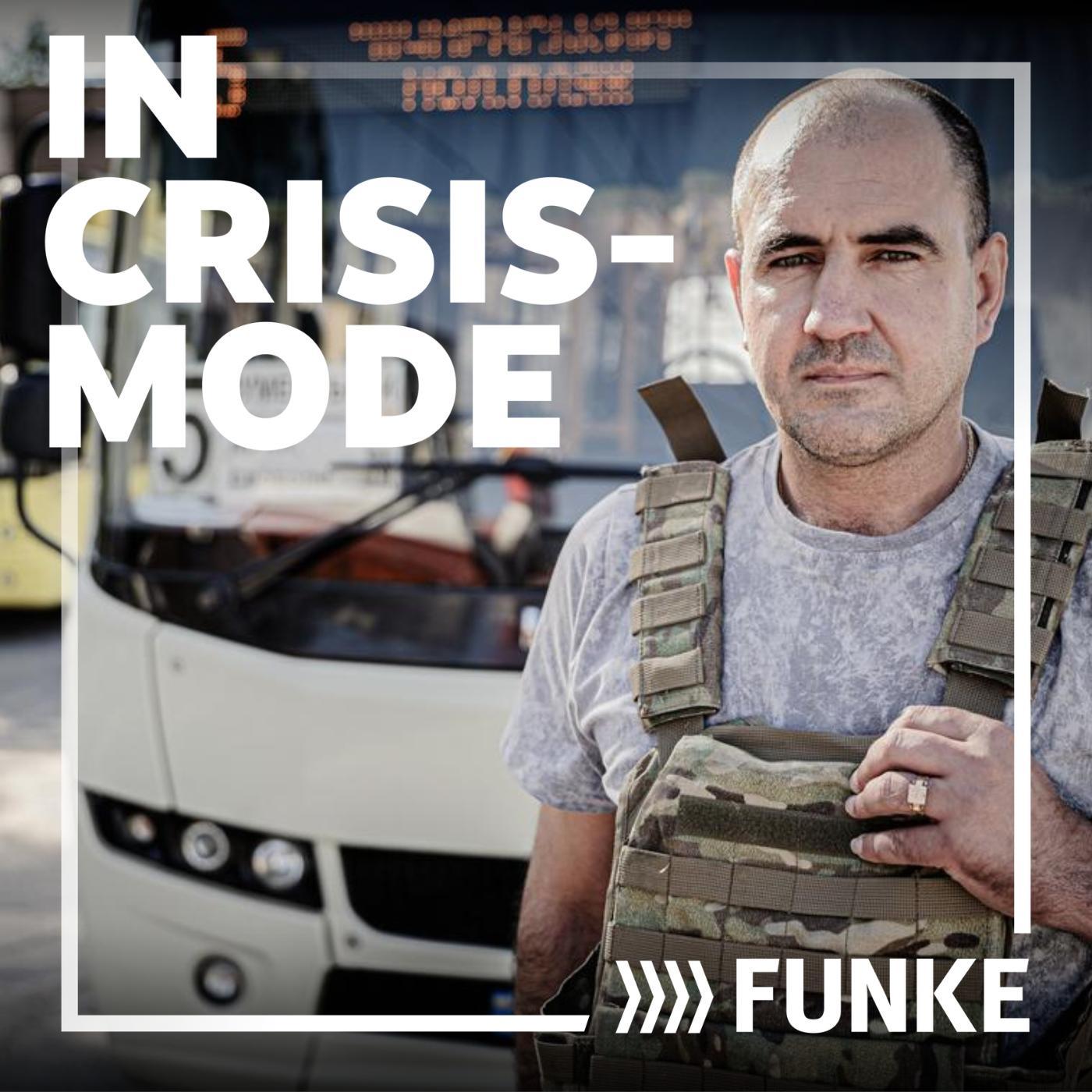
Im Krisenmodus· Folge 163
Kherson Under Drone Attack: How a City Survives in the Shadow of War
Mittwoch, 22. Juli 2026 · 25 min
Kapitelklicken springt direkt hin
Shownotes
This episode was made with the help of AI.
Kherson is one of the most dangerous cities in Ukraine. Since its liberation in the fall of 2022, the city has faced almost daily attacks from Russian-occupied territory across the Dnipro River. Today, the greatest threat comes from drones that target buses, first responders, and civilians going about their everyday lives.
FUNKE war reporter Jan Jessen traveled to Kherson to meet the people living and working under this constant threat. Maksym has been a bus driver for 17 years. Today, he wears body armor and a helmet, trained to get his passengers to the nearest shelter during a drone strike. Oleksandra Knyha works in theater and supports local children alongside her family, organizing cultural events and trips to safer regions so kids can just be kids, if only for a short time. Liudmyla Rubanyak has spent nearly every night for three years in a basement shelter with her neighbors. While drones circle overhead, this underground sanctuary has become the only place she can find peace.
This episode is a report on how public transit, cultural work, and community support keep a city alive—and how everyday tasks become life-threatening in times of war.
Featured in this Episode
• Jan Jessen – Head of Politics at NRZ and War/Crisis Reporter for FUNKE Media Group
• Maksym – Bus Driver in Kherson
• Oleksandra Knyha – Theater Maker and Community Helper
• Liudmyla Rubanyak – Basement Shelter Resident in Kherson
• Oleksandr Prokudin – Governor of the Kherson Oblast
🧭 Chapter Markers
• [01] Life in a City Under Drone Attack
• Jan Jessen introduces daily life in Kherson—a city where bus drivers must learn to dodge drones.
• [02] Maksym and the City’s Buses
• A bus driver shares why he keeps driving despite daily dangers, and why residents rely on public transit.
• [03] When the Drone Detector Sounds
• Maksym describes a drone strike on his bus and explains what drivers must do in a matter of seconds.
• [04] Theater and Childhood Under Fire
• Oleksandra Knyha discusses keeping cultural work alive and why her organization brings children out of danger zones.
• [05] When Night Falls in Kherson
• As darkness sets in, residents retreat from their apartments into bomb shelters.
• [06] A Night in the Bunker
• Liudmyla Rubanyak describes life underground and why a damp basement has become her sanctuary.
• [07] How a City Endures
• The next morning, the buses run again. Jan reflects: Kherson functions because people carry out everyday tasks that have become life-threatening in war.
📬 Contact & Feedback
Questions, comments, or suggestions? Email us at:
✉️ krisenmodus@funkemedien.de
🟢 Subscribe Now
Im Krisenmodus – available on all major podcast platforms:
Spotify (open.spotify.com/show/0IQW1w25NYSrz60aAPzwvB?s…) | Apple Podcasts (podcasts.apple.com/de/podcast/im-krisenmodus/i…) | Deezer (deezer.com/de/show/3737197) | YouTube (youtube.com/@Krisenmodus-Podcast_FUNKE)
📅 New Episodes
Every two weeks, Wednesdays.
In Crisis Mode is a podcast by FUNKE Media Group.
Transkriptvom Podcast bereitgestellt · Zeitmarken springen hin
Die Übersetzung von Jans Stimme vom Deutschen ins Englische wurde mit einer KI erstellt. Imagine you take public transit and at the start of your journey you don't even know if you will reach your destination because a drone might strike the bus or the trams. How does a city live when bus drivers have to learn how to outrun drones?
When children are actually supposed to be evacuated yet thousands stay anyway? And when for many people the day doesn't end in their own bedroom but in the basement? A few days ago I was in Kursen in the south of Ukraine. Ich habe mich mit Menschen, die genau wie das Leben leben. Ein von ihnen ist Maxim.
Er hat die Buss-Bus in der Stadt seit 17 Jahren gearbeitet. Und jetzt ist er, dass er nicht mehr die Zeit über die Zeit über die Passagierungen ist, sondern eher wie ein Drone-Attack zu überleben. Ja. Drone-Attacks haben sich sehr viel erhöht. Es gibt auch immer noch die Artilie-Shellung. Aber Artilie-Shellung ist Artilie-Shellung.
Wir haben gewohnt es, zu einem bestimmten Fall. However, when drones attack, it's something else. We are equipped with electronic tracking devices, so it can be frightening when a signal appears on the screen and you realize a drone is circling nearby. We also wear additional protection, a helmet. And in moments like that, you have to act quickly and try to get people to the nearest shelter as fast as possible.
How does a city and the residents endure something like this? That is what this episode is about. In Crisis Mode The Podcast from Conflict Zones with Jan Jessen. Hello, I am Jan Jessen, Head of Politics at the NRZ and a War and Crisis Reporter for the Funke Mediengrupper. You can find my articles in the NRZ, the WAZ, the Berliner Morgenpost, the Hamburger Abendblatt, and on our online portals.
A few days ago, I was traveling in Kherson, a city in the south of Ukraine. It is a city we have reported on many times here in this podcast. We will put a few of those episodes in the show notes for you. Kurson is unique because it was occupied by the Russians in 2022, was liberated in November 2022, and now faces the problem that it sits on the banks of the Dnipro River, which flows through Ukraine.
The Russians are positioned on the opposite side of the river, and they have been shelling the city every single day since its liberation. They use artillery, mortars, and now, in recent months and years, primarily drones that they unleash into the city, small FPV drones, those small kamikaze drones that we have also discussed multiple times on this podcast.
This results in injuries almost every day and very often, unfortunately, deaths, which naturally makes life in the city highly problematic. Despite everything, 60,000 people still live in Kursen. Previously, the city had a population of around 250,000. Now it is 60,000. Viele von ihnen, aber auch die Flüchtlinge aus den verletzten Süden des Landes, Und ja, für diese Menschen, die Leben von constantem Gefahr ist.
Wenn man durch die Stadt oder in Kürzen geht, kann man klar sehen, wie gefährlich die Situation ist. Als man in die Stadt geht, kann man durch nette Tunnels, die jetzt über die ganze Stadt über den ganzen Stadt. Das sind, wie ich gesagt, ein Tunnel mit Nets auf den Seiten und auf dem Topf. So dass wenn Drones fliegen, sie nicht auf die Fahrzeuge unterhalten.
Du auch sehen Soldaten überall auf der Stadt mit Räufchen, mit Assault Räufchen, scanning the sky to see if drones are approaching and then of course when the drones arrive they try to shoot them down and these drones, when they do attack if the Russian drone pilots manage to get into the city they attack absolutely everything they don't just attack military targets though perhaps they do in some places but primarily civilians people out for a walk, people carrying their groceries children playing or even private vehicles buses, ambulances and other emergency vehicles like those belonging to the fire department Das macht Dinge unglaublich schwierig.
Als wir in die Stadt in den letzten Februar für den ersten Mal mussten wir unsere Vests, die mit unseren Press-Badgen, damit wir nicht die Tarkance für russische Drone-Pilots die aktuellen Journalisten aktiv sind. During our last visit a few days ago, we also visited a bus depot in Kersen. It smelled of oil and welding smoke. We saw mechanics working on damaged vehicles.
And we spoke with Vadim Melnik, the director of the Kersen Transit Authority. He told us how precarious the situation is and gave us a short tour. He showed us an ambulance that was completely destroyed, inside of which a patient had died. That's what he told us. A drone had crashed right through the roof. You see a lot of these vehicles, it's not just transit buses standing there, but other vehicles as well, and many of them were damaged.
The windshields were shattered and so on. You could see that these vehicles go through a lot. And then we met Maxim. He was standing in front of an old man bus, wearing only a shrapnel vest. In the driver's cabin of the bus, there was a helmet, and next to it, a box with loose change. Hello, my name is Maxim, and I am a bus driver for public transit in Kursen.
I have been doing this job for over 17 years, but in the last five years the situation significantly got worse due to Russian military aggression. Nevertheless, we keep going and continue our work. This, nevertheless, is something you hear often in Kherson. It doesn't sound melodramatic here, it sounds like a pragmatic choice made under duress.
Vadim, the head of the Transit Authority, told me that buses are frequently targeted and that the bus drivers suffer from it. By now, eight drivers have been injured in attacks and two of them died. So, of course, I asked Maxim why he doesn't just quit and why he keeps doing this life-threatening job. He told me, Because our parents and children still live here, they need our support.
Leaving is not that easy. Yes, it is dangerous here, but unfortunately, in other regions, there is often no opportunity to start a new life. That is why we continue to live and work here, Wir unterstützen uns und zusammenarbeiten. Und das ist ein wichtiges Punkt. Wenn du um Kurson umsetzt und du da bist, du natürlich fragst, warum die Menschen immer noch zu kaufen?
Warum versuchen sie eine normale Leben zu halten? Warum nicht die einfach diese Stadt, die in der Ukraine ist einer der gefährlichen Gebäude? Die Realität ist, für einen, dass ihre Familien dort leben, sie brauchen Arbeit und sie nicht mehr Geld außerhalb von Kurson. Viele haben ihre eigenen Häusern oder Apartements, und wenn sie zu verlassen Kursen und gehen zu Kiew oder einen anderen anderen Ukrainian-Ukrainien, sie würden sie verlieren, auf der einen Seite und auf der anderen Seite würden, sie würden viel mehr für dailye expenses als sie in Kursen haben.
Most Menschen einfach nicht afforden das. Die Busse in Kursen sind also viel mehr als nur standard public transit. Sie sind ein lifeline von Infrastruktur. Wir haben den Bus mit Maxim, er sat in der driver's seat, mit seinem Helmett beside ihm, als ich erwähnt. He was wearing a protective vest, admittedly an unusual sight, a bus driver in a shrapnel vest with a helmet next to him.
On the very morning we arrived in Kurson, a young man had died when a bus was attacked by a Russian drone pilot. Because of that, I naturally expected the bus to be completely empty with maybe one or two people inside. But no, from stop to stop, the bus filled up until it was absolutely packed. A bus ride in Kurson costs 10 hrivnia, which is roughly 20 cents, so it's entirely affordable.
But as I said, it was surprising to see the bus so full, despite the mortal danger. People were commuting to work. Others were on their way to the hospital. I spoke with two elderly ladies who said they had to go to a hospital in the so-called Red Zone, the area of the city that repeatedly suffers from very heavy attacks.
This too is part of the daily reality in Kurson. Hospitals are constantly attacked, medical and nursing staff are killed or wounded, and patients lose their lives. Wir hatten eine Geschichte, die wir hier auf dem Podcast diskutierten, in der Forensik-Departement in Kurson. Wir waren in die Morgue und sahen. Es hat die Vizepräsidenten von Russischen Angriff, die in verschiedenen Explosionen sterben.
Shortly after our visit, that very morgue was completely destroyed in another Russian strike. These are definitively not legitimate targets of war or military objectives. It is pure terror against the civilian population of Kherson. During the ride, you could clearly feel the tension. On one hand, there were people talking quite animatedly.
On the other hand, there were people who looked visibly relieved when their journey ended. You could tell that, despite the routine they live in, they know they are in mortal danger every single day and on every single ride. Outside, you could also see people walking around, standing at bus stops or shopping, and their eyes would repeatedly scan the sky with a sense of anxiety.
You could tell they were constantly checking the sky for anything approaching so they could get to safety. This route also passes through the netting tunnels I mentioned earlier. They cannot prevent drones from exploding, but they reduce the impact of the blasts. I have seen this a few times now in Ukraine. You can see where a drone has struck the top of the net.
They have contact fuses, meaning as soon as they hit something, they explode. The same happens with the nets. It tears a large hole in the netting above, but it mitigates the force of the explosion. If a drone hits a vehicle directly, the people inside usually die or are at least severely wounded. We have witnessed this a few times ourselves.
For instance, in October of last year, we were travelling in Kramatorsk and learned that two of our colleagues had been killed. They wanted to do a story about an attacked bus stop and were targeted themselves by a Russian Lancet drone. The vehicle was completely destroyed in the strike and both of them lost their lives.
So these tunnels, these nets, they do help, but it is still a jarring sight to see an entire city having to be protected this way because these drones attack constantly. Maxim says that the people know exactly what his work means to them. Most people do, yes, of course. They support us and we receive a lot of gratitude because we help keep the city running.
We take risks and our passengers take risks too, but people still need transportation to get to work. Und wichtig, zu kommen, zu der hospital. Deswegen ist unsere Arbeit sehr wichtig. Bus travel in Kärsson ist nicht mehr nur ein dailyes Routine. Es ist ein Stück von Infrastruktur, das die Stadt alive hält.
Anyone, die zu arbeiten, zu den hospitalen oder zu relatives, relies auf diese Busse und auf die Fahrer. Alongside Maxim, es gibt 59 Menschen, including ein paar Frauen, die in diesen Busse und fahren alle Tage. Aber wie ich sagte, jede Reise kann sich in eine Hazard sein. Oleksandr Prokudin, der Herr der Kärsson-Region, hat nur wie massiv die Gefahr in Kärsson hat.
Today's greatest threats to Kherson region comes from Russian UAVs. We face up to 5,500 drone attacks every week, hunting civilians, children, ambulances and rescue teams. They target older people on their way to the market, children out for a walk, and paramedics responding to emergency calls. Now, Russian drone operators do not care who ends up in their sights.
That is the fundamental difference between artillery shelling and these drone attacks. When we first started reporting on the war in Ukraine, we encountered drones mostly as reconnaissance drones. Back then, you had to keep an eye out, because as soon as a reconnaissance drone was spotted, it meant it was directing enemy or Russian artillery.
Even so, artillery fire is very localized. Once a shell is fired, it lands somewhere, but it cannot be adjusted mid-flight. With drones, it's completely different. Drones fly, the pilot identifies a target below, and can steer the drone precisely into that target, regardless of whether you run away from it or not.
A drone attack is far more targeted than an artillery or mortar strike. This is what has drastically altered daily life in Kurson and made it highly dangerous today. Maxim mentioned earlier that he has a detector on board. We had one with us this time as well. A drone detector is an instrument that looks a bit like a tablet with three antennas.
It's a plastic device with a screen. And the idea is that it scans for and picks up the signals of approaching drones. However, this only works for radio-controlled drones. It doesn't work for fiber-optic guided drones, which are increasingly appearing on the battlefield and in cities. Aber für radio-controlled Drones, dieses device catcht die radio und video-signals von der Incoming-Drone.
Erst du hörst ein Beeping-Sound das acceleriert, die closer die Drone gets. Dann, suddenly, die Screen-Despläne ist genau das die Approche-Drone sieht. Auf der einen Seite, das Bild auf der Detektor und das Bild an der Drone ist, dass ein Drone irgendwo ist, ist wirklich verrückt. Auf der anderen Seite, es gibt eine kleine Begriffe auf Sicherheit.
Wenn du dein eigenes Fahrzeug auf der Screen-Despläne sollte sofort parken und rauskommen aus dem Auto Das ist genau das Maxim. Er sagt mir, was passiert, wenn der Detektor ist, die Alarm. Ja, ein Jahr später, oder eher ein bisschen mehr als ein Jahr, an May 20, ein Drone dropped an Explosive device near der Bus.
Was hat uns was die Alarm von der Detektor. Ich sah, dass der Drone in eine Attack Position war, so ich acceleriert es etwas. Die Drone landed near der Rear-Wheel, right next zu der Bus. Und fortunately, es hat uns nicht direkt. Maxim mentioned this pretty casually, but it was a situation that could have ended horribly.
When a drone like that hits, they carry an explosive payload of up to 9 kg. That is substantial and causes massive damage. Und ja, wie ich sagte, die Menschen in Kursson sind jeden Tag in Kursson und oft getötet worden. Ich erinnere mich kurz nach unserer Besuchung, auf Juli 1, da wurde ein Rapport von Kursson dass ein Drone hat in einem Bus wieder crashed. Two Menschen in der Bus died.
Eine junge Frau war komplett in zwei. Die Mutter versucht, die Kind auszuliehen, well, Kind. Sie war über 18 Jahre alt und auf der Weg nach der Schule, um zu enroll. Sie wurden attackiert und wenn die Mutter versucht, sie auszuliehen, sie nur die Oberstürfe in ihren Händen. A truly horrific situation And as casually as Maxim tells it You just have to ensure you are constantly aware Constantly alert to what is happening around you And you must have good reflexes Because in those moments Just a few seconds decide whether people live or die Step on the gas, look for cover Get the bus to the nearest shelter.
Of course. First, you should accelerate, look for the largest available tree for cover, avoid moving in a straight line, or head to a shelter. Since the city has many shelters, a long escape is usually not necessary. The goal is to get people to the nearest shelter as quickly as possible. We must not forget that Maxim is not a soldier. Maxim is simply a bus driver, but a bus driver who has to talk about evasive maneuvers to avoid drones instead of timetables, and that is the bitter reality in this city where life somehow continues despite everything.
One truly fascinating place in Kherson is the theatre. The Kherson Theatre is a massive building called the Mikola Kulish Theatre. It used to be very well known in Ukraine because it regularly hosted international festivals. The theatre had a highly renowned director and we met his daughter right there in the building.
This theatre is also located in the red zone. It has been heavily damaged by countless attacks. The walls are covered in shrapnel scars. There are no windows left, only plywood panels. We met Oleksandra Kniha, who not only works at the theatre, but also volunteers with her family to support children.
Our theatre building has been through a lot. It was built using the same design, as the Mariupol Drama Theatre. Currently, no performances take place here anymore. Most of our productions are now touring shows, performed in safer locations across the city and the region. Last year we had 13 premieres.
Die meisten haben hier in Kherson gespielt. Wir waren sehr glücklich über das. Die meisten von ihnen waren gerade in Kherson. Und wir haben hier auch gegründet. Über die Premiere, sie sprechen von »This Theater ist eigentlich großartig. Wir sind in die Zeit, und es ist ein wirklich wunderbares Auditorium.
Es hat sich in die Zeit für 600 Menschen und war immer sehr gut beendet, bevor der Russische Invasion. Während der occupation, die Russische versucht, den Regierer zu arbeiten für sie. Er hat nicht gegründet, und er wurde verletzt und verletzt in September 2022. Olexandra's father, who was the director of this theatre for many years, fled after being mistreated by the Russians for refusing to cooperate.
Now they are back and they hold these theatre performances down in the basement. We went down there. It is a very small space, like a cabaret room with maybe 60 or 70 seats. I don't remember exactly. They hold regular performances there. For me, this was another symbol of how these people refuse to let themselves be broken or defeated.
And that culture keeps going. I found that deeply impressive because it shows how they try to live a normal life in Kursen despite everything. We organize educational and cultural events, creative workshops, classes and summer camps. We take children to the Carpathians and abroad so they can experience a safe environment and a peaceful sky and recover from the stress.
Our goal is to give them unforgettable experiences and allow them to just be children. Dass sie die Möglichkeit haben, die Kinder zu leben. To just be children is no longer given in Kurson, which is why that sentence is so powerful. Alexandra also talks about the situation in the city itself. There is constant shelling and drone attacks. And unfortunately, the situation is not improving.
I have already suffered two concussions myself, one from artillery shelling and the other during a drone attack. Thank God I am alive and unharmed, und ich werde immer wieder leben und arbeiten. Aber, unfortunately, die Situation ist, dass Menschen müssen die Stadt wegnehmen. Wir wissen und verstehen, das ist warum wir die Kinder zu verraten, um die Stadt zu verraten.
Staying and having to leave are both true at the same time in Kurson. Oleksandra stays to help children while simultaneously trying to get those exact children out of the city. You might remember an episode of our podcast, we will definitely link it in the show notes again, where we talked specifically about the children in Kurson.
There are various places in the city where safe spaces have been built, in basements for children to play and meet peers. Playing outside is life-threatening. There are videos published by the Russians themselves on their Telegram channels showing grenades being dropped from cargo or bomber drones onto playing children.
It is highly dangerous for children to be outside, which is why these safe spaces exist in certain areas, allowing them to forget the madness of war for at least a few hours. We also visited a basement during our recent trip to Kursun a few days ago. It was a basement under a residential building in the Red Zone.
In the evening, as dusk began to fall, several elderly people emerged from their apartments carrying their belongings and made their way down. It is a basement where they have spent every single night for a very long time, out of fear of Russian shelling and drones, simply to have a comparatively peaceful night.
I met Lyudmila Rubaniak there. Lyudmila is a property manager responsible for six of the apartment blocks in that neighborhood. She acted as the manager and head of this basement. She used to work for the railway und heute, sie schaut nach diesen Blocken. Für drei Jahre, sie hat sie in dieser Basement mit anderen Residenz.
Mein Name ist Liud Myla. Ich bin 64 Jahre alt und wir sind in der Stadt Kursen, in einem Basement Bunker. Wir begannen diese Place in September 2023 weil es uns von shelling und weiterentwickelt uns zu diesem Tag. Wenn die Schelling passiert, wir sind nicht Angst hier. When we arrived, you have to picture it. Old, large apartment blocks, five or six stories high, showing significant signs of age with peeling plaster, not a fancy neighborhood by any means.
In front of the building with the basement shelter, there stood a large concrete wall, which I would estimate was about two and a half meters high. The wall was designed to mitigate the blast waves if something hit the street. A few weeks prior, a mortar shell or some other projectile had reportedly landed right on that street.
Sie waren nicht ganz sicher, was es war. Wir sind draußen und gesprochen für ein bisschen. Ludmila hat sich ein paar Dinge über sich, aber dann hat sie gesagt, dass das Bereich ist, dass es sozusagen eine Drone Highway ist, als sie gesagt hat, dass wir die Sound von Drone overhead hörten. Diese FPV-Drones sound wie laut Mosquitos. Als das Sound war gehört.
Alle in die Basement nach der Basement nach der Basement kam. Es war nicht panisch, aber die elderly residents einfach gesagt, jetzt müssen wir gehen, da ist etwas in der I will not be able to get to the basement. Inside it smelled heavily of mold. Rusty pipes ran along unplastered walls. On the table stood glasses, cups and tin cans filled with cigarette butts illuminated by a bare bulb that cast a dim, pale light.
It was certainly not a comfortable place. There were areas in the basement that were completely unfinished. There was a toilet in a truly dilapidated state, which I won't describe in detail. Und dann waren die Beds mit sehr dampen Blankets und ein Dirty-Carpet auf dem floor. Es war nicht ein kohesy environment, aber es war ein Ort, wo man comparativlich sicher ist. Liudmila hat gesagt, wie sie aktuell die Situation in Kursson erlebt.
It is very terrifying. We are being shelled, and they won't leave us in peace. Now drones are constantly circling above us, and it feels like being in a movie. They have turned it into a veritable safari, hunting for human beings. It is truly frightening. Anyone traveling through Kurson immediately understands what she means.
Aside from cities right on the front line, I have rarely experienced a city in Ukraine where the shelling is so intense and where something is constantly happening you constantly hear the, rattle of assault rifles in Kherson when mobile drone defence units become active, the danger is omnipresent and what is truly staggering is this feeling of being deliberately hunted by Russian drone pilots.
There is a very cynical term used for this, human safari every time I visit I feel highly tense driving into the city because you know what you might encounter and death or injury strikes entirely at random. As I mentioned, we now tape over our press vests to avoid being targeted, but we drive around in civilian vehicles and at any moment a drone pilot might decide that our vehicle is a target to attack and destroy.
When night fell, you could hear the mutual artillery duels truly begin. It gets incredibly loud when the so-called outgoings, the Ukrainian artillery fire, go out and on the other side, the Russian artillery fire comes in. Sie können die Explosionen clearly hören, aber in der Basement ist alles sehr muffled. Aber Sie können sich das viel passiert.
Das ist genau das, was Liudmaila und die anderen gehen in dieser Basement jeden Abend. Wir kommen hier jeden Abend. Wir fühlen hier calm. Und sogar während der Schöne oder Schöne, wir sind nicht afraid. Das ist ein安全es Ort. Das ist ein gefährliches Ort. Well, when a musty basement becomes the place where people find peace, I think that speaks volumes about the state of a city.
Yes, when we left the bunker, the buses were running again. Work was going on in the theater. Children were playing in the street and riding their bicycles around the neighborhood. And in the evening, many people will return to that basement where we also spent the night. Perhaps that is the exact answer to the question from the beginning of this podcast.
How does a city live under drones? By people simply keeping going. Bus drivers, theater makers, neighbors, not because they aren't afraid, but because someone has to keep daily life running. That was today's episode of our podcast In Crisis Mode. This podcast was produced by Alexander Baumeister. He is also a journalist and works for a radio station of the Funke Mediengruppe.
If you enjoyed this podcast, please like and follow us. That definitely helps make our work more visible. And feel free to write to me if you have a suggestion for one of our episodes, or if this question from Kirsten stays with you, Was hast du die meisten über die Storien von Kersen? Du kannst uns an christenmodus.funkamedian.de Geh' dir vor, bis zum nächsten Mal. Tschüss.
