

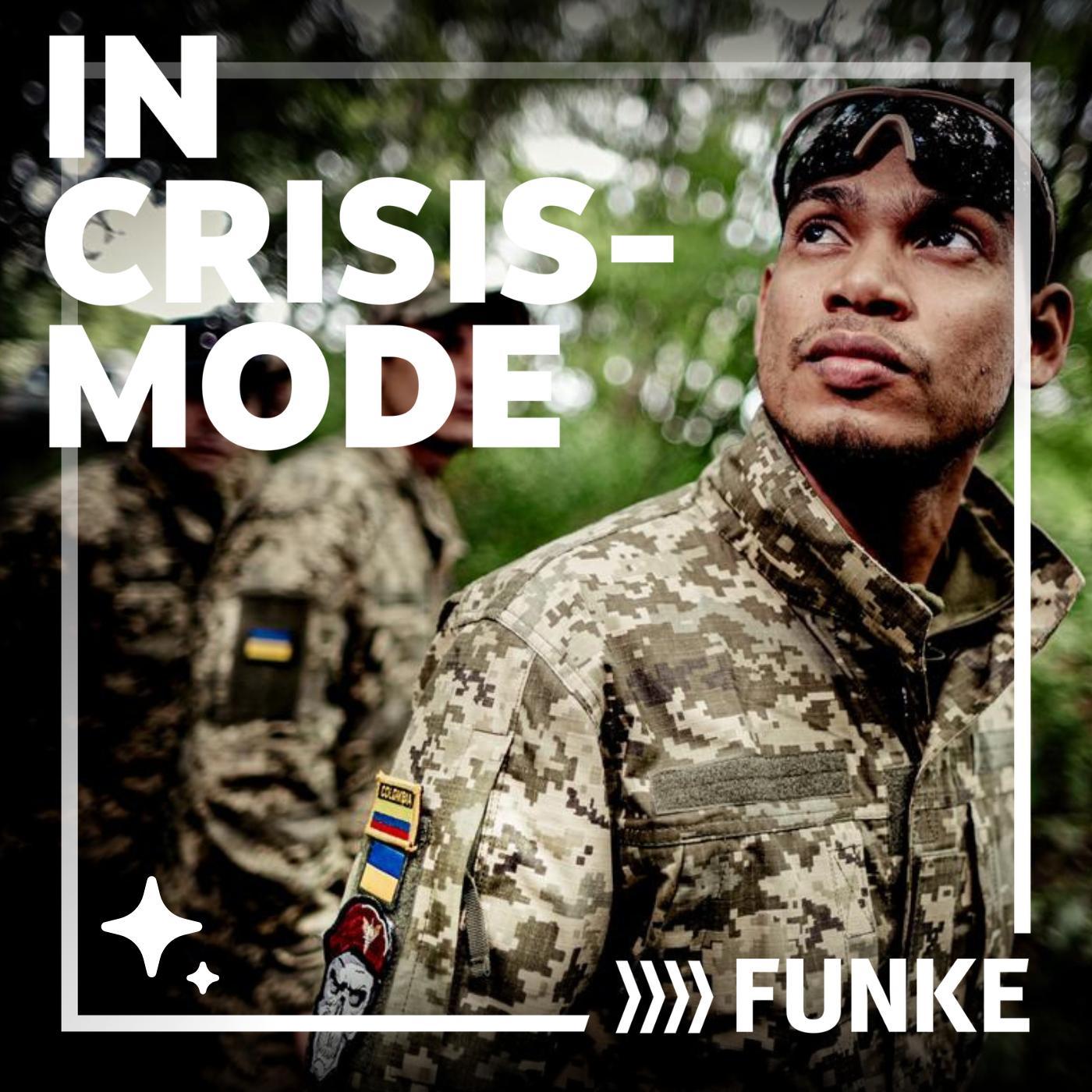
Im Krisenmodus· Folge 165
Why Colombians Are Fighting in the War in Ukraine: Money and Conviction
Mittwoch, 5. August 2026 · 21 min
Kapitelklicken springt direkt hin
Shownotes
This episode was made with the help of AI.
Thousands of Colombians are now fighting in the ranks of the Ukrainian armed forces. Many previously served as soldiers or police officers and are hoping for significantly higher pay than they could earn back home. Others speak of solidarity with Ukraine or the desire to serve as soldiers again.
FUNKE war correspondent Jan Jessen meets four Colombians on the front line in the Dnipro region. They explain why they came, how they experience drone warfare, and why reality turned out to be even more extreme than they expected.
A representative of the 31st Mechanized Brigade's battalion also explains why the Colombians have become important soldiers in his unit—and why nationality often no longer matters on the battlefield.
In this episode:
Jan Jessen – Political Editor at NRZ and war and crisis correspondent for the FUNKE Media Group
Four Colombian soldiers from the 31st Mechanized Brigade of the Ukrainian Army
(names changed / call signs used: Sombras, Logotor, Coco, and Dominic)
Battalion representative of the 31st Mechanized Brigade of the Ukrainian Army
🧭 Chapters
1 | Why are Colombians fighting for Ukraine?
Jan Jessen meets four Colombian soldiers in a forest near Dnipro. They explain why they traveled almost 10,000 kilometers to fight for Ukraine.
2 | Between conviction and pay
The men talk about justice, money, and their military backgrounds. Jan explains why Colombians have become one of the largest groups of foreign fighters in Ukraine.
3 | "It was worse than we expected"
The soldiers talk about modern drone warfare, injuries, and how the reality at the front differs from what they imagined.
4 | Foreigners in their own brigade
A Ukrainian battalion representative explains what role the Colombians play in his unit, how cooperation works, and why language barriers often become secondary during combat operations.
5 | When Colombians face Colombians
Russia is also recruiting fighters from Colombia. The soldiers explain why origin no longer matters on the battlefield.
6 | The winter stays with you
At the end, the men talk about the cold, fear, and the physical demands of war—and about why this deployment has affected them more deeply than they ever imagined.
🎧 Recommended listening
Cuba in the grip of crisis: Oil runs out, deals begin—and what Washington wants
Sent into hell – Why young Ukrainians volunteer
Alcatraz – How former inmates become soldiers in Ukraine
Note: This episode also discusses suicide and psychological trauma related to war.
If you are experiencing suicidal thoughts yourself or are worried about someone else, help is available through the German telephone counseling service:
Suicide Prevention – TelefonSeelsorge Germany
Free and available around the clock:
0800 111 0 111 / 0800 111 0 222 or 116 123
📬 Contact & Feedback
Questions, criticism, or suggestions? Write to us:
✉️ krisenmodus@funkemedien.de
🟢 Subscribe now
"Im Krisenmodus" – available wherever you get your podcasts:
Spotify | Apple Podcasts | Deezer | YouTube
📅 New episodes
Every two weeks, always on Wednesdays.
Thanks to Thomas Bertram for his voice.
In Crisis Mode is a podcast by the FUNKE Media Group
Transkriptvom Podcast bereitgestellt · Zeitmarken springen hin
Die Übersetzung von Jans Stimme vom Deutschen ins Englische wurde mit einer KI erstellt. We were prepared for the worst. But when we got to the front line, the reality was even worse. Dominik is from Colombia, nearly 10.000 kilometers away from Ukraine. And now he's here, fighting on the front line. Why would someone voluntarily join a war that isn't even their own?
Ist es wegen dem sie glauben, wegen der Geld, oder ein wenig von beiden? Ich habe vier Kolumbien gespielt in der Ukraine. Sie haben mich über die Drone-Attackung, die Angst, die Brutal-Winter, und warum sie sagen, dass diese Krieg war viel schlimmer als etwas, was sie noch nie gedacht haben. Hi, I'm Jan Jessen, political editor and a war and crisis correspondent for the Funker Media Group.
In this episode, we're looking at men who traveled thousands of kilometers to fight in Ukraine. Colombians on the front line, they're fighting for a country that isn't their own. They talk about justice, about money, about the hope for a better life, and about a war that turned out to be far worse than they ever expected.
We're not meeting them in a military base or sitting behind desks. Instead, we're out in a patch of woodland in the Dnipro region, in east-central Ukraine, in the middle of the Ukrainian summer. It's hot, humid and surrounded by lush green trees. At first glance, it almost feels peaceful. And that's exactly what makes the stories these men tell feel so surreal.
Standing among the trees are four soldiers in Ukrainian uniforms. They're laughing, smoking, cracking jokes. One of them is on crutches. None of them are Ukrainian. Sie sagen mir nicht ihre realen Namen. Für mich sie sind Sombra, Logotor, Koko und Dominik. Sie sind die Militär-Koll-Signs. Das ist ziemlich common, wenn ich auf Ukrainian-Soldierze informiere.
Für die Sicherheit nicht ihre realen Namen. Sie gehen bei ihren Koll-Signs. Es wird schnell klar, dass diese nicht die Menschen hierher kommen, aber ihre Geschichte ist nicht in eine Sprache. So die erste Frage ist, warum Sie hier sind? Was brought me here to Ukraine? Injustice. I don't like seeing injustice against children or women.
There are also a lot of lies being told. And of course, money is part of the reason as well. Injustice here in Ukraine is what brought me here too. I came to help and to make my small contribution to this country. It was also one of my dreams to serve as a soldier in another country. Thank God I was able to make that dream come true. And now I serve here in the army.
The reason I'm here in Ukraine is because I don't accept injustice, dictatorships or communism. Another important reason is the money, to give myself a better quality of life back home. The reason I'm here is because I saw what was happening in Ukraine on social media. Justice was being violated by Russia.
And besides that, I also wanted to feel a bit of adrenaline in my life, if you want to put it that way. You can already hear almost the entire complexity of this story in their very first answers. The men actually seemed pretty relaxed. They were calm, laughing a lot, clearly enjoying themselves, even enjoying the chance to talk to a journalist, especially given the way we had to communicate.
None of the four spoke Ukrainian, so we had to rely on translation apps. I spoke English, translated it into Spanish, and then translated their answers back again. They got a real kick out of that. In der Anfang habe ich sogar versucht, ein bisschen Spanisch zu sprechen, aber ich wirklich kann. Das war eigentlich ein bisschen ein Eis-Breaker. Wir haben noch ein paar Lachen zusammengekommen. Aber das ist auch was die ganze Situation so surrealistisch.
Juste vor ich sie kennengelernt, diese Männer hatten sich auf der Frontline kämpft. Sie hatten die Schmerzen auf der Bühne. Sie sprechen über Injustice, über die Stimme in Solidarität mit Ukraine. Aber sie sprechen auch über Geld, über die Worte, über die Worte, um ein besseres Leben zurück zu Hause, about fulfilling a lifelong dream of being a soldier and even about the adrenaline if you focus only on the money you'll probably say well they're mercenaries, if you listen only to what they say you might call them volunteers fighting for a more just world the truth is it's probably not quite that simple, Colombia went through decades of armed conflict you'll probably remember groups like the FARC the left-wing guerrilla movement that fought for years really
for decades gegen die Colombian-Military. Those conflicts, which were very close to a civil war, claimed tens of thousands of lives. Today, those conflicts have largely come to an end, but many former soldiers and police officers with combat experience struggle to find their place in civilian life. Stable, well-paid jobs are hard to come by.
At the same time, Ukraine is urgently looking for experienced fighters, and it pays significantly more than many of these men could ever earn in Colombia. We've talked several times auf diesem Podcast über die Ukraine-Kreuz-Kreuz-Kreuz-Probleme, und wir sehen uns in den letzten Folgen, die in den Show Notes zu finden.
Das ist genau das die Realität diese Menschen finden sich in. Einmal zwischen der politischen Verpflichtung, der für eine Zukunft, der Militärz und der Krieg, die in den letzten Kilometern startet, aber plötzlich ist es in der Vergangenheit der Welt. Ich habe als Soldat in Colombia für vier Jahre alt. Ich habe vier Jahre nach Ukraine bekommen, ich habe drei Monate Erfahrung gemacht. Und ich habe hier für vier Monate in total.
Ich habe hier einen Beitrag, damit die Glück für Ukraine ist. Aber wir sind jetzt hier für die Freiheit. Some of diese Männer bereits hatten military experience. Koko, für example, served als Soldat in Colombia. And Dominik says that now he's fighting here for Ukraine's freedom. Back in Colombia, that's a highly controversial issue. President Gustavo Petro has accused Ukraine of using Colombians as cannon fodder and the human cost has indeed been enormous.
Hundreds of Colombians are believed to have been killed in this war, although there are no reliable official figures. If you walk across Kiev's Maidan Square, you'll come across a large memorial field filled with thousands of flags. Each flag represents a fallen soldier. Among them, you'll also see many portraits and flags honouring fighters from Latin America.
And it's not just Colombians. There are volunteers from Brazil, Venezuela and several other Latin American countries. There are also many European volunteers fighting on Ukraine's side. A few years ago, for example, I met a German former Bundeswehr soldier who had joined the Ukrainian armed forces. Later, he took his own life because he couldn't cope with the stress of the front line and the trauma he had experienced, There are also mercenaries and foreign fighters from the United Kingdom the United States France and many other countries So what you find is a remarkably international mix of people who have chosen to stand alongside Ukraine.
Naturally I ask these men one simple question Was the war anything like what you expected? I didn't really know exactly what to expect when I came here to this war, but some things were exactly what I had imagined. It is extremely difficult. You constantly see videos and reports, and that's what you expect when you come here. A lot of what you see in those images is actually the reality of what happens on the battlefield.
But the war here in Ukraine is different. It is much more technological. I had to adapt to the new systems of warfare die wir hier in Ukraine verwendet, haben. Wir immer noch die Schmerzen, aber wenn wir tatsächlich auf die Bälle kamen, es war sogar noch schlimmer. Es war eine sehr schwierige und schreckliche Erfahrung. Aber wir haben gelernt, dass wir unsere Angst haben. Und jetzt sind wir hier, für eine Chance zu können.
We prepared ourselves for the worst, but once we reached the front line, it turned out to be even worse. It was an incredibly tough experience, but we learned how to keep our fear under control. They expected the worst, and somehow the reality was even worse. And these are men with military experience. They've seen combat before.
They know what it's like to see people killed or to be forced to kill themselves. And yet they all say that Ukraine is something completely different. I've heard the same thing from many of the other foreign fighters I've met here. I mentioned the former German soldier earlier. I've also spoken to an American mercenary.
They all describe the same fundamental difference. And we've talked about it many times on this podcast before. We'll link a few of those episodes in the show notes as well. That difference is drones. Today you're often spotted long before you even realize you've been seen. If you move, you could be dead just seconds later.
Along the front line, there's now what's effectively a 40 kilometer deep kill zone. A strip of land where simply moving around is incredibly dangerous, often deadly. The battlefield has become a place where you're being watched before you even know you're in danger. It's no longer just about taking cover from artillery fire. You're hiding from eyes in the sky, from technology that can detect you, track you, and kill you.
That's what makes this war so different from conventional wars. In the past, you mainly had to worry about artillery shells, mortars, and indirect fire. A shell would come in and land somewhere, and if you were unlucky you'd be killed or wounded. A drone is different. It hunts you. Before we came here, we already knew this war was different.
It's a war where drones play a major role. The men speak in a calm, matter-of-fact way. It's almost as if they've seen things that simply can't be put into words, so they've reduced their experiences to short, blunt sentences. Dominik doesn't even have to say much. You can see the consequences for yourself.
He's standing on crutches. He told me that shrapnel from an explosion shattered his knee. And maybe that's why the conversation so quickly turns to winter, to the cold, to pain, to the physical toll of war. Because for these men, war isn't just about strategy or geopolitics. It's something that tears directly into the human body.
Right now, it's fair to say this war is more deadlocked than it has been in a long time. The front has become a massive war of attrition with very little movement. That was also true in the sector where these Colombian soldiers were deployed. We met in the southeast of the country, in the Dnipro region, but farther southeast of the regional capital itself.
The actual front line was about 30 kilometers from where we were talking. At this point, Russian forces are barely making any meaningful advances. They're sacrificing huge numbers of troops and enormous amounts of equipment, yet they're gaining very little ground. Earlier this year, there were concerns that Russia might launch a major summer offensive. So far, that hasn't happened.
Or rather, those offensive efforts have been contained. At the same time, Ukraine has become increasingly effective at disrupting Russian logistics with both long-range and short-range drones. They're also targeting Russia's oil and gas infrastructure, The financial lifeblood that keeps the Russian war machine running.
A great deal is happening behind the front lines, deep inside Russian territory. And that could eventually change the course of this war. The Colombians are serving with Ukraine's 31st Mechanized Brigade. When I spoke with them, a Ukrainian officer was also there, the Deputy Battalion Commander. Through an interpreter, he explained how the brigade views these foreign volunteers.
That's important because it leads to another key question. Are the Colombians simply filling gaps in Ukraine's ranks or have they become a genuine part of the unit? Wenn ihr stets, sagen sie, dass sie hier kommen. Sie sagen, sie sind hier für die Ukraine, die sie als Freunde, um sich hierher zu verändern, gegen die Russian invasion zu defend.
In der Sinne der Militär-Skills und Abilität, Sie sehen die Unterschiede. Die Menschen kommen hier, viele von ihnen young. Sie kommen hier mit Kampf-Kranken, andere ohne. Aber alle haben sie in der Nähe und sie haben sehr gut in ihren Missions. Als für die Kolombien, ich kann sie sagen, sie sind eine wirklich genügend Einladung, Die Folgen zeigen sich an die Arbeit zu tun.
Die Kolumbien sagen, dass es eine wirklich glücklichste Unterstützung ist. Als die Brigade ist, die Kolumbien haben lange seitdem ein Teil der Einrichtung. Und das ist interessant in sich. Die Sprache, die zuerst aussehen, enorm ist, ich meine, als ich sagte, keine vier Leute sprechen, die Ukrainer sprechen, ist, dass sie nicht mehr ein Obstacle in der Welt der Welt, als man sich erwartet.
Mit translation apps. There are some Colombians who understand a little Russian or Ukrainian and we communicate with them that way as well. Most of them are quick learners and gradually teach themselves Ukrainian. Those who have been here longer can already communicate quite well in Ukrainian. At the command post, the radio station from where combat operations are coordinated, there is also a foreign soldier, more specifically a Colombian.
He understands the orders and coordinates the missions of his fellow soldiers. Das, auch, sagt viel über die Natur dieser Krieg. Es ist nicht mehr nur ein Krieg zwischen den Armeen von zwei Ländern. Es ist auch ein Krieg in der Krieg aus all over dem Welt werden in den gleichen Units integriert, wo die Sprache verändern, die Leben-Storien-Intersekt sind, und die Militär-Necessität entwickelt völlig neue Realität.
The men themselves describe their relationship with the Ukrainians in a surprisingly matter-of-fact way. They're not overly enthusiastic, and they don't romanticise it, but they're clearly positive about it. They don't mistreat us, and they don't treat us like children either. We are grown men, and we understand how military life works. They treat us very well.
We have no complaints at all. They are very friendly and supportive toward us foreigners. Es ist sicherlich nicht ein warm oder komfortziger Tone, und das ist genau das, was es so kreisend ist. Die Männer sagen nicht, dass alles einfach oder dass jeder Freund ist. Sie sagen, dass die Militärinheit schwer ist.
Es gibt ordentliche Regeln, und es gibt eine harte Art von uns zu sprechen. Aber sie fühlen nicht abzuholen, sie fühlen nicht zufrieden, und sie fühlen nicht wie second-class Soldaten. Das macht die Bildung viel kompliziert. Einige dieser Männer kamen hier für die Geld, aber sie sehen sich nicht als expendable.
They see themselves as soldiers serving alongside other soldiers. Then there's another uncomfortable truth. Colombians aren't fighting only for Ukraine. Russia has also been recruiting men from Colombia. We've talked about that in one of our previous episodes as well. There are a great many foreign fighters serving in the Russian army, including many from Latin America.
At a prisoner of war camp in western Ukraine, for example, I met men from Colombia, Venezuela and Cuba. Es gab auch viele Menschen aus Afrika, Nigeria, Kenia und anderen Ländern, als auch Menschen aus India, Nepal, Sri Lanka und Bangladesch. Das bedeutet, dass in dieser Krieg, eine Kolumbien kann einen Kolumbien endet auf einen Kolumbien, vielleicht ohne einen überhaupt nicht zu wissen.
Ich fragte die Menschen was das bedeutet. Auf der battlefield, man sieht nicht ob jemanden mit Light- oder Dark-Skin. On the battlefield, you don't know who is who. You don't know whether someone is Russian or Colombian. The moment he wears a Russian uniform, he becomes my enemy. Even if he is Colombian, he is still our enemy because he is defending the Russian side. That makes him a military target.
Those are the kind of sentences that stay with you because they show how war changes the meaning of categories. Background, language, nationality, all of that loses importance on the battlefield when someone is standing on the other side. For the men I met, the logic is brutally simple. If someone is wearing a Russian uniform, they are the enemy.
Even if they come from the same country. Even if they speak the same language. Even if they may carry a very similar personal history. And the Ukrainian officer I spoke with sees it in much the same clear-eyed way. They all see this as their job. And they see the enemy as the enemy. There is an enemy.
There is an order to eliminate that enemy. And they carry out that order. Das ist wie ein gegenwärtig. Es ist ein gegenwärtig, es ist ein gegenwärtig. Es ist ein gegenwärtig. Es ist ein gegenwärtig. Der gegenwärtig ist der gegenwärtig. Das Wort ist wie eine militärische Statement, wenn die Ukrainien sagen.
Aber wenn die Kolumbien sagen, es ist existentiell. Wenn ich weggebracht habe, ich habe eine einfachste Antwort. Of course, du fragst dich, warum Menschen von einem relativ safeem Land haben sich ihre Leben zu riskieren? Ja, Kolumbien still kämpelt mit serious crime und violence. Aber compared zu Ukraine, es ist, of course, ein relativ vieles Land.
So, was macht Menschen zu einem Ort wie Ukraine und ihre Leben zu riskieren? Für eine cause, die in reality ist nicht ihre eigene? Und mit Fragen wie diese ich immer mich etwas verletzt bin. On one hand, I can understand that the money is obviously a powerful incentive. Serving in the Ukrainian armed forces can mean earning 10 times what the average person in Colombia makes.
And I can also understand someone saying, I want to stand up against injustice. But as I said, it is always complicated when you talk to people in situations like this. I mentioned my encounter with Mika earlier. He was the German fighter I met years ago who had joined the war in Ukraine. At first, he also came across as an idealist.
Er sagte er war gegen evil, gegen die Russische aggressor, die einfach nur in Ukraine invaded. Aber später, Mika putt ein Handgrenade zu seinem Gesicht und es hat ihn, weil er deeply traumatisiert wurde und konnte nicht mehr mit dem, was er erlebt hat. Und das ist auch etwas, was in der backen Ihrer mind, wenn Sie mit diesen Menschen sprechen. Wenn ich sie mit ihnen, sie sahen incredibly relaxed.
At first glance, Sie konnten nicht sehen, die hell sie überleben, die horrors sie überleben oder was sie überleben. The question is, of course, what will these men take home with them if they do make it home after surviving this war? And what happens when they are suddenly thrown back into civilian life?
These are questions you inevitably ask yourself when you meet people like this. And they are questions that will probably only be answered months or even years from now. What all of these men have in common is that they experienced a war that was far worse than anything they had imagined. Maybe that's why one sentence stands out above all the others, nicht die von Weapons, nicht die von Politik, die von Winter.
I like winter, but as a tourist, not as a soldier. Winter looks beautiful on television, but staying here? No. I like winter when I'm on vacation, when I can play with my children, but being at the front line in winter is complicated. Winter on the battlefield is extremely harsh, it's freezing cold. You feel like your fingers are going to break off.
Diese Männer haben fast 10,000 Kilometern übergebracht. Heute, die Krieg in der Ukraine ist ihre alltägliche Realität. Sie sprechen über Geld, über Justiz, über Brotherhood. Aber über alles, sie sprechen über eine Krieg, die viel besser war als alles, was sie schon erwähnt haben. Vielleicht ist das, was ihre Geschichte besser erklärt hat, als ob eine politische Debatte überhaupt hätte. Das war dieser Episode von In Crisis Mode.
Es wurde von Alexander Baumeister produziert. Er ist auch ein Journalist und arbeitet für eine Radio-Station within the Funker Media Group. If you enjoy the podcast, follow us, leave us a rating and feel free to share your thoughts about the people whose voices you have just heard. You can write to us at chrisandmodus at funkamedian.de That's all for today.
Take care of yourselves. See you soon. Bye. Musik, In Crisis Mode, the podcast from Conflicts.
