

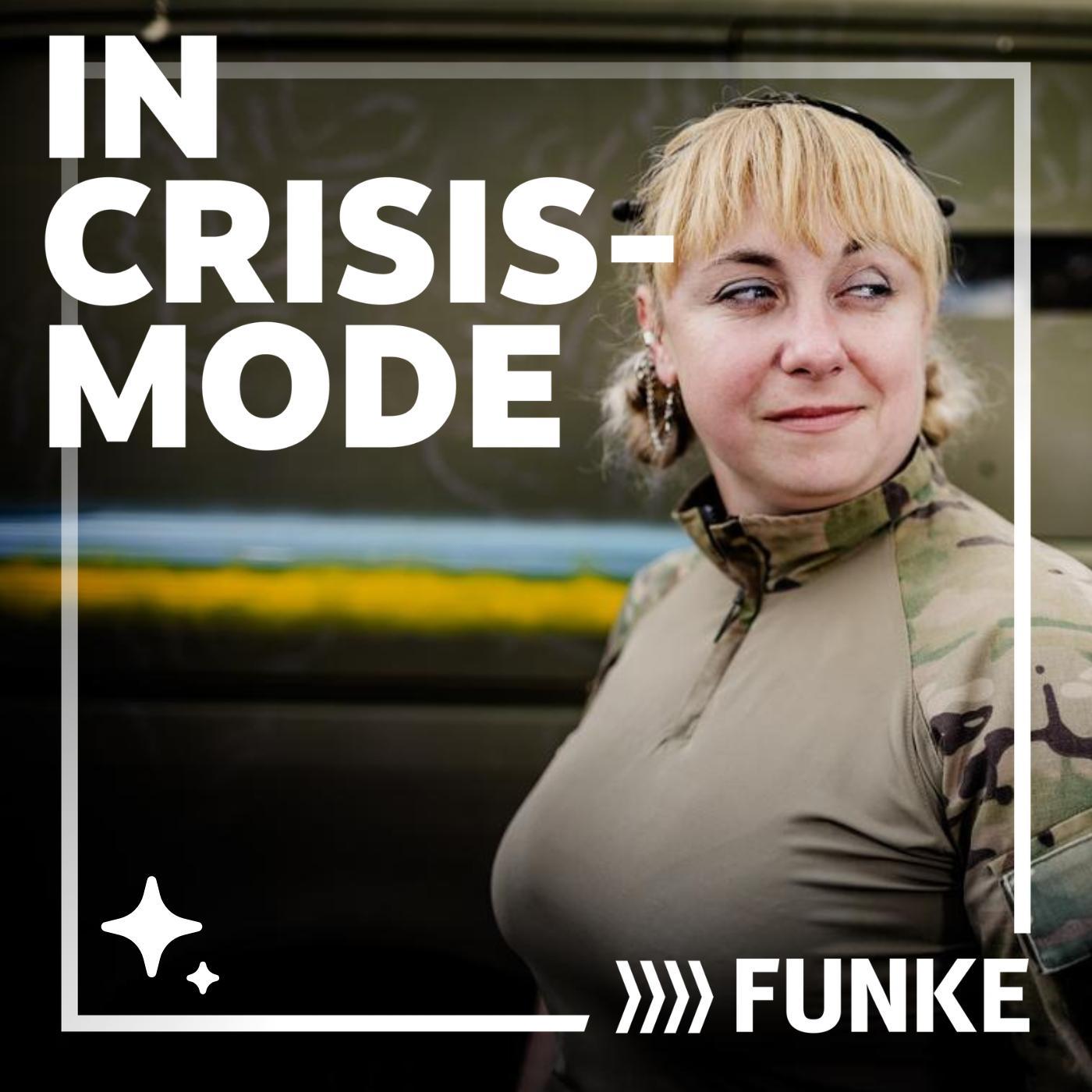
Im Krisenmodus· Folge 167
Women in Ukraine’s War: Taking Responsibility on the Front and at Home
Mittwoch, 19. August 2026 · 38 min
Kapitelklicken springt direkt hin
Shownotes
*This Episode is made with the help of AI
_____
How Does War Change Women’s Lives?
In this episode of In Crisis Mode, FUNKE war correspondent Jan Jessen speaks with six Ukrainian women who have taken on extraordinary responsibilities in very different circumstances.
Anna Purtowa is a member of the Ukrainian parliament, where she works on issues affecting veterans, missing persons, and prisoners of war. Lena Dembitska, call sign “Lisa,” served as a combat medic at the front. Today, she trains soldiers in tactical medicine, drawing on her experience on the battlefield.
Liliya Chertenko develops orthopedic shoes for people who have lost parts of their feet in the war.
Alina Maksymenko is working to keep her cosmetics company in Kyiv afloat while managing everyday family life during wartime. Tetyana Stramnova is fighting to keep her goat farm near Kherson running while bearing sole responsibility for her animals and her two children with disabilities. Nataliya Dykul, a marine biologist and oceanographer, now also works as a UNDP adviser on underwater mine clearance in the Black Sea.
The six women share how the war has transformed their work, their families, and their understanding of their own roles. Their stories span political responsibility, military service, medical care, economic survival, and the responsibilities women assume when many men are fighting at the front.
Anna Purtowa believes that women will carry much of the responsibility for rebuilding Ukraine after the war. The episode explores whether these new responsibilities are simply a consequence of wartime necessity—or whether they could bring about lasting changes in Ukrainian society.
In this episode
Jan Jessen — Head of Politics at the NRZ and war and crisis correspondent for FUNKE Mediengruppe
Anna Purtowa — Member of the Ukrainian parliament
Lena Dembitska, call sign “Lisa” — Combat medic and tactical medicine instructor
Liliya Chertenko — Professor of fashion technology and developer of orthopedic footwear
Alina Maksymenko — Entrepreneur and co-founder of the cosmetics brand M2O
Tetyana Stramnova — Founder and operator of the Amalthea goat farm
Nataliya Dykul — Oceanographer and adviser on underwater mine clearance
🧭 Chapters
01 | What does responsibility mean in wartime?
Jan Jessen introduces the central question of the episode. Anna Purtowa talks about the reconstruction of Ukraine and the responsibility women are taking on.
02 | Anna Purtowa: Missing people and prisoners of war
A member of parliament talks about families, prisoners of war, and the limits of international law.
03 | Lena Dembitska: Combat medic at the front
The combat medic talks about her deployments, her injuries, and training a new generation of soldiers.
04 | Liliya Chertenko: Orthopedic shoes for the wounded
A professor helps people who have lost parts of their feet as a result of the war.
05 | Alina Maksymenko: Business and family under attack
An entrepreneur from Kyiv talks about growth, fear, and the responsibility women are taking on behind the front lines.
06 | Tetyana Stramnova: The goat farm near Kherson
A farmer fights to keep her farm, her animals, and her two children with disabilities going.
07 | Nataliya Dykul: Science in the service of dealing with the consequences of war
An oceanographer advises underwater mine-clearance teams in the Black Sea.
08 | Who will carry Ukraine forward after the war?
Six stories and the question of what responsibilities women will continue to take on after the war.
📬 Contact & Feedback
Questions, criticism, or suggestions? Write to us:
✉️ krisenmodus@funkemedien.de
🟢 Subscribe now
"In Crisis Mode" – available wherever you get your podcasts:
Spotify | Apple Podcasts | Deezer | YouTube
📅 New episodes
Every two weeks, always on Wednesdays.
Thanks to Thomas Bertram for his voice.
In Crisis Mode is a podcast by the FUNKE Media Group
Transkriptvom Podcast bereitgestellt · Zeitmarken springen hin
Die Übersetzung von Jans Stimme vom Deutschen ins Englische wurde mit einer KI erstellt. Was bedeutet das? Und ich persönlich glaube, dass sich die Ukraine in der Zukunft, nach der Krieg zu Ende, auf die Frauen zu Ende, wird es auf die Frauen. In Crisis Mode, the podcast from Conflict Zones. Anna Portova is a member of the Ukrainian Parliament. She serves on the Budget Committee.
Since the beginning of Russia's full-scale invasion, she has also been working on issues concerning veterans, people with war-related disabilities, and the families of missing soldiers and prisoners of war. Her assessment is certainly a political statement, but it also reflects something that comes through in many personal stories.
During wartime, women not only take on new responsibilities, They also hold together several different areas of life at the same time. Hallo, ich bin Jan Jessen, Political Editor-in-Chief und War und Crisis Reporter für Funkamedia Group. Ihr könnt mir meine Artikel auf unseren digitalen Plattformen finden.
Für diese Episode, ich spreche mit sechs Frauen in Ukraine. Sie leben in der Kapitel, Kyiv, neben der Frontline oder in der Süddeutsche Land, und ihre Rolle in der Süddeutschen kann sich nicht mehr anders sein. Eine von ihnen arbeitet in Parlament und versucht zu helfen die Familien der Kriegen der Kriegen. eine als Kombat-Medik in der Front selbst. Vielen.
Dank. Biologist advises Mine Clearance Teams in the Black Sea. I'd like to start with Anna Potova because her work particularly clearly shows how the war reaches into areas that, at first glance, seem far removed von der BATTLEFIELD. Anna Patova ist 44 Jahre alt und kommt aus Dnipro, eine große Stadt in der eastern part der Zentral Ukraine.
Sie ist ein Mitglied der Servant der People Party, die die sich um die Vlodomir Zielenk hat, der Präsident und ist auch die Gouvernein Party. Sie ist auf der Budget Committee der Ukraine. Vorher in der Politik, sie hat die Unternehmen gewonnen, insbesondere auf die Digitalisierung. Since the Russian invasion, she has also been dealing with the consequences of the war.
She is particularly focused on people returning from captivity, the wounded, and the families of soldiers whose fate remains unclear. When women or mothers ask her whether she knows where their husbands and sons are, she often has no answer. According to Ukrainian officials, Russia does not reliably confirm which soldiers are being held in captivity, International organizations have only limited access. We heard this again and again on our travels when we spoke with former Ukrainian prisoners of war.
We'll put the relevant episode in the show notes for you. Anna, therefore, does not just talk about individual cases. She is talking about a political system that is failing to deliver on its promise to protect prisoners of war. We have a lot of job to do here inside the country. We need to accept special laws to help the families, to organize medical support of them and other things. But this is the work that we can do by ourselves and we are trying to organize everything.
For me, the biggest challenge is to work with international organizations, to work with our international partners and other countries. As, for example, in the world, everybody is still thinking that there are genetic conventions that are responsible for the rules, how people, how countries behave with the prisoners of war but they don't work anymore Russia has joined them, has signed them many years ago, but we see that they just don't care about it and we as, international as other countries we need to talk together what we are doing with this we just need to accept the fact that they don't work anymore international laws doesn't work anymore and we need to think what to do as.
We still have no idea how many people are in Russian prisons. They don't give us the name. Again, it's written in GENEV protocol that other countries need to confirm how many people and who they have. They don't do it. We don't have access to check their situation, what conditions they have in prisons. We don't have this.
And we need to work together with other countries, with the European Union, United States, and international authorities to change these old protocols and start them to work. Anna describes a very specific problem here. Russia does not disclose the names of prisoners and does not confirm how many people are actually being held in Russian prisons.
That is a huge problem because around 100,000 Ukrainian service members are currently considered missing. And of course their families want to know what has happened to them, where they are, whether they are lying dead somewhere on the battlefield, or whether they are being held in Russian prisoner of war camps.
The Geneva Conventions and International Humanitarian Law establish minimum standards for the treatment of prisoners of war. These include registering prisoners of war and granting the International Committee of the Red Cross access to them. When these rules are not enforced, families face a double uncertainty.
As I said, they do not know whether their loved ones are dead, whether they have been wounded, or whether they are being held in Russian captivity. Anna is trying to help at the national level. Sie arbeitet auf legislation, medical care und finanziell support für affected families. At the same time, sie encounters ein internationales Problem über which sie hat sehr wenig influence herself.
Die Regeln exist, aber Russia disregards sie. Und das ist nicht limited zu Russland. Wir sehen es wieder und wieder in andere Krisen und Konflikt zones, wo international law ist being trampled unter foot. Whether es die Krieg in Afrika, die Krieg in Gaza, oder der aktuellen Krieg gegen Iran, über die USA, international law ist überall erodet.
In her work, she also encounters people who have lost their sight in the war. One of them, a young man named Mikola, was, in a sense, the catalyst for her work. She told me that she met him relatively early in the Russian invasion. Shortly after he volunteered to serve, he was severely wounded. He lost both arms and his eyesight. Anna arranged for him to receive prostheses, but of course she cannot give him back his sight.
What she can do is try to ensure that people like him do not disappear from the political field of vision. Then Anna talks about the role of women. It's a very big role. It's a very big role as men are doing their great job to protect our country. But actually now Ukraine is number one country in the world with the amount of women that also serve in army.
We have more than 70,000 of women now in the army. Women are creating and supporting business and work here, our economy they are doing a lot of jobs that they didn't do before the war we just didn't need this. As men were working as plumbers or in agricultural jobs but now women have learned how to do it and to do it, they continue to grow up children no matter if they need work more and more now and me personally I believe that rebuild and reconstruct Ukraine in the future, after the war will be finished, it will be on women's shoulders.
This, of course, is not a statement that women are inherently stronger than men. It is simply about the consequences of war. Many men are fighting, are wounded, have been killed, or are being held in captivity. And as a result, women have to take on responsibilities that were previously often shared among several people.
Anna says that after the war, Ukraine will have to rebuild more than just houses, roads, and bridges. It will also have to rebuild families and businesses, support the return of veterans, and integrate people who have suffered severe injuries. Another particularly interesting question after the war will be what happens when all the people who have fled abroad, women, men, and children alike, return to Ukraine and encounter a society that has spent four years, or probably considerably longer, living through war.
How will that society function then? And women will certainly play a major role in that as well. In der Vergangenheit habe ich wieder mit Psychologen und Psychiatristen gesprochen und mit ihnen über diese Frage gesprochen. Und ich glaube, dass dies eine sehr schwierige Aufgabe für die Gesellschaft als ein whole, aber insbesondere für die Frauen in der Ukraine.
The next woman I spoke with works in a place where the consequences of injuries are visible every day, in military training. Olena Dembitska calls herself Lena. Her military call sign is Lisa. Lisa means Little Fox. She is a combat medic in the 3rd company of the 31st Mechanized Brigade and now trains new soldiers in tactical medicine.
In the past, she told me, she went to the front lines herself. She treated wounded soldiers and evacuated people from dangerous situations. Today, her battalion commander has decided that she should pass on her combat experience to younger colleagues. We met her near a training centre where she told us about her past and why she decided to join the military in the first place.
She said that it had always been a challenge for her. She also told us in our pre-interview that she had always been fascinated by medicine. At some point, she volunteered to join the military. She also met her husband, who himself serves in the 31st Brigade. As I said, she initially worked as a combat medic and had some very intense experiences.
Now, because her battalion commander told her that she should no longer go to the front, she doesn't simply teach according to a fixed curriculum. Instead, she works with the March Protocol for Tactical Medicine, while also adapting it to the conditions she herself experienced on. The front. Ich Das, war's für heute.
Bestimmte adjustments dass die Training so close wie möglich zu realen conditions auf der Frontline ist. This, of course, is not a statement that women are inherently stronger than men. It is simply about the consequences of war. Many men are fighting, are wounded, have been killed, or are being held in captivity.
And as a result, women have to take on responsibilities that were previously often shared among several people. Anna says that after the war, Ukraine will have to rebuild more than just houses, roads, and bridges. It will also have to rebuild families and businesses, support the return of veterans, and integrate people who have suffered severe injuries.
Another particularly interesting question after the war will be what happens when all the people who have fled abroad, women, men, and children alike, return to Ukraine and encounter a society that has spent four years, or probably considerably longer, living through war. How will that society function then? And women will certainly play a major role in that as well.
In der Vergangenheit habe ich wieder mit Psychologen und Psychiatristen gesprochen und mit ihnen darüber gesprochen, und ich glaube, dass es eine sehr schwierige Aufgabe für die Gesellschaft als ein whole wird, aber insbesondere für Frauen in der Ukraine. The next woman I spoke with works in a place where the consequences of injuries are visible every day, in military training.
Olena Dembitska calls herself Lena. Her military call sign is Lisa. Lisa means Little Fox. She is a combat medic in the 3rd company of the 31st Mechanized Brigade and now trains new soldiers in tactical medicine. In the past, she told me, she went to the front lines herself. She treated wounded soldiers and evacuated people from dangerous situations.
Today, her battalion commander has decided that she should pass on her combat experience to younger colleagues. We met her near a training centre, where she told us about her past and why she decided to join the military in the first place. She said that it had always been a challenge for her. She also told us in our pre-interview that she had always been fascinated by medicine.
At some point, she volunteered to join the military. She also met her husband, who himself serves in the 31st Brigade. As I said, she initially worked as a combat medic and had some very intense experiences. Now, because her battalion commander told her that she should no longer go to the front, she doesn't simply teach according to a fixed curriculum.
Instead, she works with the March Protocol for Tactical Medicine while also adapting it to the conditions she herself experienced on the front. The role of a man and a woman? Well, basically, we should have absolutely equal rights. There is no difference between a boy and a girl. Being a woman does not mean you do not go to the positions. If your job requires you to go, Also, wer noch kommt?
Lina emphasizes that the conditions are constantly changing. New drones, new weapons, different ways of evacuating. What worked yesterday may already not be enough today. We've also talked a lot about this on the podcast, about how much has changed on the front, particularly because of drone warfare.
We can also link to relevant episodes in the show notes. So her job isn't just about medical training. She also tries to mentally prepare the soldiers for what they're going to face. Some are scared, others try to suppress the danger, and some openly say that they don't want to fight. That's exactly what frustrates Lina, especially when mobilized men come to her training and say, this is not my war.
Despite her disappointment, she continues working with them because she knows that in a real-life situation, a soldier like that isn't only putting himself at risk. If he doesn't help, it could potentially be fatal for a wounded soldier. Lina also says that fundamentally women and men should have the same rights and responsibilities in war.
Well, of course, war changes everyone. It changes every person. As for me, I would say that I am probably still the same person I always was. But perhaps I have become more open and more confident. I feel braver and stronger. I feel much better about myself. In a way, your character reveals itself more.
In civilian life, you are quieter and calmer. Und hier, du kannst dich immer wieder sein, aber auch noch nicht weiter, und nicht mehr zeigen, deine Weakness. Wenn es hart ist, wenn du keine Kraft hast, wenn du denkst, ich kann nicht, ich kann nicht, ich will, du kannst dich nicht mehr zeigen. Du kannst dich zusammen, dich in und aus, und dich in und aus, dich zu tun. Wenn es zu tun ist, dann muss es zu tun. Wenn es zu tun ist, dann muss es zu tun.
Lena put it pretty matter-of-factly, without making a big deal out of it. For her, the question isn't whether a woman belongs at the front. The question is what role she has and whether she can do that job. But her own work has changed as well, and you could tell that she wasn't entirely comfortable talking about it.
She was deployed continuously for a long time, treated more than 300 wounded soldiers, and was herself injured by a piece of shrapnel that hit her knee. Since then, she says, Das ist eine der Grund, warum sie die Battalion Commander gesagt hat, dass sie sie nur auf Training für heute focussen hat. Seit dann, sie manchmal kriegt Panik-Attacks. Oder zumindest ihre Hands starten shaking.
Und, well, sie sagt, dass, weil sie das clearly post-traumatisch stress ist, sie kann nicht mehr arbeiten. Eine der deployments sie uns über war, war die erste sie in der ersten Parten. Her Platoon Commander war wirklich in den Legen von Schrapnel. Sie dann worked ihr Weg all den Weg zu den Fronten unter mortar fire, hat ihn ihn und hat ihn zurück zu seinem Leben.
Ever seitdem, er hat ihn seine kleine Sistin. Und ein paar Monate später, sie hat sich schon ein Jahr und ein halb in heavy combat, sie hat sich in eine Situation in Pokrovsk. Und es war so intensiv, mit so vielen Drones in den air und so viele Explosionen going off around sie, dass sie sicherlich kam weg von es mit einer psychologischen Trauma.
Und wie ich gesagt habe, das ist, dass sie nicht mehr arbeiten. Aber diese Erfahrungen sind auch die Grunde, dass sie nicht ihre Freunde aus der Zeit trainieren, direkt aus einem Textbuch. Sie weiß, wie schnell eine medicale Situation kann verändern, wenn man unter Feuer ist. Und gleichzeitig sagt sie, und ich finde das wirklich interessant, dass die Krieg hat sie mehr offen und mehr self-confident.
Ich versuche, mit volunteers zu contactieren, und manchmal begrennt sie für Hilfe. Sie helfen little by little. Aber natürlich, ich würde lieber für unser Staat zu helfen, was wir brauchen, als wir für ihn fragen, was wir brauchen. Natürlich ist das nicht um Romantizieren der Krieg in einer Weise. Lina sagt nicht, dass die Angst hat weggegangen.
Sie sagt, sie hat gelernt, zu agen der Angst. Heute, ihre Arbeit consists von Training, Sourcing Equipment und Organisieren. Nach den Training Courses, sie reinträgt von einem Militär-Base nach dem anderen. Sie setzt mit Medikamenten Backpacks und versucht, zu bekommen weitere Medikamenten Supply. Aber sie auch auf die Volunteer zu tun.
Ich studiere und mache Forschung auf orthopedic footwear und fühle mich besonders mit denjenigen, die ihre Gesundheit verbringten, um die Ukraine zu verbringern. Das ist deshalb, dass ich die Menschen, die es braucht, durch die Entwicklung und die Produktion von orthopedic footwear verbringern. So, Lina works at the intersection between the front lines and the home front.
She trains soldiers for deployment, but at the same time she also has to make sure that those soldiers have enough medical supplies to take with them in the first place. And there's a similar connection between expertise and practical help in Kiev with Lilia Chertenko. Lilia is an associate professor in the Department of Fashion Technology at the National University of Technologies and Design.
She researches orthopaedic footwear. Since the beginning of the war, she has been developing and making shoes for people who have lost parts of their feet as a result of their injuries. That, of course, happens again and again in this war. Soldiers are wounded at the front and lose limbs. We've talked about that several times on this podcast as well, and we'll put some relevant episodes in the show notes for you.
Lilia, however, doesn't work with people who need prosthetics. For example, people who have had an entire foot, leg or arm amputated. She focuses on people who have lost only parts of their feet and she makes custom orthopedic shoes for them. In her workshop, there's a 3D scanner and a pressure-sensitive plate that patients walk across.
This allows Lilia to see exactly how the injury affects the way they walk. She then uses that information to create individually tailored shoes. Für einen Soldaten mit einem Partial Amputation, für example, her shoes waren die erste Pair in which er nicht immer fühlt wie er war. So für Lilia, das ist nicht eine Abstrache Forschung. Das ist nicht so, dass sie anstrengungen, Menschen arbeiten können.
In reality, eine Person alleine kann nicht mehr erreichen. Neither eine Frau, nor ein Mann. Aber zusammen, wir sind strong. Durch Mutual Support und Kommunikation, different projects emerge, different forms of assistance take shape and various forms of cooperation develop. It is through this collaboration that we are able to make our contribution to our future victory.
Das ist sehr interessant, was in diesem Feld zu sehen, was in diesem Feld ist möglich. Aber es ist auch ein großes Geld, die investiert, und viel Forschung geht. Das ist nicht wirklich das Fall in dem Feld, das Lillia arbeitet. Und trotzdem, diese Orthopädie-Klücke sind natürlich unglaublich wichtig.
A lot of wounded soldiers einfach nicht brauchen eine prosthetische. They've only lost part of their foot, but they can't walk in regular military boots, and the strain can cause further damage to their health. Other soldiers, meanwhile, remain at the front in their boots for days at a time. We've talked about this several times as well, how increasingly difficult it has become for soldiers to leave their positions because of all the drones in the air.
Some soldiers end up spending 200 days in the same position, and you can probably imagine that taking off their boots can be quite a challenge in those circumstances. And when you're wearing a regular boot, the foot itself can obviously also be severely affected by the strain. That's why Lillia is also researching footwear that can be worn under extreme conditions.
Her work, however, has so far received only limited support from the Ukrainian government. She relies on private donations, international support, and experts who provide materials or training. That's why Lillia says that no project is ever created by one person alone. Das, auf jeden Fall, auf alle Ukrainer. Wahrscheinlich, dass es alles anders ist. Weil, Frau, zuerst, ist alles, dass... War, unfortunately, affects all Ukrainians.
Es wahrscheinlich affects Männern und Frauen anders. A Frau ist, erst und foremost, eine Mutter. Und als Mutter, ich kann sagen, dass meine Haupttasschung ist, meine Kinder. Aber, besides das, ich bin ein Arbeitsländer, so ich versuche, die ich in meinem Arbeitsplatz zu helfen. Und in der Zeit, dass ich frei von Arbeit und meine Kinder schaffe, ich auch versuche, in eine Weise zu helfen.
Well, actually, if we talk about how the war affects, then yes, in different ways. I think in different ways. Ich kann auch etwas helfen. Ich denke, wenn man sich über die Situation geht, dann ist es so anders. Ich denke, es ist so anders. Lilia isn't just describing her own work here. She's describing a network of people who step in where state structures aren't enough.
At the same time, she's a mother. Her daughter is now nine years old. And because of the drone attacks, the two of them repeatedly sleep in the hallway of their apartment in Kiev. The hallway wouldn't protect them from a direct hit, but it can help prevent shards of glass from being thrown into the room by the blast wave. Lilia says.
In fact, the war had such an impact that we accelerated a lot from the beginning of 2022 because there was a very high level of customer loyalty to what was created in Ukraine. We worked very hard, there was very rapid growth. But in 2023, under the influence of the war, we made a decision that we would not develop our own production, but would outsource the production of cosmetics.
This decision was directly influenced by the war. Wir haben die Verarbeitung des Kosmetikes auf den Betriebskern, auf den Aus-Sorten. Und auf diese Entscheidung, in realem Weise, die Krieg verletzte. That concern exists alongside her work, it doesn't replace it. Lilia helps wounded soldiers while at the same time trying to get her daughter through a daily life in which drone attacks have become part of family life.
You may have noticed in the past few days that Kiev has been coming under heavy attack, particularly over the last few weeks. We were there most recently in June when we met Lilia and since then the situation in Kiev has become even more difficult. There are now very frequent attacks involving ballistic missiles, heavy projectiles with warheads weighing several hundred kilograms, that Ukraine's air defences, which have been severely stretched because there aren't enough Patriot missiles, are unable to intercept.
And that, of course, means that people in Kiev are facing some incredibly difficult nights at the moment. Alina Maximenko also knows what it means to balance professional responsibility with concern for her family. Alina ist 38 Jahre alt und in der Solomiansky-District von Kyiv. Mit einem Unternehmen, sie brennt die Kosmetik-Brand M2O.
Die Firma produziert die Skincare, Haircare und Bodycare Produkte. Erstens, die Krieg eigentlich acceleriert die Firma. Viele Kunden wollten die Produkte in Ukraine unterstützen, so die Firma sehr schnell verbreitet. Aber in 2023. Alina macht eine Entscheidung die direkt zu der Krieg. Die Firma hat sich nicht weiterentwickelt, sondern sie ausgesucht die Produkte zu den Produkten.
Sie hat diese Entscheidung gemacht, weil sie sie Angst haben, dass ihre eigenen Warehouses werden könnten, und dass alles in den Städten dort werden könnten. Es ist ein Beispiel, wie die Krieg verändern, die politische Entscheidungen, verändern. Verwalt ist möglich, aber Investitionen in ihre eigenen Produkte hat sich viel riskier.
Ich war sehr, sehr, sehr, sehr, sehr, sehr, sehr, sehr, sehr, sehr, sehr, sehr, sehr, sehr, sehr, sehr, sehr, sehr, sehr, sehr, sehr, sehr, sehr, sehr, sehr, sehr, sehr, sehr, sehr, sehr, sehr, sehr, sehr, sehr, sehr, sehr, sehr, sehr, sehr, sehr, sehr, sehr, sehr, sehr, sehr, sehr, sehr, sehr, sehr, sehr, sehr, sehr, sehr, sehr, sehr, sehr, sehr, sehr, sehr, sehr, sehr, sehr, sehr, sehr, sehr, sehr, sehr, sehr, sehr, sehr, sehr, sehr, sehr, sehr, sehr, sehr, sehr, sehr, sehr, sehr, sehr, sehr, sehr, sehr, sehr, sehr, sehr, sehr, sehr, sehr, sehr, sehr, sehr, sehr, sehr, sehr, sehr, sehr, sehr, sehr, sehr, sehr, sehr, sehr, sehr, sehr, sehr, sehr, sehr, sehr, sehr when there is despair, there are days when you need to recover,
gain strength to move on. But in general, we are fighting and believe in a better future. We believe that we will be able to overcome all obstacles and live in a peaceful country. But in general, we fight and believe in the best future and believe in that we will succeed to overcome all the dangers and live in a peaceful country.
Alina isn't only talking about economic decisions, though. At the beginning of the full-scale invasion, she left Kyiv with her family and spent a month in Venezia, a city in central western Ukraine that has not been anywhere near as heavily affected by the war. There are attacks there from time to time as well, but nowhere near as many as in Kyiv or cities like Odessa, Dnipro, Kharkiv and others.
As soon as it was possible, she returned to Kyiv. Today, she lives with the attacks on the capital. She talks about days of despair and about how sometimes people need to take a moment to gather their strength before they can keep going. I feel that women are now very responsible. For how we all live in the rear. I feel that women are now very responsible for how we all live in the RIA.
There are a lot of female soldiers and they protect us as well. But the way everything is developing here now, businesses, how we take care of our children, how we nurture our family, how we invest emotionally to stabilize the situation in the RIA, this falls very heavily on the shoulders of women. It is both difficult and, at the same time, motivating, because each of us has our own mission to do everything possible to continue to maintain a good atmosphere in the country, which will nevertheless continue to exist. Es ist alles möglich, um dann, eine gute Atmosphäre in der Lande, die, die weitergeht, weiter zu existieren und weiter nach dieser Krieg.
Alina doesn't experience the war only as a business owner. Recently a drone hit her apartment building, just two floors above her apartment. She threw herself over her 12-year-old son to protect him, and of course that's a difficult experience for a child. She says he's actually coping with it quite well, but you could also tell that she's naturally very worried about him.
At the same time she's trying to keep her business going. She says that women today carry a particularly large share of the responsibility on the home front. Wir sind in der Stadt Muzikivka, in der Amalthea Goat Farm. Mein Name ist Tetiana Stramnova, und ich bin der Chef- und Founder von diesem Farm.
Wir spezialisieren in goat breeding und cheese production. In den letzten Jahren, wir organisieren tastings, tourism activities und inclusion programmes, aber in dem Moment sind wir nur auf goat breeding. Und sie versuchen, und zu erhalten, eine Art von normativen, to create a nice atmosphere and keep things moving forward, even under these circumstances.
Alina doesn't talk about the home front as a peaceful counterpart to the front lines. Kiev is under attack. Businesses have to adapt to power outages, air raid alerts and changing supply chains. Families have to deal with fear. In southern Ukraine, the economic pressure is even more immediate. In the village of Muzikivka, near Kherson, Tetiana Stramnova runs the Amalthea Goat Farm.
Sie used to breed goats there, make cheese, offer tastings and welcome visitors. We've talked about Kherson several times on this podcast as well. It's a city in southern Ukraine that is constantly being attacked by Russian forces. They're basically just across the river from Kherson, which separates the city from the wider southern part of the country.
And the city is under constant attack by drones, artillery, all kinds of weapons. Sadly, people are being killed there all the time, and this village was very close to the fighting. When we were there, we could repeatedly hear the sound of artillery in the distance, and Tatiana is now facing the problem that many of the things she used to do are simply no longer possible.
There isn't enough electricity to produce cheese. She can barely afford to buy feed for the goats. Customers and tourists, of course, have stopped coming, and Tatiana's husband has been mobilized, which means he was recently called up for military service. So she is now solely responsible for the farm, the animals, and her two children, both of whom have disabilities. We are in the village of Muzikipka at the Amalthea Goat Farm.
My name is Tetiana Stramnova, and I am the owner and founder of this farm. We specialize in goat breeding and cheese production. In the past, we also organized tastings, tourism activities, and inclusion programs, but at the moment we are focused solely on goat breeding. The goats and the cheese were part of a business model that combined farming with bringing people together.
They even offered goat yoga classes. Sie könnten eine Yoga-Klasse mit diesen kleinen, sehr süß, Kamerun Dwarf-Göten, die apparently sehr gentil und freundlich machen, und mit Yoga mit ihnen. Es war wirklich etwas, sie hat so viel Entfusiasmus mit so viel Entfusiasmus und wirklich ließ, was sie da gemacht hat.
Die Krieg ist nicht zuerst in dieser Geschäftsmodelle in eine single attack. Es ist zuerst, indem es zuerst möglich, Schritt nach dem Schritt, durch die Arbeit, die Kunden, die Kosten, die Kosten, und die Mobilität von der Frau. Wir sehen uns in einem quieten und peacefulen Ort, aber gegen die Hintergrund der all diese Aggressionen, es sind nicht sehr schön hier.
Wir haben auch sehr sehr Probleme, mit finanzieren, mit Feed. Und wir sind nicht auf der Zeit, weil wir nicht genug haben, in der Power Grid. Also, weil mein Mann war mobilisiert, es gibt keine Verkaufnahme, also dass es niemanden zu nehmen. Wir haben zwei Kinder mit disabilities, ich kann sie nicht bei ihnen bleiben.
Das ist, wo die Krieg und Familie leben direkt. Tetjana kann nicht einfach arbeiten lange Stunden, verhüben sie Produkte weiterfüllen, oder lassen sie ihre Kinder selbst. Sie ist der Mann, die Mobilität nicht nur die Familie verändern, sondern auch die Farm zu verändern. In einer von ihren Interviews sagt, dass sie jetzt muss die Dinge, die Menschen hatten. Sie ist nicht nur eine Farmer, sie ist eine Mutter, eine Geschäftsführer und eine Begeber für ihre Kinder.
Tatjana's story shows how war reaches into a farm and into a family. For Natalia Dikul, on the other hand, it changes the context in which she does her job. The oceanographer now works not only on climate research, but also on the dangers that the war has left behind in the Black Sea. Natalia Dikul is an oceanographer at the Antarctic Center of Ukraine.
She normally conducts research aboard the research vessel NOSFERA, studying ocean currents und Klimawandel in der Süden Osten. Sie hat sich in der Antarktik twice beendet. Heute, sie arbeitet auch als UNDP-Advisor auf Unterwärter Mine Clearance. Die Black Sea ist verletzend mit mines, unexploded ordnance und anderen gefährlichen Remenanten der Krieg.
Ich bin Natalia Dikul und ich arbeite als Oceanographer für den Antarktischen Zentrum der Ukraine. Ja, und ich bin auch Individual Consultant für UNDP für Underwaterde-Mining. Natalia works in zwei sehr unterschiedliche Plätze. In Antarktika, sie studiert die Ölgebericht und die Effekte der Klimawandel.
In der Black Sea, sie ist mit sehr konkreten Dangerschränkungen zu Menschen, Schiff und die Arbeit in der field. Das war eigentlich eine sehr interessante Gespräche mit ihr. I also asked her about her work in Antarctica, where Ukraine not only has a research vessel, but also its own research station.
I asked her what kind of discoveries she had made there. She had worked particularly on glaciers. And she said that when it comes to the climate, we've now reached a tipping point. And that essentially we need global action. And I said, well, we were sitting there on the shore of the Black Sea in Odessa, and there was another air raid alert going off.
And I asked her, well, isn't this also a global challenge? Don't we have to tackle that together globally? And isn't it kind of bizarre that, as human beings, instead of doing that, we're fighting each other, not just in Ukraine, but in so many other parts of the world? She just shrugged and said, well, maybe it's because we're stupid.
The work of the mine clearance teams is particularly difficult because visibility underwater in the Black Sea is often extremely poor. So Natalia advises them on currents and different layers of water. So they are just still growing in amount and also different types of the underwater, Yuxo and landmines.
Just gave me more work, to be honest, and also providing much more responsibility for the work. Die Krieg hat nicht geplantiert, sie hat es in eine andere Kontext geplant. Die Wissen Natalia braucht für marine Forschung ist nun auch zu verändern, um die Gefahr leften von der Krieg. Sie sagt, die Black Sea ist voll von Gefahr, die man nicht von der Erde sehen kann. So die Gefahr nicht endet, wenn die Schelling stopt.
Mines und ordnanzöscht werden, auch wenn es auf der Erde ist, wenn es auf der Erde ist. Natalia also hat die Rolle von Frauen in der Krieg. It affects, because we are also fighting on the war and we are supporting the peaceful life. So there's two work in one. These six women don't share one single story. They're not all fighting at the front, and they're not doing the same jobs.
And of course, their stories don't represent all women in Ukraine. Anna works with the families of missing people and prisoners of war. Lena trains soldiers. Lilia helps wounded people. Alina keeps a business running. Tetiana is fighting to keep her farm and her children safe. Natalia is using scientific knowledge to tackle the dangers left behind by the war.
What they have in common is not that they're unafraid. What they have in common is that the war has increased their responsibilities and that they keep taking action even when those responsibilities leave them exhausted. Anna Portowa says that Reconstruction will rest on the shoulders of women. Maybe that's less a prediction than a description of the present, because that Reconstruction has already begun, in parliaments, workshops, businesses, barns and laboratories.
The open question is whether women will be pushed out of these new areas of responsibility once the war is over, or whether Ukrainian society will be permanently changed by them. That's it for today's episode of our podcast, Krizen Modus. This podcast was produced by Alexander Baumeister who is also a journalist and works for a radio station owned by the Funkamedia Group If you enjoyed this podcast, please like and follow us It definitely helps make our work more visible, And feel free to get in touch if you have an idea for one of our episodes You can reach us at chrisinmodus at funkamedian.de, And maybe take a moment to think about the question of what roles people take on when a war changes the roles they once had Was bleibt von diesen Veränderungen, wenn die Krieg endet?
Geht euch auf, bis zum nächsten Mal. Bis zum nächsten Mal.
