

Im Krisenmodus· Folge 179
Riots in France: Could the Violence Spread to Germany?
Mittwoch, 28. Oktober 2026 · 33 min
Kapitelklicken springt direkt hin
Shownotes
This episode was made with the help of AI.
A woman puts socks on her dog to protect its paws from broken glass. In Paris, shops have been looted and storefronts smashed. But while some neighbourhoods have been hit hard by the riots, life goes on elsewhere. Stefan Brändle, France correspondent for the FUNKE Media Group, describes what he has witnessed on the streets of the French capital.
The protests began with school students demanding better learning conditions. But other groups quickly joined them. Hundreds of thousands of people took to the streets to protest against the rising cost of living, social inequality and the French government's policies. At the same time, violent riots broke out. Who is behind the violence? What role do far-left groups, France's suburbs and the debate over migration play? And what political consequences could the unrest have for Emmanuel Macron, Marine Le Pen and Jean-Luc Mélenchon?
Protest researcher Simon Teune explains in a conversation with Jan Jessen how violence at demonstrations can escalate and why social media draw attention to burning cars and street clashes. He also explores why protests in France work differently from those in Germany.
Could similar riots happen in Germany? This episode of Im Krisenmodus examines the potential for protests in Germany, why political discontent does not automatically lead to violence, and the role protest movements themselves can play in de-escalation. Jan Jessen also discusses the risk of foreign actors deliberately fuelling social tensions through disinformation.
Featured in this episode
Jan Jessen – Head of Politics at NRZ and war and crisis reporter for the FUNKE Media Group
Stefan Brändle – France correspondent for the FUNKE central editorial team in Paris
Dr Simon Teune – Political sociologist and protest researcher based in Berlin
Chapters
01 | Paris after the riots – Stefan Brändle reports on the destruction on the streets of the French capital.
02 | How student protests become a mass movement – The causes of the protests and the different groups taking to the streets.
03 | Who is behind the violence? – Far-left groups, looting and the debate over migration.
04 | Why violence escalates – Simon Teune on confrontations with police, France's political system and the role of social media.
05 | Macron, Le Pen and Mélenchon – The potential political consequences of the riots and comparisons with Germany.
06 | Could this happen in Germany? – Differences between protest cultures and why discontent does not automatically lead to violence.
07 | How violence can be contained – The role protest movements themselves can play in de-escalation.
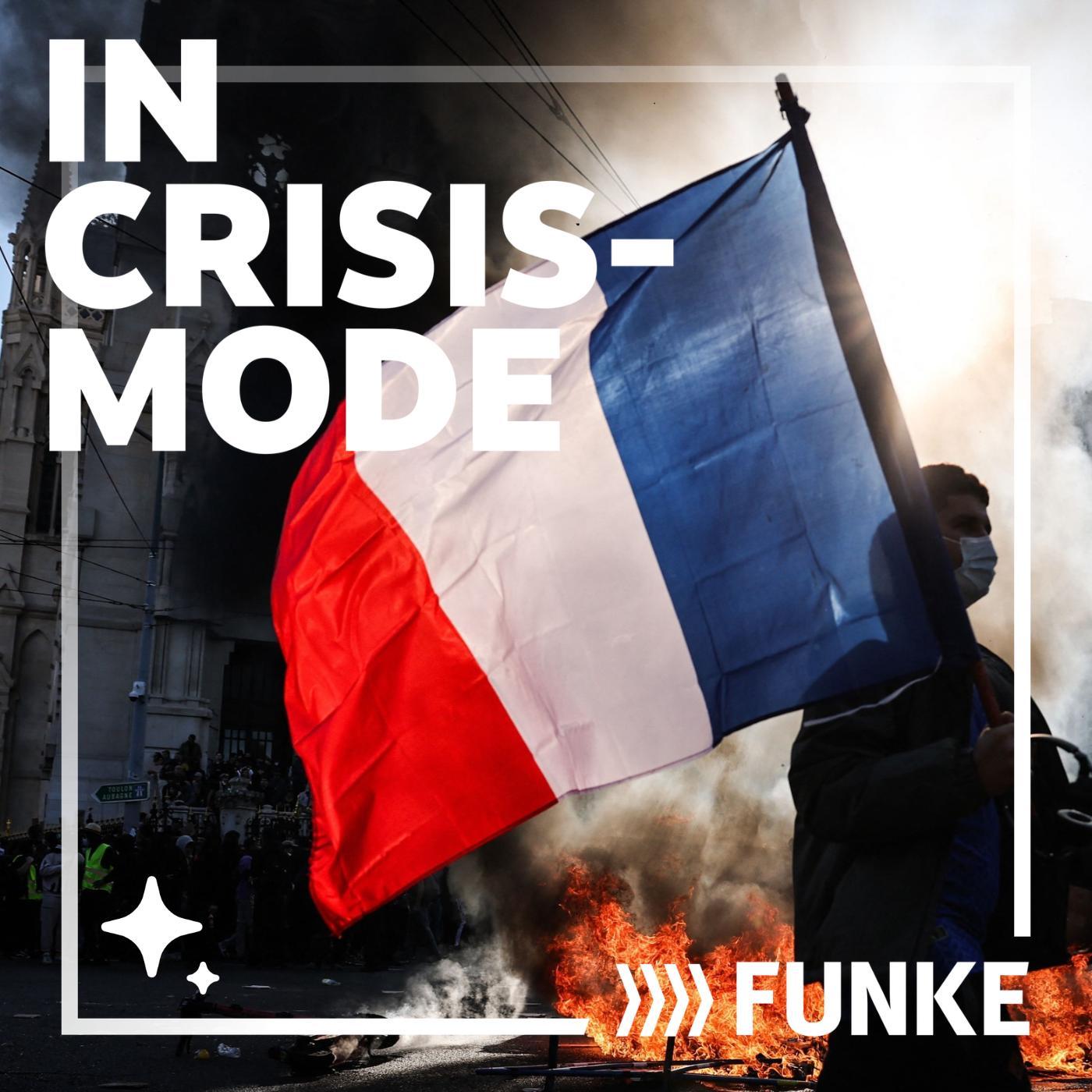
Cover image
A demonstrator holding a French national flag in front of a fire during the riots in Marseille on 17 October 2026. Protests against the rising cost of living have brought various groups onto the streets across France.
Photo: Thibaud Moritz / AFP
Contact and feedback
Questions, criticism or suggestions? Get in touch:
krisenmodus@funkemedien.de
Subscribe now
Im Krisenmodus — wherever you get your podcasts:
Spotify (open.spotify.com/show/0IQW1w25NYSrz60aAPzwvB?s…) | Apple Podcasts (podcasts.apple.com/de/podcast/im-krisenmodus/i…) | Deezer (deezer.com/de/show/3737197) | YouTube (youtube.com/@Krisenmodus-Podcast_FUNKE)
New episodes
Every two weeks, on Wednesdays.
Im Krisenmodus is a podcast by FUNKE Media Group.
Transkriptvom Podcast bereitgestellt · Zeitmarken springen hin
Die Übersetzung von Jans Stimme vom Deutschen ins Englische wurde mit einer KI erstellt. Protest researcher Simon Thun says there is one crucial difference. We have to look at this in the context of Germany's protest culture. In Germany, confrontations like these are very unusual. That also means that people who might potentially take part in them aren't familiar with this kind of protest.
So, for them, getting into a physical confrontation with the police isn't the first thing that comes to mind. What drives people to protest that way? Why do protests in France keep escalating? And how likely are we to see images and videos like these in Germany too? That's what we're looking at today on In Crisis Mode.
In Crisis Mode, the podcast from Conflict Zones with Jan Jessen. Hello, I'm Jan Jessen, Political Editor-in-Chief at the NRZ and a war and crisis reporter for Funka Media Group. France is in turmoil. Several cities have seen serious unrest. Shops have been looted, police stations attacked and people injured.
In Limoges, even the town hall is on fire. The government is responding with curfews and bans on demonstrations. But the protests began very differently. School students were calling for better learning conditions. Aber in nur ein paar Wochen, ihre Aktions wurden in eine Nation-Wide-Move. Mehr und mehr Menschen kamen auf die Straße.
Es war nicht mehr nur über den Bildungssystem und den Problemen. Die Proteste kamen zu reflektieren Angst über soziale Inequalität, die riesenggültige Kosten für die Leben und die Regierung. Last Saturday, mehr als half a million Menschen demonstriert es peacefully. Nachdem, aber, sehr viel rioting broke. Wer ist die Violenz?
Wie ist es mit den Original-Protesten? Und warum wird France immer wieder durchgeführt? Ich habe zwei Leute darüber gesprochen. Stefan Brendel hat sich von France als Journalist für Jahre. Er ist Funker Media Groups Correspondent in Paris und kennt die Länder politische Konflikte inside-out. Simon Thun ist ein Sociologist und Protest Researcher bei der Institut für Protest und Movement Research in Berlin.
Ich habe ihn darüber gesprochen, warum Protests kann eskalate und was setzt France apart von Deutschland. First, let's go to Paris. When I speak to Stefan Brandl, he has just cycled through the city. He wanted to see the damage for himself. And he noticed something interesting. In some neighborhoods, there is barely any sign of the unrest, while on the other side of the Seine, the scene is completely different.
It's quite difficult to get an overall picture, Especially because we've all seen those terrible images of destruction and damage. But if you live in Paris, you also have to remember that this doesn't cover the entire city. Yesterday I cycled through the south of the city, along the left bank of the Seine.
As a journalist I was looking for signs of the destruction, but I couldn't find any. Then I crossed the bridge over the Seine and came across a truly awful, almost warlike scene on Rue Etienne Marcel. There was hardly a shop, boutique or store whose windows hadn't been smashed. Wenn man sich zu Fuß bewegt, ist man eigentlich in der ganzen Straße und in den ganzen Viertel läuft man auf Glassplittern.
Und ich habe mit einer Frau gesprochen, deren Hund sie mit Strümpfen versehen hat, damit er sich nicht verletzt. A dog wearing socks because there's broken glass everywhere. It's an almost absurd scene. But it also shows how practically some people in Paris are dealing with this escalation of violence.
Above all, it shows just how much the unrest has changed everyday life in some neighborhoods. But how did things get this far? It all began online. September 21, students blocked Antoine de Saint-Exupery Secondary School near Paris. They were protesting a lack of staff and the dilapidated state of the school.
Among other things, the deputy headteacher's position and a school nurse's post had not been filled. The action spread on social media, as so many protests have in recent years. Other schools joined in, and before long the issue was no longer just about better learning conditions. The student protests were taking place in a society where discontent was already widespread.
The government was planning major spending cuts. Prime Minister Sébastien Lecornu announced cuts worth 54 billion euros. It's hardly surprising that many people were worried about their future. They were struggling with high prices, rising living costs, and the feeling that politicians weren't taking their problems seriously.
More and more groups joined the protests. Students, Trade Unions, Farmers and the Yellow Vests who have been a force in France since 2018. You may remember the huge Yellow Vest protests in 2018 and 2019. Many of the protesters came from working class and lower middle class backgrounds. They demonstrated on a massive scale and there were major street battles and clashes with the police.
On Saturday, October 17th, more than half a million people took to the streets peacefully, but afterwards the situation escalated in several cities. Shops were looted, public buildings attacked, and suddenly the headlines were no longer about the demonstrators' demands, but about images of violence. Who are the people rioting, and what do they have to do with the original protests?
Stefan Brendel says very different groups have come together, people with different social backgrounds, different problems and in some cases completely different goals. I think man könnte fast von einem soziologischen Unterschied sprechen. Ich meine, diese Gelbwesten, das waren und sind Leute, die eher aus ländlichen Gegenden stammen. could almost describe it as a sociological difference.
Die Yellow Vests waren, und still sind, die Menschen aus den Ruralen, die haben die Jobs haben. Sie sind nicht unabhängig, oder keine Geld. Die meisten haben eine Income, aber es ist sehr hoch. Sie müssen sehr gut budgeten. In der Mitte der Woche haben sie oft keine Geld left. Sie versuchen, die Unterstützung von der Regierung, insbesondere Welfare, Benefizienz oder andere Formen von Unterstützung.
Das ist sehr unterschiedlich von den Sekunden-School-Studienern, die in den Städten demonstrieren und in den Städten gehen, besonders in den Städten. Dann gibt es den Black Block, den Far Left, die von einem völlig anderen Hintergrund, und hat sehr unterschiedliche Aims. So, Sie könnten sagen, dass drei oder vier verschiedene Social-Gruppen sind zusammen.
Das macht nicht unbedingt eine kohärente politische Agenda, aber es macht einen Level von Potenzial-Violenz die sehr schwierig zu verhalten werden. Vielleicht drei, vier verschiedene soziologische Bevölkerungsgruppen da zusammenkommen. Das gibt nicht unbedingt eine politische Kohärenz, aber es führt dazu, dass ein gewisses Gewaltpotenzial da ist, das sich sehr schwer bekämpfen lässt.
So very different people are coming together Students demanding better learning conditions Workers whose wages are barely enough to live on Groups from the militant left looking for confrontation, And marginalised people from the banlieus The suburbs around French cities Many of them from migrant backgrounds, They're all on the same streets But they're by no means pursuing the same goals, And then there are people who simply take advantage of the chaos, The French government is mainly blaming far-left groups for the unrest.
Aber in Deutschland, auch, die Leute sind jetzt über die Veränderung. According zu Bild, Deutschland Minister Alexander Dobrindt hat gesprochen von left-wingen Extremisten und einem migranten Milieu joining forces zu kämpfen den demokratischen System. Ist da eine Evidence für diese Verbindung? Was role die junge Menschen aus den Frenchen Suburbs, known als die Banlieus, spielen?
Und kann Religion sein in die Veränderung? Was den Islam betrifft, sehe ich keine Beziehung, keinen Link zu den heutigen Krawallen. Was hingegen die Vorstädte anbelangt, ist es schon klar, dass, ich würde mal schätzen, eine kleine Mehrheit aus diesen Banlieue-Vierteln kommt. Aber es gibt, wie gesagt, auch andere Mitläufer, Trittbrettfahrer und auch Agitatoren.
As far as Islam is concerned, I don't see any connection with the current riots. As for the suburbs, I think it's clear that perhaps a small majority of those involved come from the Banlouz. But as I said, there are also other people joining in, opportunists and agitators. More generally, I do think that parts of the third generation of immigrants in France follow different rules, rules that don't have much to do with our understanding of the rule of law.
Sie sind nicht das für politische Gründe, weil sie nicht die France lieben oder weil sie die alten Schöne mit dem alten Kolonialen. Es gibt auch viel stupendliche Stufen. Die Looters stole mobile Phones und waren bereits offensichtlich für den Weg online. Die Polizei war natürlich schnell zu step in und arresten sie.
Die Regierung ist jetzt bereit, zu beurteilen. Diese sind junge Leute, die, wie ich gesagt, follow ihre eigenen Regeln. They may know that what they're doing isn't right, but they don't really have a sense of wrongdoing. And I think we need to be cautious here. The situation is very complex. France has a colonial history.
At the same time, many young people of Maghreb origin seem unwilling to assimilate into French society or find a way to live within the French Republic. They live on the margins of society and often struggle to integrate into the labor market or society in other ways. Da muss man schon auch eine gewisse Vorsicht walten lassen.
Die Dinge sind sehr komplex. Frankreich hat wie gesagt eine Kolonialgeschichte. Umgekehrt ist bei vielen, vor allem Maghreb-Jugendlichen, keine Bereitschaft zu spüren, sich zu assimilieren. In Frankreich, auch mit der Französischen Republik, ein Auskommen zu finden. Die leben am Rande der Gesellschaft und sind oft nicht in der Lage, dann auch auf dem Arbeitsmarkt oder anderweitig sich in die Gesellschaft zu integrieren.
Er ist nicht so, dass viele French-Subserbs sind, die Menschen von Nord- oder West-Afrika auswählen sind. Viele haben lange been French-Sitizien in der zweiten oder even third-generationen. Aber diese Neubauern haben auch für Jahre altes Konflikt über soziale Exclusion, ein lack von prospects und relations mit der Polizei.
Die Polizei ist oft verwendet, zu benutzen, zu benutzen, zu benutzen, zu benutzen, zu benutzen, zu benutzen, und zu benutzen, zu benutzen. Aber nichts davon sagt uns, wer in den aktuellen Unrest ist, wenn es, was die individuelle Verletzungen motiviert. So die wichtigste Frage ist nicht nur, wer ist auf den Straßen, aber warum die Situation war, in der ersten Zeit.
Die relationship zwischen den demonstratoren und den Polizei spielt eine wichtige Rolle hier. The French police have a reputation for taking a very tough approach, particularly at demonstrations. And the clashes didn't begin last weekend. Confrontations with the police took place during the first student protests too.
How can encounters like these develop into an ever-growing cycle of violence? I spoke to protest researcher Simon Thun. Ja, ich glaube, das, was wir da in Frankreich beobachten konnten, das hat eine doppelte Geschichte. Einmal haben die Proteste selbst eine Vorgeschichte. Das heißt, das hat jetzt nicht am Wochenende angefangen. I think what we've seen in France has two sides to it.
First, the protests themselves have a history. They didn't start last weekend. They've been going on for several weeks. The police responded with violence to the student protests very early on. Schools had been occupied and access blocked to draw attention to the terrible conditions, both in terms of staffing and the state of the buildings.
That led to confrontations with the police at a very early stage. So there was already a history of violent confrontations during the student protests. When I see the other side, in this case the police, as an enemy, I become more willing to use violence myself. That's generally how confrontations involving violence work.
Wenn ich das Gegenüber, in dem Fall die Polizei, als Gegner wahrnehme, dann sinkt die Schwelle, selbst Gewalt anzuwenden. Das gilt erstmal generell in Gewaltkonfrontationen. Of course, it does not justify attacks on police officers, looting or setting shops on fire. Why does France keep seeing these escalations? We remember the Yellow Vest protests in 2018 and 2019.
Barricades were burning then too, and there were serious street battles. And they weren't the only examples. France saw similar confrontations in the 1960s, 70s and 80s. There were major farmers and wine growers protests, some of them involving deaths and serious injuries. France has a long history of intense social conflict.
Simon Thun says that also has to do with the country's political system. One difference between Germany and France is that we have two very different political systems. France has a centralized system with few intermediary institutions. Laws are simply passed first, and then the government sees how people react.
If the reaction is strong, the laws may quickly be withdrawn or scaled back from what was originally planned. Germany works differently. It has a federal system. Education is a clear example. Responsibility lies primarily with the individual states. That means protests in France tend to erupt more suddenly. There's a clear opponent in the central government, and tensions can boil over at moments like this.
In Germany, protests are much more continuous and much more part of everyday life. der Protest dann sozusagen in solchen Momenten hochkocht. In Deutschland haben wir einen sehr viel dauerhafteren Strom von Protesten, der so sehr viel alltäglicher In France, protests are therefore directed very strongly at the government in Paris.
Für viele Menschen ist es der Hauptgrund der Angst. In Deutschland, politische Entscheidungen sind über verschiedene Levels der Regierung. Das machte nicht automatisch die Proteste peaceful, aber es schäte wie sie entwickeln und wer sie target. There is another difference. In France, fierce clashes with the police have long been part of the history of social protest.
In Germany, such confrontations are much less common. And today, there is another factor that can significantly change the dynamics of unrest. Social media. Images of burning cars, smashed shop windows and street battles spread within seconds. Often, those are the images that go on to dominate the public debate.
What does that mean for the protest movement? Social media matter because images of the unrest are available in real time. Reactions happen immediately, and they are heavily shaped by the images people see. We no longer see the huge crowds at demonstrations. Instead, we see individual clips of violent escalations, and those clips become the basis for our discussions.
That puts even more emphasis on violence. It makes taking part more attractive to groups that use violence because they know they'll get everyone's attention. But it also increases the pressure on politicians to act. Sich zu beteiligen, weil sie wissen, dass sie die ganze Aufmerksamkeit haben. Das macht aber auch sozusagen den Handlungsdruck in der Politik noch mal größer als er sowieso schon ist.
So, violence gets the most attention, that's tragic. It's true of social media, but also of traditional media, which naturally focus on images of burning barricades and similar scenes, rather than on the hundreds of thousands of people demonstrating peacefully. Das macht es schwierig. Als Medienorganisationen müssen wir auch fragen, ob wir den Fokus in der richtige Richtung stellen müssen.
Aber diese Beobachtung ändert sich auch, wie die Menschen die Proteste verursachen und erhöht sich die Druck auf die Regierung zu tun. In France, die Autoritäten versuchen, zu verhindern, weiteres Unrest, mit curfews und bans auf Demonstrationen. According to the figures available, 2,331 people were taken into custody nationwide last weekend.
The government faces a dilemma. It has to stop the violence and protect the public. At the same time, the social problems that brought so many people onto the streets have not gone away. And that could be politically dangerous for the parties in the centre. France is heading towards next year's presidential election, which is about six months away.
The incumbent president, Emmanuel Macron, cannot run again. And two of his most prominent political opponents seem poised to benefit from the situation. Marine Le Pen on the right and Jean-Luc Mélenchon on the left. But who really gains from the unrest? Our France correspondent, Stéphane Brendel, believes Marine Le Pen has the advantage.
Ich glaube, es ist relativ klar, dass Marine Le Pen von diesen schweren Unruhen profitieren wird. Ich denke, es ist ziemlich klar, dass Marine Le Pen will benefit from this serious Unrest. In recenten Monaten, sie hat sich sehr moderatet, almost statesmanlike, strongly Republican und respectable. Das ist anders aus der AfD in Deutschland, oder in Eastern Germany, wo provocation, und vielleicht deliberate, politische Provokation, spielt eine Rolle.
Le Pen ist die andere Richtung in Frankreich. Sie presentiert sich als eine Stateswoman und ist bereits über die Zeit, wenn sie in der Elysee-Palasse ist. Jean-Luc Mélenchon may be more likely to suffer from this massive outbreak of violence. At first, he may have gained something from the student protests.
Er hat auch sehr skillfully gewohnt, die Unterstützung in den Suburbs gewinnen. Aber seit dem Saturday, als die Proteste eskalte und die Szenen wurden genügend gefährlich, Mélenchon hat wahrscheinlich zu einer Disadvantage getroffen. Schülerprotesten. Er hat es auf relativ geschickte Weise auch geschafft, die Vorstädte auf seine Seite zu bringen.
Aber jetzt, seit Samstag, wo wo diese Proteste eskaliert sind und wo es wirklich. Beängstigende Szenen gab, ist wahrscheinlich Mélenchon eher im Nachteil. Marine Le Pen could therefore benefit from the unrest. This is not unique to France. In Germany too, right-wing politicians often try to capitalize on violent clashes, particularly when people from migrant backgrounds are involved.
The uncomfortable truth is that the perpetrators are playing into the hands of the right. The more images of violence and destruction dominate public debate, the more attention shifts to security and law and order, key issues for the political right. That could become a problem for Jean-Luc Mélenchon. He is trying to turn social discontent into political support.
Aber wenn die Protests getrennt werden, über alles mit den Börsen und looten Schöpfen, dann kommen auch unter Druck. Das ist unser Correspondent's Assessant. Ob es wird, in nächstes Jahr der Presidential-Elektion sein, bleibt zu sehen. Aber die Unrest ist bereits verändern, die politische Debatte. Erstens, die Fokus war auf die Schöne-Stelle in Schulen, die riesige Kosten für die Leben und ob die Leute noch fühlt sich von der Regierung.
Jetzt ist der Fokus mainly auf violence, Sicherheit und der Staat's response. Das lässt die peacefulen Demonstratern ein großes Problem face. Seine Demonstrationen rischen, sich durch den Unresten zerbrechen. Was passiert dann? Stefan Brendel sieht bereits neue Anwälte für Proteste. Die Yellow Vests können auch bereit sein, wieder zu mobilisieren.
Gleichzeitig versuchen die politische und soziale Gruppe, die Situation zu schalten. Es gibt, wenn man in sozialen Medien schaut, jetzt schon Aufrufe für kommenden Samstag, Auch in zwei Wochen. Die Gelbwesten, die waren schon letzten Samstag present, nur sind die völlig untergegangen. If you look at social media, there are already calls for demonstrations next Saturday, and again in two weeks.
The yellow vests were present last Saturday, but they were completely lost in the general chaos. Es ist möglich, dass sie wieder mobilisieren können in den Ruralen, vielleicht durch die Runde blockieren, wie sie in 2018 und 2019 bringen private traffic zu einem Standstill. Das ist eine Möglichkeit. Aber in Paris, heute kann man eine Degree von Hesitanz zwischen politischen und sozialen Bewegungen und Parten über die Strecke wieder so schnell zu kommen.
The efforts of these parties and movements are now focused on de-escalation. They are trying to calm things down, so it's still unclear how these movements will develop from here. Das ganze Bemühen dieser Parteien und Bewegungen läuft schon darauf hinaus, eine gewisse De-eskalisation zu erreichen. Man versucht, die Dinge zu beruhigen und es ist deshalb noch nicht sicher, wie jetzt diese Bewegungen weitergezogen werden.
Es bleibt sehen, ob die Situation in Frankreich wird, oder ob die Proteste wird weiterentwickeln. Aber die Discontent, die so viele Menschen auf die Straße bringen, wird nicht einfach disappear. Und Frankreich ist nicht alleine. Menschen in anderen europäischen Ländern sind auch protesting against political decisions, the high cost of living and a lack of prospects.
Italy, for example, has also seen violent unrest in recent days. The triggers may differ, but the questions are often the same. Can I still afford to live? Do I have a future? And are politicians listening at all? These concerns are widespread in Germany too. Social researcher Klaus Hörlmann has warned in our newspapers against confusing the comparatively calm situation on German streets with political satisfaction.
Many young people are worried about their future, rising housing costs, and their financial security. Youth researcher Simon Schnetzer also sees considerable potential for protest. He has even described it as a ticking time bomb. But dissatisfaction does not automatically mean people will take to the streets, and protest certainly does not inevitably lead to violence.
That brings us back to the question we asked at the beginning of this episode. Could we see unrest like this in France, here in Germany? Protest researcher Simon Thune believes it is possible in principle, but he also sees important differences between the two countries. That doesn't rule out the possibility that there are people who would want this to happen and would see an opportunity in it.
But they would need a larger, more chaotic situation in which to get something like this started. We're not seeing major protests in Germany right now. I think there is a great deal of dissatisfaction with social policy, but people don't feel that protesting will achieve very much. So, we're not in a situation that mirrors France.
And I don't see the same potential among large numbers of people to express themselves in this way. Das Potenzial dafür, dass Menschen sich in der Form artikulieren. Simon Thun therefore considers an escalation as brutal as the one in France unlikely in Germany at the moment. That is good news at least, not because there is no discontent here or because protests in Germany always remain peaceful.
We remember the serious riots during the G20 summit in Hamburg in 2017, for example, or the fierce clandestine. Über die Konstruktion der West-Runwein an Frankfurt Airport, sowie über die Proteste gegen die Nutzung des Nutzers. Demonstrations can get out of control in Germany, too. There's no question about that. But Thun currently sees no comparable situation, no similarly broad protest movement, and no equivalent dynamic between demonstrators and the police.
Above all, violent confrontation is much less embedded in Germany's protest culture than it is in France. That doesn't mean similar unrest could never happen here. But the images from France are not proof that Germany is about to experience the same thing. What matters is the conditions under which people protest, how politicians and the police respond and which groups take part.
Protest movements themselves can also play an important role. They don't have to stand by while others use their demonstrations as an opportunity for violence. Simon Thun recalls an incident during the G20 summit in Hamburg. Also diese Form von Selbstregulation findet statt, also die findet im Vorfeld von Protesten statt, indem man darüber nachdenkt, dass wir nicht darüber nachdenken.
Es beginnt vor Protests, wenn Leute diskutieren, was ihre Protests soll, und was sie nicht wollen. Es also passiert in der Moment selbst. Take the G20 Summit in Hamburg. People had lit fires in the street, some dangerously close to residential buildings. Others stepped in and said, this isn't acceptable, you can't do that.
We repeatedly see protest movements stepping in to stop such excesses, or at least clearly marking them as crossing a line. People who are demonstrating themselves but still step in when others cross the line. People who make it clear that violence against bystanders is not part of their protest. Of course, demonstrators cannot be expected to put themselves in danger, But protest movements can make clear what they stand for and what they do not.
Let's remember the woman in Paris Stéphane Brandl told us about, the one putting socks on her dog's paws so it wouldn't get hurt by the broken glass on the street. For her, the unrest is not an abstract political debate. She has to live with the consequences of the violence, just like the people whose shops have been destroyed or who fear that their neighbourhood may see more unrest.
At the same time, hundreds of thousands of people are demonstrating peacefully for better living conditions. They want their demands to be heard. France faces a difficult task. The government has to protect people from violence, but it also has to find answers to the social problems that helped make this protest movement so large in the first place.
And in Germany, two people are anxious about the future, worried about social insecurity, and feel that politicians do not adequately represent them, that does not mean we are on the brink of similar unrest. But it would be a mistake to take these concerns seriously only once people are out on the streets or the first cars are burning.
Another problem is that social media play a major role not only in amplifying domestic grievances, but also in giving foreign actors a way to try to destabilize other countries. Ich bin über alle von Russland. Es gibt Bot-Netzungen, die online-Bot arbeiten. Es gibt considerable evidence von dieser, insbesondere von intelligente Agenziensten, und deren Ziel ist es, sozusagen, zu füllen Menschen's anger.
Wir sehen dies in Deutschland, auch, wenn Far-Reit-Gruppen von AI-Generated Content durch A.I.-Generated Content und die Angst ist deliberately stirred up. I think this adds another serious challenge for societies. There are forces from outside that can amplify protests, potentially to the point where they turn violent.
I believe it is extremely important to take people's concerns seriously. Peaceful protest should not have to turn violent before it gets attention. That was today's episode of Im Kreisen Modus. The podcast was produced by Alexander Baumeister, a journalist and radio editor at a radio station belonging to Funky Media Group.
If you enjoyed this episode, please subscribe to our podcast and recommend it to others. It helps us reach more people with our stories. And I'd like to hear what you think. Do you feel that politicians take your concerns seriously? And what would need to happen for that to change? Write to us at christenmodus at funkemedian.de.
Take care. Bye.
