

Im Krisenmodus· Folge 177
War in Ukraine: Doubts Cast on Russia’s Claim of Victory in Kostiantynivka
Mittwoch, 14. Oktober 2026 · 34 min
Kapitelklicken springt direkt hin
Shownotes
*This Podcast is made with the help of AI
In early July, Russia announces that it has fully captured the strategically important city of Kostiantynivka. Ukraine’s General Staff rejects the claim. The US-based Institute for the Study of War also finds no evidence that Russia has established full control of the city.
Almost three months later, FUNKE war correspondent Jan Jessen follows a Ukrainian resupply mission to Kostiantynivka from Kramatorsk. The drone commander Hordyi reports that Ukrainian soldiers are still fighting in the city. Vudi, deputy company commander of a drone battalion, explains why a mission covering just seven kilometres can now take up to ten hours.
Further north, Ukraine’s Operation Vivaldi is under way. Major Dmytro Rohoziuk, commander of the 60th Separate Inhulets Mechanized Brigade, challenges another Russian victory claim: Sviatohirsk has not been captured either. Military analyst Dr Gustav Gressel explains how drones, electronic warfare and mechanised units work together in the operation.
Meanwhile, Nataliia Bahrii reports on people who return to destroyed towns and villages despite the danger. Their stories show that regaining territory militarily does not make it safe. This episode asks when a city can truly be considered captured — and what impact a false picture of the battlefield can have on the course of the war.
Featured in this episode
Jan Jessen — Head of Politics at the NRZ newspaper and war and crisis correspondent for FUNKE Media Group
Dr Gustav Gressel — Military analyst at the National Defence Academy in Vienna
Major Dmytro Rohoziuk — Commander of the 60th Separate Inhulets Mechanized Brigade, part of the 3rd Army Corps
Akhmet — Callsign of a battle captain and combat operations officer with the 60th Inhulets Brigade
Hordyi — Callsign of the commander of a drone team with the 28th Separate Mechanized Brigade
Vudi — Callsign of a deputy company commander with the 39th Separate Drone Battalion
Nataliia Bahrii — Head of civil-military cooperation for the 60th Inhulets Brigade
Chapters
01 | Russia claims to have captured Kostiantynivka
In Kramatorsk, Jan Jessen follows a resupply mission into the embattled city. Hordyi challenges Russia’s claim of victory.
02 | Seven kilometres in ten hours
Vudi explains how drones and mined roads can turn even short resupply routes into missions lasting most of the day.
03 | Russia’s assault on the fortress belt
The plan to attack Kostiantynivka directly and encircle Ukrainian defensive hubs from the north and south.
04 | Operation Vivaldi
Gustav Gressel and Major Dmytro Rohoziuk explain Ukraine’s counteroffensive and the situation in Sviatohirsk.
05 | Drones, tanks and the 20th Guards Army
Why local superiority in the drone war can enable mechanised assaults — and how Akhmet describes the condition of Russian forces.
06 | Why people refuse to leave
Nataliia Bahrii recounts the stories of people returning home, evacuation efforts and one family the soldiers were too late to save.
07 | Liberated does not mean safe
Why recaptured towns continue to come under fire — and what consequences Russia’s false battlefield claims can have.
Recommended listening
Kherson Under Drone Attack: How a City Keeps Going in Wartime (morgenpost.de/podcast/article412579288/cherson…)
Terminator Myths in Drone Warfare: Ground Robots and AI in Ukraine (morgenpost.de/podcast/article411774655/termina…)
Swarm Warfare: One Pilot Controls Many Drones — Reality vs. AI (morgenpost.de/podcast/article410821036/schwarm…)
Target Acquired: The Drone Front in Ukraine (morgenpost.de/podcast/article409271168/ziel-er…)
Cover image
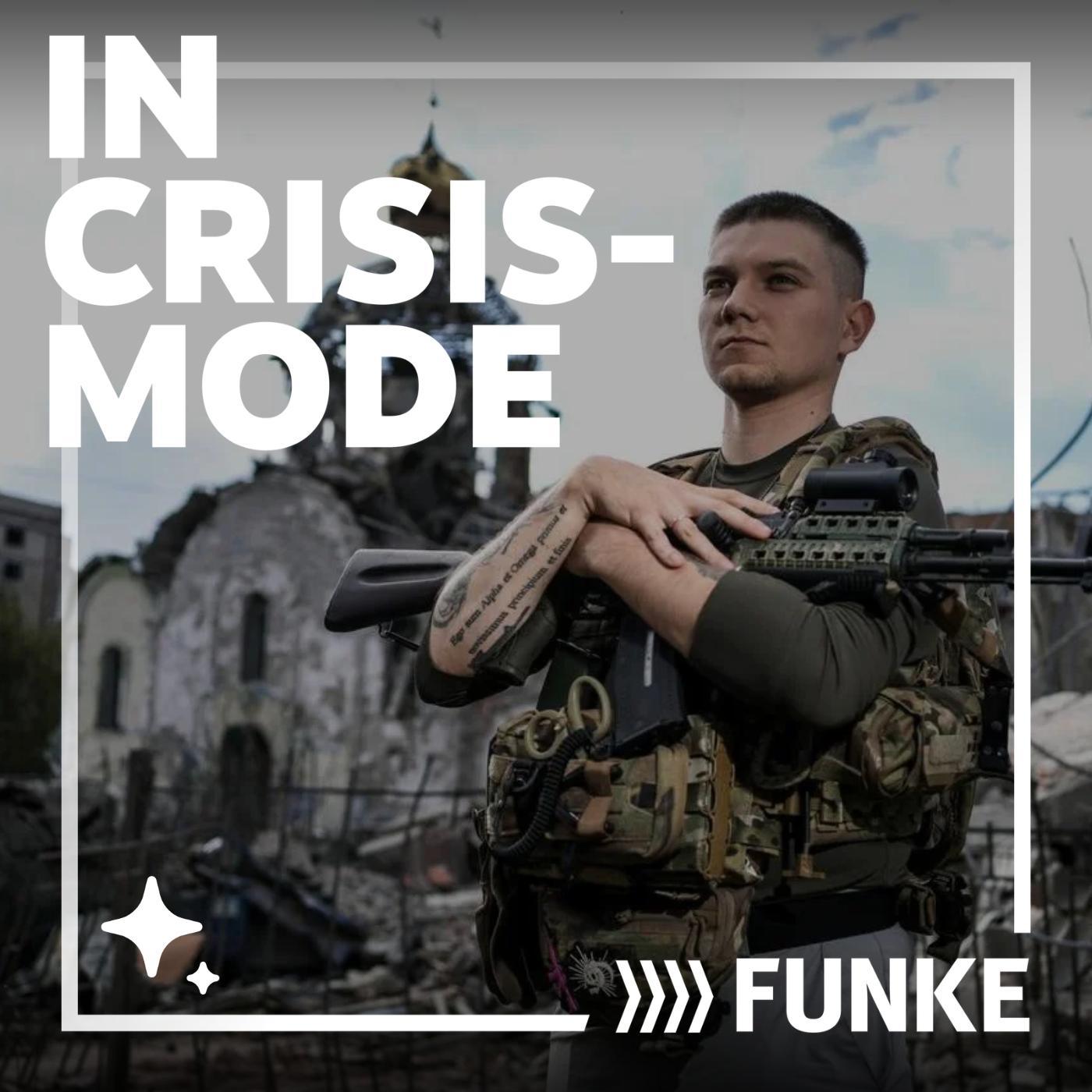
The cover photo was taken on 25 September 2026 in Kramatorsk. In the background is the historic Ukrainian Orthodox Church of the Nativity of St John the Baptist, damaged in a bombing.
Photo: Reto Klar / FUNKE Photo Services
Contact and feedback
Questions, criticism or suggestions? Get in touch:
krisenmodus@funkemedien.de
Subscribe now
Im Krisenmodus — wherever you get your podcasts:
Spotify (open.spotify.com/show/0IQW1w25NYSrz60aAPzwvB?s…) | Apple Podcasts (podcasts.apple.com/de/podcast/im-krisenmodus/i…) | Deezer (deezer.com/de/show/3737197) | YouTube (youtube.com/@Krisenmodus-Podcast_FUNKE)
New episodes
Every two weeks, on Wednesdays.
Thanks to Thomas Bertram (radiooberhausen.de/moderator/thomas-bertram-26…), Michelle Bollen (radiokw.de/moderator/michelle-bollen-280337), Jonathan Goeke (radiokw.de/moderator/jonathan-goeke-2556269) and Stefan Merten (radiomuelheim.de/moderator/stefan-merten-260170) for lending their voices.
Im Krisenmodus is a podcast by FUNKE Media Group.
Transkriptvom Podcast bereitgestellt · Zeitmarken springen hin
Die Übersetzung von Jans Stimme vom Deutschen ins Englische wurde mit einer KI erstellt. At the beginning of July, Russia announces a major military success. The strategically important city of Kostyantinivka in the Donetsk region has been completely captured. Ukraine's general staff disputes the claim.
Analysts at the US-based Institute for the Study of War also see no evidence that Russia has gained full control of the city. Almost three months later, I'm sitting in an unremarkable house on a side in Kramatorsk. In front of me, two Ukrainian soldiers are tracking the flight of a large drone on a monitor.
The images show Kostiantynivka, burned out houses, destroyed rooftops, empty streets. The drone hovers over a building and drops its payload. It's delivering supplies to Ukrainian soldiers, in a city Russia declared captured long ago. One of the men goes by the call sign, He commands a drone unit in the 28th Separate Mechanized Brigade.
His unit supplies Ukrainian positions in Kostiantinivka with food, ammunition and medicine. I confront him with Russia's announcement of victory. Of course the Russians have superior numbers. They are a formidable opponent, and they must not be underestimated. We don't underestimate them, but we are putting up strong resistance.
How can Russia declare a city captured when Ukrainian soldiers are still fighting there and receiving supplies? What does it actually mean to control a city in this war? And what has the Ukrainian operation codenamed Vivaldi changed on the front line? That's what this episode is about. In Crisis Mode, the podcast from Conflict Zones with Jan Jessen.
Hello, I'm Jan Jessen, Political Editor-in-Chief and War and Crisis Reporter for Funker Media Group. Kramatorsk has changed dramatically since my last visit in the spring. The city has now become a fortress. Barbed wire and concrete anti-tank obstacles line the streets. Net tunnels have been erected over major roads to protect against incoming kamikaze drones.
Russian glide bombs have hit buildings in several locations. Just a few days before my visit, one exploded in a residential neighbourhood, destroying the Church of St. John the Baptist. Small kamikaze drones are now flying over Kramatorsk too. We've already reported on this threat in our episode about Kursen.
We'll link to that episode in the show notes. These drones sound a bit like mosquitoes turned up to an unbearable volume. It's a nerve-wracking noise, and it makes working in Kramatorsk considerably more difficult. Kramatorsk und nahe Slovyansk formen das Herz der Ukraine fortifieden Beldung in der Donetskregion.
Drushkivka and Kostyantinivka are also part of this chain of cities. About one-fifth of the Donetsk region remains under Ukrainian control. Capturing the entire region is one of Russia's most important war aims. This year, Russia intended to break through along several axes. To help you picture the situation, Slovyansk lies to the north, with Kramatorsk below it, then Drushkivka, and farther south, Kostyantinivka.
Russian forces are attacking Kostyantinivka directly. At the same time, they are trying to bypass the entire fortified belt, advancing from Lyman in the northeast and from Dobropilya in the southwest. The aim is a pincer movement. Russian troops want to cut Ukrainian supply routes and gradually encircle the major cities.
So far, this plan has not succeeded. In the north, Ukrainian forces have even managed to push back the Russian advance. We'll come back to that in more detail shortly. Kostyantinivka has now been heavily destroyed and is the scene of fierce fighting. Small Russian units are infiltrating the city, but Ukrainian soldiers are still holding positions there too.
At the beginning of July, the Russian military and President Vladimir Putin declared the city fully captured. Yet almost three months later, Ukrainian soldiers are still fighting there. Hordyi's unit supplies them from the air. Large drones carry food, water, ammunition and medicine to the front lines.
When Russian soldiers get too close to Ukrainian positions, these drones are also used to attack them. Every flight is a risk. Hordyi says many of their drones are shot down. Sometimes rain and fog provide the most effective protection from Russian air defenses. In good visibility, he says, flying without being detected is almost impossible.
Even so, his unit tries to keep the position supplied at all times. Something else interesting happened while we were talking to Hordyi. As we discussed kamikaze drones, we suddenly heard machine gun fire not far away. Ukrainian units were trying to shoot down incoming drones over Kramatorsk. That too has now become part of everyday life in the city.
Naturally, we can't independently verify every detail of his account. For journalists like us, getting into Kostyantinivka is currently impossible. You would have to cover around 20, 25 or even 30 km on foot. And the chances of arriving in anything resembling one piece are relatively slim. At this point, it's simply no longer possible for us to get there.
However, Hordi's central claim is also supported by outside observers. The Institute for the Study of War says there is no evidence that Russia has fully captured Kostyantinivka. At another position in Kramatorsk, I meet another Ukrainian officer. His callsign is Vudi. He is deputy company commander in the 39th Separate Drone Battalion.
Vudi's unit has a different role from Hordi's team. It does not directly supply Ukrainian positions in Kostyantinivka. Instead, its medium-range drones attack Russian supply lines. Unmanned ground vehicles also transport ammunition, water and food to areas that are now almost impossible for people or conventional vehicles to reach.
These ground robots also help evacuate the wounded and recover fallen soldiers. We've talked about this several times on the podcast already. Getting into these positions has become extremely difficult. The so-called kill zone now extends 40 kilometers and in some places 50 kilometers, meaning an area where drones are operating everywhere.
Getting wounded soldiers out of there is incredibly difficult. If you send people in to do the job, you need at least two people to evacuate one wounded soldier, usually three or four. That means that rescuing a single casualty can suddenly put another three, four or five people in mortal danger. That's...
We started doing this in April. Back then, we had just one small ground robot. I took it on a mission to Kostianti Nivka. After that, we built up the unit step by step. By now, it's almost the size of a company. Today, the job is much more difficult. Back then the threat was considerably lower, and getting into Kostiantinivka was still relatively straightforward.
Today a single mission from Kramatorsk to Drushkivka can take 8, 9 or even 10 hours, sometimes a whole day, and that's a distance of only about 7km. We constantly have to stop and wait. The road might be mined before we even set off. Then we have to wait until it's been cleared, because we can't do that ourselves. It's pretty difficult.
Wir. Warten, aber es ist sehr schwierig. 7 km in, um 10 Stunden. Under normalen Konditionen, das wäre ein sehr kurzer Drei. 7 km könnte 10 Minuten dauern. Aber unter den Konditionen über diese Frontline, das gleiche Reise kann einen ganzen Tag dauern. Drones monitorieren die Straßen. Other Drones attacken Fahrzeuge.
Routes können gebraucht werden. Wieder und wieder, Soldaten müssen und warten und warten. Ein Roboter in der Bühne nicht die Gefahr, natürlich. But it changes who is exposed to them. If the robot is hit, equipment is lost. If a person is inside a vehicle, the same mission can cost them their life. But drones don't just determine how Ukrainian soldiers are supplied.
They are also key to the counteroffensive taking place farther north. Its codename is Vivaldi. You may have read a little about it already. It was a very, very interesting operation that began back in the spring and was kept completely secret. Just think about what that means. The operation was carried out by Ukraine's 3rd Army Corps.
Several brigades were involved, that is, tens of thousands of soldiers, and yet the Ukrainians managed to keep the operation secret well into the autumn. That's a remarkable achievement, and it took the international community by surprise as well. Um zu verstehen, ich spreche mit Dr. Gustav Gressel, ein Militärer der National Defense Academy in Vienna.
Gressel doesn't describe Vivaldi as a major Ukrainian offensive designed to force a deep breakthrough. He says it is a limited attack with a broader defensive purpose. In my view, Vivaldi has operational significance, but it's not an operational level offensive. It's essentially a tactical offensive with an operational, defensive objective.
If we look back to the spring, the Russians were trying to encircle Ukraine's fortified defensive belt with two pincer movements. The idea wasn't to capture it head-on, but to surround it. One thrust aimed to advance from the Lyman area towards the Oskil River, while the other pushed north from Dobropilya.
In the south around Dobropilya, Russian military pressure was significantly greater than in the north. The Russians were more successful there in supplying their spearheads. In the north, it was more difficult because several smaller rivers and streams channeled Russian movements along certain routes.
The Ukrainians were more successful there in thinning out those attacking forces. That's why the Ukrainians launched a counteroffensive in the north to eliminate the Russian salient. Vivaldi, then, is a tactical attack with a broader defensive impact. In effect, it has already achieved an operational objective.
Ukrainian forces are aiming to push back the Russian salient near Lyman. They have now succeeded in doing so. The goal is to protect supply routes to Slovyansk and Kramatorsk, while disrupting the northern flank of Russia's planned Pinsa movement. A key role in this operation has been played by the 60th separate Inhulets mechanized brigade, Teil der 3. Armee Korps, die in dieser Region aktiviert ist.
In late September, I meet the brigade's commander, Major Dimitro Rohoziuk, in a bombed-out school building in Izium. His brigade's initial task was to halt the Russian advance. That was the first phase of Operation Vivaldi. The name, of course, is no coincidence. Antonio Vivaldi's best-known work is The Four Seasons, and this Operation II is divided into several phases.
For operational security reasons, however, the commander won't reveal anything about the fourth phase. According to Major Rohoziuk, Russia's offensive was aimed at capturing Lyman, reaching Sviatohirsk, and advancing towards the road linking Kharkiv and Slovyansk. I'll come back to Sviatohirsk in a moment because this town is also a case in point when it comes to Russian disinformation.
In early September, Putin had already declared that Russian forces had captured Sviatohirsk. Naturally, I asked the Major what truth there was to that claim. His answer was unequivocal. Ihr müsst verstehen, dass es in meinen Augen ist, weil ich verstehe, weil ich verstehe, weil ich es völlig absurd ist, weil ich weiß, wie unsere Truppen sind.
Svyatohirsk hat in der Rear-Area von der 60th Brigade all along und wir haben unsere Defensive Lines da gehalten. Als vorhin als ein Jahr ago, ich war durch alle diese Stadt und ich bin da schon mal zurückgegangen. Über den Kursen dieses Jahr. Sviatohirsk und die Bereiche von Yarova und Drobishev sind behind die 60 Brigade's positions.
Es ist möglich, dass unsere Sicherheitsmeasures misleid die enemy. Wir haben nicht nur wie stabil die Situation da eigentlich war, oder dass isoliert die Russische Infiltration nicht die Gefängnisse der 60 Brigade, oder die 3rd Army Corps als ein. Das ist genau das, was das so absurd ist. Wie können Sie darüber reden, wenn unsere Forces in dieser Sektor Ich kann es sagen, dass die Verlangen des Einwohnern des Einwohnern, die sehr wichtig sind, wenn in diesem Moment, die unsere Reichweite sind im Krieg des Anstums.
Rohoziuk does not deny that small Russian units are trying to infiltrate Ukrainian lines. But he makes a more precise point. The presence of individual soldiers or small groups does not mean that Russia has military control over a town. This, incidentally, is another tactic Russian forces have been using more and more frequently lately, or at least more frequently this year.
They send in small infiltration teams, essentially suicide squads or one-way missions. Their sole purpose is often to pose somewhere with a Russian flag. A Russian drone films a soldier standing there, waving the flag. Then he quickly rolls it up and tries to get out, assuming he makes it out alive. The Russians use this footage to claim military successes on the battlefield that, in reality, never happened on anything like the scale they suggest.
As I said, Ukraine's counter-offensive in this area was a very, very large operation, und es bleibt für Monate gegründet. Preparations for Operation Vivaldi began as early as the spring. It was only in early September that the first details of the operation began to emerge. At the time of our conversation, Rochosiuk says Ukrainian forces have brought more than 125 square kilometers under their control.
By the end of the third phase, that figure, according to the Ukrainian side, has risen to more than 170 square kilometers. As always, the precise extent of the territorial gains and Russian losses cannot be fully independently verified. But the course of the front line does show that Ukraine has managed to push back the Russian salient in this sector.
All publicly available maps tell the same story, including those published by the Institute for the Study of War and Deep State, a Ukrainian open source intelligence project. Und hier ist ein wichtiger Punkt. Even Russian-Military-Bloggers, die normalerweise ein starkes-Russisch-Russien-Line, sagen, dass Ukraine hat eine Successful Counteroffensive in diesem Bereich gemacht. Das hat sich in den letzten Wochen verletzt.
Sie sind in den Armen über die Ukraine-Offensive, über Ukraine's capabilities, und über alles, über wie tief sie fühlen, sie haben sich selbst verletzt von ihren eigenen Leidenschaft. Aber was erinnert ist, dass nicht nur die Ukraine-Förse sind auf die Offensive, sondern nur die Positionen, wie sie für vieles Jahr gemacht haben.
Was wirklich wichtig ist, wie sie vorbereiteten für die Attacken haben. According zu Gustav Gressel, die Ukraine-Unitär erst brauchen zu erstellen local superiority in der Drone War. Only then can tanks and mechanized infantry advance. Preparations for the offensive probably began in March, with the first attacks taking place in May.
A crucial part of the operation was establishing local superiority in the drone war. That meant systematically degrading Russia's ability to operate drones in this sector through electronic warfare and reconnaissance, essentially boxing the Russian units into a corner, identifying their positions and then systematically destroying their capabilities.
This also shows just how much preparation time is needed for a mechanized assault. The Ukrainians did attack with mechanized forces, but those forces were only deployed once the drone situation had been prepared accordingly. So, for everyone now shouting, main battle tanks are back, mobile warfare, blitzkrieg, maneuver warfare, hooray!
Well, it's not that simple. Of course, main battle tanks have value. And of course, you need mechanized infantry to carry out attacks like this. But these forces can only operate effectively as combat formations when they are integrated with drone units. They also need to be coordinated through digital command and control systems alongside electronic warfare and electronic intelligence.
And all of this has to happen at lower levels of command too, not just at core level or above, as is often the case in European armies, but right down to the smallest tactical units. That's how you establish drone superiority. und nur dann kann man attacken. Tanks and infantry, then, are not disappearing from the battlefield, but they can no longer be used effectively if enemy drones are constantly hovering overhead.
We've talked several times on this podcast about how warfare has changed in recent years and about the huge role drones now play. We can also add links to other episodes in the show notes where we explore this subject in more detail. In the case of Operation Vivaldi, Untertitelung des ZDF. Die Ukraine hat sich in den USA gelegt, dass die Russen in den USA gelegt, die in den USA gelegt wurden, die in den USA gelegt wurden.
Das ist genau das die Ukrainien in den USA während Operation Vivaldi. Sie hat auch die Verlust und Verlust hinter den Russen gelegt, durch die Russen gelegt wurden. Diese wurden transportiert hinter enemy Lines by large drones. Equipped with heavy machine guns, the ground robots could then suddenly become active behind Russian lines and open fire.
Gressel describes this as an entirely new form of combined arms warfare. Traditional tanks, mechanized infantry and artillery are now integrated with reconnaissance drones, attack drones, ground robots, electronic warfare and digital command and control systems, another member of the 60th brigade describes how the ukrainian side views the state of its opponent, his call sign is akhmet akhmet is a battle captain an officer responsible for coordinating combat operations, he manages cooperation between the battalions and the various units he also checks whether the brigade commander's orders are being und ich habe, ihn mit ihm, auch in Izyum, ich frage ihn über die Russische 20th Armee, die seine Brigade ist gegenwärtig.
Sie können uns noch ein, wie sagen wir es sagen, eine Stabilität. Aber die 20-Jährigen ist unbeziehungsweise. Die 20-Jährigen hat sich als eine maximale kaltige Arme. Sie können noch ein bisschen aufwärts sein, aber die Gegend ist, die, 20-Jährigen hat sich selbst zu verletzt. Die 20-Jährigen hat sich selbst zu sein, dass sie sich selbst verletzt hat, dass sie ihre eigenen Soldaten haben.
Sie haben einfach nur ihre eigenen Männern. I don't know how else to put it. To me, it looked as though the 20th Army hadn't planned anything at all. They just sent men forward to plug gaps. Their main task seemed to be preventing their own troops from retreating. They're sitting there hungry and dehydrated. They keep asking for food and water to be brought to them.
But nothing arrives. And yet they remain in their positions, in some cases still trying to carry out their orders. Aber sie trotzdem, wie sie, sie versuchen es zu sehen, und sie versuchen sogar sogar zu diese Aufgabe zu stellen. Achmed describes Russian forces from the perspective of a Ukrainian officer.
Naturally, his language is harsh. But he also makes it clear that an exhausted enemy is not necessarily a defeated one. Russian units can still put up resistance. Another thing I found striking in our conversation was that the Russians apparently haven't really changed their tactics. We're talking about what are known as human wave attacks. A grim term, but one that is widely used to describe this approach.
»Large numbers of soldiers are sent towards Ukrainian positions. Regardless of how many are killed, the hope is that one or two will make it through, or that Ukrainian positions will eventually run out of ammunition or suffer weapons failures. We've seen this pattern in one form or another since the beginning of the war in Ukraine.
We saw it in Bakhmut, in Avdivka, and in many other towns, where Russia has been willing to sustain enormous losses to achieve its objectives. Und es scheint es zu sein zu haben, um Leiman zu sein. Auf einem Punkt, Achmet's observations sind die Zusammenarbeit mit Gressel's analysis. Gressel also believes that Russian units in der Norden Sektor waren weniger als die further south, um Dobropylia zu sein.
Die Ukrainian forces apparently found a gap zwischen den reporteden Strenzen der Russian Formationen und den numberen Soldaten eigentlich fit für combat. Sie waren able zu exploit das Weakness in der Counteroffensive. So far, we've been talking about territorial gains, supply routes and military control, but the same places commanders discuss on their maps are still home to civilians.
The transition from ground robots to these people is more direct than it might first appear. The same robots that carry water and ammunition to the front can bring back wounded soldiers or recover the dead on their return journey. In one widely reported case, the 60th Inhulets Brigade also used a ground robot to evacuate an elderly woman from a contested area.
Natalia Bahri heads the Civil-Military Cooperation Department of the 60th Inhulets Brigade. Her team stays in contact with people who have remained in areas affected by the fighting. They try to organise evacuations from Sviatohirsk, Leimann, Stavki and other settlements. Natalia tells me about people who have already been evacuated once, only to return when the situation temporarily calms down.
One family returns and ends up living in a basement, surviving on whatever food supplies they have left. Ukrainian soldiers stumble across them by chance and eventually manage to get them out. This family had already been evacuated once, back in 2022. Then the situation improved and they returned home.
Wenn Things deteriorated Again, they decided to stay Anyway. They were living in a basement, surviving on whatever supplies they had left. They had no intention of leaving again. Our soldiers came across them by chance, while carrying out a mission in the area. We offered to evacuate them. Later I spoke to them at the evacuation point in Slovyansk.
I asked them, why? You're putting yourselves in danger. You could die. Do you realize that? I got the answer we hear so often. We came back home. This is our home. This is our home. From the outside, it can be hard to understand why anyone would return to a largely destroyed town with no electricity, no reliable water supply and the constant threat of further attacks.
But for the people who live there, it's about more than just a building. It's about the life they had before, their possessions, their memories and sometimes the only place where they still feel they belong. This is something we've come back to time and again on this podcast when discussing the war in Ukraine, the sheer absurdity of civilians still living in towns where fighting is taking place, in some cases right on the ground around them.
I think of Chasiv Yar and Bakhmut, where people were still trying to make some kind of life for themselves, or Kherson, where I was just recently, and where you really have to ask yourself, what kind of life is this? And yet people don't want to leave. Some even return to towns and villages that have been almost completely destroyed.
Natalia says that families with children, too, repeatedly refuse evacuation. One of these encounters, and this is the tragic reality of this war, ends in death. Recently, one of our units was operating in the area. The soldiers went into a basement and found a family there with a child. They said, we're moving on, come with us, we'll get you out of here.
Die Familie hat gesagt, nein. Nachher, die Soldaten wiedergekommen sind. Once mehr, sie sagten, wir nehmen Sie mit uns. Und wieder, die Familie hat gesagt, nein, es gibt keine 필요, wir machen. Die dritte Mal, die Familie hat endlich geregelt, aber wenn die Soldaten zurückgekommen sind, sie waren tot, dass sie es. All die da waren, waren ihre Böse.
Natalia doesn't name the place. She simply refers to it as a death zone. This story shows why terms like captured, held and liberated are not enough on their own to describe the reality facing people on the ground. A place can be retaken militarily and still remain deadly. One particularly striking example is Kherson in southern Ukraine, where I go quite oft.
For me, the city has become a focal point of this war, a symbol of what it means. Kursen was liberated in late 2022, after months of Russian occupation. Since then, the city has been under constant Russian fire. From the other side of the Dnipro River, Russian forces attack with artillery, mortars, snipers, tanks and drones.
And yet people stay, even though life. Natalia says Russia has, in some cases, even stepped up its attacks on places that have been retaken. Civilians hear that a town or city has been liberated and believe they can return home. But once they get there, they are still exposed to drones, artillery and guided bombs.
We control this area. But some civilians hear that and decide to return home. And that's exactly the problem. Liberating an area doesn't mean it's immediately safe. On the contrary, the enemy often turns even more of its attention to that place. It steps up its attacks with guided bombs, drones and other weapons.
Some people hear that a village or town has been liberated and believe that now is the right time to go back. We keep explaining to them. Just because a place has been liberated doesn't mean it's safe to return." According to Natalia's figures at the time, in late September, 272 people were still living in Sviatohirsk.
Around 240 of them were staying in the area around the Lavra monastery. There was no regular electricity supply. Some people got their water from private wells. A few small shops were still open, but normal urban life was no longer possible. In early September, Putin declared that Sviatohirsk had been captured.
Everyone I spoke to told me the same thing. That was complete bullshit. In Kostyantinivka, at least, Russian soldiers are present in the city, even though they haven't captured it entirely. But in Sviatohirsk, the front line is still 30 or 40 kilometers away. No Russian soldier has set foot in the city for years.
It's a rear area for the 60th Brigade. So the claim is completely bonkers. But it also suggests that Putin may be receiving false information about what is actually happening on the front. These figures can change quickly, but they show something that military maps cannot capture. A map shows which army controls a place. It doesn't tell you whether water comes out of the tap.
Es zeigt sich nicht, ob eine Ambulanz kann durch die Straße gehen. Es zeigt sich nicht, wie viele Fälle sagen, bevor es endlich zu bevacuert. Russia's claims to have captured Kostyantinivka and Sviatohirska simply false, and that carries a certain risk. If I believe I'm succeeding on the battlefield, that perception may also affect my willingness to negotiate.
Gustav Gressel shares this assessment. Er sieht diese Russische falsche Claims als ein Risiko für politische und militärische Decision-Making. Die Implicationen von diesen disinformationen für Negotiations sind ein wichtiges Problem. Putin believes er hat die upper Hand bei einem gewissen Margin. Throughout dieser Krieg, Putin hat sich überrascht, die Ukraine's willingness, und ability zu resistieren.
Die Terror-Attacks auf Kyiv, die auch, um die Ukraine zu tun, und break its will to fight, are based on a false assumption about Ukrainian domestic politics and the determination of Ukrainians to defend their country's existence as a state. These miscalculations are what make the war drag on, or more precisely, they help explain why it was launched in the first place as a completely futile undertaking.
But all of that gets drowned out by the fascists here, clamoring for peace. Aber das geht ja im Friedensgegröle der Faschisten hier unter. Russland hat Kostyan-Tenivka geimpft. Sie hat Svyatohirska geimpft. Aber die ukrainischen Soldaten, die ich mit gesprochen habe, beschreiben eine sehr andere Realität.
Die russischen Unen sind in Kostyan-Tenivka geimpft. Aber ukrainische Soldaten sind noch immer auf die Position. Sie sind von Dronen geimpft. Die Stadt ist stark contestiert, aber es ist nicht unter russischem Kontrolle. Und Sviatohirska, wie ich sagte, ist rund 30 km von der Front Line. Es ist einfach absurd.
Natürlich, das ist nichts von dem Gefahr hat. Kosty Antonivka liegt in den Ruinen. Russische Pressure continues. Und wenn eine Militär-Line holds oder eine Stadt ist retaken, das nicht die Menschen da sind, die da sind, sind sie sicher. Vielleicht ist das die wichtigste Lehre von dieser trip. Words wie Captured, Held und Liberated sound, als wenn sie eine klar-cut Situation beschreiben.
Aber auf der Grund, sie oft beschreiben nur eine Moment in einem Situation, das immer noch immer verändert wird. Eine Stadt kann nicht fallen, und es kann weiterhin werden, und es kann immer noch nie werden, nachdem es sich verletzt. A road may be open on the map, but a journey of just 7 km can still take an entire day.
A village may have been liberated, while its residents are still living in basements. And a victory announcement tells us nothing about whether someone can actually return home. What would you like to know from the people who remain in places like these, where the fighting is still going on? And how can the media report military successes without losing sight of what they mean for the civilian population?
I'd love to hear your thoughts. Write to me and let me know. That's it for today's episode of our podcast. This podcast was produced by Alexander Baumeister. He's also a journalist and works for a radio station belonging to the Funky Media Group. If you enjoyed this episode, please like and follow the podcast.
It really helps more people discover our work. And if you have an idea for a future episode, I'd love to hear from you. Until next time, bye-bye.
