

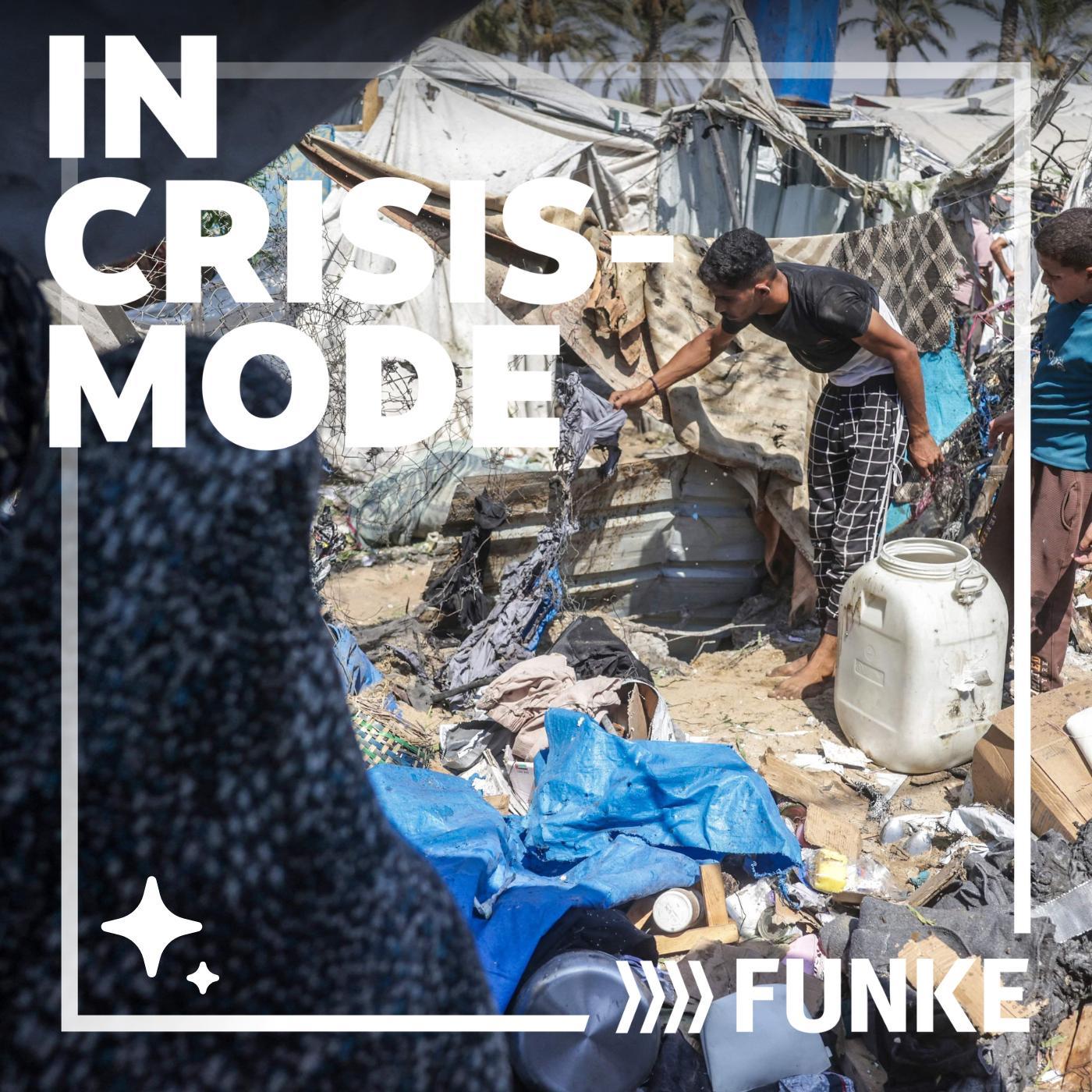
Im Krisenmodus· Folge 173
Gaza War After Nearly Three Years: Why the Peace Plan Is Stalling
Mittwoch, 16. September 2026 · 32 min
Kapitelklicken springt direkt hin
Shownotes
This episode was made with the help of AI.
Almost three years after Hamas’s terrorist attack on Israel and the beginning of the Gaza war, there is still no sustainable peace. Ali, a father from Rafah who has been displaced multiple times, talks about the extreme shortage of food during the war and his family’s destroyed everyday life. The doctor Dr. Fady Almadhoun describes the current medical emergency: although the food supply has improved, healthy and balanced food remains scarce or hardly affordable. In the FUNKE podcast “Im Krisenmodus,” war and crisis reporter Jan Jessen (nrz.de/autoren/jan-jessen) also speaks with Middle East expert Dr. Jan Busse. He explains why the peace plan is stalled, how the disarmament of Hamas and an Israeli withdrawal are connected, and whether there is still a political perspective for Gaza.
Guests and Voices
Ali – Father from Rafah, now in Khan Younis. His name has been changed for his protection.
Dr. Fady Almadhoun – Doctor; he is responsible for the medical activities of Médecins Sans Frontières in Gaza City and in the north of the Gaza Strip
Dr. Jan Busse – Political scientist and Middle East expert at the University of the Bundeswehr Munich
Chapter Overview
1 | A Child Wishes for a Place Without Bombs
Dr. Fady Almadhoun talks about what the war means for his four-year-old son.
2 | A Family Is Displaced Again and Again
Ali talks about his destroyed home in Rafah, the extreme shortage of food during the war and life without a safe place.
3 | Medical Care with the Last Remaining Resources
Gaza’s clinics lack equipment, medical supplies and specialized professionals.
4 | More Food Does Not Yet Mean a Healthy Diet
Why balanced food continues to be unavailable or unaffordable for many families.
5 | Why the Peace Plan Is Stalled
Jan Busse explains the dispute over the disarmament of Hamas and the Israeli withdrawal.
6 | Who Is Supposed to Govern Gaza in the Future?
It is about a Palestinian transitional administration, vetted police forces and the danger of a power vacuum.
7 | Can There Still Be a Palestinian State?
The situation in the West Bank and the question of whether people’s lives can improve over the coming year.
Listening Recommendations
Gaza During the Ceasefire: Doctors and Experts on the Real Situation (morgenpost.de/podcast/article410489444/gaza-in…)
Carlo Masala: “Israel’s Actions Violate International Law” (morgenpost.de/podcast/article409037996/carlo-m…)
There Is No Safe Place in Gaza (morgenpost.de/podcast/article408793043/es-gibt…)
Ways to Support
Welthungerhilfe
Information about projects and donation opportunities:
Donations for People in Gaza – Welthungerhilfe (welthungerhilfe.de/spenden-gaza?wc=DGGOFM4000&…)
Médecins Sans Frontières
Emergency medical assistance in Gaza and other crisis areas:
Our Assistance in the Palestinian Territories – Médecins Sans Frontières (aerzte-ohne-grenzen.de/unsere-arbeit/einsatzla…)
Contact & Feedback
Questions, criticism, suggestions? Write to us:
krisenmodus@funkemedien.de
Subscribe Now
“Im Krisenmodus” – wherever podcasts are available:
Spotify (open.spotify.com/show/0IQW1w25NYSrz60aAPzwvB?s…) | Apple Podcasts (podcasts.apple.com/de/podcast/im-krisenmodus/i…) | Deezer (deezer.com/de/show/3737197) | YouTube (youtube.com/@Krisenmodus-Podcast_FUNKE)
New Episodes
Every two weeks, always on Wednesdays.
Im Krisenmodus is a podcast by FUNKE Media Group.
Transkriptvom Podcast bereitgestellt · Zeitmarken springen hin
Die Übersetzung von Jans Stimme vom Deutschen ins Englische wurde mit einer KI erstellt. Almost three years after October 7, 2023, the war in Gaza is still not over. There is a peace plan and talks about a new political order for the Gaza Strip, but little of this can be felt on the ground. Attacks are continuing. Many people are living in tents or damaged buildings.
The healthcare system is operating under extremely difficult conditions, and for the people there, it remains completely unconstrued. Er ist nicht klar, wie und wo sie leben in der Zukunft. Die Antwort von einem 4-jährigen Kind illustrierts diese Uncertainty. His Vater, Feidi, arbeitet als doctor für Doctors Without Borders in Gaza.
On der Morgen unserer Gespräche, er sitzt mit seinem Son und fragt ihn was erinnert. Er sagt mir, ich möchte weit weg. Ich sage ihm, wo du gehst? Er sagt mir, ich brauche einen Safer Platz. Ich brauche nicht zu hören, ein Bombay. Und das ist ein sehr catastrophisches Gefühl von meinem Seite. A 4-jährige Kind, whose greatest wish is simply to live somewhere without the sound of bombs.
What does everyday life in Gaza look like today? And why does a lasting end to the war remain so elusive, despite a peace plan and intense international mediation? In Crisis Mode, the podcast from Conflict Zones with Jan Jessen. Hello, I'm Jan Jessen, Head of Politics and a War and Crisis Reporter for the Funker Media Group.
Almost three years after October 7th, we're taking a look in this episode at what life is like for people in Gaza today and why the war still has not come to an end. To do that, we speak to three people. Ali, a father from Gaza. Fadi, a doctor working there for Doctors Without Borders. And Jan Busse, a Middle East expert at the University of the German Federal Armed Forces in Munich.
Ali and Fedi describe what they are experiencing on the ground. Boussi explains why the political implementation of the peace plan, presented by US President Donald Trump almost exactly a year ago, has stalled, and what would have to happen for the current ceasefire to develop into something more lasting.
The starting point of this war is October 7, 2023. It is important to remember what happened on that terrible day. Hamas and other armed groups attacked Israel, killing people and taking hostages back to the Gaza Strip. Israel then launched a war against Hamas. The Israeli military carried out a massive offensive across Gaza.
Large parts of the coastal territory were destroyed and much of the population was displaced during the course of the war. The humanitarian situation deteriorated dramatically. In September 2025, US President Donald Trump unveiled a 20-point peace plan for Gaza with his customary grand flourish. Trump described it as one of the greatest days in the history of civilization and held out the prospect of peace for the entire Middle East.
The plan includes a ceasefire in Gaza, an exchange of Israeli hostages for Palestinian prisoners, the establishment of a civilian administration and the reconstruction of the Gaza Strip. It also calls for Hamas to be disarmed and for Israeli troops to withdraw. But to this day, no lasting political solution has been found.
As always when reporting on Gaza, there is an important limitation we need to mention. Independent foreign journalists are still not allowed to enter the Gaza Strip freely and report from there. That is deeply frustrating. It has been the case since the beginning of the war. Journalists from around the world have repeatedly tried to put pressure on the Israeli military and the Israeli government to allow them into Gaza.
So far, however, access has not been granted. That means we are speaking to people who live and work there themselves. We cannot independently verify every detail of their accounts. But we cross-check their statements as far as possible against other sources and known developments. One of our interviewees is Ali. That is the name we use to protect his identity.
He is a father of several children and comes from Rafa in the southern Gaza Strip. According to his account, he now lives with his family in the ruins of a destroyed school in Khan Yunis. You may already know Ali from previous episodes of this podcast in which we have reported on Gaza. We'll include those episodes in the show notes. Ich bin in Kontakt mit ihm für eine sehr lange Zeit, eigentlich seit dem Anfang der Krieg in Oktober 2023.
Ali regelmäßig sende ich voice-messages, berühmte mich über seine Familie, was er persönlich ist, und was es wie in Gaza life in Gaza ist. According to Ali, his family has been displaced more than seven times since the beginning of the war. Their home in Rafa has been destroyed. At times, the family has lived in tents.
This is how Ali describes what they have experienced over the course of these almost three years. My family and I have endured, Mein Familie und ich haben in der Zeit terrible ordeal. An unrelenting nightmare. We have suffered the worst imaginable hardship under relentless bombardment from the air, from land and from the sea. Dozens of our neighbours were killed.
We endured hunger, fear and repeated displacement. We have been displaced more than seven times. The first time was from our home in Rafa, which was completely destroyed, just like the city of Rafa itself. We lived in tents and were then forced to flee in the middle of the night. We had to leave our belongings behind. Ich bin jetzt in die Ruins des Stuhl.
Mehr als sieben Displacements in weniger als drei Jahre. Für die Familie, das bedeutet, dass sie immer wieder aufhören, und hoffen, dass sie dort werden, können. Es ist keine solche Sache als ein permanentes Haus. Meine Frau, während dieser Krieg, zwei Tochter zur Welt, und sie hatten nie genug zu essen.
Ich werde diese Nächte nie vergessen, indem sie vor Hunger weinten. Meine Frau, die zwei Däute, die nicht mehr zu essen hatten, und sie nie hatten genug zu essen. Ich werde nie vergessen, dass sie von Hunger wundern. Für Monate, wir waren nur halb ein Stück von einem Laufen per Person, jeden Tag. I watched my eldest son, who was 12 at the time, become so emaciated that he was nothing but skin and bones.
I walked more than 7km there and back, putting my life at risk, just to get a handful of food. Many of my colleagues and relatives were killed or wounded. For three years, my children have not been able to go to school. For three years, I have watched my wife wash clothes by hand and cook under these conditions.
Wische. Von Hand wisst und kocht. Food supplies have improved in the meantime, that is also a result of the peace plan presented in September last year, and the ceasefire that followed. Border crossings were reopened, and significantly more humanitarian aid has been able to reach Gaza. But Ali's family is still a long way from anything resembling a normal life.
There is no regular income, no home of their own, no school for the children, and a healthcare system that is itself struggling with the consequences of the war. Dr. Fahdi Al-Madun experiences the difficulties of medical care firsthand every day. Fahdi was born in Gaza in 1991 and has been working for Doctors Without Borders for around 10 years.
He oversees the organisation's medical operations in Gaza City and the northern Gaza Strip. These include a specialised clinic for burn and trauma injuries, as well as three mobile medical teams. The healthcare system is still functioning. Clinics continue to treat the wounded, where they still exist at all.
Doctors and medical staff continue to treat and operate on patients. But Fadi is working under conditions that have little in common with a normal hospital environment. Medical and surgical supplies are in short supply. Many pieces of equipment are broken, while others, according to Fadi, cannot be brought into Gaza from outside.
Actually, we have a lot of shortage, a lot of lack of resources. And now we are working with limited resources here in Gaza. A lot of devices cannot be able to bring from outside, like X-Fix. Also, a lot of machine already broken. We are trying to work and support the patient with limited material and resources. Also, we can speak about the medical supply, supplement, and surgical material. All of these items, we can't be able to find in Gaza.
What we are doing nowadays and during the 1,000 days of war, we are trying to support the life-saving cases. I remember during the second evacuation of Gaza City in September 2025, we are stuck here 15 days inside the clinic and we are starting to sterile and sterile goes just to support the wounded patients.
That means we are trying to support as much as possible with what we have of limited resources. Feidi's team has therefore started sterilizing available dressing materials themselves so they can continue treating the wounded. But the consequences of the war are not limited to people injured by bombs or gunfire. Many families are living in tents or makeshift shelters.
There are, of course, no proper kitchens. And that has led to another consequence of the war, Feidi says. His team is treating a particularly high number of children with burns. Feidi explains why. Und in der gleichen Zeit, ich möchte auf die Bär-Investitionen auf den Bär-Investitionen sprechen. In dieser Situation, alle Menschen sind in der Bär-Investitionen, die es in der Bär-Investitionen gibt.
Sie versuchen, die Bär-Investitionen in den Bär-Investitionen zu machen, in der Bär-Investitionen gibt. Das bedeutet, dass die Bär-Investitionen für Bär-Investitionen ist. Und das erhöht die Bär-Investitionen von Bär-Investitionen gibt. Für uns und die größte Gruppe von Kindern in 10 Jahren. These children are not injured directly in an attack. They suffer burns while cooking under conditions created by the war.
This is something we have also seen repeatedly during our reporting trips to Afghanistan and to refugee camps in Iraq. People are living in extremely precarious conditions. They often have to cook using gas burners, open flames or kerosene stoves. These devices can easily catch fire or tip over and young children can suffer severe burns as a result.
Das Problem ist, dass wenn diese Injuries nicht gut behandelt werden, dann kann sie oft zu schmerzen. Das kann schmerzen, dass Kinder nicht mehr können, zu vollen Augen zu öffnen, oder zu schmerzen, oder zu schmerzen. Diese sind die lang-term Konsequenzen von Burn Injuries, die besonders schwierig zu behandeln in Gaza zu behandeln. Es gibt eine Lacken von bestimmten Medikanten, sowie specialist-doktoren, including Plastik-Surgeons.
Fadi also describes a mixed picture when it comes to food. While the supply of food has improved, many people have had no regular income for years. And according to Fadi, what is now reaching Gaza is still not enough to provide a balanced diet, something that is particularly important for people who are sick or recovering from injuries.
Look, to be honest, the food supply is better than before the recent piece of plan. Aber die Hauptsache ist, dass sie auf die Füße in generell sind, nicht auf die healthy Füße. Man kann sehr gut wissen, dass die Neues für Protein, die Neues für Vitamins, die Neues für die Vegetables, die Vegetables und die Früchte.
All diese können nicht sehr gut in Gaza gehen und mit allen Restrictionen. Und gleichzeitig, es ist sehr günstig für die Bevölkerung in Gaza. After the three years of war, most population, lay people, they don't have any work, they don't have any source of money. I can give you some examples. If you would like to go and bring some vegetables like banana, like mango, the one kilo equals 20 dollars.
So, according to Faydi and Ali, conditions have improved in some respects, but improvement is a long way from normality. Für viele Menschen, die Frage ist viel mehr fundamental. Was ist der Leben supposed zu sehen, von hier? Fadi sagt, dass viele Menschen mittlerweile haben wenig Energie leften zu denken über die Politik, oder was die Zukunft der Gaza-Futur might look like.
Der Fokus ist einfach auf den nächsten Tag. Die Menschen, heute sind sie. Weig. Sie denken nicht über all diese Punkte, because they spend 1,000 days, just go for a walk more than a kilometer to bring one gallon of water to drink their families. They do not think about all of this situation. They just try to solve the daily problems, to bring some food, to bring some water.
For many people then, there is barely any energy left in everyday life to think about political plans. And yet those plans will determine whether their living conditions can change at all. Who will control Gaza in the future? Who will provide security? When will reconstruction begin? And ultimately, will there be a political future for the Palestinian people, not only in Gaza, but also in the occupied West Bank?
To understand where this process currently stands, I spoke with political scientist and Middle East expert Dr. Jan Busse from the University of the Bundeswehr Munich. Busse divides the peace plan into three phases. In the first phase, the fighting is supposed to end, the hostages are to be released, and humanitarian aid is to be allowed back into Gaza on a large scale.
In the second phase, Hamas is to be disarmed. At the same time, Israel is supposed to gradually withdraw from the Gaza Strip. Only in the third phase does the plan turn to the reconstruction of Gaza and to a political path toward Palestinian self-determination and statehood. We have to say that we are still stuck somewhere between Phase 1 and Phase 2.
That means we are still a long way from reconstruction. Die humanitarian Situation hat sich verbessert, besonders wenn es zu food supplies ist, aber es ist noch sehr poor, besonders wenn es zu housing und shelter. Die Leute in der Gaza Strip sind noch in den Tents. Das ist eine extrem precarische Situation.
Ausbrechen von Krankheit können in diesen Situationen Und vor allem, Sommer und Winter bringen periods of heavy rainfall, die Menschen dort fast komplett exposed zu den Aliments. Wenn sie so schutzlos ausgesetzt sind, Yes, at first glance, that sounds like a fairly clear sequence. The fighting is supposed to end, humanitarian aid is supposed to resume, then Hamas is to give up its weapons, and Israel is to withdraw.
But it is precisely at this next step that the dispute begins. And that is why the entire process has stalled. The peace plan was presented in September last year. Since then, comparatively little has happened, especially considering the enormous attention Trump generated when he unveiled it. According to Buse, Hamas has agreed to a roadmap that links its gradual disarmament to an Israeli withdrawal.
The Israeli government, however, has so far not agreed to the roadmap. Der Peace Council, mit der backing der US-Administration, hat eine Roadmap für Disarmament, unter welchen Hamas ist zu handeln, all its weapons in stages, während Israel simultaneously withdraws. Was ist remarkable ist, dass Hamas jetzt eigentlich agreed zu diesem Plan ist.
Netanyahu, aber nicht. So, once wieder, wir haben eine Situation in der die Prozess ist stalled. Wir sind noch lange weg von und implementieren Phase 2 und daher von einem stag von genuine Reconstruction und einem politischen Zukunft. Das ist aktuell der Stand. Das ist jetzt der Stand. Hamas' Agreement zu der Roadmap, however, nicht so dass es eigentlich bereit ist, um die Weapons zu handeln. Es ist eine Roadmap, aber die Implementation ist zu bestimmten Regeln.
Wir sollten nicht vergessen, dass die Arm-Struggle ist, in a sense, part of Hamas' DNA, the armed fight against Israel, along with the anti-Semitism, anti-Zionism and rejection of Israel embedded in the organisation's ideology. So, naturally, Hamas finds it difficult to give up its weapons. Surrendering weapons also means surrendering power.
And for an organisation that has ruled the Gaza Strip with an iron grip for years, that is obviously a difficult step to take. Hamas has also made its own disarmament und conditional on one crucial demand, an Israeli withdrawal. And that brings us to the next major sticking point. Why is Israel not withdrawing?
And why has the Israeli government so far refused to agree to such a step? One apparent reason lies in Israeli domestic politics. Prime Minister Benjamin Netanyahu is under pressure from parties and voters to his right, who oppose far-reaching concessions to the Palestinians. There are elections in Israel in October, and Netanyahu will obviously do everything he can to avoid making concessions, now that could be portrayed as a sign of weakness by parties further to the right or by his own voter base.
Und in diesem Fall, es ist wichtig, dass Netanyahu hat klar, dass er will, dass er die Prospekt des Palästinien-State ist. Ultimately, das ist ein Counter, both zu Israel's international commitments, und zu der Idee behind last Jahr's Peace Plan, das deliberately sought zu halten, such a Prospekt. Aber ich glaube, dass wir nicht die Wahrheit, dass da wirklich eine historicere Chance ist hier ist.
Hamas hat gesagt, dass sie sich nicht verraten. Ich denke, das wäre unheimlich, ein Jahr ago. Denn der sogenannte Bewerbende Kampf ist ein definierendes Merkmal für die Hamas. So Buse sieht dies als eine historische Möglichkeit, aber eine, die noch nicht in die Praxis gelegt wird. Agreeing to a road map does not mean that Hamas is already handing over its weapons.
The other side of the agreement, Israel's phased withdrawal, remains unresolved as well. Alongside this disarmament, there is also supposed to be a gradual Israeli withdrawal from the Gaza Strip. And that is where we run into the next major problem. For one thing, Israel has expanded the area under its control from the original figure of more than 50% of the Gaza Strip to around 70%.
Und Netanyahu hat klargestellt, dass Israel nicht zu verlassen ist, so es nicht nur dass es keinen Ende zu der Kampf auf der Israelite ist. In der Moment gibt es auch keine Willenheit, zu abide by die Agreementen, auf Phase 2, und zu verlassen von den Gaza Strip. Und ich denke, hierher zu werden, wenn es die USA aus den USA kommt.
Für die Planung ist das eine cruciale Problem. Hamas' disarmament und Israel's withdrawal sind direkt links. If Hamas is expected to give up its weapons while Israel continues to maintain military control over large parts of the Gaza Strip, the proposed second phase will be extremely difficult to implement.
That is why attention is also turning to Washington. The problem is that Trump is a president who wants quick results. When he announces something, he essentially expects it to be implemented the next day. He finds it relatively difficult to take a long-term approach. He is not a fan of lengthy, drawn-out negotiations.
In the meantime, he has also turned his attention to completely different conflicts, the war with Iran, for example, and now he has once again sent envoys to Ukraine to try to broker peace. Gaza seems to have slipped somewhat out of focus for him, and when something slips out of Trump's focus, it naturally tends to slip out of the focus of his administration as well.
Busse nevertheless considers continued US pressure to be crucial. In his view, Washington can change the political cost-benefit calculations of both the Israeli government and Hamas. Without external pressure, he says, little is likely to change. Israel is closely tied to the United States militarily, diplomatically and politically.
The US government therefore has considerable leverage over the Israeli government, considerably more, of course, than European countries, including Germany, do. There is, however, another factor that could prove important. Israel has been seeking to normalise relations with Saudi Arabia for years. Busse argues that this goal cannot ultimately be separated from the Palestinian question either.
Israel has a very strong interest in normalising diplomatic relations with Saudi Arabia, und das sollte wirklich viel mehr front und center sein. Die einzige Weg, um das zu erreichen, ist, einen genüllen politischen Weg zu palästinischen Selbstdetermination und Statehut. Man könnte sagen, dass die Weg nach Riyadh durch Gaza geht. Das sollte nicht unterestimiert werden.
... potenziellen anderen Regierungen, die ohne Netanjahu auskommen, weil wir einfach noch nicht wissen, wie die Wahlen ausgehen, dass das eben dieser Weg nach Riyadh, der führt über Gaza, könnte man eigentlich sagen. Und das sollte eben nicht unterschätzt werden. The normalisation of relations with Saudi Arabia that Israel is seeking could therefore become a political lever for pushing for concrete progress for the Palestinians.
But even if Hamas is disarmed and Israel gradually withdraws, another crucial question remains. Who will govern Gaza afterward? Who will provide security? Who will run schools, hospitals and public services? And who will prevent a power vacuum from emerging once the fighting ends? The peace plan provides for a Palestinian transitional administration to take on these responsibilities.
According to Buse, this body has already been established. The Israeli government, however, has so far not allowed it to begin operating in Gaza. As far as Buse knows, members of the proposed transitional administration are currently in places including Cairo, waiting for access to the Gaza Strip. Such an administration also needs security forces. Buse cautions against automatically labeling everyone who worked as a civilian police officer under Hamas as a combatant.
Parts of the existing civilian police force could potentially continue working after individual vetting. The key question would be, who was involved in fighting or other acts of violence? According to Basse, Jordan and Egypt have already trained Palestinian police officers. The EU could also contribute its experience through its police mission in the West Bank.
The peace plan also calls for an international stabilisation force to provide security in Gaza. So far, however, only a small number of countries have committed to taking part. As a result, there is still not enough personnel. The new administration then would not necessarily have to start entirely from scratch.
Existing administrative structures include professionals who may have no direct connection to Hamas. But a new administration could only function if the fighting ends, political responsibilities are clearly defined, and Israel actually begins its phased withdrawal. Yet even a functioning administration in Gaza would not resolve the wider Israeli-Palestinian conflict.
Politically, Gaza cannot be permanently separated from the West Bank. If there is ultimately to be a path toward Palestinian self-determination, something like a two-state solution, rebuilding Gaza alone will not be enough. The situation in the West Bank is also deteriorating. As you may know, the West Bank is effectively a patchwork divided into Areas A, B and C.
Areas A are formerly under Palestinian civil and security control. In Areas B, Palestinians are responsible for civil administration, while security responsibilities are shared. Area C remains under Israeli control. On a map, the West Bank resembles a patchwork quilt. At the same time, Israel continues to expand its settlements.
They are considered illegal under international law by the prevailing view of the international community. This is compounded by violence by extremist settlers against Palestinians. One particularly controversial development concerns the E1 area east of Jerusalem. Further construction there, many critics warn, would fragment the West Bank even further and make it significantly more difficult to maintain a territorial connection between its northern and southern parts.
Jan Basser, however, says the deterioration in the West Bank goes far beyond E1. At least for now, the conditions could hardly be worse. And I think that if we look at the West Bank, we are seeing a dramatic escalation there as well, one that goes far beyond the example of E1, we are seeing settler violence on an unprecedented scale.
There are essentially daily attacks on the Palestinian civilian population. Militant settlers are moving into the so-called Area A, places where they had never previously ventured, and are trying to bring houses there under their control. Settlement construction is at a level we have not seen since the beginning of the Oslo peace process in 1993, and the far-right members of the Israeli government openly boast about the fact that they want to bury any political prospect for the Palestinians.
If settlement expansion and settler violence continue to undermine the territorial foundations of a possible Palestinian state, rebuilding Gaza alone will not be enough to achieve a lasting solution. The prospect of a contiguous and politically viable Palestinian state is becoming increasingly difficult to imagine.
That is the broader political context. For Ali, however, the question of a political future has long since become a deeply personal one. Can he still give his children a future in Gaza? A war that has destroyed everything we had, even our health and our future. What did we do to deserve this? What did my wife and my young children do to deserve this? Let Israel take my land then. Just let me build a future for my children somewhere outside this place.
Lass Israel doch mein Land nehmen und mir erlauben meinen Kindern außerhalb dieses Ortes eine Zukunft aufzubauen. Ali ist nicht proposing a political plan hier, nor ist he endorsing the idea of displacement. As you may know, some Israeli politicians have floated the idea of removing all 2 million people living in Gaza from the Strip, evacuating them and resettling them in other countries.
Such a move would be a catastrophic violation von international law, und es wird sicherlich verletzt Israel's standing in der Welt. Und yet Defense Minister Israel Katz hat nur recently gesagt, dass die Idee nicht fully abandone. Ali's words, however, show just how deeply his faith in a future inside Gaza hat eroded.
Und Feidi, our doctor, sagt, dass viele Menschen nicht mehr wissen was für die Kinder in Gaza. Und wenn man sich über die Zukunft und deine Kinder und deine Kinder keine Schulen, keine gute Hospen, keine Safer Pläne zu bleiben, keine Renovation. Ein paar Familien waren drei und vier floors, und jetzt bleiben sie in den Städten.
Sie haben viele Fragen, warum wir in dieser Land bleiben, wenn wir nicht alle diese Punkte haben. So, ultimately, this is not just about whether the war ends. It is about whether afterward a life can be rebuilt that people actually want to stay for. A life with schools, hospitals, security, a home and a political future.
That is why, at the end of our conversation, I asked Jan Busser what he would say to someone in Gaza who wants to know, will things be better next year? I hope that will be the case, but we simply cannot be sure of it. At the moment, we have very good reason to be pessimistic. And we have to look at what can actually be done, even if only through small adjustments, to at least prevent the worst from happening.
Of course, the humanitarian situation in the Gaza Strip needs to continue improving. But those are not good prospects if we are really only talking about such minimal changes. I find that a deeply sobering answer. Almost three years after October 7th, Gaza is still a long way from anything resembling normal life.
A peace plan is on the table. According to Buse, Hamas has agreed to a road map that provides for its gradual disarmament. At the same time, Israel is supposed to withdraw from the Gaza Strip. A third phase is supposed to bring reconstruction and a path toward Palestinian self-determination. But enormous political and military obstacles stand between these steps.
The fighting has still not fully ended. Israel's withdrawal remains unresolved. A new administration has yet to be allowed to begin its work. Und ein politischer Weg zur Palästinian-State-Hood still appears to be a distant prospect. Und ich denke, es ist wichtig, dass wir immer darüber sprechen, weil die Verantwortung auch mit Ländern, die nicht die gleiche Leistung auf Israel als die USA haben.
Es ist auch die Verantwortung von Ländern wie Deutschland und anderen Europäischen Ländern zu geben, und zu machen, dass, als Partner und Freund, wir expecten Israel zu nehmen die notwendige Schritte to improve the lives of people in Gaza, and to enable Palestinians to live with dignity and exercise self-determination.
Für Menschen wie Ali und Fahdi, all of das bedeutet, dass sie noch nicht wissen, wie lange ihre Familien werden müssen, ohne safe Homes, funktionierende Schulen und Medikamenten zu leben. Die Planung desgrüßt eine mögliche Zukunft. Aber so far, das Zukunft hat noch nicht zu erreichen, dass die Welt der Menschen in den ganzen Leben leben.
Dieser Podcast wurde von Alexander Baumeister. Er ist auch ein Journalist und arbeitet für eine radio-station in der Funker Media Group. If you enjoyed this episode, please like and follow us. It helps make our work more visible, and we'd love to hear from you. What needs to happen for a peace plan to become a tangible future for people like Ali and Fadi?
Send us your questions, criticism, and suggestions for future topics at christenmodus.funcomedian.de. Take care of yourselves. See you next time. Bye-bye.
